
BLOCK DIAGRAM OF COMPUTER &
STORAGE UNIT OF MEMORY
Designed by Rita Gokani
MEASURING STORAGE CAPACITY
 As you know that all items that we purchase are
measured in some measuring units, In the same
way, we have units to measure Storage Capacity of
various computer Devices.
 Smallest Storage unit of Memory is a BIT(Binary
Digit i.e. 0 & 1).
 Computer understands only binary language i.e it
recognizes only 2 digits 0 & 1.
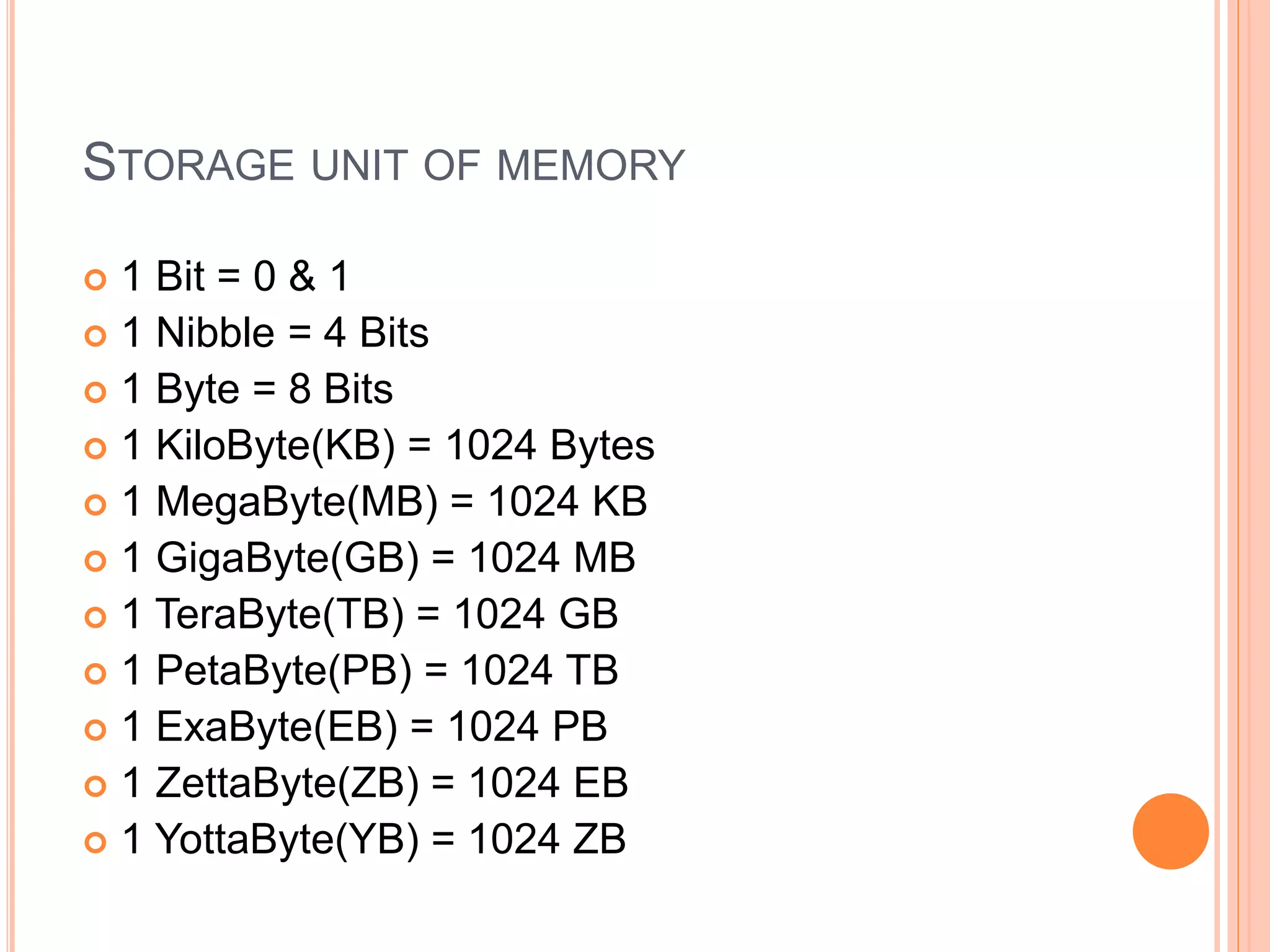
STORAGE UNIT OF MEMORY
 1 Bit = 0 & 1
 1 Nibble = 4 Bits
 1 Byte = 8 Bits
 1 KiloByte(KB) = 1024 Bytes
 1 MegaByte(MB) = 1024 KB
 1 GigaByte(GB) = 1024 MB
 1 TeraByte(TB) = 1024 GB
 1 PetaByte(PB) = 1024 TB
 1 ExaByte(EB) = 1024 PB
 1 ZettaByte(ZB) = 1024 EB
 1 YottaByte(YB) = 1024 ZB
COMPUTER SYSTEM
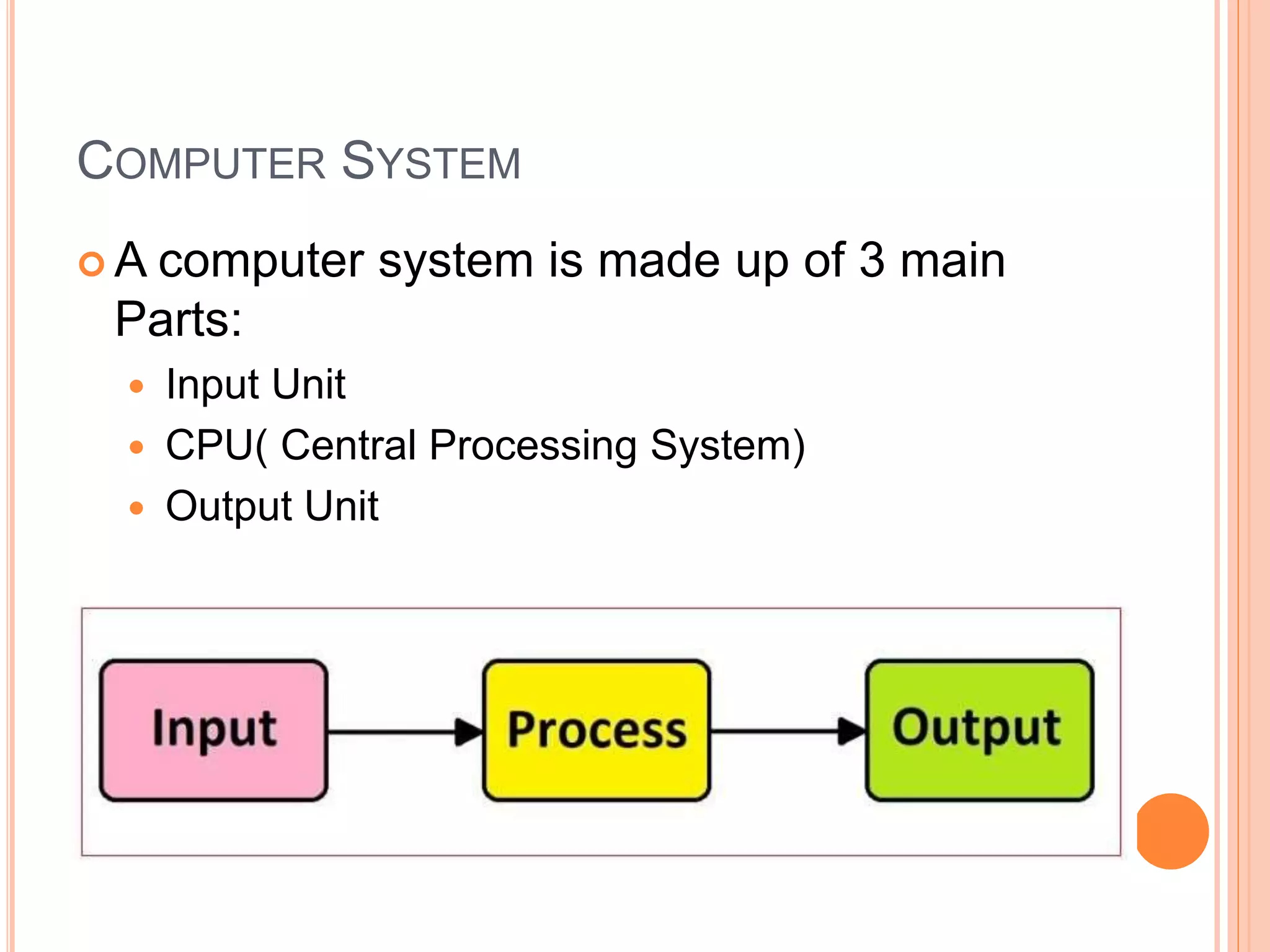
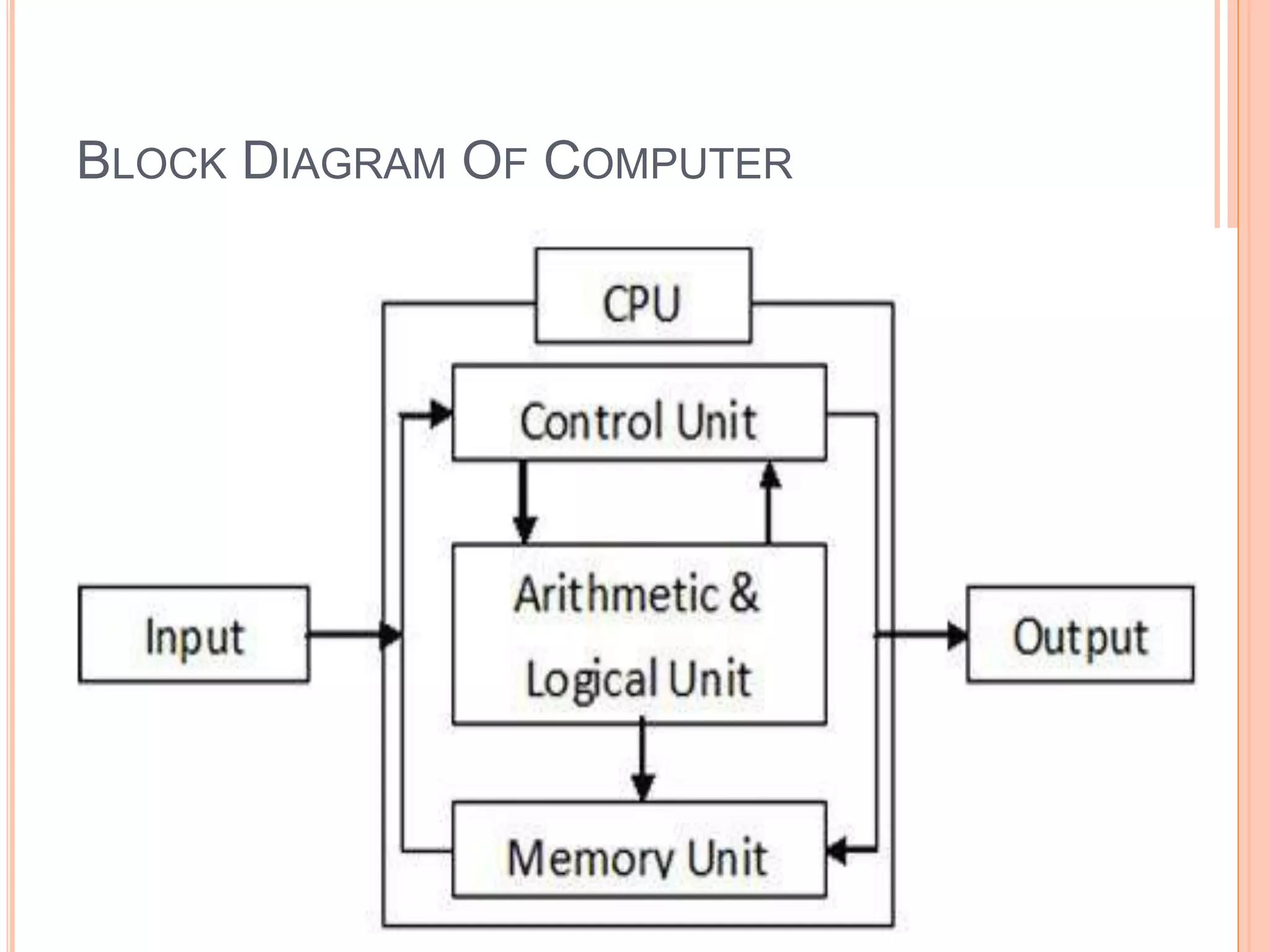
 A computer system is made up of 3 main
Parts:
 Input Unit
 CPU( Central Processing System)
 Output Unit
BLOCK DIAGRAM OF COMPUTER
INPUT
 This is the process of entering data and
programs into the computer system.
 As you know that computer is an electronic
machine which takes as inputs raw data and
performs some processing giving out
processed data.
 The devices that give data & instructions to
computer are called Input Devices
 Example: Keyboard, Mouse, Light Pen,
Scanner etc.
CPU(CENTRAL PROCESSING UNIT)
 CPU is the heart of the computer.
 CPU performs all types of data processing
operations.
 It stores data, intermediate results, and instructions
(program).
 It controls the operation of all parts of the computer.
 The CPU has 3 parts. They are :
 Control Unit
 ALU (Arithmetic and Logic Unit)
 Memory Unit
CONTROL UNIT
 It controls all other units in the computer.
 The control unit instructs the input unit, where
to store the data after receiving it from the user.
 It controls the flow of data and instructions from
the storage unit to ALU.
 It also controls the flow of results from the ALU
to the storage unit.
 The control unit is generally referred as the
central nervous system of the computer that
control and synchronizes its working.
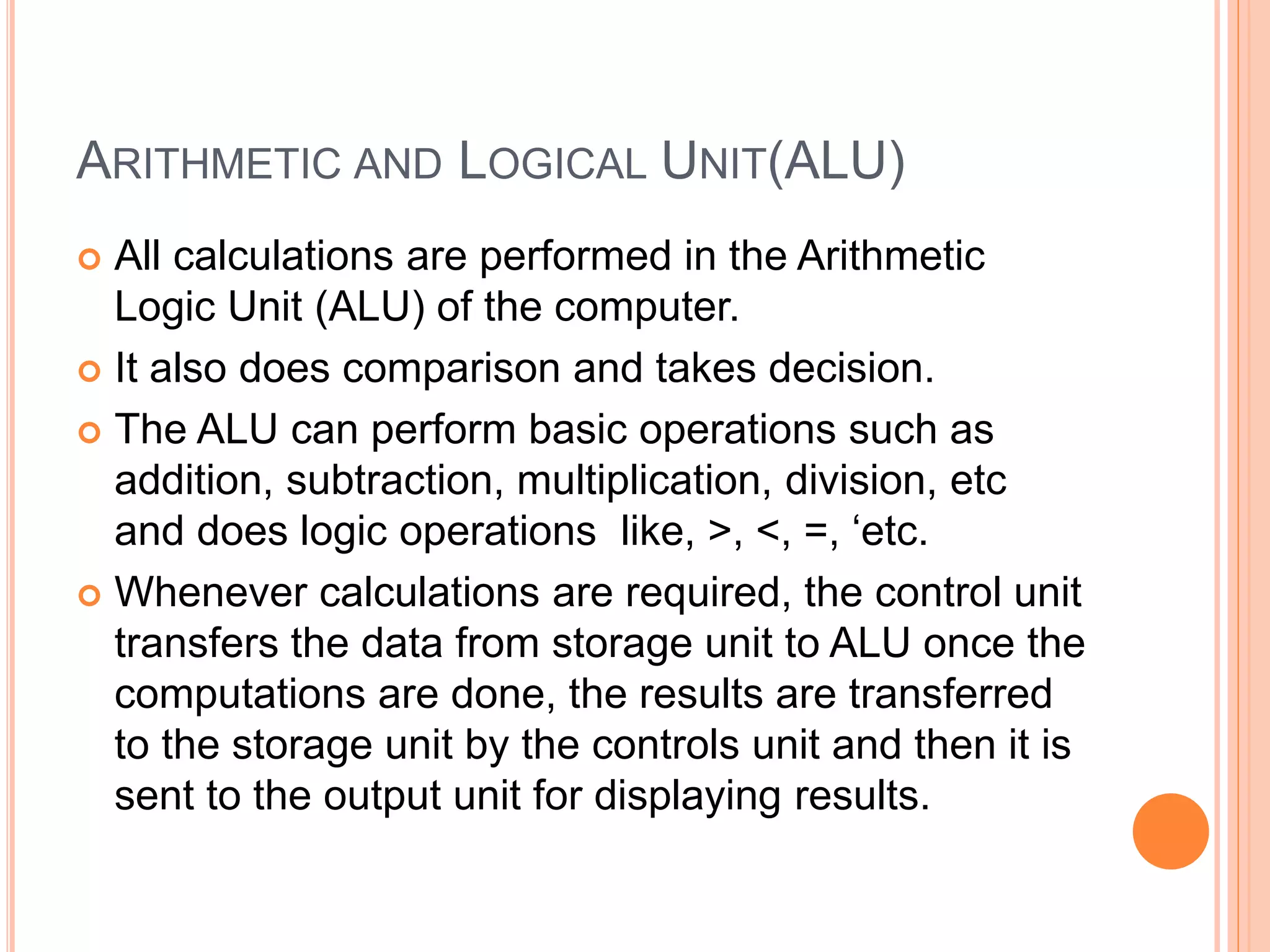
ARITHMETIC AND LOGICAL UNIT(ALU)
 All calculations are performed in the Arithmetic
Logic Unit (ALU) of the computer.
 It also does comparison and takes decision.
 The ALU can perform basic operations such as
addition, subtraction, multiplication, division, etc
and does logic operations like, >, <, =, ‘etc.
 Whenever calculations are required, the control unit
transfers the data from storage unit to ALU once the
computations are done, the results are transferred
to the storage unit by the controls unit and then it is
sent to the output unit for displaying results.
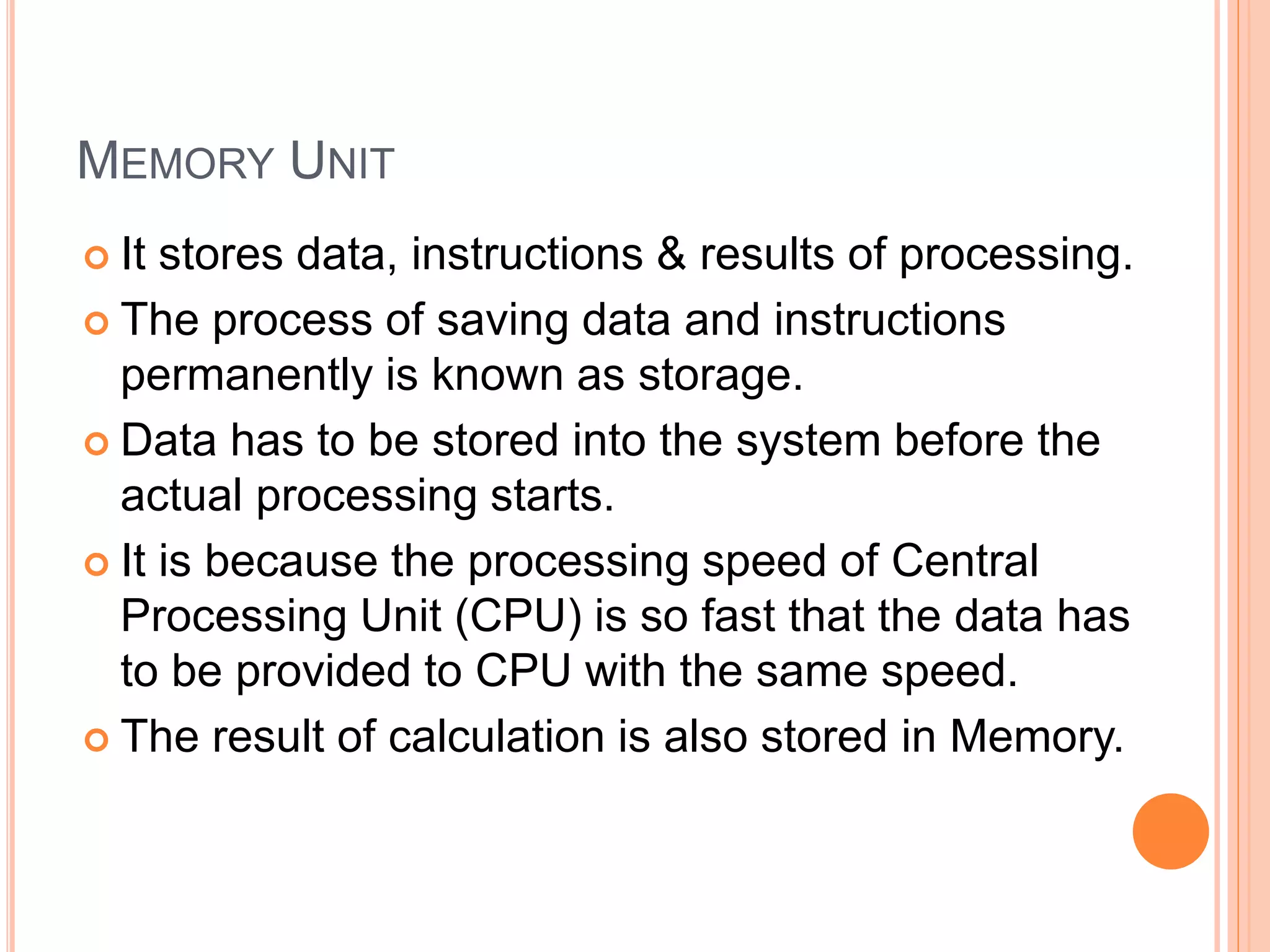
MEMORY UNIT
 It stores data, instructions & results of processing.
 The process of saving data and instructions
permanently is known as storage.
 Data has to be stored into the system before the
actual processing starts.
 It is because the processing speed of Central
Processing Unit (CPU) is so fast that the data has
to be provided to CPU with the same speed.
 The result of calculation is also stored in Memory.
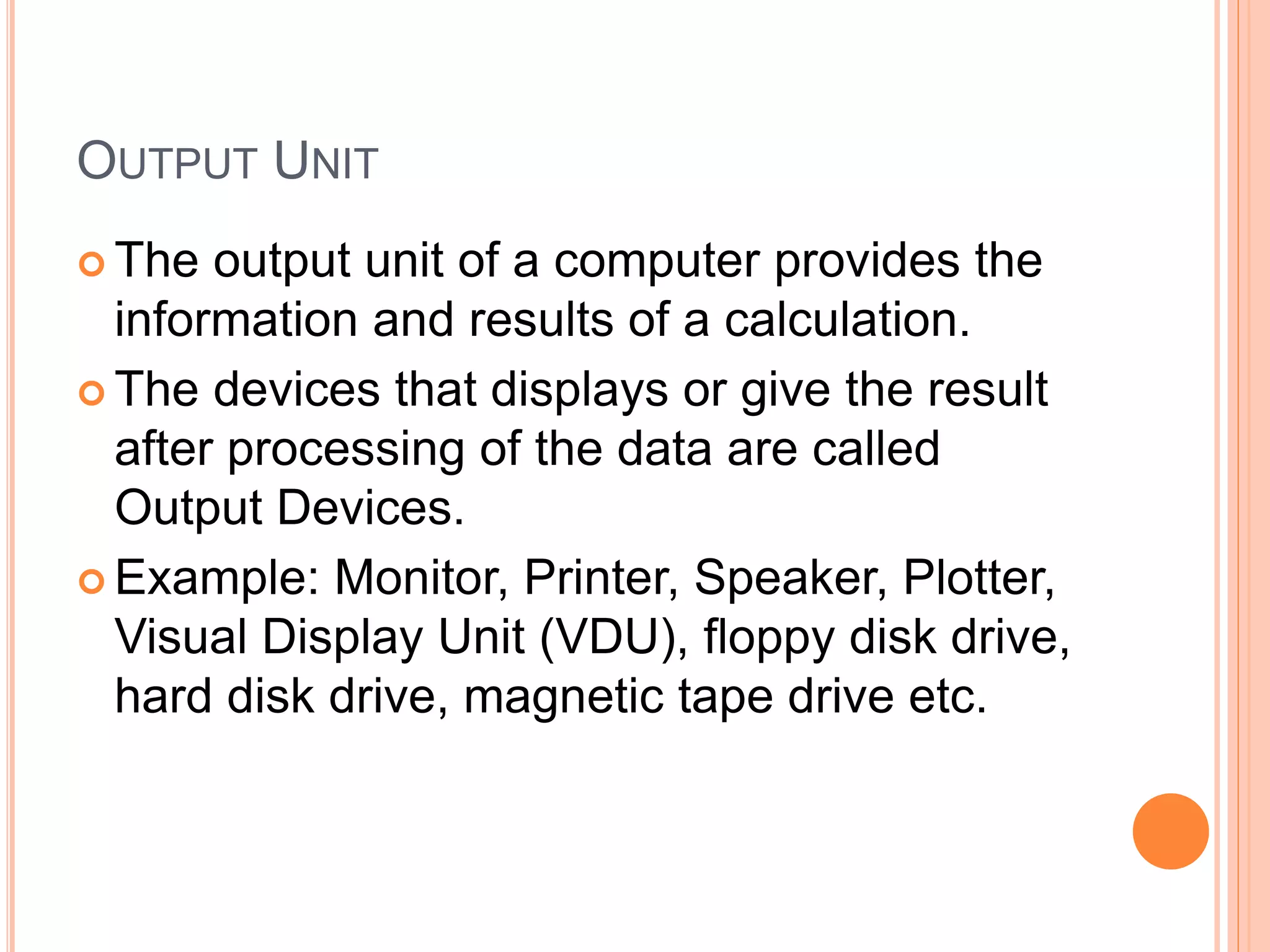
OUTPUT UNIT
 The output unit of a computer provides the
information and results of a calculation.
 The devices that displays or give the result
after processing of the data are called
Output Devices.
 Example: Monitor, Printer, Speaker, Plotter,
Visual Display Unit (VDU), floppy disk drive,
hard disk drive, magnetic tape drive etc.
Block diagram of computer & storage unit of memory

Block diagram of computer & storage unit of memory

  • 1.
    BLOCK DIAGRAM OFCOMPUTER & STORAGE UNIT OF MEMORY Designed by Rita Gokani
  • 2.
    MEASURING STORAGE CAPACITY As you know that all items that we purchase are measured in some measuring units, In the same way, we have units to measure Storage Capacity of various computer Devices.  Smallest Storage unit of Memory is a BIT(Binary Digit i.e. 0 & 1).  Computer understands only binary language i.e it recognizes only 2 digits 0 & 1.
  • 3.
    STORAGE UNIT OFMEMORY  1 Bit = 0 & 1  1 Nibble = 4 Bits  1 Byte = 8 Bits  1 KiloByte(KB) = 1024 Bytes  1 MegaByte(MB) = 1024 KB  1 GigaByte(GB) = 1024 MB  1 TeraByte(TB) = 1024 GB  1 PetaByte(PB) = 1024 TB  1 ExaByte(EB) = 1024 PB  1 ZettaByte(ZB) = 1024 EB  1 YottaByte(YB) = 1024 ZB
  • 4.
    COMPUTER SYSTEM  Acomputer system is made up of 3 main Parts:  Input Unit  CPU( Central Processing System)  Output Unit
  • 5.
  • 6.
    INPUT  This isthe process of entering data and programs into the computer system.  As you know that computer is an electronic machine which takes as inputs raw data and performs some processing giving out processed data.  The devices that give data & instructions to computer are called Input Devices  Example: Keyboard, Mouse, Light Pen, Scanner etc.
  • 7.
    CPU(CENTRAL PROCESSING UNIT) CPU is the heart of the computer.  CPU performs all types of data processing operations.  It stores data, intermediate results, and instructions (program).  It controls the operation of all parts of the computer.  The CPU has 3 parts. They are :  Control Unit  ALU (Arithmetic and Logic Unit)  Memory Unit
  • 8.
    CONTROL UNIT  Itcontrols all other units in the computer.  The control unit instructs the input unit, where to store the data after receiving it from the user.  It controls the flow of data and instructions from the storage unit to ALU.  It also controls the flow of results from the ALU to the storage unit.  The control unit is generally referred as the central nervous system of the computer that control and synchronizes its working.
  • 9.
    ARITHMETIC AND LOGICALUNIT(ALU)  All calculations are performed in the Arithmetic Logic Unit (ALU) of the computer.  It also does comparison and takes decision.  The ALU can perform basic operations such as addition, subtraction, multiplication, division, etc and does logic operations like, >, <, =, ‘etc.  Whenever calculations are required, the control unit transfers the data from storage unit to ALU once the computations are done, the results are transferred to the storage unit by the controls unit and then it is sent to the output unit for displaying results.
  • 10.
    MEMORY UNIT  Itstores data, instructions & results of processing.  The process of saving data and instructions permanently is known as storage.  Data has to be stored into the system before the actual processing starts.  It is because the processing speed of Central Processing Unit (CPU) is so fast that the data has to be provided to CPU with the same speed.  The result of calculation is also stored in Memory.
  • 11.
    OUTPUT UNIT  Theoutput unit of a computer provides the information and results of a calculation.  The devices that displays or give the result after processing of the data are called Output Devices.  Example: Monitor, Printer, Speaker, Plotter, Visual Display Unit (VDU), floppy disk drive, hard disk drive, magnetic tape drive etc.