What is Computer?
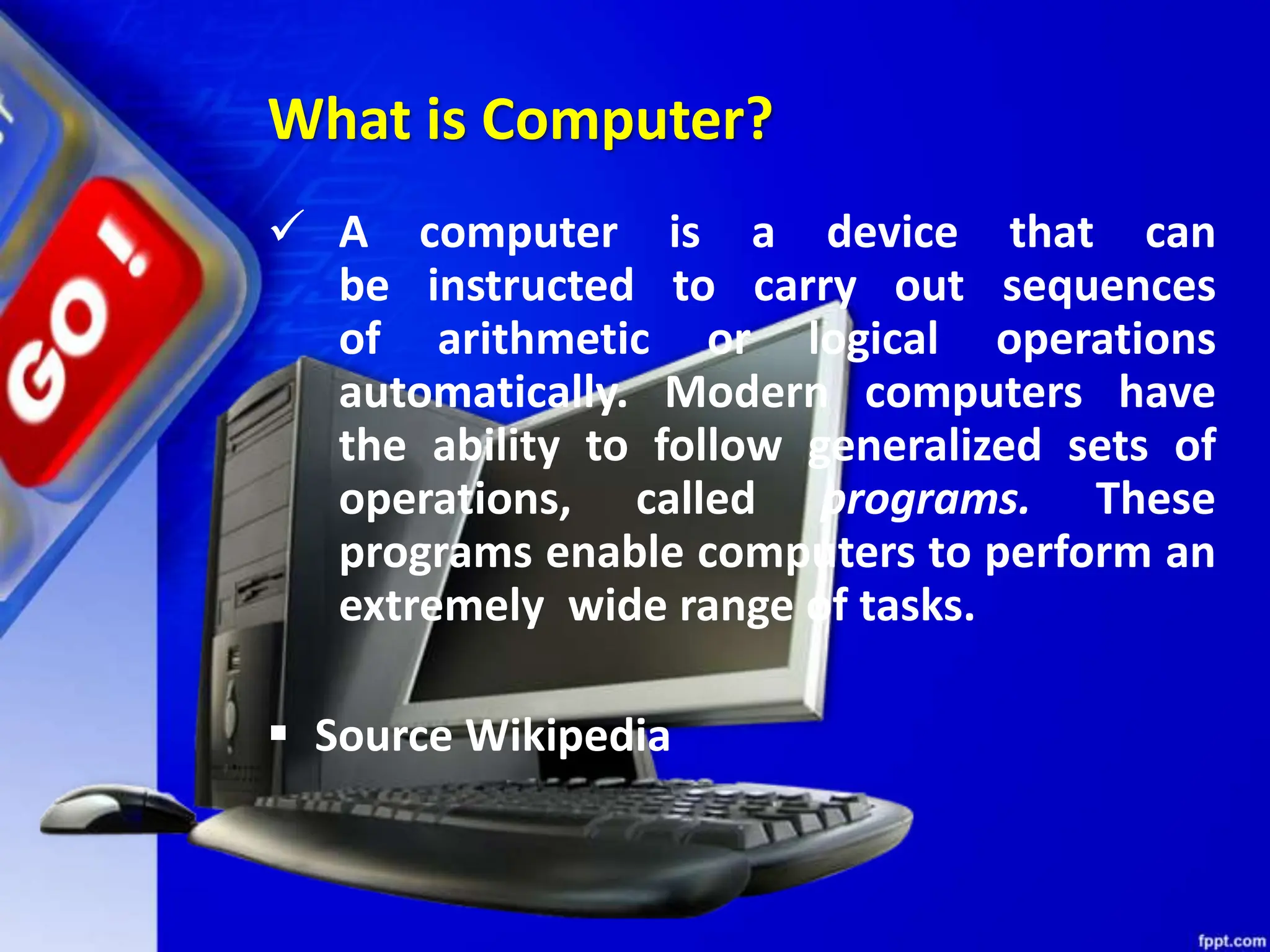
 A computer is a device that can
be instructed to carry out sequences
of arithmetic or logical operations
automatically. Modern computers have
the ability to follow generalized sets of
operations, called programs. These
programs enable computers to perform an
extremely wide range of tasks.
 Source Wikipedia
What is Data?
 Data. Data in a computer terminology mean
raw facts and figures.
 For ex-mohan,1977 etc.
What is Information?
means what we get after processing.
Data Vs. Information?
 you should understand that what goes in
the computers is data and what comes out
of them is information.
 This process of turning data into
information is also known as information
processing cycle.
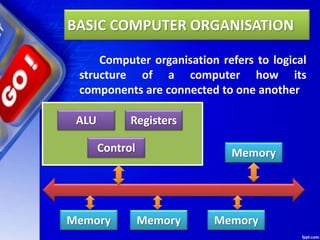
BASIC COMPUTER ORGANISATION
Computer organisation refers to logical
structure of a computer how its
components are connected to one another
ALU Registers
Control Memory
Memory Memory Memory
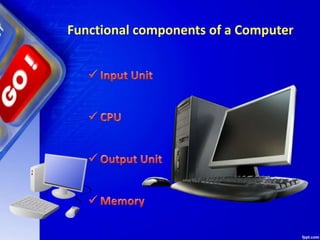
Functional components of a Computer
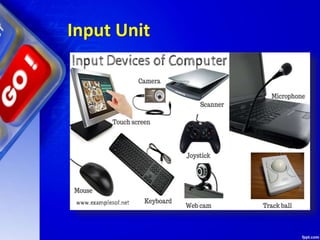
Input Unit
The input unit consists of input
devices that are attached to the
computer.
These devices take input and convert
it into binary language that the
computer understands.
Some of the common input devices
are keyboard, mouse, joystick,
scanner etc.
Input Unit
Central Processing Unit(CPU)
Once the information is entered
into the computer by the input
device, the processor processes it.
The CPU is called the brain of the
computer because it is the control
centre of the computer.
 As the CPU is located on a small
chip, it is also called the
Microprocessor.
Central Processing Unit(CPU)
• The CPU has three main
components which are responsible for
different functions –
Arithmetic Logic Unit (ALU)
The ALU, as its name suggests
performs mathematical calculations
and takes logical decisions.
Arithmetic calculations include
addition, subtraction, multiplication
and division.
Logical decisions involve comparison
of two data items to see which
one is larger or smaller or equal.
Control Unit (CU)
The Control unit coordinates and
controls the data flow in and out
of CPU and also controls all the
operations of ALU, memory registers
and also input/output units.
It is also responsible for carrying out
all the instructions stored in the
program.
Memory Registers
A register is a temporary unit of
memory in the CPU.
These receive data/information and
then this data/information is held in
them as per the requirement.
Output Unit
The output unit consists of output
devices that are attached with the
computer.
It converts the binary data coming
from CPU to human understandable
from. The
common output devices are monitor,
printer, plotter etc.

Chapter 1 Computer Fundamentals (XI) (1) (1).pptx

  • 1.
    What is Computer? A computer is a device that can be instructed to carry out sequences of arithmetic or logical operations automatically. Modern computers have the ability to follow generalized sets of operations, called programs. These programs enable computers to perform an extremely wide range of tasks.  Source Wikipedia
  • 2.
    What is Data? Data. Data in a computer terminology mean raw facts and figures.  For ex-mohan,1977 etc. What is Information? means what we get after processing.
  • 3.
    Data Vs. Information? you should understand that what goes in the computers is data and what comes out of them is information.  This process of turning data into information is also known as information processing cycle.
  • 4.
  • 5.
    BASIC COMPUTER ORGANISATION Computerorganisation refers to logical structure of a computer how its components are connected to one another ALU Registers Control Memory Memory Memory Memory
  • 6.
  • 7.
    Input Unit The inputunit consists of input devices that are attached to the computer. These devices take input and convert it into binary language that the computer understands. Some of the common input devices are keyboard, mouse, joystick, scanner etc.
  • 8.
  • 9.
    Central Processing Unit(CPU) Oncethe information is entered into the computer by the input device, the processor processes it. The CPU is called the brain of the computer because it is the control centre of the computer.  As the CPU is located on a small chip, it is also called the Microprocessor.
  • 10.
    Central Processing Unit(CPU) •The CPU has three main components which are responsible for different functions –
  • 11.
    Arithmetic Logic Unit(ALU) The ALU, as its name suggests performs mathematical calculations and takes logical decisions. Arithmetic calculations include addition, subtraction, multiplication and division. Logical decisions involve comparison of two data items to see which one is larger or smaller or equal.
  • 12.
    Control Unit (CU) TheControl unit coordinates and controls the data flow in and out of CPU and also controls all the operations of ALU, memory registers and also input/output units. It is also responsible for carrying out all the instructions stored in the program.
  • 13.
    Memory Registers A registeris a temporary unit of memory in the CPU. These receive data/information and then this data/information is held in them as per the requirement.
  • 14.
    Output Unit The outputunit consists of output devices that are attached with the computer. It converts the binary data coming from CPU to human understandable from. The common output devices are monitor, printer, plotter etc.