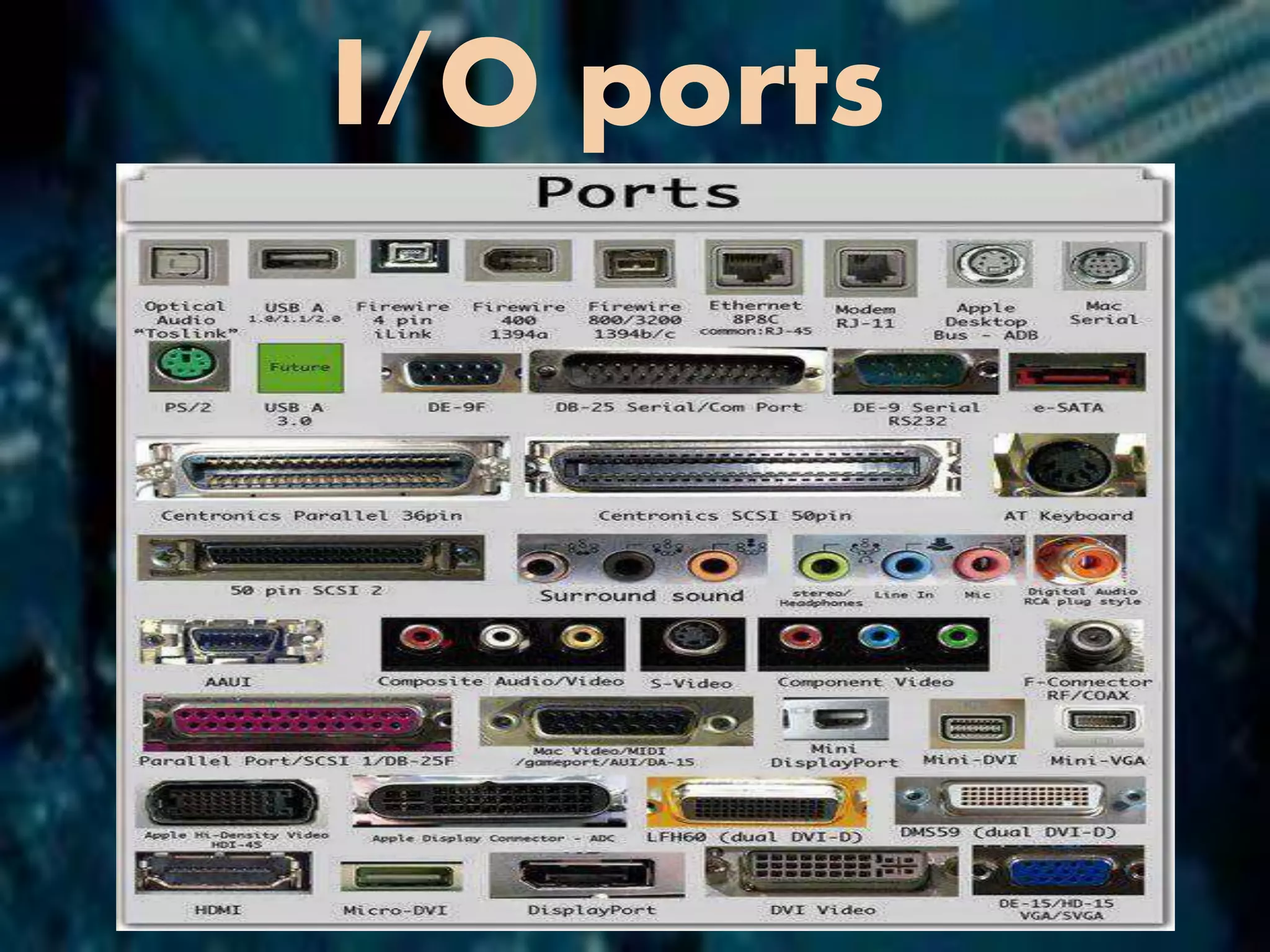
I/O ports
GROUP MEMBERS
Zia u rehman
Azhar tahir
Muhammad Aslam2
What is i/o ports ?
A Computer Port is an interface or a point of connection
between the computer and its peripheral devices. Some of
the common peripherals are mouse, keyboard, monitor or
display unit, printer, speaker, flash drive etc.
The main function of a computer port is to act as a point
of attachment, where the cable from the peripheral can be
plugged in and allows data to flow from and to the device
Types of ports
There are two types of i/o ports
Serial ports
Parallel ports
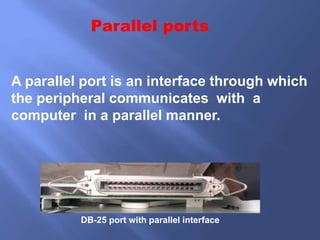
Parallel ports
A parallel port is an interface through which
the peripheral communicates with a
computer in a parallel manner.
DB-25 port with parallel interface
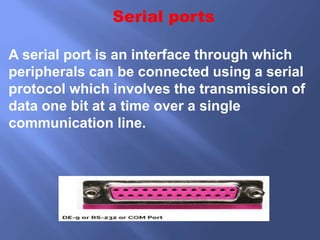
Serial ports
A serial port is an interface through which
peripherals can be connected using a serial
protocol which involves the transmission of
data one bit at a time over a single
communication line.
Some ports you may know
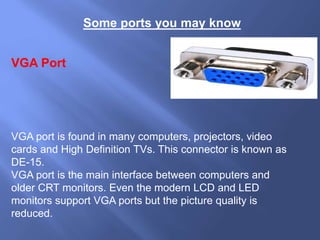
VGA Port
VGA port is found in many computers, projectors, video
cards and High Definition TVs. This connector is known as
DE-15.
VGA port is the main interface between computers and
older CRT monitors. Even the modern LCD and LED
monitors support VGA ports but the picture quality is
reduced.
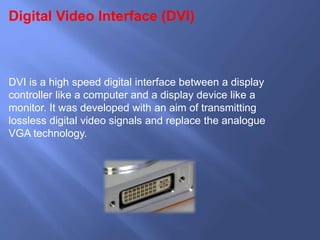
Digital Video Interface (DVI)
DVI is a high speed digital interface between a display
controller like a computer and a display device like a
monitor. It was developed with an aim of transmitting
lossless digital video signals and replace the analogue
VGA technology.
HDMI (High Definition Media Interface)
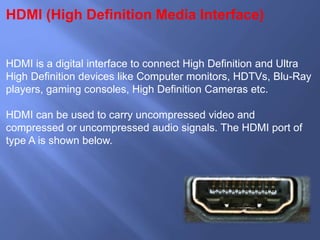
HDMI is a digital interface to connect High Definition and Ultra
High Definition devices like Computer monitors, HDTVs, Blu-Ray
players, gaming consoles, High Definition Cameras etc.
HDMI can be used to carry uncompressed video and
compressed or uncompressed audio signals. The HDMI port of
type A is shown below.
USB
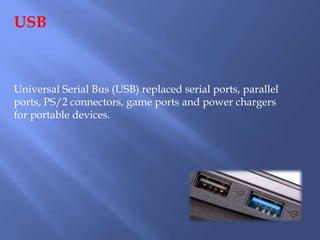
Universal Serial Bus (USB) replaced serial ports, parallel
ports, PS/2 connectors, game ports and power chargers
for portable devices.
Input output system
One of the important jobs of an Operating System is
to manage various I/O devices including mouse,
keyboards, touch pad, disk drives etc.
Device Controllers
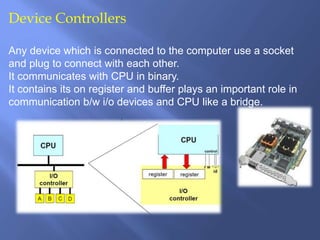
Any device which is connected to the computer use a socket
and plug to connect with each other.
It communicates with CPU in binary.
It contains its on register and buffer plays an important role in
communication b/w i/o devices and CPU like a bridge.
Device Driver:
It is a software which is an interface b/w
OS and device controller. It tells the device
Controller that how to control the I/O device.
Device drivers are software modules that can be
plugged into an OS to handle a particular device.
Operating System takes help from device drivers to
handle all I/O devices.
Input Output
Mechanism
• Programmed I/O
• Interrupts
• DMA (Direct memory Access)
The processor executes a program that gives it direct
control of the I/O operation, including sensing device
status, sending a read or write command, and
transferring the data. When the
processor issues a command to the I/O module, it must
wait until the I/O operation is complete.
If the processor is faster than the I/O module, this is
wasteful of processor time.
Programmed I/O
I/O Commands
To execute an I/O-related instruction, the processor
issues an address, specifying
the particular I/O module and external device, and an
I/O command. There are
four types of I/O commands that an I/O module may
receive when it is addressed
by a processor:
1) Control 2) Test 3) Read 4) Write
Control: Used to activate a peripheral and tell it what to do.
For example, a
magnetic-tape unit may be instructed to rewind or to move
forward one record.
Test: Used to test various status conditions associated with
an I/O module and its peripherals. The processor will want to
know that the peripheral of interest is powered on and
available for use.
Read: Causes the I/O module to obtain an item of data from
the peripheral and place it in an internal buffer.
The processor can then obtain the data item by requesting that
the I/O module place it on the data bus.
Write:
Causes the I/O module to take an item of data (byte
or word) from the
data bus and later transmit that data item to the
peripheral.
Interrupts
The problem with programmed I/O is that the processor has
to wait a long time for the I/O module of concern to be ready for
either reception or transmission of data.
An alternative is for the processor to issue an I/O command
to a module and then go on to do some other useful work.
The I/O module will then interrupt the processor to request
service when it is ready to exchange data with the processor.
For input, the I/O module receives a READ command
from the processor. The I/O
module then proceeds to read data in from an
associated peripheral. Once the data
are in the module’s data register, the module signals an
interrupt to the processor over a control line.
The module then waits until its data are requested by
the processor.
When the request is made, the module places its data
on the data bus and is then
ready for another I/O operation.
Interrupts
DMA (Direct memory Access)
Direct memory access (DMA) is a feature of computer
systems that allows certain hardware subsystems to access
main system memory (RAM), independent of the CPU.
DMA involves an additional module on the system bus. The
DMA uses the system bus to transfer the data to and from
the memory only when the processor does not need it or it
force the processor to suspend operation temporarily.
When the processor wishes to read or write a block of data, it
issues a command
to the DMA module.
input output ports

input output ports

  • 1.
  • 2.
    GROUP MEMBERS Zia urehman Azhar tahir Muhammad Aslam2
  • 3.
    What is i/oports ? A Computer Port is an interface or a point of connection between the computer and its peripheral devices. Some of the common peripherals are mouse, keyboard, monitor or display unit, printer, speaker, flash drive etc. The main function of a computer port is to act as a point of attachment, where the cable from the peripheral can be plugged in and allows data to flow from and to the device
  • 4.
    Types of ports Thereare two types of i/o ports Serial ports Parallel ports
  • 5.
    Parallel ports A parallelport is an interface through which the peripheral communicates with a computer in a parallel manner. DB-25 port with parallel interface
  • 6.
    Serial ports A serialport is an interface through which peripherals can be connected using a serial protocol which involves the transmission of data one bit at a time over a single communication line.
  • 7.
    Some ports youmay know VGA Port VGA port is found in many computers, projectors, video cards and High Definition TVs. This connector is known as DE-15. VGA port is the main interface between computers and older CRT monitors. Even the modern LCD and LED monitors support VGA ports but the picture quality is reduced.
  • 8.
    Digital Video Interface(DVI) DVI is a high speed digital interface between a display controller like a computer and a display device like a monitor. It was developed with an aim of transmitting lossless digital video signals and replace the analogue VGA technology.
  • 9.
    HDMI (High DefinitionMedia Interface) HDMI is a digital interface to connect High Definition and Ultra High Definition devices like Computer monitors, HDTVs, Blu-Ray players, gaming consoles, High Definition Cameras etc. HDMI can be used to carry uncompressed video and compressed or uncompressed audio signals. The HDMI port of type A is shown below.
  • 10.
    USB Universal Serial Bus(USB) replaced serial ports, parallel ports, PS/2 connectors, game ports and power chargers for portable devices.
  • 11.
    Input output system Oneof the important jobs of an Operating System is to manage various I/O devices including mouse, keyboards, touch pad, disk drives etc.
  • 12.
    Device Controllers Any devicewhich is connected to the computer use a socket and plug to connect with each other. It communicates with CPU in binary. It contains its on register and buffer plays an important role in communication b/w i/o devices and CPU like a bridge.
  • 13.
    Device Driver: It isa software which is an interface b/w OS and device controller. It tells the device Controller that how to control the I/O device. Device drivers are software modules that can be plugged into an OS to handle a particular device. Operating System takes help from device drivers to handle all I/O devices.
  • 14.
    Input Output Mechanism • ProgrammedI/O • Interrupts • DMA (Direct memory Access)
  • 15.
    The processor executesa program that gives it direct control of the I/O operation, including sensing device status, sending a read or write command, and transferring the data. When the processor issues a command to the I/O module, it must wait until the I/O operation is complete. If the processor is faster than the I/O module, this is wasteful of processor time. Programmed I/O
  • 16.
    I/O Commands To executean I/O-related instruction, the processor issues an address, specifying the particular I/O module and external device, and an I/O command. There are four types of I/O commands that an I/O module may receive when it is addressed by a processor: 1) Control 2) Test 3) Read 4) Write
  • 17.
    Control: Used toactivate a peripheral and tell it what to do. For example, a magnetic-tape unit may be instructed to rewind or to move forward one record. Test: Used to test various status conditions associated with an I/O module and its peripherals. The processor will want to know that the peripheral of interest is powered on and available for use. Read: Causes the I/O module to obtain an item of data from the peripheral and place it in an internal buffer. The processor can then obtain the data item by requesting that the I/O module place it on the data bus.
  • 18.
    Write: Causes the I/Omodule to take an item of data (byte or word) from the data bus and later transmit that data item to the peripheral.
  • 19.
    Interrupts The problem withprogrammed I/O is that the processor has to wait a long time for the I/O module of concern to be ready for either reception or transmission of data. An alternative is for the processor to issue an I/O command to a module and then go on to do some other useful work. The I/O module will then interrupt the processor to request service when it is ready to exchange data with the processor.
  • 20.
    For input, theI/O module receives a READ command from the processor. The I/O module then proceeds to read data in from an associated peripheral. Once the data are in the module’s data register, the module signals an interrupt to the processor over a control line. The module then waits until its data are requested by the processor. When the request is made, the module places its data on the data bus and is then ready for another I/O operation. Interrupts
  • 21.
    DMA (Direct memoryAccess) Direct memory access (DMA) is a feature of computer systems that allows certain hardware subsystems to access main system memory (RAM), independent of the CPU. DMA involves an additional module on the system bus. The DMA uses the system bus to transfer the data to and from the memory only when the processor does not need it or it force the processor to suspend operation temporarily. When the processor wishes to read or write a block of data, it issues a command to the DMA module.