Blockchain
Anusha Haleema - 04010102714
Mohit Singh - 06210102714
Roopal Kumar - 06410102714
Blockchain Overview
Blockchain technology is a digital innovation that is
poised to significantly alter financial markets within
the next few years, within a cryptographic
ecosystem that has the potential to also
significantly impact trusted computing activities
and therefore cybersecurity concerns as a whole.
Where it all started
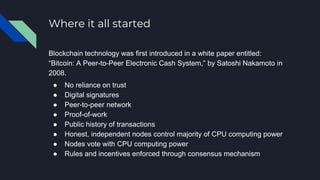
Blockchain technology was first introduced in a white paper entitled:
“Bitcoin: A Peer-to-Peer Electronic Cash System,” by Satoshi Nakamoto in
2008.
● No reliance on trust
● Digital signatures
● Peer-to-peer network
● Proof-of-work
● Public history of transactions
● Honest, independent nodes control majority of CPU computing power
● Nodes vote with CPU computing power
● Rules and incentives enforced through consensus mechanism
Three levels of blockchain
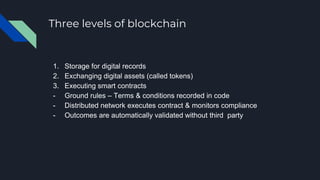
1. Storage for digital records
2. Exchanging digital assets (called tokens)
3. Executing smart contracts
- Ground rules – Terms & conditions recorded in code
- Distributed network executes contract & monitors compliance
- Outcomes are automatically validated without third party
Ledger
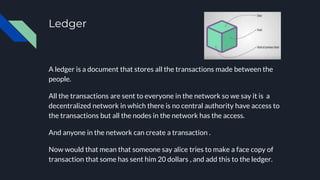
A ledger is a document that stores all the transactions made between the
people.
All the transactions are sent to everyone in the network so we say it is a
decentralized network in which there is no central authority have access to
the transactions but all the nodes in the network has the access.
And anyone in the network can create a transaction .
Now would that mean that someone say alice tries to make a face copy of
transaction that some has sent him 20 dollars , and add this to the ledger.
Digital Signature
This problem is solved by using a digital signature of every transaction of block that is created.
A digital signature contains a public and a private key so that every person can sign a block using
his private key and the data in it .
And all the other member can use his public key to ensure that the block is valid and is
generated by an authentic user
Sign( Message , Secret key) = Signature
Verify(Message , Signature , public key )
Now your would be wondering that what if someone guesses signature value and tampers with
it
Private key and Public key
There are various algorithms that define 2 keys one is named as public key and the other is
defined as a private key.
Such algorithms are :
1. RSA
2. EDSC
3. DH
Consider EDSC that creates 256 bits key, so in order to guess this signature a computer has to
generate all the permutations which is about 2^256 combinations . This is too much for even a
ton of supercomputers to crack.
Hash Functions or Digest
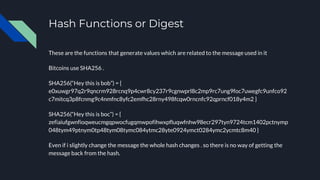
These are the functions that generate values which are related to the message used in it
Bitcoins use SHA256 .
SHA256(“Hey this is bob”) = {
e0xuwgr97q2r9qncrm928rcnq9p4cwr8cy237r9cgnwprl8c2mp9rc7ung9foc7uwegfc9unfco92
c7mitcq3p8fcnmg9c4nmfnc8yfc2emfhc28rny498fcqw0rncnfc92qprncf018y4m2 }
SHA256(“Hey this is boc”) = {
zefiaiufgwnfioqweucmgqpwocfugqmwpofihwxpfluqwfnhw98ecr297tyn9724tcm1402pctnymp
048tym49ptnym0tp48tym08tymc084ytmc28yte0924ymct0284ymc2ycmtc8m40 }
Even if i slightly change the message the whole hash changes . so there is no way of getting the
message back from the hash.
Proof of work
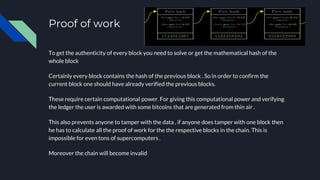
To get the authenticity of every block you need to solve or get the mathematical hash of the
whole block
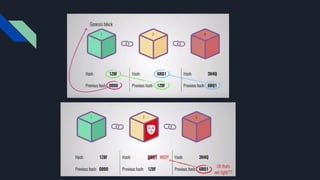
Certainly every block contains the hash of the previous block . So in order to confirm the
current block one should have already verified the previous blocks.
These require certain computational power. For giving this computational power and verifying
the ledger the user is awarded with some bitcoins that are generated from thin air .
This also prevents anyone to tamper with the data , if anyone does tamper with one block then
he has to calculate all the proof of work for the the respective blocks in the chain. This is
impossible for even tons of supercomputers .
Moreover the chain will become invalid
Consensus
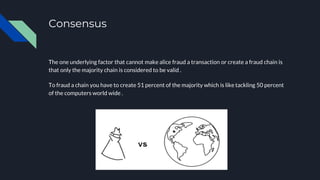
The one underlying factor that cannot make alice fraud a transaction or create a fraud chain is
that only the majority chain is considered to be valid .
To fraud a chain you have to create 51 percent of the majority which is like tackling 50 percent
of the computers world wide .
Uses
Cryptocurrency
Decentralized Notary
Medical Records
Artificial Intelligence
Digital Voting
Smart Contracts

Blockchain

  • 1.
    Blockchain Anusha Haleema -04010102714 Mohit Singh - 06210102714 Roopal Kumar - 06410102714
  • 2.
    Blockchain Overview Blockchain technologyis a digital innovation that is poised to significantly alter financial markets within the next few years, within a cryptographic ecosystem that has the potential to also significantly impact trusted computing activities and therefore cybersecurity concerns as a whole.
  • 3.
    Where it allstarted Blockchain technology was first introduced in a white paper entitled: “Bitcoin: A Peer-to-Peer Electronic Cash System,” by Satoshi Nakamoto in 2008. ● No reliance on trust ● Digital signatures ● Peer-to-peer network ● Proof-of-work ● Public history of transactions ● Honest, independent nodes control majority of CPU computing power ● Nodes vote with CPU computing power ● Rules and incentives enforced through consensus mechanism
  • 4.
    Three levels ofblockchain 1. Storage for digital records 2. Exchanging digital assets (called tokens) 3. Executing smart contracts - Ground rules – Terms & conditions recorded in code - Distributed network executes contract & monitors compliance - Outcomes are automatically validated without third party
  • 5.
    Ledger A ledger isa document that stores all the transactions made between the people. All the transactions are sent to everyone in the network so we say it is a decentralized network in which there is no central authority have access to the transactions but all the nodes in the network has the access. And anyone in the network can create a transaction . Now would that mean that someone say alice tries to make a face copy of transaction that some has sent him 20 dollars , and add this to the ledger.
  • 6.
    Digital Signature This problemis solved by using a digital signature of every transaction of block that is created. A digital signature contains a public and a private key so that every person can sign a block using his private key and the data in it . And all the other member can use his public key to ensure that the block is valid and is generated by an authentic user Sign( Message , Secret key) = Signature Verify(Message , Signature , public key ) Now your would be wondering that what if someone guesses signature value and tampers with it
  • 7.
    Private key andPublic key There are various algorithms that define 2 keys one is named as public key and the other is defined as a private key. Such algorithms are : 1. RSA 2. EDSC 3. DH Consider EDSC that creates 256 bits key, so in order to guess this signature a computer has to generate all the permutations which is about 2^256 combinations . This is too much for even a ton of supercomputers to crack.
  • 8.
    Hash Functions orDigest These are the functions that generate values which are related to the message used in it Bitcoins use SHA256 . SHA256(“Hey this is bob”) = { e0xuwgr97q2r9qncrm928rcnq9p4cwr8cy237r9cgnwprl8c2mp9rc7ung9foc7uwegfc9unfco92 c7mitcq3p8fcnmg9c4nmfnc8yfc2emfhc28rny498fcqw0rncnfc92qprncf018y4m2 } SHA256(“Hey this is boc”) = { zefiaiufgwnfioqweucmgqpwocfugqmwpofihwxpfluqwfnhw98ecr297tyn9724tcm1402pctnymp 048tym49ptnym0tp48tym08tymc084ytmc28yte0924ymct0284ymc2ycmtc8m40 } Even if i slightly change the message the whole hash changes . so there is no way of getting the message back from the hash.
  • 10.
    Proof of work Toget the authenticity of every block you need to solve or get the mathematical hash of the whole block Certainly every block contains the hash of the previous block . So in order to confirm the current block one should have already verified the previous blocks. These require certain computational power. For giving this computational power and verifying the ledger the user is awarded with some bitcoins that are generated from thin air . This also prevents anyone to tamper with the data , if anyone does tamper with one block then he has to calculate all the proof of work for the the respective blocks in the chain. This is impossible for even tons of supercomputers . Moreover the chain will become invalid
  • 11.
    Consensus The one underlyingfactor that cannot make alice fraud a transaction or create a fraud chain is that only the majority chain is considered to be valid . To fraud a chain you have to create 51 percent of the majority which is like tackling 50 percent of the computers world wide .
  • 12.