Blockchain Concepts
Murughan Palaniachari
http://www.unicomlearning.com/2017/Devops_Microservices_and_Containers_Summit_Bangalore/
Who am I?
Murughan Palaniachari
DevOps Coach, Blockchain Enthusiast
Certified DevOps guy, Speaker, Blogger and Trainer
Organizer of
Cloud and DevOps meetup
Blockchain Developers meetup
Containers Conference
Technical Agility Conference
https://elevate-org.com/
https://devopsgames.com/
https://in.linkedin.com/in/murughan
@Murughan_P With my Guru – John Willis & Jez Humble
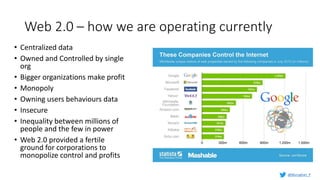
Web 2.0 – how we are operating currently
• Centralized data
• Owned and Controlled by single
org
• Bigger organizations make profit
• Monopoly
• Owning users behaviours data
• Insecure
• Inequality between millions of
people and the few in power
• Web 2.0 provided a fertile
ground for corporations to
monopolize control and profits
@Murughan_P
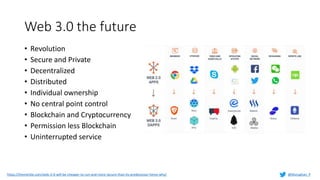
Web 3.0 the future
https://themerkle.com/web-3-0-will-be-cheaper-to-run-and-more-secure-than-its-predecessor-heres-why/
• Revolution
• Secure and Private
• Decentralized
• Distributed
• Individual ownership
• No central point control
• Blockchain and Cryptocurrency
• Permission less Blockchain
• Uninterrupted service
@Murughan_P
What is Blockchain
• Distributed Ledger
• Distributed shared and secured Database
• Next generation internet and Tool for Decentralized world
• Trust is established by Protocol
• Immutable and non-stoppable transaction
• Decentralize everything
• Transparent
@Murughan_P
What is Blockchain
• Resilient
• Each transaction are verified
• People from anywhere in the world can transact with other in large peer-to-peer
networks without centralized management
• Cryptography and computer code strengthens collaboration and cooperation
between organizations and individual to form global network.
• Blockchain-based applications can help remove the intermediaries from existing
processes.
@Murughan_P
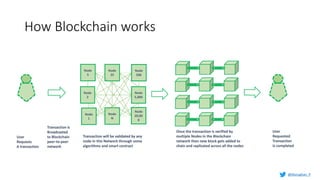
How Blockchain works
Node
2
Node
5,000
Node
N
Node
25
Transaction is
Broadcasted
to Blockchain
peer-to-peer
network
User
Requests
A transaction
Transaction will be validated by any
node in this Network through some
algorithms and smart contract
Once the transaction is verified by
multiple Nodes in the Blockchain
network then new block gets added to
chain and replicated across all the nodes
User
Requested
Transaction
Is completed
Node
500
Node
5
Node
1
Node
20,00
0
@Murughan_P
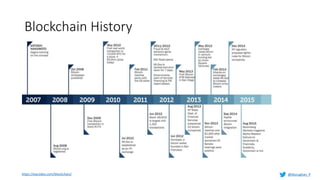
Blockchain History
https://eacodex.com/blockchain/ @Murughan_P
@Murughan_P
@Murughan_P
@Murughan_P
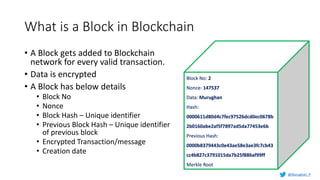
What is a Block in Blockchain
• A Block gets added to Blockchain
network for every valid transaction.
• Data is encrypted
• A Block has below details
• Block No
• Nonce
• Block Hash – Unique identifier
• Previous Block Hash – Unique identifier
of previous block
• Encrypted Transaction/message
• Creation date
Block No: 2
Nonce: 147537
Data: Murughan
Hash:
0000611d80d4c7fec97526dcd0ec0678b
2b0160abe2af5f7897ad5da77453e6b
Previous Hash:
0000b8379443c0e43ae58e3ae3fc7cb43
cc4b827c3791015da7b25f886af99ff
Merkle Root
@Murughan_P
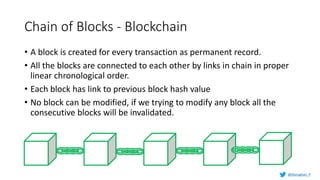
Chain of Blocks - Blockchain
• A block is created for every transaction as permanent record.
• All the blocks are connected to each other by links in chain in proper
linear chronological order.
• Each block has link to previous block hash value
• No block can be modified, if we trying to modify any block all the
consecutive blocks will be invalidated.
@Murughan_P
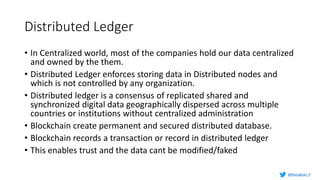
Distributed Ledger
• In Centralized world, most of the companies hold our data centralized
and owned by the them.
• Distributed Ledger enforces storing data in Distributed nodes and
which is not controlled by any organization.
• Distributed ledger is a consensus of replicated shared and
synchronized digital data geographically dispersed across multiple
countries or institutions without centralized administration
• Blockchain create permanent and secured distributed database.
• Blockchain records a transaction or record in distributed ledger
• This enables trust and the data cant be modified/faked
@Murughan_P
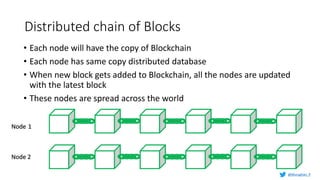
Distributed chain of Blocks
Node 2
Node 1
• Each node will have the copy of Blockchain
• Each node has same copy distributed database
• When new block gets added to Blockchain, all the nodes are updated
with the latest block
• These nodes are spread across the world
@Murughan_P
Immutable
• Blockchain is immutable – Blockchain data can’t be changes
• Block can’t be deleted
• As each block contains a hash value of previous dependent block.
• All the block are chained and linked
• Data tamper proof
• If any node trying to modify a block then entire Blockchain will be invalidated.
• In the below image node 1 is trying to modify the 3rd block data then from 3rd block till
last block are invalidated.
Node 1
@Murughan_P
Hashing
• Hashing is the process of transforming
any input data into fixed length of
random character data
• For each transaction, data is encrypted
and given a Hash value.
• Hash Value is an unique identifier of a
block
• Uses standard algorithm to compress
the code and generate unique hash
value
Hash:
0000611d80d4c7fec97526dcd0ec0678b
2b0160abe2af5f7897ad5da77453e6b
Previous Hash:
0000b8379443c0e43ae58e3ae3fc7cb43
cc4b827c3791015da7b25f886af99ff
@Murughan_P
Hashing
• For any given input (smaller or bigger) the length of hash
value is always same
• Easy to Compute the Hash Value
• You can’t track back the encrypted data with hash value.
• Infeasible to modify a message without changing the Hash
• Infeasible to find a message that has same hash
• No matter the size of input string data, the length of its
output is always fixed.
@Murughan_P
Public Key Cryptography
• Public key is the address on the Blockchain
• This is an random number generated
• Any transaction happens through Blockchain happens through Public Key
to identify the sender and receiver
• Private key is like password to access the data
• Public key is associated with Private key
• Only the person with the Private key can decrypt the data
• Digital Signature is the combination of Authentication and Non-
repudiation
@Murughan_P
Consensus
• Consensus is the agreement between the nodes in Blockchain network
which operates without trust between parties.
• Consensus are not owned and controlled any central authority rather it’s
the nodes across the world.
• State or value of block is agreed by multiple nodes in Blockchain network. If
any nodes disagrees then transaction is reverted.
• The choice of Consensus algorithm depends on Blockchain type you choose
• Consensus Mechanism is the steps taken to agree upon block state.
• Consensus will run even when some node are down
@Murughan_P
Consensus Mechanism algorithms
• Some Consensus Mechanism algorithms
• Proof of Work
• Proof of Stake
• Leased Proof of Stake
• Delegated Proof of Stake
• Proof of Importance
• Proof of Elapsed Time
• Proof of Deposit
• Federated Consensus
@Murughan_P
Transactions in the Blockchain
• Each transaction is digitally signed with cryptography
• Atomic, full operation run or not at all
• Run Independently
• Inspect able
• Immortal
• Each transaction has cost associated
• Each transaction creates block into Blockchain
@Murughan_P
Mining
• Mining is the process of validating the transactions and adding new
block to the Blockchain network.
• Broadcast to other nodes in the network who has the copy of
database
• All the nodes should agree about its state to add transaction to
nodes.
• Miner who solves the puzzle, gets the reward as crypto currency or
fee
• In Bitcoin world it uses PoW algorithm
@Murughan_P
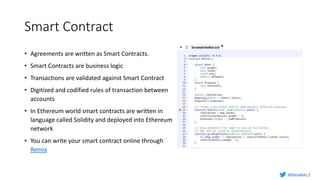
Smart Contract
• Agreements are written as Smart Contracts.
• Smart Contracts are business logic
• Transactions are validated against Smart Contract
• Digitized and codified rules of transaction between
accounts
• In Ethereum world smart contracts are written in
language called Solidity and deployed into Ethereum
network
• You can write your smart contract online through
Remix
@Murughan_P
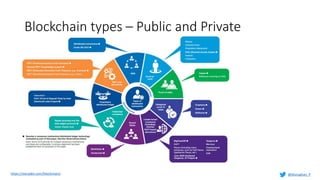
Blockchain types – Public and Private
https://eacodex.com/blockchain/ @Murughan_P
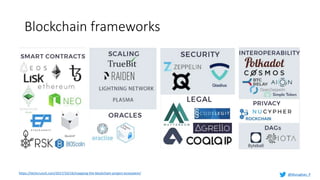
Blockchain frameworks
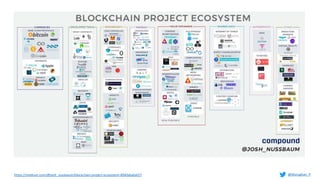
https://techcrunch.com/2017/10/16/mapping-the-blockchain-project-ecosystem/ @Murughan_P
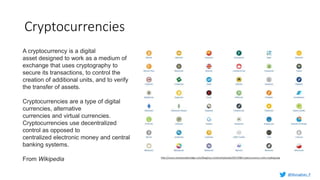
Cryptocurrencies
A cryptocurrency is a digital
asset designed to work as a medium of
exchange that uses cryptography to
secure its transactions, to control the
creation of additional units, and to verify
the transfer of assets.
Cryptocurrencies are a type of digital
currencies, alternative
currencies and virtual currencies.
Cryptocurrencies use decentralized
control as opposed to
centralized electronic money and central
banking systems.
From Wikipedia
@Murughan_P
Blockchain Use Cases
• HealthCare
• Supply-chain
• Banking
• Financial
• Fitech
• Government
• Identity
• Theft & Security
• Automotive
• Retail
• Fraud
• Voting
• Money transfer
• Cloud storage
• Education
• Marketing
• Direct selling
• Digital Payment
• Digital Currency
• Manufacturing
• Legal
• Insurance
• Media
• Energy
• Real Estate
• Charity
• Luxury Goods management
• Technology
• And More use cases
@Murughan_P
https://medium.com/@josh_nussbaum/blockchain-project-ecosystem-8940ababaf27 @Murughan_P
@Murughan_P
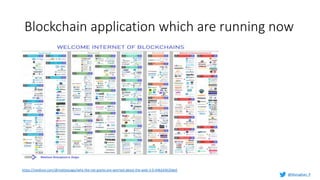
https://medium.com/@matteozago/why-the-net-giants-are-worried-about-the-web-3-0-44b2d3620da5
Blockchain application which are running now
Blockchain is already seeing success
Binance surpassed Deutsche Bank in Profits for Q1 of 2018
Takeaway
• Blockchain is the Future
• Opportunity for everyone to grow and compete with the big giants
• Decentralize everything
• Trust without any middle person/organization
• Transparent
• Traceability of any product life-cycle
• Immutable
• Still lot of research is happening in this area and more to come in the
future

Blockchain concepts

  • 1.
  • 2.
    http://www.unicomlearning.com/2017/Devops_Microservices_and_Containers_Summit_Bangalore/ Who am I? MurughanPalaniachari DevOps Coach, Blockchain Enthusiast Certified DevOps guy, Speaker, Blogger and Trainer Organizer of Cloud and DevOps meetup Blockchain Developers meetup Containers Conference Technical Agility Conference https://elevate-org.com/ https://devopsgames.com/ https://in.linkedin.com/in/murughan @Murughan_P With my Guru – John Willis & Jez Humble
  • 3.
    Web 2.0 –how we are operating currently • Centralized data • Owned and Controlled by single org • Bigger organizations make profit • Monopoly • Owning users behaviours data • Insecure • Inequality between millions of people and the few in power • Web 2.0 provided a fertile ground for corporations to monopolize control and profits @Murughan_P
  • 4.
    Web 3.0 thefuture https://themerkle.com/web-3-0-will-be-cheaper-to-run-and-more-secure-than-its-predecessor-heres-why/ • Revolution • Secure and Private • Decentralized • Distributed • Individual ownership • No central point control • Blockchain and Cryptocurrency • Permission less Blockchain • Uninterrupted service @Murughan_P
  • 5.
    What is Blockchain •Distributed Ledger • Distributed shared and secured Database • Next generation internet and Tool for Decentralized world • Trust is established by Protocol • Immutable and non-stoppable transaction • Decentralize everything • Transparent @Murughan_P
  • 6.
    What is Blockchain •Resilient • Each transaction are verified • People from anywhere in the world can transact with other in large peer-to-peer networks without centralized management • Cryptography and computer code strengthens collaboration and cooperation between organizations and individual to form global network. • Blockchain-based applications can help remove the intermediaries from existing processes. @Murughan_P
  • 7.
    How Blockchain works Node 2 Node 5,000 Node N Node 25 Transactionis Broadcasted to Blockchain peer-to-peer network User Requests A transaction Transaction will be validated by any node in this Network through some algorithms and smart contract Once the transaction is verified by multiple Nodes in the Blockchain network then new block gets added to chain and replicated across all the nodes User Requested Transaction Is completed Node 500 Node 5 Node 1 Node 20,00 0 @Murughan_P
  • 8.
  • 9.
  • 10.
  • 11.
  • 12.
    What is aBlock in Blockchain • A Block gets added to Blockchain network for every valid transaction. • Data is encrypted • A Block has below details • Block No • Nonce • Block Hash – Unique identifier • Previous Block Hash – Unique identifier of previous block • Encrypted Transaction/message • Creation date Block No: 2 Nonce: 147537 Data: Murughan Hash: 0000611d80d4c7fec97526dcd0ec0678b 2b0160abe2af5f7897ad5da77453e6b Previous Hash: 0000b8379443c0e43ae58e3ae3fc7cb43 cc4b827c3791015da7b25f886af99ff Merkle Root @Murughan_P
  • 13.
    Chain of Blocks- Blockchain • A block is created for every transaction as permanent record. • All the blocks are connected to each other by links in chain in proper linear chronological order. • Each block has link to previous block hash value • No block can be modified, if we trying to modify any block all the consecutive blocks will be invalidated. @Murughan_P
  • 14.
    Distributed Ledger • InCentralized world, most of the companies hold our data centralized and owned by the them. • Distributed Ledger enforces storing data in Distributed nodes and which is not controlled by any organization. • Distributed ledger is a consensus of replicated shared and synchronized digital data geographically dispersed across multiple countries or institutions without centralized administration • Blockchain create permanent and secured distributed database. • Blockchain records a transaction or record in distributed ledger • This enables trust and the data cant be modified/faked @Murughan_P
  • 15.
    Distributed chain ofBlocks Node 2 Node 1 • Each node will have the copy of Blockchain • Each node has same copy distributed database • When new block gets added to Blockchain, all the nodes are updated with the latest block • These nodes are spread across the world @Murughan_P
  • 16.
    Immutable • Blockchain isimmutable – Blockchain data can’t be changes • Block can’t be deleted • As each block contains a hash value of previous dependent block. • All the block are chained and linked • Data tamper proof • If any node trying to modify a block then entire Blockchain will be invalidated. • In the below image node 1 is trying to modify the 3rd block data then from 3rd block till last block are invalidated. Node 1 @Murughan_P
  • 17.
    Hashing • Hashing isthe process of transforming any input data into fixed length of random character data • For each transaction, data is encrypted and given a Hash value. • Hash Value is an unique identifier of a block • Uses standard algorithm to compress the code and generate unique hash value Hash: 0000611d80d4c7fec97526dcd0ec0678b 2b0160abe2af5f7897ad5da77453e6b Previous Hash: 0000b8379443c0e43ae58e3ae3fc7cb43 cc4b827c3791015da7b25f886af99ff @Murughan_P
  • 18.
    Hashing • For anygiven input (smaller or bigger) the length of hash value is always same • Easy to Compute the Hash Value • You can’t track back the encrypted data with hash value. • Infeasible to modify a message without changing the Hash • Infeasible to find a message that has same hash • No matter the size of input string data, the length of its output is always fixed. @Murughan_P
  • 19.
    Public Key Cryptography •Public key is the address on the Blockchain • This is an random number generated • Any transaction happens through Blockchain happens through Public Key to identify the sender and receiver • Private key is like password to access the data • Public key is associated with Private key • Only the person with the Private key can decrypt the data • Digital Signature is the combination of Authentication and Non- repudiation @Murughan_P
  • 20.
    Consensus • Consensus isthe agreement between the nodes in Blockchain network which operates without trust between parties. • Consensus are not owned and controlled any central authority rather it’s the nodes across the world. • State or value of block is agreed by multiple nodes in Blockchain network. If any nodes disagrees then transaction is reverted. • The choice of Consensus algorithm depends on Blockchain type you choose • Consensus Mechanism is the steps taken to agree upon block state. • Consensus will run even when some node are down @Murughan_P
  • 21.
    Consensus Mechanism algorithms •Some Consensus Mechanism algorithms • Proof of Work • Proof of Stake • Leased Proof of Stake • Delegated Proof of Stake • Proof of Importance • Proof of Elapsed Time • Proof of Deposit • Federated Consensus @Murughan_P
  • 22.
    Transactions in theBlockchain • Each transaction is digitally signed with cryptography • Atomic, full operation run or not at all • Run Independently • Inspect able • Immortal • Each transaction has cost associated • Each transaction creates block into Blockchain @Murughan_P
  • 23.
    Mining • Mining isthe process of validating the transactions and adding new block to the Blockchain network. • Broadcast to other nodes in the network who has the copy of database • All the nodes should agree about its state to add transaction to nodes. • Miner who solves the puzzle, gets the reward as crypto currency or fee • In Bitcoin world it uses PoW algorithm @Murughan_P
  • 24.
    Smart Contract • Agreementsare written as Smart Contracts. • Smart Contracts are business logic • Transactions are validated against Smart Contract • Digitized and codified rules of transaction between accounts • In Ethereum world smart contracts are written in language called Solidity and deployed into Ethereum network • You can write your smart contract online through Remix @Murughan_P
  • 25.
    Blockchain types –Public and Private https://eacodex.com/blockchain/ @Murughan_P
  • 26.
  • 27.
    Cryptocurrencies A cryptocurrency isa digital asset designed to work as a medium of exchange that uses cryptography to secure its transactions, to control the creation of additional units, and to verify the transfer of assets. Cryptocurrencies are a type of digital currencies, alternative currencies and virtual currencies. Cryptocurrencies use decentralized control as opposed to centralized electronic money and central banking systems. From Wikipedia @Murughan_P
  • 28.
    Blockchain Use Cases •HealthCare • Supply-chain • Banking • Financial • Fitech • Government • Identity • Theft & Security • Automotive • Retail • Fraud • Voting • Money transfer • Cloud storage • Education • Marketing • Direct selling • Digital Payment • Digital Currency • Manufacturing • Legal • Insurance • Media • Energy • Real Estate • Charity • Luxury Goods management • Technology • And More use cases @Murughan_P
  • 29.
  • 30.
  • 31.
    Blockchain is alreadyseeing success Binance surpassed Deutsche Bank in Profits for Q1 of 2018
  • 32.
    Takeaway • Blockchain isthe Future • Opportunity for everyone to grow and compete with the big giants • Decentralize everything • Trust without any middle person/organization • Transparent • Traceability of any product life-cycle • Immutable • Still lot of research is happening in this area and more to come in the future