1991 :The conceptual frame
work behind blockchain was first put
forward by a group of researchers
The idea was initially intended for time-stamping digital documents such
that backdating them will not be possible thereafter
2008 : The idea went mostly unused until it was again mentioned by
Satoshi Nakamoto in his white paper “Bitcoin: A Peer-to-Peer Electronic
Cash System”
Satoshi Nakamoto, an anonymous person/group is said to be behind the
first blockchain, which is Bitcoin
2009 : Bitcoin is the first blockchain came into existence
4.
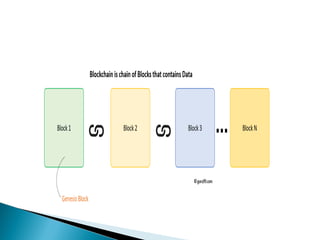
Blockchain consistsof a list of records. Such records are stored in blocks.
These blocks are in turn linked with other blocks and hence constitute a
chain called Blockchain
6.
The Blockchainis used for the secure transfer of items like money,
property, contracts, etc, without requiring a third-party intermediary like
a bank or government
Once data is recorded inside a Blockchain, it is very difficult to change it
Is the underlying technology behind cryptocurrencies like Bitcoin,
Litecoin, Namecoin (Alt Coins)
7.
Chain ofblocks that contains information
Stores information electronically in digital format
Distributed Ledger Technology
◦ Transactions are copied and stored across individual computers on the
network rather than storing on a central server
Record transactions and track assets in a network
◦ Tangible asset : property, house, vehicle, etc.
◦ Can store its ownership details, history of the ownership and location of
assets in the network
◦ Intangible asset : digital currency, intellectual property rights, etc.
◦ Can store certificate, personal information, a contract, title of ownership
8.
Blockchain arebest known for their crucial role in cryptocurrency
systems, such as Bitcoin, for maintaining a secure and decentralized
record of transactions
In Blockchain each transaction will be secured through cryptography and
later all the transaction history will be grouped and stored as blocks of data
Then the blocks are linked together with cryptography and secured from
modification
These blocks of records are copied to every participating computer in the
network, so everyone will have access to it
Create an unforgeable and immutable record
Participating nodes in the network do not need to know each other or
trust each other because each has the ability to monitor and validate chain
for themselves
9.
Centralized :One server which
has absolute control
Decentralized : No server has
absolute control
Distributed : Any server or node
connected to every other server
directly or indirectly
10.
Problem withcentralized systems are :
◦ Less transparent
◦ Prone to single point of failure
◦ Has scalability limitation
11.
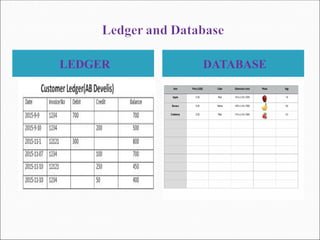
A ledgeris a collection of transactions
Works in append only mode
Before, pen and paper ledgers
In modern times, ledgers have been stored digitally, often in large
databases owned and operated by a centralized trusted third party (i.e.,
the owner of the ledger)
Can be implemented in a centralized or distributed fashion
Blockchain isa Distributed Ledger Technology (DLT), also known as a
shared ledger
The transactions are copied and stored across individual computers on the
network
Is a database that is consensually shared and synchronized across multiple
sites, institutions, or geographies, accessible by multiple people
The participant at each node of the network can access the recordings
shared across that network and can own an identical copy of it
Any changes or additions made to the ledger are reflected and copied to
all participants
There is no central administrator or centralized data storage
16.
When aledger update happens, each node constructs the new transaction,
and then the nodes vote by consensus algorithm on which copy is
correct?
Once a consensus has been determined, all the other nodes update
themselves with the new, correct copy of the ledger
Security is accomplished through cryptographic keys and signatures
Is a Shared database, which records the properties and history of an asset
Can operate on a public (permissionless) or a private (permissioned)
platform
17.
Benefits ofDistributed Ledger Technology :
◦ No need for third parties
◦ reduced complexity
◦ Increased speed of processing
◦ Faster, cheaper remittances for consumers
◦ Real-time value transfer ability
◦ No single point failure because participants hold identical copies of a
shared ledger updated algorithmically
◦ Increased accuracy and transparency
◦ Minimized logistical expense of transporting hard copies of documents
18.
Proper KYCof their clients needed before creating their digital identities
and recording them on ledger
Security in general needs to be multi-level
20.
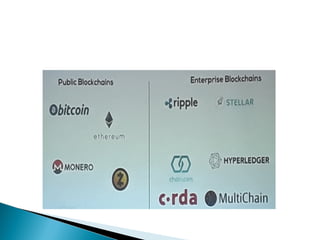
Public Blockchain
◦Non-restrictive
◦ Permissionless
◦ Anyone with internet access can sign on to become an authorized node
◦ User can access current and past records and conduct mining activities,
the complex computations used to verify transactions and add them to
the ledger
◦ Source code is usually open source
◦ Anyone can verify the transactions, find bugs or propose changes
22.
Private Blockchain
◦Works in a restrictive environment
◦ Uses peer-to-peer connections
◦ Decentralized
◦ Much smaller scale
◦ Typically are operated on a small network inside a company or
organization
◦ Also known as permissioned blockchains or enterprise blockchains
24.
Hybrid Blockchain
◦Combines elements of both private and public blockchain
◦ It lets organizations set up a private, permission-based system
alongside a public permissionless system
◦ Can control who can access specific data stored in the blockchain, and
what data will be opened up publicly
25.
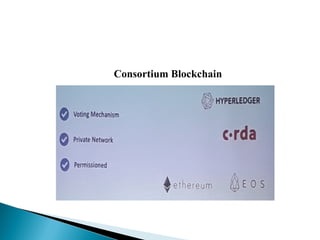
Consortium Blockchain
◦Also known as a federated blockchain
◦ Similar to a hybrid blockchain
◦ Has private and public blockchain features
◦ Different in that multiple organizational members collaborate on a
decentralized network
◦ Private blockchain with limited access to a particular group
◦ Eliminates the risks that come with just one entity controlling the
network on a private blockchain
Forecasts suggestthat spending on blockchain solutions will continue to
grow in the coming years, reaching almost 19 billion U.S. dollars by 2024
Blockchain is popular because of the following advantages :
◦ Decentralized : Control and decision making are not in one individual
or group’s hand but is evenly distributed in a network
◦ Distributed : Uses Distributed Ledgers
◦ Secure : Difficult or impossible to change, hack, or cheat the system
◦ Faster
◦ Transparent : No third-party intervention
◦ Immutable : Cannot manipulate data that's already in the blockchain
30.
Immutability
◦ Impossibleto erase or replace recorded data
Transparency
◦ Transactions and data are recorded identically in multiple locations
Censorship
◦ It does not have control of any single party. So no single party control
Traceability
◦ Easy tracing of changes on the network
Enhanced security
◦ Record can’t be altered and is encrypted end-to-end
Increased efficiency and speed
◦ No third party mediation
31.
Scalability
◦ Blockchainhave limited scalability
◦ The speed at which transactions are completed depends on the network
congestion
◦ The chances of slowing down are higher as more people or nodes join
the network
Storage
◦ Blockchain databases are stored permanently on all network nodes,
posing a storage problem
Security
◦ 51% attack : 51% of the node in a network collaborate
◦ DDoS (Distributed Denial-of-Service) attack : Slows down or stops
the network
32.
Slow
◦ Requirementof a consensus mechanism
Highly Volatile
◦ Prices of cryptocurrencies tend to be extremely volatile
High implementation cost
◦ Costlier compared to a traditional database
33.
Banking andpayments
◦ Bitcoin like cryptocurrencies can control the payment systems without
any geopolitical restrictions
Cyber Security
◦ Data is verified and secured using cryptography. It removes the
middlemen from the system so no one can make any unauthorized
changes
Supply chain
◦ Any product can be tracked completely using the blockchain supply
chain management
34.
Online DataStorage
◦ Allows distributed data storage in a more secure and robust way
Networking and IoT
◦ Can be applied in Networking and IoT to create a decentralized
network of IoT devices
Insurance
◦ Blockchain ensures trust by mutual distrust between participants
Government
◦ Applying blockchain technology in government systems will reduce
bureaucratic hurdles, red-tapism, and increases efficiency and
transparency of government operations
35.
Crowdfunding
◦ Trustis built through smart contracts and online reputation systems
◦ Eliminates the need for a central party
◦ New projects can release their own tokens that can later be exchanged
for products, services or cash
Multimedia and entertainment
◦ Will remove the middleman from the scenario
◦ Online music is one of the entertainment areas where blockchain has
already started their implementation
Real estate
◦ Can control the entire real estate systems with shared ledgers
36.
Block-Permanent storeof records/ transactions which, once written,
cannot be altered or removed
Each block consists
◦ Block header
◦ Block body
38.
Block Headercontains the following :
Block version:
◦ 4-byte long version number
◦ Indicates the protocol version used by the node for block
validation rules
Merkle tree root hash: Contains the hash value of all the
transactions in the block
Timestamp: Stores the current time as seconds in the universal
time since January 1, 1970
39.
nBits: Targetthreshold of a valid block hash (to set current
difficulty)
Nonce: Number Used Only Once is a 4-byte field that stores a
random number which usually starts with 0 and increases for
every hash calculation. Any change made to block data (like
Nonce) will change the entire block hash
Parent Block hash: Contains hash value of its parent block
Block body contains the user transactions
40.
Is theprocess of validating transactions and adding them to the
Blockchain
Nodes that performs mining process are called Miners
Thus miners provide security and confirm transactions
Mining performs two important functions
◦ Generate and release new cryptocurrency
◦ To verify, authenticate and then add transactions to Blockchain
41.
There are7 steps to process and add transactions to blockchain
Step 1 : User performs a transaction using their wallet application
Step 2 : Transactions broadcasted by wallet application and stored in pool
of unconfirmed transactions
Step 3 : Miners select transactions from these pools and form them into a
‘block’.
Miners usually prioritize transactions that have high transaction
fee set, to get highest reward
Multiple miners can select the same transaction to be included in
their block
Miners verifies and collects only the eligible transactions based on
blockchain history
42.
Step 4: Once miner has created its block, it has to be added into the
blockchain for others to register the transactions
The block first needs a signature, to confirm that it is a valid block
and other nodes can agree and accept this block
This process of obtaining signature and their by acceptance is known
as CONSENSUS
This signature is created by solving a very complex mathematical
problem that is unique to each block of transactions (finding Nonce)
Every miner will work on a different problem unique to the block
they built
43.
Step 5: The miner that first finds an eligible signature (output hash
value- a 32 digit string with preceding zero’s[signature requirement]) for
its block, broadcasts this block and its signature to all the other miners
Step 6 : Other miners verify signature’s legitimacy as follows :
Takes the string of data of the broadcasted block, hash it to see if the
output hash matches the included signature (output hash value)
If valid, the other miners will confirm its validity and agree that the
block can be added to the blockchain
The other nodes will accept the block and save it to their transaction
data as long as the transactions inside the block correspond correctly
with the current wallet balances (transaction history) at that point in time
44.
Step 7: After a block has been added to the chain, every other block that
is added on top of it counts as a ‘confirmation’ for that block
Example : If a transaction is included in block 502, and the blockchain is
507 blocks long, it means that transaction has 5 confirmations (507–502).
The more confirmations your transaction has ( the deeper the block is
embedded in the chain), the harder it is for attackers to alter it.
After a new block is added to the blockchain, all miners need to start over
again at step three
45.
1. Make transactions
2.Wait in pool to be selected by miners
3. Miners collects valid transactions, forms the block
4. Finds signature to that block- CONSENSUS mechanism
5. Broadcasts the block to others
6. Others verifies the signature
7. Block finally gets added to the chain, gets confirmations.
8. Repeat step from 3 to 7
46.
A consensusmechanism
◦ Is a fault-tolerant mechanism used in computer and blockchain systems
to achieve necessary agreement on a single data value or a single state
of the network among distributed processes or multi-agent systems, such
as with cryptocurrencies
◦ It is useful in record-keeping, among other things
47.
Why consensus?
◦Centralized system
◦ Only admins/central authority of that server can add/delete/update
the information
◦ While decentralized networks are self-regulating systems with nodes
that don’t trust each other and that work on a global scale without any
single authority
◦ They involve contributions from hundreds of thousands of participants
who work on verification and authentication of transactions occurring
on the blockchain, and on the block mining activities
48.
A setof rules that decides on the contributions by the various participants
of the blockchain
Different consensus mechanism algorithms work on different principles
◦ PoW : Proof of Work
◦ PoS : Proof of Stake
◦ PoC : Proof of Capacity
◦ PoB : Proof of Burn
49.
Is acommon consensus algorithm used by the most popular
cryptocurrency networks like bitcoin and litecoin
It requires a participant node to prove that the work done and submitted
by them qualifies them to receive the right to add new transactions to the
blockchain
However, this whole mining mechanism of bitcoin needs high energy
consumption and longer processing time
52.
A low-cost,low-energy consuming, alternative to PoW algorithm
It involves allocation of responsibility in maintaining the public ledger to
a participant node in proportion to the number of virtual currency tokens
held by it.
However, this comes with a drawback that it promotes cryptocoin saving,
instead of spending
55.
Allow sharingof memory space of the contributing nodes on the
blockchain network.
The more memory or hard disk space a node has, the more rights it is
granted for maintaining the public ledger
57.
Instead ofinvesting into expensive hardware equipment, validators ‘burn’
coins by sending them to an address from where they are irretrievable
Validators earn a privilege to mine on the system based on a random
selection process
The more coins they burn, the better are their chances of being selected to
mine the next block
Validators have a long-term commitment in exchange for their short-term
loss
59.
A digitalasset designed to work as a medium of exchange
Cryptocurrencies use decentralized control as opposed to centralized
digital currency and central banking systems
Uses strong cryptography to
◦ Secure financial transactions
◦ Control the creation of additional units
◦ Verify the transfer of assets
The decentralized control of each cryptocurrency works
through distributed ledger technology, typically a blockchain, that serves
as a public financial transaction database
60.
Bitcoin, firstreleased as open-source software in 2009, is
generally considered the first decentralized cryptocurrency
Since the release of bitcoin, over 4,000 altcoins (alternative
variants of bitcoin, or other cryptocurrencies) have been created
61.
Cryptocurrency platforms- an infrastructure to build new
blockchain application
Ethereum is an example of a cryptocurrency platform built to
run smart contracts, allows developers to build secure record-
keeping applications
Cryptocurrency applications - built on top of cryptocurrency
platforms
62.
A blockchainaccount can provide functions other than making
payments Eg: as decentralized applications or smart contracts
In this case, the units or coins are sometimes referred to as
crypto tokens (or cryptotokens)
Crypto tokens represent a particular fungible and tradable
asset or a utility that is often found on a blockchain
63.
Peer-to-Peer (P2P)technology is based on the decentralization concept,
which lets network participants conduct transactions without needing any
middle-man, intermediaries or central server
All nodes have equal power and perform the same tasks
Peer-to-peer technology is how Bitcoin (BTC) operates
No administrator is required to maintain track of user transactions on the
network
Instead, the peers in the network cooperate to handle deals and manage the
BTC
64.
A Genesisblock is the first block of a block chain
Modern versions of Bitcoin number it as block 0, though very early
versions counted it as block 1
The genesis block is almost always hardcoded into the software of the
applications that utilize its block chain
The Genesis Block is the first-ever block of Bitcoin mined by creator
Satoshi Nakamoto
The original block has 50 bitcoins in it and was mined over the course of
six days in 2009
66.
Wallets allowyou to manage your cryptocurrency accounts,
view balances and transact with other accounts
Any type of wallet is simply a combination of your private
key and public key address
Based on how and where you store them, you can categorize into
5 Cryptocurrency Wallet Types
67.
Online walletsrun on the cloud
Can be accessed from multiple devices with an internet
connection via different internet browsers such as Google
Chrome, Firefox, and IE etc. by going to URLs such
as https://xyz.com
Web wallets are sometimes hosted wallets and sometimes non-
hosted too, depending on what type of wallet you are using
In Hosted wallets a third party keeps your Crypto for you
Non-hosted wallets are recommended, so that you can control
your funds always
68.
The privatekeys are held online in these kinds of wallets in your
browser itself in some web wallets and they are also prone to
DDOS attacks (Distributed Denial-of-Service)
Some non-hosted wallets:
◦ MyEtherWallet, MetaMask
Some hosted wallets:
◦ Coinbase, CEX.io
69.
Mobile walletsare your phone applications
They are very handy
Install an app on your phone and open an account
Mobile wallets are considered to be safer than cloud wallets
The risks associated with mobile wallets are losing your assets
in case your phone breaks down or encounters a security breach
Some mobile wallet suggestions:
◦ Mycelium
◦ Coinomi
◦ Electrum
70.
They aredownloaded and installed on a PC or laptop and are
accessible from the installation device
If your computer is infected with a virus, gets hacked or
experiences external damage, there is a chance to lose all your
funds
Desktop wallets are the third most secure way to store your
cryptocurrencies
Examples
◦ Exodus
◦ Bitcoin Core
◦ Electrum
◦ Jaxx’s Chrome Extension
71.
Hardware walletsstores user’s private keys on a device,
typically a USB drive, with an OLED screen and side buttons to
navigate through the interface of the wallet
Various manufacturers make hardware wallets compatible with
different web interfaces
Hardware storage is also convenient because of its ability to
send and receive currencies by merely plugging them into the
internet enabled device and authorizing yourself
Therefore, hardware wallet is the most expensive, but also one of
the safest options
Examples
◦ Ledger Nano S
◦ Trezor
72.
A paperwallet is a physical printout, containing your private
and public keys, which you use to carry out crypto transactions
You can send funds by transferring the money to wallet’s public
address and you can withdraw or send your currencies by
entering your private keys or by scanning the QR code on the
paper wallet
73.
Decentralized applications(DApp) are digital applications or
programs that exist and run on a blockchain or peer-to-
peer (P2P) network of computers instead of a single computer
Dapps need not be always blockchain network
Example: Tor, BitTorrent, Popcorn Time, BitMessage, Dapps
that run on P2P network
Dapps, which are often built on the Ethereum platform (Smart
Contracts) can be developed for a variety of purposes including
gaming, finance, and social media
Example : A developer can create a Twitter like dApp and put
it on a blockchain where any user can publish messages. Once
posted, no one including the app creators can delete the messages
74.
Open Source
◦Ideally, it should be governed by autonomy and all changes
must be decided by the consensus, or a majority, of its users.
Its code base should be available for scrutiny
Decentralized
◦ All records of the application’s operation must be stored on a
public and decentralized blockchain to avoid pitfalls of
centralization
75.
Incentivized
◦ Validatorsof the blockchain should be incentivized by
rewarding them accordingly with cryptographic tokens
Protocol
◦ The application community must agree on a cryptographic
algorithm to show proof of value. For example, Bitcoin
uses Proof of Work (PoW) and Ethereum is currently using
PoW with plans for a hybrid PoW / Proof of Stake (PoS)
76.
Metamask isan Ethereum web browser extension that acts
as a Ethereum wallet
MetaMask allows users to store Ethereum related data like
public addresses and private keys like any other Ethereum
wallet, and it allows websites running Ethereum-based apps
and smart contracts to talk to the Ethereum blockchain
Editor's Notes
#38 nBits: target threshold of a valid block hash.
The goal of the current difficulty
The goal indicates how small the new hash must be to claim validity. In other words, every hash has a size in bits. The lower the goal in bits is, the harder it is to find a matching hash. A hash with many zeros at the beginning is smaller than a hash without zeros. Find out more about the difficulty of the proof of work.
#39 version - the current version of the block structure
previous block header hash - the reference this block's parent block
merkle root hash - a cryptographic hash of all of the transactions included in this block
time - the time that this block was created
nBits - the current difficulty that was used to create this block, to maintain the blocktime(10 mins in BTC), it can be decimal value or a hexadecimal value.
nonce ("number used once") - a random value that the creator of a block is allowed to manipulate however they so choose
nBits: target threshold of a valid block hash.
The goal of the current difficulty
The goal indicates how small the new hash must be to claim validity. In other words, every hash has a size in bits. The lower the goal in bits is, the harder it is to find a matching hash. A hash with many zeros at the beginning is smaller than a hash without zeros. Find out more about the difficulty of the proof of work.
#62 Crypto tokens represent a particular fungible and tradable asset or a utility that is often found on a blockchain.
Breaking Down Crypto Token
Terms like cryptocurrency, altcoins, and crypto tokens are often erroneously used interchangeably in the virtual currency world.
Technically, they are all different terms. Cryptocurrency is the superset, and altcoins and crypto tokens are its two subset categories.
A cryptocurrency is a standard currency which is used for the sole purpose of making or receiving payments on the blockchain. For instance, the most popular cryptocurrency is Bitcoin.
Altcoins are the various alternative cryptocurrencies that were launched after the massive success achieved by Bitcoin. The term means alternative coins—that is—other than bitcoins. They were launched as enhanced substitutes of bitcoin with the claims to overcome some or the other pain points of bitcoin. Litecoin, Bitcoin Cash, Namecoin, and Dogecoin are common examples of altcoins. Though each has tasted varying levels of success, none of them have managed to gain popularity akin to bitcoin.
Crypto tokens are special kind of virtual currency tokens that reside on their own blockchains and represent an asset or utility. For example, one can have a crypto token that represents x number of customer loyalty points on a blockchain that is used to manage such details for a retail chain. There can be another crypto token that gives entitlement to the token holder to view 10 hours of streaming content on a video-sharing blockchain. For example, another crypto token that may even represent other cryptocurrency, like one such token being equal to 15 bitcoins on a particular blockchain. Such crypto tokens are tradable and transferrable among the various participants of the blockchain.
Such crypto tokens often serve as the transaction units on the blockchains that are created using the standard templates like that of Ethereum network that allows a user to create their own tokens. Such blockchains work on the concept of smart contracts or decentralized applications, where the programmable, self-executing code is used to process and manage the various transactions occurring on the blockchain.
In essence, the cryptocurrencies and altcoins are specific virtual currencies that have their own dedicated blockchains and are primarily used as a medium for digital payments. On the other hand, the crypto tokens operate on top of a blockchain that acts as a medium for creation and execution of decentralized apps and smart contracts, and the tokens are used to facilitate the transactions.
Such crypto tokens are usually created, distributed, sold, and circulated through the standard initial coin offering (ICO) process that involves a crowdfunding exercise to fund project development.












![ Step 5 : The miner that first finds an eligible signature (output hash
value- a 32 digit string with preceding zero’s[signature requirement]) for
its block, broadcasts this block and its signature to all the other miners
Step 6 : Other miners verify signature’s legitimacy as follows :
Takes the string of data of the broadcasted block, hash it to see if the
output hash matches the included signature (output hash value)
If valid, the other miners will confirm its validity and agree that the
block can be added to the blockchain
The other nodes will accept the block and save it to their transaction
data as long as the transactions inside the block correspond correctly
with the current wallet balances (transaction history) at that point in time](https://image.slidesharecdn.com/class-module11-250407041145-f23eb0ff/85/block-chain-Class-Module-1-1-ppt-43-320.jpg)