BLOCKCHAIN Technology
The Information Technology of Future
By Alpna Singh
By: Alpna Singh
Content
 Origin Of Blockchain
 Overview of Cryptocurrency
 What is blockchain
 Distributed Ledger
 How Distributed Ledger Works
 Alliances and Industry Adoption
 Smart Contracts
 Challenges in adoption of blockchain
Alpna Singh
The origins of Blockchain – the Bitcoin
currency and payment system
• Blockchain was created to enable cryptocurrency
• Bitcoin is the first decentralized digital currency as it does not
rely on a central government authority
• Bitcoins are a “scarce asset”
– Created through a “digital mining” process
– Finite number of Bitcoins (21m), mined and unmined
• Is Bitcoin a real currency?
• As digital currencies evolve so too does the nature of money,
banking, and worldwide financial transactions. These are at the
forefront of blockchain evolution
Alpna Singh
Overview of Bitcoin
• Bitcoin (₿) is a cryptocurrency, a form of electronic cash. It is a
decentralized digital currency without a central bank or single administrator
that can be sent from user-to-user on the peer-to-peer Bitcoin network
without the need for intermediaries
Bitcoin’was started on January 3rd, 2009 at 18:15 UTC by Satoshi
Nakamoto
• Blockchain became a popular technology trend because of
cryptocurrencies. But, this technology has its applications beyond the
Bitcoin and other cryptocurrencies.
Alpna Singh
What is Crypto currency
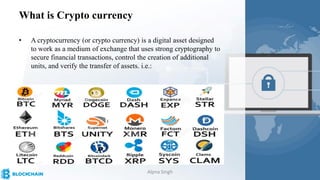
• A cryptocurrency (or crypto currency) is a digital asset designed
to work as a medium of exchange that uses strong cryptography to
secure financial transactions, control the creation of additional
units, and verify the transfer of assets. i.e.:
Alpna Singh
Bitcoin Price for today & the transactions
Alpna Singh
What is Blockchain
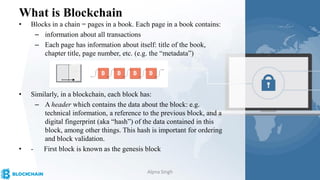
• Blocks in a chain = pages in a book. Each page in a book contains:
– information about all transactions
– Each page has information about itself: title of the book,
chapter title, page number, etc. (e.g. the “metadata”)
• Similarly, in a blockchain, each block has:
– A header which contains the data about the block: e.g.
technical information, a reference to the previous block, and a
digital fingerprint (aka “hash”) of the data contained in this
block, among other things. This hash is important for ordering
and block validation.
• - First block is known as the genesis block
Alpna Singh
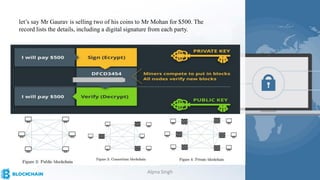
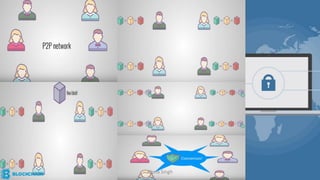
let’s say Mr Gaurav is selling two of his coins to Mr Mohan for $500. The
record lists the details, including a digital signature from each party.
Alpna Singh
Blocks
Alpna Singh
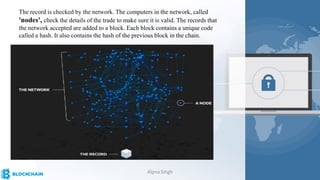
The record is checked by the network. The computers in the network, called
'nodes', check the details of the trade to make sure it is valid. The records that
the network accepted are added to a block. Each block contains a unique code
called a hash. It also contains the hash of the previous block in the chain.
Alpna Singh
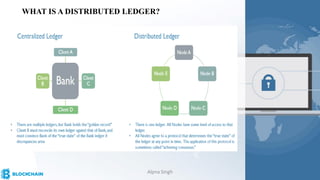
WHAT IS A DISTRIBUTED LEDGER?
Alpna Singh
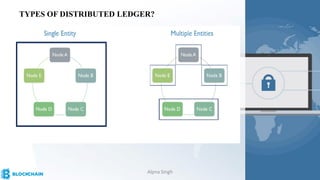
TYPES OF DISTRIBUTED LEDGER?
Alpna Singh
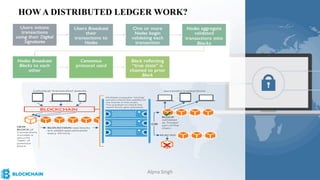
HOW A DISTRIBUTED LEDGER WORK?
Alpna Singh
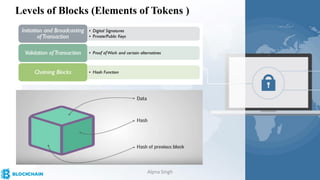
Levels of Blocks (Elements of Tokens )
Alpna Singh
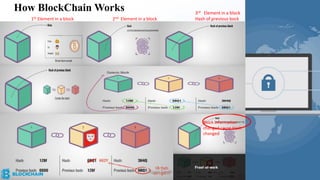
Block Information
changed cause Hash
changed
1St Element in a block 2nd Element in a block
3rd Element in a block
Hash of previous bock
How BlockChain Works
Alpna Singh
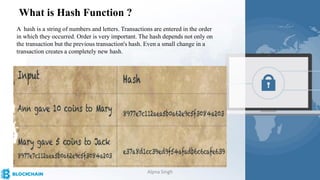
What is Hash Function ?
A hash is a string of numbers and letters. Transactions are entered in the order
in which they occurred. Order is very important. The hash depends not only on
the transaction but the previous transaction's hash. Even a small change in a
transaction creates a completely new hash.
Alpna Singh
Why Hash Function ?
• Hash function is like a finger print of a block that is unique. We can not
change hash function.
• Each transaction generates a hash. A hash is a string of numbers and letters.
Transactions are entered in the order in which they occurred. Order is very
important. The hash depends not only on the transaction but the previous
transaction's hash.
• Even a small change in a transaction creates a completely new hash. The nodes
check to make sure a transaction has not been changed by inspecting the hash.
If a transaction is approved by a majority of the nodes then it is written into a
block. Each block refers to the previous block and together make the
Blockchain.
• A Blockchain is effective as it is spread over many computers, each of which
have a copy of the Blockchain. These computers are called nodes. The
Blockchain updates itself every 10 minutes.
Alpna Singh
Alpna Singh
Smart Contracts
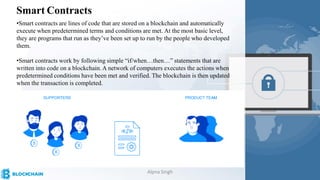
•Smart contracts are lines of code that are stored on a blockchain and automatically
execute when predetermined terms and conditions are met. At the most basic level,
they are programs that run as they’ve been set up to run by the people who developed
them.
•Smart contracts work by following simple “if/when…then…” statements that are
written into code on a blockchain. A network of computers executes the actions when
predetermined conditions have been met and verified. The blockchain is then updated
when the transaction is completed.
Alpna Singh
Characteristics of Smart Contracts
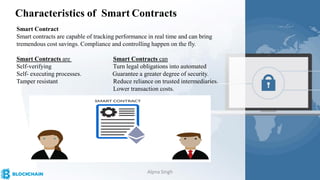
Smart Contract
Smart contracts are capable of tracking performance in real time and can bring
tremendous cost savings. Compliance and controlling happen on the fly.
Smart Contracts are Smart Contracts can
Self-verifying Turn legal obligations into automated
Self- executing processes. Guarantee a greater degree of security.
Tamper resistant Reduce reliance on trusted intermediaries.
Lower transaction costs.
Alpna Singh
Benefits of Smart Contracts
•Speed and accuracy: Smart contracts are digital and automated, so you won’t have to
spend time processing paperwork or reconciling and correcting the errors that are often
written into documents that have been filled manually. Computer code is also more exact than
the legalese that traditional contracts are written in.
•Trust: Smart contracts automatically execute transactions following predetermined rules,
and the encrypted records of those transactions are shared across participants. Thus, nobody
has to question whether information has been altered for personal benefit.
•Security: Blockchain transaction records are encrypted, and that makes them very hard to
hack. Because each individual record is connected to previous and subsequent records on a
distributed ledger, the whole chain would need to be altered to change a single record.
•Savings: Smart contracts remove the need for intermediaries because participants can trust
the visible data and the technology to properly execute the transaction. There is no need for
an extra person to validate and verify the terms of an agreement because it is built into the
code.
Alpna Singh
Blockchain Alliances
Alpna Singh
Industry Adoption
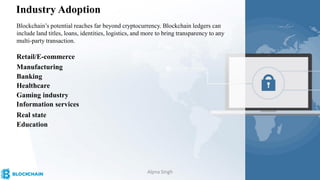
Blockchain’s potential reaches far beyond cryptocurrency. Blockchain ledgers can
include land titles, loans, identities, logistics, and more to bring transparency to any
multi-party transaction.
Retail/E-commerce
Manufacturing
Banking
Healthcare
Gaming industry
Information services
Real state
Education
Alpna Singh
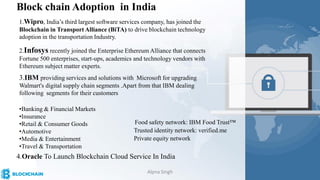
Block chain Adoption in India
1.Wipro, India’s third largest software services company, has joined the
Blockchain in Transport Alliance (BiTA) to drive blockchain technology
adoption in the transportation Industry.
2.Infosys recently joined the Enterprise Ethereum Alliance that connects
Fortune 500 enterprises, start-ups, academics and technology vendors with
Ethereum subject matter experts.
Food safety network: IBM Food Trust™
Private equity network
Trusted identity network: verified.me
3.IBM providing services and solutions with Microsoft for upgrading
Walmart's digital supply chain segments .Apart from that IBM dealing
following segments for their customers
•Banking & Financial Markets
•Insurance
•Retail & Consumer Goods
•Automotive
•Media & Entertainment
•Travel & Transportation
4.Oracle To Launch Blockchain Cloud Service In India
Alpna Singh
• Data sharing (Colleges /University / employee referrals )
• Payment processing and money transfers
• Medical recordkeeping
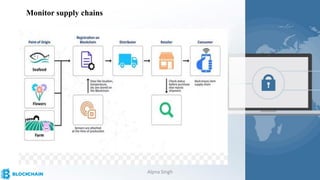
• Monitor supply chains
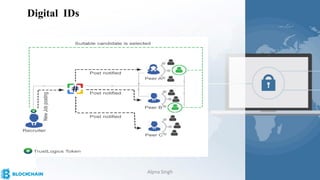
• Digital IDs
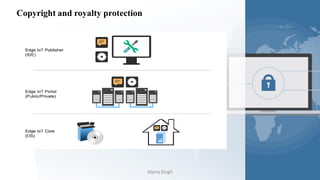
• Copyright and royalty protection
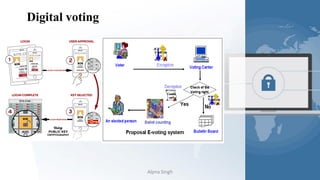
• Digital voting
• Real estate, land, and auto title transfers
• Tax regulation and compliance
• Blockchain for Travel & Transportation
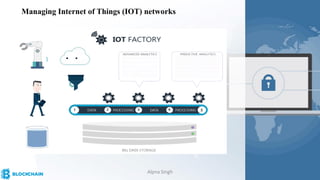
• Managing Internet of Things (IOT) networks
Where Block Chain can be used ?
Alpna Singh
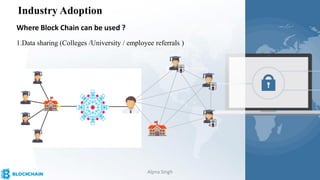
Industry Adoption
Where Block Chain can be used ?
1.Data sharing (Colleges /University / employee referrals )
Alpna Singh
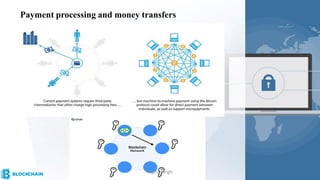
Payment processing and money transfers
Alpna Singh
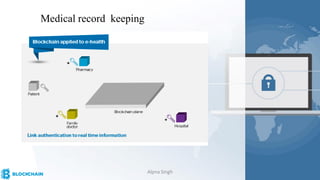
Medical record keeping
Alpna Singh
Monitor supply chains
Alpna Singh
Digital IDs
Alpna Singh
Digital voting
Alpna Singh
Copyright and royalty protection
Alpna Singh
Blockchain for Travel & Transportation
Alpna Singh
Managing Internet of Things (IOT) networks
Alpna Singh
Challenges in adoption of blockchain
Blockchain is considered as a world-changing technology and in many
ways, it is. However, some of the issues with blockchain that anyone
thinking of using it should understand. Starting with perhaps the
biggest… Challenges That Need to be Addressed Before Blockchain Mass
Adoption is Possible
1. Privacy and Security
The Bitcoin blockchain is designed to be publicly visible. All the
information pertaining to a transaction is available for anyone to view.
With the exception of privacy-centric coins, this is the same with many of
the blockchains currently in existence. While this feature may be
important in some contexts, it becomes a liability if distributed ledgers are
to be used in sensitive environments While it is rather unlikely to happen
to large blockchain networks, blockchains are vulnerable to a 51% attack.
Alpna Singh
This refers to a situation where a miner or a group of miners control more than
50 percent of the mining power.
In such a scenario, the miners would be able to control the confirmations of
new transactions, especially those by other miners. Moreover, they would be
able to reverse the transactions they confirmed and therefore double spend
tokens.
While the controlling miners would not be able to alter old blocks, this would
severely affect the integrity of the token with the affected blockchain and it
would need to recover in the public eye. Fortunately, the probability of this
attack is reduced as more people participate in the network as miners.
2.Blockchain has an environmental cost
lot of cost including time and money to change existing system,
especially when it’s an infra-structure. We have to make sure this
innovative technology not only create economic benefits, meet the
requirements of supervision, but also bridge with traditional
organization, and it always encounter difficulties from internal
organization which is existing now.
Alpna Singh
3. Lack of regulation creates a risky environment
Current Regulations Problems Use, the characteristics of decentralized
system, will weak the central bank’s ability to control the economic policy
and the amount of money, that makes government be cautious of blockchain
technologies, authorities have to research this new issue, accelerate for
mulating new policy, otherwise it will have risk on the
market.
4. Public Perception ( Trust and No one’s Liability)
The majority of the public is still oblivious to the existence and potential uses
of this technology. In order for blockchain technology to make the move to
the mainstream, there must first be a public buy-in to its benefits. Though the
technology is revolutionizing many different industries, knowledge of the
benefits of distributed ledger technology is still limited to those who are
involved in the technology space and those whose industries are adopting
blockchain solutions
Alpna Singh
5.Blockchains can be slow and cumbersome
When the new version of blockchain software published, new agreement in
consensus rule also changed when system comes to a new version or new
agreement, and it didn’t compatible with previous version, the old nodes
couldn’t agree with the mining of new nodes, so one chain became two chains.
Although new nodes computing power were stronger than old nodes, old
nodes will still continue to maintain the chain which it though was right.
When it happens, we have to request all nodes in the network to upgrade the
agreement, the nodes which haven’t been upgrade will not continue to work as
usual. If there were more old nodes didn’t upgrade, then they will continue to
work on the other completely different chain, which means the ordinary chain
will fork into two chains.
Service updation or contract changes
Alpna Singh
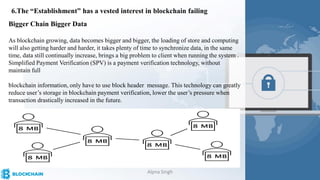
6.The “Establishment” has a vested interest in blockchain failing
Bigger Chain Bigger Data
As blockchain growing, data becomes bigger and bigger, the loading of store and computing
will also getting harder and harder, it takes plenty of time to synchronize data, in the same
time, data still continually increase, brings a big problem to client when running the system .
Simplified Payment Verification (SPV) is a payment verification technology, without
maintain full
blockchain information, only have to use block header message. This technology can greatly
reduce user’s storage in blockchain payment verification, lower the user’s pressure when
transaction drastically increased in the future.
Alpna Singh
Reference:
https://www.ibm.com/blockchain/services
https://www.infosys.com/newsroom/features/Pages/enterprise-ethereum-alliance.aspx
https://www.supplychaindigital.com/scm/wipro-joins-blockchain-transport-alliance
https://www.wikipedia.org/
https://blockchainalliance.org/
https://pdfs.semanticscholar.org/f61e/db500c023c4c4ef665bd7ed2423170773340.pdf
Alpna Singh
Alpna Singh

Blockchain technology

  • 1.
    BLOCKCHAIN Technology The InformationTechnology of Future By Alpna Singh By: Alpna Singh
  • 2.
    Content  Origin OfBlockchain  Overview of Cryptocurrency  What is blockchain  Distributed Ledger  How Distributed Ledger Works  Alliances and Industry Adoption  Smart Contracts  Challenges in adoption of blockchain Alpna Singh
  • 3.
    The origins ofBlockchain – the Bitcoin currency and payment system • Blockchain was created to enable cryptocurrency • Bitcoin is the first decentralized digital currency as it does not rely on a central government authority • Bitcoins are a “scarce asset” – Created through a “digital mining” process – Finite number of Bitcoins (21m), mined and unmined • Is Bitcoin a real currency? • As digital currencies evolve so too does the nature of money, banking, and worldwide financial transactions. These are at the forefront of blockchain evolution Alpna Singh
  • 4.
    Overview of Bitcoin •Bitcoin (₿) is a cryptocurrency, a form of electronic cash. It is a decentralized digital currency without a central bank or single administrator that can be sent from user-to-user on the peer-to-peer Bitcoin network without the need for intermediaries Bitcoin’was started on January 3rd, 2009 at 18:15 UTC by Satoshi Nakamoto • Blockchain became a popular technology trend because of cryptocurrencies. But, this technology has its applications beyond the Bitcoin and other cryptocurrencies. Alpna Singh
  • 5.
    What is Cryptocurrency • A cryptocurrency (or crypto currency) is a digital asset designed to work as a medium of exchange that uses strong cryptography to secure financial transactions, control the creation of additional units, and verify the transfer of assets. i.e.: Alpna Singh
  • 6.
    Bitcoin Price fortoday & the transactions Alpna Singh
  • 7.
    What is Blockchain •Blocks in a chain = pages in a book. Each page in a book contains: – information about all transactions – Each page has information about itself: title of the book, chapter title, page number, etc. (e.g. the “metadata”) • Similarly, in a blockchain, each block has: – A header which contains the data about the block: e.g. technical information, a reference to the previous block, and a digital fingerprint (aka “hash”) of the data contained in this block, among other things. This hash is important for ordering and block validation. • - First block is known as the genesis block Alpna Singh
  • 8.
    let’s say MrGaurav is selling two of his coins to Mr Mohan for $500. The record lists the details, including a digital signature from each party. Alpna Singh
  • 9.
  • 10.
    The record ischecked by the network. The computers in the network, called 'nodes', check the details of the trade to make sure it is valid. The records that the network accepted are added to a block. Each block contains a unique code called a hash. It also contains the hash of the previous block in the chain. Alpna Singh
  • 11.
    WHAT IS ADISTRIBUTED LEDGER? Alpna Singh
  • 12.
    TYPES OF DISTRIBUTEDLEDGER? Alpna Singh
  • 13.
    HOW A DISTRIBUTEDLEDGER WORK? Alpna Singh
  • 14.
    Levels of Blocks(Elements of Tokens ) Alpna Singh
  • 15.
    Block Information changed causeHash changed 1St Element in a block 2nd Element in a block 3rd Element in a block Hash of previous bock How BlockChain Works Alpna Singh
  • 16.
    What is HashFunction ? A hash is a string of numbers and letters. Transactions are entered in the order in which they occurred. Order is very important. The hash depends not only on the transaction but the previous transaction's hash. Even a small change in a transaction creates a completely new hash. Alpna Singh
  • 17.
    Why Hash Function? • Hash function is like a finger print of a block that is unique. We can not change hash function. • Each transaction generates a hash. A hash is a string of numbers and letters. Transactions are entered in the order in which they occurred. Order is very important. The hash depends not only on the transaction but the previous transaction's hash. • Even a small change in a transaction creates a completely new hash. The nodes check to make sure a transaction has not been changed by inspecting the hash. If a transaction is approved by a majority of the nodes then it is written into a block. Each block refers to the previous block and together make the Blockchain. • A Blockchain is effective as it is spread over many computers, each of which have a copy of the Blockchain. These computers are called nodes. The Blockchain updates itself every 10 minutes. Alpna Singh
  • 18.
  • 19.
    Smart Contracts •Smart contractsare lines of code that are stored on a blockchain and automatically execute when predetermined terms and conditions are met. At the most basic level, they are programs that run as they’ve been set up to run by the people who developed them. •Smart contracts work by following simple “if/when…then…” statements that are written into code on a blockchain. A network of computers executes the actions when predetermined conditions have been met and verified. The blockchain is then updated when the transaction is completed. Alpna Singh
  • 20.
    Characteristics of SmartContracts Smart Contract Smart contracts are capable of tracking performance in real time and can bring tremendous cost savings. Compliance and controlling happen on the fly. Smart Contracts are Smart Contracts can Self-verifying Turn legal obligations into automated Self- executing processes. Guarantee a greater degree of security. Tamper resistant Reduce reliance on trusted intermediaries. Lower transaction costs. Alpna Singh
  • 21.
    Benefits of SmartContracts •Speed and accuracy: Smart contracts are digital and automated, so you won’t have to spend time processing paperwork or reconciling and correcting the errors that are often written into documents that have been filled manually. Computer code is also more exact than the legalese that traditional contracts are written in. •Trust: Smart contracts automatically execute transactions following predetermined rules, and the encrypted records of those transactions are shared across participants. Thus, nobody has to question whether information has been altered for personal benefit. •Security: Blockchain transaction records are encrypted, and that makes them very hard to hack. Because each individual record is connected to previous and subsequent records on a distributed ledger, the whole chain would need to be altered to change a single record. •Savings: Smart contracts remove the need for intermediaries because participants can trust the visible data and the technology to properly execute the transaction. There is no need for an extra person to validate and verify the terms of an agreement because it is built into the code. Alpna Singh
  • 22.
  • 23.
    Industry Adoption Blockchain’s potentialreaches far beyond cryptocurrency. Blockchain ledgers can include land titles, loans, identities, logistics, and more to bring transparency to any multi-party transaction. Retail/E-commerce Manufacturing Banking Healthcare Gaming industry Information services Real state Education Alpna Singh
  • 24.
    Block chain Adoptionin India 1.Wipro, India’s third largest software services company, has joined the Blockchain in Transport Alliance (BiTA) to drive blockchain technology adoption in the transportation Industry. 2.Infosys recently joined the Enterprise Ethereum Alliance that connects Fortune 500 enterprises, start-ups, academics and technology vendors with Ethereum subject matter experts. Food safety network: IBM Food Trust™ Private equity network Trusted identity network: verified.me 3.IBM providing services and solutions with Microsoft for upgrading Walmart's digital supply chain segments .Apart from that IBM dealing following segments for their customers •Banking & Financial Markets •Insurance •Retail & Consumer Goods •Automotive •Media & Entertainment •Travel & Transportation 4.Oracle To Launch Blockchain Cloud Service In India Alpna Singh
  • 25.
    • Data sharing(Colleges /University / employee referrals ) • Payment processing and money transfers • Medical recordkeeping • Monitor supply chains • Digital IDs • Copyright and royalty protection • Digital voting • Real estate, land, and auto title transfers • Tax regulation and compliance • Blockchain for Travel & Transportation • Managing Internet of Things (IOT) networks Where Block Chain can be used ? Alpna Singh
  • 26.
    Industry Adoption Where BlockChain can be used ? 1.Data sharing (Colleges /University / employee referrals ) Alpna Singh
  • 27.
    Payment processing andmoney transfers Alpna Singh
  • 28.
  • 29.
  • 30.
  • 31.
  • 32.
    Copyright and royaltyprotection Alpna Singh
  • 33.
    Blockchain for Travel& Transportation Alpna Singh
  • 34.
    Managing Internet ofThings (IOT) networks Alpna Singh
  • 35.
    Challenges in adoptionof blockchain Blockchain is considered as a world-changing technology and in many ways, it is. However, some of the issues with blockchain that anyone thinking of using it should understand. Starting with perhaps the biggest… Challenges That Need to be Addressed Before Blockchain Mass Adoption is Possible 1. Privacy and Security The Bitcoin blockchain is designed to be publicly visible. All the information pertaining to a transaction is available for anyone to view. With the exception of privacy-centric coins, this is the same with many of the blockchains currently in existence. While this feature may be important in some contexts, it becomes a liability if distributed ledgers are to be used in sensitive environments While it is rather unlikely to happen to large blockchain networks, blockchains are vulnerable to a 51% attack. Alpna Singh
  • 36.
    This refers toa situation where a miner or a group of miners control more than 50 percent of the mining power. In such a scenario, the miners would be able to control the confirmations of new transactions, especially those by other miners. Moreover, they would be able to reverse the transactions they confirmed and therefore double spend tokens. While the controlling miners would not be able to alter old blocks, this would severely affect the integrity of the token with the affected blockchain and it would need to recover in the public eye. Fortunately, the probability of this attack is reduced as more people participate in the network as miners. 2.Blockchain has an environmental cost lot of cost including time and money to change existing system, especially when it’s an infra-structure. We have to make sure this innovative technology not only create economic benefits, meet the requirements of supervision, but also bridge with traditional organization, and it always encounter difficulties from internal organization which is existing now. Alpna Singh
  • 37.
    3. Lack ofregulation creates a risky environment Current Regulations Problems Use, the characteristics of decentralized system, will weak the central bank’s ability to control the economic policy and the amount of money, that makes government be cautious of blockchain technologies, authorities have to research this new issue, accelerate for mulating new policy, otherwise it will have risk on the market. 4. Public Perception ( Trust and No one’s Liability) The majority of the public is still oblivious to the existence and potential uses of this technology. In order for blockchain technology to make the move to the mainstream, there must first be a public buy-in to its benefits. Though the technology is revolutionizing many different industries, knowledge of the benefits of distributed ledger technology is still limited to those who are involved in the technology space and those whose industries are adopting blockchain solutions Alpna Singh
  • 38.
    5.Blockchains can beslow and cumbersome When the new version of blockchain software published, new agreement in consensus rule also changed when system comes to a new version or new agreement, and it didn’t compatible with previous version, the old nodes couldn’t agree with the mining of new nodes, so one chain became two chains. Although new nodes computing power were stronger than old nodes, old nodes will still continue to maintain the chain which it though was right. When it happens, we have to request all nodes in the network to upgrade the agreement, the nodes which haven’t been upgrade will not continue to work as usual. If there were more old nodes didn’t upgrade, then they will continue to work on the other completely different chain, which means the ordinary chain will fork into two chains. Service updation or contract changes Alpna Singh
  • 39.
    6.The “Establishment” hasa vested interest in blockchain failing Bigger Chain Bigger Data As blockchain growing, data becomes bigger and bigger, the loading of store and computing will also getting harder and harder, it takes plenty of time to synchronize data, in the same time, data still continually increase, brings a big problem to client when running the system . Simplified Payment Verification (SPV) is a payment verification technology, without maintain full blockchain information, only have to use block header message. This technology can greatly reduce user’s storage in blockchain payment verification, lower the user’s pressure when transaction drastically increased in the future. Alpna Singh
  • 40.
  • 41.