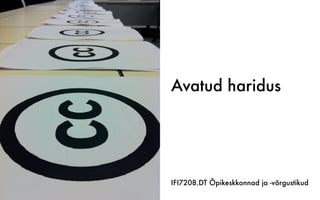
Avatud haridus
IFI7208.DT Õpikeskkonnad ja -võrgustikud
Autoriõiguse probleemid
• Pikk kehtivusaeg: autoriõigus kehtib autori kogu eluaja jooksul
ja 70 aastat pärast tema surma
• Piiratud taaskasutuse võimalused: vaikimisi on suur osa
taaskasutamise võimalustest varaliste õigustega piiratud
• Autorite ja kasutajate ebapiisav teadlikkus
• Orbteosed
(Autoriõiguse seadus, 2019)
Lessig, L. (2004). Free Culture: How Big Media Uses
Technology and the Law to Lock Down Culture and
Control Creativity. New York, NY: The Penguin
Press. http://www.free-culture.cc/freeculture.pdf
Lessig, L. (2017). Vaba kultuur ehk loovuse loomus
ja tulevik. Tartu: Tartu Ülikooli kirjastus.
https://creativecommons.org
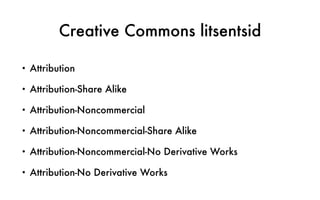
Creative Commons litsentsid
• Attribution
• Attribution-Share Alike
• Attribution-Noncommercial
• Attribution-Noncommercial-Share Alike
• Attribution-Noncommercial-No Derivative Works
• Attribution-No Derivative Works
Creative Commons piirangud
b Attribution — kohustus viidata teosele autori
poolt määratud viisil
a
Share Alike — muudatusi ja tuletatud teoseid
tuleb edasi levitada sama, lähedase või
ühilduva litsentsi alusel
n Noncommercial — teost ei tohi kasutada
ärilistel eesmärkidel
d No Derivative Works — teost ei tohi muuta ega
kasutada tuletatud teoste loomisel
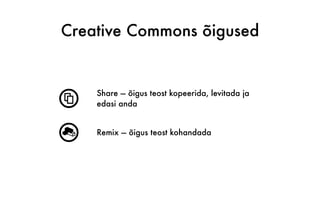
Creative Commons õigused
s
Share — õigus teost kopeerida, levitada ja
edasi anda
r Remix — õigus teost kohandada
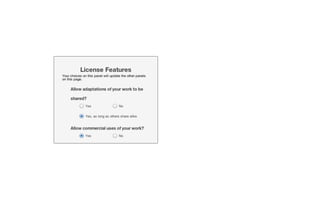
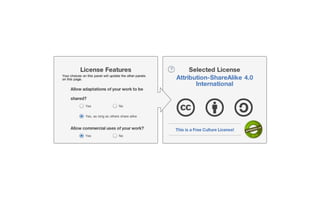
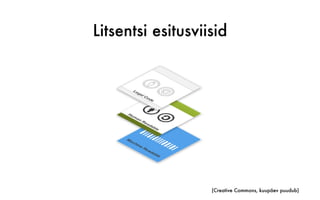
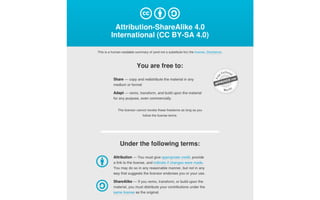
Litsentsi esitusviisid
(Creative Commons, kuupäev puudub)
Creative Commons Eesti litsentsid
• Autorile viitamine
• Autorile viitamine – Jagamine samadel tingimustel
• Autorile viitamine – Mitteäriline eesmärk
• Autorile viitamine – Mitteäriline eesmärk – Jagamine samadel
tingimustel
• Autorile viitamine – Mitteäriline eesmärk – Tuletatud teoste keeld
• Autorile viitamine – Tuletatud teoste keeld
Kuidas avatud sisulitsentsi ära
tunda?
Teose tähistamine litsentsiga
• Kui teosel puudub info litsentsi kohta, siis on kõik
autoriõigused reserveeritud
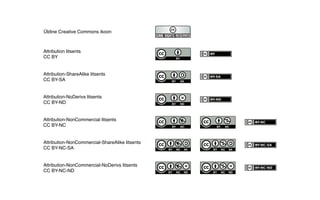
• Avatud sisulitsentsiga teosele lisatakse litsentsi nimetus, URL ja
ikoon
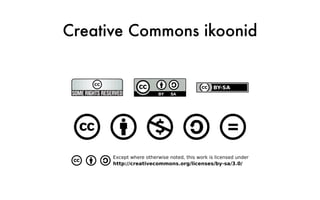
Creative Commons ikoonid
Üldine Creative Commons ikoon
Attribution litsents
CC BY
Attribution-ShareAlike litsents
CC BY-SA
Attribution-NoDerivs litsents
CC BY-ND
Attribution-NonCommercial litsents
CC BY-NC
Attribution-NonCommercial-ShareAlike litsents
CC BY-NC-SA
Attribution-NonCommercial-NoDerivs litsents
CC BY-NC-ND
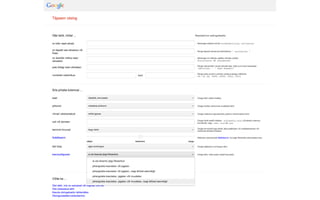
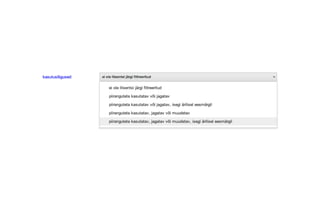
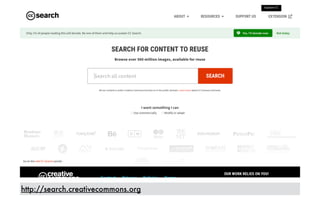
Kuidas leida avatud sisu?
BY–NC–ND
BY–ND
BY–NC–SA
BY–NC
BY–SA
BY
http://search.creativecommons.org
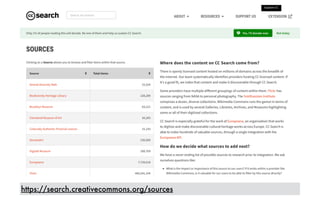
https://search.creativecommons.org/sources
Avatud sisu kogud
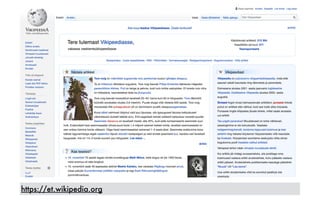
https://et.wikipedia.org
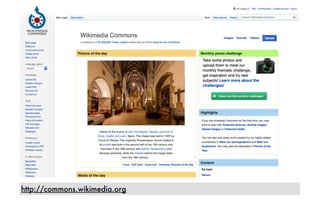
http://commons.wikimedia.org
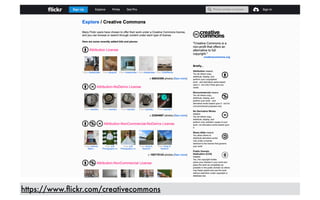
https://www.flickr.com/creativecommons
Avatud õppematerjalid
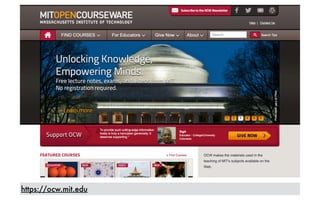
https://ocw.mit.edu
https://www.curriki.org
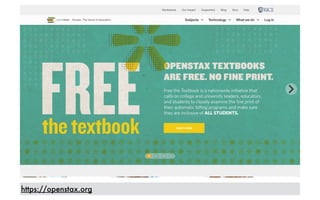
https://openstax.org
https://open.bccampus.ca
https://www.oercommons.org
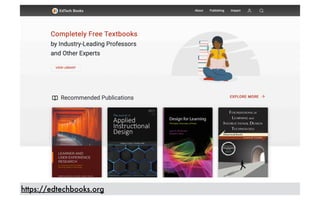
https://edtechbooks.org
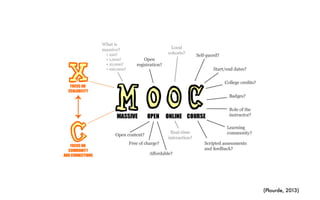
(Plourde, 2013)
Avatud hariduse liikumine
• 2001 — Creative Commons
• 2002 — UNESCO võtab kasutusele avatud õppematerjalide (Open
Educational Resources, OER) mõiste
• 2008 — Kaplinna avatud hariduse deklaratsioon
• 2012 — Pariisi OER maailmakongress ja deklaratsioon
• 2017 — Ljubljana OER maailmakongress ja tegevuskava
• 2019 — UNESCO Recommendation on OER
https://www.capetowndeclaration.org/read-the-declaration
Õpetajad ja õppijad
• Aktiivne osalemine avatud hariduse liikumises
• Avatud õppematerjalide loomine, kasutamine, kohandamine
ja edasiarendamine
• Koostööl, avastamisel ja teadmusloomel põhinevate
õppemeetodite rakendamine
• Avatud õppematerjalide loomist ja kasutamist tuleb vaadata
hariduse loomuliku osana ja vastavalt tunnustada
Avatud õppematerjalid
• Õpetajad, autorid, kirjastajad ja organisatsioonid peaksid
oma õppematerjale avatud litsentsidega vabalt jagama,
võimaldamaks nende kasutamist, tõlkimist ja edasiarendamist
• Õppematerjale tuleks jagada nii kasutamist kui
edasiarendamist võimaldaval kujul
• Võimaluse korral peaks olema õppematerjalid kasutatavad ka
erivajadustega õppijatele ja ilma internetiühenduseta
Hariduspoliitika
• Valitsused ja haridusasutused peaksid võtma avatud hariduse
prioriteediks
• Avaliku raha eest loodud õppematerjalid tuleks avaldada
avatud õppematerjalidena
• Õppematerjalide repositooriumid peaksid kaasama ja esile
tõstma avatud õppematerjale
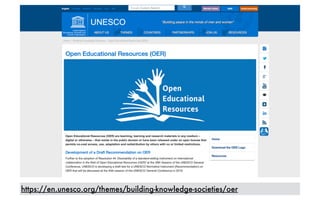
https://en.unesco.org/themes/building-knowledge-societies/oer
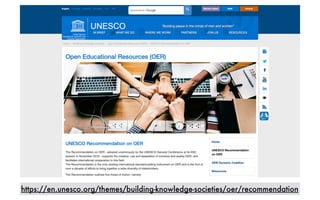
https://en.unesco.org/themes/building-knowledge-societies/oer/recommendation
Laiem vaade avatud haridusele
• Avatud õppematerjalid
• Avatud kursused (MOOCid jms)
• Avatud õpikeskkonnad
• Õppimise ja hindamise personaliseerimine
• Avaandmed ja õpianalüütika
• Institutsionaalsetest raamidest väljapoole mõtlemine
Avatud haridus Eestis
Digipööre elukestvas õppes
4.2. Tagatakse põhikooli, gümnaasiumi ja
kutseõppeasutuse õppekavas seatud eesmärkide
ning õpitulemuste saavutamist toetava digitaalse
õppevara olemasolu, mille hulka kuuluvad e-õpikud,
e-töövihikud, avatud õppematerjalid, e-
õpetajaraamatud ning veebipõhised
hindamisvahendid.
Eesti elukestva õppe
strateegia 2020
(Eesti elukestva õppe strateegia 2020, 2014)
https://www.hm.ee/et/tegevused/digipoore
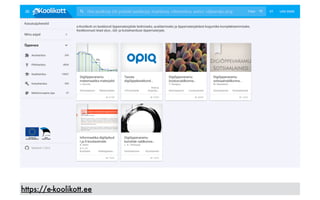
https://e-koolikott.ee
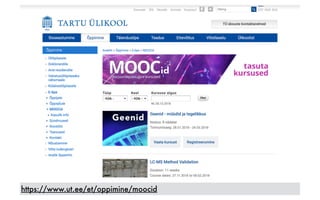
https://www.ut.ee/et/oppimine/moocid
Avatud hariduse näited TLÜst
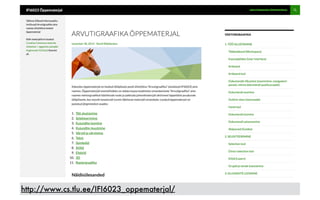
http://www.cs.tlu.ee/IFI6023_oppematerjal/
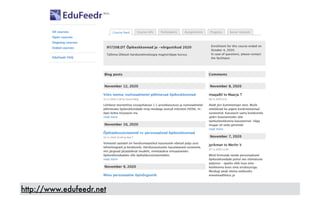
http://www.edufeedr.net
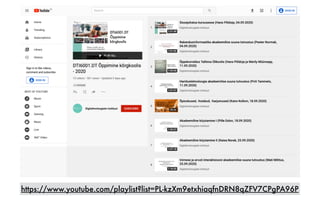
https://www.youtube.com/playlist?list=PL-kzXm9etxhiaqfnDRN8qZFV7CPgPA96P
Väljataga, T., Põldoja, H., Laanpere, M. (2011).
Open Online Courses: Responding to Design
Challenges. In H. Ruokamo, M. Eriksson, L. Pekkala,
& H. Vuojärvi (Eds.), Proceedings of the 4th
International Network-Based Education 2011
Conference The Social Media in the Middle of
Nowhere (pp. 68–75). Rovaniemi: University of
Lapland.
Proceedings of the NBE 2011
68
Open Online Courses: Responding to Design Challenges
Terje Väljataga
terje.valjataga@tlu.ee
http://terjevaljataga.eu
Hans Põldoja
hans.poldoja@tlu.ee
http://www.hanspoldoja.net
Mart Laanpere
mart.laanpere@tlu.ee
Tallinn University
Centre for Educational Technology
Narva road 25, 10120 Tallinn, Estonia
Tel: +372 6409 355, Fax: +372 6409 355
Open education and open educational resources movement as a recent trend in higher education focuses on providing free access to a
wide range of educational resources and online courses. However, such a narrow approach fails to acknowledge the transformative and
innovative opportunities openness can offer in higher education. The authors of the paper take a wider perspective to the concept of
openness in formal higher education. In addition to open technology, content and knowledge sharing openness in course design is an
important dimension to consider. Although open online course design solves many educational problems and challenges, at the same
time it also creates new ones. This paper discusses about the re-occurring course design challenges that facilitators face while designing
and running open courses. Through a multiple case study a variety of design responses to the design challenges is analyzed and
demonstrated.
Keywords: open online course model, open educational resources, pedagogical design, multiple
case study
1 Introduction
The concept of openness has multiple interpretations and dimensions in the context of higher education. Among
others, it has been used by proponents of open classroom approach in 1970-ties and by distance education
enthusiasts while establishing open universities”. The purpose was to solve a number of educational problems
and challenges, for instance, to improve access to existing study programmes and attract more (or better)
students following Huijser, Bedford, and Bull’s (2008) claim that everyone has the right to education. In
general, openness in education is attributed to a barrier-free access to education in terms of time, affordability
and admission requirements being freely available through the Internet.
A recent trend is the open educational resources (OER) movement (Atkins, Brown & Hammond, 2007), which
provides free access to a wide range of educational resources and online courses. OER and its importance has
been widely documented and demonstrated (Downes, 2007). The key tenet of open education is that “education
can be improved by making educational assets visible and accessible and by harnessing the collective wisdom
of a community of practice and reflection” (p. 2) (Iiyoshi & Kumar, 2008).
The notion of openness in education is clearly triggered by the opportunities technological development offers.
In addition to growing access to Internet, the latest evolution of digital technology and Web has fostered a new
culture of creating and sharing open content in online communities. It has been possible due to the blurred line
between producers and consumers of content allowing shifted attention from access to information toward
access to other people (Iiyoshi & Kumar, 2008). In the light of ongoing technological development, there are
educators who are exploring ways to expand the notion of openness in education beyond public sharing of
educational content. Iiyoshi & Kumar (2008) point out that with the concept of openness we might tend to grow
our collections of educational tools and resources and miss the transformative and innovative opportunities
“openness” can offer. One of the emerging practices in this direction is the open online course model.
Põldoja, H., Duval, E., & Leinonen, T. (2016). Design
and evaluation of an online tool for open learning
with blogs. Australasian Journal of Educational
Technology, 32(2), 64–81. http://dx.doi.org/
10.14742/ajet.2450
A stralasian Jo rnal of Ed cational Technolog , 2016, 32(2).
64
De ign and e al a ion of an online ool fo open lea ning
i h blog
Han P ld ja
, E
E ik D al
K L , B
Teem Lein nen
A , F
B - - ,
, . H
.
F
: , ,
, - . Ed Feedr
. I ,
10 . Ed Feedr
.
- .
In od c ion
B , ,
, .
, H (2010)
. O
.
A
. A ;
. R .
(R ) Atom
. A blogosphere.
.
(O , 2003;
& J , 2004). H (2010) :
( ) , ( ) , ( ) , ( )
, ( ) , ( ) .
K (2008) -
, ,
, , - , . P
(C , 2009; E & , 2008). B
, , ,
(C , 2013). B
, , ,
(G & D , 2012).
.
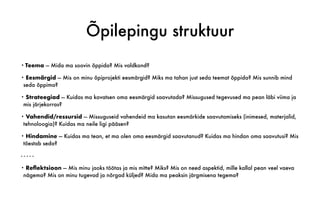
Õpilepingu struktuur
• Teema — Mida ma soovin õppida? Mis valdkond?
• Eesmärgid — Mis on minu õpiprojekti eesmärgid? Miks ma tahan just seda teemat õppida? Mis sunnib mind
seda õppima?
• Strateegiad — Kuidas ma kavatsen oma eesmärgid saavutada? Missugused tegevused ma pean läbi viima ja
mis järjekorras?
• Vahendid/ressursid — Missuguseid vahendeid ma kasutan eesmärkide saavutamiseks (inimesed, materjalid,
tehnoloogia)? Kuidas ma neile ligi pääsen?
• Hindamine — Kuidas ma tean, et ma olen oma eesmärgid saavutanud? Kuidas ma hindan oma saavutusi? Mis
tõestab seda?
- - - - -
• Reflektsioon — Mis minu jaoks töötas ja mis mitte? Miks? Mis on need aspektid, mille kallal pean veel vaeva
nägema? Mis on minu tugevad ja nõrgad küljed? Mida ma peaksin järgmisena tegema?
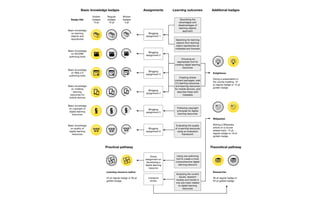
Basic Knowledge Badges Skill-based Badges
Advanced Knowledge Badges
Põldoja, H., Jürgens, P., & Laanpere, M. (2016).
Design Patterns for Badge Systems in Higher
Education. M. Spaniol, M. Temperini, D.K.W. Chiu,
I. Marenzi, & U. Nanni (toim), Advances in Web-
Based Learning — ICWL 2016 (Vol. 10013, lk 40–
49). Cham: Springer. http://dx.doi.org/
10.1007/978-3-319-47440-3_5
Design Patterns for Badge Systems in Higher Education
Hans Põldoja
(✉)
, Pirje Jürgens, and Mart Laanpere
Tallinn University, Narva mnt 25, 10120 Tallinn, Estonia
{hans.poldoja,pirje.jurgens,mart.laanpere}@tlu.ee
Abstract. Open Badges as a method for assessment and recognition of learning
originates from the context of informal learning. Thus, it cannot be introduced
into formal higher education without reconsidering the existing assessment
processes.This paper presentsexperiencesfrom three years of using Open Badges
in a master level course. In each iteration, the badge system was revised based on
learners’ feedback. Special attention was given to supporting learners with
different learning styles. To summarize our findings, this paper proposes a set of
design patterns for developing badge systems in higher education. While the
learning styles proved to be useful as generic design guidelines for separating two
alternative learning pathways for the course, more research is needed on advanced
learning-style-based learning pathways.
Keywords: Open Badges · Assessment · Higher education
1 Introduction
Open Badges (OB’s) is a web technology for recognizing and verifying knowledge,
competencies or involvements gained in online or offline settings. In a basic sense,
badges are digital images that contain embedded information about the accomplish‐
ments. The development of the Open Badges technology started in 2010, when a group
of open education activists came up with the initial concept during the Mozilla Drumbeat
Festival. Inspired by the use of digital badges in gaming and various social apps, they
proposed that badges could be used for verifying learning. The technical specification
of the Open Badges Infrastructure (OBI) was developed together with the Mozilla
Foundation and released in 2012. While digital badges are typically used within a single
environment, OBI was developed as an open standard that allows people to collect
badges from different issuers. The initial scenarios about using open badges focused on
informal learning contexts [1]. However, in recent years there have been a number of
studies about using badges in schools [2, 3] and in higher education [4–6].
Introducing open badges to formal higher education courses provides an opportunity
to reconsider the existing assessment procedures. Recent research on open badges has
proposed a number of reasons for adopting badges. Ahn, Pellicone, and Butler [7] see
badges as motivators for behavior, pedagogical tools for promoting particular learning
activities, and credentials for recognizing learning achievements. While Jovanovic and
Devedzic [8] identify similar roles for open badges, they discuss additional benefits such
as supporting alternative forms of assessment (e.g. peer-assessment), providing learners
© Springer International Publishing AG 2016
D.K.W. Chiu et al. (Eds.): ICWL 2016, LNCS 10013, pp. 40–49, 2016.
DOI: 10.1007/978-3-319-47440-3_5
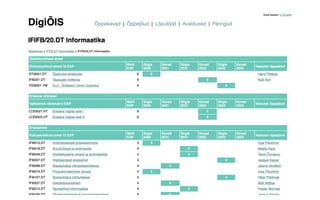
http://dti.tlu.ee/digiois/
Põldoja H., & Laanpere M. (2020). Open
Educational Resources in Estonia. R. Huang, D. Liu,
A. Tlili, Y. Gao, & R. Koper (toim), Current State of
Open Educational Resources in the “Belt and Road”
Countries. Lecture Notes in Educational Technology
(lk 35–47). Springer. https://doi.org/
10.1007/978-981-15-3040-1_3
hans.poldoja@tlu.ee
Chapter 3
Open Educational Resources in Estonia
Hans Põldoja and Mart Laanpere
1 Case Overview
Estonia is a small country situated in Northern Europe. With a population of 1.3 mil-
lion people, it is one of the smallest countries in the European Union. Despite having
a turbulent history with various rulers, Estonia has maintained its cultural traditions
and language. The Estonian educational system consists of general education, voca-
tional education and higher education. General education is divided into pre-school,
basic and upper-secondary education. Various studies have recognized the quality of
Estonian education, for example the most recent PISA study showed that the Esto-
nian basic education is among the best in Europe and in the world (OECD, 2016).
Most important developments in the area of education are guided by the Lifelong
Learning Strategy for 2014–2020 (MER, 2014), which lists five strategic goals: (1) a
change in the approach to learning; (2) competent and motivated teachers and school
leadership; (3) the concordance of lifelong learning opportunities with the needs of
the labor market; (4) a digital turn in education; and (5) equal opportunities and
increased participation in lifelong learning.
H. Põldoja (B) · M. Laanpere
School of Digital Technologies, Tallinn University, Narva mnt 25, 10120 Tallinn, Estonia
e-mail: hans.poldoja@tlu.ee
URL: http://www.hanspoldoja.net
M. Laanpere
e-mail: mart.laanpere@tlu.ee
URL: http://www.mart.laanpere.eu
© Springer Nature Singapore Pte Ltd. 2020
R. Huang et al. (eds.), Current State of Open Educational Resources
in the “Belt and Road” Countries, Lecture Notes in Educational Technology,
https://doi.org/10.1007/978-981-15-3040-1_3
35
Avatud hariduse tulevikusuunad
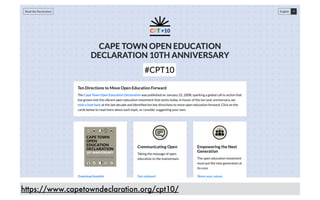
https://www.capetowndeclaration.org/cpt10/
Avatud hariduse ideede levitamine
laiemale üldsusele
Communicating Open
Taking the message of open education to the mainstream
Why is this important?
Ten years ago, the Cape Town Declaration laid out a compelling vision for a world
learners, advocates, and policymakers across the globe. Yet, after a decade of
passionate advocacy, the need for broader awareness of open education persists.
The challenge is not in reaching enough people, but rather in articulating the
meaning and value of open education in a way that resonates with mainstream
audiences in the same way that the Cape Town Declaration resonates with us. For
the open education movement to rise to the next level, we need to take our message
to the mainstream and explain why open should matter to them. In short, we need to
become better communicators.
What is the opportunity?
Uue põlvkonna õppijate ja õpetajate
kaasamine
Empowering the Next Generation
The open education movement must put the next generation at its core
Why is this important?
Students are integral to open education, but their importance is not only about
the present, it is about the future. Those sitting in classrooms ten years ago are
leading classrooms today and will be the tenured professors, senior teachers,
and education policymakers of tomorrow. Shifting the culture of our educational
institutions toward openness needs to start with the next generation, those who are
still learning the practices and habits that will inform the rest of their careers. How
we engage with and support today’s students and young educators will help shape
the movement—and our educational systems at large—for decades to come.
What is the opportunity?
Koostöö teiste avatud liikumistega
Connecting with Other Open Movements
Open education can grow stronger through collaboration with allied movements
Why is this important?
Open education is one of many movements that seek to advance
openness and access to knowledge. The broader Access to Knowledge
(A2K) movement embraces many strategies including open access to
research, open data, and copyright reform, alongside open education.
Even broader alliances can be seen with movements seeking
openness in other ways, including free and open source software, open government,
and open culture. The open education community can also see itself as part
of a larger movement to support sharing and the commons in the digital era. As the
open education movement moves into the next decade, we should consider how
we explore and leverage these connections toward shared goals.
What is the opportunity?
Avatud hariduse roll arengukoostöös
Open Education for Development
Unlocking new opportunities for education in support of development
Why is this important?
The United Nations Sustainable Development Goal 4 calls on the global community
to ensure inclusive and quality education for all and promote lifelong learning. This
same vision is at the core of the Cape Town Declaration and is a shared value of what
open education hopes to achieve. As a movement, we need to center the role of open
education in advancing development around the world.
The challenges to expanding educational opportunities related to development
are manifold. Too often, a barrier is supplying quality, locally-relevant educational
materials, especially in underserved languages and regions that traditional market
mechanisms do not prioritize. Other challenges may be infrastructural, including
the connectivity, power, or transportation systems needed for materials to reach
students, especially in rural areas. Where access to technology is expanding, teacher
vary widely across countries and contexts, a common thread is that traditional
Avatud õppimine
Open Pedagogy
Harnessing the power of open in teaching and learning practices
Why is this important?
Over the last decade, much of the focus of the open education movement has been
around the creation and adoption of open educational resources. Some of the most
exciting frontiers in open education are in open pedagogy, widely understood to
consist of teaching and learning practices enabled by the ability to retain, reuse,
revise, remix and redistribute educational materials.
static textbooks and traditional assignments, and opens the door to imaginative,
collaborative, engaging educational experiences that can help transform teaching
and learning for the better.
What is the opportunity?
Õppeasutuse raamidest väljapoole
mõtlemine
Thinking Outside the Institution
Enabling everyone, everywhere, to learn anything
Why is this important?
Open education pioneers set out to design new formats for learning and new
institutions, taking inspiration from the way open source communities work, rather
than replicating traditional schools and universities. However, while open education
has made tremendous progress within formal education, the biggest changes in how
people learn seem less connected to the open education movement today.
software developers hone their skills and LinkedIn reputations are starting to
complement formal credentials. Then there is a range of other communities that
share our ethos of sharing and learning (e.g., the Maker Movement) but remain
disconnected from open education.
Andmed ja analüütika
Data and Analytics
Exploring the intersection of open content, open data, and open learning
Why is this important?
As technology use increases in education, the basic acts of teaching and learning
result in the creation of ever-larger amounts of data. These data describe the
behaviors of people, from what students did read or did not watch to how long
it took an instructor to grade a piece of student work. At the same time, there has
been an explosion of learning analytics tools intended to help students and teachers
make sense of this deluge of data through machine learning, statistics, and other
algorithms. These tools recommend actions that impact students, such as which
assignment to complete next, or who should receive extra help.
On one hand, these developments should be embraced for their tremendous
potential to provide valuable guidance in support of teaching and learning. On the
other hand, these changes also raise serious questions regarding how data and
algorithms are designed and managed that can profoundly affect the open education
space.
Õpiku ümbermõtestamine
Beyond the Textbook
Building the open learning materials of the future
Why is this important?
The idea of moving beyond the textbook has been at the core of the open education
movement from the start. Yet experience over the last decade has driven some OER
efforts in the opposite direction. Promoting open textbooks that look, feel, and
act like traditional books has proved to be a highly successful adoption strategy in
certain contexts. These efforts have made essential progress toward expanding
the use and adoption of OER. However, the open education movement should
remain conscious that the strategy of equating OER with textbooks constrains the
imaginations of teachers and learners with regard to what modern, technology-
enhanced open learning materials can be.
What is the opportunity?
Avaliku rahaga loodud materjalide
muutmine avatud litsentsidega
kättesaadavaks
Opening Up Publicly Funded Resources
Publicly funded educational resources should be openly licensed by default
Why is this important?
Governments around the world spend billions of dollars every year on grants and
contracts to develop educational resources including textbooks, curricula, teacher
training, language learning materials, and more. These valuable resources are
created with public funds in service of the public good, yet too rarely are they made
available for public use beyond their original purpose.
educational investments by adopting policies that ensure that publicly funded
educational resources are openly licensed and shared with the public by default.
What is the opportunity?
Autoriõiguse reform
Copyright Reform for Education
Copyright reform and open education advocacy are two sides of the same coin
Why is this important?
Strong educational exceptions to copyright are just as important as open licensing of
resources, as complementary means to ensuring educational freedoms. While the
availability of openly licensed educational resources continues to grow, a wide variety
of cultural and informational resources that are critical for education remain locked
up by restrictive copyright terms. Limitations and exceptions to copyright can give
teachers and learners the necessary freedoms to use these resources for educational
purposes, without having to ask for permission. Copyright reforms taking place around
the world can strengthen these exceptions—or hurt education by weakening them.
The open education community needs to care about education-friendly copyright
law that protects and expands rights to teach and learn. Open licensing and
copyright reform are complementary of each other. The growth of openly licensed
resources demonstrates the demand for freedom, openness, and collaboration in
all kinds of educational materials. Working toward education-friendly changes to
C
Viited
• Autoriõiguse seadus. (2019). RT I, 19.03.2019, 55. https://
www.riigiteataja.ee/akt/119032019055
Kasutatud fotod
• Dom Pates, https://www.flickr.com/photos/globalismpictures/5441692868/
See materjal on avaldatud Creative Commons Autorile viitamine–Jagamine
samadel tingimustel 3.0 Eesti litsentsi alusel. Litsentsi terviktekstiga tutvumiseks
külastage aadressi http://creativecommons.org/licenses/by-sa/3.0/ee/
Hans Põldoja
hans.poldoja@tlu.ee
IFI7208.DT Õpikeskkonnad ja -võrgustikud
https://digioppevara.wordpress.com
Tallinna Ülikool
Digitehnoloogiate instituut

Avatud haridus

  • 1.
  • 2.
    Autoriõiguse probleemid • Pikkkehtivusaeg: autoriõigus kehtib autori kogu eluaja jooksul ja 70 aastat pärast tema surma • Piiratud taaskasutuse võimalused: vaikimisi on suur osa taaskasutamise võimalustest varaliste õigustega piiratud • Autorite ja kasutajate ebapiisav teadlikkus • Orbteosed (Autoriõiguse seadus, 2019)
  • 3.
    Lessig, L. (2004).Free Culture: How Big Media Uses Technology and the Law to Lock Down Culture and Control Creativity. New York, NY: The Penguin Press. http://www.free-culture.cc/freeculture.pdf
  • 4.
    Lessig, L. (2017).Vaba kultuur ehk loovuse loomus ja tulevik. Tartu: Tartu Ülikooli kirjastus.
  • 5.
  • 9.
    Creative Commons litsentsid •Attribution • Attribution-Share Alike • Attribution-Noncommercial • Attribution-Noncommercial-Share Alike • Attribution-Noncommercial-No Derivative Works • Attribution-No Derivative Works
  • 10.
    Creative Commons piirangud bAttribution — kohustus viidata teosele autori poolt määratud viisil a Share Alike — muudatusi ja tuletatud teoseid tuleb edasi levitada sama, lähedase või ühilduva litsentsi alusel n Noncommercial — teost ei tohi kasutada ärilistel eesmärkidel d No Derivative Works — teost ei tohi muuta ega kasutada tuletatud teoste loomisel
  • 11.
    Creative Commons õigused s Share— õigus teost kopeerida, levitada ja edasi anda r Remix — õigus teost kohandada
  • 12.
  • 14.
    Creative Commons Eestilitsentsid • Autorile viitamine • Autorile viitamine – Jagamine samadel tingimustel • Autorile viitamine – Mitteäriline eesmärk • Autorile viitamine – Mitteäriline eesmärk – Jagamine samadel tingimustel • Autorile viitamine – Mitteäriline eesmärk – Tuletatud teoste keeld • Autorile viitamine – Tuletatud teoste keeld
  • 15.
  • 16.
    Teose tähistamine litsentsiga •Kui teosel puudub info litsentsi kohta, siis on kõik autoriõigused reserveeritud • Avatud sisulitsentsiga teosele lisatakse litsentsi nimetus, URL ja ikoon
  • 17.
  • 18.
    Üldine Creative Commonsikoon Attribution litsents CC BY Attribution-ShareAlike litsents CC BY-SA Attribution-NoDerivs litsents CC BY-ND Attribution-NonCommercial litsents CC BY-NC Attribution-NonCommercial-ShareAlike litsents CC BY-NC-SA Attribution-NonCommercial-NoDerivs litsents CC BY-NC-ND
  • 19.
  • 22.
  • 23.
  • 24.
  • 25.
  • 26.
  • 28.
  • 29.
  • 30.
  • 32.
  • 33.
  • 34.
  • 35.
  • 36.
  • 37.
  • 38.
  • 39.
    Avatud hariduse liikumine •2001 — Creative Commons • 2002 — UNESCO võtab kasutusele avatud õppematerjalide (Open Educational Resources, OER) mõiste • 2008 — Kaplinna avatud hariduse deklaratsioon • 2012 — Pariisi OER maailmakongress ja deklaratsioon • 2017 — Ljubljana OER maailmakongress ja tegevuskava • 2019 — UNESCO Recommendation on OER
  • 40.
  • 41.
    Õpetajad ja õppijad •Aktiivne osalemine avatud hariduse liikumises • Avatud õppematerjalide loomine, kasutamine, kohandamine ja edasiarendamine • Koostööl, avastamisel ja teadmusloomel põhinevate õppemeetodite rakendamine • Avatud õppematerjalide loomist ja kasutamist tuleb vaadata hariduse loomuliku osana ja vastavalt tunnustada
  • 42.
    Avatud õppematerjalid • Õpetajad,autorid, kirjastajad ja organisatsioonid peaksid oma õppematerjale avatud litsentsidega vabalt jagama, võimaldamaks nende kasutamist, tõlkimist ja edasiarendamist • Õppematerjale tuleks jagada nii kasutamist kui edasiarendamist võimaldaval kujul • Võimaluse korral peaks olema õppematerjalid kasutatavad ka erivajadustega õppijatele ja ilma internetiühenduseta
  • 43.
    Hariduspoliitika • Valitsused jaharidusasutused peaksid võtma avatud hariduse prioriteediks • Avaliku raha eest loodud õppematerjalid tuleks avaldada avatud õppematerjalidena • Õppematerjalide repositooriumid peaksid kaasama ja esile tõstma avatud õppematerjale
  • 44.
  • 45.
  • 46.
    Laiem vaade avatudharidusele • Avatud õppematerjalid • Avatud kursused (MOOCid jms) • Avatud õpikeskkonnad • Õppimise ja hindamise personaliseerimine • Avaandmed ja õpianalüütika • Institutsionaalsetest raamidest väljapoole mõtlemine
  • 47.
  • 48.
    Digipööre elukestvas õppes 4.2.Tagatakse põhikooli, gümnaasiumi ja kutseõppeasutuse õppekavas seatud eesmärkide ning õpitulemuste saavutamist toetava digitaalse õppevara olemasolu, mille hulka kuuluvad e-õpikud, e-töövihikud, avatud õppematerjalid, e- õpetajaraamatud ning veebipõhised hindamisvahendid. Eesti elukestva õppe strateegia 2020 (Eesti elukestva õppe strateegia 2020, 2014)
  • 49.
  • 50.
  • 51.
  • 52.
  • 53.
  • 55.
  • 56.
  • 57.
    Väljataga, T., Põldoja,H., Laanpere, M. (2011). Open Online Courses: Responding to Design Challenges. In H. Ruokamo, M. Eriksson, L. Pekkala, & H. Vuojärvi (Eds.), Proceedings of the 4th International Network-Based Education 2011 Conference The Social Media in the Middle of Nowhere (pp. 68–75). Rovaniemi: University of Lapland. Proceedings of the NBE 2011 68 Open Online Courses: Responding to Design Challenges Terje Väljataga terje.valjataga@tlu.ee http://terjevaljataga.eu Hans Põldoja hans.poldoja@tlu.ee http://www.hanspoldoja.net Mart Laanpere mart.laanpere@tlu.ee Tallinn University Centre for Educational Technology Narva road 25, 10120 Tallinn, Estonia Tel: +372 6409 355, Fax: +372 6409 355 Open education and open educational resources movement as a recent trend in higher education focuses on providing free access to a wide range of educational resources and online courses. However, such a narrow approach fails to acknowledge the transformative and innovative opportunities openness can offer in higher education. The authors of the paper take a wider perspective to the concept of openness in formal higher education. In addition to open technology, content and knowledge sharing openness in course design is an important dimension to consider. Although open online course design solves many educational problems and challenges, at the same time it also creates new ones. This paper discusses about the re-occurring course design challenges that facilitators face while designing and running open courses. Through a multiple case study a variety of design responses to the design challenges is analyzed and demonstrated. Keywords: open online course model, open educational resources, pedagogical design, multiple case study 1 Introduction The concept of openness has multiple interpretations and dimensions in the context of higher education. Among others, it has been used by proponents of open classroom approach in 1970-ties and by distance education enthusiasts while establishing open universities”. The purpose was to solve a number of educational problems and challenges, for instance, to improve access to existing study programmes and attract more (or better) students following Huijser, Bedford, and Bull’s (2008) claim that everyone has the right to education. In general, openness in education is attributed to a barrier-free access to education in terms of time, affordability and admission requirements being freely available through the Internet. A recent trend is the open educational resources (OER) movement (Atkins, Brown & Hammond, 2007), which provides free access to a wide range of educational resources and online courses. OER and its importance has been widely documented and demonstrated (Downes, 2007). The key tenet of open education is that “education can be improved by making educational assets visible and accessible and by harnessing the collective wisdom of a community of practice and reflection” (p. 2) (Iiyoshi & Kumar, 2008). The notion of openness in education is clearly triggered by the opportunities technological development offers. In addition to growing access to Internet, the latest evolution of digital technology and Web has fostered a new culture of creating and sharing open content in online communities. It has been possible due to the blurred line between producers and consumers of content allowing shifted attention from access to information toward access to other people (Iiyoshi & Kumar, 2008). In the light of ongoing technological development, there are educators who are exploring ways to expand the notion of openness in education beyond public sharing of educational content. Iiyoshi & Kumar (2008) point out that with the concept of openness we might tend to grow our collections of educational tools and resources and miss the transformative and innovative opportunities “openness” can offer. One of the emerging practices in this direction is the open online course model.
  • 58.
    Põldoja, H., Duval,E., & Leinonen, T. (2016). Design and evaluation of an online tool for open learning with blogs. Australasian Journal of Educational Technology, 32(2), 64–81. http://dx.doi.org/ 10.14742/ajet.2450 A stralasian Jo rnal of Ed cational Technolog , 2016, 32(2). 64 De ign and e al a ion of an online ool fo open lea ning i h blog Han P ld ja , E E ik D al K L , B Teem Lein nen A , F B - - , , . H . F : , , , - . Ed Feedr . I , 10 . Ed Feedr . - . In od c ion B , , , . , H (2010) . O . A . A ; . R . (R ) Atom . A blogosphere. . (O , 2003; & J , 2004). H (2010) : ( ) , ( ) , ( ) , ( ) , ( ) , ( ) . K (2008) - , , , , - , . P (C , 2009; E & , 2008). B , , , (C , 2013). B , , , (G & D , 2012). .
  • 60.
    Õpilepingu struktuur • Teema— Mida ma soovin õppida? Mis valdkond? • Eesmärgid — Mis on minu õpiprojekti eesmärgid? Miks ma tahan just seda teemat õppida? Mis sunnib mind seda õppima? • Strateegiad — Kuidas ma kavatsen oma eesmärgid saavutada? Missugused tegevused ma pean läbi viima ja mis järjekorras? • Vahendid/ressursid — Missuguseid vahendeid ma kasutan eesmärkide saavutamiseks (inimesed, materjalid, tehnoloogia)? Kuidas ma neile ligi pääsen? • Hindamine — Kuidas ma tean, et ma olen oma eesmärgid saavutanud? Kuidas ma hindan oma saavutusi? Mis tõestab seda? - - - - - • Reflektsioon — Mis minu jaoks töötas ja mis mitte? Miks? Mis on need aspektid, mille kallal pean veel vaeva nägema? Mis on minu tugevad ja nõrgad küljed? Mida ma peaksin järgmisena tegema?
  • 61.
    Basic Knowledge BadgesSkill-based Badges Advanced Knowledge Badges
  • 62.
    Põldoja, H., Jürgens,P., & Laanpere, M. (2016). Design Patterns for Badge Systems in Higher Education. M. Spaniol, M. Temperini, D.K.W. Chiu, I. Marenzi, & U. Nanni (toim), Advances in Web- Based Learning — ICWL 2016 (Vol. 10013, lk 40– 49). Cham: Springer. http://dx.doi.org/ 10.1007/978-3-319-47440-3_5 Design Patterns for Badge Systems in Higher Education Hans Põldoja (✉) , Pirje Jürgens, and Mart Laanpere Tallinn University, Narva mnt 25, 10120 Tallinn, Estonia {hans.poldoja,pirje.jurgens,mart.laanpere}@tlu.ee Abstract. Open Badges as a method for assessment and recognition of learning originates from the context of informal learning. Thus, it cannot be introduced into formal higher education without reconsidering the existing assessment processes.This paper presentsexperiencesfrom three years of using Open Badges in a master level course. In each iteration, the badge system was revised based on learners’ feedback. Special attention was given to supporting learners with different learning styles. To summarize our findings, this paper proposes a set of design patterns for developing badge systems in higher education. While the learning styles proved to be useful as generic design guidelines for separating two alternative learning pathways for the course, more research is needed on advanced learning-style-based learning pathways. Keywords: Open Badges · Assessment · Higher education 1 Introduction Open Badges (OB’s) is a web technology for recognizing and verifying knowledge, competencies or involvements gained in online or offline settings. In a basic sense, badges are digital images that contain embedded information about the accomplish‐ ments. The development of the Open Badges technology started in 2010, when a group of open education activists came up with the initial concept during the Mozilla Drumbeat Festival. Inspired by the use of digital badges in gaming and various social apps, they proposed that badges could be used for verifying learning. The technical specification of the Open Badges Infrastructure (OBI) was developed together with the Mozilla Foundation and released in 2012. While digital badges are typically used within a single environment, OBI was developed as an open standard that allows people to collect badges from different issuers. The initial scenarios about using open badges focused on informal learning contexts [1]. However, in recent years there have been a number of studies about using badges in schools [2, 3] and in higher education [4–6]. Introducing open badges to formal higher education courses provides an opportunity to reconsider the existing assessment procedures. Recent research on open badges has proposed a number of reasons for adopting badges. Ahn, Pellicone, and Butler [7] see badges as motivators for behavior, pedagogical tools for promoting particular learning activities, and credentials for recognizing learning achievements. While Jovanovic and Devedzic [8] identify similar roles for open badges, they discuss additional benefits such as supporting alternative forms of assessment (e.g. peer-assessment), providing learners © Springer International Publishing AG 2016 D.K.W. Chiu et al. (Eds.): ICWL 2016, LNCS 10013, pp. 40–49, 2016. DOI: 10.1007/978-3-319-47440-3_5

  • 63.
  • 66.
    Põldoja H., &Laanpere M. (2020). Open Educational Resources in Estonia. R. Huang, D. Liu, A. Tlili, Y. Gao, & R. Koper (toim), Current State of Open Educational Resources in the “Belt and Road” Countries. Lecture Notes in Educational Technology (lk 35–47). Springer. https://doi.org/ 10.1007/978-981-15-3040-1_3 hans.poldoja@tlu.ee Chapter 3 Open Educational Resources in Estonia Hans Põldoja and Mart Laanpere 1 Case Overview Estonia is a small country situated in Northern Europe. With a population of 1.3 mil- lion people, it is one of the smallest countries in the European Union. Despite having a turbulent history with various rulers, Estonia has maintained its cultural traditions and language. The Estonian educational system consists of general education, voca- tional education and higher education. General education is divided into pre-school, basic and upper-secondary education. Various studies have recognized the quality of Estonian education, for example the most recent PISA study showed that the Esto- nian basic education is among the best in Europe and in the world (OECD, 2016). Most important developments in the area of education are guided by the Lifelong Learning Strategy for 2014–2020 (MER, 2014), which lists five strategic goals: (1) a change in the approach to learning; (2) competent and motivated teachers and school leadership; (3) the concordance of lifelong learning opportunities with the needs of the labor market; (4) a digital turn in education; and (5) equal opportunities and increased participation in lifelong learning. H. Põldoja (B) · M. Laanpere School of Digital Technologies, Tallinn University, Narva mnt 25, 10120 Tallinn, Estonia e-mail: hans.poldoja@tlu.ee URL: http://www.hanspoldoja.net M. Laanpere e-mail: mart.laanpere@tlu.ee URL: http://www.mart.laanpere.eu © Springer Nature Singapore Pte Ltd. 2020 R. Huang et al. (eds.), Current State of Open Educational Resources in the “Belt and Road” Countries, Lecture Notes in Educational Technology, https://doi.org/10.1007/978-981-15-3040-1_3 35
  • 67.
  • 68.
  • 69.
    Avatud hariduse ideedelevitamine laiemale üldsusele Communicating Open Taking the message of open education to the mainstream Why is this important? Ten years ago, the Cape Town Declaration laid out a compelling vision for a world learners, advocates, and policymakers across the globe. Yet, after a decade of passionate advocacy, the need for broader awareness of open education persists. The challenge is not in reaching enough people, but rather in articulating the meaning and value of open education in a way that resonates with mainstream audiences in the same way that the Cape Town Declaration resonates with us. For the open education movement to rise to the next level, we need to take our message to the mainstream and explain why open should matter to them. In short, we need to become better communicators. What is the opportunity?
  • 70.
    Uue põlvkonna õppijateja õpetajate kaasamine Empowering the Next Generation The open education movement must put the next generation at its core Why is this important? Students are integral to open education, but their importance is not only about the present, it is about the future. Those sitting in classrooms ten years ago are leading classrooms today and will be the tenured professors, senior teachers, and education policymakers of tomorrow. Shifting the culture of our educational institutions toward openness needs to start with the next generation, those who are still learning the practices and habits that will inform the rest of their careers. How we engage with and support today’s students and young educators will help shape the movement—and our educational systems at large—for decades to come. What is the opportunity?
  • 71.
    Koostöö teiste avatudliikumistega Connecting with Other Open Movements Open education can grow stronger through collaboration with allied movements Why is this important? Open education is one of many movements that seek to advance openness and access to knowledge. The broader Access to Knowledge (A2K) movement embraces many strategies including open access to research, open data, and copyright reform, alongside open education. Even broader alliances can be seen with movements seeking openness in other ways, including free and open source software, open government, and open culture. The open education community can also see itself as part of a larger movement to support sharing and the commons in the digital era. As the open education movement moves into the next decade, we should consider how we explore and leverage these connections toward shared goals. What is the opportunity?
  • 72.
    Avatud hariduse rollarengukoostöös Open Education for Development Unlocking new opportunities for education in support of development Why is this important? The United Nations Sustainable Development Goal 4 calls on the global community to ensure inclusive and quality education for all and promote lifelong learning. This same vision is at the core of the Cape Town Declaration and is a shared value of what open education hopes to achieve. As a movement, we need to center the role of open education in advancing development around the world. The challenges to expanding educational opportunities related to development are manifold. Too often, a barrier is supplying quality, locally-relevant educational materials, especially in underserved languages and regions that traditional market mechanisms do not prioritize. Other challenges may be infrastructural, including the connectivity, power, or transportation systems needed for materials to reach students, especially in rural areas. Where access to technology is expanding, teacher vary widely across countries and contexts, a common thread is that traditional
  • 73.
    Avatud õppimine Open Pedagogy Harnessingthe power of open in teaching and learning practices Why is this important? Over the last decade, much of the focus of the open education movement has been around the creation and adoption of open educational resources. Some of the most exciting frontiers in open education are in open pedagogy, widely understood to consist of teaching and learning practices enabled by the ability to retain, reuse, revise, remix and redistribute educational materials. static textbooks and traditional assignments, and opens the door to imaginative, collaborative, engaging educational experiences that can help transform teaching and learning for the better. What is the opportunity?
  • 74.
    Õppeasutuse raamidest väljapoole mõtlemine ThinkingOutside the Institution Enabling everyone, everywhere, to learn anything Why is this important? Open education pioneers set out to design new formats for learning and new institutions, taking inspiration from the way open source communities work, rather than replicating traditional schools and universities. However, while open education has made tremendous progress within formal education, the biggest changes in how people learn seem less connected to the open education movement today. software developers hone their skills and LinkedIn reputations are starting to complement formal credentials. Then there is a range of other communities that share our ethos of sharing and learning (e.g., the Maker Movement) but remain disconnected from open education.
  • 75.
    Andmed ja analüütika Dataand Analytics Exploring the intersection of open content, open data, and open learning Why is this important? As technology use increases in education, the basic acts of teaching and learning result in the creation of ever-larger amounts of data. These data describe the behaviors of people, from what students did read or did not watch to how long it took an instructor to grade a piece of student work. At the same time, there has been an explosion of learning analytics tools intended to help students and teachers make sense of this deluge of data through machine learning, statistics, and other algorithms. These tools recommend actions that impact students, such as which assignment to complete next, or who should receive extra help. On one hand, these developments should be embraced for their tremendous potential to provide valuable guidance in support of teaching and learning. On the other hand, these changes also raise serious questions regarding how data and algorithms are designed and managed that can profoundly affect the open education space.
  • 76.
    Õpiku ümbermõtestamine Beyond theTextbook Building the open learning materials of the future Why is this important? The idea of moving beyond the textbook has been at the core of the open education movement from the start. Yet experience over the last decade has driven some OER efforts in the opposite direction. Promoting open textbooks that look, feel, and act like traditional books has proved to be a highly successful adoption strategy in certain contexts. These efforts have made essential progress toward expanding the use and adoption of OER. However, the open education movement should remain conscious that the strategy of equating OER with textbooks constrains the imaginations of teachers and learners with regard to what modern, technology- enhanced open learning materials can be. What is the opportunity?
  • 77.
    Avaliku rahaga loodudmaterjalide muutmine avatud litsentsidega kättesaadavaks Opening Up Publicly Funded Resources Publicly funded educational resources should be openly licensed by default Why is this important? Governments around the world spend billions of dollars every year on grants and contracts to develop educational resources including textbooks, curricula, teacher training, language learning materials, and more. These valuable resources are created with public funds in service of the public good, yet too rarely are they made available for public use beyond their original purpose. educational investments by adopting policies that ensure that publicly funded educational resources are openly licensed and shared with the public by default. What is the opportunity?
  • 78.
    Autoriõiguse reform Copyright Reformfor Education Copyright reform and open education advocacy are two sides of the same coin Why is this important? Strong educational exceptions to copyright are just as important as open licensing of resources, as complementary means to ensuring educational freedoms. While the availability of openly licensed educational resources continues to grow, a wide variety of cultural and informational resources that are critical for education remain locked up by restrictive copyright terms. Limitations and exceptions to copyright can give teachers and learners the necessary freedoms to use these resources for educational purposes, without having to ask for permission. Copyright reforms taking place around the world can strengthen these exceptions—or hurt education by weakening them. The open education community needs to care about education-friendly copyright law that protects and expands rights to teach and learn. Open licensing and copyright reform are complementary of each other. The growth of openly licensed resources demonstrates the demand for freedom, openness, and collaboration in all kinds of educational materials. Working toward education-friendly changes to C
  • 79.
    Viited • Autoriõiguse seadus.(2019). RT I, 19.03.2019, 55. https:// www.riigiteataja.ee/akt/119032019055
  • 80.
    Kasutatud fotod • DomPates, https://www.flickr.com/photos/globalismpictures/5441692868/
  • 81.
    See materjal onavaldatud Creative Commons Autorile viitamine–Jagamine samadel tingimustel 3.0 Eesti litsentsi alusel. Litsentsi terviktekstiga tutvumiseks külastage aadressi http://creativecommons.org/licenses/by-sa/3.0/ee/ Hans Põldoja hans.poldoja@tlu.ee IFI7208.DT Õpikeskkonnad ja -võrgustikud https://digioppevara.wordpress.com Tallinna Ülikool Digitehnoloogiate instituut