Ectopic Pregnancy and Emergencies in the First 20 Weeks
of Pregnancy
By Dr Kushiya Sri K
Approach to the childbearing women
Brief history
Initial Assessment (Primary Survey)
 Airway, Breathing, Circulation (ABCs):
o Airway: Ensure the airway is patent
o Breathing: Assess respiratory rate and oxygen saturation. Provide supplemental oxygen if needed
o Circulation: Monitor heart rate, blood pressure, and signs of shock (e.g., tachycardia, hypotension, pallor)
 Assess for Hemodynamic Stability:
o Unstable Patient: If the patient presents with signs of shock (e.g., hypotension, tachycardia, altered mental
status), initiate immediate resuscitation (Airway securing) , Blood products and prepare for urgent surgical
intervention.
o Stable Patient: If the patient is hemodynamically stable, proceed with further evaluation and diagnostic workup
History
• Menstrual history
• Ask about previous pregnancy problems and miscarriages
• Discuss previous medical and surgical history and ask about substance abuse and smoking
• Ask about sexual activity and contraception
• Spontaneous abortion
• In a woman of childbearing age, hysterectomy with oophorectomy excludes ectopic
pregnancy.
• In the situation of hysterectomy without oophorectomy, ectopic pregnancy is exceedingly rare.
The theory is that a fistulous tract after hysterectomy enables embryo implantation in the tube
or adnexa
 Physical Examination:
o Vital Signs: Check blood pressure, heart rate, respiratory rate, and temperature
o Abdominal Exam: Assess for tenderness, rebound, or guarding, which may indicate peritoneal irritation
o Pelvic Exam:
 Assess for cervical motion tenderness, adnexal tenderness or masses, and uterine size. Vaginal bleeding
may also be noted
Diagnostic Evaluation
 Pregnancy Test:
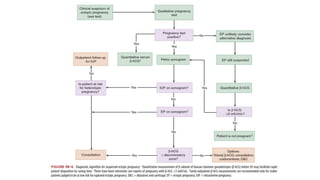
o Obtain a UPT or serum hCG (human chorionic gonadotropin) test to confirm pregnancy.
 Quantitative Serum hCG:
o Measure the serum quantitative hCG level to help assess the viability and location of the pregnancy
 Transvaginal Ultrasound (TVUS):
o Perform a transvaginal ultrasound to determine the location of the pregnancy. Key findings include:
 Intrauterine Pregnancy (IUP): Presence of a gestational sac within the uterus generally excludes
ectopic pregnancy.
 Ectopic Pregnancy: Absence of an intrauterine pregnancy with a positive hCG level
Management Based on Hemodynamic Status
 Hemodynamically Unstable Patient:
o Immediate Resuscitation:
 Administer IV fluids (e.g., normal saline or lactated Ringer’s) rapidly to stabilize the patient.
 Transfuse blood products if there is evidence of significant blood loss or ongoing haemorrhage.
o Emergency Surgery:
 Consult with obstetrics/gynaecology for immediate surgical intervention (e.g., laparotomy or
laparoscopy) to control bleeding and remove the ectopic pregnancy.
Hemodynamically Stable Patient:
o Medical Management:
 Methotrexate: Consider medical management with methotrexate if the patient meets criteria (e.g.,
hCG level <5,000 IU/L, no fetal cardiac activity, and patient is compliant with follow-up).
 Obtain informed consent and provide counselling regarding the risks, benefits, and need for close
follow-up.
o Surgical Management:
 Laparoscopy: Indicated if the patient prefers surgery, methotrexate is contraindicated, or the
ectopic pregnancy is not suitable for medical management.
Common obstetric-related conditions in the first 20 weeks of pregnancy
 Ectopic Pregnancy
 Spontaneous Abortion
 Septic Abortion
 Gestational Trophoblastic Disease
 Nausea And Vomiting Of Pregnancy
Ectopic Pregnancy
Ectopic pregnancy occurs when a conceptus implants outside of the uterine cavity; ruptured
ectopic pregnancies are a leading cause of maternal death in the first trimester of pregnancy
Major Risk Factors for Ectopic Pregnancy
• Pelvic inflammatory disease, history of sexually transmitted infections
• History of tubal surgery or tubal sterilization
• Conception with intrauterine device in place
• Maternal age 35–44 (age-related change in tubal function)
• Previous ectopic pregnancy
• Cigarette smoking (may alter embryo tubal transport)
Pathophysiology
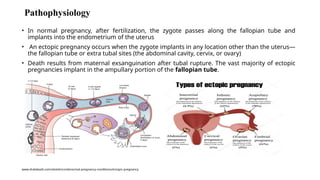
• In normal pregnancy, after fertilization, the zygote passes along the fallopian tube and
implants into the endometrium of the uterus
• An ectopic pregnancy occurs when the zygote implants in any location other than the uterus—
the fallopian tube or extra tubal sites (the abdominal cavity, cervix, or ovary)
• Death results from maternal exsanguination after tubal rupture. The vast majority of ectopic
pregnancies implant in the ampullary portion of the fallopian tube.
www.draliabadi.com/obstetrics/abnormal-pregnancy-conditions/ectopic-pregnancy
The underlying cause is most often damage to the tubal mucosa from
Previous infection
Preventing transport of the ovum to the uterus
Tubal surgery
Defects in the ovum resulting in premature implantation
Symptoms of Ectopic Pregnancy
• Sudden, sharp pain in the abdomen
• Abnormal bleeding. Either light spotting or heavy bleeding that occurs between periods.
• Feeling weak, dizzy, or faint. Blood loss due to internal bleeding can cause dizzy spells and
fainting.
• Shoulder pain. When blood from a ruptured tube collects underneath the diaphragm, it can put
pressure on the chest and shoulders, causing pain
Diagnosis :
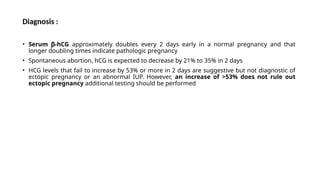
• Serum β-hCG approximately doubles every 2 days early in a normal pregnancy and that
longer doubling times indicate pathologic pregnancy
• Spontaneous abortion, hCG is expected to decrease by 21% to 35% in 2 days
• HCG levels that fail to increase by 53% or more in 2 days are suggestive but not diagnostic of
ectopic pregnancy or an abnormal IUP. However, an increase of >53% does not rule out
ectopic pregnancy additional testing should be performed
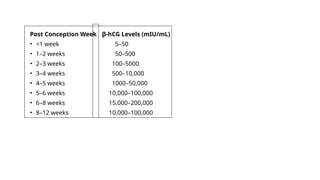
Post Conception Week β-hCG Levels (mIU/mL)
• <1 week 5–50
• 1–2 weeks 50–500
• 2–3 weeks 100–5000
• 3–4 weeks 500–10,000
• 4–5 weeks 1000–50,000
• 5–6 weeks 10,000–100,000
• 6–8 weeks 15,000–200,000
• 8–12 weeks 10,000–100,000
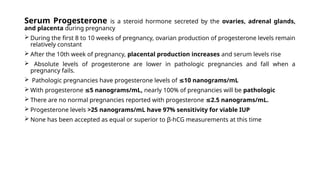
Serum Progesterone is a steroid hormone secreted by the ovaries, adrenal glands,
and placenta during pregnancy
 During the first 8 to 10 weeks of pregnancy, ovarian production of progesterone levels remain
relatively constant
 After the 10th week of pregnancy, placental production increases and serum levels rise
 Absolute levels of progesterone are lower in pathologic pregnancies and fall when a
pregnancy fails.
 Pathologic pregnancies have progesterone levels of 10 nanograms/mL
≤
 With progesterone 5 nanograms/mL,
≤ nearly 100% of pregnancies will be pathologic
 There are no normal pregnancies reported with progesterone 2.5 nanograms/mL.
≤
 Progesterone levels >25 nanograms/mL have 97% sensitivity for viable IUP
 None has been accepted as equal or superior to β-hCG measurements at this time
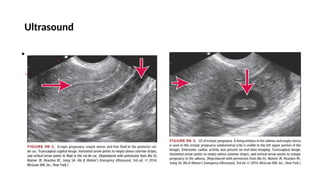
Ultrasound
• .
The Discriminatory Zone
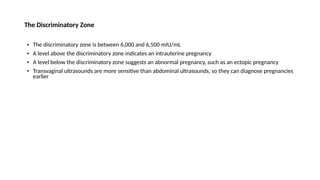
• The discriminatory zone is between 6,000 and 6,500 mIU/mL
• A level above the discriminatory zone indicates an intrauterine pregnancy
• A level below the discriminatory zone suggests an abnormal pregnancy, such as an ectopic pregnancy
• Transvaginal ultrasounds are more sensitive than abdominal ultrasounds, so they can diagnose pregnancies
earlier
Other Diagnostic Modalities
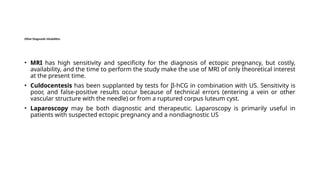
• MRI has high sensitivity and specificity for the diagnosis of ectopic pregnancy, but costly,
availability, and the time to perform the study make the use of MRI of only theoretical interest
at the present time.
• Culdocentesis has been supplanted by tests for β-hCG in combination with US. Sensitivity is
poor, and false-positive results occur because of technical errors (entering a vein or other
vascular structure with the needle) or from a ruptured corpus luteum cyst.
• Laparoscopy may be both diagnostic and therapeutic. Laparoscopy is primarily useful in
patients with suspected ectopic pregnancy and a nondiagnostic US
Treatment
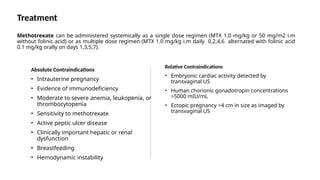
Methotrexate can be administered systemically as a single dose regimen (MTX 1.0 mg/kg or 50 mg/m2 i.m
without folinic acid) or as multiple dose regimen (MTX 1.0 mg/kg i.m daily 0,2,4,6 alternated with folinic acid
0.1 mg/kg orally on days 1,3,5,7).
Absolute Contraindications
• Intrauterine pregnancy
• Evidence of immunodeficiency
• Moderate to severe anemia, leukopenia, or
thrombocytopenia
• Sensitivity to methotrexate
• Active peptic ulcer disease
• Clinically important hepatic or renal
dysfunction
• Breastfeeding
• Hemodynamic instability
Relative Contraindications
• Embryonic cardiac activity detected by
transvaginal US
• Human chorionic gonadotropin concentrations
>5000 mIU/mL
• Ectopic pregnancy >4 cm in size as imaged by
transvaginal US
Surgical Management
Laparoscopy: A minimally invasive procedure where small incisions are made in the abdomen to
remove the ectopic pregnancy.
Open surgery (laparotomy): A larger incision is made in the abdomen to directly access the
fallopian tube or affected areas.
Salpingostomy vs. Salpingectomy: Different surgical approaches to address the ectopic pregnancy.
SPONTANEOUS ABORTION
The World Health Organization defines spontaneous abortion as loss of pregnancy before 20 weeks or loss of a
fetus weighing <500 grams
• Other associations include advanced maternal age, prior poor obstetric history, concurrent medical disorders,
previous abortion, infection
• Exposure to some agents, such as certain anesthetic agents, certain heavy metals, and tobacco, may also
contribute to the incidence of abortion
Diagnosis
• Obtain a quantitative serum β-hCG level, CBC to evaluate for blood loss, blood type, Rh factor and antibody
screen, and urinalysis (urinary tract infection has been associated with increased fetal wastage)
• US can help rule out ectopic pregnancy, aid as a prognostic tool for fetal viability, and diagnose retained products
of conception
Treatment
• Patients with a diagnosis of incomplete abortion should have the uterus evacuated
• The decision to proceed with medical treatment, such as PO misoprostol 600 micrograms
• If opted for surgical treatment such as dilatation and curettage should be made by an obstetrician
• Patients with a complete abortion, as shown by US and complete passage of products of conception
and can be discharged safely with follow-up
Septic Abortion
A septic abortion is a spontaneous or abortion complicated by a pelvic infection.
• Presenting complaints include fever, abdominal pain, vaginal discharge, vaginal bleeding, and
history of recent pregnancy
• The most common causes are retained products of conception due to incomplete spontaneous or
therapeutic abortion and introduction of either normal or pathologic vaginal bacteria by
instrumentation.
Diagnosis
 Obtain a quantitative serum β-hCG level, Routine Investigation
 A US will help identify retained products of conception in the uterus
Treatment consists of fluid resuscitation, broad-spectrum IV antibiotics and early obstetric
consultation for evacuation of the uterus
Antibiotics, such as ampicillin/sulbactam, 3 grams IV or clindamycin 600 milligrams plus gentamicin 1
to 2 milligrams/kg IV
Gestational Trophoblastic Disease
 Gestational trophoblastic disease is a neoplasm that arises in the trophoblastic cells of the placenta
 Complete moles are more common in that is no actual fetus and in the partial mole a deformed
nonviable fetus is present
 Patients with a history of hydatidiform molar pregnancy are at increased risk of future molar
pregnancies , choriocarcinoma with cerebral metastases
 A risk of 1% in subsequent gestations after one molar pregnancy and a risk as high as 23% after two
molar gestations
Symptoms include vaginal bleeding in the first or second trimester (75% to 95% of cases), hyperemesis
(26%) and Preeclampsia
• When pregnancy-induced hypertension is seen before 24 weeks of gestation,
consider the possibility of a molar pregnancy
• If trophoblastic disease is suspected because of abnormally high β-hCG levels
• Because not all molar pregnancies are found on US
Treatment is by suction curettage in the hospital setting because of risk of hemorrhage
β-hCG levels that fail to decrease after evaluation are evidence of persistent or invasive
disease necessitating chemotherapy
Metastasis to lung, liver, and brain may occur, but the prognosis for most patients is very
good
Nausea and Vomiting of Pregnancy and Hyperemesis Gravidarum
Nausea and vomiting of pregnancy is quite common with these symptoms reported in
up to 90% of pregnancies
Severe nausea and vomiting of pregnancy is known as hyperemesis gravidarum and
is defined as vomiting with weight loss, volume depletion and laboratory values
showing hypokalemia or ketonemia
Findings on physical examination in nausea and vomiting of pregnancy are usually
normal except for signs of volume depletion
• Laboratory tests to consider include CBC, serum electrolytes, BUN, creatinine, and
urinalysis. The finding of ketonuria is important because it is an early sign of
starvation
• The presence of abdominal pain in nausea and vomiting of pregnancy or
hyperemesis gravidarum is highly unusual and should suggest another
diagnosis
• Cholelithiasis and cholecystitis are more common in pregnant women than in
women of comparable age and health status who are not pregnant
• Differential diagnosis of vomiting or vomiting with abdominal pain should include
cholecystitis, cholelithiasis, gastroenteritis, pancreatitis, appendicitis, hepatitis,
peptic ulcer, pyelonephritis, ectopic pregnancy, fatty liver of pregnancy
• Treatment consists of IV fluids containing 5% glucose in either lactated Ringer’s
solution or normal saline to replete volume and reverse ketonuria
THANK YOU…..

ECTOPIC PREGNENCY.pptx ectopic pregnancy ppt

  • 1.
    Ectopic Pregnancy andEmergencies in the First 20 Weeks of Pregnancy By Dr Kushiya Sri K
  • 2.
    Approach to thechildbearing women Brief history Initial Assessment (Primary Survey)  Airway, Breathing, Circulation (ABCs): o Airway: Ensure the airway is patent o Breathing: Assess respiratory rate and oxygen saturation. Provide supplemental oxygen if needed o Circulation: Monitor heart rate, blood pressure, and signs of shock (e.g., tachycardia, hypotension, pallor)  Assess for Hemodynamic Stability: o Unstable Patient: If the patient presents with signs of shock (e.g., hypotension, tachycardia, altered mental status), initiate immediate resuscitation (Airway securing) , Blood products and prepare for urgent surgical intervention. o Stable Patient: If the patient is hemodynamically stable, proceed with further evaluation and diagnostic workup
  • 3.
    History • Menstrual history •Ask about previous pregnancy problems and miscarriages • Discuss previous medical and surgical history and ask about substance abuse and smoking • Ask about sexual activity and contraception • Spontaneous abortion • In a woman of childbearing age, hysterectomy with oophorectomy excludes ectopic pregnancy. • In the situation of hysterectomy without oophorectomy, ectopic pregnancy is exceedingly rare. The theory is that a fistulous tract after hysterectomy enables embryo implantation in the tube or adnexa
  • 4.
     Physical Examination: oVital Signs: Check blood pressure, heart rate, respiratory rate, and temperature o Abdominal Exam: Assess for tenderness, rebound, or guarding, which may indicate peritoneal irritation o Pelvic Exam:  Assess for cervical motion tenderness, adnexal tenderness or masses, and uterine size. Vaginal bleeding may also be noted
  • 5.
    Diagnostic Evaluation  PregnancyTest: o Obtain a UPT or serum hCG (human chorionic gonadotropin) test to confirm pregnancy.  Quantitative Serum hCG: o Measure the serum quantitative hCG level to help assess the viability and location of the pregnancy  Transvaginal Ultrasound (TVUS): o Perform a transvaginal ultrasound to determine the location of the pregnancy. Key findings include:  Intrauterine Pregnancy (IUP): Presence of a gestational sac within the uterus generally excludes ectopic pregnancy.  Ectopic Pregnancy: Absence of an intrauterine pregnancy with a positive hCG level
  • 6.
    Management Based onHemodynamic Status  Hemodynamically Unstable Patient: o Immediate Resuscitation:  Administer IV fluids (e.g., normal saline or lactated Ringer’s) rapidly to stabilize the patient.  Transfuse blood products if there is evidence of significant blood loss or ongoing haemorrhage. o Emergency Surgery:  Consult with obstetrics/gynaecology for immediate surgical intervention (e.g., laparotomy or laparoscopy) to control bleeding and remove the ectopic pregnancy.
  • 7.
    Hemodynamically Stable Patient: oMedical Management:  Methotrexate: Consider medical management with methotrexate if the patient meets criteria (e.g., hCG level <5,000 IU/L, no fetal cardiac activity, and patient is compliant with follow-up).  Obtain informed consent and provide counselling regarding the risks, benefits, and need for close follow-up. o Surgical Management:  Laparoscopy: Indicated if the patient prefers surgery, methotrexate is contraindicated, or the ectopic pregnancy is not suitable for medical management.
  • 8.
    Common obstetric-related conditionsin the first 20 weeks of pregnancy  Ectopic Pregnancy  Spontaneous Abortion  Septic Abortion  Gestational Trophoblastic Disease  Nausea And Vomiting Of Pregnancy
  • 9.
    Ectopic Pregnancy Ectopic pregnancyoccurs when a conceptus implants outside of the uterine cavity; ruptured ectopic pregnancies are a leading cause of maternal death in the first trimester of pregnancy Major Risk Factors for Ectopic Pregnancy • Pelvic inflammatory disease, history of sexually transmitted infections • History of tubal surgery or tubal sterilization • Conception with intrauterine device in place • Maternal age 35–44 (age-related change in tubal function) • Previous ectopic pregnancy • Cigarette smoking (may alter embryo tubal transport)
  • 10.
    Pathophysiology • In normalpregnancy, after fertilization, the zygote passes along the fallopian tube and implants into the endometrium of the uterus • An ectopic pregnancy occurs when the zygote implants in any location other than the uterus— the fallopian tube or extra tubal sites (the abdominal cavity, cervix, or ovary) • Death results from maternal exsanguination after tubal rupture. The vast majority of ectopic pregnancies implant in the ampullary portion of the fallopian tube. www.draliabadi.com/obstetrics/abnormal-pregnancy-conditions/ectopic-pregnancy
  • 11.
    The underlying causeis most often damage to the tubal mucosa from Previous infection Preventing transport of the ovum to the uterus Tubal surgery Defects in the ovum resulting in premature implantation
  • 12.
    Symptoms of EctopicPregnancy • Sudden, sharp pain in the abdomen • Abnormal bleeding. Either light spotting or heavy bleeding that occurs between periods. • Feeling weak, dizzy, or faint. Blood loss due to internal bleeding can cause dizzy spells and fainting. • Shoulder pain. When blood from a ruptured tube collects underneath the diaphragm, it can put pressure on the chest and shoulders, causing pain
  • 13.
    Diagnosis : • Serumβ-hCG approximately doubles every 2 days early in a normal pregnancy and that longer doubling times indicate pathologic pregnancy • Spontaneous abortion, hCG is expected to decrease by 21% to 35% in 2 days • HCG levels that fail to increase by 53% or more in 2 days are suggestive but not diagnostic of ectopic pregnancy or an abnormal IUP. However, an increase of >53% does not rule out ectopic pregnancy additional testing should be performed
  • 14.
    Post Conception Weekβ-hCG Levels (mIU/mL) • <1 week 5–50 • 1–2 weeks 50–500 • 2–3 weeks 100–5000 • 3–4 weeks 500–10,000 • 4–5 weeks 1000–50,000 • 5–6 weeks 10,000–100,000 • 6–8 weeks 15,000–200,000 • 8–12 weeks 10,000–100,000
  • 15.
    Serum Progesterone isa steroid hormone secreted by the ovaries, adrenal glands, and placenta during pregnancy  During the first 8 to 10 weeks of pregnancy, ovarian production of progesterone levels remain relatively constant  After the 10th week of pregnancy, placental production increases and serum levels rise  Absolute levels of progesterone are lower in pathologic pregnancies and fall when a pregnancy fails.  Pathologic pregnancies have progesterone levels of 10 nanograms/mL ≤  With progesterone 5 nanograms/mL, ≤ nearly 100% of pregnancies will be pathologic  There are no normal pregnancies reported with progesterone 2.5 nanograms/mL. ≤  Progesterone levels >25 nanograms/mL have 97% sensitivity for viable IUP  None has been accepted as equal or superior to β-hCG measurements at this time
  • 16.
  • 18.
    The Discriminatory Zone •The discriminatory zone is between 6,000 and 6,500 mIU/mL • A level above the discriminatory zone indicates an intrauterine pregnancy • A level below the discriminatory zone suggests an abnormal pregnancy, such as an ectopic pregnancy • Transvaginal ultrasounds are more sensitive than abdominal ultrasounds, so they can diagnose pregnancies earlier
  • 19.
    Other Diagnostic Modalities •MRI has high sensitivity and specificity for the diagnosis of ectopic pregnancy, but costly, availability, and the time to perform the study make the use of MRI of only theoretical interest at the present time. • Culdocentesis has been supplanted by tests for β-hCG in combination with US. Sensitivity is poor, and false-positive results occur because of technical errors (entering a vein or other vascular structure with the needle) or from a ruptured corpus luteum cyst. • Laparoscopy may be both diagnostic and therapeutic. Laparoscopy is primarily useful in patients with suspected ectopic pregnancy and a nondiagnostic US
  • 20.
    Treatment Methotrexate can beadministered systemically as a single dose regimen (MTX 1.0 mg/kg or 50 mg/m2 i.m without folinic acid) or as multiple dose regimen (MTX 1.0 mg/kg i.m daily 0,2,4,6 alternated with folinic acid 0.1 mg/kg orally on days 1,3,5,7). Absolute Contraindications • Intrauterine pregnancy • Evidence of immunodeficiency • Moderate to severe anemia, leukopenia, or thrombocytopenia • Sensitivity to methotrexate • Active peptic ulcer disease • Clinically important hepatic or renal dysfunction • Breastfeeding • Hemodynamic instability Relative Contraindications • Embryonic cardiac activity detected by transvaginal US • Human chorionic gonadotropin concentrations >5000 mIU/mL • Ectopic pregnancy >4 cm in size as imaged by transvaginal US
  • 21.
    Surgical Management Laparoscopy: Aminimally invasive procedure where small incisions are made in the abdomen to remove the ectopic pregnancy. Open surgery (laparotomy): A larger incision is made in the abdomen to directly access the fallopian tube or affected areas. Salpingostomy vs. Salpingectomy: Different surgical approaches to address the ectopic pregnancy.
  • 22.
    SPONTANEOUS ABORTION The WorldHealth Organization defines spontaneous abortion as loss of pregnancy before 20 weeks or loss of a fetus weighing <500 grams • Other associations include advanced maternal age, prior poor obstetric history, concurrent medical disorders, previous abortion, infection • Exposure to some agents, such as certain anesthetic agents, certain heavy metals, and tobacco, may also contribute to the incidence of abortion Diagnosis • Obtain a quantitative serum β-hCG level, CBC to evaluate for blood loss, blood type, Rh factor and antibody screen, and urinalysis (urinary tract infection has been associated with increased fetal wastage) • US can help rule out ectopic pregnancy, aid as a prognostic tool for fetal viability, and diagnose retained products of conception
  • 23.
    Treatment • Patients witha diagnosis of incomplete abortion should have the uterus evacuated • The decision to proceed with medical treatment, such as PO misoprostol 600 micrograms • If opted for surgical treatment such as dilatation and curettage should be made by an obstetrician • Patients with a complete abortion, as shown by US and complete passage of products of conception and can be discharged safely with follow-up
  • 24.
    Septic Abortion A septicabortion is a spontaneous or abortion complicated by a pelvic infection. • Presenting complaints include fever, abdominal pain, vaginal discharge, vaginal bleeding, and history of recent pregnancy • The most common causes are retained products of conception due to incomplete spontaneous or therapeutic abortion and introduction of either normal or pathologic vaginal bacteria by instrumentation. Diagnosis  Obtain a quantitative serum β-hCG level, Routine Investigation  A US will help identify retained products of conception in the uterus Treatment consists of fluid resuscitation, broad-spectrum IV antibiotics and early obstetric consultation for evacuation of the uterus Antibiotics, such as ampicillin/sulbactam, 3 grams IV or clindamycin 600 milligrams plus gentamicin 1 to 2 milligrams/kg IV
  • 25.
    Gestational Trophoblastic Disease Gestational trophoblastic disease is a neoplasm that arises in the trophoblastic cells of the placenta  Complete moles are more common in that is no actual fetus and in the partial mole a deformed nonviable fetus is present  Patients with a history of hydatidiform molar pregnancy are at increased risk of future molar pregnancies , choriocarcinoma with cerebral metastases  A risk of 1% in subsequent gestations after one molar pregnancy and a risk as high as 23% after two molar gestations Symptoms include vaginal bleeding in the first or second trimester (75% to 95% of cases), hyperemesis (26%) and Preeclampsia
  • 26.
    • When pregnancy-inducedhypertension is seen before 24 weeks of gestation, consider the possibility of a molar pregnancy • If trophoblastic disease is suspected because of abnormally high β-hCG levels • Because not all molar pregnancies are found on US Treatment is by suction curettage in the hospital setting because of risk of hemorrhage β-hCG levels that fail to decrease after evaluation are evidence of persistent or invasive disease necessitating chemotherapy Metastasis to lung, liver, and brain may occur, but the prognosis for most patients is very good
  • 27.
    Nausea and Vomitingof Pregnancy and Hyperemesis Gravidarum Nausea and vomiting of pregnancy is quite common with these symptoms reported in up to 90% of pregnancies Severe nausea and vomiting of pregnancy is known as hyperemesis gravidarum and is defined as vomiting with weight loss, volume depletion and laboratory values showing hypokalemia or ketonemia Findings on physical examination in nausea and vomiting of pregnancy are usually normal except for signs of volume depletion • Laboratory tests to consider include CBC, serum electrolytes, BUN, creatinine, and urinalysis. The finding of ketonuria is important because it is an early sign of starvation
  • 28.
    • The presenceof abdominal pain in nausea and vomiting of pregnancy or hyperemesis gravidarum is highly unusual and should suggest another diagnosis • Cholelithiasis and cholecystitis are more common in pregnant women than in women of comparable age and health status who are not pregnant • Differential diagnosis of vomiting or vomiting with abdominal pain should include cholecystitis, cholelithiasis, gastroenteritis, pancreatitis, appendicitis, hepatitis, peptic ulcer, pyelonephritis, ectopic pregnancy, fatty liver of pregnancy • Treatment consists of IV fluids containing 5% glucose in either lactated Ringer’s solution or normal saline to replete volume and reverse ketonuria
  • 30.