Bleeding in early
pregnancy
Prof. Aboubakr Elnashar
Benha university Hospital,
Egypt
ABOUBAKR ELNASHAR
CAUSES
I. Miscarriage.
II. Ectopic pregnancy.
III. Gestational trophoblastic disease.
IV. Rarely gynaecological lower tract pathology
 Chlamydia
 cervical cancer
 polyp
ABOUBAKR ELNASHAR
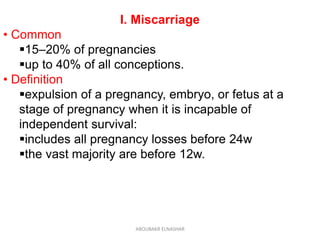
I. Miscarriage
• Common
15–20% of pregnancies
up to 40% of all conceptions.
• Definition
expulsion of a pregnancy, embryo, or fetus at a
stage of pregnancy when it is incapable of
independent survival:
includes all pregnancy losses before 24w
the vast majority are before 12w.
ABOUBAKR ELNASHAR
Early pregnancy assessment
• TVS and serum hCG
invaluable in the diagnosis of early pregnancy
problems
• TVS
provides the definitive diagnosis if a miscarriage is
not clinically apparent..
ABOUBAKR ELNASHAR
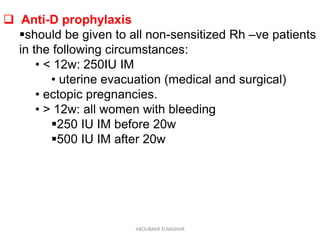
 Anti-D prophylaxis
should be given to all non-sensitized Rh –ve patients
in the following circumstances:
• < 12w: 250IU IM
• uterine evacuation (medical and surgical)
• ectopic pregnancies.
• > 12w: all women with bleeding
250 IU IM before 20w
500 IU IM after 20w
ABOUBAKR ELNASHAR
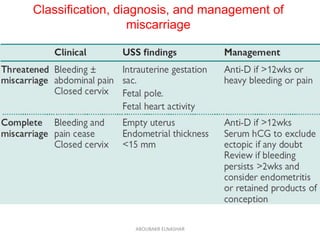
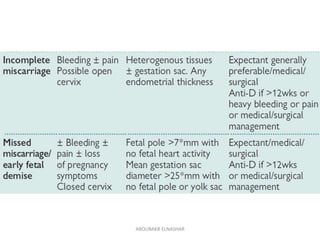
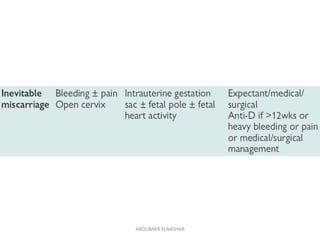
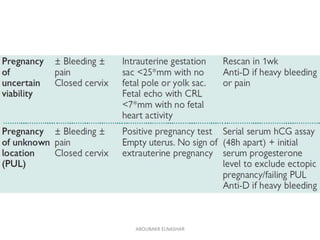
Classification, diagnosis, and management of
miscarriage
ABOUBAKR ELNASHAR
ABOUBAKR ELNASHAR
ABOUBAKR ELNASHAR
ABOUBAKR ELNASHAR
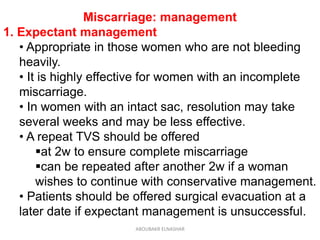
Miscarriage: management
1. Expectant management
• Appropriate in those women who are not bleeding
heavily.
• It is highly effective for women with an incomplete
miscarriage.
• In women with an intact sac, resolution may take
several weeks and may be less effective.
• A repeat TVS should be offered
at 2w to ensure complete miscarriage
can be repeated after another 2w if a woman
wishes to continue with conservative management.
• Patients should be offered surgical evacuation at a
later date if expectant management is unsuccessful.
ABOUBAKR ELNASHAR
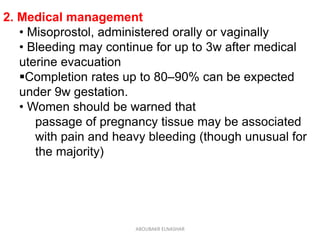
2. Medical management
• Misoprostol, administered orally or vaginally
• Bleeding may continue for up to 3w after medical
uterine evacuation
Completion rates up to 80–90% can be expected
under 9w gestation.
• Women should be warned that
passage of pregnancy tissue may be associated
with pain and heavy bleeding (though unusual for
the majority)
ABOUBAKR ELNASHAR
3. Surgical management of miscarriage SMM
• performed in patients who have
excessive or persistent bleeding or
request surgical management.
• Suction curettage should be used.
ABOUBAKR ELNASHAR
Complications of SMM
• Infection.
• Haemorrhage.
• Uterine perforation (and rarely intraperitoneal
injury).
• Retained products of conception.
• Intrauterine adhesions.
• Cervical tears.
• Intra-abdominal trauma.
Uterine and cervical trauma
 may be minimized by administering
prostaglandin (misoprostol) before the procedure.
(RCOG, 2006).
ABOUBAKR ELNASHAR
Psychological sequelae
• Miscarriage is usually very distressing.
• Offer
appropriate support and
counseling, and
written information.
ABOUBAKR ELNASHAR
II. Ectopic pregnancy: diagnosis
ALL women of reproductive age are
pregnant until proved otherwise and
it is ectopic until clearly demonstrated to be
intrauterine.
• Definition:
implantation of a conceptus outside the uterine cavity.
• Incidence:
1–2:100 pregnancies and increasing.
ABOUBAKR ELNASHAR
• Types:
9 8% are tubal
the remainder
Abdominal
Ovarian
Cervical
rarely in CS scars
ABOUBAKR ELNASHAR
Risk factors for ectopic pregnancy
May be present in 25–50% of patients
majority will have no obvious risk factors:
• History of infertility or assisted conception.
• History of PID.
• Endometriosis.
• Pelvic or tubal surgery.
• Previous ectopic (recurrence risk 10–20%).
• IUCD in situ.
• Assisted conception, especially IVF.
• Smoking.
ABOUBAKR ELNASHAR
Symptoms
• often asymptomatic. e.g. unsure dates
• amenorrhoea (usually 6–8w)
• pain
lower abdominal
often mild and vague
classically unilateral
• vaginal bleeding
usually small amount
often brown
• diarrhoea and vomiting
should never be ignored
• dizziness and light-headedness
• shoulder tip pain
{diaphragmatic irritation—haemoperitoneum}
• collapse (if ruptured).ABOUBAKR ELNASHAR
Symptoms of ectopic pregnancy
• Tend to have a poor positive predictive value to help
discriminate between intra- and extrauterine
pregnancy.
• The majority of women with an ectopic pregnancy
will be clinically well and stable with minimal
symptoms and signs.
All women with a positive pregnancy test should
therefore be considered to have an ectopic
pregnancy until proved otherwise.
ABOUBAKR ELNASHAR
Signs:
• often no specific signs
• uterus usually normal size
• cervical excitation and adnexal tenderness:
occasionally
• adnexal mass: very rarely
• peritonism
{intra-abdominal blood if ectopic ruptured}
There is no evidence that examining patients may lead
to rupturing the ectopic.
More important to examine them so you do not miss
significant abdominal or pelvic tenderness.
ABOUBAKR ELNASHAR
DD:
1. threatened or complete miscarriage
2. bleeding corpus luteal cyst
3. ovarian cyst accident
4. pelvic inflammation.
ABOUBAKR ELNASHAR
Investigations
• TVS/USS:
to establish
location of the pregnancy,
presence of adnexal masses
free fluid
• Serum progesterone:
helpful to distinguish:
whether a pregnancy is failing:
<20nmol/Lhighly suggestive of this,
whether ectopic pregnancy (EP) or intrauterine
pregnancy (IUP).
ABOUBAKR ELNASHAR
• Serum hCG: repeated 48h later:
• rate of rise is important
• rise of ≥66% suggests an IUP
• suboptimal rise is
suspicious, but
not diagnostic of an EP.
At serum hCG ≥ 1500IU, an IUP should be seen with
TVS/USS.
However, there is considerable variation in normal IUPs
and this is a guide only—care is needed to avoid
harming an early IUP.
The rate of change is more important than any one
value
ABOUBAKR ELNASHAR
• Laparoscopy:
gold standard
should only be necessary for
clinical reasons or
in a minority where a diagnosis cannot be made
TVS/USS should pick up 90%
ABOUBAKR ELNASHAR
Ectopic pregnancy: management
Expectant and medical management
safe options even with a diagnosed EP if there are
strict selection criteria:
• Clinically stable.
• Asymptomatic or minimal symptoms.
• hCG, initially <3000IU (can be tried >3000IU but less
successful).
• E P <3cm and no fetal cardiac activity on TV USS.
• No haemoperitoneum on TV USS.
• Fully understand symptoms and implications of EP.
• Language should not be a barrier to understanding or
communicating the problem to a third party (such as
phoning an ambulance).
• Live in close proximity to the hospital and have support at
home.
• You deem the patient will not default on follow-up.ABOUBAKR ELNASHAR
All women managed expectantly or medically
should be counselled about importance of
compliance with follow-up
should be within easy access of the hospital.
There is no level of hCG at which rupture cannot occur
even when it is falling
Symptoms and the clinical parameters are always more
important than blood tests and scans!
ABOUBAKR ELNASHAR
I. Expectant
• With a falling hCG level and fulfilling the above
criteria.
• Requires serum hCG
initially every 48h until repeated fall in level;
then weekly until <15IU.
• With a plateauing hCG, as long as they remain
clinically well it is perfectly acceptable to wait as the
hCG will usually decline if given time as the
pregnancy fails—hCG measurement is as above.
• With slow rising hCG in asymptomatic patient,
decision for expectant management should only be
made by a senior clinician.
ABOUBAKR ELNASHAR
II. Medical
• Methotrexate
IM as a single dose of 50mg/m2.
• hCG levels should be measured at
4 and 7 days
another dose of methotrexate given (up to 25% of
cases) if the d in hCG is <15% on days 4–7.
 Women should be given
clear, written information about adverse effects
possible need for further treatment.
They should use reliable contraception for 3mths
after, as methotrexate is teratogenic.
ABOUBAKR ELNASHAR
Side effects of methotrexate
• Conjunctivitis.
• Stomatitis.
• Gastrointestinal upset.
Some women will experience abdominal pain, which
can be difficult to differentiate from the pain of a
rupturing ectopic.
ABOUBAKR ELNASHAR
III. Surgical
Laparoscopy
preferable to laparotomy
{shorter
operating times and
hospital stays
decrease
analgesia requirements
blood loss.}
Laparotomy
In haemodynamically unstable patients, is more
appropriate, as it is quicker.
ABOUBAKR ELNASHAR
Salpingectomy
is preferable to salpingotomy when the
contralateral tube and ovary appear normal.
There is no difference in subsequent intrauterine
pregnancy rates, but salpingectomy is
associated with lower rates of persistent
trophoblast and recurrent ectopic pregnancy.
Salpingotomy
In the presence of visible contralateral tubal disease,
Remember Anti-D in Rh –ve patients.
ABOUBAKR ELNASHAR
Treatment of the haemodynamically unstable
patient
Resuscitation
• Two large-bore IV lines and IV fluids
(colloids or crystalloids).
• Cross-match 6U blood.
• Call senior help and anaesthetic assistance
urgently.
Surgery
• Laparotomy with salpingectomy once the patient
has been resuscitated.
(RCOG, 2004).
ABOUBAKR ELNASHAR
Less common sites for ectopic pregnancy
Cervical, ovarian, CS scar, and interstitial
pregnancies
need expert input as there are no universally agreed
ways to treat them.
• Generally, preference is for medical treatment, with
surgical reserved for clinical need.
Case series report high rates of success with
medical management as long as the patient is
asymptomatic and stable.
• Consider referral to a hospital have the best
experience of these rare entities.
ABOUBAKR ELNASHAR
III. Pregnancy of unknown location
Definition
no sign of
intrauterine pregnancy
ectopic pregnancy, or
retained products of conception
in the presence of a positive pregnancy test or
serum hCG >5 IU/L.
ABOUBAKR ELNASHAR
The possible outcomes can be:
• early IUP
• failing PUL
• ectopic pregnancy (10% of PULs)
• persisting PUL
• complete miscarriage
• very, very rarely another source (hCG secreting
tumours).
ABOUBAKR ELNASHAR
Even if the history is highly suggestive of a complete
miscarriage having occurred
classify as a PUL until you have evidence of an IUP.
5–10% of ‘complete miscarriages’ diagnosed on
history alone with an empty uterus, on scan, will in
fact be ectopic pregnancies!
Presentation
• Asymptomatic.
• PV bleeding.
• Abdominal pain.
ABOUBAKR ELNASHAR
Management
• The symptoms and clinical parameters
are the most important factors as for ectopic
pregnancy.
• laparoscopy.
significant pain, tenderness, or
haemoperitoneum
• If patient is well and stable
serum progesterone
hCG
at the first visit
repeat hCG after 48h.
ABOUBAKR ELNASHAR
Interpreting hCG and progesterone results in PUL
If progesterone <20nmol/L
• Likely failing pregnancy.
• Repeat hCG in further 7 days.
If hCG ≥ 66% rise from 0–48h
• Likely IUP.
• Rescan in 10–14 days.
If rise in serial hCG <66% or plateauing
• Possible ectopic.
• Close monitoring with
serial hCG and
TVS
until diagnosis made or
hCG <15IU/L.
ABOUBAKR ELNASHAR
•If hCG plateauing or fluctuating
• Persistent PUL after 3 consecutive samples with
no diagnosis.
• Conservative management if asymptomatic or
methotrexate.
If initial hCG >1500IU/L
• Probable ectopic pregnancy.
• Consider all management options depending
upon clinical need.
All the same principles and criteria of expectant and
medical management of ectopic pregnancies apply
equally to PULs.
ABOUBAKR ELNASHAR
Hyatidiform mole
Complete mole
• Consists of diffuse hydropic villi with trophoblastic
hyperplasia.
• This is diploid, derived from sperm duplicating its
own chromosome following fertilization of an ‘empty’
ovum.
This is mostly 46XX with no evidence of fetal tissue.
ABOUBAKR ELNASHAR
Partial mole
• Consists of hydropic and normal villi.
• This is triploid (69XXX, XXY, XYY) with one
maternal and two paternal haploid sets.
Most cases occur following two sperms fertilizing an
ovum, and a fetus may be present.
ABOUBAKR ELNASHAR
Diagnosis
• Irregular first-trimester vaginal bleeding (>90%).
• Uterus large for dates (25%).
• Pain from large theca lutein cysts (20%)
resulting from ovarian hyperstimulation by high hCG levels.
• Vaginal passage of vesicles containing products of
conception (10%).
• Exaggerated pregnancy symptoms:
• hyperemesis (10%)
• hyperthyroidism (5%)
• early pre-eclampsia (5%).
Serum hCG
excessively high with complete moles
levels may be within the normal range for partial
moles. ABOUBAKR ELNASHAR
Risk factors for hyatidiform mole
• Age:
extremes of reproductive life (>40yrs and <15yrs of
age) in complete moles, not partial moles.
• Ethnicity:
x2 higher in east Asia, particularly Korea and
Japan.
• Previous molar pregnancy:
x10 higher risk of developing future molar
pregnancy.
ABOUBAKR ELNASHAR
USS findings
Complete mole
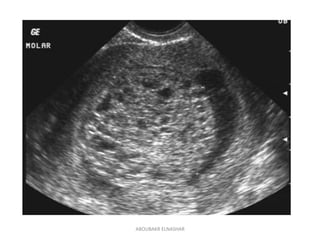
• Snowstorm’ appearance of mixed echogenecity,
representing hydropic villi and intrauterine
haemorrhage.
• Large theca lutein cysts.
Partial mole
Fetus may be viable,
with signs of early growth restriction or
structural abnormalities.
ABOUBAKR ELNASHAR
ABOUBAKR ELNASHAR
IV. Hydatidiform mole: management
• Complete mole:
surgical evacuation is advisable and should be
performed by an experienced surgeon as risks of
uterine perforation and haemorrhage are significant.
Oxytocin
may be required to reducethe risk of
haemorrhage
its use is associated with a theoretical risk of
tissue dissemination leading to metastatic disease
to the lungs or brain
should be avoided until the uterus is evacuated if
possible.
ABOUBAKR ELNASHAR
• Partial mole:
surgical evacuation is preferable, unless the size of
fetal parts necessitates medical evacuation.
• Histological examination
of products of conception is essential to confirm
diagnosis.
ABOUBAKR ELNASHAR
Treatment of persistent gestational trophoblastic
disease
Risk of requiring chemotherapy is
15% after a complete mole and
0.5% after a partial mole.
ABOUBAKR ELNASHAR
Indications for chemotherapy
• Serum hCG levels >20 000IU/L at 4wks after uterine
evacuation.
• Static or rising hCG after uterine evacuation in
absence of new pregnancy.
• Persistent symptoms, e.g. uterine bleeding and/or
abdominal pain.
• Evidence of metastases.
• Histological diagnosis of choriocarcinoma.
ABOUBAKR ELNASHAR
Prognosis
• With effective registration and treatment
programme, cure rate is high (98–100%) with low
chemotherapy rates (5–8%).
• Recurrence rate is low (1/55).
• Women should be advised not to conceive until hCG
level has been normal for 6mths.
• hCG levels should be checked 6 and 10w after each
subsequent pregnancy.
ABOUBAKR ELNASHAR
Contraception and hormone replacement therapy
• Barrier contraception should be used until serum
hCG is normal.
• The COCP and HRT are safe to use after hCG
levels have returned to normal.
ABOUBAKR ELNASHAR
Specialist follow-up for molar pregnancy
follow-up with hCG ranges from 6mths to 2yrs after
uterine evacuation.
• Serum hCG should be checked fortnightly until
levels are normal (<4IU/L).
• Following this, urine hCG is requested at 4-weekly
intervals until 1yr post-evacuation, then every 3mths
in the 2nd year of follow-up.
• If hCG normalizes within 8wks, follow-up will be
limited to 6mths.
• Patients who do not have normal hCG values within
8wks of evacuation should have the 2-yr follow-up.
ABOUBAKR ELNASHAR

Bleeding in early pregnancy

  • 1.
    Bleeding in early pregnancy Prof.Aboubakr Elnashar Benha university Hospital, Egypt ABOUBAKR ELNASHAR
  • 2.
    CAUSES I. Miscarriage. II. Ectopicpregnancy. III. Gestational trophoblastic disease. IV. Rarely gynaecological lower tract pathology  Chlamydia  cervical cancer  polyp ABOUBAKR ELNASHAR
  • 3.
    I. Miscarriage • Common 15–20%of pregnancies up to 40% of all conceptions. • Definition expulsion of a pregnancy, embryo, or fetus at a stage of pregnancy when it is incapable of independent survival: includes all pregnancy losses before 24w the vast majority are before 12w. ABOUBAKR ELNASHAR
  • 4.
    Early pregnancy assessment •TVS and serum hCG invaluable in the diagnosis of early pregnancy problems • TVS provides the definitive diagnosis if a miscarriage is not clinically apparent.. ABOUBAKR ELNASHAR
  • 5.
     Anti-D prophylaxis shouldbe given to all non-sensitized Rh –ve patients in the following circumstances: • < 12w: 250IU IM • uterine evacuation (medical and surgical) • ectopic pregnancies. • > 12w: all women with bleeding 250 IU IM before 20w 500 IU IM after 20w ABOUBAKR ELNASHAR
  • 6.
    Classification, diagnosis, andmanagement of miscarriage ABOUBAKR ELNASHAR
  • 7.
  • 8.
  • 9.
  • 10.
    Miscarriage: management 1. Expectantmanagement • Appropriate in those women who are not bleeding heavily. • It is highly effective for women with an incomplete miscarriage. • In women with an intact sac, resolution may take several weeks and may be less effective. • A repeat TVS should be offered at 2w to ensure complete miscarriage can be repeated after another 2w if a woman wishes to continue with conservative management. • Patients should be offered surgical evacuation at a later date if expectant management is unsuccessful. ABOUBAKR ELNASHAR
  • 11.
    2. Medical management •Misoprostol, administered orally or vaginally • Bleeding may continue for up to 3w after medical uterine evacuation Completion rates up to 80–90% can be expected under 9w gestation. • Women should be warned that passage of pregnancy tissue may be associated with pain and heavy bleeding (though unusual for the majority) ABOUBAKR ELNASHAR
  • 12.
    3. Surgical managementof miscarriage SMM • performed in patients who have excessive or persistent bleeding or request surgical management. • Suction curettage should be used. ABOUBAKR ELNASHAR
  • 13.
    Complications of SMM •Infection. • Haemorrhage. • Uterine perforation (and rarely intraperitoneal injury). • Retained products of conception. • Intrauterine adhesions. • Cervical tears. • Intra-abdominal trauma. Uterine and cervical trauma  may be minimized by administering prostaglandin (misoprostol) before the procedure. (RCOG, 2006). ABOUBAKR ELNASHAR
  • 14.
    Psychological sequelae • Miscarriageis usually very distressing. • Offer appropriate support and counseling, and written information. ABOUBAKR ELNASHAR
  • 15.
    II. Ectopic pregnancy:diagnosis ALL women of reproductive age are pregnant until proved otherwise and it is ectopic until clearly demonstrated to be intrauterine. • Definition: implantation of a conceptus outside the uterine cavity. • Incidence: 1–2:100 pregnancies and increasing. ABOUBAKR ELNASHAR
  • 16.
    • Types: 9 8%are tubal the remainder Abdominal Ovarian Cervical rarely in CS scars ABOUBAKR ELNASHAR
  • 17.
    Risk factors forectopic pregnancy May be present in 25–50% of patients majority will have no obvious risk factors: • History of infertility or assisted conception. • History of PID. • Endometriosis. • Pelvic or tubal surgery. • Previous ectopic (recurrence risk 10–20%). • IUCD in situ. • Assisted conception, especially IVF. • Smoking. ABOUBAKR ELNASHAR
  • 18.
    Symptoms • often asymptomatic.e.g. unsure dates • amenorrhoea (usually 6–8w) • pain lower abdominal often mild and vague classically unilateral • vaginal bleeding usually small amount often brown • diarrhoea and vomiting should never be ignored • dizziness and light-headedness • shoulder tip pain {diaphragmatic irritation—haemoperitoneum} • collapse (if ruptured).ABOUBAKR ELNASHAR
  • 19.
    Symptoms of ectopicpregnancy • Tend to have a poor positive predictive value to help discriminate between intra- and extrauterine pregnancy. • The majority of women with an ectopic pregnancy will be clinically well and stable with minimal symptoms and signs. All women with a positive pregnancy test should therefore be considered to have an ectopic pregnancy until proved otherwise. ABOUBAKR ELNASHAR
  • 20.
    Signs: • often nospecific signs • uterus usually normal size • cervical excitation and adnexal tenderness: occasionally • adnexal mass: very rarely • peritonism {intra-abdominal blood if ectopic ruptured} There is no evidence that examining patients may lead to rupturing the ectopic. More important to examine them so you do not miss significant abdominal or pelvic tenderness. ABOUBAKR ELNASHAR
  • 21.
    DD: 1. threatened orcomplete miscarriage 2. bleeding corpus luteal cyst 3. ovarian cyst accident 4. pelvic inflammation. ABOUBAKR ELNASHAR
  • 22.
    Investigations • TVS/USS: to establish locationof the pregnancy, presence of adnexal masses free fluid • Serum progesterone: helpful to distinguish: whether a pregnancy is failing: <20nmol/Lhighly suggestive of this, whether ectopic pregnancy (EP) or intrauterine pregnancy (IUP). ABOUBAKR ELNASHAR
  • 23.
    • Serum hCG:repeated 48h later: • rate of rise is important • rise of ≥66% suggests an IUP • suboptimal rise is suspicious, but not diagnostic of an EP. At serum hCG ≥ 1500IU, an IUP should be seen with TVS/USS. However, there is considerable variation in normal IUPs and this is a guide only—care is needed to avoid harming an early IUP. The rate of change is more important than any one value ABOUBAKR ELNASHAR
  • 24.
    • Laparoscopy: gold standard shouldonly be necessary for clinical reasons or in a minority where a diagnosis cannot be made TVS/USS should pick up 90% ABOUBAKR ELNASHAR
  • 25.
    Ectopic pregnancy: management Expectantand medical management safe options even with a diagnosed EP if there are strict selection criteria: • Clinically stable. • Asymptomatic or minimal symptoms. • hCG, initially <3000IU (can be tried >3000IU but less successful). • E P <3cm and no fetal cardiac activity on TV USS. • No haemoperitoneum on TV USS. • Fully understand symptoms and implications of EP. • Language should not be a barrier to understanding or communicating the problem to a third party (such as phoning an ambulance). • Live in close proximity to the hospital and have support at home. • You deem the patient will not default on follow-up.ABOUBAKR ELNASHAR
  • 26.
    All women managedexpectantly or medically should be counselled about importance of compliance with follow-up should be within easy access of the hospital. There is no level of hCG at which rupture cannot occur even when it is falling Symptoms and the clinical parameters are always more important than blood tests and scans! ABOUBAKR ELNASHAR
  • 27.
    I. Expectant • Witha falling hCG level and fulfilling the above criteria. • Requires serum hCG initially every 48h until repeated fall in level; then weekly until <15IU. • With a plateauing hCG, as long as they remain clinically well it is perfectly acceptable to wait as the hCG will usually decline if given time as the pregnancy fails—hCG measurement is as above. • With slow rising hCG in asymptomatic patient, decision for expectant management should only be made by a senior clinician. ABOUBAKR ELNASHAR
  • 28.
    II. Medical • Methotrexate IMas a single dose of 50mg/m2. • hCG levels should be measured at 4 and 7 days another dose of methotrexate given (up to 25% of cases) if the d in hCG is <15% on days 4–7.  Women should be given clear, written information about adverse effects possible need for further treatment. They should use reliable contraception for 3mths after, as methotrexate is teratogenic. ABOUBAKR ELNASHAR
  • 29.
    Side effects ofmethotrexate • Conjunctivitis. • Stomatitis. • Gastrointestinal upset. Some women will experience abdominal pain, which can be difficult to differentiate from the pain of a rupturing ectopic. ABOUBAKR ELNASHAR
  • 30.
    III. Surgical Laparoscopy preferable tolaparotomy {shorter operating times and hospital stays decrease analgesia requirements blood loss.} Laparotomy In haemodynamically unstable patients, is more appropriate, as it is quicker. ABOUBAKR ELNASHAR
  • 31.
    Salpingectomy is preferable tosalpingotomy when the contralateral tube and ovary appear normal. There is no difference in subsequent intrauterine pregnancy rates, but salpingectomy is associated with lower rates of persistent trophoblast and recurrent ectopic pregnancy. Salpingotomy In the presence of visible contralateral tubal disease, Remember Anti-D in Rh –ve patients. ABOUBAKR ELNASHAR
  • 32.
    Treatment of thehaemodynamically unstable patient Resuscitation • Two large-bore IV lines and IV fluids (colloids or crystalloids). • Cross-match 6U blood. • Call senior help and anaesthetic assistance urgently. Surgery • Laparotomy with salpingectomy once the patient has been resuscitated. (RCOG, 2004). ABOUBAKR ELNASHAR
  • 33.
    Less common sitesfor ectopic pregnancy Cervical, ovarian, CS scar, and interstitial pregnancies need expert input as there are no universally agreed ways to treat them. • Generally, preference is for medical treatment, with surgical reserved for clinical need. Case series report high rates of success with medical management as long as the patient is asymptomatic and stable. • Consider referral to a hospital have the best experience of these rare entities. ABOUBAKR ELNASHAR
  • 34.
    III. Pregnancy ofunknown location Definition no sign of intrauterine pregnancy ectopic pregnancy, or retained products of conception in the presence of a positive pregnancy test or serum hCG >5 IU/L. ABOUBAKR ELNASHAR
  • 35.
    The possible outcomescan be: • early IUP • failing PUL • ectopic pregnancy (10% of PULs) • persisting PUL • complete miscarriage • very, very rarely another source (hCG secreting tumours). ABOUBAKR ELNASHAR
  • 36.
    Even if thehistory is highly suggestive of a complete miscarriage having occurred classify as a PUL until you have evidence of an IUP. 5–10% of ‘complete miscarriages’ diagnosed on history alone with an empty uterus, on scan, will in fact be ectopic pregnancies! Presentation • Asymptomatic. • PV bleeding. • Abdominal pain. ABOUBAKR ELNASHAR
  • 37.
    Management • The symptomsand clinical parameters are the most important factors as for ectopic pregnancy. • laparoscopy. significant pain, tenderness, or haemoperitoneum • If patient is well and stable serum progesterone hCG at the first visit repeat hCG after 48h. ABOUBAKR ELNASHAR
  • 38.
    Interpreting hCG andprogesterone results in PUL If progesterone <20nmol/L • Likely failing pregnancy. • Repeat hCG in further 7 days. If hCG ≥ 66% rise from 0–48h • Likely IUP. • Rescan in 10–14 days. If rise in serial hCG <66% or plateauing • Possible ectopic. • Close monitoring with serial hCG and TVS until diagnosis made or hCG <15IU/L. ABOUBAKR ELNASHAR
  • 39.
    •If hCG plateauingor fluctuating • Persistent PUL after 3 consecutive samples with no diagnosis. • Conservative management if asymptomatic or methotrexate. If initial hCG >1500IU/L • Probable ectopic pregnancy. • Consider all management options depending upon clinical need. All the same principles and criteria of expectant and medical management of ectopic pregnancies apply equally to PULs. ABOUBAKR ELNASHAR
  • 40.
    Hyatidiform mole Complete mole •Consists of diffuse hydropic villi with trophoblastic hyperplasia. • This is diploid, derived from sperm duplicating its own chromosome following fertilization of an ‘empty’ ovum. This is mostly 46XX with no evidence of fetal tissue. ABOUBAKR ELNASHAR
  • 41.
    Partial mole • Consistsof hydropic and normal villi. • This is triploid (69XXX, XXY, XYY) with one maternal and two paternal haploid sets. Most cases occur following two sperms fertilizing an ovum, and a fetus may be present. ABOUBAKR ELNASHAR
  • 42.
    Diagnosis • Irregular first-trimestervaginal bleeding (>90%). • Uterus large for dates (25%). • Pain from large theca lutein cysts (20%) resulting from ovarian hyperstimulation by high hCG levels. • Vaginal passage of vesicles containing products of conception (10%). • Exaggerated pregnancy symptoms: • hyperemesis (10%) • hyperthyroidism (5%) • early pre-eclampsia (5%). Serum hCG excessively high with complete moles levels may be within the normal range for partial moles. ABOUBAKR ELNASHAR
  • 43.
    Risk factors forhyatidiform mole • Age: extremes of reproductive life (>40yrs and <15yrs of age) in complete moles, not partial moles. • Ethnicity: x2 higher in east Asia, particularly Korea and Japan. • Previous molar pregnancy: x10 higher risk of developing future molar pregnancy. ABOUBAKR ELNASHAR
  • 44.
    USS findings Complete mole •Snowstorm’ appearance of mixed echogenecity, representing hydropic villi and intrauterine haemorrhage. • Large theca lutein cysts. Partial mole Fetus may be viable, with signs of early growth restriction or structural abnormalities. ABOUBAKR ELNASHAR
  • 45.
  • 46.
    IV. Hydatidiform mole:management • Complete mole: surgical evacuation is advisable and should be performed by an experienced surgeon as risks of uterine perforation and haemorrhage are significant. Oxytocin may be required to reducethe risk of haemorrhage its use is associated with a theoretical risk of tissue dissemination leading to metastatic disease to the lungs or brain should be avoided until the uterus is evacuated if possible. ABOUBAKR ELNASHAR
  • 47.
    • Partial mole: surgicalevacuation is preferable, unless the size of fetal parts necessitates medical evacuation. • Histological examination of products of conception is essential to confirm diagnosis. ABOUBAKR ELNASHAR
  • 48.
    Treatment of persistentgestational trophoblastic disease Risk of requiring chemotherapy is 15% after a complete mole and 0.5% after a partial mole. ABOUBAKR ELNASHAR
  • 49.
    Indications for chemotherapy •Serum hCG levels >20 000IU/L at 4wks after uterine evacuation. • Static or rising hCG after uterine evacuation in absence of new pregnancy. • Persistent symptoms, e.g. uterine bleeding and/or abdominal pain. • Evidence of metastases. • Histological diagnosis of choriocarcinoma. ABOUBAKR ELNASHAR
  • 50.
    Prognosis • With effectiveregistration and treatment programme, cure rate is high (98–100%) with low chemotherapy rates (5–8%). • Recurrence rate is low (1/55). • Women should be advised not to conceive until hCG level has been normal for 6mths. • hCG levels should be checked 6 and 10w after each subsequent pregnancy. ABOUBAKR ELNASHAR
  • 51.
    Contraception and hormonereplacement therapy • Barrier contraception should be used until serum hCG is normal. • The COCP and HRT are safe to use after hCG levels have returned to normal. ABOUBAKR ELNASHAR
  • 52.
    Specialist follow-up formolar pregnancy follow-up with hCG ranges from 6mths to 2yrs after uterine evacuation. • Serum hCG should be checked fortnightly until levels are normal (<4IU/L). • Following this, urine hCG is requested at 4-weekly intervals until 1yr post-evacuation, then every 3mths in the 2nd year of follow-up. • If hCG normalizes within 8wks, follow-up will be limited to 6mths. • Patients who do not have normal hCG values within 8wks of evacuation should have the 2-yr follow-up. ABOUBAKR ELNASHAR