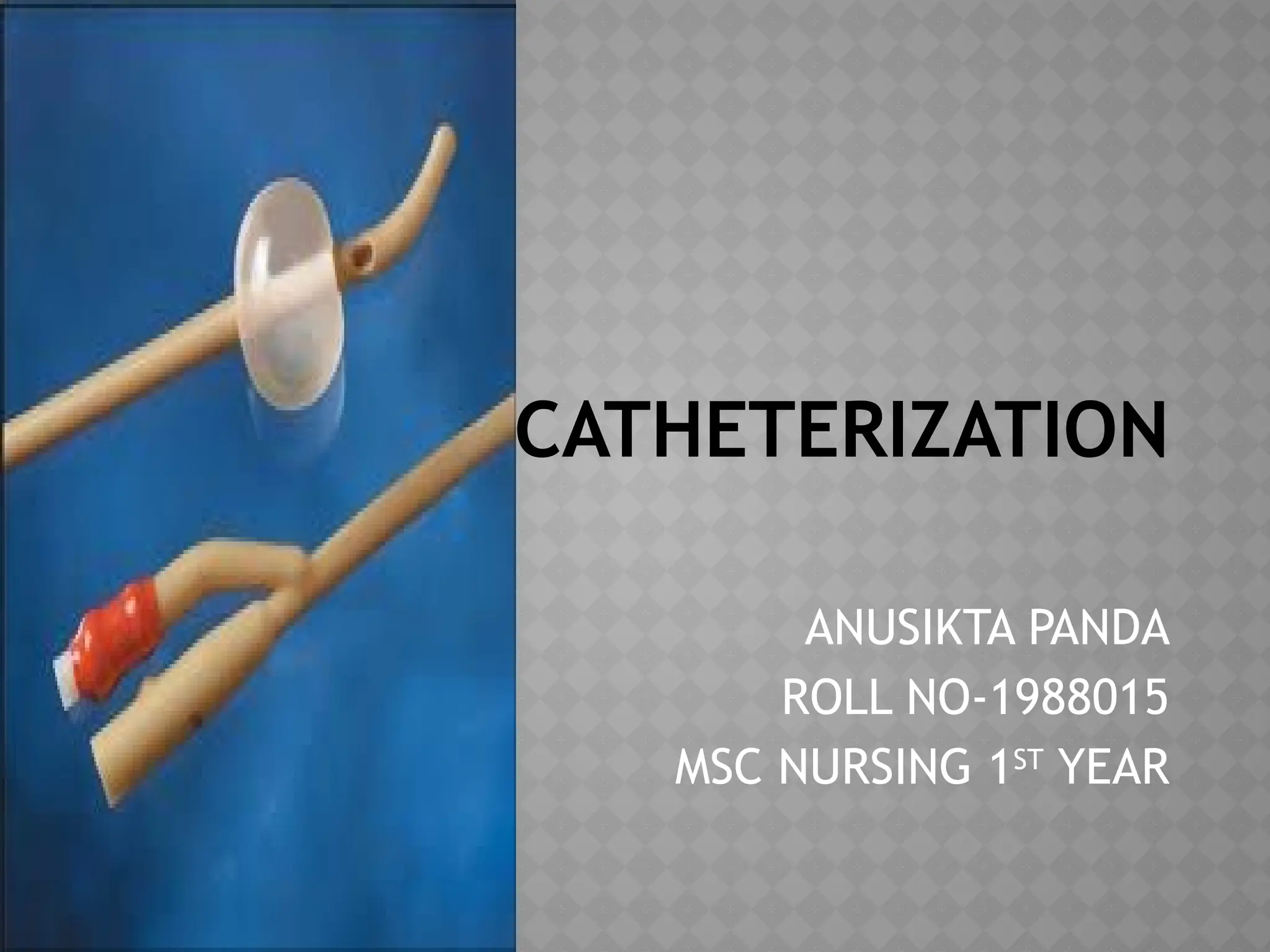
CATHETERIZATION
ANUSIKTA PANDA
ROLL NO-1988015
MSC NURSING 1ST
YEAR
INTRODUCTION
URINARY CATHETERIZATION
is the introduction of a tube
(catheter) through the
urethra into the urinary
bladder to drain the urine
DEFINITION
Urinary catheterization is an
aseptic method of introducing
the catheter into the urinary
bladder through the external
urethra for the withdrawal of
urine.
PURPOSES
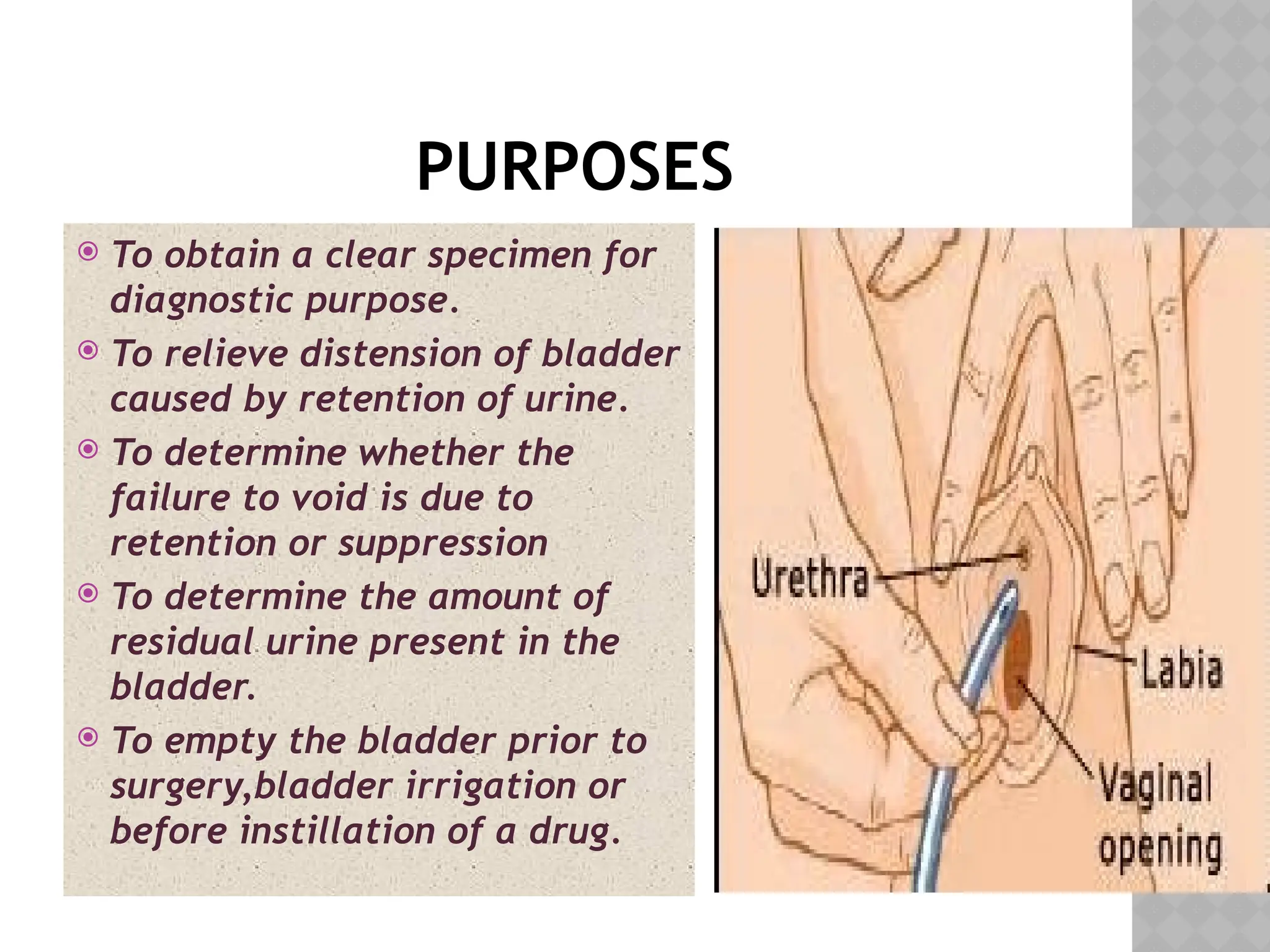
 To obtain a clear specimen for
diagnostic purpose.
 To relieve distension of bladder
caused by retention of urine.
 To determine whether the
failure to void is due to
retention or suppression
 To determine the amount of
residual urine present in the
bladder.
 To empty the bladder prior to
surgery,bladder irrigation or
before instillation of a drug.
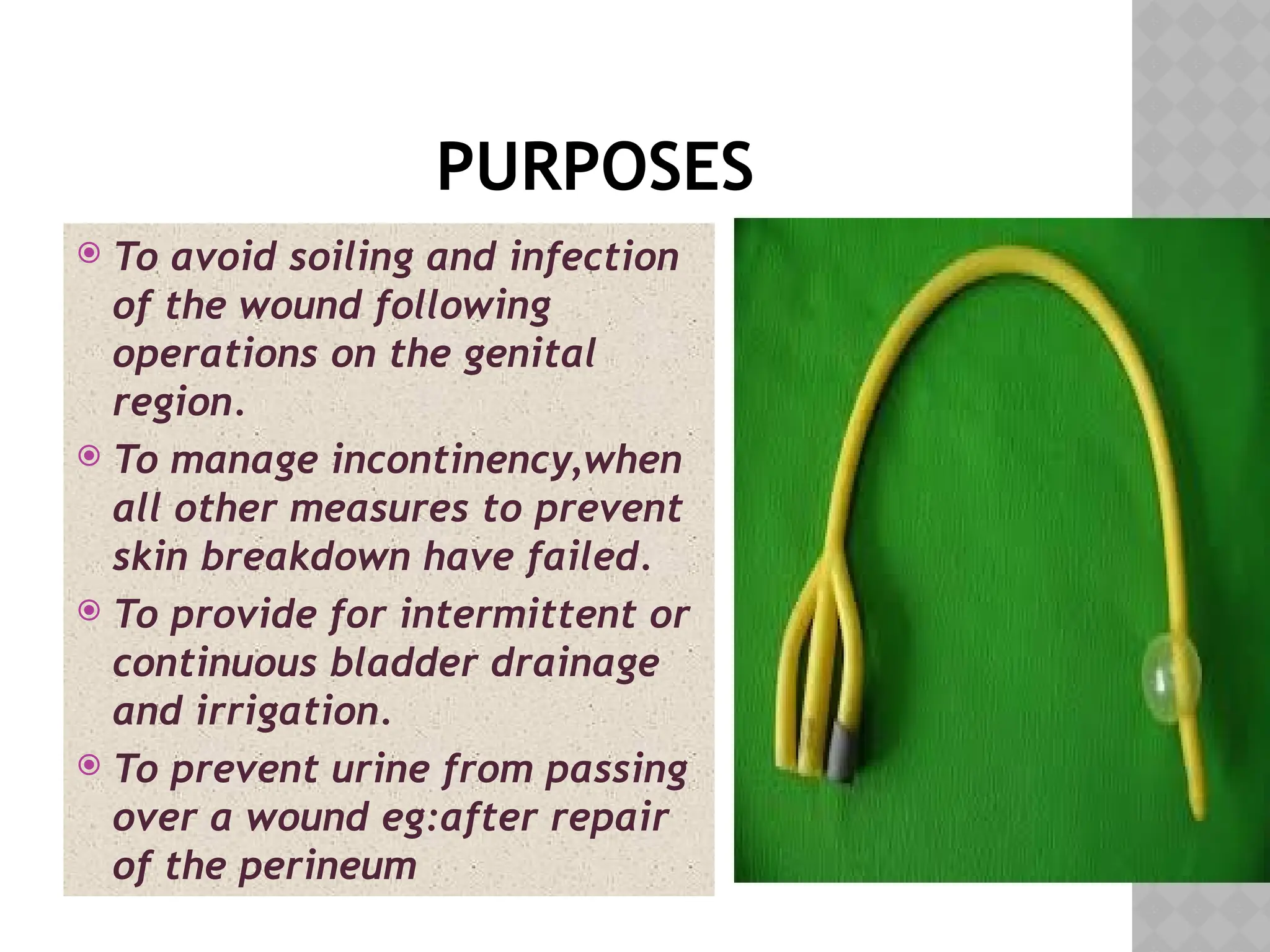
PURPOSES
 To avoid soiling and infection
of the wound following
operations on the genital
region.
 To manage incontinency,when
all other measures to prevent
skin breakdown have failed.
 To provide for intermittent or
continuous bladder drainage
and irrigation.
 To prevent urine from passing
over a wound eg:after repair
of the perineum
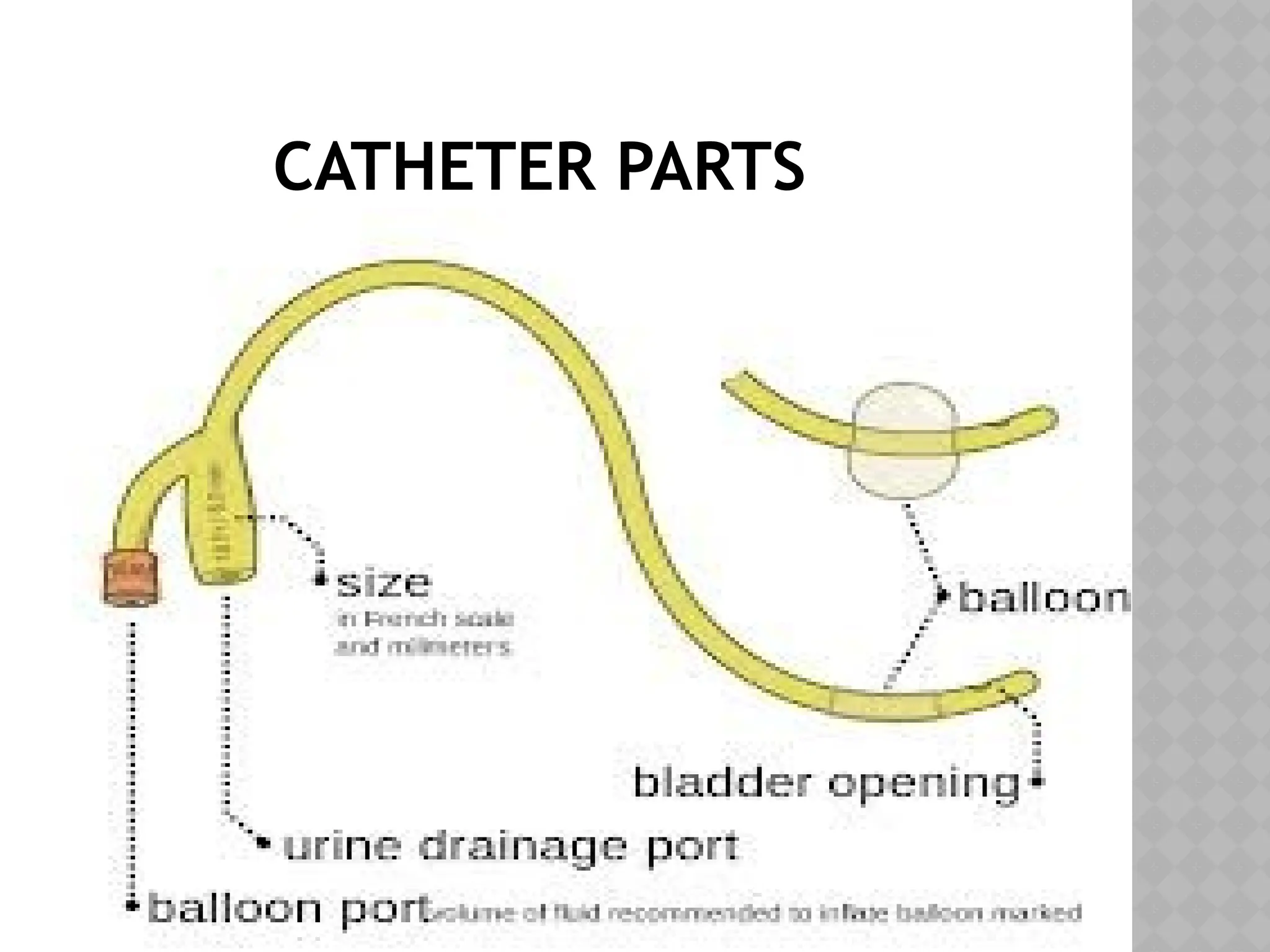
CATHETER PARTS
PRINCIPLES
 Pathogenic organisms
are transmitted from
the source to a new
host directly on by
contaminated articles.
 Urinary bladder is a
sterile cavity and the
urinary meatus acts as
a portal of entry for
pathogenic organisms.
 Cleaning of the area
minimize the spread of
organisms.
 A break in the integrity
of the skin amd mucus
membrane provides
ready entrance for
microorganisms
 Lubrication reduces the
friction
 Thorough knowledge of
the anatomy and
physiology of the genito
urinary system
facilitates
catheterization of the
urinary bladder
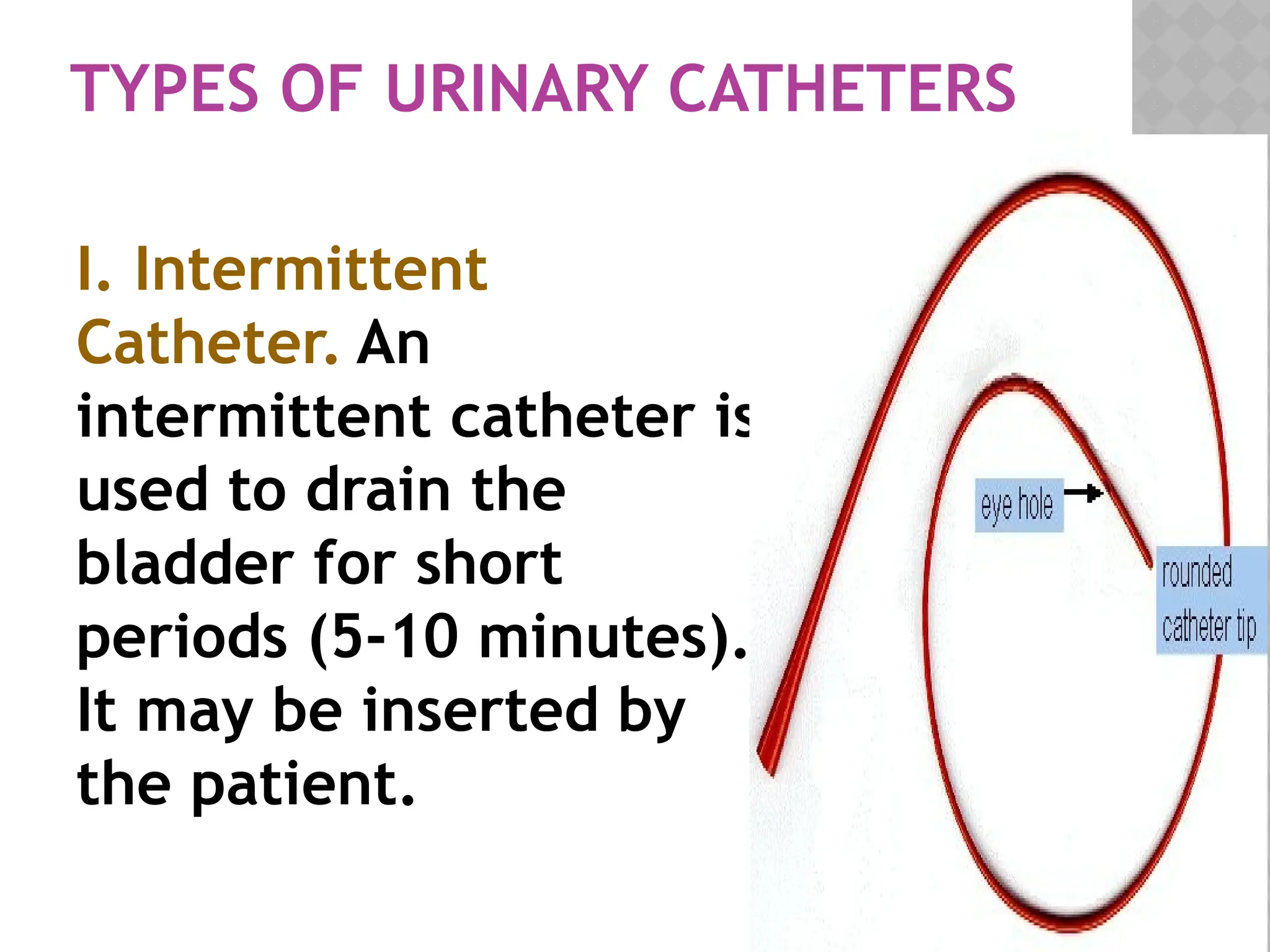
TYPES OF URINARY CATHETERS
I. Intermittent
Catheter. An
intermittent catheter is
used to drain the
bladder for short
periods (5-10 minutes).
It may be inserted by
the patient.
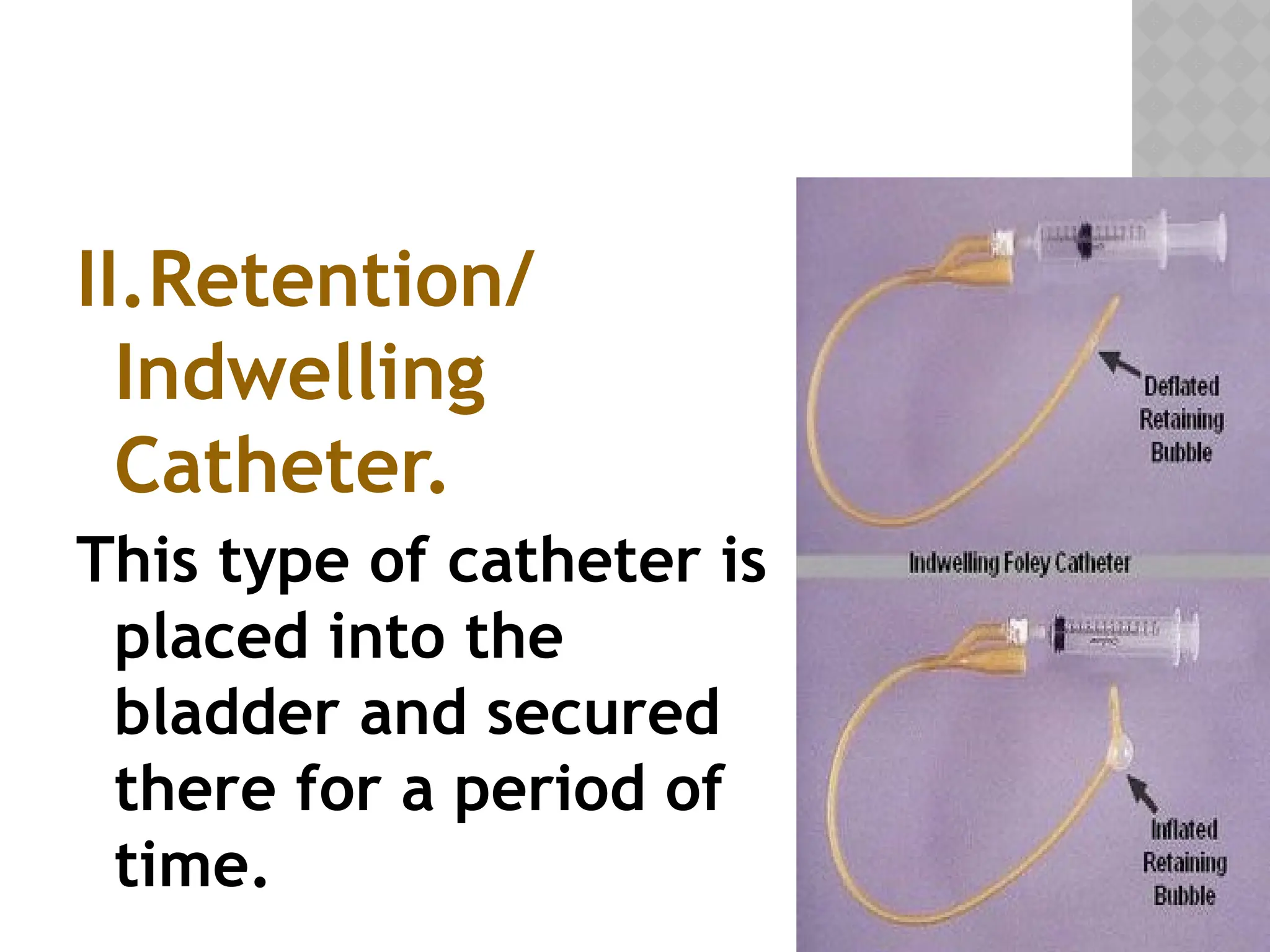
II.Retention/
Indwelling
Catheter.
This type of catheter is
placed into the
bladder and secured
there for a period of
time.
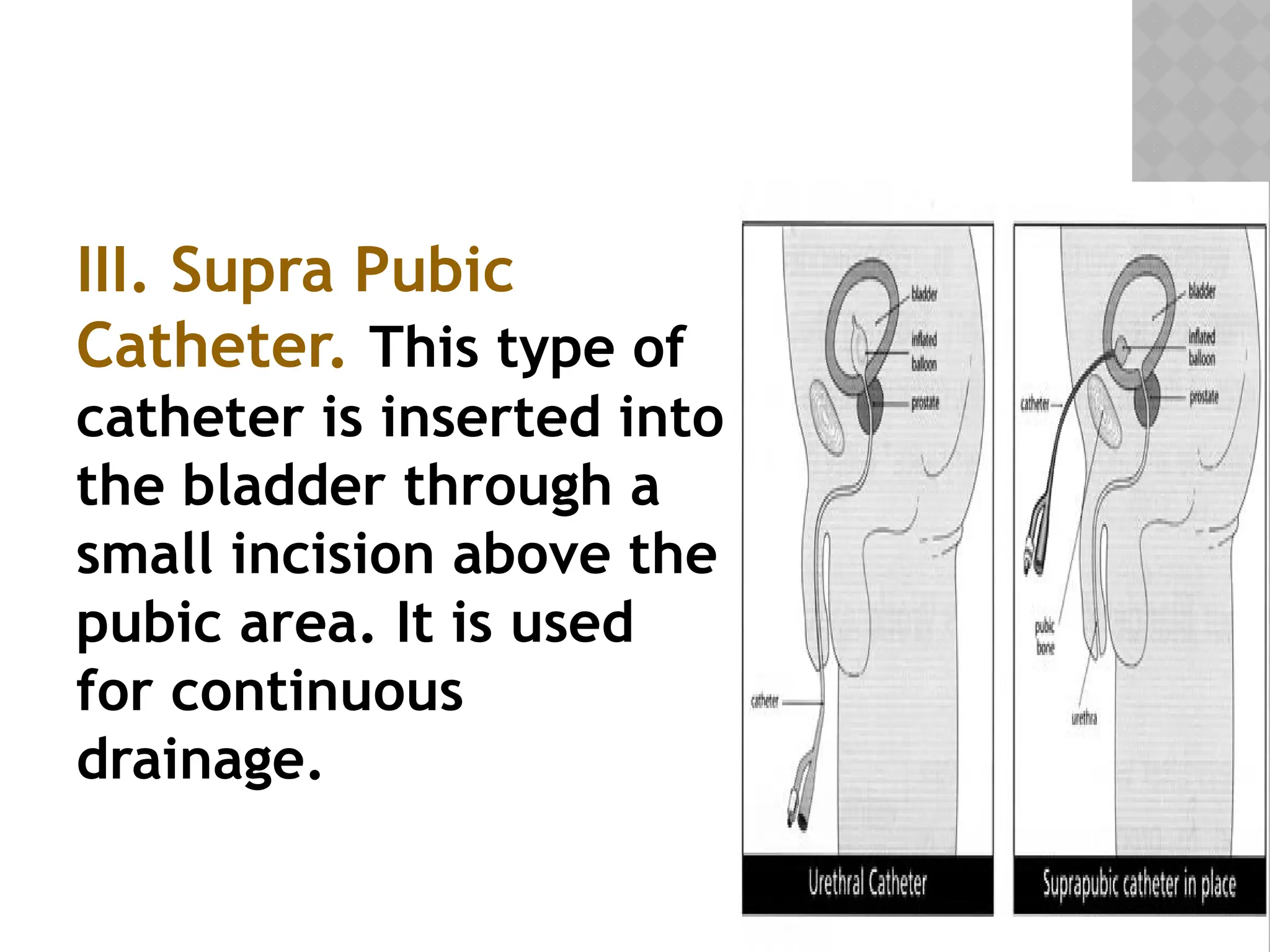
III. Supra Pubic
Catheter. This type of
catheter is inserted into
the bladder through a
small incision above the
pubic area. It is used
for continuous
drainage.
PRELIMINARY ASSESSMENT
 CHECK:-
 Doctors order for any specific precautions
 Identify the purpose of catheterization
 Level of consciousness
 Any contraindications
 General condition of the patient
 Articles available in the unit.
PREPARATION OF THE PATIENT
AND THE ENVIRONMENT
 Explain the sequence
of the procedure
 Arrange the articles
at the bedside locker
 Provide privacy
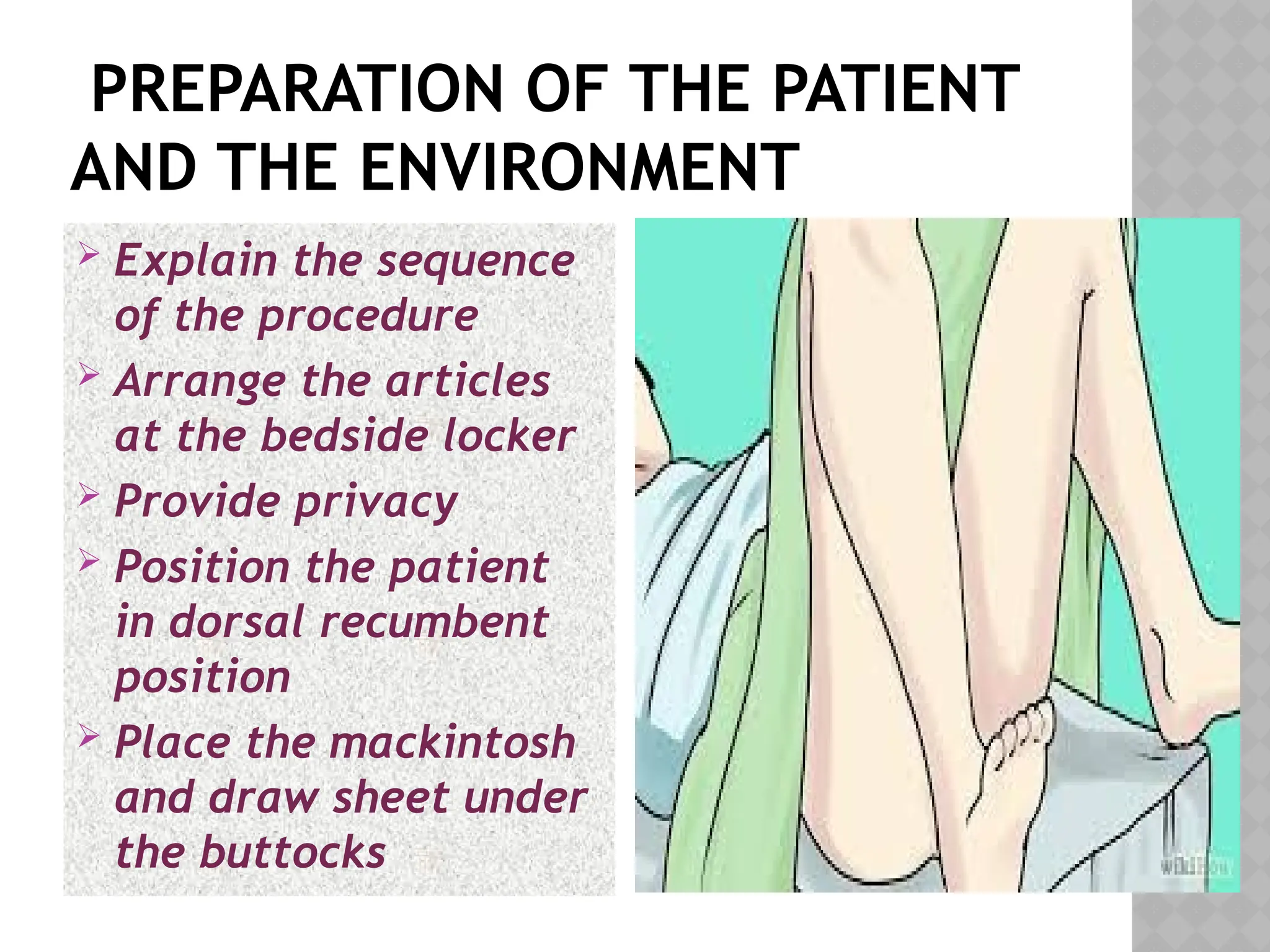
 Position the patient
in dorsal recumbent
position
 Place the mackintosh
and draw sheet under
the buttocks
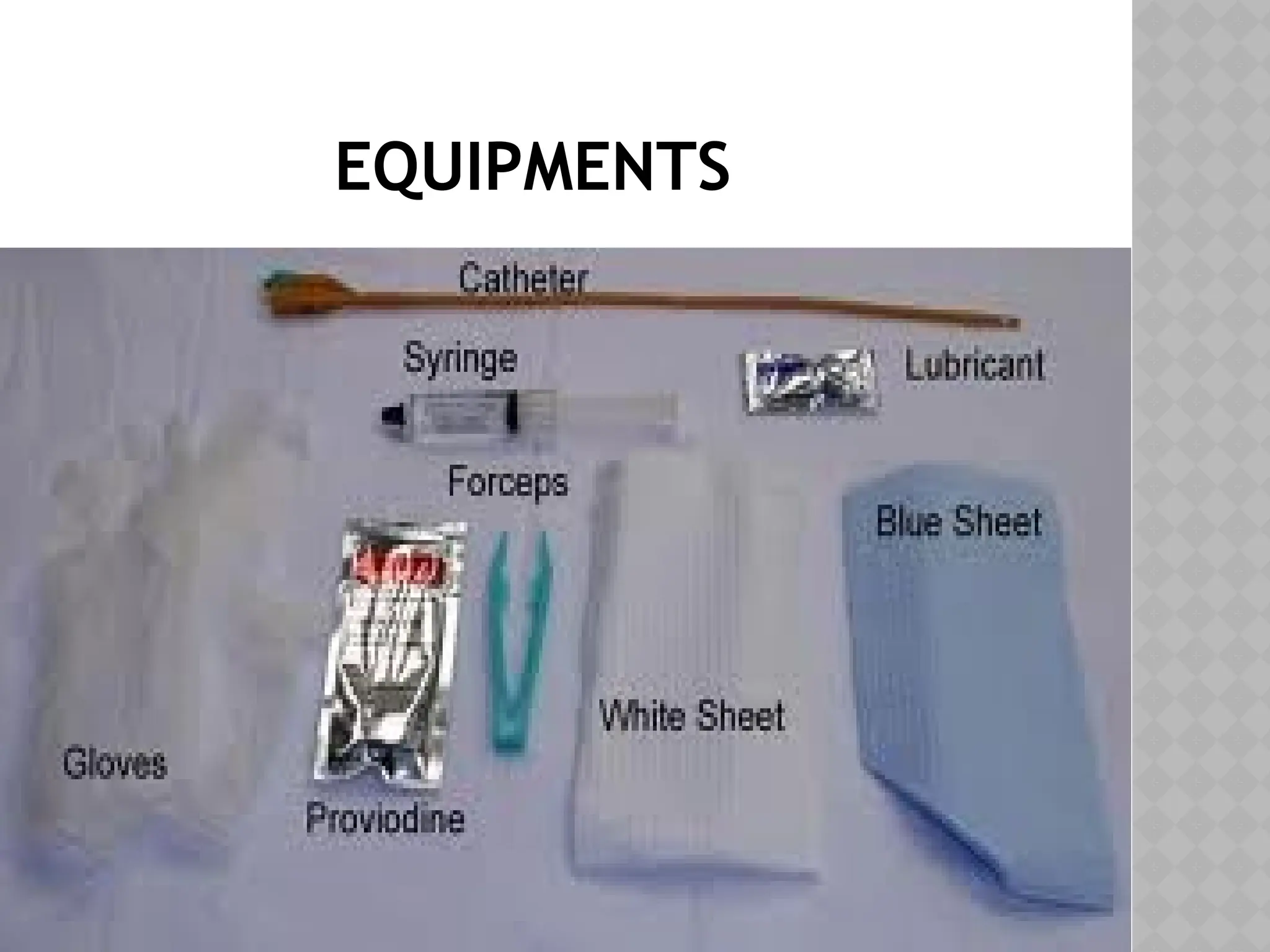
EQUIPMENTS
EQUIPMENTS
A STERILE TRAY
CONTAINING:-
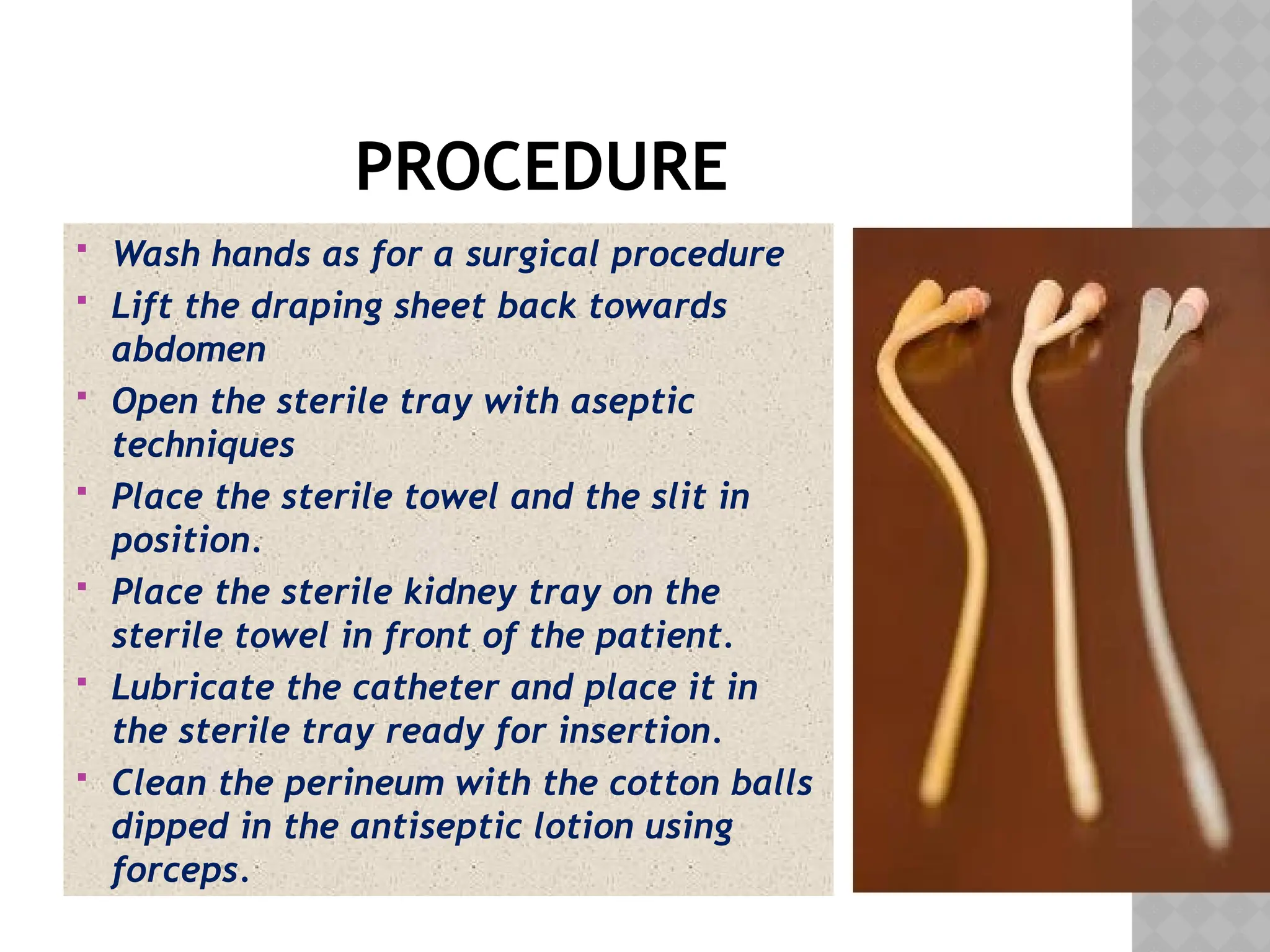
Catheter of correct
size
Small bowl
containing an
antiseptic
Cotton swabs
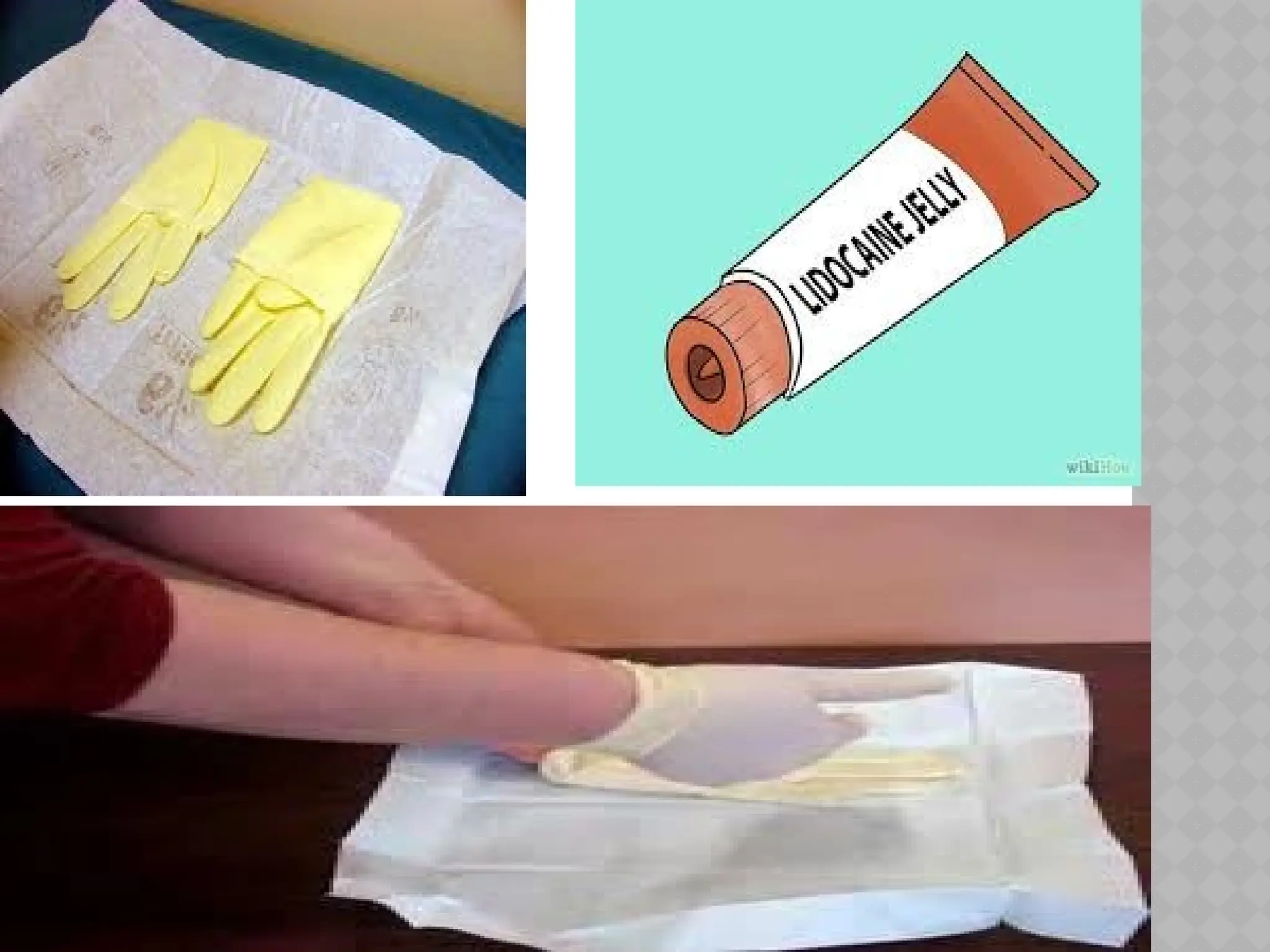
Pair of gloves
sponge holder
 Sterile kidney tray
prefilled syringe
with sterile water.
 Sterile towel,sterile
draining tubing and
collection bag
 Test tube or
specimen bottle
 Small cup
containing lubricant
A CLEAN TRAY CONTAINING
 MACKINTOSH AND TOWEL
 BATH BLANKET
 KIDNEY TRAY
 ADHESIVE TAPE AND SCISSORRS
 BEDPAN TO EMPTY THE URINE THE KIDNEY
TRAY
 MEASURING JAR
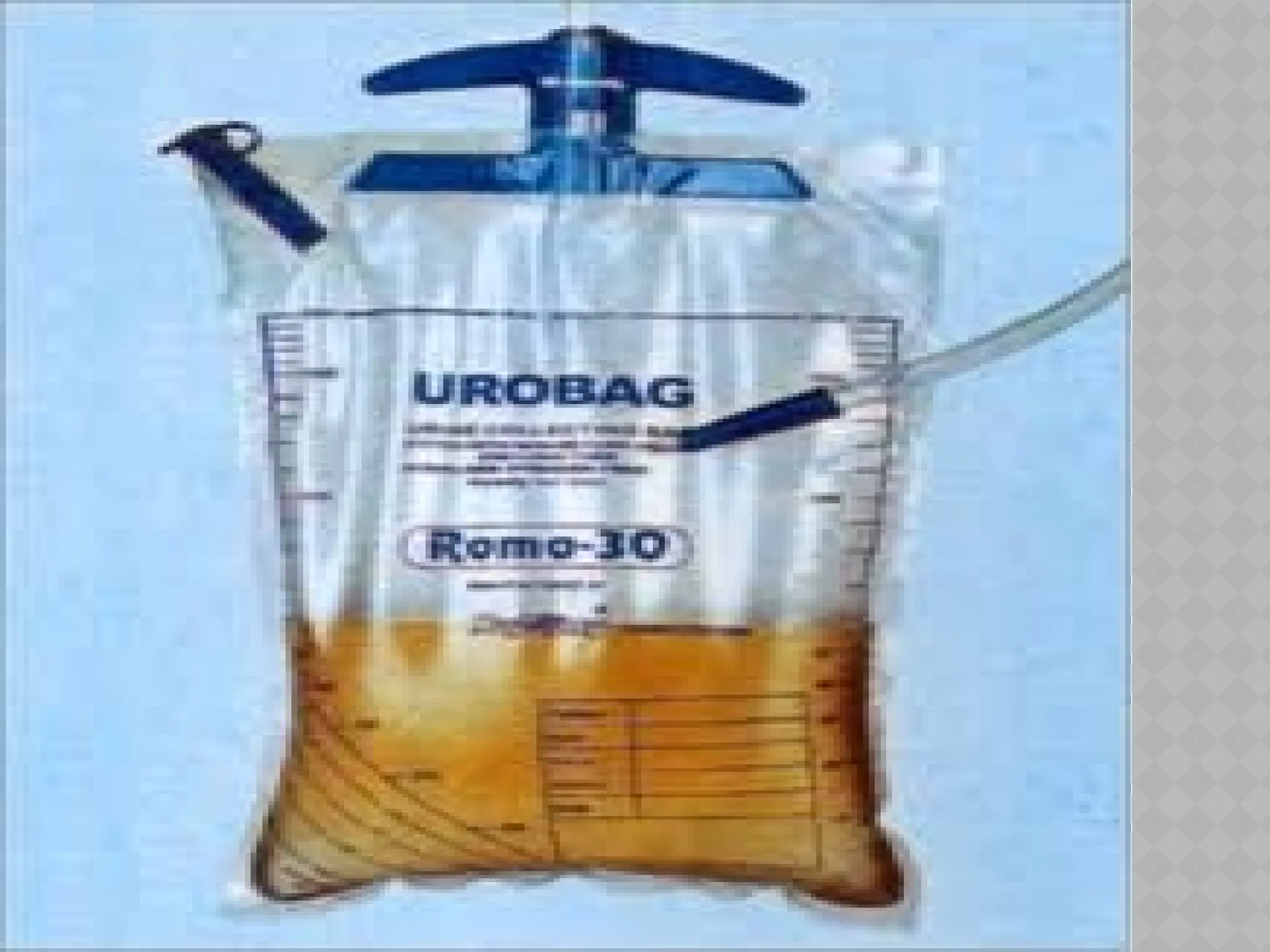
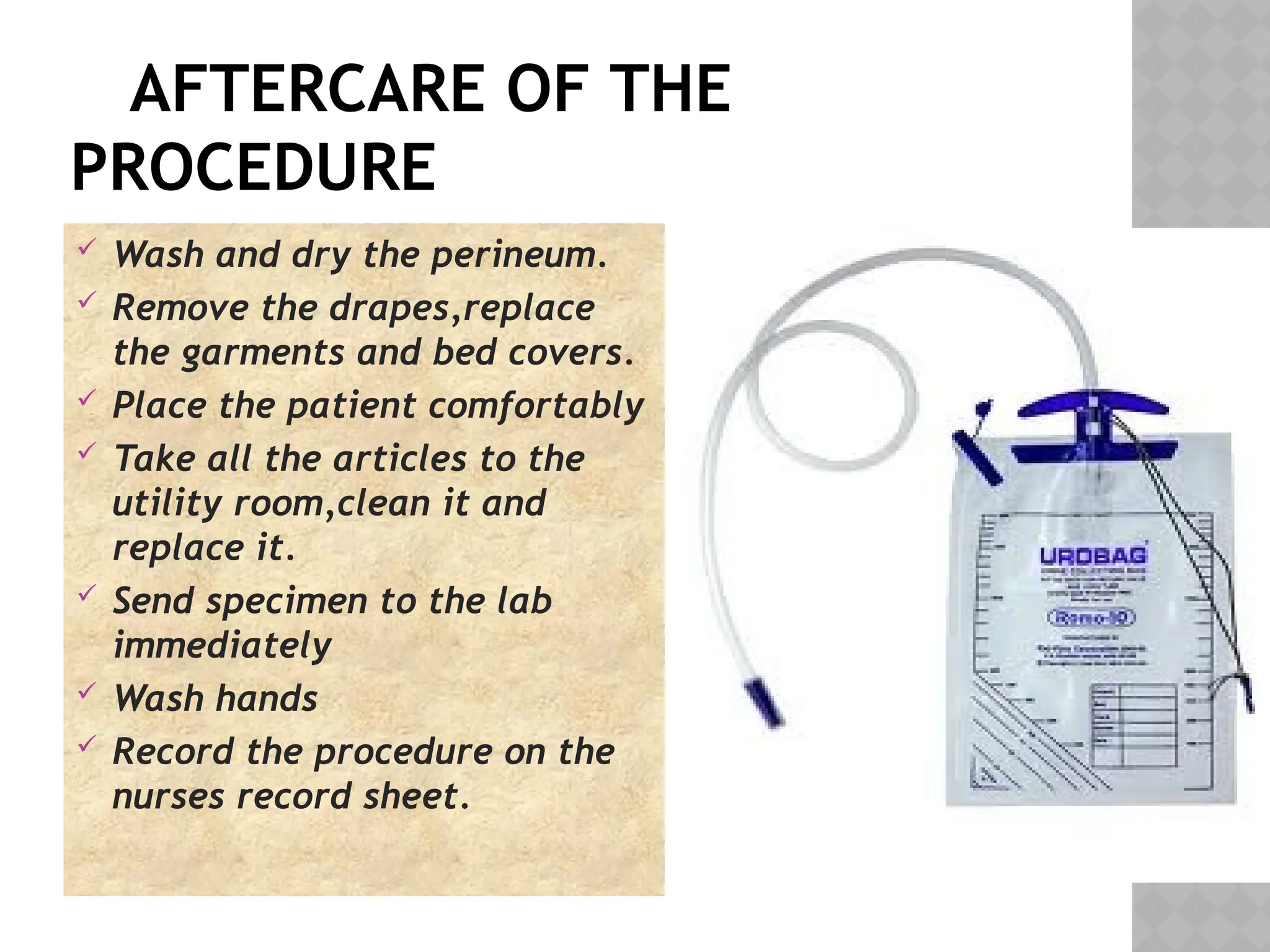
 UROBAG OR COLLECTION BAG
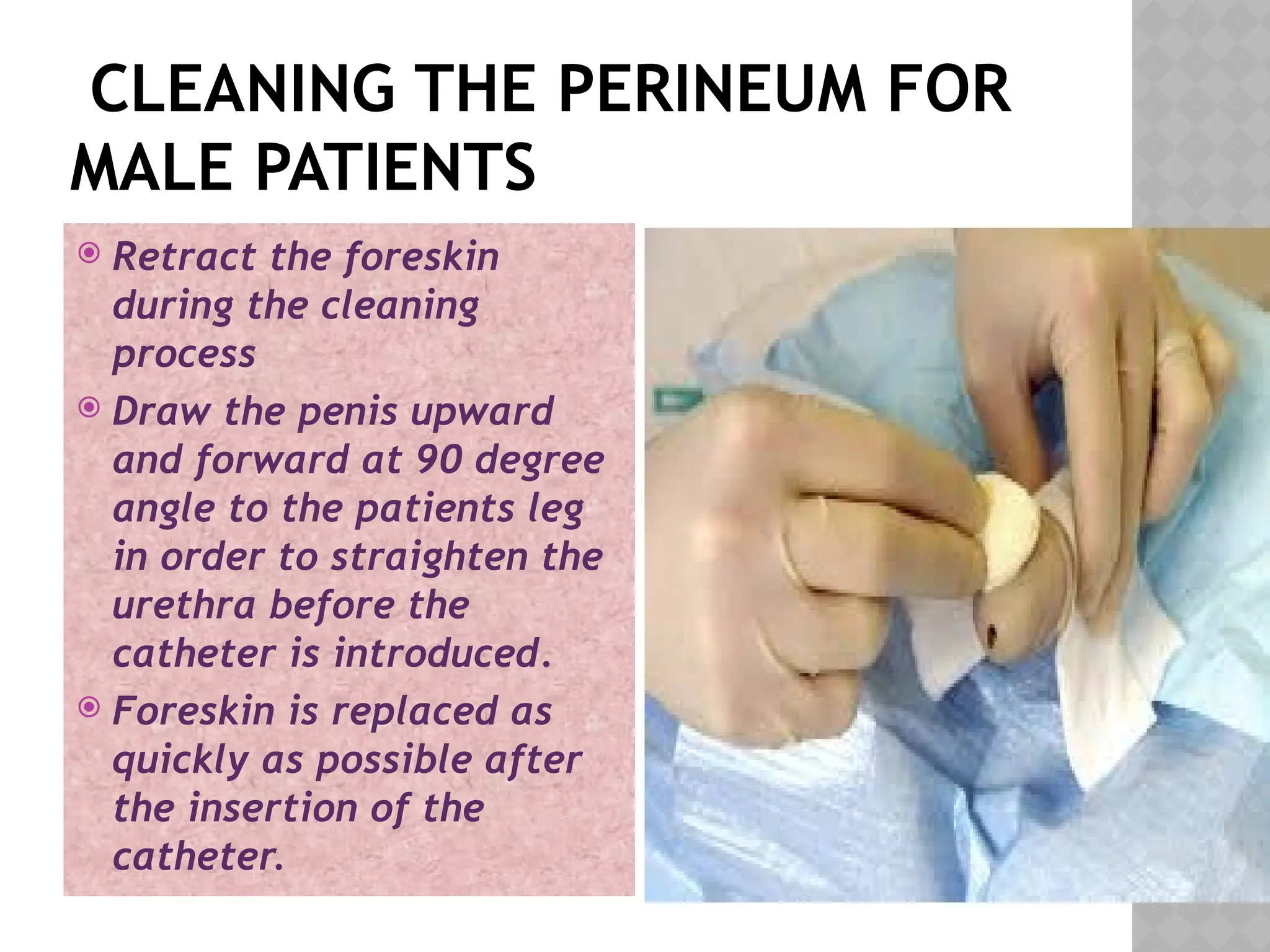
CLEANING THE PERINEUM FOR
MALE PATIENTS
 Retract the foreskin
during the cleaning
process
 Draw the penis upward
and forward at 90 degree
angle to the patients leg
in order to straighten the
urethra before the
catheter is introduced.
 Foreskin is replaced as
quickly as possible after
the insertion of the
catheter.
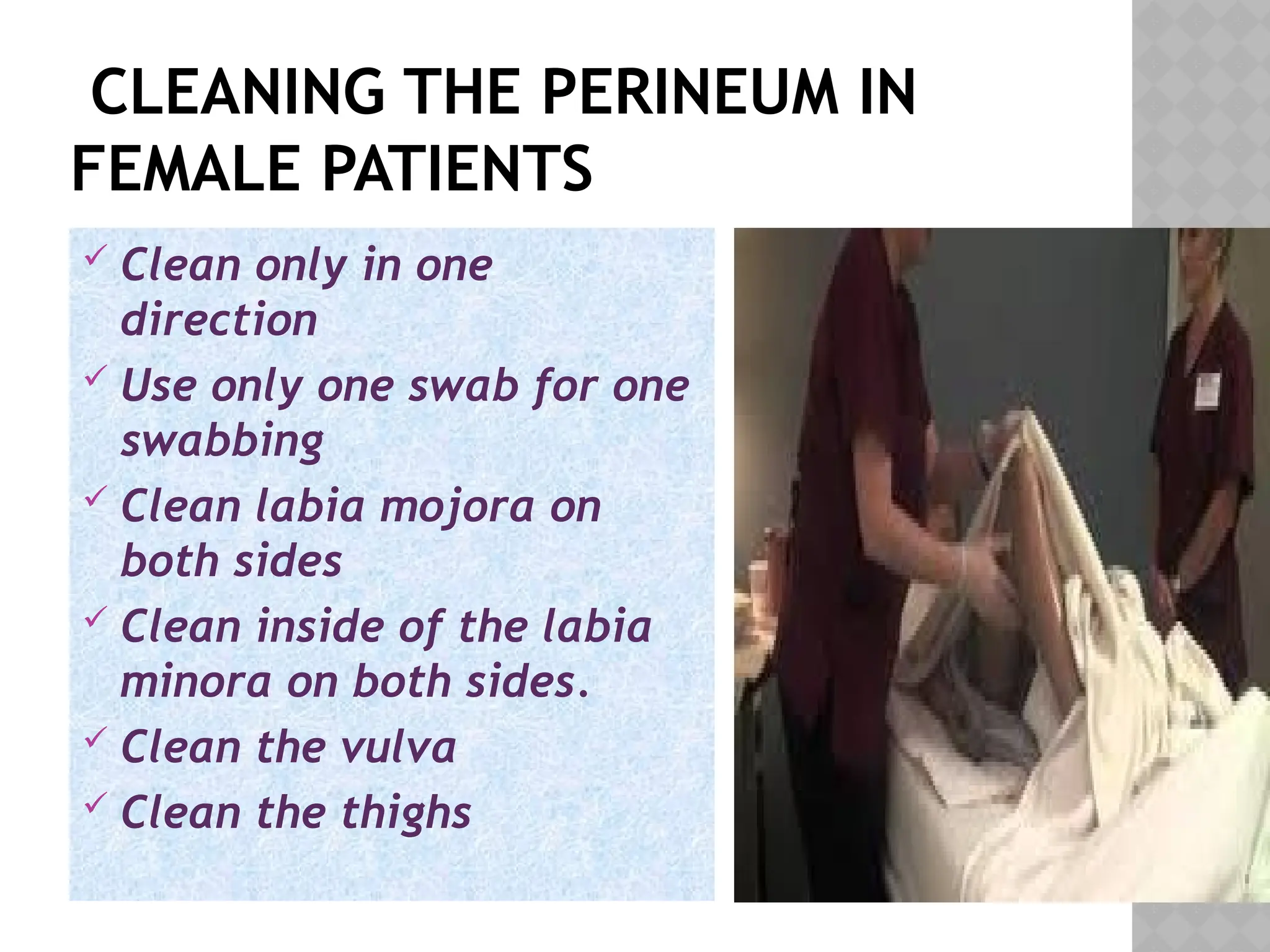
CLEANING THE PERINEUM IN
FEMALE PATIENTS
 Clean only in one
direction
 Use only one swab for one
swabbing
 Clean labia mojora on
both sides
 Clean inside of the labia
minora on both sides.
 Clean the vulva
 Clean the thighs
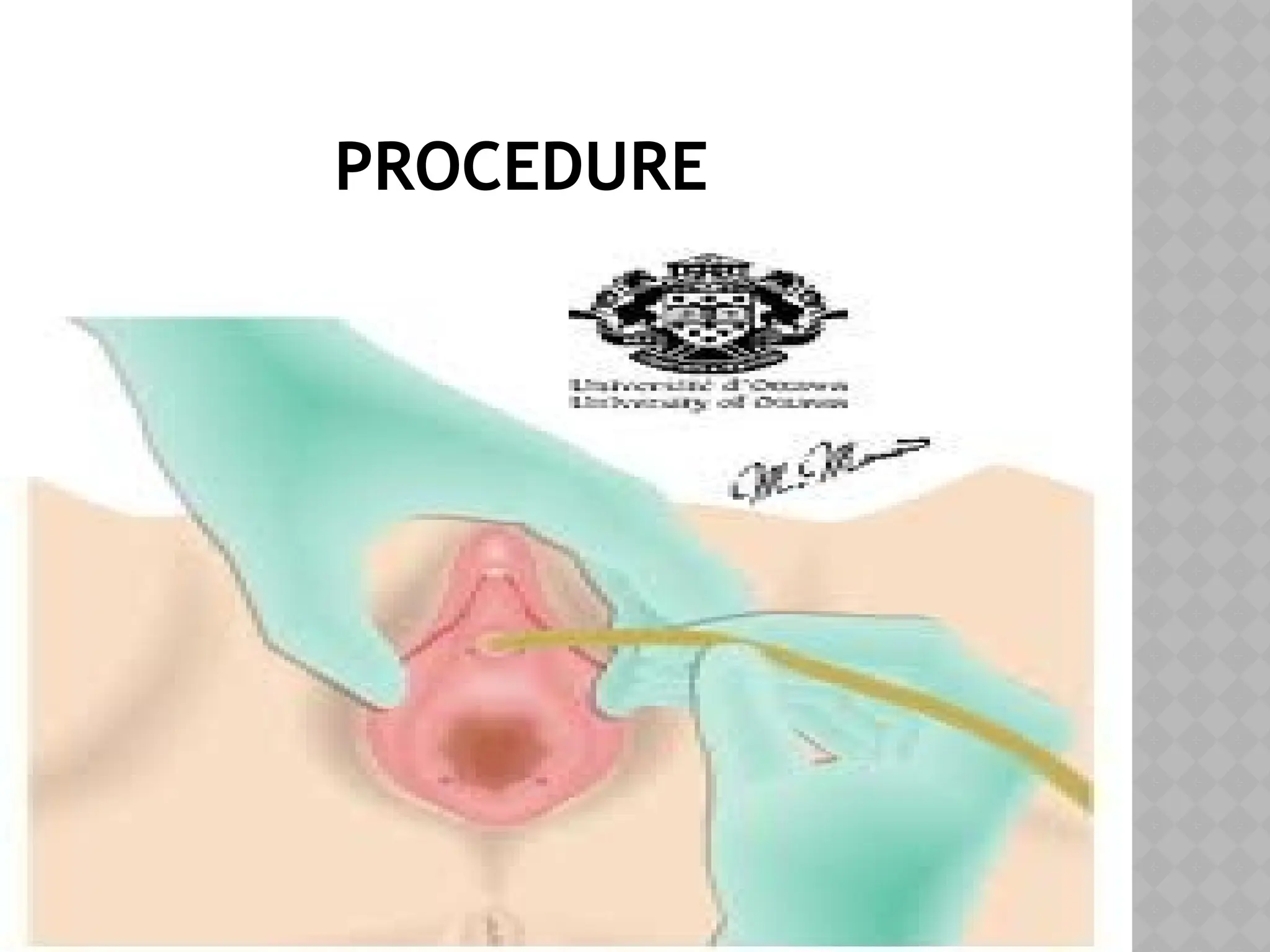
PROCEDURE
PROCEDURE
 Wash hands as for a surgical procedure
 Lift the draping sheet back towards
abdomen
 Open the sterile tray with aseptic
techniques
 Place the sterile towel and the slit in
position.
 Place the sterile kidney tray on the
sterile towel in front of the patient.
 Lubricate the catheter and place it in
the sterile tray ready for insertion.
 Clean the perineum with the cotton balls
dipped in the antiseptic lotion using
forceps.
PROCEDURE CONT....
 Discard the swab in the paper bag and discard the
forceps in an unutterable kidney tray.
 Pick up the catheter with the gloved
hand,holding i about 7.5cm from the tip and
place the distal end in the sterile kidney tray.
 Gently insert the catheter about 5 to 7.5cm in
females,the uine will flow into the kidney tray.
 Collect the urine specimen if required.attach the
drainage tubing if an indwelling catheter is put on
AFTERCARE OF THE
PROCEDURE
 Wash and dry the perineum.
 Remove the drapes,replace
the garments and bed covers.
 Place the patient comfortably
 Take all the articles to the
utility room,clean it and
replace it.
 Send specimen to the lab
immediately
 Wash hands
 Record the procedure on the
nurses record sheet.
BIBLIOGRAPHY
 1.CLEMENT,BASIC CONCEPTS OF NURSING
PROCEDURES,SECOND EDITION,JAYPEE BROTHERS
MEDICAL PUBLISHERS,NEW DELHI.PAGE NO:115-117
 2.PRAKASH,RATNA,MANIPAL MANUAL OF NURSING
PROCEDURES,CBS PUBLISHERS AND
DISTRIBUTORS,PVT LTD.PAGE NO:202-206
 3.SR.NANCY,PRINCIPLES AND PRACTICE OF
NURSING,VOLUME 1,N.R.
BROTHERS,INDORE(2004),PAGE NO:312-316
 4.http://www.google.com
 5.http://www.wikepedia.com
CATHETERIZATION INSERTION PRESENTATION AND DETAIL INFO

CATHETERIZATION INSERTION PRESENTATION AND DETAIL INFO

  • 2.
  • 3.
    INTRODUCTION URINARY CATHETERIZATION is theintroduction of a tube (catheter) through the urethra into the urinary bladder to drain the urine
  • 4.
    DEFINITION Urinary catheterization isan aseptic method of introducing the catheter into the urinary bladder through the external urethra for the withdrawal of urine.
  • 5.
    PURPOSES  To obtaina clear specimen for diagnostic purpose.  To relieve distension of bladder caused by retention of urine.  To determine whether the failure to void is due to retention or suppression  To determine the amount of residual urine present in the bladder.  To empty the bladder prior to surgery,bladder irrigation or before instillation of a drug.
  • 6.
    PURPOSES  To avoidsoiling and infection of the wound following operations on the genital region.  To manage incontinency,when all other measures to prevent skin breakdown have failed.  To provide for intermittent or continuous bladder drainage and irrigation.  To prevent urine from passing over a wound eg:after repair of the perineum
  • 7.
  • 8.
    PRINCIPLES  Pathogenic organisms aretransmitted from the source to a new host directly on by contaminated articles.  Urinary bladder is a sterile cavity and the urinary meatus acts as a portal of entry for pathogenic organisms.  Cleaning of the area minimize the spread of organisms.  A break in the integrity of the skin amd mucus membrane provides ready entrance for microorganisms  Lubrication reduces the friction  Thorough knowledge of the anatomy and physiology of the genito urinary system facilitates catheterization of the urinary bladder
  • 9.
    TYPES OF URINARYCATHETERS I. Intermittent Catheter. An intermittent catheter is used to drain the bladder for short periods (5-10 minutes). It may be inserted by the patient.
  • 10.
    II.Retention/ Indwelling Catheter. This type ofcatheter is placed into the bladder and secured there for a period of time.
  • 11.
    III. Supra Pubic Catheter.This type of catheter is inserted into the bladder through a small incision above the pubic area. It is used for continuous drainage.
  • 12.
    PRELIMINARY ASSESSMENT  CHECK:- Doctors order for any specific precautions  Identify the purpose of catheterization  Level of consciousness  Any contraindications  General condition of the patient  Articles available in the unit.
  • 13.
    PREPARATION OF THEPATIENT AND THE ENVIRONMENT  Explain the sequence of the procedure  Arrange the articles at the bedside locker  Provide privacy  Position the patient in dorsal recumbent position  Place the mackintosh and draw sheet under the buttocks
  • 14.
  • 15.
    EQUIPMENTS A STERILE TRAY CONTAINING:- Catheterof correct size Small bowl containing an antiseptic Cotton swabs Pair of gloves sponge holder  Sterile kidney tray prefilled syringe with sterile water.  Sterile towel,sterile draining tubing and collection bag  Test tube or specimen bottle  Small cup containing lubricant
  • 16.
    A CLEAN TRAYCONTAINING  MACKINTOSH AND TOWEL  BATH BLANKET  KIDNEY TRAY  ADHESIVE TAPE AND SCISSORRS  BEDPAN TO EMPTY THE URINE THE KIDNEY TRAY  MEASURING JAR  UROBAG OR COLLECTION BAG
  • 17.
    CLEANING THE PERINEUMFOR MALE PATIENTS  Retract the foreskin during the cleaning process  Draw the penis upward and forward at 90 degree angle to the patients leg in order to straighten the urethra before the catheter is introduced.  Foreskin is replaced as quickly as possible after the insertion of the catheter.
  • 18.
    CLEANING THE PERINEUMIN FEMALE PATIENTS  Clean only in one direction  Use only one swab for one swabbing  Clean labia mojora on both sides  Clean inside of the labia minora on both sides.  Clean the vulva  Clean the thighs
  • 19.
  • 21.
    PROCEDURE  Wash handsas for a surgical procedure  Lift the draping sheet back towards abdomen  Open the sterile tray with aseptic techniques  Place the sterile towel and the slit in position.  Place the sterile kidney tray on the sterile towel in front of the patient.  Lubricate the catheter and place it in the sterile tray ready for insertion.  Clean the perineum with the cotton balls dipped in the antiseptic lotion using forceps.
  • 22.
    PROCEDURE CONT....  Discardthe swab in the paper bag and discard the forceps in an unutterable kidney tray.  Pick up the catheter with the gloved hand,holding i about 7.5cm from the tip and place the distal end in the sterile kidney tray.  Gently insert the catheter about 5 to 7.5cm in females,the uine will flow into the kidney tray.  Collect the urine specimen if required.attach the drainage tubing if an indwelling catheter is put on
  • 24.
    AFTERCARE OF THE PROCEDURE Wash and dry the perineum.  Remove the drapes,replace the garments and bed covers.  Place the patient comfortably  Take all the articles to the utility room,clean it and replace it.  Send specimen to the lab immediately  Wash hands  Record the procedure on the nurses record sheet.
  • 27.
    BIBLIOGRAPHY  1.CLEMENT,BASIC CONCEPTSOF NURSING PROCEDURES,SECOND EDITION,JAYPEE BROTHERS MEDICAL PUBLISHERS,NEW DELHI.PAGE NO:115-117  2.PRAKASH,RATNA,MANIPAL MANUAL OF NURSING PROCEDURES,CBS PUBLISHERS AND DISTRIBUTORS,PVT LTD.PAGE NO:202-206  3.SR.NANCY,PRINCIPLES AND PRACTICE OF NURSING,VOLUME 1,N.R. BROTHERS,INDORE(2004),PAGE NO:312-316  4.http://www.google.com  5.http://www.wikepedia.com