POORNIMA COLLEGE OF
ENGINEERING
Submitted By :-
Ashish Bhaskar
• INTRODUCTION
• BLACK HOLE
• TYPES OF BLACK HOLE
• FORMATION OF BLACK HOLES
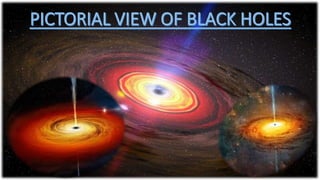
• PICTORIAL VIEW OF BLACK HOLE
• BLACK HOLES NEAR US
• FACTS
INTRODUCTION
• A Black hole is a geometrically defined region of space-time exhibiting such
strong gravitational effects that nothing, including particles and
electromagnetic radiation such as light, can escape from inside it.
• The theory of general relativity predicts that a sufficiently compact mass can
deform space-time to form a black hole.
• The boundary of the region from which no escape is possible is called the
event horizon.
• Although crossing the event horizon has enormous effect on the fate of the
object crossing it, it appears to have no locally detectable features.
• In many ways a black hole acts like an ideal black body, as it reflects no light.
• There might be three types of Black Holes depending on their mass:
• Miniature Black Holes
• No one has ever discovered a miniature Black Hole, which would have a mass much smaller than that of our
Sun.
• But it's possible that miniature black holes could have formed shortly after the "Big Bang,“ which is thought to
have started the universe 13.7 billion years ago.
• Stellar Black Holes
• Stellar Black Holes form when a massive star collapses.
• Supermassive Black Holes
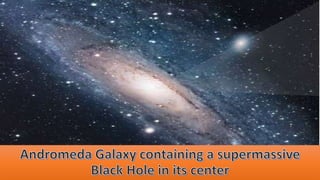
• Supermassive Black Holes which can have a mass equivalent to billions of suns, likely exist in the centers of
most galaxies, including our own galaxy, the Milky Way.
• We don't know exactly how supermassive black holes form, but it's likely that they're a byproduct of galaxy
formation.
• Because of their location in the centers of galaxies, close to many tightly packed stars and gas clouds,
supermassive black holes continue to grow on a steady diet of matter.
• A Black Hole forms when any object reaches a certain critical density, and
its gravity causes it to collapse to an almost infinitely small pinpoint.
• Stellar-mass black holes form when a massive star can no longer produce
energy in its core.
• With the radiation from its nuclear reactions to keep the star "puffed up,"
gravity causes the core to collapse.
• The star's outer layers may blast away into space, or they may collapse
into themselves.
• When a star with massive density collapse into itself, a Black Hole is
formed.
• The closest Black Holes yet discovered are several thousand light-years
away.
• They are so far that they have no effect on Earth or its environment.
• A supermassive black hole appears to inhabit the center of the Milky
Way galaxy, about 27,000 light-years away.
• Although it is several million times the mass of the Sun, its great
distance insures that it won't affect our solar system.
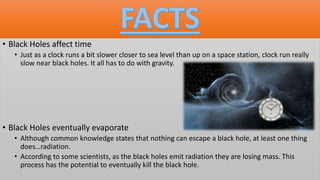
• Black Holes affect time
• Just as a clock runs a bit slower closer to sea level than up on a space station, clock run really
slow near black holes. It all has to do with gravity.
• Black Holes eventually evaporate
• Although common knowledge states that nothing can escape a black hole, at least one thing
does…radiation.
• According to some scientists, as the black holes emit radiation they are losing mass. This
process has the potential to eventually kill the black hole.
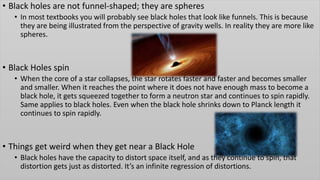
• Black holes are not funnel-shaped; they are spheres
• In most textbooks you will probably see black holes that look like funnels. This is because
they are being illustrated from the perspective of gravity wells. In reality they are more like
spheres.
• Black Holes spin
• When the core of a star collapses, the star rotates faster and faster and becomes smaller
and smaller. When it reaches the point where it does not have enough mass to become a
black hole, it gets squeezed together to form a neutron star and continues to spin rapidly.
Same applies to black holes. Even when the black hole shrinks down to Planck length it
continues to spin rapidly.
• Things get weird when they get near a Black Hole
• Black holes have the capacity to distort space itself, and as they continue to spin, that
distortion gets just as distorted. It’s an infinite regression of distortions.
Black Holes
Black Holes

Black Holes

  • 1.
  • 3.
    • INTRODUCTION • BLACKHOLE • TYPES OF BLACK HOLE • FORMATION OF BLACK HOLES • PICTORIAL VIEW OF BLACK HOLE • BLACK HOLES NEAR US • FACTS
  • 4.
    INTRODUCTION • A Blackhole is a geometrically defined region of space-time exhibiting such strong gravitational effects that nothing, including particles and electromagnetic radiation such as light, can escape from inside it. • The theory of general relativity predicts that a sufficiently compact mass can deform space-time to form a black hole. • The boundary of the region from which no escape is possible is called the event horizon. • Although crossing the event horizon has enormous effect on the fate of the object crossing it, it appears to have no locally detectable features. • In many ways a black hole acts like an ideal black body, as it reflects no light.
  • 5.
    • There mightbe three types of Black Holes depending on their mass: • Miniature Black Holes • No one has ever discovered a miniature Black Hole, which would have a mass much smaller than that of our Sun. • But it's possible that miniature black holes could have formed shortly after the "Big Bang,“ which is thought to have started the universe 13.7 billion years ago. • Stellar Black Holes • Stellar Black Holes form when a massive star collapses. • Supermassive Black Holes • Supermassive Black Holes which can have a mass equivalent to billions of suns, likely exist in the centers of most galaxies, including our own galaxy, the Milky Way. • We don't know exactly how supermassive black holes form, but it's likely that they're a byproduct of galaxy formation. • Because of their location in the centers of galaxies, close to many tightly packed stars and gas clouds, supermassive black holes continue to grow on a steady diet of matter.
  • 6.
    • A BlackHole forms when any object reaches a certain critical density, and its gravity causes it to collapse to an almost infinitely small pinpoint. • Stellar-mass black holes form when a massive star can no longer produce energy in its core. • With the radiation from its nuclear reactions to keep the star "puffed up," gravity causes the core to collapse. • The star's outer layers may blast away into space, or they may collapse into themselves. • When a star with massive density collapse into itself, a Black Hole is formed.
  • 9.
    • The closestBlack Holes yet discovered are several thousand light-years away. • They are so far that they have no effect on Earth or its environment. • A supermassive black hole appears to inhabit the center of the Milky Way galaxy, about 27,000 light-years away. • Although it is several million times the mass of the Sun, its great distance insures that it won't affect our solar system.
  • 10.
    • Black Holesaffect time • Just as a clock runs a bit slower closer to sea level than up on a space station, clock run really slow near black holes. It all has to do with gravity. • Black Holes eventually evaporate • Although common knowledge states that nothing can escape a black hole, at least one thing does…radiation. • According to some scientists, as the black holes emit radiation they are losing mass. This process has the potential to eventually kill the black hole.
  • 11.
    • Black holesare not funnel-shaped; they are spheres • In most textbooks you will probably see black holes that look like funnels. This is because they are being illustrated from the perspective of gravity wells. In reality they are more like spheres. • Black Holes spin • When the core of a star collapses, the star rotates faster and faster and becomes smaller and smaller. When it reaches the point where it does not have enough mass to become a black hole, it gets squeezed together to form a neutron star and continues to spin rapidly. Same applies to black holes. Even when the black hole shrinks down to Planck length it continues to spin rapidly. • Things get weird when they get near a Black Hole • Black holes have the capacity to distort space itself, and as they continue to spin, that distortion gets just as distorted. It’s an infinite regression of distortions.