
Welcome
THE DREAM CATCHERS
Name ID
Mahbubun Nabi Rasel M21421111108
Nazmus Shoeb Jamil M21421111122
TOPIC
Kepler-452B
The Moments Of
Discovery
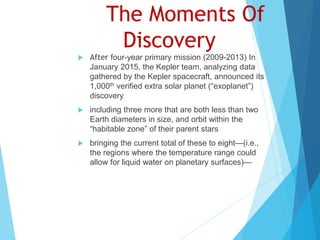
 After four-year primary mission (2009-2013) In
January 2015, the Kepler team, analyzing data
gathered by the Kepler spacecraft, announced its
1,000th verified extra solar planet (“exoplanet”)
discovery
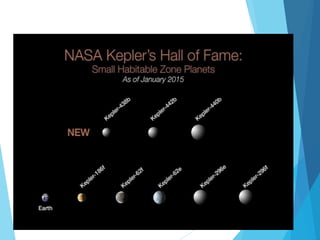
 including three more that are both less than two
Earth diameters in size, and orbit within the
“habitable zone” of their parent stars
 bringing the current total of these to eight—(i.e.,
the regions where the temperature range could
allow for liquid water on planetary surfaces)—
How Are the Discoveries Made?
.
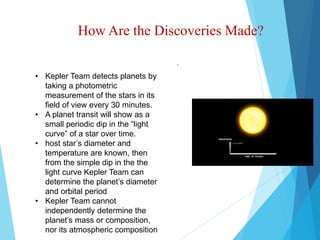
• Kepler Team detects planets by
taking a photometric
measurement of the stars in its
field of view every 30 minutes.
• A planet transit will show as a
small periodic dip in the “light
curve” of a star over time.
• host star’s diameter and
temperature are known, then
from the simple dip in the the
light curve Kepler Team can
determine the planet’s diameter
and orbital period
• Kepler Team cannot
independently determine the
planet’s mass or composition,
nor its atmospheric composition
The Big Picture
.
Kepler’s 1,000 exoplanet
discoveries—and counting—have
demonstrated that planets are
everywhere, and that small
planets are more common than
large ones.
Prior to Kepler, the vast majority of known exoplanets were Neptune-size or
larger. This was a selection bias due to the difficulty of detecting smaller
exoplanets. Kepler can detect, and is detecting, smaller planets not possible
by other methods, and is increasing the odds of finding planets that resemble
Earth.An important goal in the search for exoplanets is to find that “other
Earth”—one of similar size.
What are the Implications?
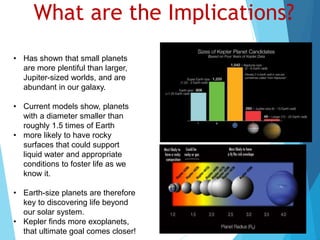
• Has shown that small planets
are more plentiful than larger,
Jupiter-sized worlds, and are
abundant in our galaxy.
• Current models show, planets
with a diameter smaller than
roughly 1.5 times of Earth
• more likely to have rocky
surfaces that could support
liquid water and appropriate
conditions to foster life as we
know it.
• Earth-size planets are therefore
key to discovering life beyond
our solar system.
• Kepler finds more exoplanets,
that ultimate goal comes closer!
Kepler 452 System
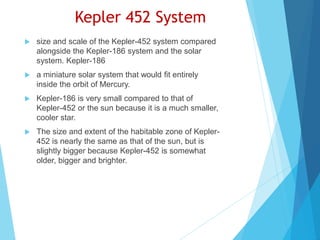
 size and scale of the Kepler-452 system compared
alongside the Kepler-186 system and the solar
system. Kepler-186
 a miniature solar system that would fit entirely
inside the orbit of Mercury.
 Kepler-186 is very small compared to that of
Kepler-452 or the sun because it is a much smaller,
cooler star.
 The size and extent of the habitable zone of Kepler-
452 is nearly the same as that of the sun, but is
slightly bigger because Kepler-452 is somewhat
older, bigger and brighter.
The habitable zone of the orbit
of Kepler-452b is nearly the
same as that of the Earth at 1.05
AU. Kepler-452b orbits its star
once every 385 days
Exoplanets Plotted
 figure plots exoplanet
discoveries on a graph.
showing the size (radius)
versus the orbital period.
 Kepler transit discoveries
as yellow dots. The pink
dots represent transit
discoveries by other
means than Kepler.
 light blue dots represent
discoveries using the
radial velocity method
1 10 100 1000 10000 100000
1
4
10
20
40
2015
OrbitalPeriod[days]
PlanetRadius[Re
] Earth
Neptune
Jupiter
2015
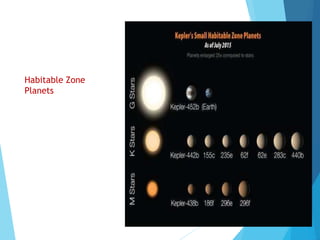
Habitable Zone
Planets
Planets in Habitable Zones
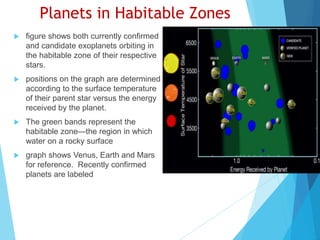
 figure shows both currently confirmed
and candidate exoplanets orbiting in
the habitable zone of their respective
stars.
 positions on the graph are determined
according to the surface temperature
of their parent star versus the energy
received by the planet.
 The green bands represent the
habitable zone—the region in which
water on a rocky surface
 graph shows Venus, Earth and Mars
for reference. Recently confirmed
planets are labeled
Time Duration
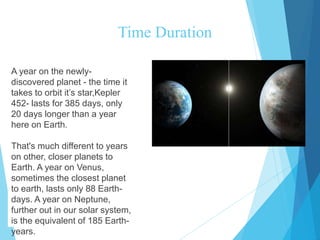
A year on the newly-
discovered planet - the time it
takes to orbit it’s star,Kepler
452- lasts for 385 days, only
20 days longer than a year
here on Earth.
That's much different to years
on other, closer planets to
Earth. A year on Venus,
sometimes the closest planet
to earth, lasts only 88 Earth-
days. A year on Neptune,
further out in our solar system,
is the equivalent of 185 Earth-
years.
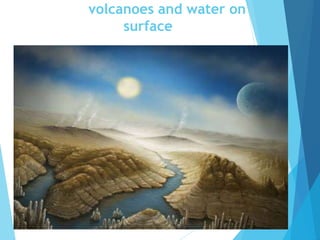
volcanoes and water on
surface
 Kepler 452b is possibly the
right temperature to allow
liquid water to exist on the
surface essential for
supporting life.
 According to John Coughlin,
a researcher at the SETI
Institute in California, the
Kepler team is to find out
the make-up of the planet.
 Due to its size and age, it's
likely that it is a rocky
planet, meaning it could
have a volcanic system
under its surface.
Living In Kepler
 new planet is slightly larger
than Earth
 estimated to have twice the
gravitational pull of our own
planet.
 according to the scientists
on the Kepler team, that
doesn’t mean it couldn’t
support life.
 Jon Jenkins said that
humans could "adapt" to the
gravity, possibly becoming
"more stocky over many
generations."
 "People already adapt to
heavy weights - humans are
built to do this kind of thing.
The human body has an
amazing ability to repair
itself.
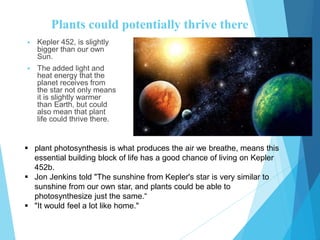
Plants could potentially thrive there
 Kepler 452, is slightly
bigger than our own
Sun.
 The added light and
heat energy that the
planet receives from
the star not only means
it is slightly warmer
than Earth, but could
also mean that plant
life could thrive there.
 plant photosynthesis is what produces the air we breathe, means this
essential building block of life has a good chance of living on Kepler
452b.
 Jon Jenkins told "The sunshine from Kepler's star is very similar to
sunshine from our own star, and plants could be able to
photosynthesize just the same.“
 "It would feel a lot like home."
Pretty much impossible to get there
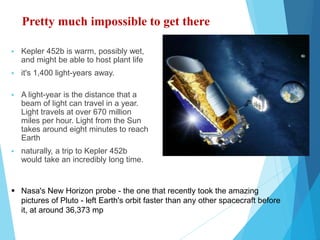
 Kepler 452b is warm, possibly wet,
and might be able to host plant life
 it's 1,400 light-years away.
 A light-year is the distance that a
beam of light can travel in a year.
Light travels at over 670 million
miles per hour. Light from the Sun
takes around eight minutes to reach
Earth
 naturally, a trip to Kepler 452b
would take an incredibly long time.
 Nasa's New Horizon probe - the one that recently took the amazing
pictures of Pluto - left Earth's orbit faster than any other spacecraft before
it, at around 36,373 mp
THANK YOU
ANY QUESTIONS?

Presentation on Kepler

  • 1.
  • 2.
    THE DREAM CATCHERS NameID Mahbubun Nabi Rasel M21421111108 Nazmus Shoeb Jamil M21421111122
  • 3.
  • 4.
    The Moments Of Discovery After four-year primary mission (2009-2013) In January 2015, the Kepler team, analyzing data gathered by the Kepler spacecraft, announced its 1,000th verified extra solar planet (“exoplanet”) discovery  including three more that are both less than two Earth diameters in size, and orbit within the “habitable zone” of their parent stars  bringing the current total of these to eight—(i.e., the regions where the temperature range could allow for liquid water on planetary surfaces)—
  • 6.
    How Are theDiscoveries Made? . • Kepler Team detects planets by taking a photometric measurement of the stars in its field of view every 30 minutes. • A planet transit will show as a small periodic dip in the “light curve” of a star over time. • host star’s diameter and temperature are known, then from the simple dip in the the light curve Kepler Team can determine the planet’s diameter and orbital period • Kepler Team cannot independently determine the planet’s mass or composition, nor its atmospheric composition
  • 7.
    The Big Picture . Kepler’s1,000 exoplanet discoveries—and counting—have demonstrated that planets are everywhere, and that small planets are more common than large ones. Prior to Kepler, the vast majority of known exoplanets were Neptune-size or larger. This was a selection bias due to the difficulty of detecting smaller exoplanets. Kepler can detect, and is detecting, smaller planets not possible by other methods, and is increasing the odds of finding planets that resemble Earth.An important goal in the search for exoplanets is to find that “other Earth”—one of similar size.
  • 8.
    What are theImplications? • Has shown that small planets are more plentiful than larger, Jupiter-sized worlds, and are abundant in our galaxy. • Current models show, planets with a diameter smaller than roughly 1.5 times of Earth • more likely to have rocky surfaces that could support liquid water and appropriate conditions to foster life as we know it. • Earth-size planets are therefore key to discovering life beyond our solar system. • Kepler finds more exoplanets, that ultimate goal comes closer!
  • 9.
    Kepler 452 System size and scale of the Kepler-452 system compared alongside the Kepler-186 system and the solar system. Kepler-186  a miniature solar system that would fit entirely inside the orbit of Mercury.  Kepler-186 is very small compared to that of Kepler-452 or the sun because it is a much smaller, cooler star.  The size and extent of the habitable zone of Kepler- 452 is nearly the same as that of the sun, but is slightly bigger because Kepler-452 is somewhat older, bigger and brighter.
  • 10.
    The habitable zoneof the orbit of Kepler-452b is nearly the same as that of the Earth at 1.05 AU. Kepler-452b orbits its star once every 385 days
  • 11.
    Exoplanets Plotted  figureplots exoplanet discoveries on a graph. showing the size (radius) versus the orbital period.  Kepler transit discoveries as yellow dots. The pink dots represent transit discoveries by other means than Kepler.  light blue dots represent discoveries using the radial velocity method 1 10 100 1000 10000 100000 1 4 10 20 40 2015 OrbitalPeriod[days] PlanetRadius[Re ] Earth Neptune Jupiter 2015
  • 12.
  • 13.
    Planets in HabitableZones  figure shows both currently confirmed and candidate exoplanets orbiting in the habitable zone of their respective stars.  positions on the graph are determined according to the surface temperature of their parent star versus the energy received by the planet.  The green bands represent the habitable zone—the region in which water on a rocky surface  graph shows Venus, Earth and Mars for reference. Recently confirmed planets are labeled
  • 14.
    Time Duration A yearon the newly- discovered planet - the time it takes to orbit it’s star,Kepler 452- lasts for 385 days, only 20 days longer than a year here on Earth. That's much different to years on other, closer planets to Earth. A year on Venus, sometimes the closest planet to earth, lasts only 88 Earth- days. A year on Neptune, further out in our solar system, is the equivalent of 185 Earth- years.
  • 15.
  • 16.
     Kepler 452bis possibly the right temperature to allow liquid water to exist on the surface essential for supporting life.  According to John Coughlin, a researcher at the SETI Institute in California, the Kepler team is to find out the make-up of the planet.  Due to its size and age, it's likely that it is a rocky planet, meaning it could have a volcanic system under its surface.
  • 17.
    Living In Kepler new planet is slightly larger than Earth  estimated to have twice the gravitational pull of our own planet.  according to the scientists on the Kepler team, that doesn’t mean it couldn’t support life.  Jon Jenkins said that humans could "adapt" to the gravity, possibly becoming "more stocky over many generations."
  • 18.
     "People alreadyadapt to heavy weights - humans are built to do this kind of thing. The human body has an amazing ability to repair itself.
  • 19.
    Plants could potentiallythrive there  Kepler 452, is slightly bigger than our own Sun.  The added light and heat energy that the planet receives from the star not only means it is slightly warmer than Earth, but could also mean that plant life could thrive there.  plant photosynthesis is what produces the air we breathe, means this essential building block of life has a good chance of living on Kepler 452b.  Jon Jenkins told "The sunshine from Kepler's star is very similar to sunshine from our own star, and plants could be able to photosynthesize just the same.“  "It would feel a lot like home."
  • 20.
    Pretty much impossibleto get there  Kepler 452b is warm, possibly wet, and might be able to host plant life  it's 1,400 light-years away.  A light-year is the distance that a beam of light can travel in a year. Light travels at over 670 million miles per hour. Light from the Sun takes around eight minutes to reach Earth  naturally, a trip to Kepler 452b would take an incredibly long time.  Nasa's New Horizon probe - the one that recently took the amazing pictures of Pluto - left Earth's orbit faster than any other spacecraft before it, at around 36,373 mp
  • 21.