Hole
1. Introduction to Black Holes
2. What are Black Holes?
3. How are Black Holes created?
4. Types of Black Holes.
5. Parts of Black Holes.
6. Spaguettification
1.INTRODUCTION
The first time the idea of a black hole
was suggested was in the late 1790´s
by John Michell of England and Pierre-
Simon Laplace of France. They both
proposed the idea of the existence of
an “invisible star” by applying the first
Newton Law. They calculated its mass
and size, which is now called the
“event horizon” that an object would
need in order to be faster than even
the speed of light. Later, in 1915,
Einstein predicted the existence of
black holes with his general relativity
theory. After that, in 1967, John
Wheeler, an American theoretical
physicist, applied the term of black
holes to what it means now.
2.WHAT ARE BLACK HOLES?
A black hole is a great amount of matter packed in a very small area. It
is a place in space which has such a big gravitational field, that
nothing, not even light can escape. Scientists can’t directly observe
black holes, and the only way to perceive them is by detecting their
effect on other matter nearby. As the attracted matter accelerates &
heats up, it emits x-rays that radiate into space, emitting powerful
gamma rays bursts, which devour nearby stars.
3.How are Black Holes created?
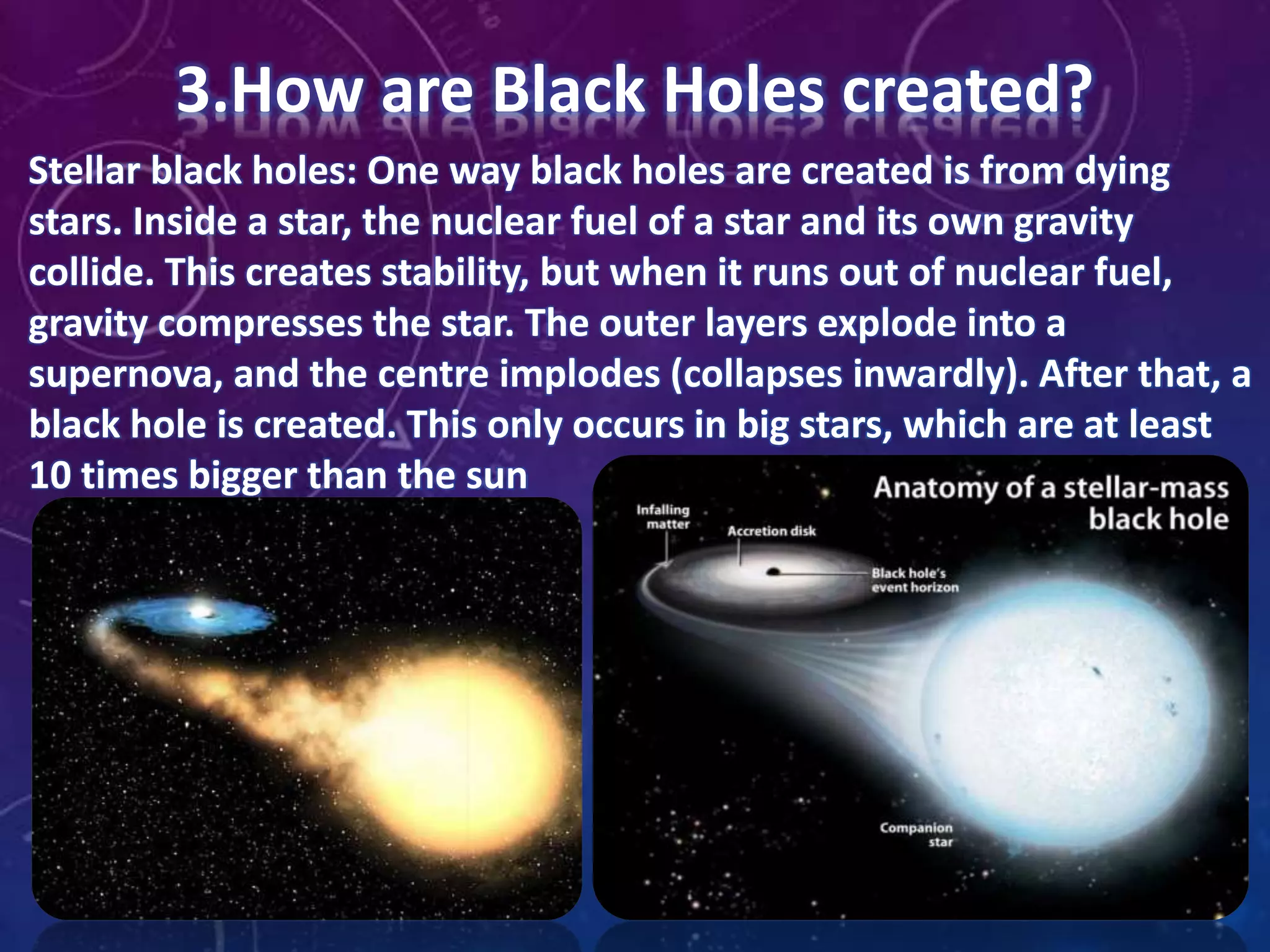
Stellar black holes: One way black holes are created is from dying
stars. Inside a star, the nuclear fuel of a star and its own gravity
collide. This creates stability, but when it runs out of nuclear fuel,
gravity compresses the star. The outer layers explode into a
supernova, and the centre implodes (collapses inwardly). After that, a
black hole is created. This only occurs in big stars, which are at least
10 times bigger than the sun
3.Types of Black Holes.
A. Miniature Black Hole
These type of black holes have
event horizons as small as atomic
particles. Physicists suggest that
these were created during the Big
Bang. Miniature black holes were
created more than 10 billion years
ago, and they compressed into a
really small point, which later
exploded and created a massive
explosion.
B. Super Massive Black Hole
Fast-moving gas jets and
gravitational forces are equal
to 10 billion suns compressed
together. These are what we
call super massive black
holes. Their event horizon is
an imaginary sphere around
them which nothing can
escape. When matter enters
the black hole, it increases in
size, reaching other matter
which it could not absorb
before.
ACCORDING TO ITS PHYSICAL
PROPERTIES:
The Schwarzschild black hole, which has no
charge, or rotation, the simplest type of black
hole that exists. The Reissner-Nordstrom black
hole, which does not rotate, but which has
electrical charge. The Kerr-Newman black hole,
which has charge and rotates. The Kerr black
hole, which rotates and does not have charge
inside.
White Holes
White holes are not proved
to exist. A White hole is
considered to be the exact
opposite of a black hole. It
cannot absorb matter, it can
only expulse it. It is
considered by some
physicists to be the
mathematical answer to the
general equations of
relativity.
Worm Holes
If white holes actually
existed, then, we would
also see the appearance of
a wormhole. A wormhole is
the combination of a black
hole and a wormhole.
Wormholes would make
matter enter through the
black hole, and appear
again through the white
hole, because as they are
too close to each other,
Spaguettification would not
happen.
5.Parts Of Black Hole.
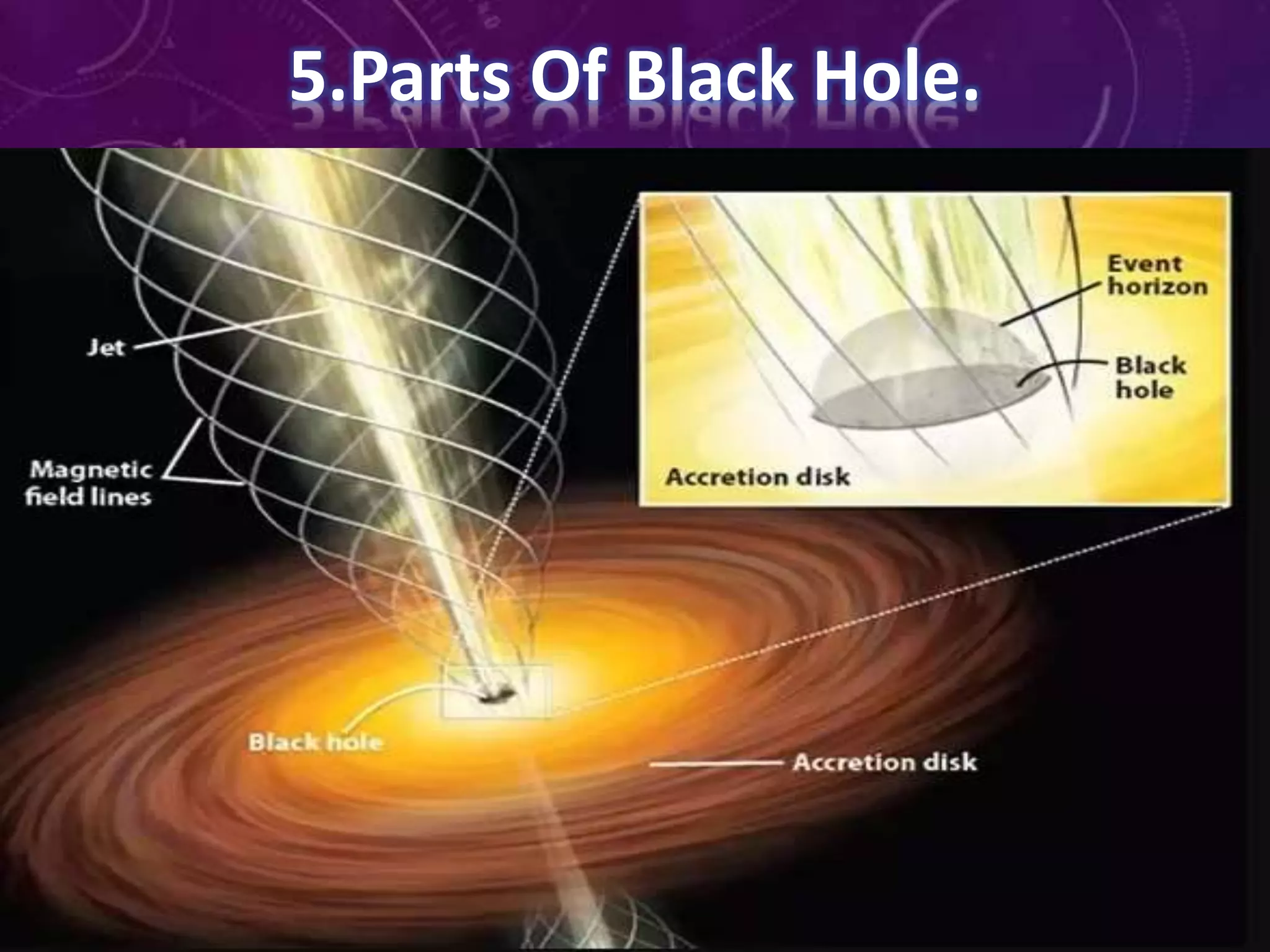
: This is the part of the
Black hole where nothing can get out. It is
Usually defined as a big sphere that
Surrounds the black hole, and which
absorbs any material including light. Some
theories say that only radiation can escape
this area.
: This is the part of a black
Hole in which all the mass of the black
hole has been compressed to a very small
space. As a result, the Singularity has
almost infinite density.
: This is a disk
that is composed by stellar
material, which goes around
the black hole, forming a spiral.
: If a black hole
is rotating, as it spins, its mass
causes the space and time to
rotate around it.
: the photon
sphere is a place in which gravity
is so high that photons have to
travel around the black Holes‘
orbit. It is the place in which light
Is forced to stay inside the black
hole.
: This is
the Event horizon´s radius. It is the
radius at which the escape
velocity is equal to the speed of
light.Is the event’s horizon radius.
Its formula is:
R=2GM/c2
: In some black holes, there is such high intensity
that magnetic fields are emitted perpendicular to the accretion
disk. Due to this, some charged particles have to go around the
black hole, because it is in a magnetic field.
6.spaghettification
In Astrophysics, this term refers to the effect a black Hole
imposes on a body or matter. The term was
proposed by Stephen Hawkins in his book “A Brief History Of
Time “,where he compared this effect to spaghettis,
saying that you are stretched, and you turn so thin that you
Break apart, and transform into matter.
Curious Facts About Black Hole
1.They can explode (only the smaller ones).
2.They fire Intergalactic Death Rays .
3.It is not their mass, it is their size what
matters.
4.Black holes distort Space-Time.
5.Objects appear to ‘freeze’ near a Black Hole.
6.Black Holes eventually evaporate over time.
Real Photo Of
Black Hole
After Coloring
Different matters.

Black hole

  • 1.
  • 2.
    1. Introduction toBlack Holes 2. What are Black Holes? 3. How are Black Holes created? 4. Types of Black Holes. 5. Parts of Black Holes. 6. Spaguettification
  • 3.
    1.INTRODUCTION The first timethe idea of a black hole was suggested was in the late 1790´s by John Michell of England and Pierre- Simon Laplace of France. They both proposed the idea of the existence of an “invisible star” by applying the first Newton Law. They calculated its mass and size, which is now called the “event horizon” that an object would need in order to be faster than even the speed of light. Later, in 1915, Einstein predicted the existence of black holes with his general relativity theory. After that, in 1967, John Wheeler, an American theoretical physicist, applied the term of black holes to what it means now.
  • 4.
    2.WHAT ARE BLACKHOLES? A black hole is a great amount of matter packed in a very small area. It is a place in space which has such a big gravitational field, that nothing, not even light can escape. Scientists can’t directly observe black holes, and the only way to perceive them is by detecting their effect on other matter nearby. As the attracted matter accelerates & heats up, it emits x-rays that radiate into space, emitting powerful gamma rays bursts, which devour nearby stars.
  • 5.
    3.How are BlackHoles created? Stellar black holes: One way black holes are created is from dying stars. Inside a star, the nuclear fuel of a star and its own gravity collide. This creates stability, but when it runs out of nuclear fuel, gravity compresses the star. The outer layers explode into a supernova, and the centre implodes (collapses inwardly). After that, a black hole is created. This only occurs in big stars, which are at least 10 times bigger than the sun
  • 6.
    3.Types of BlackHoles. A. Miniature Black Hole These type of black holes have event horizons as small as atomic particles. Physicists suggest that these were created during the Big Bang. Miniature black holes were created more than 10 billion years ago, and they compressed into a really small point, which later exploded and created a massive explosion.
  • 7.
    B. Super MassiveBlack Hole Fast-moving gas jets and gravitational forces are equal to 10 billion suns compressed together. These are what we call super massive black holes. Their event horizon is an imaginary sphere around them which nothing can escape. When matter enters the black hole, it increases in size, reaching other matter which it could not absorb before.
  • 8.
    ACCORDING TO ITSPHYSICAL PROPERTIES: The Schwarzschild black hole, which has no charge, or rotation, the simplest type of black hole that exists. The Reissner-Nordstrom black hole, which does not rotate, but which has electrical charge. The Kerr-Newman black hole, which has charge and rotates. The Kerr black hole, which rotates and does not have charge inside.
  • 9.
    White Holes White holesare not proved to exist. A White hole is considered to be the exact opposite of a black hole. It cannot absorb matter, it can only expulse it. It is considered by some physicists to be the mathematical answer to the general equations of relativity. Worm Holes If white holes actually existed, then, we would also see the appearance of a wormhole. A wormhole is the combination of a black hole and a wormhole. Wormholes would make matter enter through the black hole, and appear again through the white hole, because as they are too close to each other, Spaguettification would not happen.
  • 10.
  • 11.
    : This isthe part of the Black hole where nothing can get out. It is Usually defined as a big sphere that Surrounds the black hole, and which absorbs any material including light. Some theories say that only radiation can escape this area. : This is the part of a black Hole in which all the mass of the black hole has been compressed to a very small space. As a result, the Singularity has almost infinite density.
  • 12.
    : This isa disk that is composed by stellar material, which goes around the black hole, forming a spiral. : If a black hole is rotating, as it spins, its mass causes the space and time to rotate around it.
  • 13.
    : the photon sphereis a place in which gravity is so high that photons have to travel around the black Holes‘ orbit. It is the place in which light Is forced to stay inside the black hole. : This is the Event horizon´s radius. It is the radius at which the escape velocity is equal to the speed of light.Is the event’s horizon radius. Its formula is: R=2GM/c2
  • 14.
    : In someblack holes, there is such high intensity that magnetic fields are emitted perpendicular to the accretion disk. Due to this, some charged particles have to go around the black hole, because it is in a magnetic field.
  • 15.
    6.spaghettification In Astrophysics, thisterm refers to the effect a black Hole imposes on a body or matter. The term was proposed by Stephen Hawkins in his book “A Brief History Of Time “,where he compared this effect to spaghettis, saying that you are stretched, and you turn so thin that you Break apart, and transform into matter.
  • 16.
    Curious Facts AboutBlack Hole 1.They can explode (only the smaller ones). 2.They fire Intergalactic Death Rays . 3.It is not their mass, it is their size what matters. 4.Black holes distort Space-Time. 5.Objects appear to ‘freeze’ near a Black Hole. 6.Black Holes eventually evaporate over time.
  • 17.
    Real Photo Of BlackHole After Coloring Different matters.