This document discusses black box testing, which involves testing software without knowledge of its internal implementation. Key points made include:
- Black box testing focuses on a system's external behavior and functionality as defined by requirements and specifications.
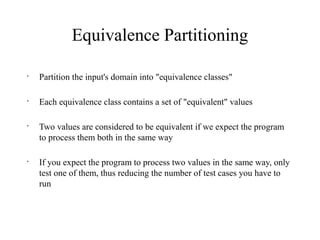
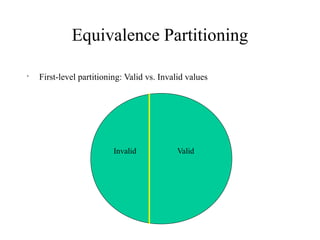
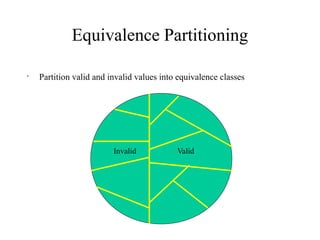
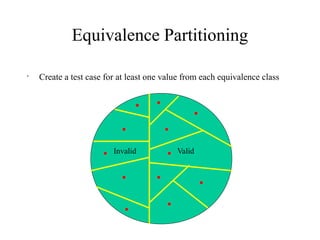
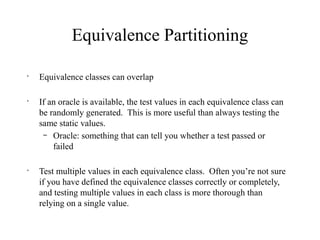
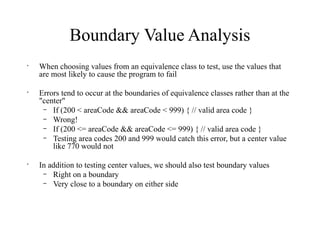
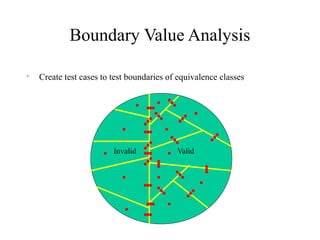
- Equivalence partitioning and boundary value analysis are techniques to reduce the number of test cases by grouping inputs into classes and focusing on boundary values.
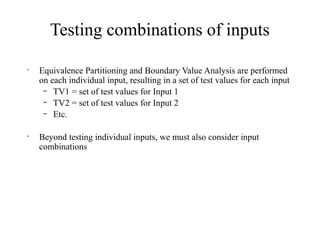
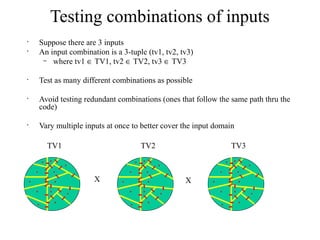
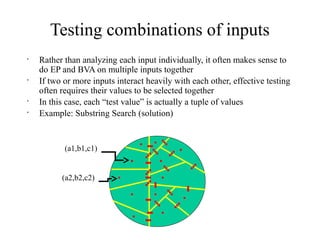
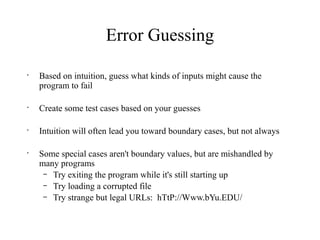
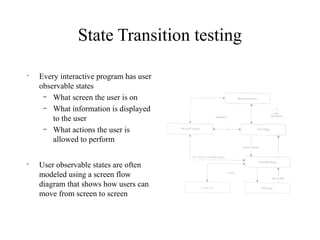
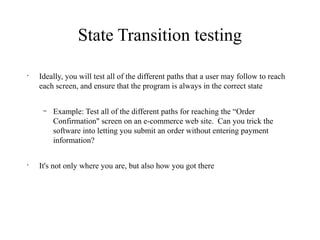
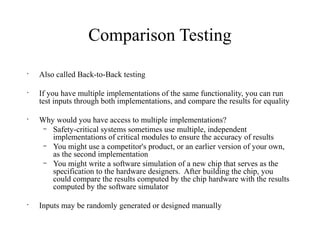
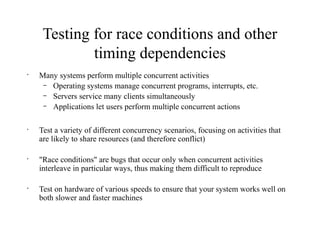
- Combinations of inputs should be tested, not just individual inputs. Other techniques mentioned include error guessing, state transition testing, comparison testing, and testing for timing dependencies.
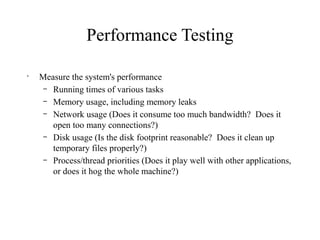
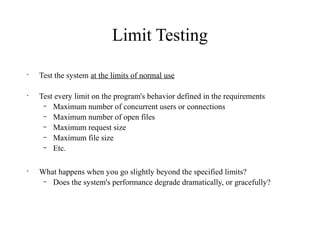
- Black box testing is also used to evaluate usability, performance, security, recovery, configuration, and more. The goal is to exercise the system's full
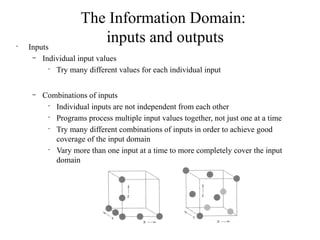
![Equivalence Partitioning - examples
Input Valid Equivalence Classes Invalid Equivalence Classes
A integer N such that:
-99 <= N <= 99
? ?
Phone Number
Area code: [200, 999]
Prefix: (200, 999]
Suffix: Any 4 digits
? ?](https://image.slidesharecdn.com/blackboxtesting-150710103048-lva1-app6891/85/Black-boxtesting-13-320.jpg)
![Equivalence Partitioning - examples
Input Valid Equivalence Classes Invalid Equivalence Classes
A integer N such that:
-99 <= N <= 99
[-99, -10]
[-9, -1]
0
[1, 9]
[10, 99]
?
Phone Number
Area code: [200, 999]
Prefix: (200, 999]
Suffix: Any 4 digits
? ?](https://image.slidesharecdn.com/blackboxtesting-150710103048-lva1-app6891/85/Black-boxtesting-14-320.jpg)
![Equivalence Partitioning - examples
Input Valid Equivalence Classes Invalid Equivalence Classes
A integer N such that:
-99 <= N <= 99
[-99, -10]
[-9, -1]
0
[1, 9]
[10, 99]
< -99
> 99
Malformed numbers
{12-, 1-2-3, …}
Non-numeric strings
{junk, 1E2, $13}
Empty value
Phone Number
Area code: [200, 999]
Prefix: (200, 999]
Suffix: Any 4 digits
? ?](https://image.slidesharecdn.com/blackboxtesting-150710103048-lva1-app6891/85/Black-boxtesting-15-320.jpg)
![Equivalence Partitioning - examples
Input Valid Equivalence Classes Invalid Equivalence Classes
A integer N such that:
-99 <= N <= 99
[-99, -10]
[-9, -1]
0
[1, 9]
[10, 99]
< -99
> 99
Malformed numbers
{12-, 1-2-3, …}
Non-numeric strings
{junk, 1E2, $13}
Empty value
Phone Number
Area code: [200, 999]
Prefix: (200, 999]
Suffix: Any 4 digits
555-5555
(555)555-5555
555-555-5555
200 <= Area code <= 999
200 < Prefix <= 999
?](https://image.slidesharecdn.com/blackboxtesting-150710103048-lva1-app6891/85/Black-boxtesting-16-320.jpg)
![Equivalence Partitioning - examples
Input Valid Equivalence Classes Invalid Equivalence Classes
A integer N such that:
-99 <= N <= 99
[-99, -10]
[-9, -1]
0
[1, 9]
[10, 99]
< -99
> 99
Malformed numbers
{12-, 1-2-3, …}
Non-numeric strings
{junk, 1E2, $13}
Empty value
Phone Number
Area code: [200, 999]
Prefix: (200, 999]
Suffix: Any 4 digits
555-5555
(555)555-5555
555-555-5555
200 <= Area code <= 999
200 < Prefix <= 999
Invalid format 5555555,
(555)(555)5555, etc.
Area code < 200 or > 999
Area code with non-numeric
characters
Similar for Prefix and Suffix](https://image.slidesharecdn.com/blackboxtesting-150710103048-lva1-app6891/85/Black-boxtesting-17-320.jpg)
![Boundary Value Analysis - examples
Input Boundary Cases
A number N such that:
-99 <= N <= 99
?
Phone Number
Area code: [200, 999]
Prefix: (200, 999]
Suffix: Any 4 digits
?](https://image.slidesharecdn.com/blackboxtesting-150710103048-lva1-app6891/85/Black-boxtesting-20-320.jpg)
![Boundary Value Analysis - examples
Input Boundary Cases
A number N such that:
-99 <= N <= 99
-100, -99, -98
-10, -9
-1, 0, 1
9, 10
98, 99, 100
Phone Number
Area code: [200, 999]
Prefix: (200, 999]
Suffix: Any 4 digits
?](https://image.slidesharecdn.com/blackboxtesting-150710103048-lva1-app6891/85/Black-boxtesting-21-320.jpg)
![Boundary Value Analysis - examples
Input Boundary Cases
A number N such that:
-99 <= N <= 99
-100, -99, -98
-10, -9
-1, 0, 1
9, 10
98, 99, 100
Phone Number
Area code: [200, 999]
Prefix: (200, 999]
Suffix: Any 4 digits
Area code: 199, 200, 201
Area code: 998, 999, 1000
Prefix: 200, 199, 198
Prefix: 998, 999, 1000
Suffix: 3 digits, 5 digits](https://image.slidesharecdn.com/blackboxtesting-150710103048-lva1-app6891/85/Black-boxtesting-22-320.jpg)
![Boundary Value Analysis - examples
•
Numeric values are often entered as strings which are then converted to
numbers internally [int x = atoi(str);]
•
This conversion requires the program to distinguish between digits and
non-digits
•
A boundary case to consider: Will the program accept / and : as digits?
/ 0 1 2 3 4 5 6 7 8 9 :
47 48 49 50 51 52 53 54 55 56 57 58
Char
ASCII](https://image.slidesharecdn.com/blackboxtesting-150710103048-lva1-app6891/85/Black-boxtesting-23-320.jpg)