• Requirements-based testing
• Positive and negative testing
• Boundary value analysis
• Decision tables
• Equivalence partitioning
• State-based testing
• Compatibility testing
• User documentation testing
• Domain testing (leads to ad hoc testing)
Techniques / Methodologies of Black Box
Testing
• black box with well- defined inputs and outputs, a good
approach to selecting test inputs is to use a method
called equivalence class partitioning
• important points related to equivalence class partitioning
• The tester must consider both valid and invalid
equivalence classes.
• Equivalence classes may also be selected for output
conditions.
• The derivation of input or outputs equivalence classes is
a heuristic process
• In some cases it is difficult for the tester to identify
equivalence classes. The conditions/boundaries that help
to define classes may be absent,
Equivalence Class Partitioning
• If an input condition for the software-under-test is specified
as a range of values, select one valid equivalence class that
covers the allowed range and two invalid equivalence
classes, one outside each end of the range.
• valid equivalence class that contains all the members of the
set and one invalid equivalence class for any value outside
the set.‘‘
• If an input condition for the software-under-test is specified
as a “must be” condition, select one valid equivalence class
to represent the must be condition and one invalid class
that does not include the “must be condition”
List of Conditions
• If an input condition for the software-under-test is specified
as a set of valid input values, then select one valid
equivalence class that contains all the members of the set
and one invalid equivalence class for any value outside the
set
• equivalence class is not handled - then the class should be
further partitioned into smaller equivalence classes.‘‘
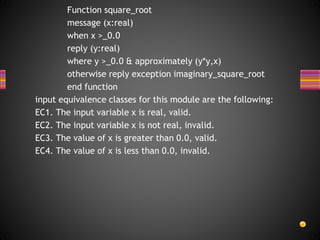
Function square_root
message (x:real)
when x >_0.0
reply (y:real)
where y >_0.0 & approximately (y*y,x)
otherwise reply exception imaginary_square_root
end function
input equivalence classes for this module are the following:
EC1. The input variable x is real, valid.
EC2. The input variable x is not real, invalid.
EC3. The value of x is greater than 0.0, valid.
EC4. The value of x is less than 0.0, invalid.
After the equivalence classes have been identified the next
step in test case design - following steps.
• Each equivalence class should be assigned a unique
identifier.
• Develop test cases for all valid equivalence classes until all
have been covered by (included in) a test case.
• Develop test cases for all invalid equivalence classes until
all have been covered individually.
• The test cases developed based on equivalence class
partitioning can be strengthened by use of an
technique called boundary value analysis.
• The rules-of-thumb
– If an input condition for the software-under-test is
specified as a range of values, develop valid test
cases for the ends of the range, and invalid test
cases for possibilities just above and below the
ends of the range.
– If an input condition for the software-under-test is
specified as a number of values, develop valid test
cases for the minimum and maximum numbers as
well as invalid test cases that include one lesser and
one greater than the maximum and minimum.
Boundary value analysis (Eg : unit payment)
• If the input or output of the software-under-test
is an ordered set, such as a table or a linear list,
develop tests that focus on the first and last
elements of the set. It is important for the tester
to keep in mind that equivalence class
partitioning and boundary value analysis apply
to testing both inputs and output.
–Positive testing checks the product
with collection of expected output.
–Negative task demonstrate that the
product doesn't fail when
unexpected data is given
Positive & Negative testing
• List of decision variable
• Condition for every decision variable
• Actions to be done in each
combination of condition.
Decision Table (Tax/ Claims)
• Decision variable found
• Find the values of every decision variable
• Create the combination of values of decision variables
• Identify the cases when values assumed by a variable are
immaterial for the given combination - denoted by “don’t
care” symbol.
• From a table, listing in each, the last column list the action
item expressed in boolean – “true , false r don’t care”.
Decision table creation - steps
• Internal configuration of a system or component
• It is based on the concepts of states and finite-state
machines.
• A state is an internal configuration of a system or
component. It is defined in terms of the values
assumed at a particular time for the variables that
characterize the system or component.
• A finite-state machine is an abstract machine that
can be represented by a state graph having a finite
number of states and a finite number of transitions
between states.
State based / Graph based testing
• Can be started with an optimal sign
• Optimal sign should be followed by any number
of digits
• The digits are followed by decimal points
• When decimal point is viewed, then there
should be two digits after the decimal
• If any number comes without decimal point then
it may be ended by a blank.
Rules
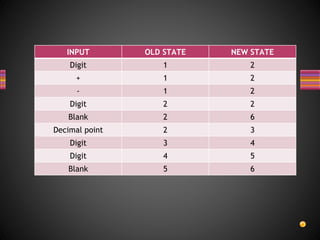
INPUT OLD STATE NEW STATE
Digit 1 2
+ 1 2
- 1 2
Digit 2 2
Blank 2 6
Decimal point 2 3
Digit 3 4
Digit 4 5
Blank 5 6
• A major weakness with equivalence class partitioning is that
it does not allow testers to combine conditions.
• Cause-and-effect graphing is a technique that can be used
to combine conditions.
Cause - and - Effect Graphing
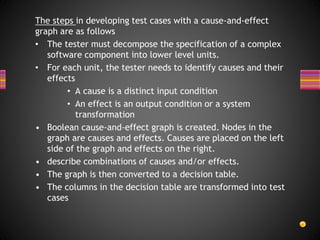
The steps in developing test cases with a cause-and-effect
graph are as follows
• The tester must decompose the specification of a complex
software component into lower level units.
• For each unit, the tester needs to identify causes and their
effects
• A cause is a distinct input condition
• An effect is an output condition or a system
transformation
• Boolean cause-and-effect graph is created. Nodes in the
graph are causes and effects. Causes are placed on the left
side of the graph and effects on the right.
• describe combinations of causes and/or effects.
• The graph is then converted to a decision table.
• The columns in the decision table are transformed into test
cases
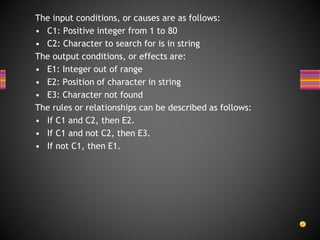
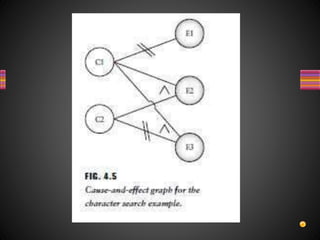
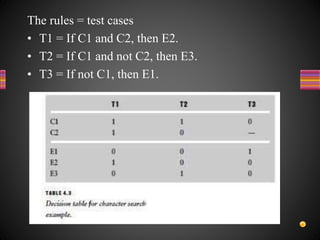
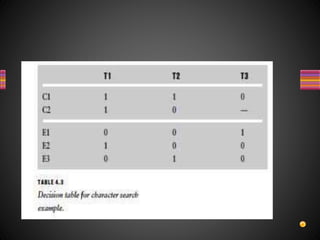
The input conditions, or causes are as follows:
• C1: Positive integer from 1 to 80
• C2: Character to search for is in string
The output conditions, or effects are:
• E1: Integer out of range
• E2: Position of character in string
• E3: Character not found
The rules or relationships can be described as follows:
• If C1 and C2, then E2.
• If C1 and not C2, then E3.
• If not C1, then E1.
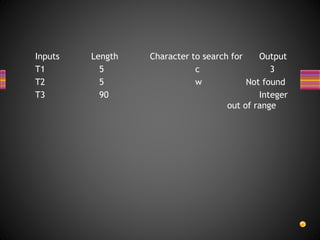
Inputs Length Character to search for Output
T1 5 c 3
T2 5 w Not found
T3 90 Integer
out of range
The rules = test cases
• T1 = If C1 and C2, then E2.
• T2 = If C1 and not C2, then E3.
• T3 = If not C1, then E1.
• Error guessing approach is based on the tester‘s
developer‘s past experience with code similar to the
code-under- test.
• Code similarities may extend to the structure of the
code, its domain, the design approach used, its
complexity
• The tester/developer is sometimes able to make an
educated use as to which types of defects may be
present and design test cases to reveal them.
Error Guessing
• Reuse of software components - important role.
• Reuse of components means that developers need not
reinvent the wheel; instead they can reuse an existing
software component with the required functionality
• Components produced by vendor organizations are known
as commercial off-the-shelf, or COTS, components, code
reuse library
• inputs/outputs and functionality is available, then
equivalence class partitioning and boundary value analysis
may be useful for detecting defects .
• If COTs component is small The tester use this approach for
identifying any unwanted or unexpected functionality
Black Box Testing and Commercial Off-
the-Shelf (COTS) Components
• Large-sized COTS components may be better served by
using random or statistical testing guided by usage profiles.
• Usage profiles are characterizations of the population of
intended uses of the software in its intended
environment.
• Testing of COTS components requires the development of
test cases, test oracles, and auxiliary code called a test
harness.
• COTS components, additional code, called glue software,
must be developed to bind the COTS component to other
modules for smooth functioning.
• Researchers are continually working on issues related to
testing and certification of COTS components.
• Certification refers to third-party assurance that a
product (in our case a software product), process, or
service meets a specific set of requirements.
• Type of testing which confirms the working of product which
different infrastructure components.
• Can be affected by following parameters:
– Processor and number of processors in machine
– Characteristics and architecture of machine
– Available resources
– Available equipment's
– Type of operating system
– Middle tire infrastructure components
– Back end
– Software used to generate binaries
– Various technological components
– Services which need some special h/w and s/w.
If 4 values is taken for each parameter then 40 different values to be
tested – affects the compatibility of product.
Compatibility testing
• Horizontal combination-all the values of parameters to
execute test cases are combined into a row in the
compatibility matrix – more time and effort
• Intelligent sampling – to solve problem of horizontal
combination – combination of infrastructure parameters are
combined - base on permutation and combinations.
– If the parameter is less dependent on set of parameters
then it is removed – others are continued – this method
significantly reduces the number of permutations and
combinations.
Techniques to do compatibility testing
• Backward compatibility testing : the testing ensures the
current version of the product continues to work with older
version of the same product
• Forward compatibility testing : ensures that the risk
involved in product for future requirement in minimized
Types of compatibility testing
• UDT covers all the manuals, user guides, installation guides,
setup guides, read me file, software release notes, online help.
Objective:
• To verify what is given in document is available in product
• To verify what is available in product is correctly given in
document.
Benefits:
• Highlighting the problems over looked during reviews.
• Minimizes possible defects reported by customers.
• New programmers can use the documentation.
User documentation testing
• Type of testing which doesn’t even look on specifications,
purely based on domain knowledge.
• Expertise in domain
Domain testing
• The tester‘s goal is to determine if all the logical and data
elements in the software unit are functioning properly. This is
called the white box, or glass box .
Test adequacy criteria
• Goal for white box testing is to ensure that the internal
components of a program are working properly.
• A common focus is on structural elements such as statements and
branches.
• Improves chances for detecting defects
• Testers need a framework for deciding which structural elements
to select as the focus of testing, for choosing the appropriate test
data, and for deciding when the testing efforts are adequate
enough to terminate . Such a framework exists in the form of test
adequacy criteria.
Using white box approach to test design
The application scope of adequacy criteria also includes:
(i) helps testers to select properties of a program.
(ii) helps testers to select a test data set for a program based on
the selected properties.
(iii) supports testers with the development of quantitative
objective.
(iv) Indicate to testers whether or not testing can be stopped for
that program.
• A test data set is statement, or branch, adequate if a test set T
for program P causes all the statements, or branches, to be
executed respectively.
• The concept of test data adequacy criteria, and the requirement
that certain features or properties of the code are to be
exercised by test cases, leads to an approach called coverage
analysis, is used to set test goals and to develop and evaluate
test data.
• When a coverage-related testing goal is expressed as a percent
(%), it is often called the degree of coverage.
Under some circumstances, the planned degree of coverage may be
less than 100% possibly due to the following:
The nature of the unit
• Some statements/branches may not be reachable.
• The unit may be simple, and not mission, or safety, critical, and
so complete coverage is thought to be unnecessary.
The lack of resources
• The time set aside for testing is not adequate to achieve 100%
coverage.
• There are not enough trained testers to achieve complete
coverage for all of the units.
• There is a lack of tools to support complete coverage.
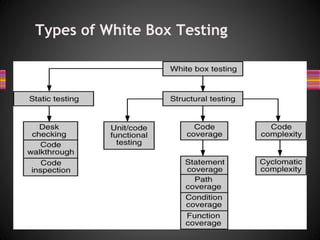
Types of White Box Testing
Static testing Vs structural testing
• Static testing – type of testing which needs only the source
code of product not the executable.
• Test group accepts
– Requirement document
– Application
– Design document
– Manuals
• Testing done by
– Humans
– Some specialized tools
• Static testing – human – methods
– desk checking of code
– Code walkthrough
– Code review
– Code inspection
• Static testing – various tools – finds errors like
– If any unreachable code available
– Definition and assign
– Illegal use of variable
• Author informally checks the code against the specifications
and corrects defects found.
• No structured method or formalism is required to ensure
completeness.
• No log or checklist is maintained.
• It relies only on the thoroughness of the author.
Desk Checking
• Advantages
– The programmer knows the code and programming
language well and hence is best suited to read the
program
– Less scheduling and logistics overheads
– Reduces delay in defect detection and correction
• Disadvantages
– Person dependent, not scalable or reproducible
– Tunnel visioning of developers
– Developers prefer writing new code and don’t like
testing
Advantages and Disadvantages of Desk
Checking
• Group oriented (as against desk checking)
• Brings in multiple perspectives
• Multiple specific roles (author, moderator, inspector, etc.),
asks questions to the author.
• If the author unable to answer, he takes and find the
answers
• Completeness is limited.
Code Walkthrough
• Group-oriented activity
• Highly formal and structured
• Has specific roles
• Requires thorough preparation
Formal Inspection / Fagan Inspection
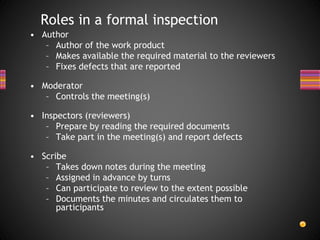
• Author
– Author of the work product
– Makes available the required material to the reviewers
– Fixes defects that are reported
• Moderator
– Controls the meeting(s)
• Inspectors (reviewers)
– Prepare by reading the required documents
– Take part in the meeting(s) and report defects
• Scribe
– Takes down notes during the meeting
– Assigned in advance by turns
– Can participate to review to the extent possible
– Documents the minutes and circulates them to
participants
Roles in a formal inspection
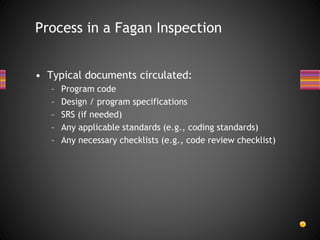
• Typical documents circulated:
– Program code
– Design / program specifications
– SRS (if needed)
– Any applicable standards (e.g., coding standards)
– Any necessary checklists (e.g., code review checklist)
Process in a Fagan Inspection
• Advantages
– Thorough, when prepared well
– Brings in multiple perspectives
– Has been found to be very effective
• Disadvantages
– Logistically difficult
– Time consuming
– May not be possible to exhaustively go through the
entire code
Advantages and Disadvantages of Fagan
Inspection
Coverage and Control Flow Graphs
• Application - use of control and data flow models to
represent program structural elements and data.
• The logic elements most commonly considered for coverage
are based on the flow of control in a unit of code.
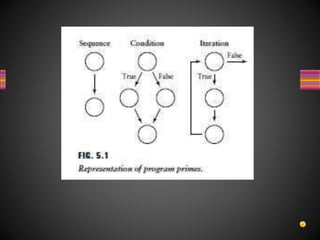
• These logical elements are rooted in the concept of a
program prime.
• A program prime is an atomic programming unit.
• All structured programs can be built from three basic primes
– sequential (e.g., assignment statements)
– decision (e.g., if/then/else statements)
– and iterative (e.g., while, for loops).
Covering code logic
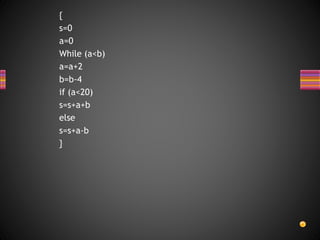
• module is executed 100%
• the goal is to satisfy the statement adequacy/ coverage
criterion, then set of test cases should be developed.
• when the module is executed, all (100%) of the statements in
the module are executed at least once.
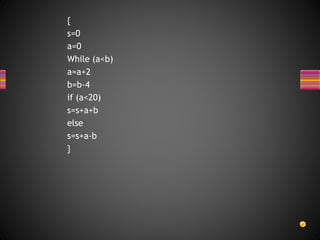
{
s=0
a=0
While (a<b)
a=a+2
b=b-4
if (a<20)
s=s+a+b
else
s=s+a-b
}
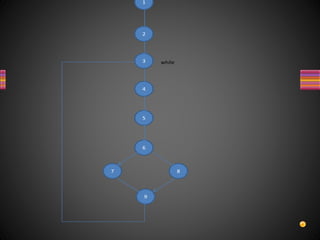
while
9
7 8
1
6
5
4
3
2
Structural testing
• Takes into account the code, code structure, internal design
and how they are coded.
• It’s the actual run by the computer on the built product.
Types:
• Unit functional testing
• Code coverage testing
• Code complexity testing.
Unit /code functional test
• Initially by knowing the i/p and o/p the tester does a
quick test – checks mistakes
• Modules with logic or condition, the developer can
build a “debug version” by placing some
intermediate statements – assure those intermediate
statements are removed later
• To run the product under debugger or IDE – allows
the developer to stop at the end of each instruction,
view and modify the contents
Code Coverage Testing
• Exercises different parts of code
• Maps parts of code to required
functionality
• Finds out percentage of code
covered by “instrumentation”
• Instrumentation rebuilds the
product, linking it with libraries
• Instrumented code can monitor what
parts of code is covered
• Can help identify critical portions of
code, executed often
Types of Code Coverage
• Statement coverage
• Path coverage
• Condition coverage
• Function coverage
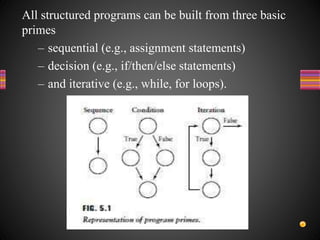
All structured programs can be built from three basic
primes
– sequential (e.g., assignment statements)
– decision (e.g., if/then/else statements)
– and iterative (e.g., while, for loops).
Sequential Coverage
• module is executed 100%
• when the module is executed, all (100%) of
the statements in the module are executed at
least once.
{
s=0
a=0
While (a<b)
a=a+2
b=b-4
if (a<20)
s=s+a+b
else
s=s+a-b
}
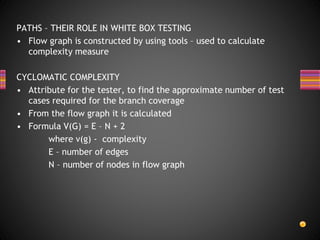
PATHS – THEIR ROLE IN WHITE BOX TESTING
• Flow graph is constructed by using tools – used to calculate
complexity measure
CYCLOMATIC COMPLEXITY
• Attribute for the tester, to find the approximate number of test
cases required for the branch coverage
• From the flow graph it is calculated
• Formula V(G) = E – N + 2
where v(g) - complexity
E – number of edges
N – number of nodes in flow graph
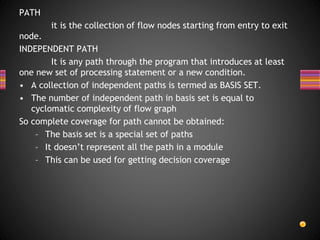
PATH
it is the collection of flow nodes starting from entry to exit
node.
INDEPENDENT PATH
It is any path through the program that introduces at least
one new set of processing statement or a new condition.
• A collection of independent paths is termed as BASIS SET.
• The number of independent path in basis set is equal to
cyclomatic complexity of flow graph
So complete coverage for path cannot be obtained:
– The basis set is a special set of paths
– It doesn’t represent all the path in a module
– This can be used for getting decision coverage
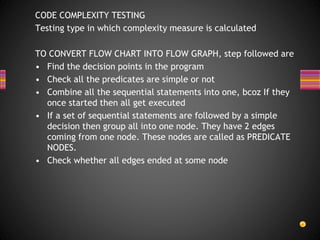
CODE COMPLEXITY TESTING
Testing type in which complexity measure is calculated
TO CONVERT FLOW CHART INTO FLOW GRAPH, step followed are
• Find the decision points in the program
• Check all the predicates are simple or not
• Combine all the sequential statements into one, bcoz If they
once started then all get executed
• If a set of sequential statements are followed by a simple
decision then group all into one node. They have 2 edges
coming from one node. These nodes are called as PREDICATE
NODES.
• Check whether all edges ended at some node
CALCULATING COMPLEXITY MEASURE
• Draw the flow graph from given set of program statements.
• From flow graph, by using formula
V(G) = E – N + 2/ {edges – nodes +2}
• Other formula used to find complexity is
V(G) = P + 1
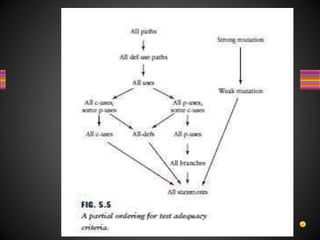
Evaluating Test Adequacy Criteria
• Testers are often faced with the decision of which criterion
to apply to a given item under test
• Satisfying an adequacy criterion at the higher levels of the
hierarchy implies a greater thoroughness in testing
• Achieving all definition-use (def-use) path adequacy means
the tester has also achieved both branch and statement
adequacy. Note from the hierarchy that statement adequacy
is the weakest of the test adequacy criteria.
• Unfortunately, in many organizations achieving a high level
of statement coverage is not even included as a minimal
testing goal.
Axioms
Support for evaluating test adequacy criteria comes from a
theoretical treatment developed by Weyuker
allow testers to formalize properties which should be satisfied by
any good program-based test data adequacy criterion.
1. Applicability Property
• For every program there exists an adequate test set.
• we should be able to design an adequate test set that properly
tests.
• The test set may be very large so the tester will want to select
representable points of the specification – exhaustive test set.
2. Non exhaustive Applicability Property
• a tester does not need an exhaustive test set in order to
adequately test a program.
3. Monotonicity Property
• If a test set T is adequate for program P, and if T is equal to, or
a subset of T , then T is adequate for program P.
4. Inadequate Empty Set

Unit 2 - Test Case Design

  • 1.
    • Requirements-based testing •Positive and negative testing • Boundary value analysis • Decision tables • Equivalence partitioning • State-based testing • Compatibility testing • User documentation testing • Domain testing (leads to ad hoc testing) Techniques / Methodologies of Black Box Testing
  • 2.
    • black boxwith well- defined inputs and outputs, a good approach to selecting test inputs is to use a method called equivalence class partitioning • important points related to equivalence class partitioning • The tester must consider both valid and invalid equivalence classes. • Equivalence classes may also be selected for output conditions. • The derivation of input or outputs equivalence classes is a heuristic process • In some cases it is difficult for the tester to identify equivalence classes. The conditions/boundaries that help to define classes may be absent, Equivalence Class Partitioning
  • 3.
    • If aninput condition for the software-under-test is specified as a range of values, select one valid equivalence class that covers the allowed range and two invalid equivalence classes, one outside each end of the range. • valid equivalence class that contains all the members of the set and one invalid equivalence class for any value outside the set.‘‘ • If an input condition for the software-under-test is specified as a “must be” condition, select one valid equivalence class to represent the must be condition and one invalid class that does not include the “must be condition” List of Conditions
  • 4.
    • If aninput condition for the software-under-test is specified as a set of valid input values, then select one valid equivalence class that contains all the members of the set and one invalid equivalence class for any value outside the set • equivalence class is not handled - then the class should be further partitioned into smaller equivalence classes.‘‘
  • 5.
    Function square_root message (x:real) whenx >_0.0 reply (y:real) where y >_0.0 & approximately (y*y,x) otherwise reply exception imaginary_square_root end function input equivalence classes for this module are the following: EC1. The input variable x is real, valid. EC2. The input variable x is not real, invalid. EC3. The value of x is greater than 0.0, valid. EC4. The value of x is less than 0.0, invalid.
  • 6.
    After the equivalenceclasses have been identified the next step in test case design - following steps. • Each equivalence class should be assigned a unique identifier. • Develop test cases for all valid equivalence classes until all have been covered by (included in) a test case. • Develop test cases for all invalid equivalence classes until all have been covered individually.
  • 7.
    • The testcases developed based on equivalence class partitioning can be strengthened by use of an technique called boundary value analysis. • The rules-of-thumb – If an input condition for the software-under-test is specified as a range of values, develop valid test cases for the ends of the range, and invalid test cases for possibilities just above and below the ends of the range. – If an input condition for the software-under-test is specified as a number of values, develop valid test cases for the minimum and maximum numbers as well as invalid test cases that include one lesser and one greater than the maximum and minimum. Boundary value analysis (Eg : unit payment)
  • 8.
    • If theinput or output of the software-under-test is an ordered set, such as a table or a linear list, develop tests that focus on the first and last elements of the set. It is important for the tester to keep in mind that equivalence class partitioning and boundary value analysis apply to testing both inputs and output.
  • 9.
    –Positive testing checksthe product with collection of expected output. –Negative task demonstrate that the product doesn't fail when unexpected data is given Positive & Negative testing
  • 10.
    • List ofdecision variable • Condition for every decision variable • Actions to be done in each combination of condition. Decision Table (Tax/ Claims)
  • 11.
    • Decision variablefound • Find the values of every decision variable • Create the combination of values of decision variables • Identify the cases when values assumed by a variable are immaterial for the given combination - denoted by “don’t care” symbol. • From a table, listing in each, the last column list the action item expressed in boolean – “true , false r don’t care”. Decision table creation - steps
  • 12.
    • Internal configurationof a system or component • It is based on the concepts of states and finite-state machines. • A state is an internal configuration of a system or component. It is defined in terms of the values assumed at a particular time for the variables that characterize the system or component. • A finite-state machine is an abstract machine that can be represented by a state graph having a finite number of states and a finite number of transitions between states. State based / Graph based testing
  • 13.
    • Can bestarted with an optimal sign • Optimal sign should be followed by any number of digits • The digits are followed by decimal points • When decimal point is viewed, then there should be two digits after the decimal • If any number comes without decimal point then it may be ended by a blank. Rules
  • 14.
    INPUT OLD STATENEW STATE Digit 1 2 + 1 2 - 1 2 Digit 2 2 Blank 2 6 Decimal point 2 3 Digit 3 4 Digit 4 5 Blank 5 6
  • 15.
    • A majorweakness with equivalence class partitioning is that it does not allow testers to combine conditions. • Cause-and-effect graphing is a technique that can be used to combine conditions. Cause - and - Effect Graphing
  • 16.
    The steps indeveloping test cases with a cause-and-effect graph are as follows • The tester must decompose the specification of a complex software component into lower level units. • For each unit, the tester needs to identify causes and their effects • A cause is a distinct input condition • An effect is an output condition or a system transformation • Boolean cause-and-effect graph is created. Nodes in the graph are causes and effects. Causes are placed on the left side of the graph and effects on the right. • describe combinations of causes and/or effects. • The graph is then converted to a decision table. • The columns in the decision table are transformed into test cases
  • 17.
    The input conditions,or causes are as follows: • C1: Positive integer from 1 to 80 • C2: Character to search for is in string The output conditions, or effects are: • E1: Integer out of range • E2: Position of character in string • E3: Character not found The rules or relationships can be described as follows: • If C1 and C2, then E2. • If C1 and not C2, then E3. • If not C1, then E1.
  • 19.
    Inputs Length Characterto search for Output T1 5 c 3 T2 5 w Not found T3 90 Integer out of range
  • 20.
    The rules =test cases • T1 = If C1 and C2, then E2. • T2 = If C1 and not C2, then E3. • T3 = If not C1, then E1.
  • 22.
    • Error guessingapproach is based on the tester‘s developer‘s past experience with code similar to the code-under- test. • Code similarities may extend to the structure of the code, its domain, the design approach used, its complexity • The tester/developer is sometimes able to make an educated use as to which types of defects may be present and design test cases to reveal them. Error Guessing
  • 23.
    • Reuse ofsoftware components - important role. • Reuse of components means that developers need not reinvent the wheel; instead they can reuse an existing software component with the required functionality • Components produced by vendor organizations are known as commercial off-the-shelf, or COTS, components, code reuse library • inputs/outputs and functionality is available, then equivalence class partitioning and boundary value analysis may be useful for detecting defects . • If COTs component is small The tester use this approach for identifying any unwanted or unexpected functionality Black Box Testing and Commercial Off- the-Shelf (COTS) Components
  • 24.
    • Large-sized COTScomponents may be better served by using random or statistical testing guided by usage profiles. • Usage profiles are characterizations of the population of intended uses of the software in its intended environment. • Testing of COTS components requires the development of test cases, test oracles, and auxiliary code called a test harness. • COTS components, additional code, called glue software, must be developed to bind the COTS component to other modules for smooth functioning. • Researchers are continually working on issues related to testing and certification of COTS components. • Certification refers to third-party assurance that a product (in our case a software product), process, or service meets a specific set of requirements.
  • 25.
    • Type oftesting which confirms the working of product which different infrastructure components. • Can be affected by following parameters: – Processor and number of processors in machine – Characteristics and architecture of machine – Available resources – Available equipment's – Type of operating system – Middle tire infrastructure components – Back end – Software used to generate binaries – Various technological components – Services which need some special h/w and s/w. If 4 values is taken for each parameter then 40 different values to be tested – affects the compatibility of product. Compatibility testing
  • 26.
    • Horizontal combination-allthe values of parameters to execute test cases are combined into a row in the compatibility matrix – more time and effort • Intelligent sampling – to solve problem of horizontal combination – combination of infrastructure parameters are combined - base on permutation and combinations. – If the parameter is less dependent on set of parameters then it is removed – others are continued – this method significantly reduces the number of permutations and combinations. Techniques to do compatibility testing
  • 27.
    • Backward compatibilitytesting : the testing ensures the current version of the product continues to work with older version of the same product • Forward compatibility testing : ensures that the risk involved in product for future requirement in minimized Types of compatibility testing
  • 28.
    • UDT coversall the manuals, user guides, installation guides, setup guides, read me file, software release notes, online help. Objective: • To verify what is given in document is available in product • To verify what is available in product is correctly given in document. Benefits: • Highlighting the problems over looked during reviews. • Minimizes possible defects reported by customers. • New programmers can use the documentation. User documentation testing
  • 29.
    • Type oftesting which doesn’t even look on specifications, purely based on domain knowledge. • Expertise in domain Domain testing
  • 30.
    • The tester‘sgoal is to determine if all the logical and data elements in the software unit are functioning properly. This is called the white box, or glass box . Test adequacy criteria • Goal for white box testing is to ensure that the internal components of a program are working properly. • A common focus is on structural elements such as statements and branches. • Improves chances for detecting defects • Testers need a framework for deciding which structural elements to select as the focus of testing, for choosing the appropriate test data, and for deciding when the testing efforts are adequate enough to terminate . Such a framework exists in the form of test adequacy criteria. Using white box approach to test design
  • 31.
    The application scopeof adequacy criteria also includes: (i) helps testers to select properties of a program. (ii) helps testers to select a test data set for a program based on the selected properties. (iii) supports testers with the development of quantitative objective. (iv) Indicate to testers whether or not testing can be stopped for that program. • A test data set is statement, or branch, adequate if a test set T for program P causes all the statements, or branches, to be executed respectively. • The concept of test data adequacy criteria, and the requirement that certain features or properties of the code are to be exercised by test cases, leads to an approach called coverage analysis, is used to set test goals and to develop and evaluate test data. • When a coverage-related testing goal is expressed as a percent (%), it is often called the degree of coverage.
  • 32.
    Under some circumstances,the planned degree of coverage may be less than 100% possibly due to the following: The nature of the unit • Some statements/branches may not be reachable. • The unit may be simple, and not mission, or safety, critical, and so complete coverage is thought to be unnecessary. The lack of resources • The time set aside for testing is not adequate to achieve 100% coverage. • There are not enough trained testers to achieve complete coverage for all of the units. • There is a lack of tools to support complete coverage.
  • 33.
    Types of WhiteBox Testing
  • 34.
    Static testing Vsstructural testing • Static testing – type of testing which needs only the source code of product not the executable. • Test group accepts – Requirement document – Application – Design document – Manuals • Testing done by – Humans – Some specialized tools
  • 35.
    • Static testing– human – methods – desk checking of code – Code walkthrough – Code review – Code inspection • Static testing – various tools – finds errors like – If any unreachable code available – Definition and assign – Illegal use of variable
  • 36.
    • Author informallychecks the code against the specifications and corrects defects found. • No structured method or formalism is required to ensure completeness. • No log or checklist is maintained. • It relies only on the thoroughness of the author. Desk Checking
  • 37.
    • Advantages – Theprogrammer knows the code and programming language well and hence is best suited to read the program – Less scheduling and logistics overheads – Reduces delay in defect detection and correction • Disadvantages – Person dependent, not scalable or reproducible – Tunnel visioning of developers – Developers prefer writing new code and don’t like testing Advantages and Disadvantages of Desk Checking
  • 38.
    • Group oriented(as against desk checking) • Brings in multiple perspectives • Multiple specific roles (author, moderator, inspector, etc.), asks questions to the author. • If the author unable to answer, he takes and find the answers • Completeness is limited. Code Walkthrough
  • 39.
    • Group-oriented activity •Highly formal and structured • Has specific roles • Requires thorough preparation Formal Inspection / Fagan Inspection
  • 40.
    • Author – Authorof the work product – Makes available the required material to the reviewers – Fixes defects that are reported • Moderator – Controls the meeting(s) • Inspectors (reviewers) – Prepare by reading the required documents – Take part in the meeting(s) and report defects • Scribe – Takes down notes during the meeting – Assigned in advance by turns – Can participate to review to the extent possible – Documents the minutes and circulates them to participants Roles in a formal inspection
  • 41.
    • Typical documentscirculated: – Program code – Design / program specifications – SRS (if needed) – Any applicable standards (e.g., coding standards) – Any necessary checklists (e.g., code review checklist) Process in a Fagan Inspection
  • 42.
    • Advantages – Thorough,when prepared well – Brings in multiple perspectives – Has been found to be very effective • Disadvantages – Logistically difficult – Time consuming – May not be possible to exhaustively go through the entire code Advantages and Disadvantages of Fagan Inspection
  • 43.
    Coverage and ControlFlow Graphs • Application - use of control and data flow models to represent program structural elements and data. • The logic elements most commonly considered for coverage are based on the flow of control in a unit of code. • These logical elements are rooted in the concept of a program prime. • A program prime is an atomic programming unit. • All structured programs can be built from three basic primes – sequential (e.g., assignment statements) – decision (e.g., if/then/else statements) – and iterative (e.g., while, for loops).
  • 45.
    Covering code logic •module is executed 100% • the goal is to satisfy the statement adequacy/ coverage criterion, then set of test cases should be developed. • when the module is executed, all (100%) of the statements in the module are executed at least once.
  • 46.
  • 47.
  • 48.
    Structural testing • Takesinto account the code, code structure, internal design and how they are coded. • It’s the actual run by the computer on the built product. Types: • Unit functional testing • Code coverage testing • Code complexity testing.
  • 49.
    Unit /code functionaltest • Initially by knowing the i/p and o/p the tester does a quick test – checks mistakes • Modules with logic or condition, the developer can build a “debug version” by placing some intermediate statements – assure those intermediate statements are removed later • To run the product under debugger or IDE – allows the developer to stop at the end of each instruction, view and modify the contents
  • 50.
    Code Coverage Testing •Exercises different parts of code • Maps parts of code to required functionality • Finds out percentage of code covered by “instrumentation” • Instrumentation rebuilds the product, linking it with libraries • Instrumented code can monitor what parts of code is covered • Can help identify critical portions of code, executed often
  • 51.
    Types of CodeCoverage • Statement coverage • Path coverage • Condition coverage • Function coverage
  • 52.
    All structured programscan be built from three basic primes – sequential (e.g., assignment statements) – decision (e.g., if/then/else statements) – and iterative (e.g., while, for loops).
  • 53.
    Sequential Coverage • moduleis executed 100% • when the module is executed, all (100%) of the statements in the module are executed at least once.
  • 54.
  • 55.
    PATHS – THEIRROLE IN WHITE BOX TESTING • Flow graph is constructed by using tools – used to calculate complexity measure CYCLOMATIC COMPLEXITY • Attribute for the tester, to find the approximate number of test cases required for the branch coverage • From the flow graph it is calculated • Formula V(G) = E – N + 2 where v(g) - complexity E – number of edges N – number of nodes in flow graph
  • 56.
    PATH it is thecollection of flow nodes starting from entry to exit node. INDEPENDENT PATH It is any path through the program that introduces at least one new set of processing statement or a new condition. • A collection of independent paths is termed as BASIS SET. • The number of independent path in basis set is equal to cyclomatic complexity of flow graph So complete coverage for path cannot be obtained: – The basis set is a special set of paths – It doesn’t represent all the path in a module – This can be used for getting decision coverage
  • 57.
    CODE COMPLEXITY TESTING Testingtype in which complexity measure is calculated TO CONVERT FLOW CHART INTO FLOW GRAPH, step followed are • Find the decision points in the program • Check all the predicates are simple or not • Combine all the sequential statements into one, bcoz If they once started then all get executed • If a set of sequential statements are followed by a simple decision then group all into one node. They have 2 edges coming from one node. These nodes are called as PREDICATE NODES. • Check whether all edges ended at some node
  • 58.
    CALCULATING COMPLEXITY MEASURE •Draw the flow graph from given set of program statements. • From flow graph, by using formula V(G) = E – N + 2/ {edges – nodes +2} • Other formula used to find complexity is V(G) = P + 1
  • 59.
    Evaluating Test AdequacyCriteria • Testers are often faced with the decision of which criterion to apply to a given item under test • Satisfying an adequacy criterion at the higher levels of the hierarchy implies a greater thoroughness in testing • Achieving all definition-use (def-use) path adequacy means the tester has also achieved both branch and statement adequacy. Note from the hierarchy that statement adequacy is the weakest of the test adequacy criteria. • Unfortunately, in many organizations achieving a high level of statement coverage is not even included as a minimal testing goal.
  • 61.
    Axioms Support for evaluatingtest adequacy criteria comes from a theoretical treatment developed by Weyuker allow testers to formalize properties which should be satisfied by any good program-based test data adequacy criterion. 1. Applicability Property • For every program there exists an adequate test set. • we should be able to design an adequate test set that properly tests. • The test set may be very large so the tester will want to select representable points of the specification – exhaustive test set. 2. Non exhaustive Applicability Property • a tester does not need an exhaustive test set in order to adequately test a program.
  • 62.
    3. Monotonicity Property •If a test set T is adequate for program P, and if T is equal to, or a subset of T , then T is adequate for program P. 4. Inadequate Empty Set