

COCKPIT VOICE RECORDER
Presented by
Sub/Lt SH Munna
CONTENTS
• WHAT IS CVR?
• LOCATION OF CVR ON AIRCRAFT
• HISTORY
• MODERN COCKPIT VOICE RECORDER
• ICAO REQUIREMENTS FOR CVR
• ICAO RECOMMENDATION TO CONTACTING
STATE
• REFERENCES
What is CVR?
• Cockpit Voice Recorder
• A device used to record the audio environment in the flight deck for
accidents and incident investigation purposes. The CVR records and stores
the audio signals of the microphones and earphones of the pilots’
headsets and of an area microphone installed in the cockpit.”
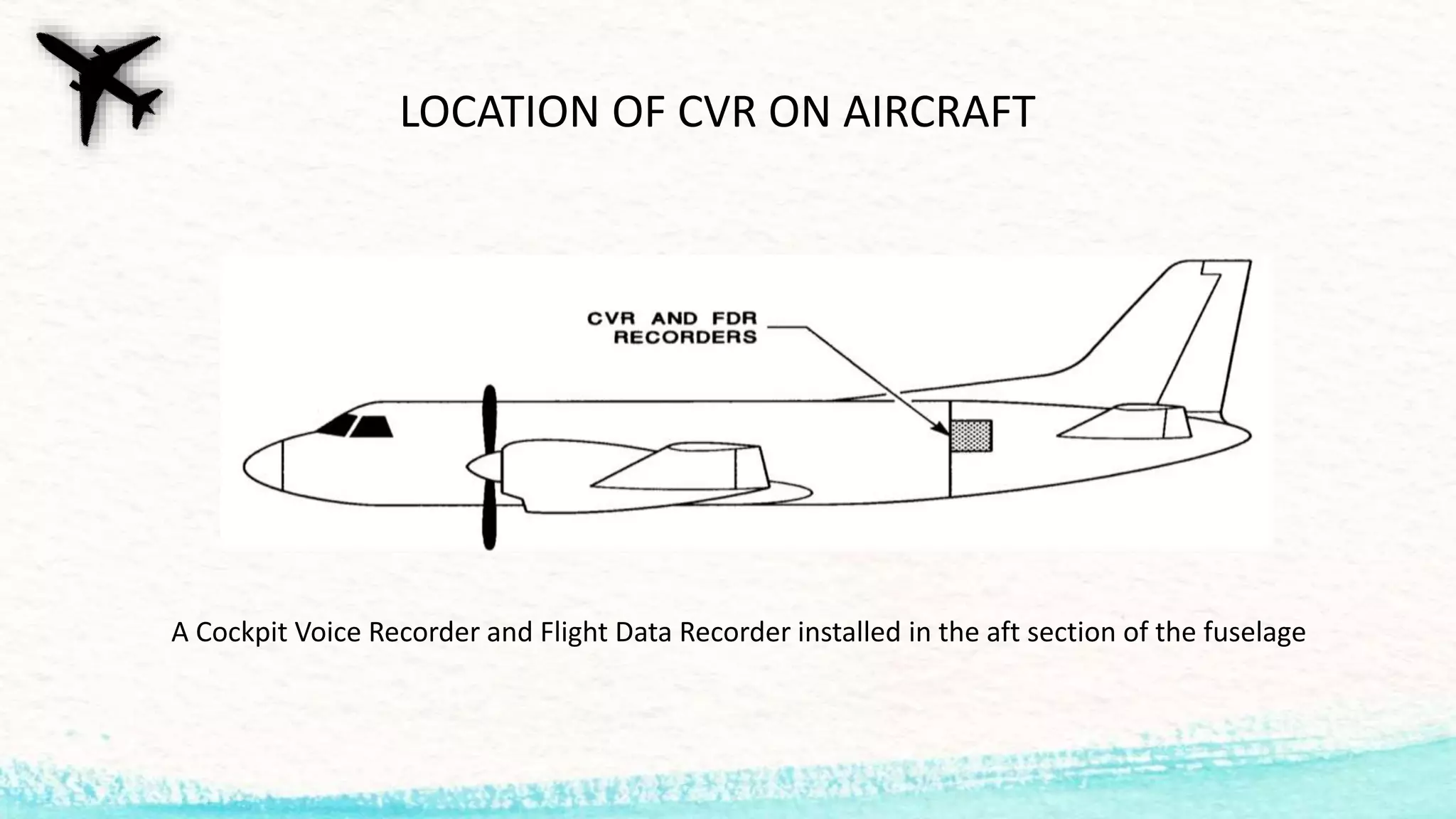
LOCATION OF CVR ON AIRCRAFT
A Cockpit Voice Recorder and Flight Data Recorder installed in the aft section of the fuselage
Figure: Cockpit Voice Recorder
History
• The first prototype FDR was produced in 1956 by Dr. David Warren
• He built the world's first cockpit-voice and flight-data recorder in 1958
• In 1960 Australia became the first country in the world to make the Black
Box mandatory for all commercial aircraft
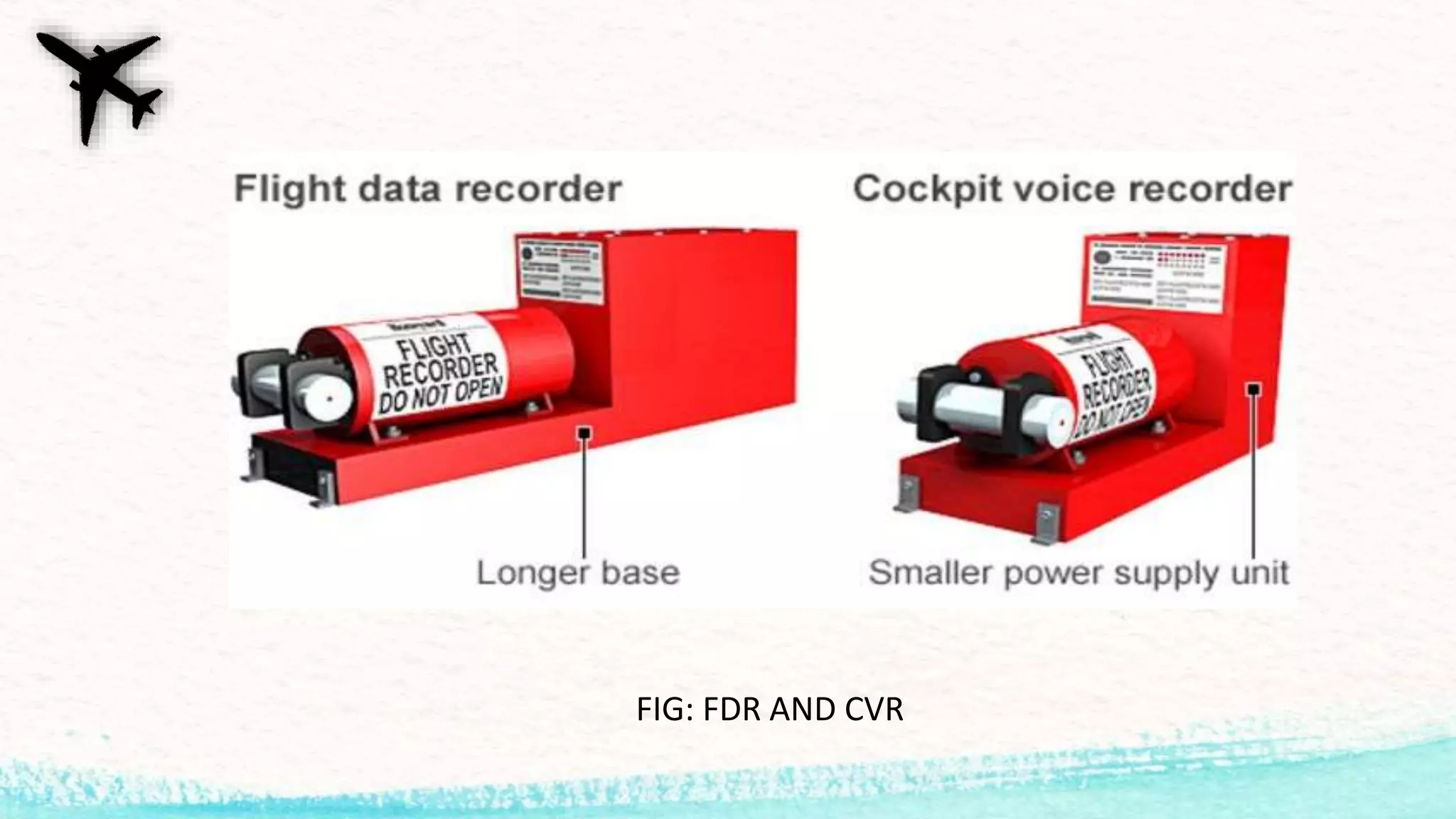
FIG: FDR AND CVR
History
• The earliest CVRs used analog wire recording,
• later replaced by analog magnetic tape.
• Some of the tape units used two reels, with the tape automatically
reversing at each end.
• Currently, the most widely used CVRs in commercial transportation are
capable of recording 4 channels of audio data for a period of 2 hours.
FIGURE: The first flight recorder
MODERN COCKPIT VOICE RECORDER
• The previous requirement for a CVR to record for 30 minutes was found to
be insufficient in many cases.
• In some accident investigations, significant parts of the pertinent audio
data were missing as they occurred more than 30 minutes before the end
of the recording (the tape capacity would result in audio information
being overwritten every 30 min.)
• The latest CVR use solid-state memory and digital recording techniques which
make them much more resistant to shock, vibration and moisture.
• With the reduced power requirements of solid-state recorders, it is possible to
incorporate a battery in the units, so that recording can continue until flight
termination, even if the aircraft electrical system fails.
• Regarding the introduction of video recordings in the cockpit: the
attempts of some operators to introduce on-board video recording
in the flight deck have met very little success to date due to
resistance from pilot professional organizations and unions.
ICAO REQUIREMENTS
According to the provisions in ICAO Annex 6 “Operation of Aircraft”, Volume I:
• Fixed-wing aero plane and helicopters shall be equipped with a cockpit voice
recorder with a recording duration of at least 30 minutes of its operation.
• Fixed-wing aero planes with a maximum take-off mass of more than 5700 kg
and for which the certificate of airworthiness is first issued after 1 January 2003
shall be equipped with a CVR with a recording duration of two hours.
• Helicopters for which the certificate of airworthiness is first issued after 1
January 2003 shall be equipped with a CVR with a recording duration of
two hours.
ICAO recommends the following to Contracting States:
• A CVR, installed in aero planes of a maximum certificated take-off mass of over
5700 kg for which the individual certificate of airworthiness is first issued on or after
1 January 1990, should be capable of retaining the information recorded during at
least the last two hours of its operation.
• A CVR, installed in helicopters for which the individual certificate of airworthiness
is first issued on or after 1 January 1990, should be capable of retaining the
information recorded during at least the last two hours of its operation.
German-wings Flight 9525
• German-wings Flight 9525 was a scheduled international passenger flight from
Barcelona–El Prat Airport in Spain to Düsseldorf Airport in Germany. The flight was
operated by German-wings, a low-cost carrier owned by the German airline
Lufthansa.
• Date: March 24, 2015 Registration: D-AIPX
• Fatalities: 150 (all) Operator: German-wings
• Survivor: 0 Passenger count: 144
FIG: CVR of German-wings Flight 9525
REFERENCES
• Flight recorder. (2017, September 7). In Wikipedia, The Free Encyclopedia. Retrieved
03:19, September 17, 2017, from
https://en.wikipedia.org/w/index.php?title=Flight_recorder&oldid=799335320
• CVR. (2016, October 19). In Wikipedia, The Free Encyclopedia. Retrieved 14:16,
September 22, 2017, from
https://en.wikipedia.org/w/index.php?title=CVR&oldid=745075261
Cockpit voice recorder

Cockpit voice recorder

  • 1.
  • 2.
    CONTENTS • WHAT ISCVR? • LOCATION OF CVR ON AIRCRAFT • HISTORY • MODERN COCKPIT VOICE RECORDER • ICAO REQUIREMENTS FOR CVR • ICAO RECOMMENDATION TO CONTACTING STATE • REFERENCES
  • 3.
    What is CVR? •Cockpit Voice Recorder • A device used to record the audio environment in the flight deck for accidents and incident investigation purposes. The CVR records and stores the audio signals of the microphones and earphones of the pilots’ headsets and of an area microphone installed in the cockpit.”
  • 4.
    LOCATION OF CVRON AIRCRAFT A Cockpit Voice Recorder and Flight Data Recorder installed in the aft section of the fuselage
  • 5.
  • 6.
    History • The firstprototype FDR was produced in 1956 by Dr. David Warren • He built the world's first cockpit-voice and flight-data recorder in 1958 • In 1960 Australia became the first country in the world to make the Black Box mandatory for all commercial aircraft
  • 7.
  • 8.
    History • The earliestCVRs used analog wire recording, • later replaced by analog magnetic tape. • Some of the tape units used two reels, with the tape automatically reversing at each end. • Currently, the most widely used CVRs in commercial transportation are capable of recording 4 channels of audio data for a period of 2 hours.
  • 9.
    FIGURE: The firstflight recorder
  • 10.
    MODERN COCKPIT VOICERECORDER • The previous requirement for a CVR to record for 30 minutes was found to be insufficient in many cases. • In some accident investigations, significant parts of the pertinent audio data were missing as they occurred more than 30 minutes before the end of the recording (the tape capacity would result in audio information being overwritten every 30 min.)
  • 11.
    • The latestCVR use solid-state memory and digital recording techniques which make them much more resistant to shock, vibration and moisture. • With the reduced power requirements of solid-state recorders, it is possible to incorporate a battery in the units, so that recording can continue until flight termination, even if the aircraft electrical system fails.
  • 12.
    • Regarding theintroduction of video recordings in the cockpit: the attempts of some operators to introduce on-board video recording in the flight deck have met very little success to date due to resistance from pilot professional organizations and unions.
  • 13.
    ICAO REQUIREMENTS According tothe provisions in ICAO Annex 6 “Operation of Aircraft”, Volume I: • Fixed-wing aero plane and helicopters shall be equipped with a cockpit voice recorder with a recording duration of at least 30 minutes of its operation. • Fixed-wing aero planes with a maximum take-off mass of more than 5700 kg and for which the certificate of airworthiness is first issued after 1 January 2003 shall be equipped with a CVR with a recording duration of two hours.
  • 14.
    • Helicopters forwhich the certificate of airworthiness is first issued after 1 January 2003 shall be equipped with a CVR with a recording duration of two hours.
  • 15.
    ICAO recommends thefollowing to Contracting States: • A CVR, installed in aero planes of a maximum certificated take-off mass of over 5700 kg for which the individual certificate of airworthiness is first issued on or after 1 January 1990, should be capable of retaining the information recorded during at least the last two hours of its operation. • A CVR, installed in helicopters for which the individual certificate of airworthiness is first issued on or after 1 January 1990, should be capable of retaining the information recorded during at least the last two hours of its operation.
  • 16.
    German-wings Flight 9525 •German-wings Flight 9525 was a scheduled international passenger flight from Barcelona–El Prat Airport in Spain to Düsseldorf Airport in Germany. The flight was operated by German-wings, a low-cost carrier owned by the German airline Lufthansa. • Date: March 24, 2015 Registration: D-AIPX • Fatalities: 150 (all) Operator: German-wings • Survivor: 0 Passenger count: 144
  • 17.
    FIG: CVR ofGerman-wings Flight 9525
  • 18.
    REFERENCES • Flight recorder.(2017, September 7). In Wikipedia, The Free Encyclopedia. Retrieved 03:19, September 17, 2017, from https://en.wikipedia.org/w/index.php?title=Flight_recorder&oldid=799335320 • CVR. (2016, October 19). In Wikipedia, The Free Encyclopedia. Retrieved 14:16, September 22, 2017, from https://en.wikipedia.org/w/index.php?title=CVR&oldid=745075261