Using Electric UAV sizing Methodology


                             Philip Asante
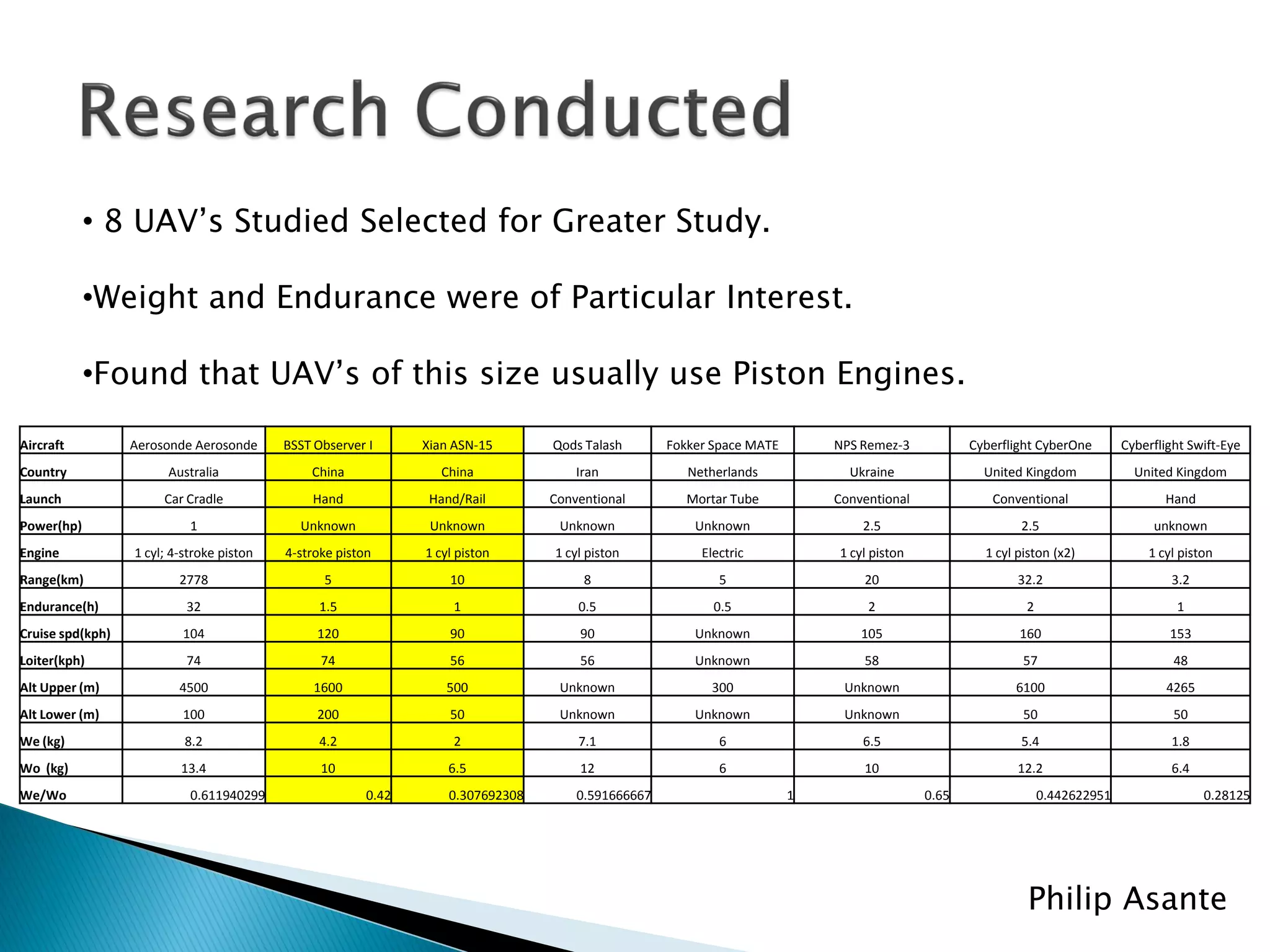
• 8 UAV’s Studied Selected for Greater Study.

            •Weight and Endurance were of Particular Interest.

            •Found that UAV’s of this size usually use Piston Engines.

Aircraft          Aerosonde Aerosonde      BSST Observer I      Xian ASN-15       Qods Talash       Fokker Space MATE       NPS Remez-3           Cyberflight CyberOne       Cyberflight Swift-Eye
Country                 Australia              China              China               Iran             Netherlands            Ukraine               United Kingdom             United Kingdom
Launch                 Car Cradle              Hand              Hand/Rail        Conventional         Mortar Tube          Conventional             Conventional                   Hand
Power(hp)                   1                Unknown             Unknown           Unknown              Unknown                 2.5                       2.5                     unknown
Engine            1 cyl; 4-stroke piston   4-stroke piston      1 cyl piston      1 cyl piston           Electric           1 cyl piston            1 cyl piston (x2)            1 cyl piston
Range(km)                 2778                   5                  10                 8                    5                   20                        32.2                       3.2
Endurance(h)               32                    1.5                 1                0.5                  0.5                   2                         2                          1
Cruise spd(kph)           104                   120                 90                90                Unknown                 105                       160                        153
Loiter(kph)                74                    74                 56                56                Unknown                 58                         57                         48
Alt Upper (m)             4500                  1600               500             Unknown                300                Unknown                     6100                       4265
Alt Lower (m)             100                   200                 50             Unknown              Unknown              Unknown                       50                         50
We (kg)                    8.2                   4.2                 2                7.1                   6                   6.5                       5.4                        1.8
Wo (kg)                   13.4                   10                 6.5               12                    6                   10                        12.2                       6.4
We/Wo                       0.611940299                  0.42       0.307692308       0.591666667                       1                  0.65                0.442622951                 0.28125


                                                                                                                                                            Philip Asante
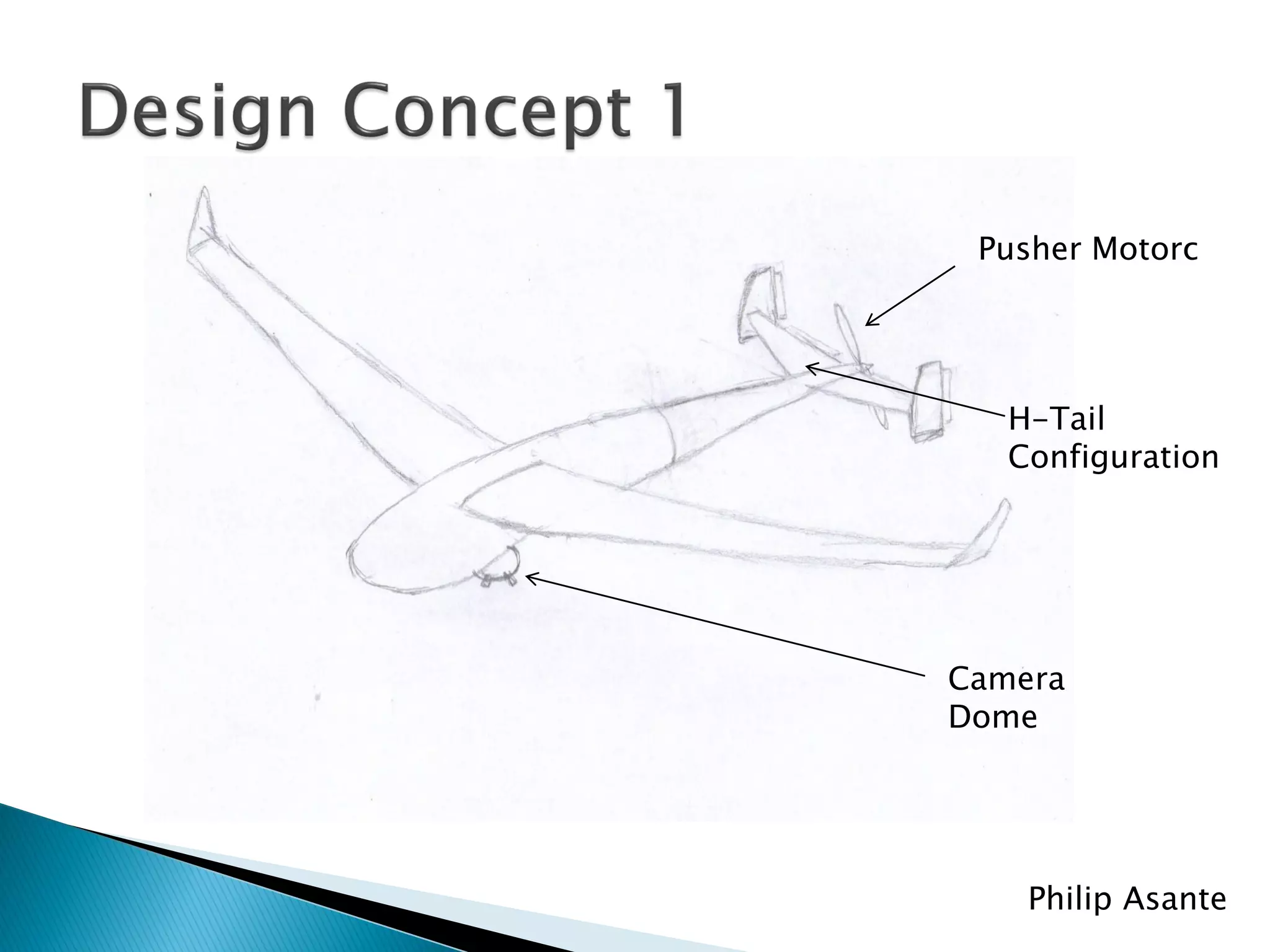
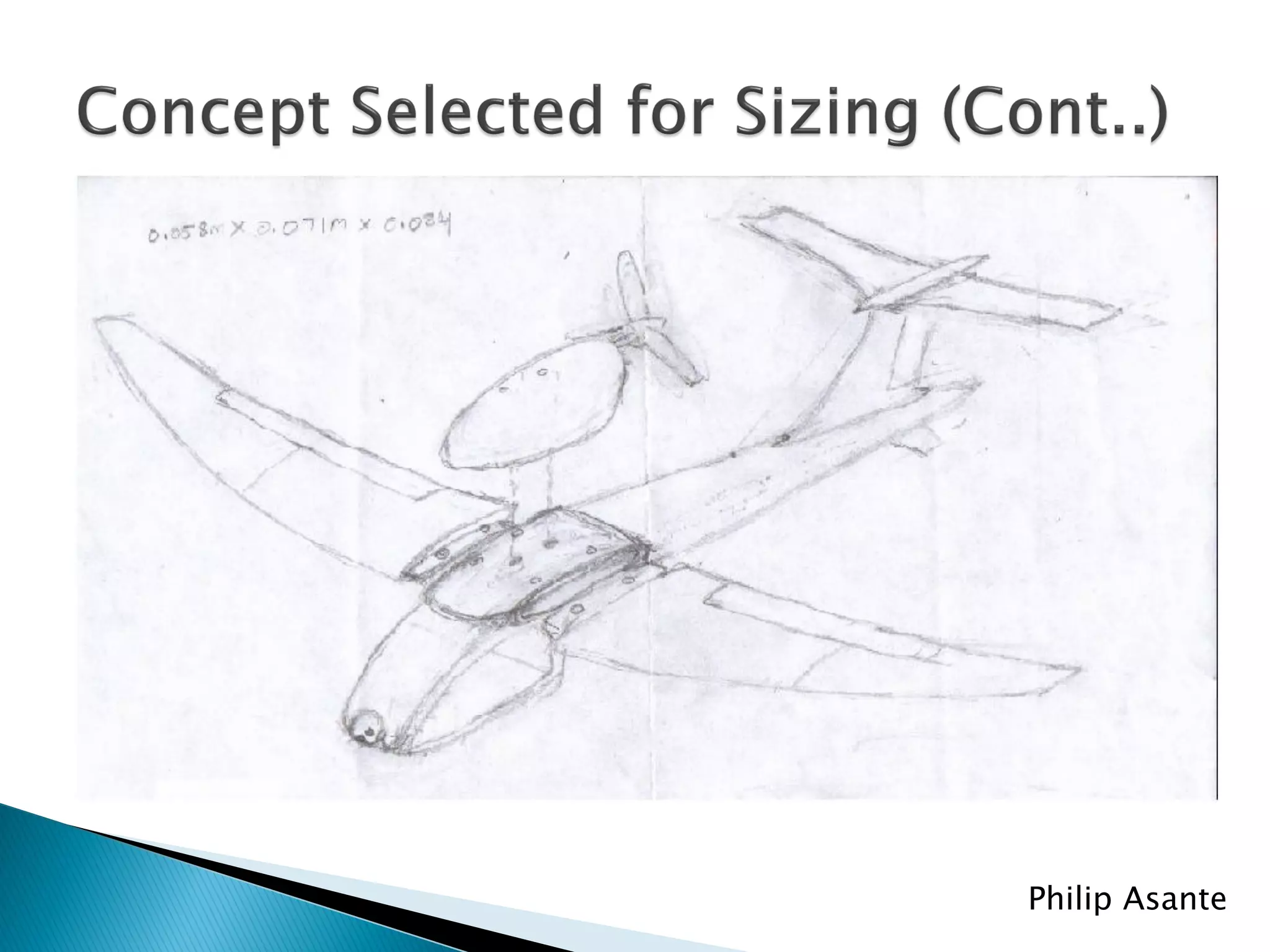
Pusher Motorc


   H-Tail
   Configuration


Camera
Dome


    Philip Asante
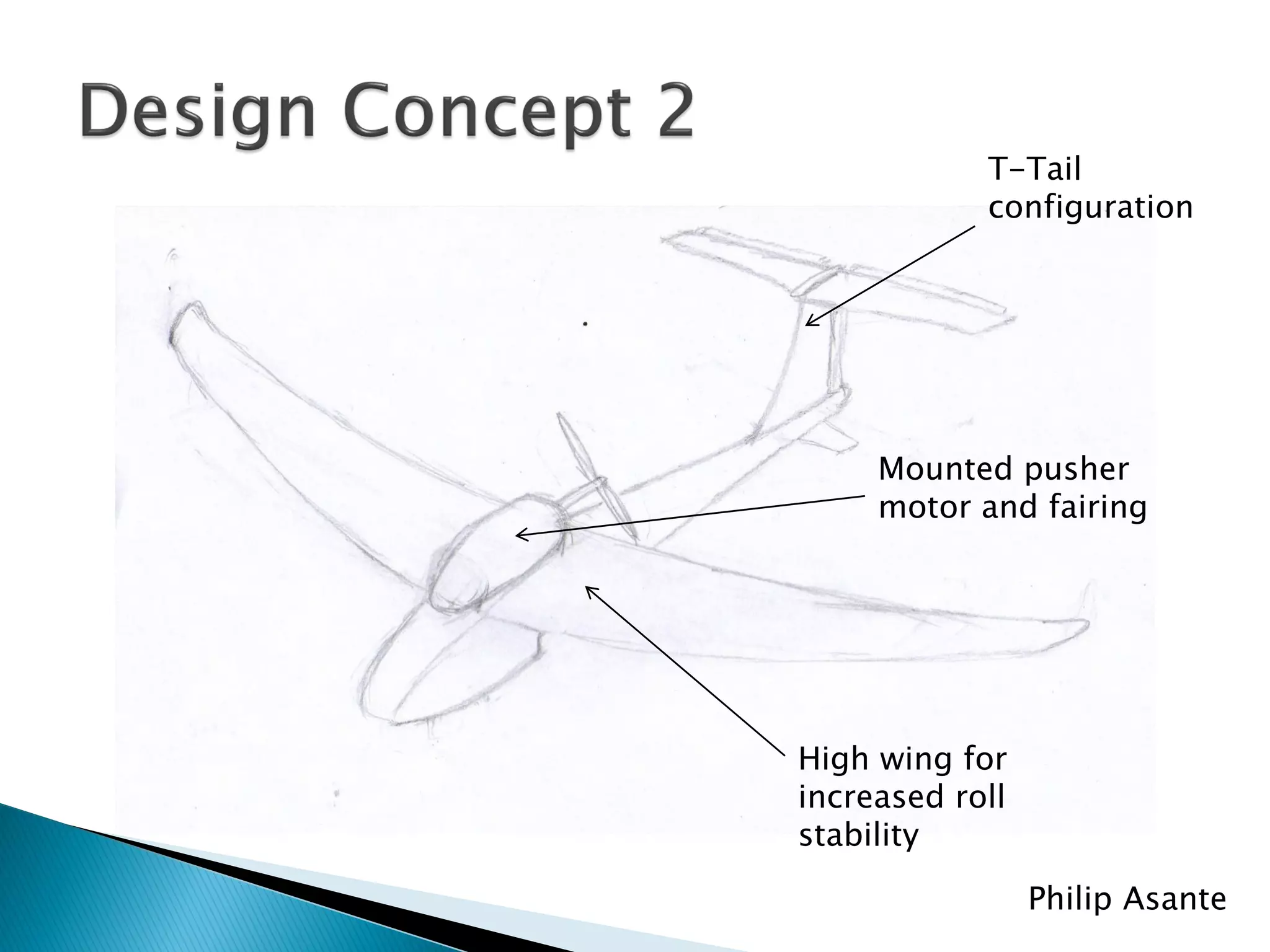
T-Tail
            configuration


     Mounted pusher
     motor and fairing


High wing for
increased roll
stability

                 Philip Asante
Philip Asante
Philip Asante
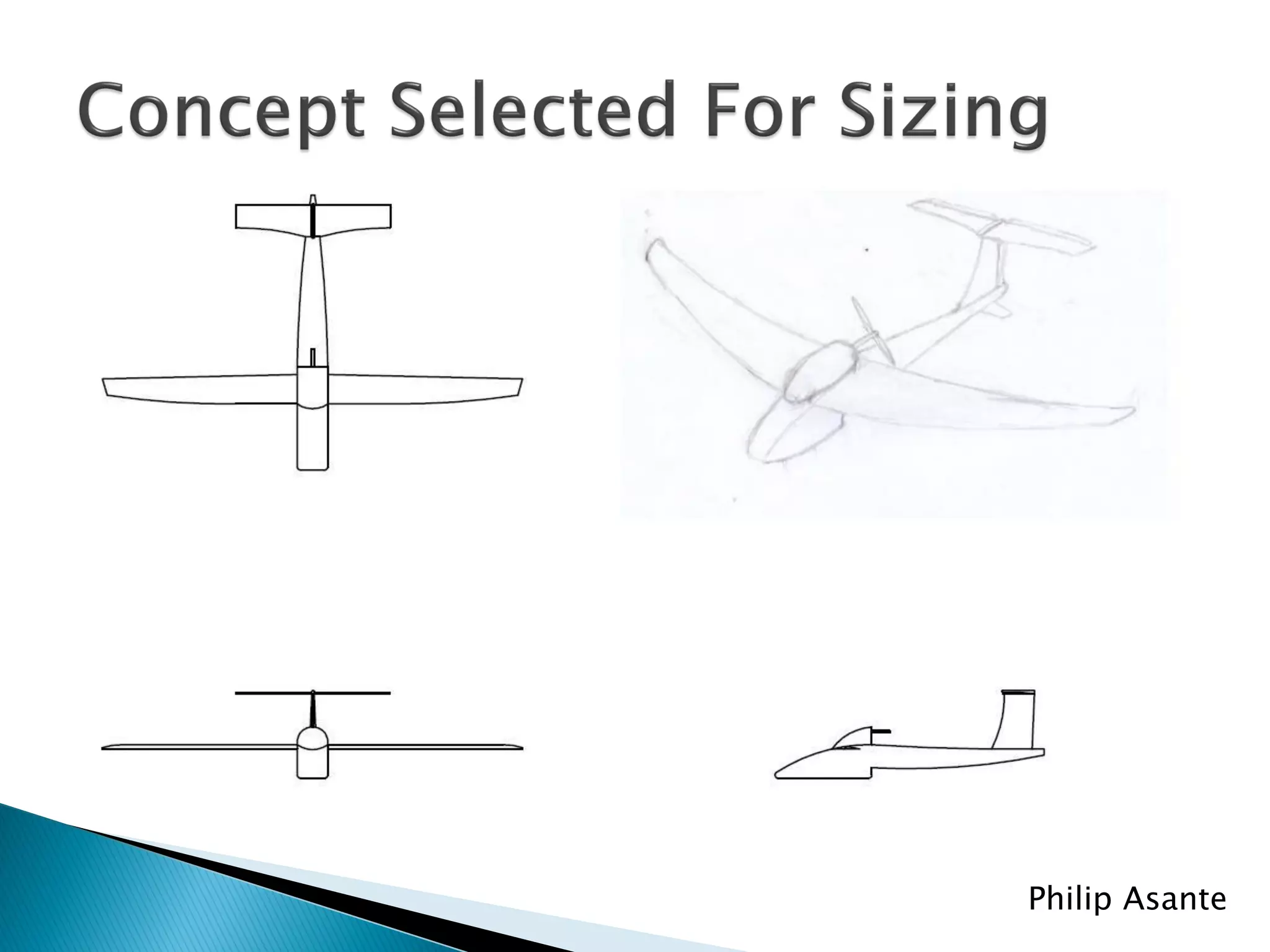
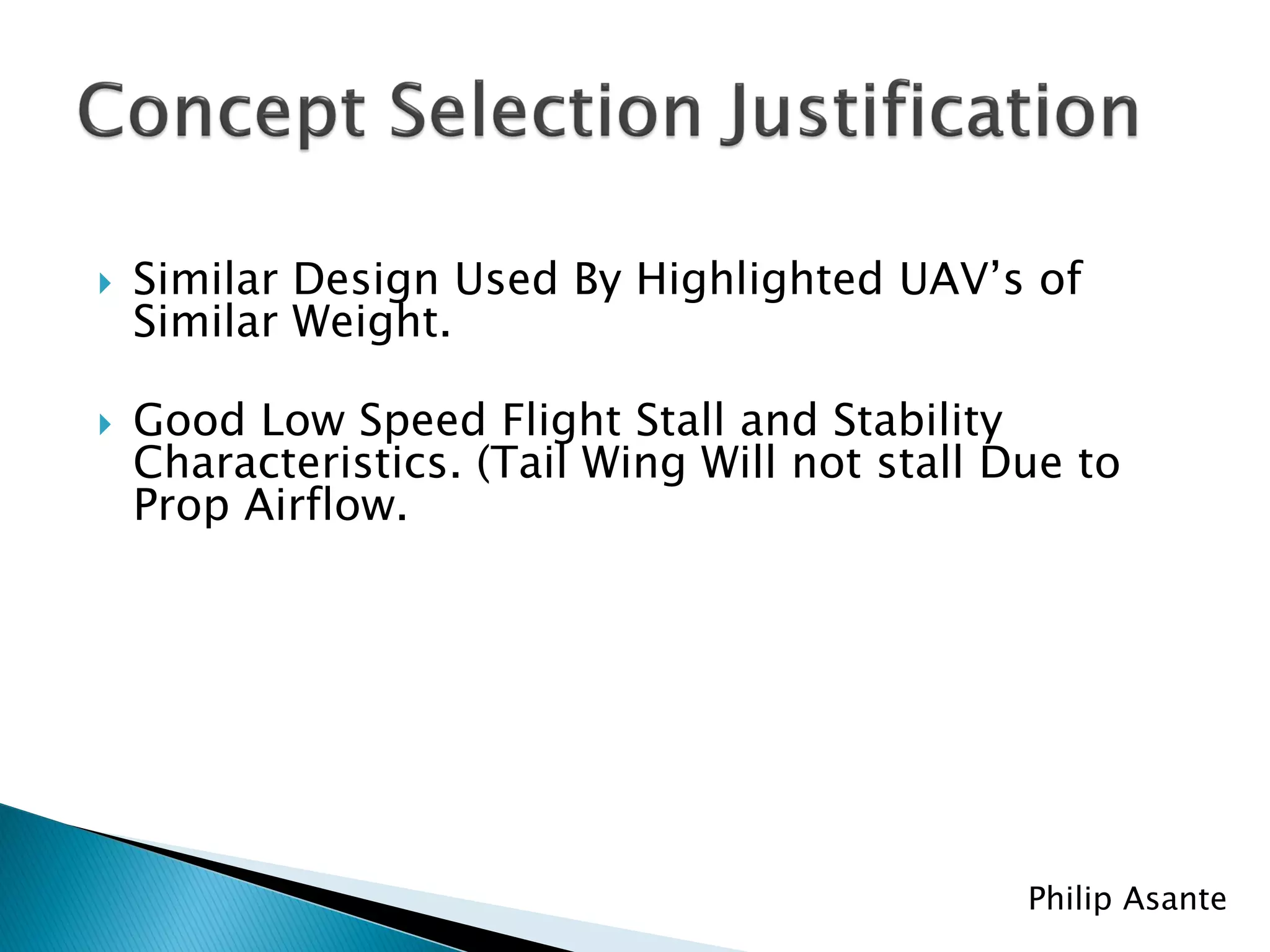
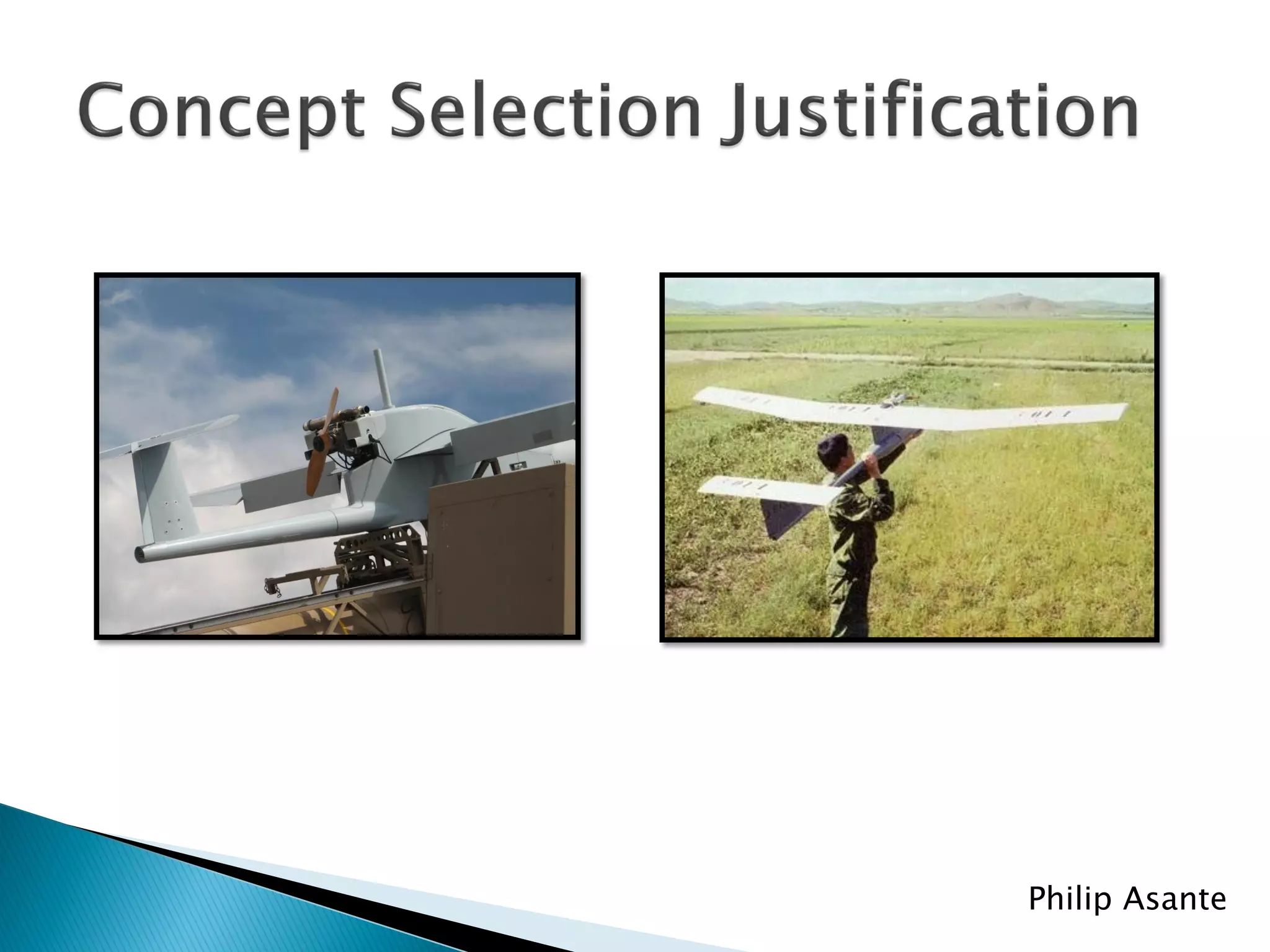
   Similar Design Used By Highlighted UAV’s of
    Similar Weight.

   Good Low Speed Flight Stall and Stability
    Characteristics. (Tail Wing Will not stall Due to
    Prop Airflow.


                                                Philip Asante
Philip Asante
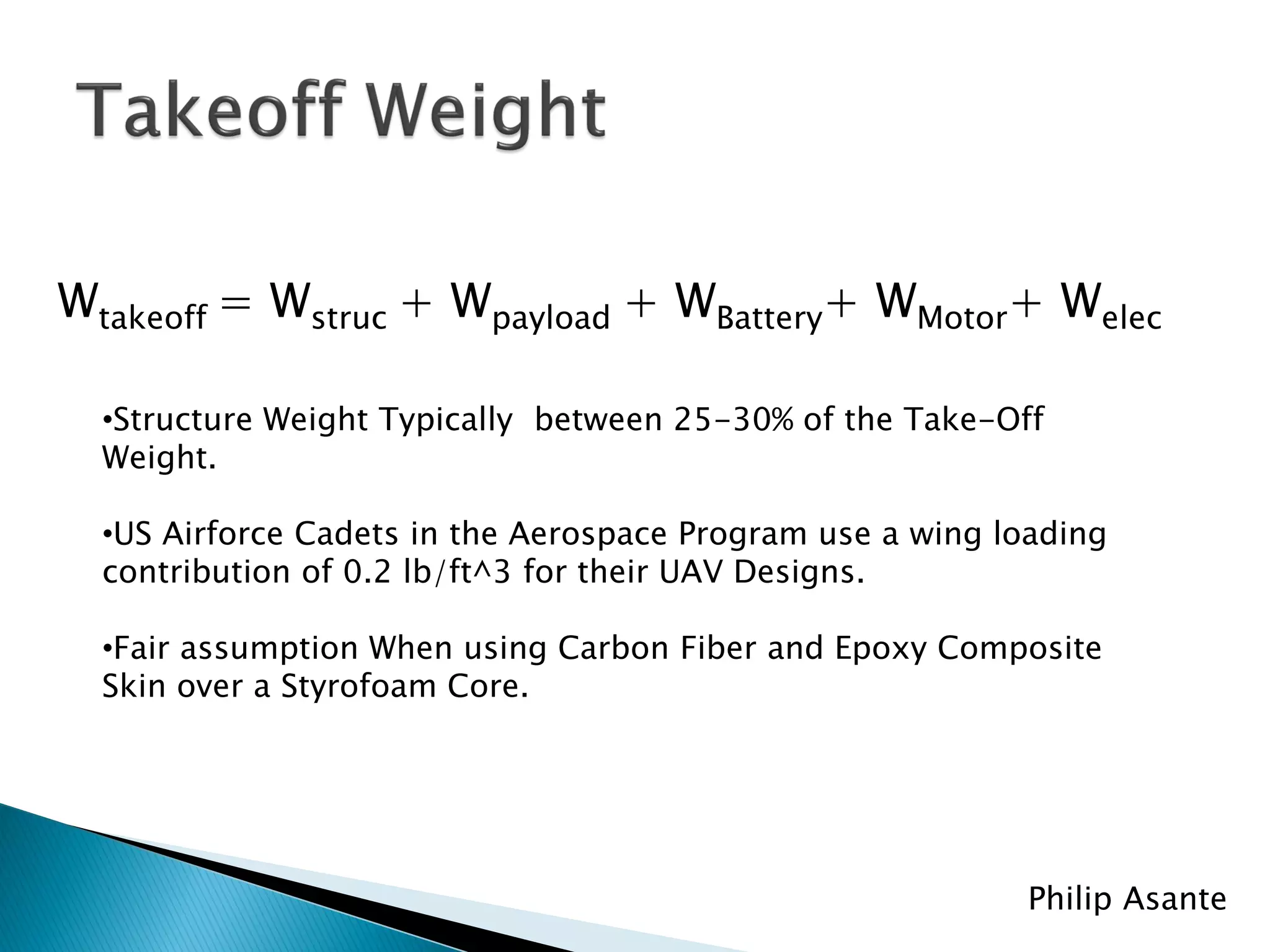
Wtakeoff = Wstruc + Wpayload + WBattery+ WMotor+ Welec

  •Structure Weight Typically between 25-30% of the Take-Off
  Weight.

  •US Airforce Cadets in the Aerospace Program use a wing loading
  contribution of 0.2 lb/ft^3 for their UAV Designs.

  •Fair assumption When using Carbon Fiber and Epoxy Composite
  Skin over a Styrofoam Core.


                                                            Philip Asante
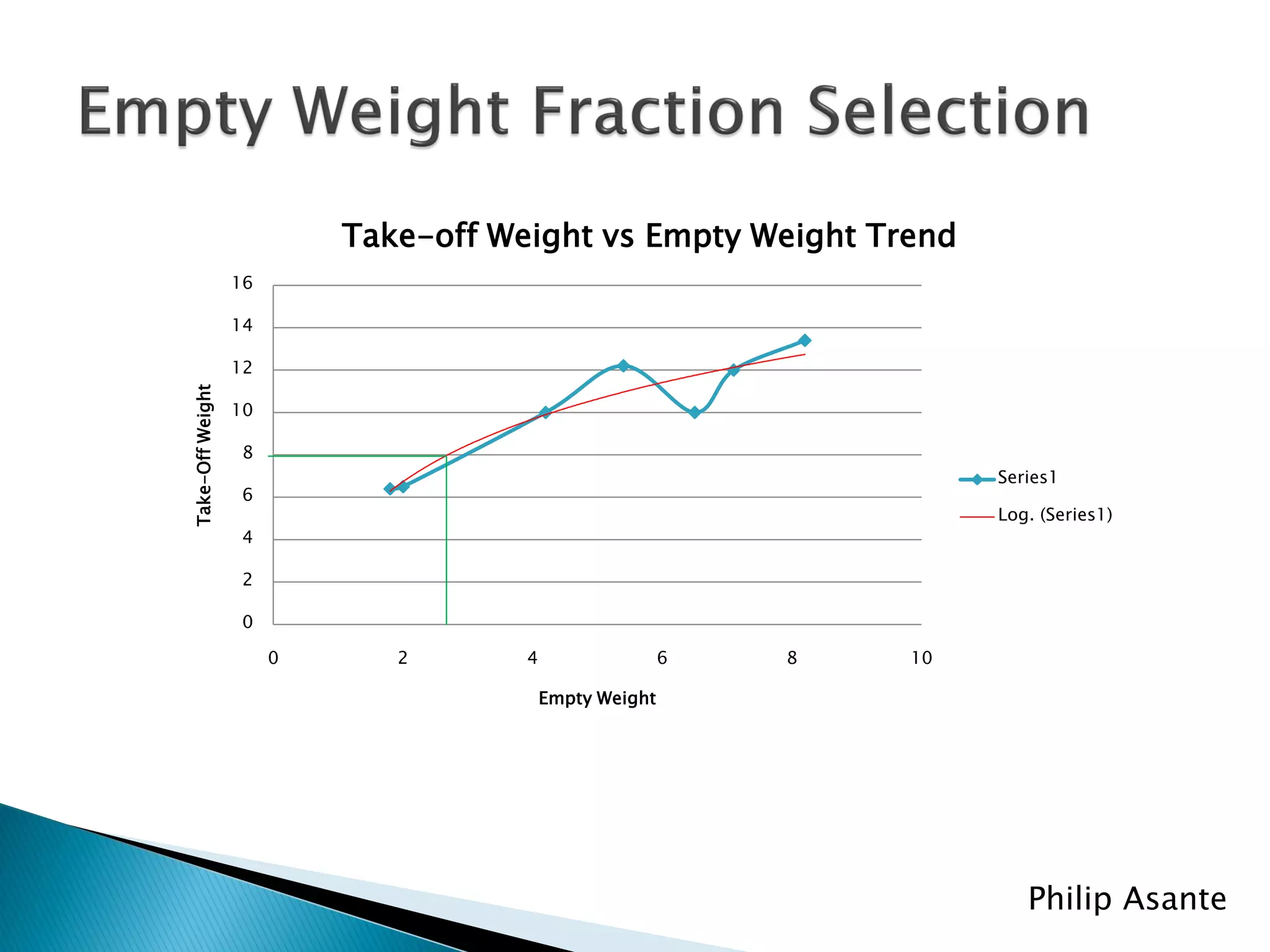
Take-off Weight vs Empty Weight Trend
                  16

                  14

                  12
Take-Off Weight


                  10

                  8
                                                                      Series1
                  6
                                                                      Log. (Series1)
                  4

                  2

                  0

                       0      2       4                  6   8   10

                                          Empty Weight


                                                                         Philip Asante
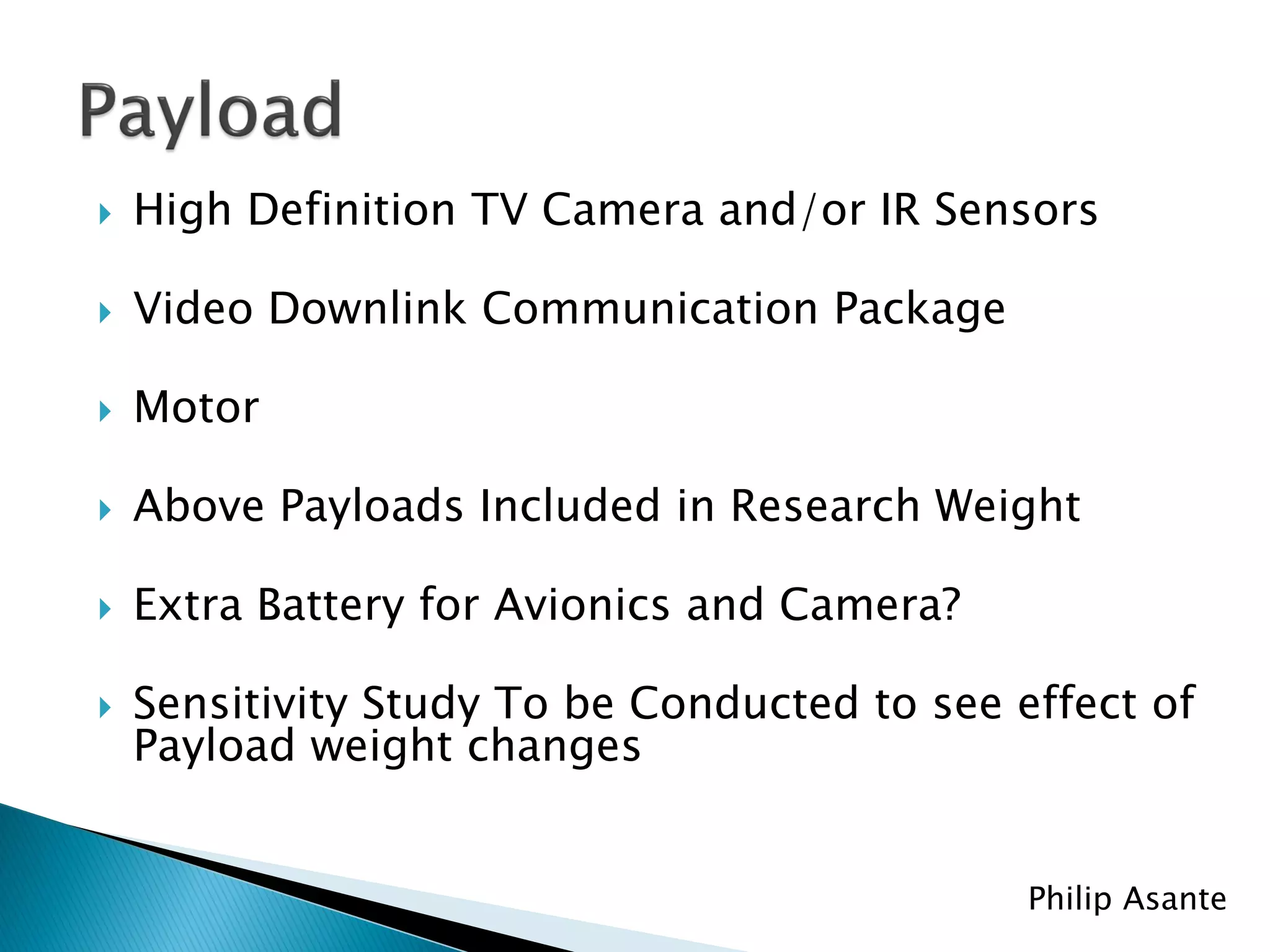
   High Definition TV Camera and/or IR Sensors

   Video Downlink Communication Package

   Motor

   Above Payloads Included in Research Weight

   Extra Battery for Avionics and Camera?

   Sensitivity Study To be Conducted to see effect of
    Payload weight changes


                                              Philip Asante
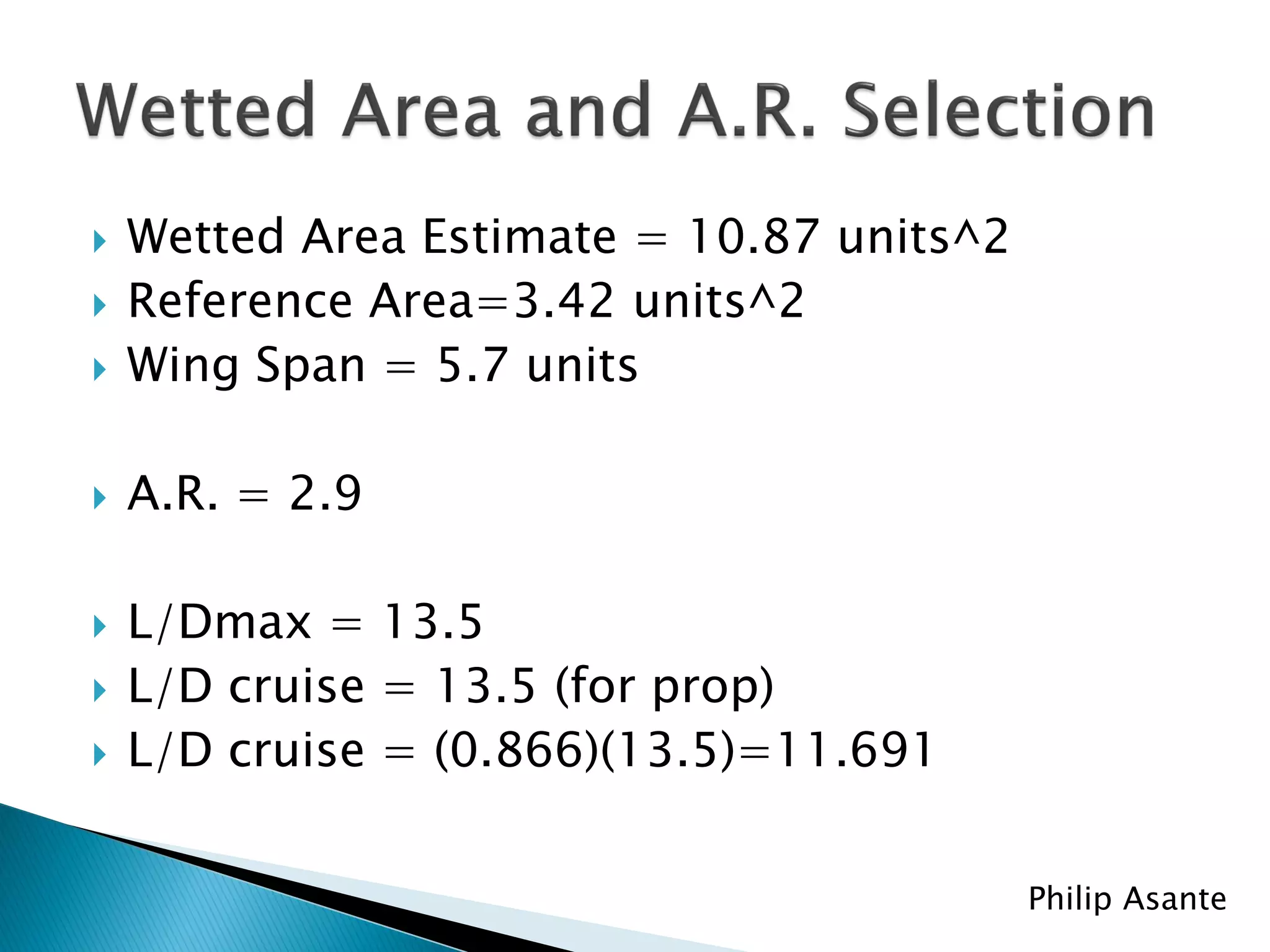
   Wetted Area Estimate = 10.87 units^2
   Reference Area=3.42 units^2
   Wing Span = 5.7 units

   A.R. = 2.9

   L/Dmax = 13.5
   L/D cruise = 13.5 (for prop)
   L/D cruise = (0.866)(13.5)=11.691


                                           Philip Asante
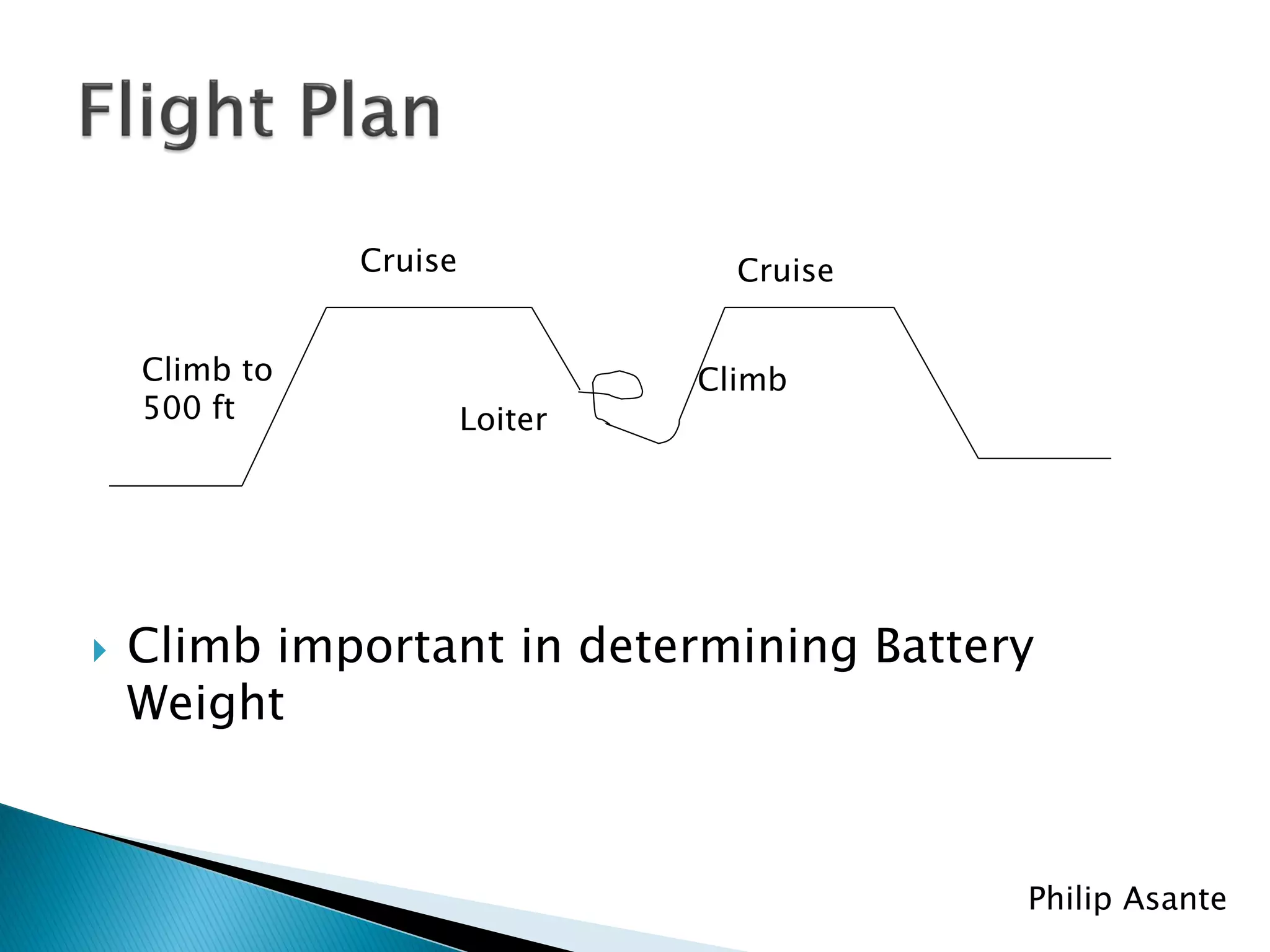
Cruise              Cruise


    Climb to                     Climb
    500 ft              Loiter


   Climb important in determining Battery
    Weight


                                            Philip Asante
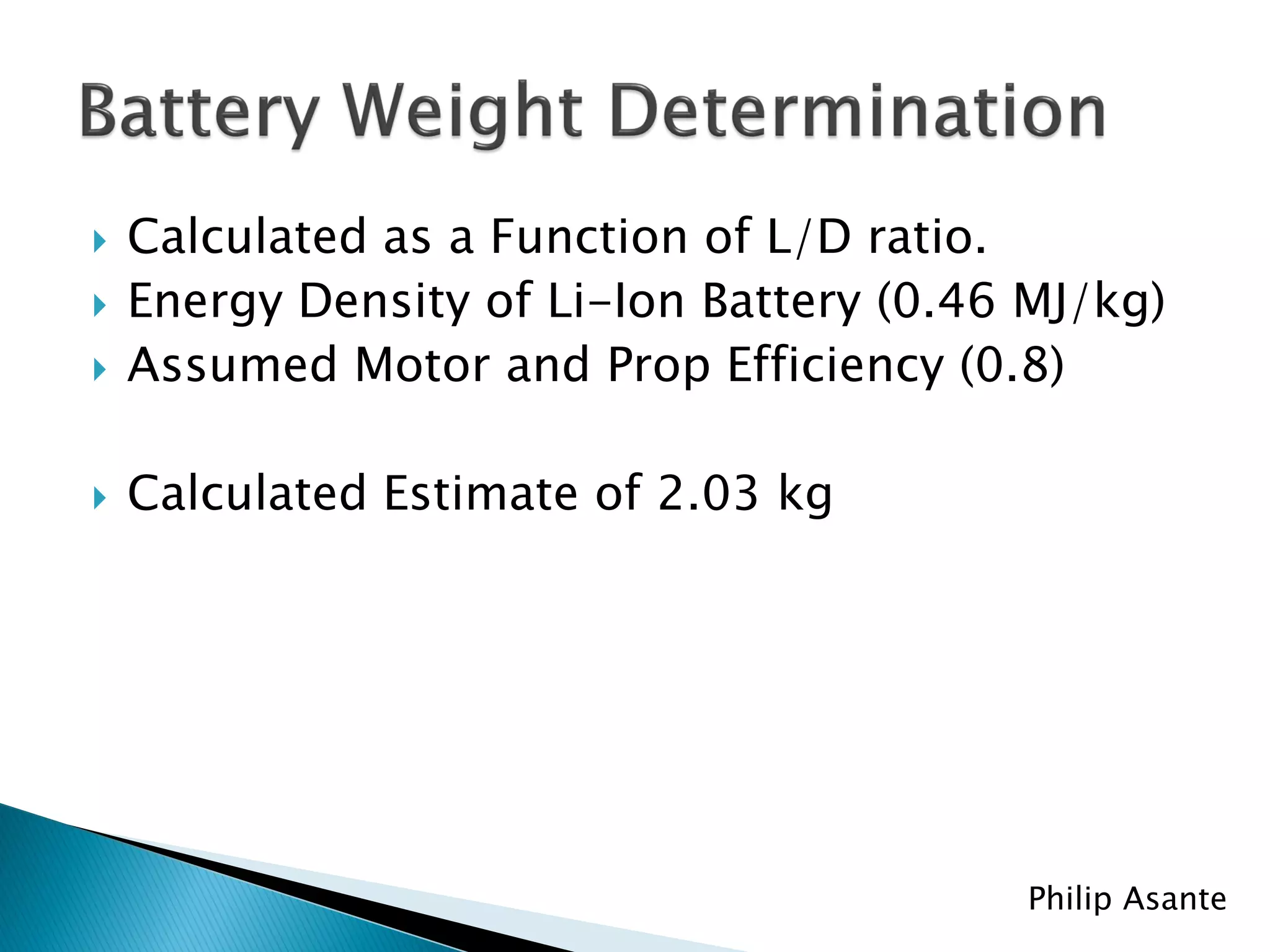
   Calculated as a Function of L/D ratio.
   Energy Density of Li-Ion Battery (0.46 MJ/kg)
   Assumed Motor and Prop Efficiency (0.8)

   Calculated Estimate of 2.03 kg


                                           Philip Asante
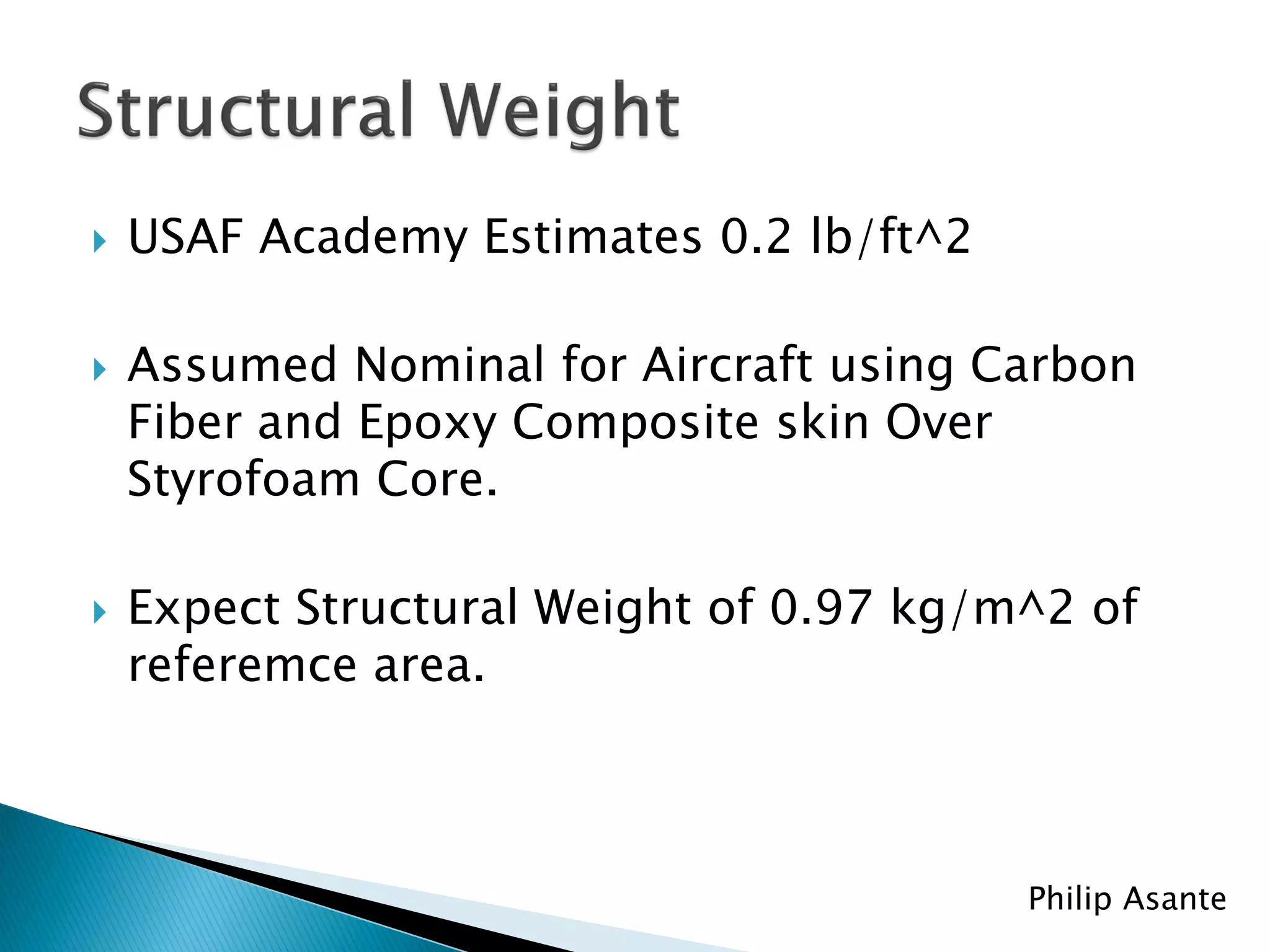
   USAF Academy Estimates 0.2 lb/ft^2

   Assumed Nominal for Aircraft using Carbon
    Fiber and Epoxy Composite skin Over
    Styrofoam Core.

   Expect Structural Weight of 0.97 kg/m^2 of
    referemce area.


                                         Philip Asante
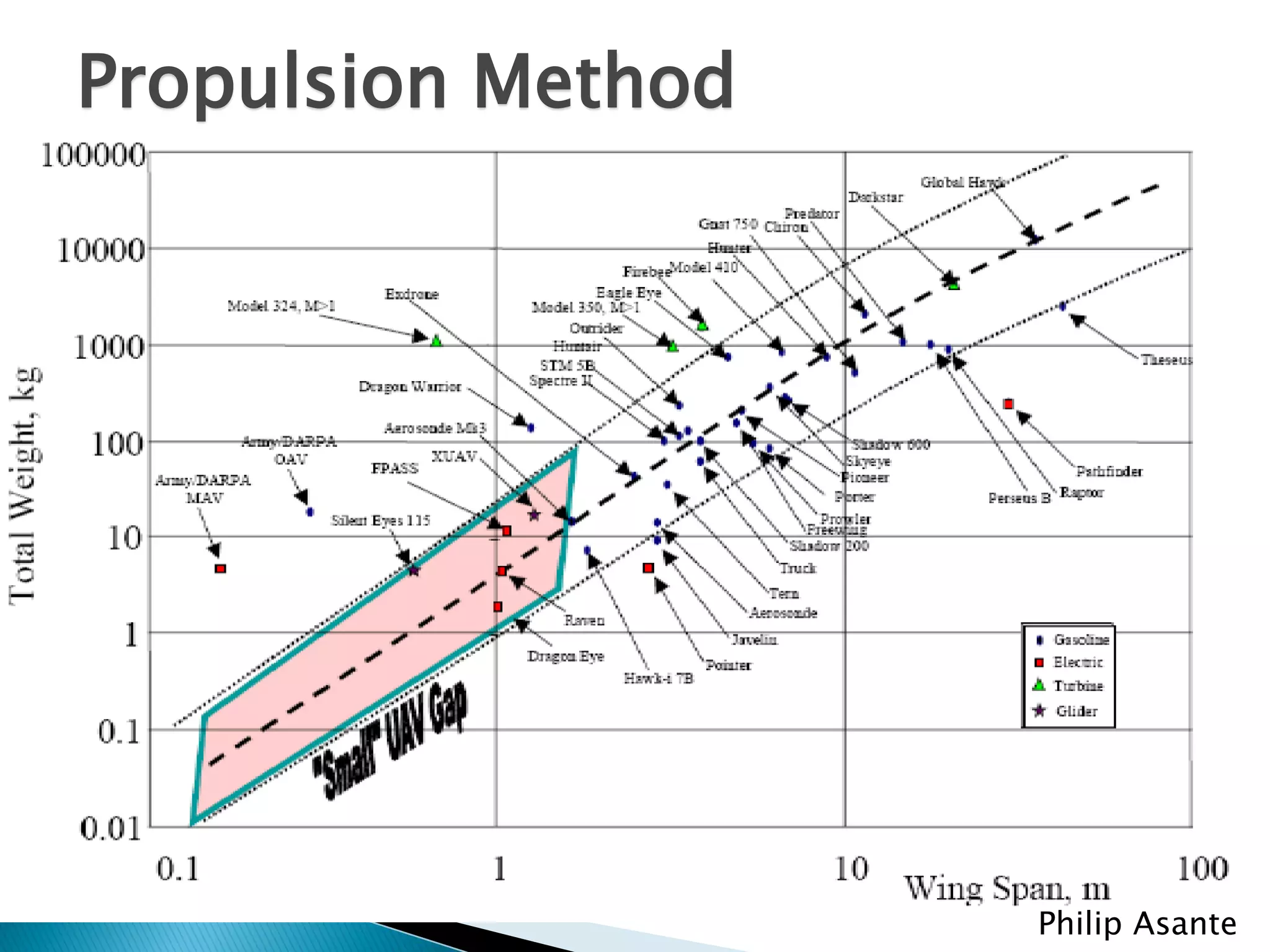
Propulsion Method


                    Philip Asante
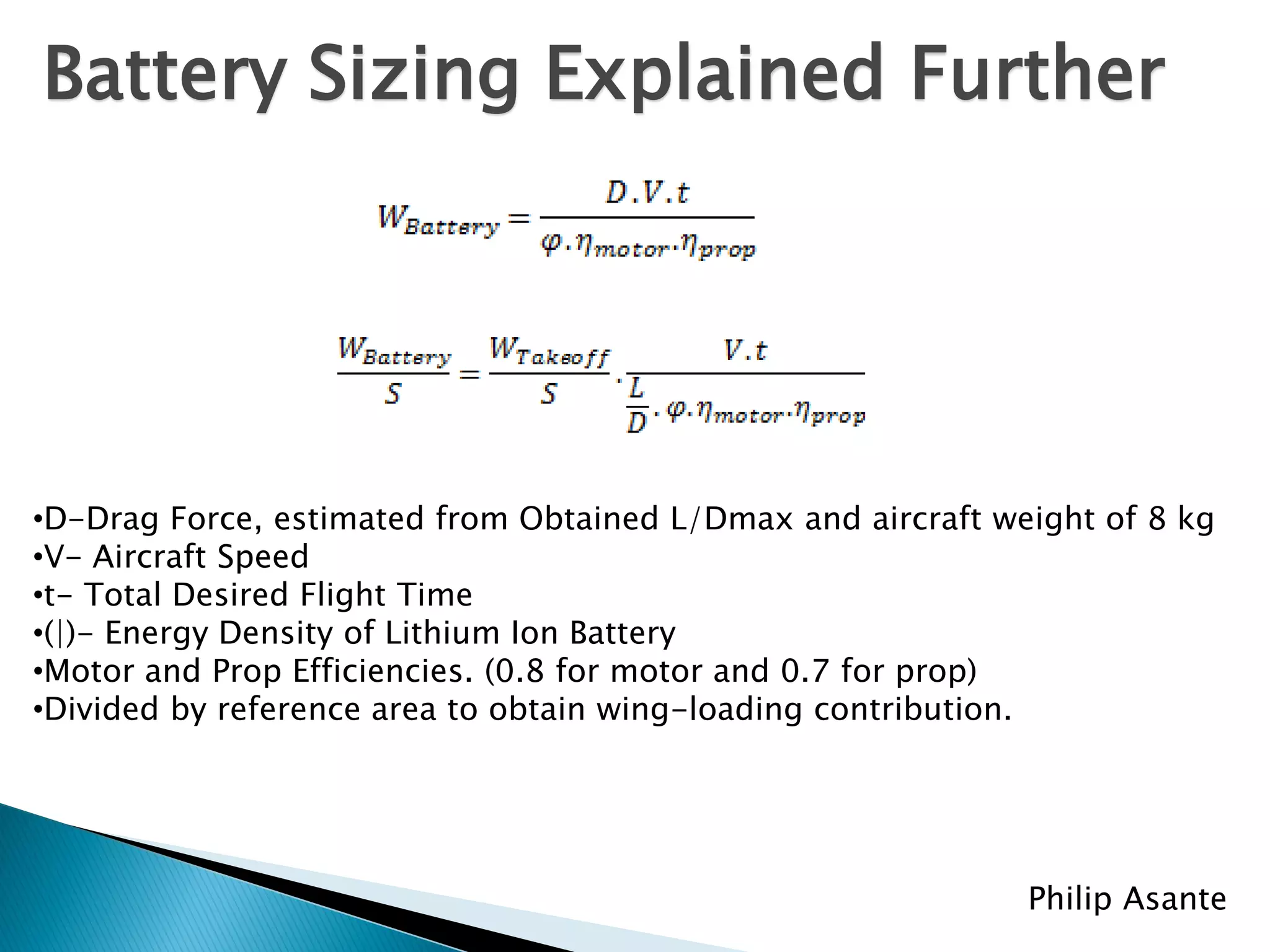
Battery Sizing Explained Further


•D-Drag Force, estimated from Obtained L/Dmax and aircraft weight of 8 kg
•V- Aircraft Speed
•t- Total Desired Flight Time
•(|)- Energy Density of Lithium Ion Battery
•Motor and Prop Efficiencies. (0.8 for motor and 0.7 for prop)
•Divided by reference area to obtain wing-loading contribution.


                                                             Philip Asante
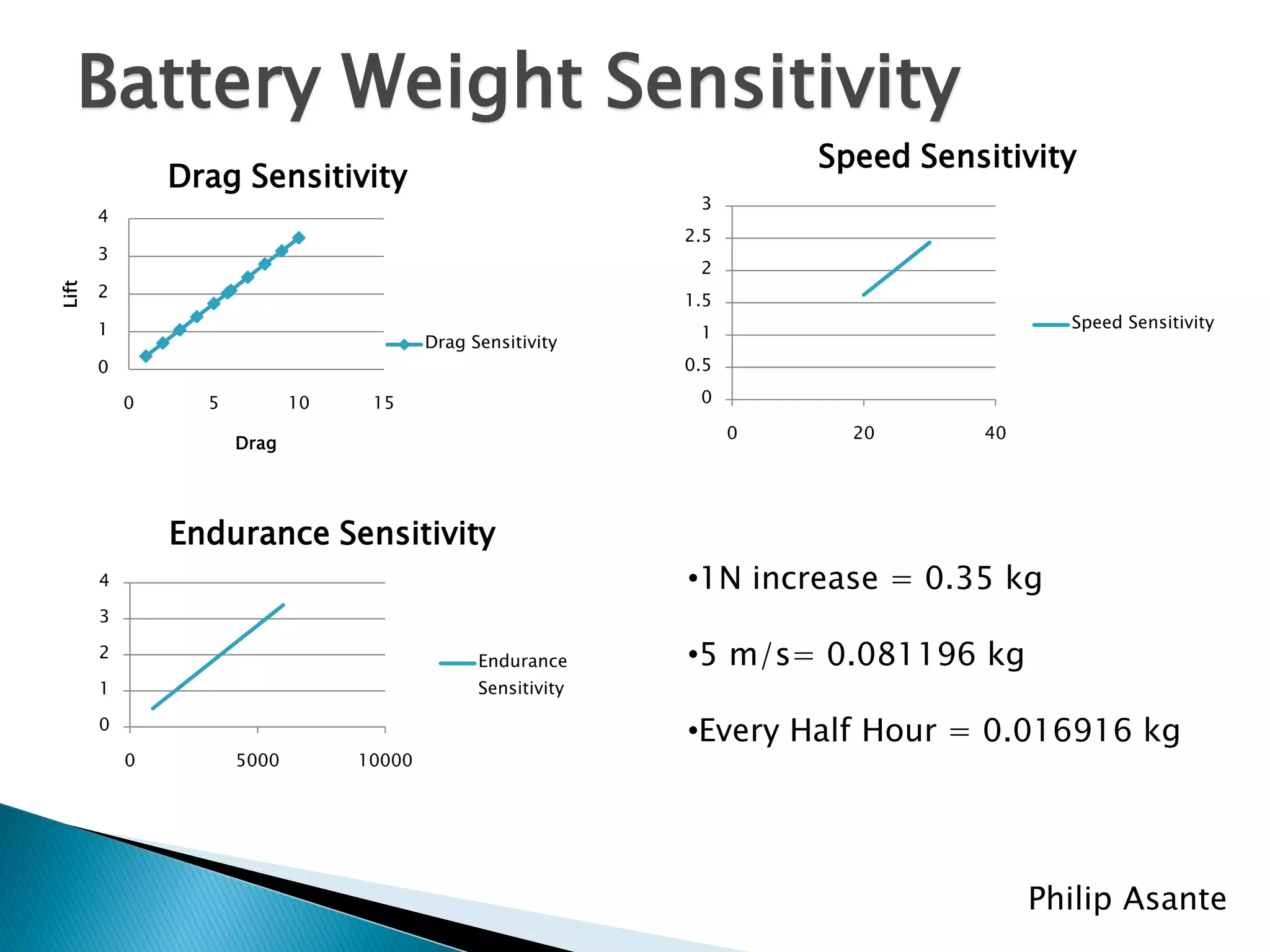
Battery Weight Sensitivity
                                                                       Speed Sensitivity
               Drag Sensitivity
                                                              3
       4
                                                             2.5
       3
                                                              2
       2
Lift


                                                             1.5
       1                                                                                Speed Sensitivity
                                                              1
                                         Drag Sensitivity
       0                                                     0.5

           0     5          10    15                          0

                                                                   0     20      40
                     Drag


               Endurance Sensitivity
       4                                                     •1N increase = 0.35 kg
       3

       2                                       Endurance     •5 m/s= 0.081196 kg
       1                                       Sensitivity

       0
                                                             •Every Half Hour = 0.016916 kg
           0         5000        10000


                                                                                      Philip Asante
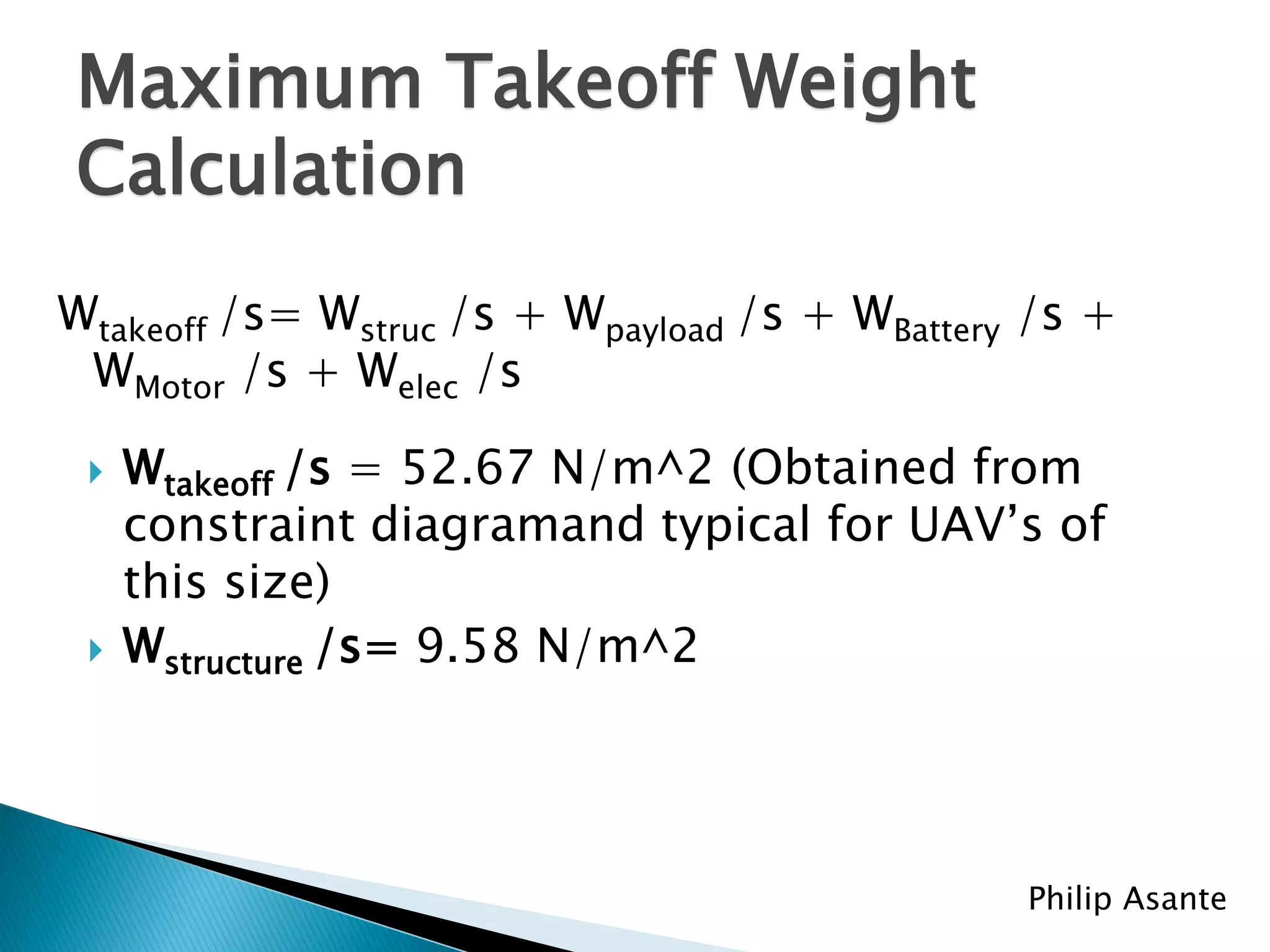
Maximum Takeoff Weight
Calculation
Wtakeoff /s= Wstruc /s + Wpayload /s + WBattery /s +
 WMotor /s + Welec /s

    Wtakeoff /s = 52.67 N/m^2 (Obtained from
     constraint diagramand typical for UAV’s of
     this size)
    Wstructure /s= 9.58 N/m^2


                                               Philip Asante
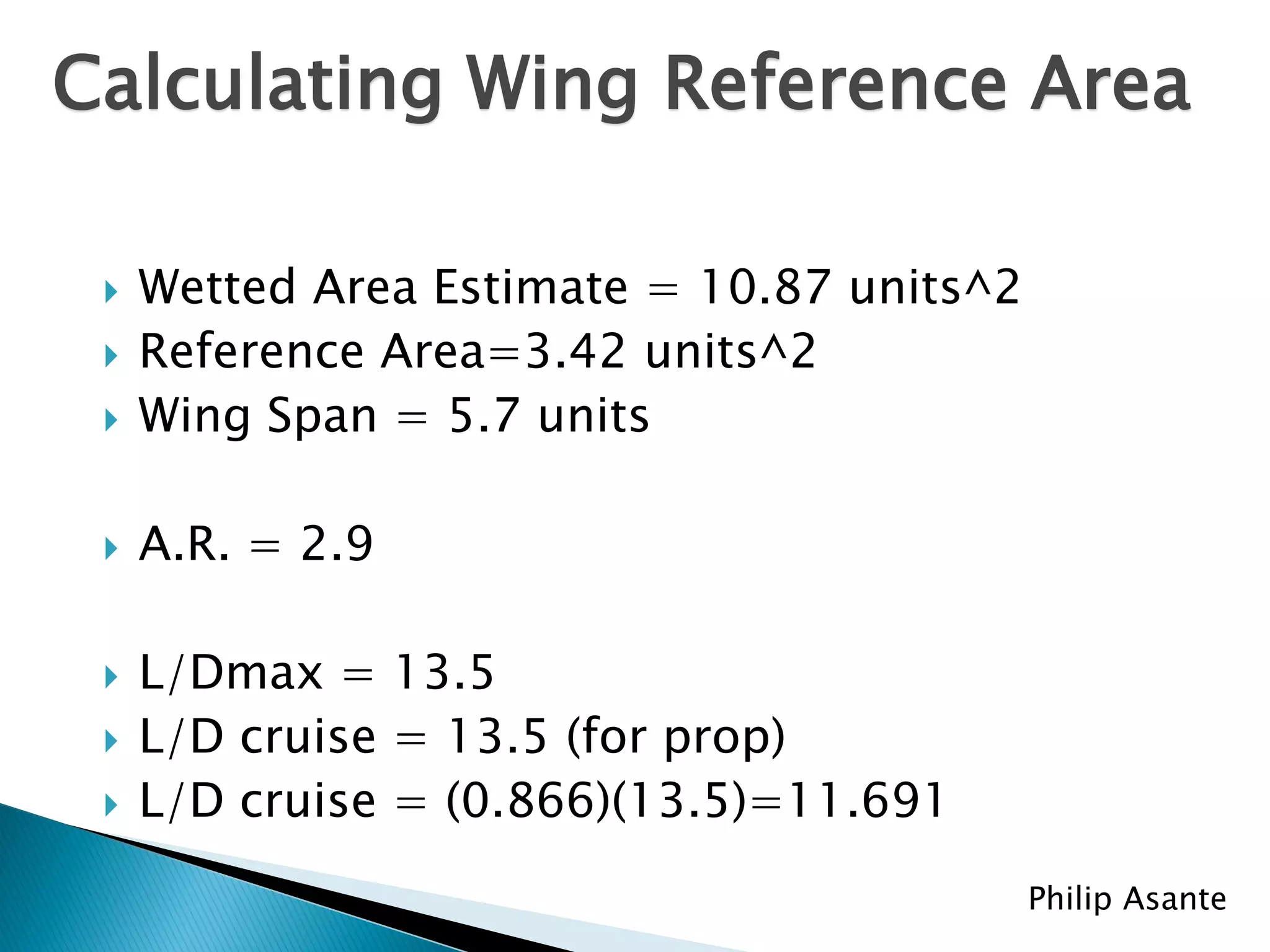
Calculating Wing Reference Area

    Wetted Area Estimate = 10.87 units^2
    Reference Area=3.42 units^2
    Wing Span = 5.7 units

    A.R. = 2.9

    L/Dmax = 13.5
    L/D cruise = 13.5 (for prop)
    L/D cruise = (0.866)(13.5)=11.691
                                            Philip Asante
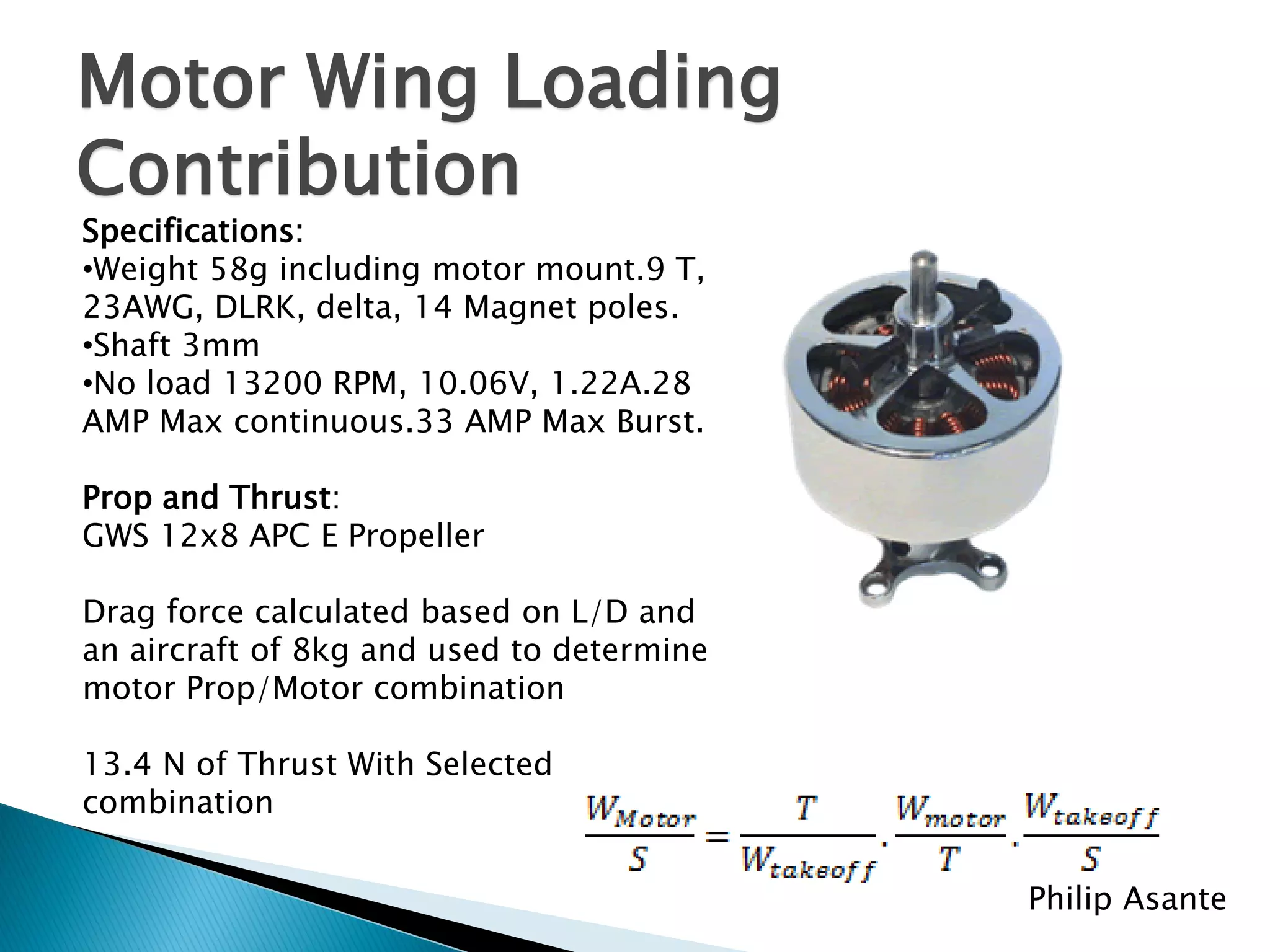
Motor Wing Loading
Contribution
Specifications:
•Weight 58g including motor mount.9 T,
23AWG, DLRK, delta, 14 Magnet poles.
•Shaft 3mm
•No load 13200 RPM, 10.06V, 1.22A.28
AMP Max continuous.33 AMP Max Burst.

Prop and Thrust:
GWS 12x8 APC E Propeller

Drag force calculated based on L/D and
an aircraft of 8kg and used to determine
motor Prop/Motor combination

13.4 N of Thrust With Selected
combination


                                           Philip Asante
Next Step

  •Create Program That adjusts Take-off
  Weight and Wingspan w.r.t. Payload
  mass.

  •Prepare concept structural design
  proposal

  •Perform stability and control analysis


                                            Philip Asante

Black Bird Uav Initial Sizing Methadology

  • 1.
    Using Electric UAVsizing Methodology Philip Asante
  • 2.
    • 8 UAV’sStudied Selected for Greater Study. •Weight and Endurance were of Particular Interest. •Found that UAV’s of this size usually use Piston Engines. Aircraft Aerosonde Aerosonde BSST Observer I Xian ASN-15 Qods Talash Fokker Space MATE NPS Remez-3 Cyberflight CyberOne Cyberflight Swift-Eye Country Australia China China Iran Netherlands Ukraine United Kingdom United Kingdom Launch Car Cradle Hand Hand/Rail Conventional Mortar Tube Conventional Conventional Hand Power(hp) 1 Unknown Unknown Unknown Unknown 2.5 2.5 unknown Engine 1 cyl; 4-stroke piston 4-stroke piston 1 cyl piston 1 cyl piston Electric 1 cyl piston 1 cyl piston (x2) 1 cyl piston Range(km) 2778 5 10 8 5 20 32.2 3.2 Endurance(h) 32 1.5 1 0.5 0.5 2 2 1 Cruise spd(kph) 104 120 90 90 Unknown 105 160 153 Loiter(kph) 74 74 56 56 Unknown 58 57 48 Alt Upper (m) 4500 1600 500 Unknown 300 Unknown 6100 4265 Alt Lower (m) 100 200 50 Unknown Unknown Unknown 50 50 We (kg) 8.2 4.2 2 7.1 6 6.5 5.4 1.8 Wo (kg) 13.4 10 6.5 12 6 10 12.2 6.4 We/Wo 0.611940299 0.42 0.307692308 0.591666667 1 0.65 0.442622951 0.28125 Philip Asante
  • 3.
    Pusher Motorc H-Tail Configuration Camera Dome Philip Asante
  • 4.
    T-Tail configuration Mounted pusher motor and fairing High wing for increased roll stability Philip Asante
  • 5.
  • 6.
  • 7.
    Similar Design Used By Highlighted UAV’s of Similar Weight.  Good Low Speed Flight Stall and Stability Characteristics. (Tail Wing Will not stall Due to Prop Airflow. Philip Asante
  • 8.
  • 9.
    Wtakeoff = Wstruc+ Wpayload + WBattery+ WMotor+ Welec •Structure Weight Typically between 25-30% of the Take-Off Weight. •US Airforce Cadets in the Aerospace Program use a wing loading contribution of 0.2 lb/ft^3 for their UAV Designs. •Fair assumption When using Carbon Fiber and Epoxy Composite Skin over a Styrofoam Core. Philip Asante
  • 10.
    Take-off Weight vsEmpty Weight Trend 16 14 12 Take-Off Weight 10 8 Series1 6 Log. (Series1) 4 2 0 0 2 4 6 8 10 Empty Weight Philip Asante
  • 11.
    High Definition TV Camera and/or IR Sensors  Video Downlink Communication Package  Motor  Above Payloads Included in Research Weight  Extra Battery for Avionics and Camera?  Sensitivity Study To be Conducted to see effect of Payload weight changes Philip Asante
  • 12.
    Wetted Area Estimate = 10.87 units^2  Reference Area=3.42 units^2  Wing Span = 5.7 units  A.R. = 2.9  L/Dmax = 13.5  L/D cruise = 13.5 (for prop)  L/D cruise = (0.866)(13.5)=11.691 Philip Asante
  • 13.
    Cruise Cruise Climb to Climb 500 ft Loiter  Climb important in determining Battery Weight Philip Asante
  • 14.
    Calculated as a Function of L/D ratio.  Energy Density of Li-Ion Battery (0.46 MJ/kg)  Assumed Motor and Prop Efficiency (0.8)  Calculated Estimate of 2.03 kg Philip Asante
  • 15.
    USAF Academy Estimates 0.2 lb/ft^2  Assumed Nominal for Aircraft using Carbon Fiber and Epoxy Composite skin Over Styrofoam Core.  Expect Structural Weight of 0.97 kg/m^2 of referemce area. Philip Asante
  • 16.
    Propulsion Method Philip Asante
  • 17.
    Battery Sizing ExplainedFurther •D-Drag Force, estimated from Obtained L/Dmax and aircraft weight of 8 kg •V- Aircraft Speed •t- Total Desired Flight Time •(|)- Energy Density of Lithium Ion Battery •Motor and Prop Efficiencies. (0.8 for motor and 0.7 for prop) •Divided by reference area to obtain wing-loading contribution. Philip Asante
  • 18.
    Battery Weight Sensitivity Speed Sensitivity Drag Sensitivity 3 4 2.5 3 2 2 Lift 1.5 1 Speed Sensitivity 1 Drag Sensitivity 0 0.5 0 5 10 15 0 0 20 40 Drag Endurance Sensitivity 4 •1N increase = 0.35 kg 3 2 Endurance •5 m/s= 0.081196 kg 1 Sensitivity 0 •Every Half Hour = 0.016916 kg 0 5000 10000 Philip Asante
  • 19.
    Maximum Takeoff Weight Calculation Wtakeoff/s= Wstruc /s + Wpayload /s + WBattery /s + WMotor /s + Welec /s  Wtakeoff /s = 52.67 N/m^2 (Obtained from constraint diagramand typical for UAV’s of this size)  Wstructure /s= 9.58 N/m^2 Philip Asante
  • 20.
    Calculating Wing ReferenceArea  Wetted Area Estimate = 10.87 units^2  Reference Area=3.42 units^2  Wing Span = 5.7 units  A.R. = 2.9  L/Dmax = 13.5  L/D cruise = 13.5 (for prop)  L/D cruise = (0.866)(13.5)=11.691 Philip Asante
  • 21.
    Motor Wing Loading Contribution Specifications: •Weight58g including motor mount.9 T, 23AWG, DLRK, delta, 14 Magnet poles. •Shaft 3mm •No load 13200 RPM, 10.06V, 1.22A.28 AMP Max continuous.33 AMP Max Burst. Prop and Thrust: GWS 12x8 APC E Propeller Drag force calculated based on L/D and an aircraft of 8kg and used to determine motor Prop/Motor combination 13.4 N of Thrust With Selected combination Philip Asante
  • 22.
    Next Step •Create Program That adjusts Take-off Weight and Wingspan w.r.t. Payload mass. •Prepare concept structural design proposal •Perform stability and control analysis Philip Asante