AIRCRAFT DESIGN                                                              MADE
                                                                             EASY
                                                                                                        By
                                                                                                        Chris
                                                                                                        Heintz
The following article, which is a first installement of a two-part article, describes a simple method for the
preliminary design of an airplane of conventional configuration. This method will allow you to design an
aircraft relatively easily with just a few sheets of paper, a pencil (and an eraser to make corrections!), plus a
$10 calculator. No need for a computer, web link, or spreadsheets. The example chosen would fit into the
proposed Light-Sport Aircraft category as defined in the FAA's proposed Sport Pilot / Light-Sport Aircraft
category.

         Basic Choices and Weights                         And, here’s a warning about our engine selection.
                                                           Never design a new airplane to be equipped with a
This airplane is intended to carry two occupants (a        new, unknown engine. You simply double the
pilot and one passenger) and the fuel required to          potential problems (we learned this from
keep the engine running at least the length of time        experience), and your fantastic design may
we want to enjoy flying. The weight of each                become a failure because of an unreliable engine...
occupant is estimated at 190 pounds, and the fuel          or vice versa!
consumption at a rate of 6 gallons per hour (gph)          It’s also important to carefully check the
per 100 hp installed.                                      powerplant’s weight, including engine, exhaust,
Fuel weighs approximately 6 pounds per gallon, so          coolers, coolant, oil, reduction unit, propeller, and
6 gallons of fuel will weigh 36 pounds, thus we’ll         other accessories. Is this weight within acceptable
need 36 pounds of fuel per hour endurance for 100          limits of today’s technology -- that is, less than two
bhp. A practical airplane needs two to four hours’         pounds per hp? Also check the fuel consumption:
endurance, so let’s choose three hours as our goal.        Does it fit with our assumptions above?
If the engine has 80 bhp, similar to the Rotax or
Jabiru 2200, the weight of fuel required for three         Empty Weight (We)
hours endurance will be:                                   Next we have to estimate the empty weight of our
                                                           new airplane. We do this by choosing one of the
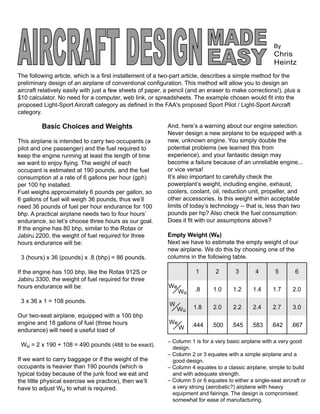
 3 (hours) x 36 (pounds) x .8 (bhp) = 86 pounds.           columns in the following table.

If the engine has 100 bhp, like the Rotax 912S or                      1       2       3        4       5        6
Jabiru 3300, the weight of fuel required for three
hours endurance will be:                                    We
                                                                 Wu    .8     1.0     1.2      1.4     1.7      2.0
 3 x 36 x 1 = 108 pounds.
                                                            W
                                                                Wu    1.8     2.0     2.2      2.4     2.7      3.0
Our two-seat airplane, equipped with a 100 bhp
engine and 18 gallons of fuel (three hours                  We        .444   .500     .545    .583     .642    .667
endurance) will need a useful load of                            W

                                                           – Column 1 is for a very basic airplane with a very good
 Wu = 2 x 190 + 108 = 490 pounds (488 to be exact).
                                                             design.
                                                           – Column 2 or 3 equates with a simple airplane and a
If we want to carry baggage or if the weight of the          good design.
occupants is heavier than 190 pounds (which is             – Column 4 equates to a classic airplane, simple to build
typical today because of the junk food we eat and            and with adequate strength.
the little physical exercise we practice), then we’ll      – Column 5 or 6 equates to either a single-seat aircraft or
have to adjust Wu to what is required.                       a very strong (aerobatic?) airplane with heavy
                                                             equipment and fairings. The design is compromised
                                                             somewhat for ease of manufacturing.
Yes, this is a wide range of aircraft options! Let us    Without going into complicated theories (and then
not overestimate our design capability, especially if    finding out that practically built wings may have lift
this is our first attempt at designing an airplane.      coefficients quite different than from the theory) we
Unless we are geniuses, most likely our airplane will    make a reasonably good estimate with the following
end up heavier than anticipated. So, let’s be humble     configuration of wing sections with full-span flaps:
when determining the maximum weight:

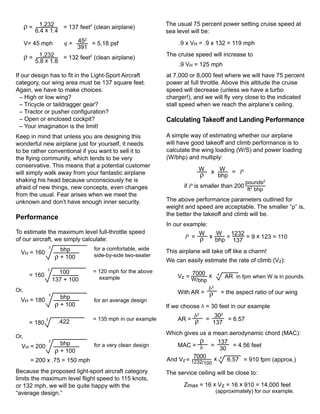
 W = We + Wu = Wu 1 + [    We
                                Wu   ]                                                                   CLmax = 1.4
Choosing to be a modest designer, we pick column                   CLEAN WING
4 as our guide to obtain our maximum weight:

 W = 490 (1 + 1.4) = 1,176 pounds
                                                                                                         CLmax = 2.2
This allows us an error of 1,232 pounds (the                        PLAIN FLAP
proposed weight for a Light-Sport Aircraft) minus
1,176 pounds, leaving us 56 pounds of “room for
error,” that is, being heavier than planned.
                                                                                                         CLmax = 2.8
We could increase the useful load by 20 pounds to                SLOTTED FLAP
510 pounds:

 Wu = 490 + 20 = 510 pounds
                                                                                                         CLmax = 3.6
                                                               LEADING EDGE SLAT
Then,                                                          AND SLOTTED FLAP

 W = 510 (1 + 1.4) = 1,224 pounds maximum weight
                                                                           Chord
That’s pretty close to the proposed 1,232 pounds
for a Light-Sport Aircraft.                              For a simple design, we choose a simple, plain
                                                         flap, and we do not forget that the flap portion of
Landing Speeds and Wing Area                             the wing is only about one-half of the wingspan
Having selected the weights, we now have to select       (the ailerons occupy the outboard one-half span
the maximum stall speeds. The proposed Light-            approximately).
Sport Aircraft category prescribes these as:
                                                           CLflaps down = 1/2 CLno flaps + 1/2 CLwith flaps
 VSO = 39 knots = 45 mph (flaps down)
 VS = 44 knots = 50 mph (clean configuration)              = [1.4/2] + [2.2/2] = .7 + 1.1 = 1.8
                                                         and
At these speeds, the airplane will be easy and
relatively safe to land, which is one of the purposes      CLclean = 1.4
of creating the Light-Sport Aircraft category.
If you are interested in designing an experimental       With these values we find the required wing area (ρ)
category aircraft that exceeds the performance           to meet the selected stall speed requirements:
parameters of a Light-Sport Aircraft.. .and you are a
good pilot.. .you could go up to a VSO of 60 mph.          W = ρ x q x CLmax
But, be aware that above this speed, the energy                       ρv2    v2                 v2
                                                           where q = 2 = 19.77 =               391
generated becomes so large that there is very little
chance of survival in the case of a landing accident.    (q is in PSF, pounds per square foot, when V is in mph)
Next, we have to know the airplane’s maximum lift                   ρ= W
coefficient (CL) for both configurations -- flaps down
                                                            Or           qCLmax and for
and flaps up (clean). The lift coefficient will depend                                  2
                                                                                  q = 50 = 6.4 psf
on the wing planform, Reynolds number, airfoil             V= 50 mph                    391
roughness, and center of gravity (CG) position.
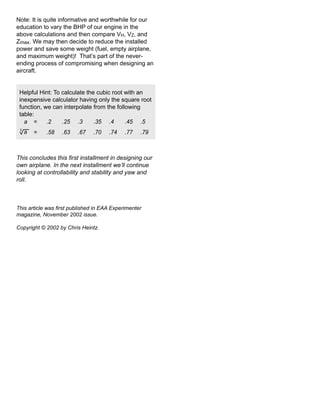
ρ = 1,232                                                   The usual 75 percent power setting cruise speed at
                          = 137 feet2 (clean airplane)
         6.4 x 1.4                                                sea level will be:
                                 2
      V= 45 mph            q = 45 = 5.18 psf                           .9 x VH = .9 x 132 = 119 mph
                                 391
      ρ = 1,232                                                   The cruise speed will increase to
                          = 132 feet2 (clean airplane)
         5.8 x 1.8
                                                                       .9 VH = 125 mph
If our design has to fit in the Light-Sport Aircraft              at 7,000 or 8,000 feet where we will have 75 percent
category, our wing area must be 137 square feet.                  power at full throttle. Above this altitude the cruise
Again, we have to make choices:                                   speed will decrease (unless we have a turbo
  – High or low wing?                                             charger!), and we will fly very close to the indicated
  – Tricycle or taildragger gear?                                 stall speed when we reach the airplane’s ceiling.
  – Tractor or pusher configuration?
  – Open or enclosed cockpit?                                     Calculating Takeoff and Landing Performance
  – Your imagination is the limit!
Keep in mind that unless you are designing this                   A simple way of estimating whether our airplane
wonderful new airplane just for yourself, it needs                will have good takeoff and climb performance is to
to be rather conventional if you want to sell it to               calculate the wing loading (W/S) and power loading
the flying community, which tends to be very                      (W/bhp) and multiply:
conservative. This means that a potential customer
                                                                               W        x W = P
will simply walk away from your fantastic airplane                              ρ         bhp
shaking his head because unconsciously he is                                                          pounds2
afraid of new things, new concepts, even changes                         if P is smaller than 200
                                                                                                       ft2 bhp
from the usual. Fear arises when we meet the
unknown and don’t have enough inner security.                     The above performance parameters outlined for
                                                                  weight and speed are acceptable. The smaller “p” is,
                                                                  the better the takeoff and climb will be.
Performance
                                                                  In our example:
To estimate the maximum level full-throttle speed                            W   W    1232
of our aircraft, we simply calculate:                                    P = ρ x    =      = 9 x 123 = 110
                                                                                 bhp 137
                   3
                         bhp           for a comfortable, wide    This airplane will take off like a charm!
  VH = 160
                       ρ + 100         side-by-side two-seater
                                                                  We can easily estimate the rate of climb (Vz):
               3
                         100           = 120 mph for the above             7000 x
       = 160                             example                      Vz = W             4
                                                                                              AR in fpm when W is in pounds.
                       137 + 100                                            /bhp
Or,                                                                             b2
                   3
                                                                      With AR = ρ            = the aspect ratio of our wing
                         bhp
  VH = 180                             for an average design
                       ρ + 100                                    If we choose b = 30 feet in our example
                                                                           b2            302
               3
                         .422          = 135 mph in our example       AR = ρ        =        = 6.57
       = 180                                                                            137
                                                                  Which gives us a mean aerodynamic chord (MAC):
Or,
                   3
                         bhp                                                  ρ     137
  VH = 200                             for a very clean design       MAC = b =            = 4.56 feet
                       ρ + 100                                                       30
                                                                            7000 x 4
        = 200 x .75 = 150 mph                                     And Vz = 1232/        6.57 = 910 fpm (approx.)
                                                                                 100
Because the proposed light-sport aircraft category                The service ceiling will be close to:
limits the maximum level flight speed to 115 knots,
or 132 mph, we will be quite happy with the                              Zmax = 16 x Vz = 16 x 910 = 14,000 feet
“average design.”                                                                       (approximately) for our example.
Note: It is quite informative and worthwhile for our
education to vary the BHP of our engine in the
above calculations and then compare VH, VZ, and
Zmax. We may then decide to reduce the installed
power and save some weight (fuel, empty airplane,
and maximum weight)! That’s part of the never-
ending process of compromising when designing an
aircraft.


 Helpful Hint: To calculate the cubic root with an
 inexpensive calculator having only the square root
 function, we can interpolate from the following
 table:
   a =      .2    .25 .3       .35 .4      .45 .5
 3
     a   =   .58   .63   .67    .70   .74    .77   .79


This concludes this first installment in designing our
own airplane. In the next installment we’ll continue
looking at controllability and stability and yaw and
roll.


This article was first published in EAA Experimenter
magazine, November 2002 issue.

Copyright © 2002 by Chris Heintz.

Aircraft design 1

  • 1.
    AIRCRAFT DESIGN MADE EASY By Chris Heintz The following article, which is a first installement of a two-part article, describes a simple method for the preliminary design of an airplane of conventional configuration. This method will allow you to design an aircraft relatively easily with just a few sheets of paper, a pencil (and an eraser to make corrections!), plus a $10 calculator. No need for a computer, web link, or spreadsheets. The example chosen would fit into the proposed Light-Sport Aircraft category as defined in the FAA's proposed Sport Pilot / Light-Sport Aircraft category. Basic Choices and Weights And, here’s a warning about our engine selection. Never design a new airplane to be equipped with a This airplane is intended to carry two occupants (a new, unknown engine. You simply double the pilot and one passenger) and the fuel required to potential problems (we learned this from keep the engine running at least the length of time experience), and your fantastic design may we want to enjoy flying. The weight of each become a failure because of an unreliable engine... occupant is estimated at 190 pounds, and the fuel or vice versa! consumption at a rate of 6 gallons per hour (gph) It’s also important to carefully check the per 100 hp installed. powerplant’s weight, including engine, exhaust, Fuel weighs approximately 6 pounds per gallon, so coolers, coolant, oil, reduction unit, propeller, and 6 gallons of fuel will weigh 36 pounds, thus we’ll other accessories. Is this weight within acceptable need 36 pounds of fuel per hour endurance for 100 limits of today’s technology -- that is, less than two bhp. A practical airplane needs two to four hours’ pounds per hp? Also check the fuel consumption: endurance, so let’s choose three hours as our goal. Does it fit with our assumptions above? If the engine has 80 bhp, similar to the Rotax or Jabiru 2200, the weight of fuel required for three Empty Weight (We) hours endurance will be: Next we have to estimate the empty weight of our new airplane. We do this by choosing one of the 3 (hours) x 36 (pounds) x .8 (bhp) = 86 pounds. columns in the following table. If the engine has 100 bhp, like the Rotax 912S or 1 2 3 4 5 6 Jabiru 3300, the weight of fuel required for three hours endurance will be: We Wu .8 1.0 1.2 1.4 1.7 2.0 3 x 36 x 1 = 108 pounds. W Wu 1.8 2.0 2.2 2.4 2.7 3.0 Our two-seat airplane, equipped with a 100 bhp engine and 18 gallons of fuel (three hours We .444 .500 .545 .583 .642 .667 endurance) will need a useful load of W – Column 1 is for a very basic airplane with a very good Wu = 2 x 190 + 108 = 490 pounds (488 to be exact). design. – Column 2 or 3 equates with a simple airplane and a If we want to carry baggage or if the weight of the good design. occupants is heavier than 190 pounds (which is – Column 4 equates to a classic airplane, simple to build typical today because of the junk food we eat and and with adequate strength. the little physical exercise we practice), then we’ll – Column 5 or 6 equates to either a single-seat aircraft or have to adjust Wu to what is required. a very strong (aerobatic?) airplane with heavy equipment and fairings. The design is compromised somewhat for ease of manufacturing.
  • 2.
    Yes, this isa wide range of aircraft options! Let us Without going into complicated theories (and then not overestimate our design capability, especially if finding out that practically built wings may have lift this is our first attempt at designing an airplane. coefficients quite different than from the theory) we Unless we are geniuses, most likely our airplane will make a reasonably good estimate with the following end up heavier than anticipated. So, let’s be humble configuration of wing sections with full-span flaps: when determining the maximum weight: W = We + Wu = Wu 1 + [ We Wu ] CLmax = 1.4 Choosing to be a modest designer, we pick column CLEAN WING 4 as our guide to obtain our maximum weight: W = 490 (1 + 1.4) = 1,176 pounds CLmax = 2.2 This allows us an error of 1,232 pounds (the PLAIN FLAP proposed weight for a Light-Sport Aircraft) minus 1,176 pounds, leaving us 56 pounds of “room for error,” that is, being heavier than planned. CLmax = 2.8 We could increase the useful load by 20 pounds to SLOTTED FLAP 510 pounds: Wu = 490 + 20 = 510 pounds CLmax = 3.6 LEADING EDGE SLAT Then, AND SLOTTED FLAP W = 510 (1 + 1.4) = 1,224 pounds maximum weight Chord That’s pretty close to the proposed 1,232 pounds for a Light-Sport Aircraft. For a simple design, we choose a simple, plain flap, and we do not forget that the flap portion of Landing Speeds and Wing Area the wing is only about one-half of the wingspan Having selected the weights, we now have to select (the ailerons occupy the outboard one-half span the maximum stall speeds. The proposed Light- approximately). Sport Aircraft category prescribes these as: CLflaps down = 1/2 CLno flaps + 1/2 CLwith flaps VSO = 39 knots = 45 mph (flaps down) VS = 44 knots = 50 mph (clean configuration) = [1.4/2] + [2.2/2] = .7 + 1.1 = 1.8 and At these speeds, the airplane will be easy and relatively safe to land, which is one of the purposes CLclean = 1.4 of creating the Light-Sport Aircraft category. If you are interested in designing an experimental With these values we find the required wing area (ρ) category aircraft that exceeds the performance to meet the selected stall speed requirements: parameters of a Light-Sport Aircraft.. .and you are a good pilot.. .you could go up to a VSO of 60 mph. W = ρ x q x CLmax But, be aware that above this speed, the energy ρv2 v2 v2 where q = 2 = 19.77 = 391 generated becomes so large that there is very little chance of survival in the case of a landing accident. (q is in PSF, pounds per square foot, when V is in mph) Next, we have to know the airplane’s maximum lift ρ= W coefficient (CL) for both configurations -- flaps down Or qCLmax and for and flaps up (clean). The lift coefficient will depend 2 q = 50 = 6.4 psf on the wing planform, Reynolds number, airfoil V= 50 mph 391 roughness, and center of gravity (CG) position.
  • 3.
    ρ = 1,232 The usual 75 percent power setting cruise speed at = 137 feet2 (clean airplane) 6.4 x 1.4 sea level will be: 2 V= 45 mph q = 45 = 5.18 psf .9 x VH = .9 x 132 = 119 mph 391 ρ = 1,232 The cruise speed will increase to = 132 feet2 (clean airplane) 5.8 x 1.8 .9 VH = 125 mph If our design has to fit in the Light-Sport Aircraft at 7,000 or 8,000 feet where we will have 75 percent category, our wing area must be 137 square feet. power at full throttle. Above this altitude the cruise Again, we have to make choices: speed will decrease (unless we have a turbo – High or low wing? charger!), and we will fly very close to the indicated – Tricycle or taildragger gear? stall speed when we reach the airplane’s ceiling. – Tractor or pusher configuration? – Open or enclosed cockpit? Calculating Takeoff and Landing Performance – Your imagination is the limit! Keep in mind that unless you are designing this A simple way of estimating whether our airplane wonderful new airplane just for yourself, it needs will have good takeoff and climb performance is to to be rather conventional if you want to sell it to calculate the wing loading (W/S) and power loading the flying community, which tends to be very (W/bhp) and multiply: conservative. This means that a potential customer W x W = P will simply walk away from your fantastic airplane ρ bhp shaking his head because unconsciously he is pounds2 afraid of new things, new concepts, even changes if P is smaller than 200 ft2 bhp from the usual. Fear arises when we meet the unknown and don’t have enough inner security. The above performance parameters outlined for weight and speed are acceptable. The smaller “p” is, the better the takeoff and climb will be. Performance In our example: To estimate the maximum level full-throttle speed W W 1232 of our aircraft, we simply calculate: P = ρ x = = 9 x 123 = 110 bhp 137 3 bhp for a comfortable, wide This airplane will take off like a charm! VH = 160 ρ + 100 side-by-side two-seater We can easily estimate the rate of climb (Vz): 3 100 = 120 mph for the above 7000 x = 160 example Vz = W 4 AR in fpm when W is in pounds. 137 + 100 /bhp Or, b2 3 With AR = ρ = the aspect ratio of our wing bhp VH = 180 for an average design ρ + 100 If we choose b = 30 feet in our example b2 302 3 .422 = 135 mph in our example AR = ρ = = 6.57 = 180 137 Which gives us a mean aerodynamic chord (MAC): Or, 3 bhp ρ 137 VH = 200 for a very clean design MAC = b = = 4.56 feet ρ + 100 30 7000 x 4 = 200 x .75 = 150 mph And Vz = 1232/ 6.57 = 910 fpm (approx.) 100 Because the proposed light-sport aircraft category The service ceiling will be close to: limits the maximum level flight speed to 115 knots, or 132 mph, we will be quite happy with the Zmax = 16 x Vz = 16 x 910 = 14,000 feet “average design.” (approximately) for our example.
  • 4.
    Note: It isquite informative and worthwhile for our education to vary the BHP of our engine in the above calculations and then compare VH, VZ, and Zmax. We may then decide to reduce the installed power and save some weight (fuel, empty airplane, and maximum weight)! That’s part of the never- ending process of compromising when designing an aircraft. Helpful Hint: To calculate the cubic root with an inexpensive calculator having only the square root function, we can interpolate from the following table: a = .2 .25 .3 .35 .4 .45 .5 3 a = .58 .63 .67 .70 .74 .77 .79 This concludes this first installment in designing our own airplane. In the next installment we’ll continue looking at controllability and stability and yaw and roll. This article was first published in EAA Experimenter magazine, November 2002 issue. Copyright © 2002 by Chris Heintz.