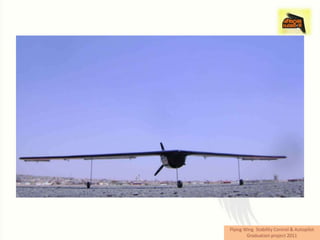
African Hawk II
        Automated Version


             Graduation Project
                 Done By:
   Mamdouh        Sadek      Al- Moatasem BelaaH
     Samy         Samir          Khattab
Introduction
Introduction
•   Mini UAVs
•   Pheonix 607 (2006/2007)
•   Mantis (2007/2009)
•   Buraq (2008/2009)
•   African Hawk (2009/2010)
Introduction
• It’s a Vision

• UAS

• Autopilot
Introduction
                   Objectives
• Modeling and Manufacturing of the aircraft.
• Design and installation of autopilot chip
  onboard of the aircraft.
Introduction
                   What’s New?!
•   Internal Arrangement
•   Landing Gear
•   Vacuum Bagging
•   MicroPilot Autopilot
•   Emergency Recovery System
Propulsion Model
Objective
• Set Mathematical to relate parameters

• Thrust

• RPM

• Velocity
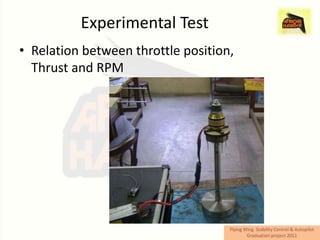
Experimental Test
• Relation between throttle position,
  Thrust and RPM
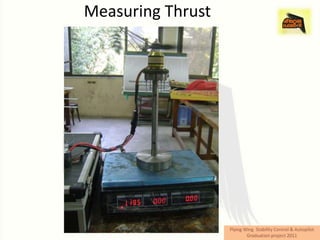
Measuring Thrust
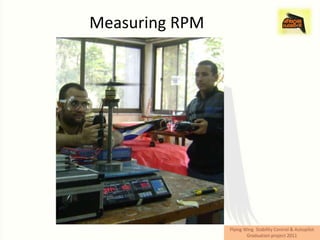
Measuring RPM
Results
                    1- Thrust Vs. Throttle Position
             4500

                              y = 0.209x2 + 18.981x
             4000
                                   R² = 0.9939

             3500


             3000
thrust(gm)


             2500


             2000


             1500


             1000


             500


               0
                    0    20         40                 60             80   100   120
                                              throttle position (%)
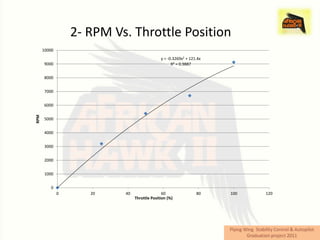
2- RPM Vs. Throttle Position
      10000
                                              y = -0.3269x2 + 121.4x
      9000                                          R² = 0.9887


      8000


      7000


      6000
RPM


      5000


      4000


      3000


      2000


      1000


          0
              0      20    40                  60                80    100   120
                                Throttle Position (%)
3-Thrust Vs. RPM
      12000


                                                        y = 2.5148x
                                                        R² = 0.8367
      10000


      8000
rpm


      6000


      4000


      2000


          0
              0   500   1000   1500   2000      2500   3000      3500   4000   4500
                                        THRUST(gm)
Endurance Vs. Throttle Position-4
                 140


                 120

                                                                       y = 103681x-2.112
                                                                          R² = 0.9964
                 100
Endurance- min


                  80


                  60


                  40


                  20


                   0
                       0       20    40            60             80           100         120
                                          Throttle position (%)
5Thrust Vs. airplane Velocity
• BEM Theory

• CL and CD

• No geometry for blades

• 3D Scanning

• 2D Sections
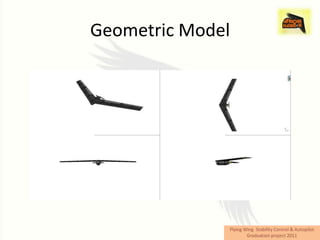
Geometric Model
What’s New ?!
• Nothing Changed in the external geometry


• Some internal parts were edited


• Some new internal parts were added
Wing
Wing
Ribs
Servo Motors
 Flap Servo
Servos
Slim Servo
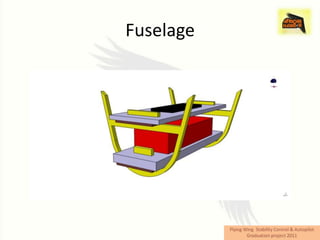
Fuselage
Fuselage
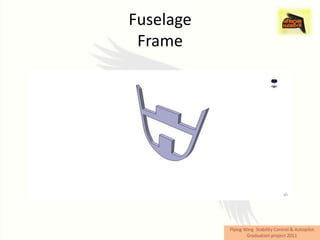
Fuselage
 Frame
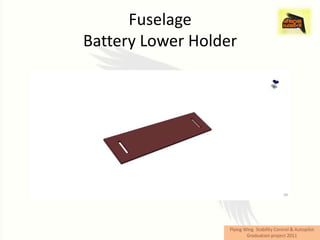
Fuselage
Battery Lower Holder
Fuselage
Battery Upper Holder
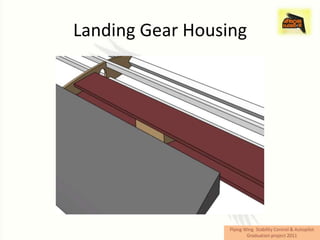
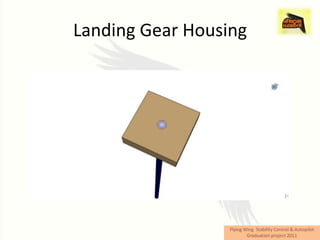
Landing Gear Housing
Mass Model
Mass Model

• Objective:

Center of Gravity of the aircraft is related to
 the stability condition of the aircraft.

Moment of inertias will be needed for the
 calculation of the stability derivatives.
Mass Model

• Two methods of calculations:

The first method (using CAD software)

The second technique (Manual calculations)
Mass Model

• Firstly we will define the Axis system we used:
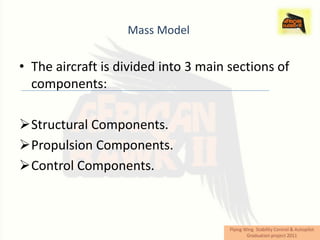
We took the center of the general Axis at the
  leading edge of the airfoil cross section of the
  wing’s root.
The +ve Z direction is upward,
the +ve Y direction is in the right wing
  direction from the front view,
the +ve X direction is in the direction of the
  fuselage rear.
Mass Model

• The aircraft is divided into 3 main sections of
  components:

Structural Components.
Propulsion Components.
Control Components.
Mass Model

  Results
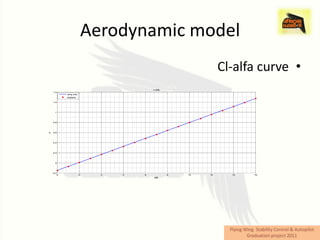
Aerodynamic model
                                                                    Cl-alfa curve •
                                            cl-alfa
     1.4
              wing only
              airplane

     1.2


       1


     0.8


     0.6
cl


     0.4


     0.2


       0


     -0.2
         -2               0     2   4   6             8   10   12     14   16
                                             alfa
Aerodynamic Model
Drag polar
                                   cl-cd , drag polar
     1.4
                wing only
                airplane
     1.2


       1


     0.8


     0.6
cl


     0.4


     0.2


       0


     -0.2
            0   0.01        0.02    0.03        0.04    0.05   0.06   0.07
                                           cd
Cm-alfa
                                 cm-alfa
     0.06
                                                              wing only
                                                              airplane
     0.04


     0.02


         0


     -0.02
cm


     -0.04


     -0.06


     -0.08


      -0.1


     -0.12


     -0.14
          -2   0   2   4     6             8   10   12   14               16
                                  alfa
Manufacturing
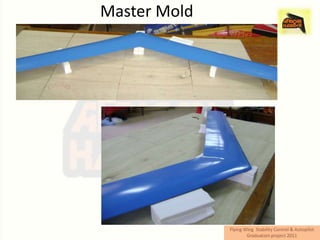
  Master Mold
Manufacturing Steps
• Laser cutting and structure assembly

• Balsa Surface fabrication

• Composite Surface fabrication

• Surface finish
Ribs Fabricating & arrangement

• Plywood, 27 ribs.
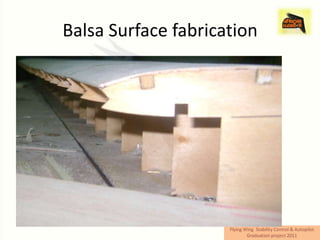
Balsa Surface fabrication

  1.5 mm Balsa wood sheet covering •
Balsa Surface fabrication
Composite Surface fabrication

•   First layer: fiber glass 200 gm/m2
•   Other layers fiber glass 400 gm/m3
•   Lower Surface
•   Painting
Master Mold
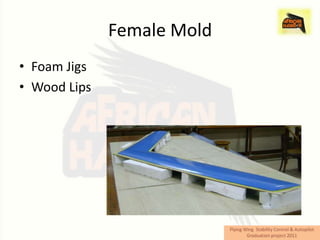
Female Mold
• Foam Jigs
• Wood Lips
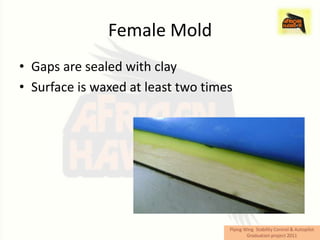
Female Mold
• Gaps are sealed with clay
• Surface is waxed at least two times
Female Mold
• Applying Epoxy Resin
• Start from root
• Brush in one direction
Female Mold
• Six layers
• Around 30 min between each layer
• Most reusable part
Manufacturing
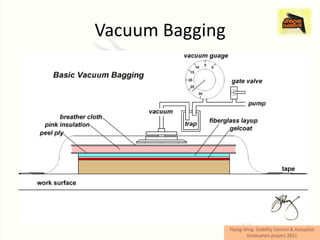
Vacuum Bagging
Manufacturing Skin Using Vacuum
      Bagging Technique
• What is vacuum Bagging ?!
   a new technique used in composite manufacturing that used the
 pressure as a clamping force to press the fiber laminates together with the
 mold until the resin is cured.
Vacuum Bagging
Vacuum Bagging
                                  Light weight Product •
    vacuum bagging results in absorbing of excessive resin in the breather
material and can reduce Epoxy resin weight by 30% and total weight by
                                                                   15%

   Better uniformity of lay up (No thick / •
                     thin cross sections)
                             exact shaping •
       vacuum Bagging lay up results in perfect shape that exactly like the
female mold shape due to clamping force between mold and laminate.

              Strong bonding between layers •
Vacuum Bagging Layers
• Carbon fiber


• Release Fabric
• Perforated film


• Breather /bleeder
• Bag
Vacuum Bagging Equipment
1-Vacuum Pump


2-Gauge
3-hose & Regulator
Vacuum Bagging
    Easy lock
Vacuum Bagging
  Tubing Clamps
Vacuum Bagging
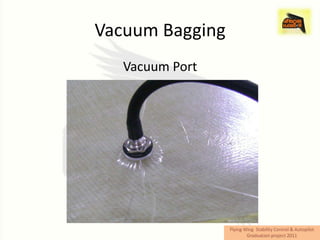
   Vacuum Port
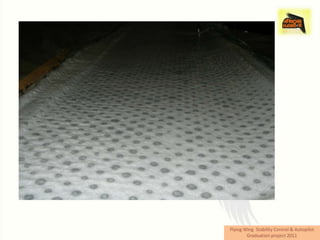
Final Shape
Manufacturing procedures
               1-Cutting carbon fiber cloth   •
2-Cutting vacuum bagging layers   •
• 3. Preparation of bag and vacuum bagging equipment
• 4. Female mold preparation
• 5-Mixing Epoxy resin
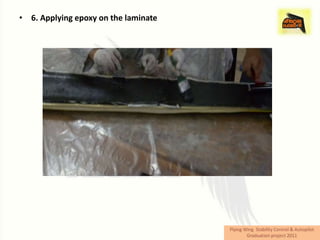
• 6. Applying epoxy on the laminate
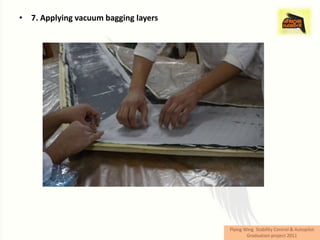
• 7. Applying vacuum bagging layers
8. Mold Entrance in the bag & sealing the open side   •
                         9. Opening vacuum pump       •
• 10. Removing skin from the mold
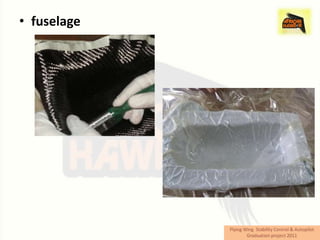
• fuselage
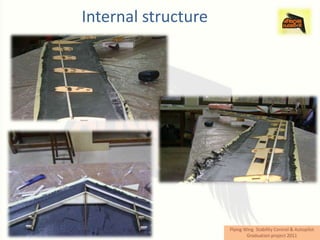
Internal structure
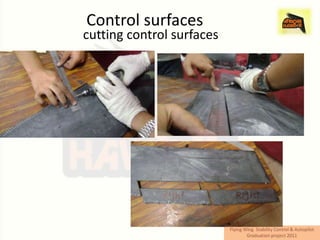
Control surfaces
cutting control surfaces
Control Surfaces
Balsa Leading Edges
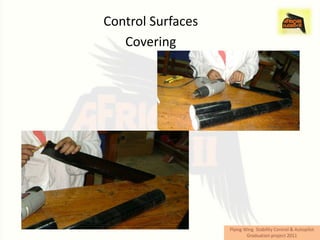
Control Surfaces
   Covering
TO BE CONTINUED………….

African hawk 2 part 1