Submersible Aircraft


                Joseph Thomas
                     0710343E
Introduction
A submersible aircraft would combine the key
capabilities of three different platforms:
1) The speed and range of an aircraft
2) The loiter capabilities of a boat
3) The stealth of a submarine
Introduction
Things to consider

•   The skin thickness needed to resist the external loads.
•   The seals for the vents and ports
•   Control and stability underwater
•   Propulsion and power source underwater
•   Take off on the surface
•   Submerging from the surface
Boat Features
• Flair the angled base of the hull. The shape is
  to ensure that the water is swept away from
  the main body. The higher the angle the faster
  the boat can go.
• Step is a sharp discontinuity just aft of the
  COG. Landing on the step breaks the water
  and makes for a smooth, long touchdown.
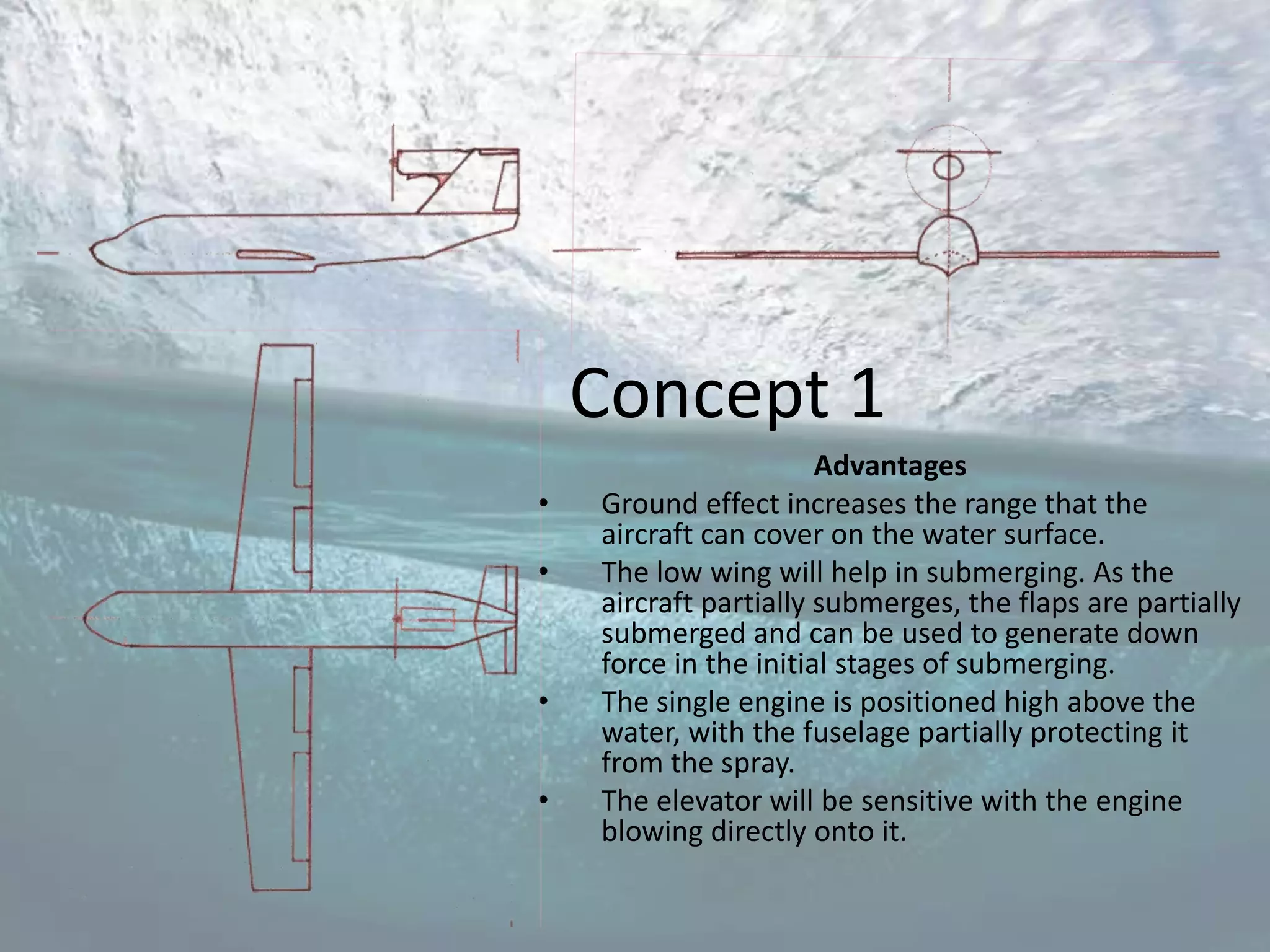
Concept 1
                       Advantages
•   Ground effect increases the range that the
    aircraft can cover on the water surface.
•   The low wing will help in submerging. As the
    aircraft partially submerges, the flaps are partially
    submerged and can be used to generate down
    force in the initial stages of submerging.
•   The single engine is positioned high above the
    water, with the fuselage partially protecting it
    from the spray.
•   The elevator will be sensitive with the engine
    blowing directly onto it.
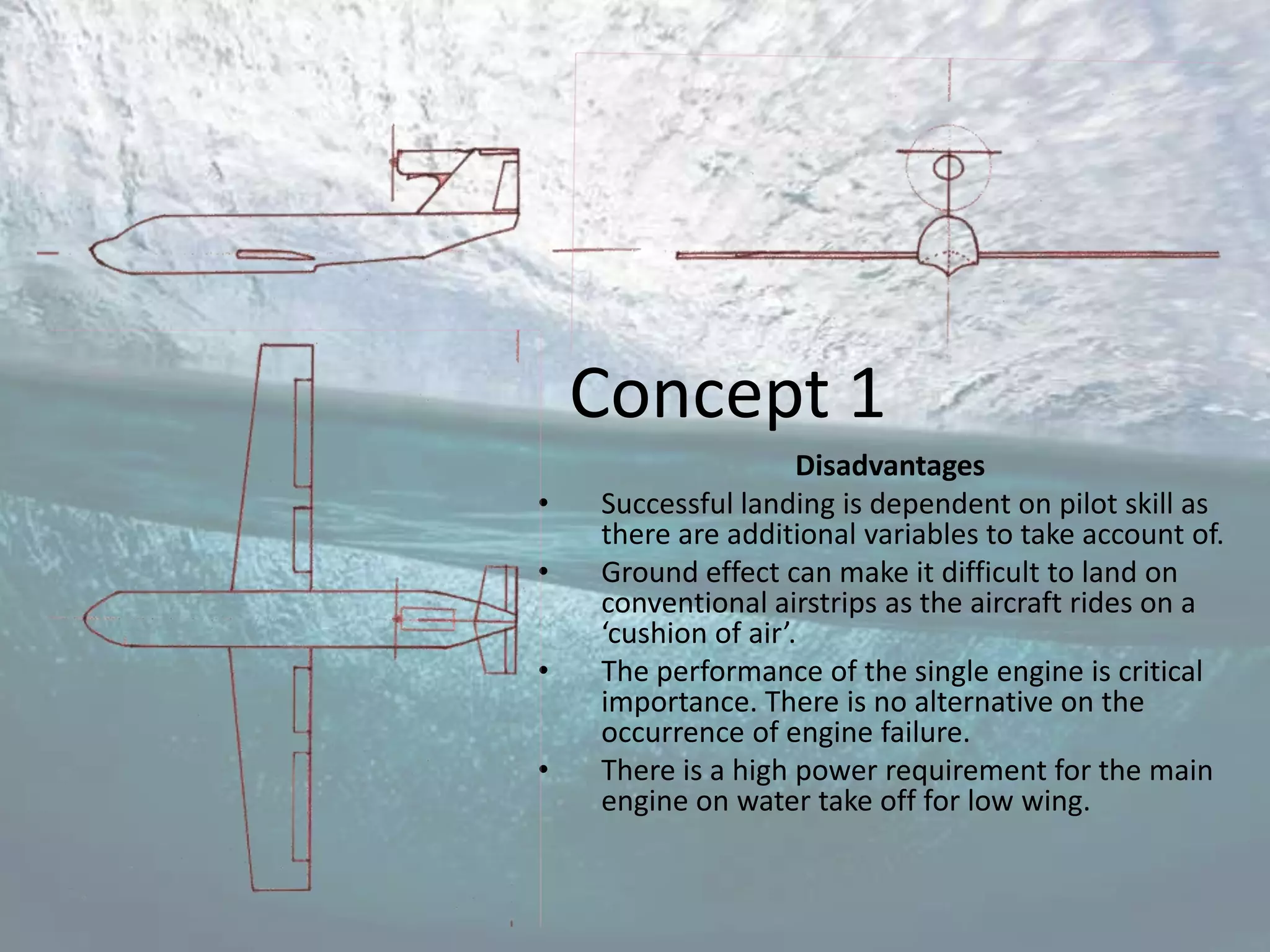
Concept 1
                     Disadvantages
•   Successful landing is dependent on pilot skill as
    there are additional variables to take account of.
•   Ground effect can make it difficult to land on
    conventional airstrips as the aircraft rides on a
    ‘cushion of air’.
•   The performance of the single engine is critical
    importance. There is no alternative on the
    occurrence of engine failure.
•   There is a high power requirement for the main
    engine on water take off for low wing.
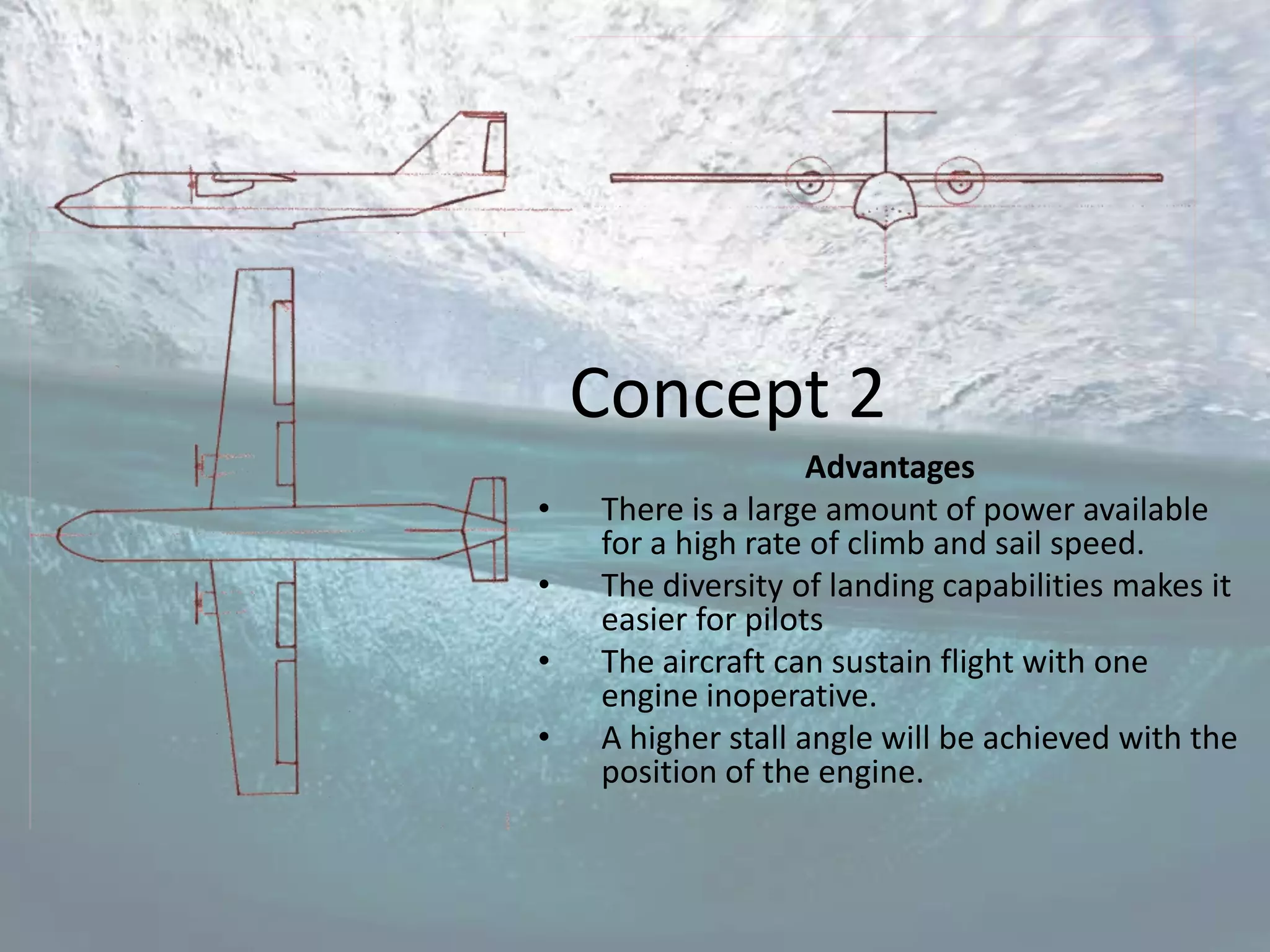
Concept 2
                    Advantages
•   There is a large amount of power available
    for a high rate of climb and sail speed.
•   The diversity of landing capabilities makes it
    easier for pilots
•   The aircraft can sustain flight with one
    engine inoperative.
•   A higher stall angle will be achieved with the
    position of the engine.
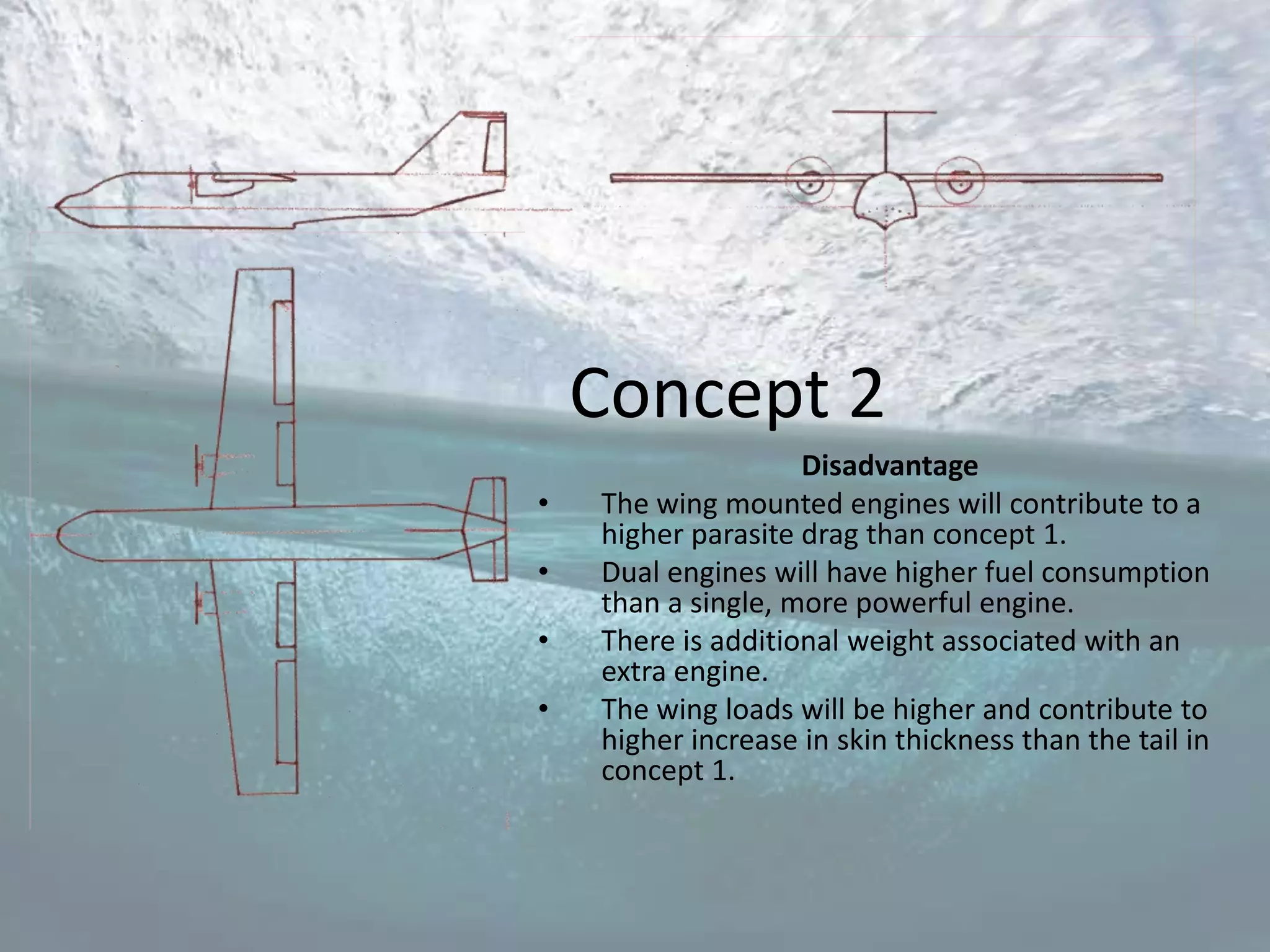
Concept 2
                    Disadvantage
•   The wing mounted engines will contribute to a
    higher parasite drag than concept 1.
•   Dual engines will have higher fuel consumption
    than a single, more powerful engine.
•   There is additional weight associated with an
    extra engine.
•   The wing loads will be higher and contribute to
    higher increase in skin thickness than the tail in
    concept 1.
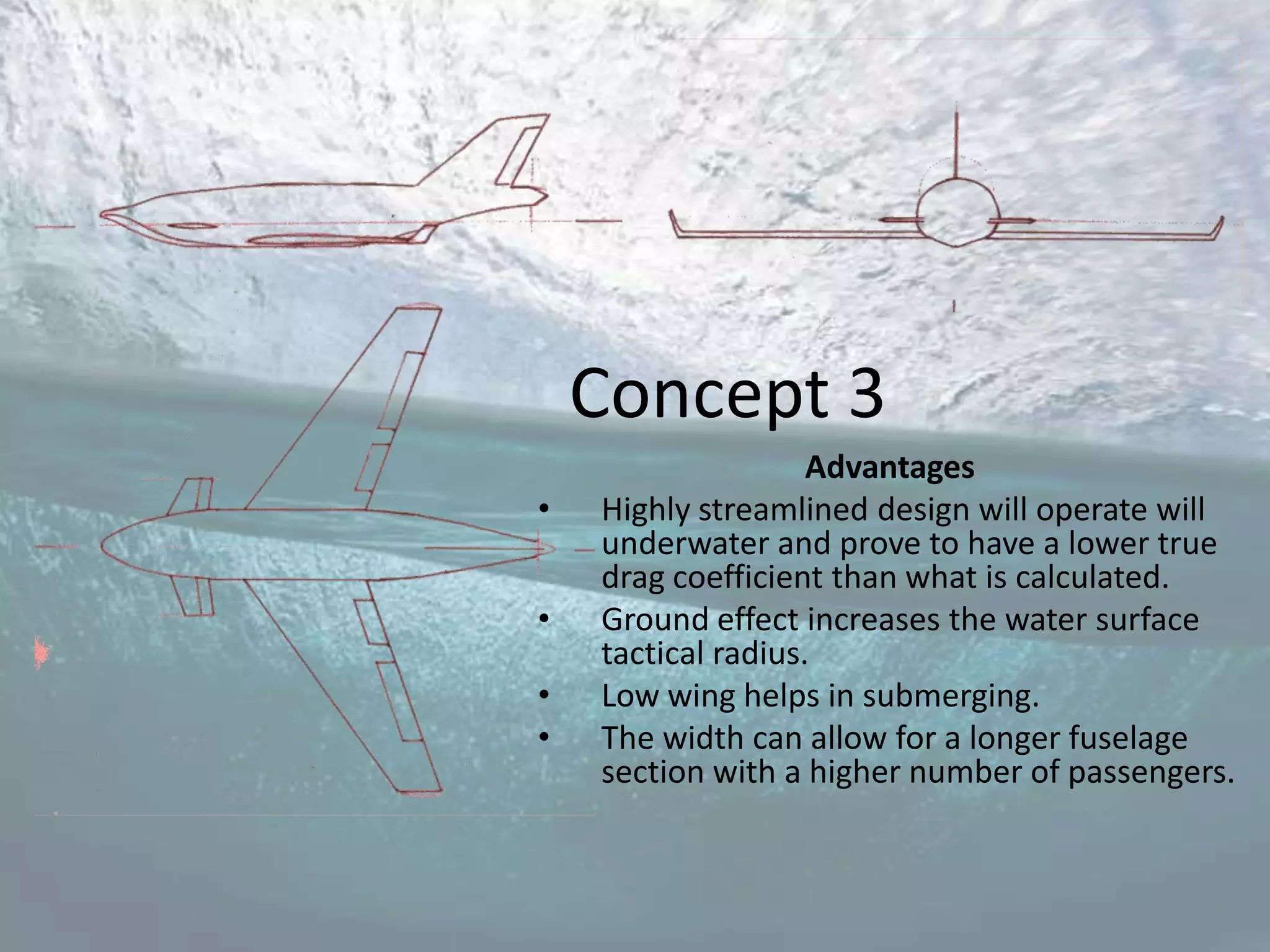
Concept 3
                    Advantages
•   Highly streamlined design will operate will
    underwater and prove to have a lower true
    drag coefficient than what is calculated.
•   Ground effect increases the water surface
    tactical radius.
•   Low wing helps in submerging.
•   The width can allow for a longer fuselage
    section with a higher number of passengers.
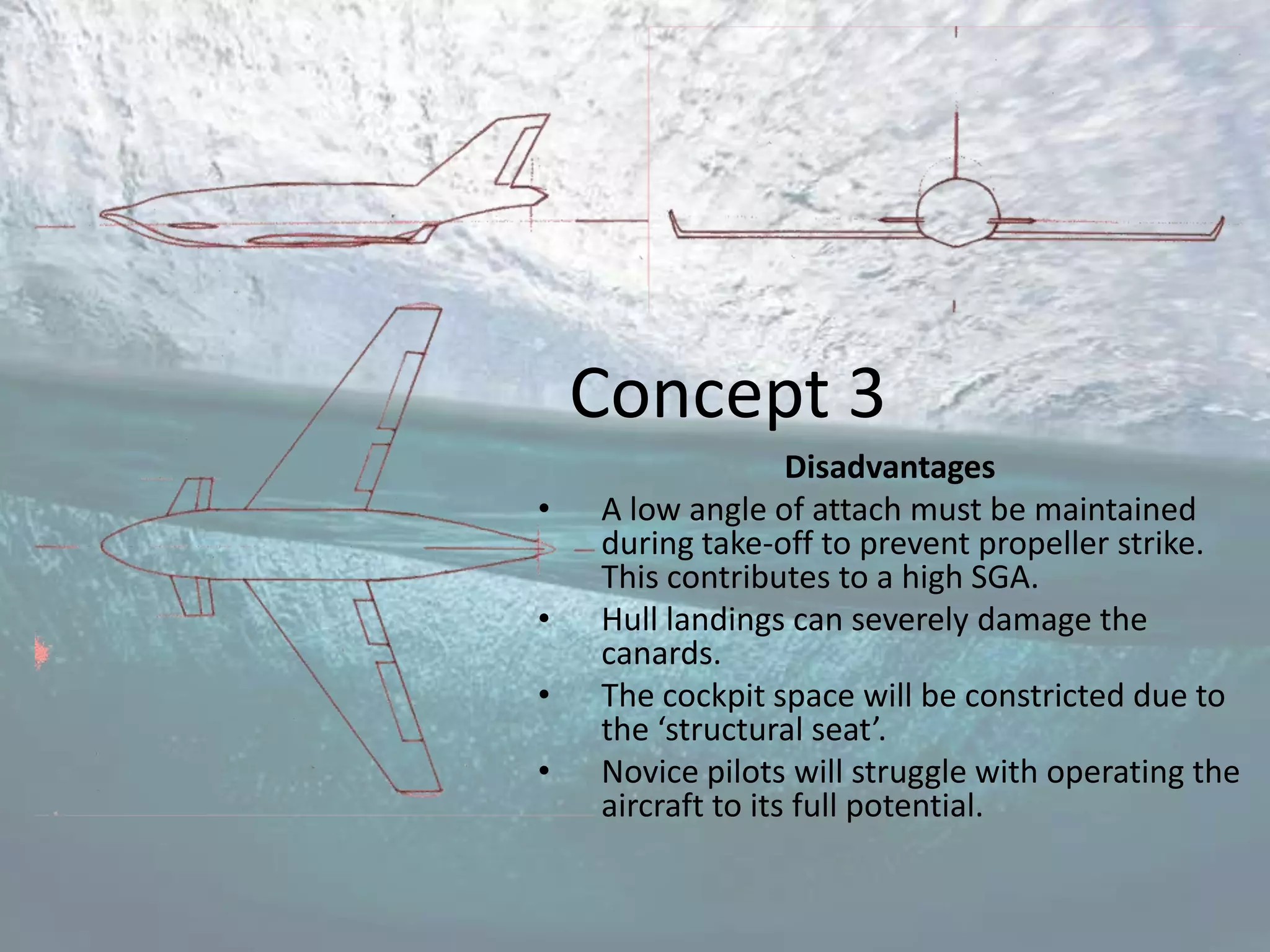
Concept 3
                   Disadvantages
•   A low angle of attach must be maintained
    during take-off to prevent propeller strike.
    This contributes to a high SGA.
•   Hull landings can severely damage the
    canards.
•   The cockpit space will be constricted due to
    the ‘structural seat’.
•   Novice pilots will struggle with operating the
    aircraft to its full potential.
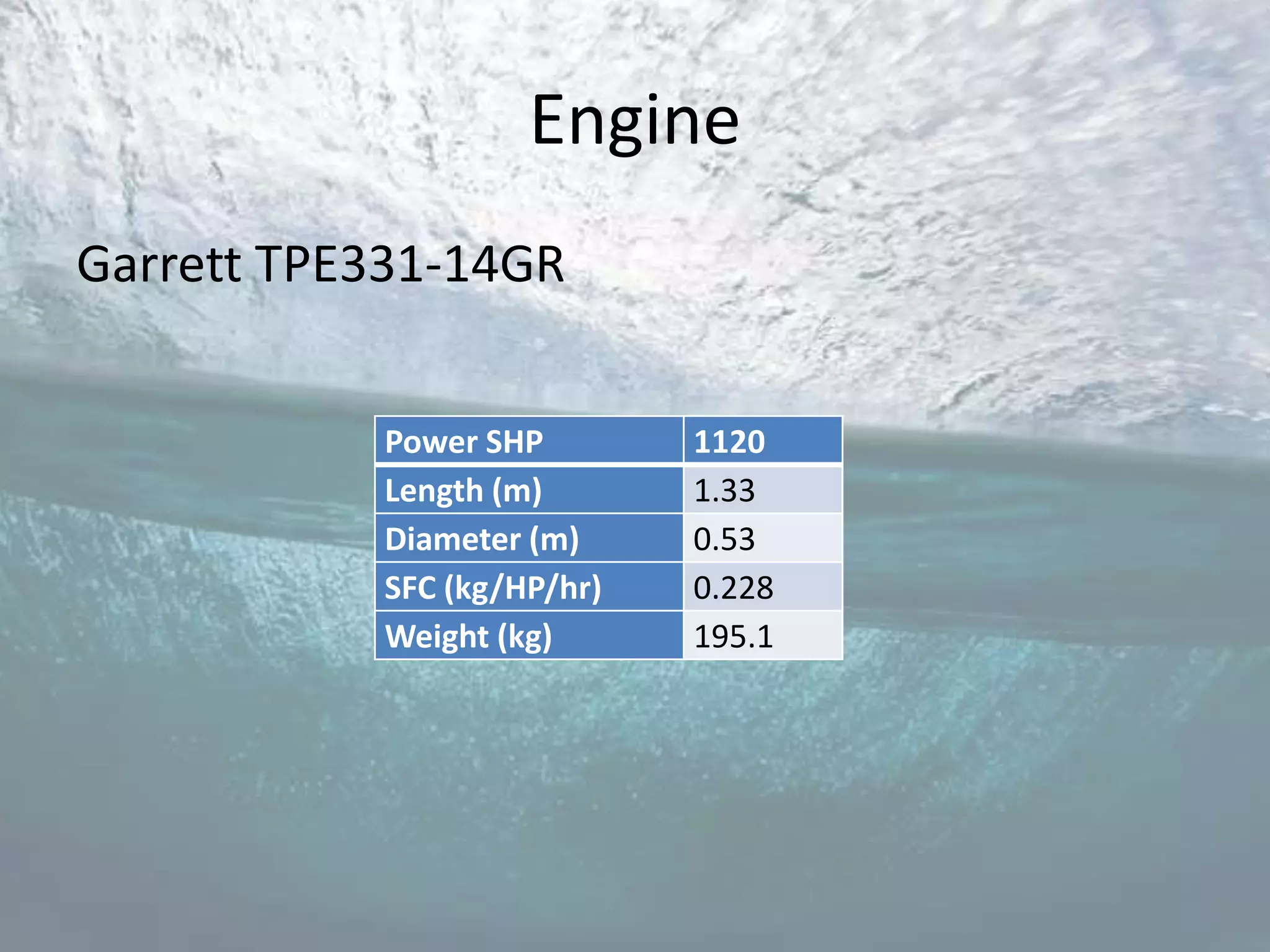
Engine
Garrett TPE331-14GR


           Power SHP        1120
           Length (m)       1.33
           Diameter (m)     0.53
           SFC (kg/HP/hr)   0.228
           Weight (kg)      195.1
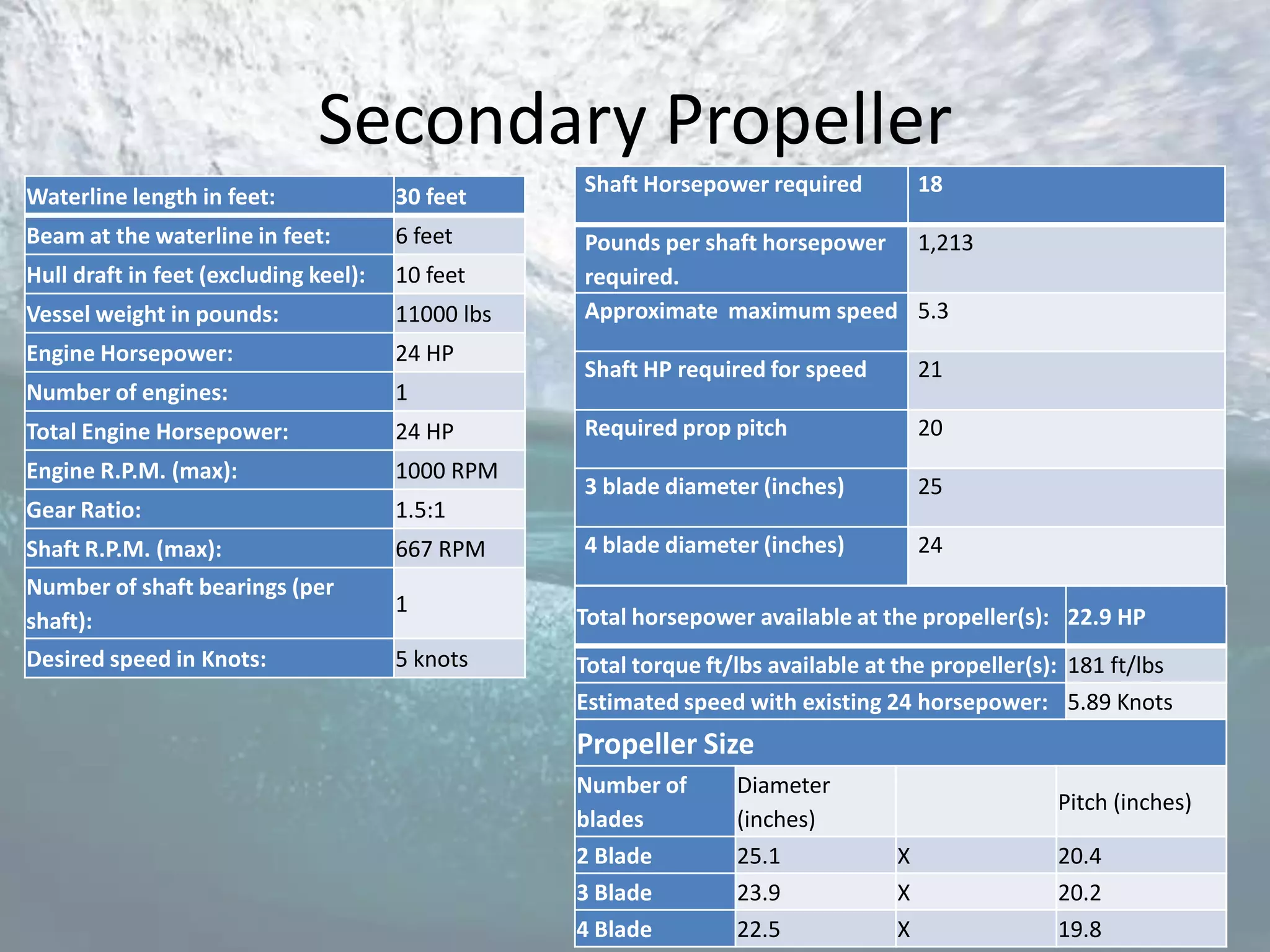
Secondary Propeller
                                                   Shaft Horsepower required           18
Waterline length in feet:              30 feet
Beam at the waterline in feet:         6 feet      Pounds per shaft horsepower 1,213
Hull draft in feet (excluding keel):   10 feet     required.
Vessel weight in pounds:               11000 lbs   Approximate maximum speed 5.3
Engine Horsepower:                     24 HP
                                                   Shaft HP required for speed         21
Number of engines:                     1
Total Engine Horsepower:               24 HP       Required prop pitch                 20
Engine R.P.M. (max):                   1000 RPM
                                                   3 blade diameter (inches)           25
Gear Ratio:                            1.5:1
Shaft R.P.M. (max):                    667 RPM     4 blade diameter (inches)           24
Number of shaft bearings (per
                                       1
shaft):                                            Total horsepower available at the propeller(s): 22.9 HP
Desired speed in Knots:                5 knots     Total torque ft/lbs available at the propeller(s): 181 ft/lbs
                                                   Estimated speed with existing 24 horsepower: 5.89 Knots
                                                   Propeller Size
                                                   Number of       Diameter
                                                                                                    Pitch (inches)
                                                   blades          (inches)
                                                   2 Blade         25.1            X                20.4
                                                   3 Blade         23.9            X                20.2
                                                   4 Blade         22.5            X                19.8
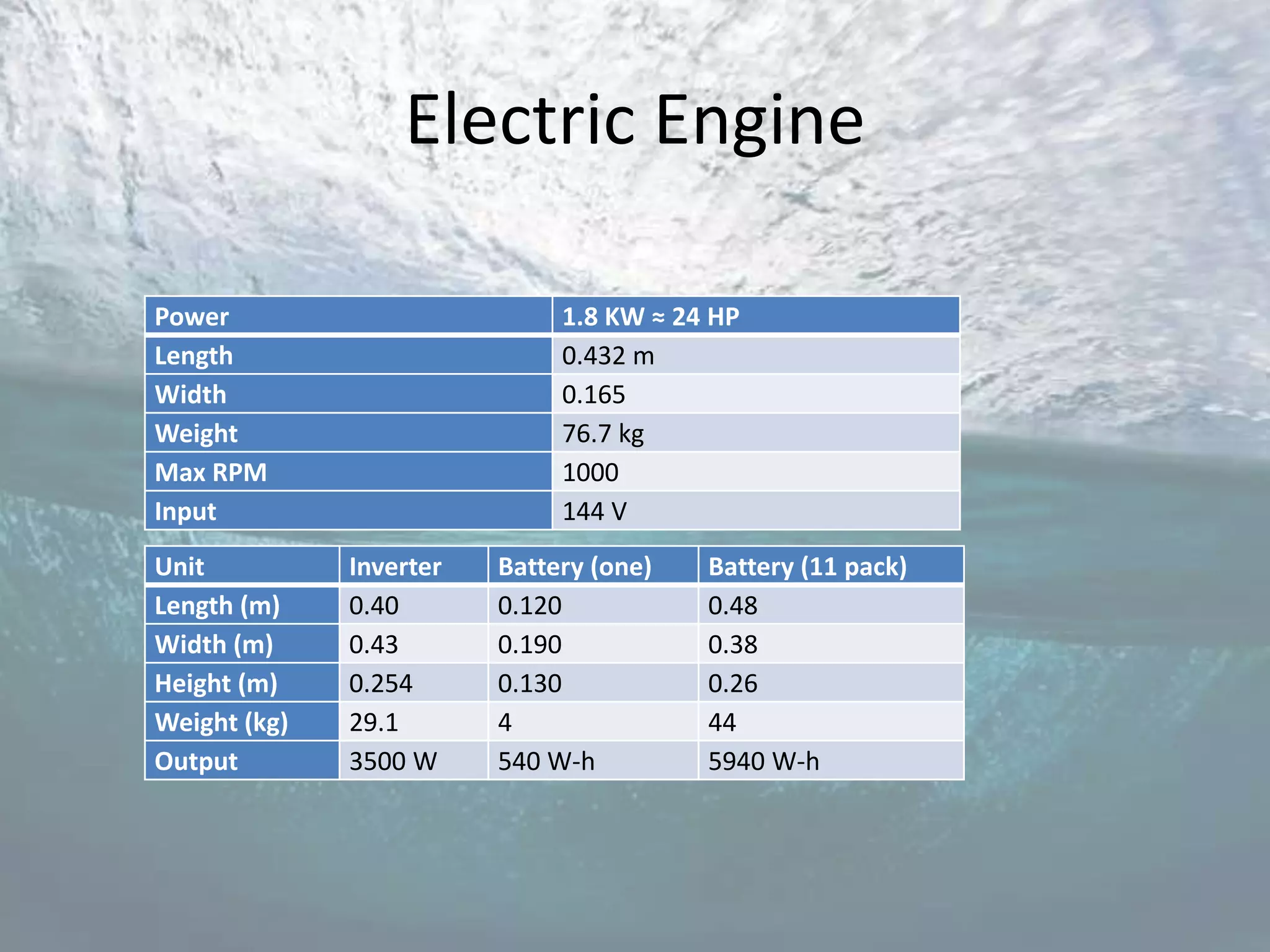
Electric Engine

Power                         1.8 KW ≈ 24 HP
Length                        0.432 m
Width                         0.165
Weight                        76.7 kg
Max RPM                       1000
Input                         144 V
Unit          Inverter   Battery (one)   Battery (11 pack)
Length (m)    0.40       0.120           0.48
Width (m)     0.43       0.190           0.38
Height (m)    0.254      0.130           0.26
Weight (kg)   29.1       4               44
Output        3500 W     540 W-h         5940 W-h
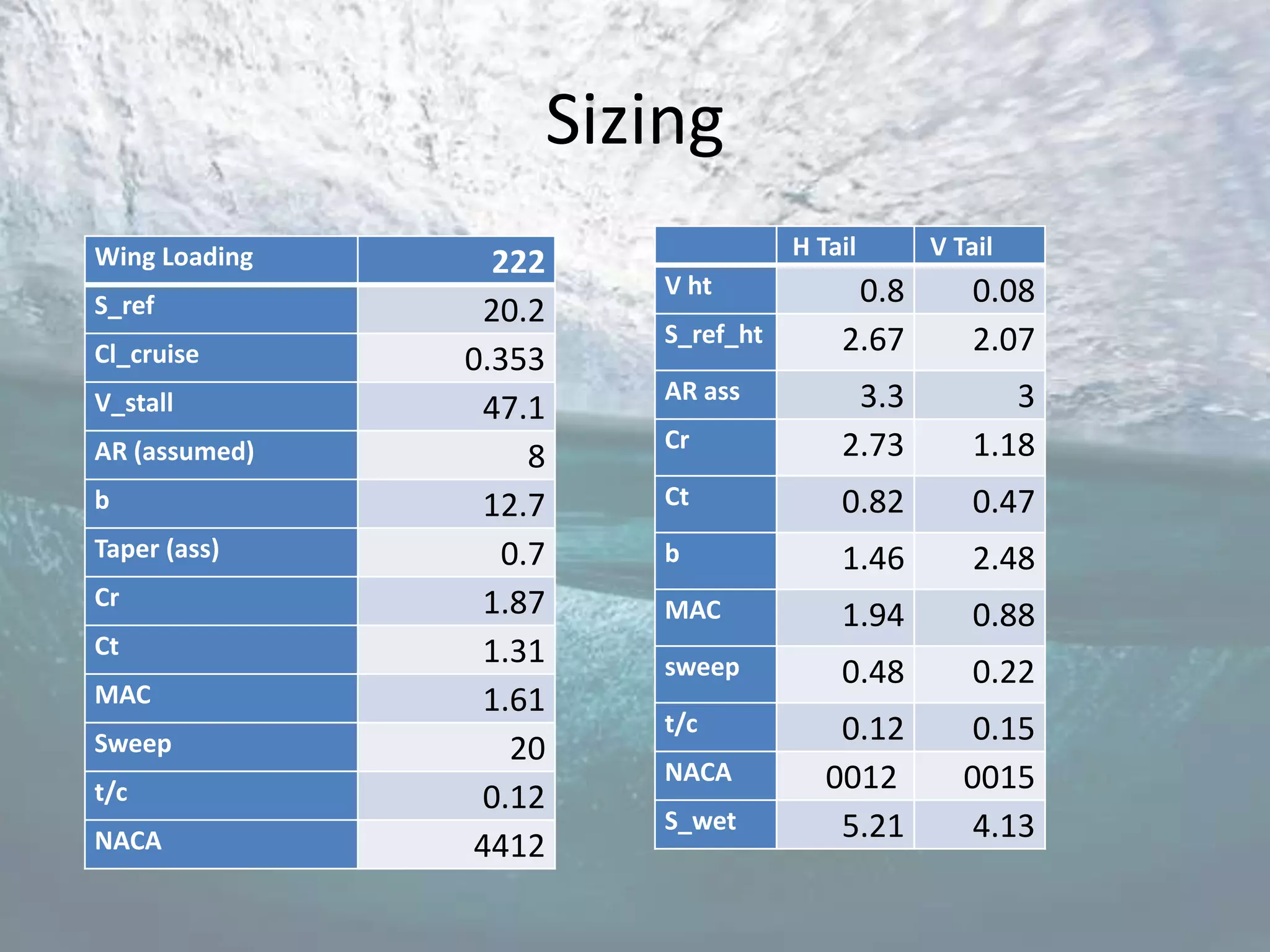
Sizing
Wing Loading                       H Tail     V Tail
                 222
                        V ht            0.8       0.08
S_ref           20.2
                        S_ref_ht       2.67       2.07
Cl_cruise      0.353
V_stall                 AR ass          3.3          3
                47.1
AR (assumed)            Cr             2.73       1.18
                    8
b               12.7    Ct             0.82       0.47
Taper (ass)       0.7   b              1.46       2.48
Cr              1.87    MAC            1.94       0.88
Ct              1.31    sweep          0.48       0.22
MAC             1.61
                        t/c            0.12       0.15
Sweep             20
                        NACA          0012       0015
t/c             0.12
                        S_wet          5.21       4.13
NACA           4412
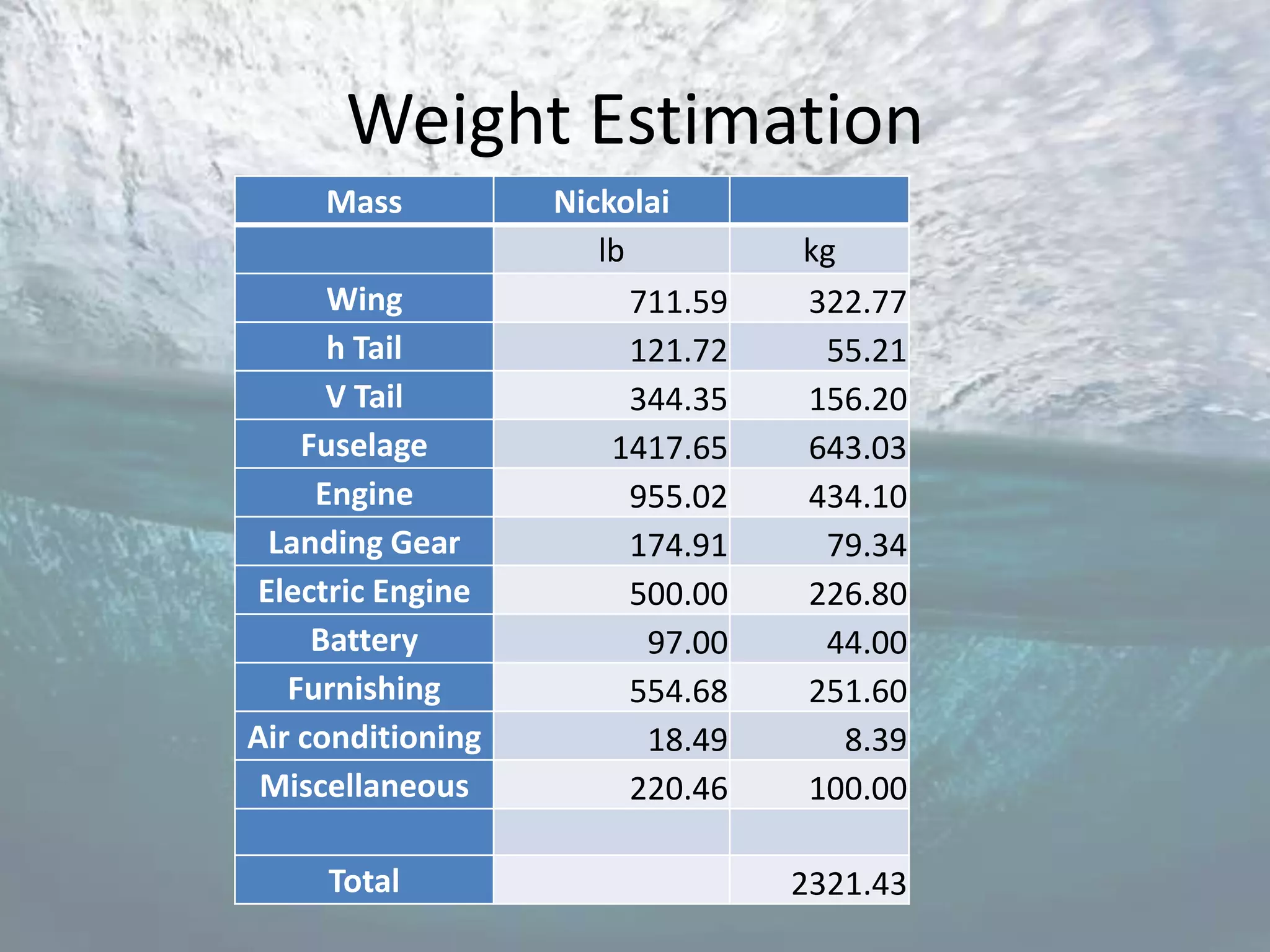
Weight Estimation
     Mass          Nickolai
                      lb          kg
      Wing               711.59   322.77
      h Tail             121.72    55.21
      V Tail             344.35   156.20
    Fuselage           1417.65    643.03
     Engine              955.02   434.10
  Landing Gear           174.91    79.34
 Electric Engine         500.00   226.80
     Battery              97.00    44.00
   Furnishing            554.68   251.60
Air conditioning          18.49      8.39
 Miscellaneous           220.46   100.00

     Total                        2321.43
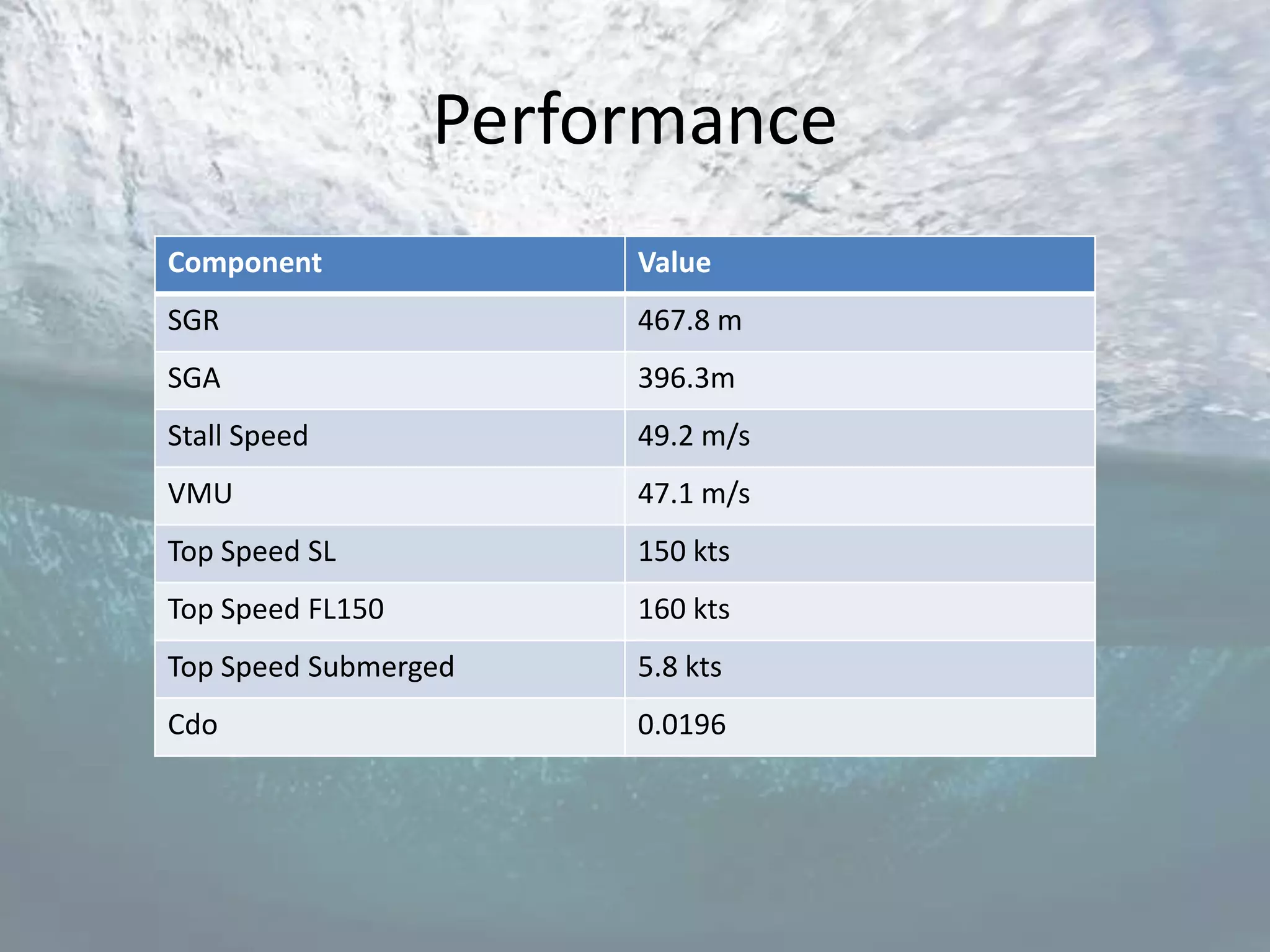
Performance
Component              Value
SGR                    467.8 m
SGA                    396.3m
Stall Speed            49.2 m/s
VMU                    47.1 m/s
Top Speed SL           150 kts
Top Speed FL150        160 kts
Top Speed Submerged    5.8 kts
Cdo                    0.0196
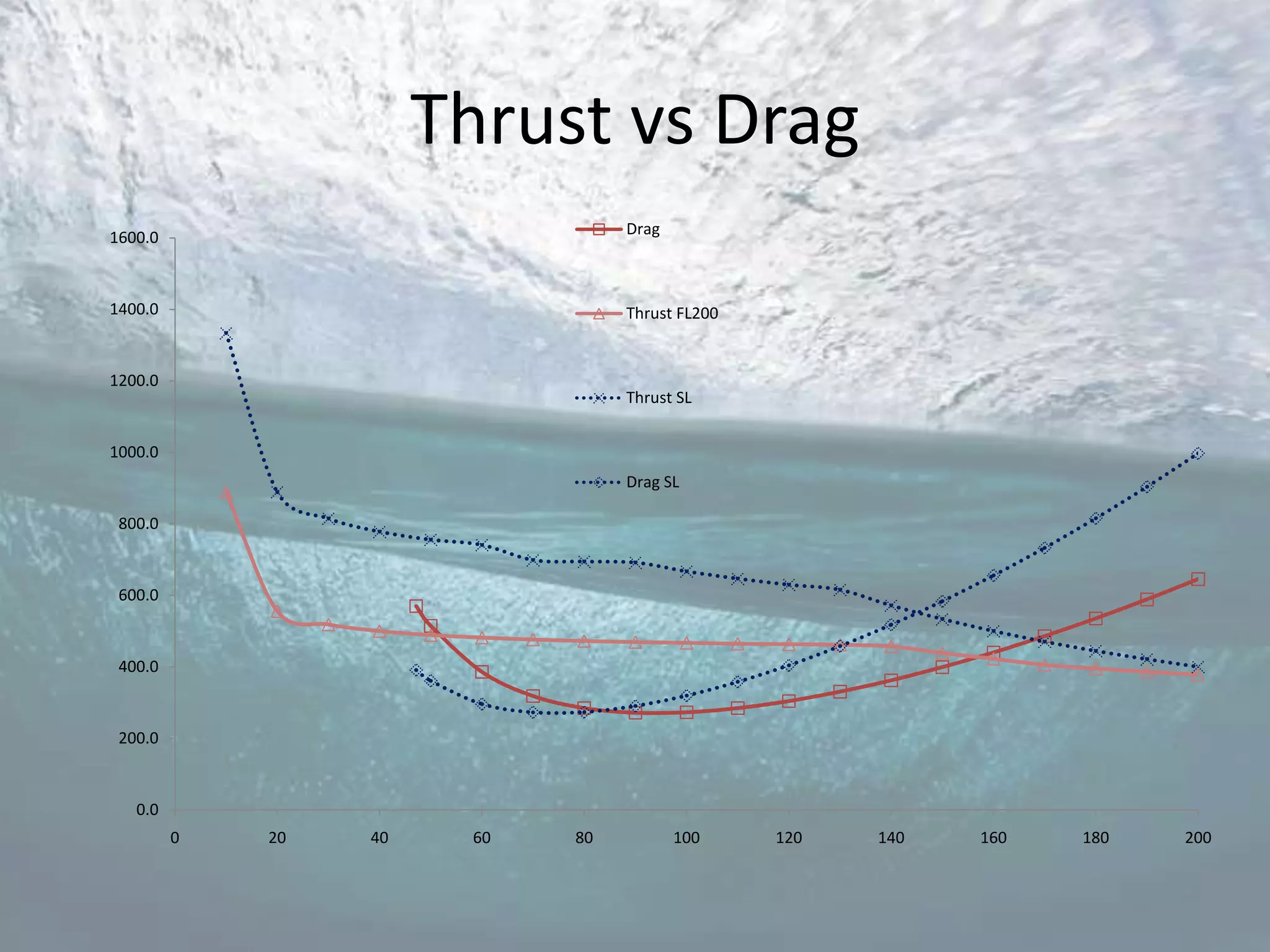
Thrust vs Drag
1600.0                            Drag


1400.0                            Thrust FL200


1200.0
                                  Thrust SL


1000.0
                                  Drag SL

 800.0


 600.0


 400.0


 200.0


   0.0
         0   20   40    60   80          100     120   140   160   180   200
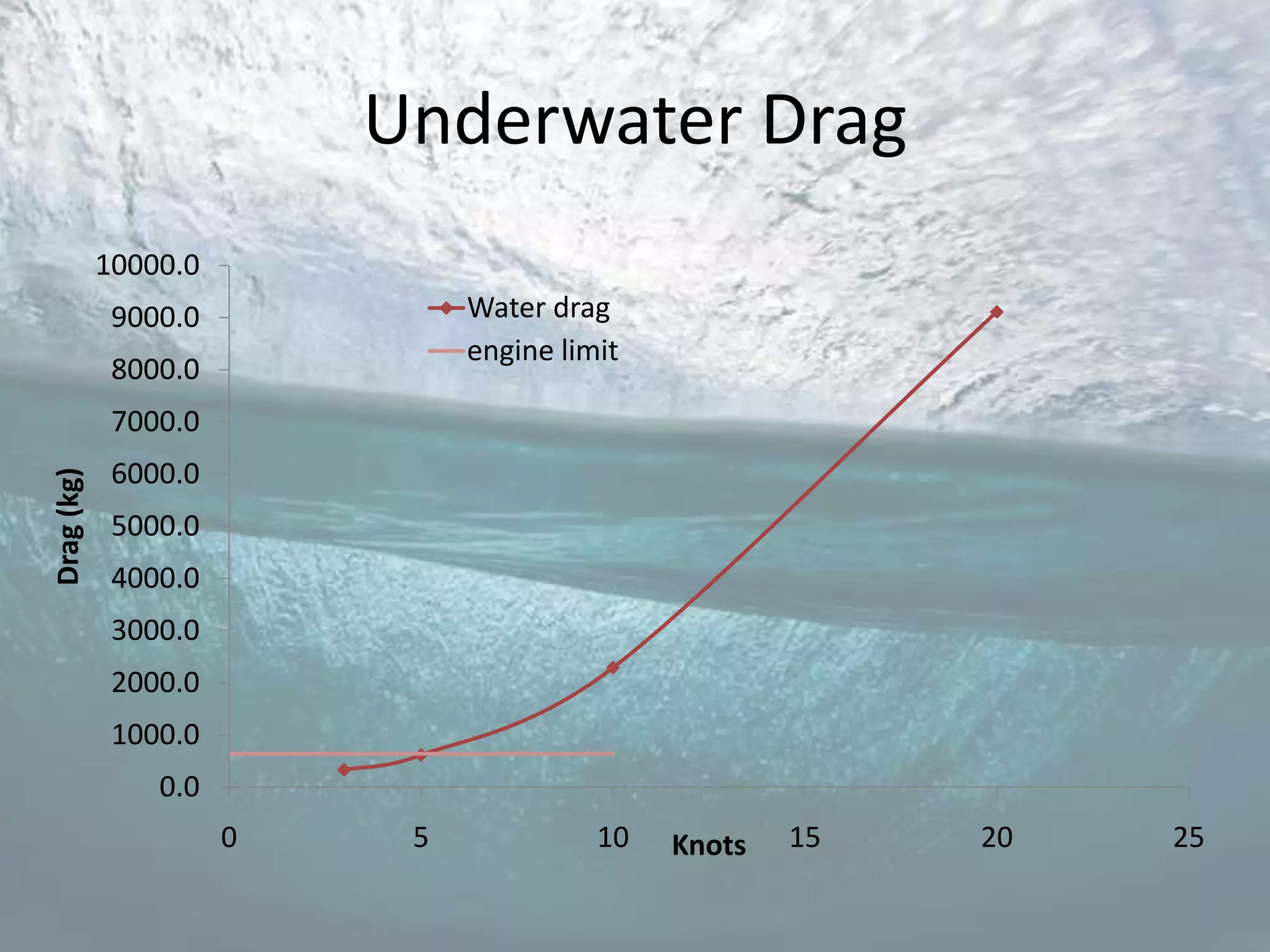
Underwater Drag
            10000.0
             9000.0            Water drag
                               engine limit
             8000.0
             7000.0
             6000.0
Drag (kg)


             5000.0
             4000.0
             3000.0
             2000.0
             1000.0
                0.0
                      0    5             10   Knots   15   20   25
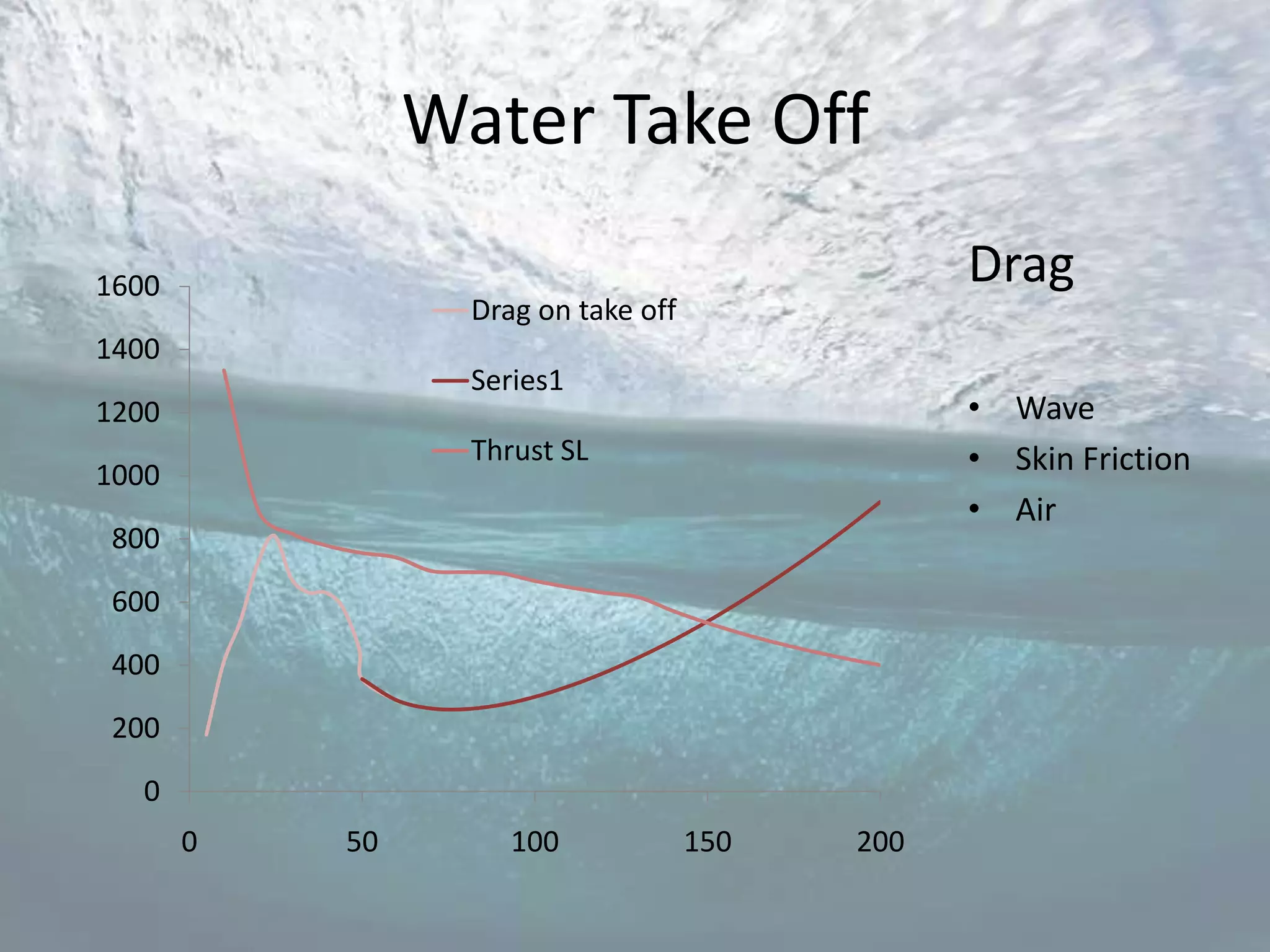
Water Take Off
1600                                             Drag
                  Drag on take off
1400
                  Series1
1200                                             • Wave
                  Thrust SL                      • Skin Friction
1000
                                                 • Air
800
600
400
200
   0
       0   50        100             150   200
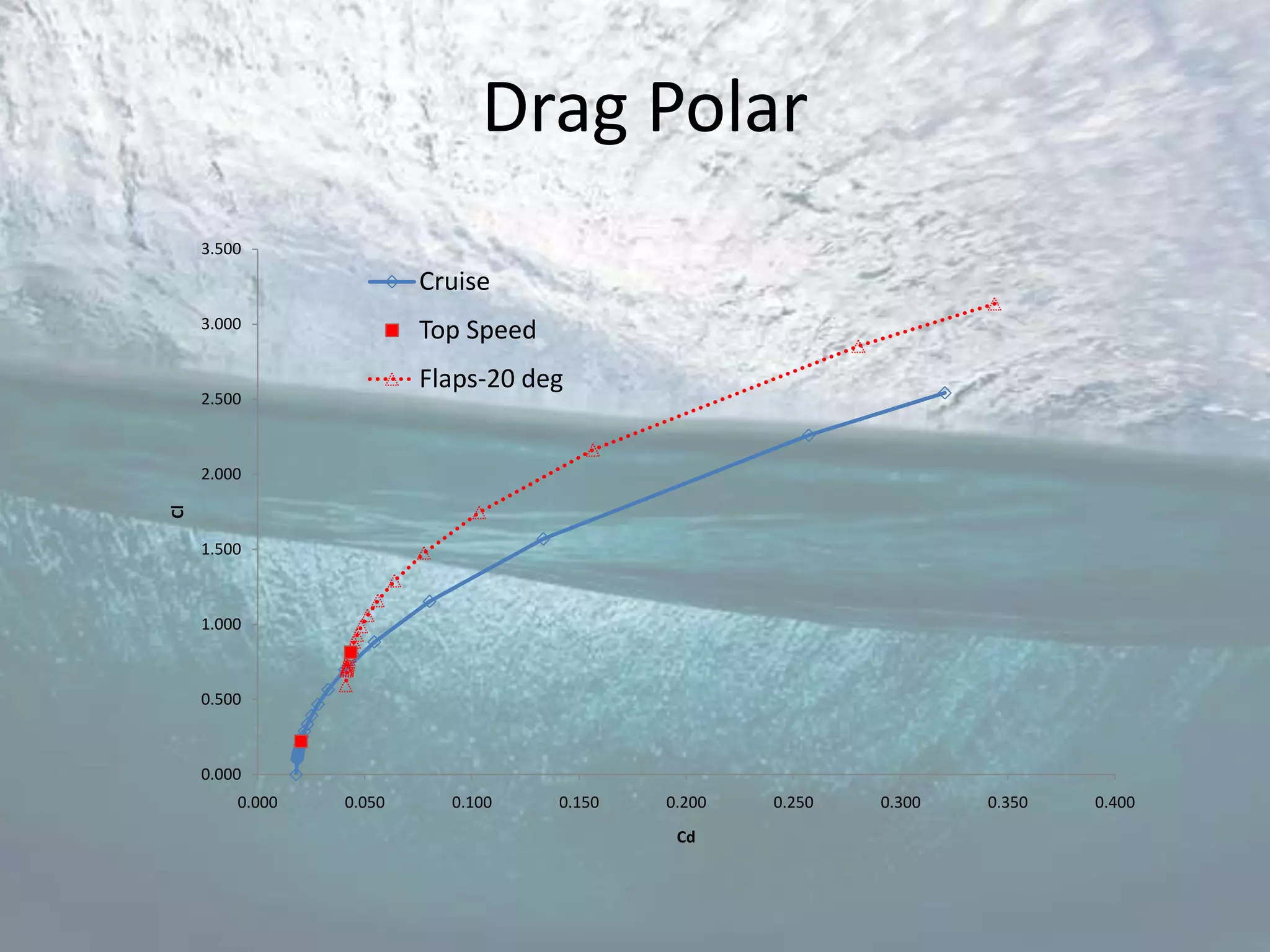
Drag Polar
     3.500

                         Cruise
     3.000
                         Top Speed
                         Flaps-20 deg
     2.500


     2.000
Cl


     1.500


     1.000


     0.500


     0.000
         0.000   0.050     0.100     0.150   0.200   0.250   0.300   0.350   0.400
                                              Cd
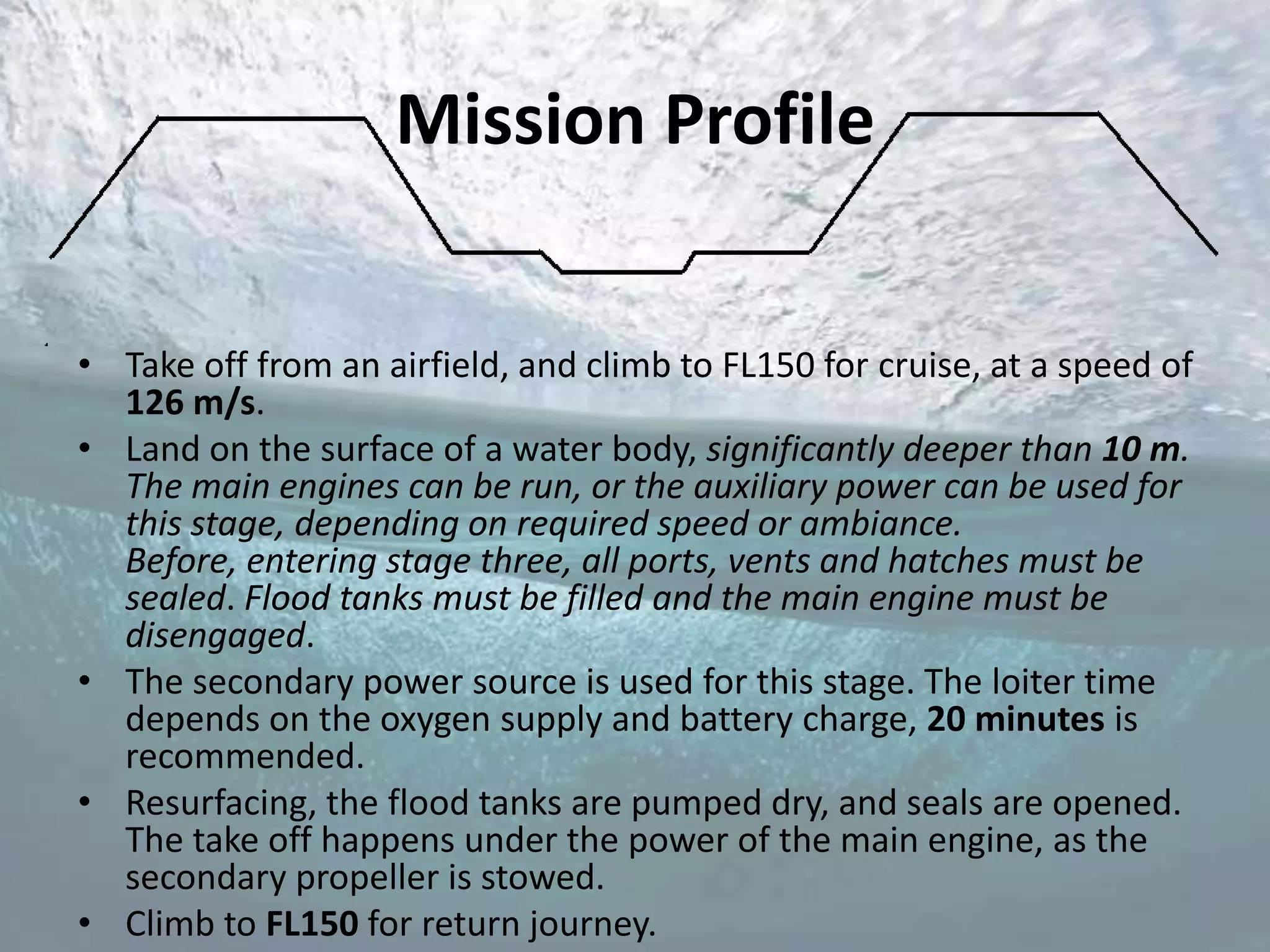
Mission Profile


• Take off from an airfield, and climb to FL150 for cruise, at a speed of
  126 m/s.
• Land on the surface of a water body, significantly deeper than 10 m.
  The main engines can be run, or the auxiliary power can be used for
  this stage, depending on required speed or ambiance.
  Before, entering stage three, all ports, vents and hatches must be
  sealed. Flood tanks must be filled and the main engine must be
  disengaged.
• The secondary power source is used for this stage. The loiter time
  depends on the oxygen supply and battery charge, 20 minutes is
  recommended.
• Resurfacing, the flood tanks are pumped dry, and seals are opened.
  The take off happens under the power of the main engine, as the
  secondary propeller is stowed.
• Climb to FL150 for return journey.
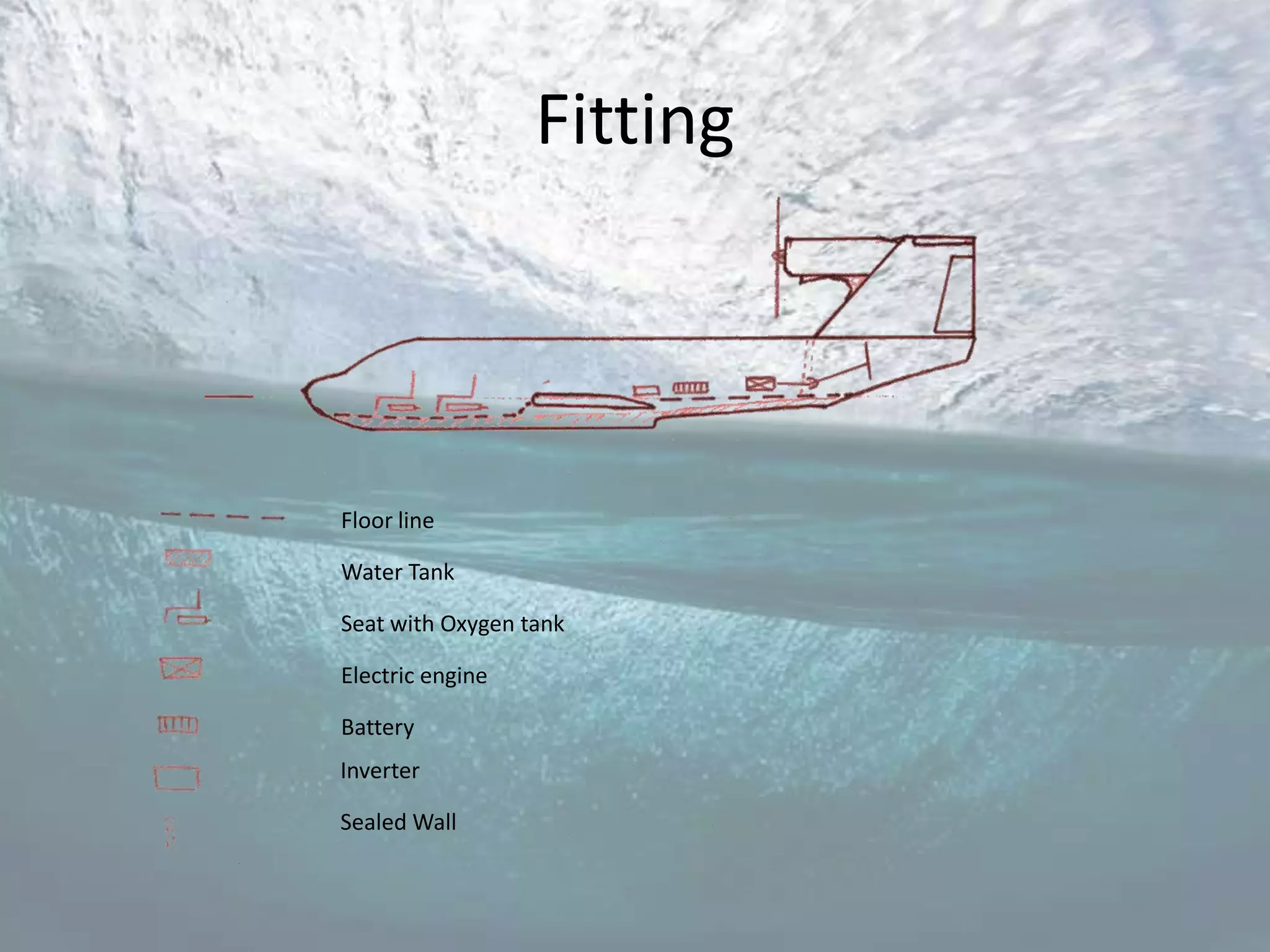
Fitting


Floor line

Water Tank

Seat with Oxygen tank

Electric engine

Battery
Inverter

Sealed Wall
Joe yppt

Joe yppt

  • 1.
    Submersible Aircraft Joseph Thomas 0710343E
  • 2.
    Introduction A submersible aircraftwould combine the key capabilities of three different platforms: 1) The speed and range of an aircraft 2) The loiter capabilities of a boat 3) The stealth of a submarine
  • 3.
    Introduction Things to consider • The skin thickness needed to resist the external loads. • The seals for the vents and ports • Control and stability underwater • Propulsion and power source underwater • Take off on the surface • Submerging from the surface
  • 4.
    Boat Features • Flairthe angled base of the hull. The shape is to ensure that the water is swept away from the main body. The higher the angle the faster the boat can go. • Step is a sharp discontinuity just aft of the COG. Landing on the step breaks the water and makes for a smooth, long touchdown.
  • 5.
    Concept 1 Advantages • Ground effect increases the range that the aircraft can cover on the water surface. • The low wing will help in submerging. As the aircraft partially submerges, the flaps are partially submerged and can be used to generate down force in the initial stages of submerging. • The single engine is positioned high above the water, with the fuselage partially protecting it from the spray. • The elevator will be sensitive with the engine blowing directly onto it.
  • 6.
    Concept 1 Disadvantages • Successful landing is dependent on pilot skill as there are additional variables to take account of. • Ground effect can make it difficult to land on conventional airstrips as the aircraft rides on a ‘cushion of air’. • The performance of the single engine is critical importance. There is no alternative on the occurrence of engine failure. • There is a high power requirement for the main engine on water take off for low wing.
  • 7.
    Concept 2 Advantages • There is a large amount of power available for a high rate of climb and sail speed. • The diversity of landing capabilities makes it easier for pilots • The aircraft can sustain flight with one engine inoperative. • A higher stall angle will be achieved with the position of the engine.
  • 8.
    Concept 2 Disadvantage • The wing mounted engines will contribute to a higher parasite drag than concept 1. • Dual engines will have higher fuel consumption than a single, more powerful engine. • There is additional weight associated with an extra engine. • The wing loads will be higher and contribute to higher increase in skin thickness than the tail in concept 1.
  • 9.
    Concept 3 Advantages • Highly streamlined design will operate will underwater and prove to have a lower true drag coefficient than what is calculated. • Ground effect increases the water surface tactical radius. • Low wing helps in submerging. • The width can allow for a longer fuselage section with a higher number of passengers.
  • 10.
    Concept 3 Disadvantages • A low angle of attach must be maintained during take-off to prevent propeller strike. This contributes to a high SGA. • Hull landings can severely damage the canards. • The cockpit space will be constricted due to the ‘structural seat’. • Novice pilots will struggle with operating the aircraft to its full potential.
  • 11.
    Engine Garrett TPE331-14GR Power SHP 1120 Length (m) 1.33 Diameter (m) 0.53 SFC (kg/HP/hr) 0.228 Weight (kg) 195.1
  • 12.
    Secondary Propeller Shaft Horsepower required 18 Waterline length in feet: 30 feet Beam at the waterline in feet: 6 feet Pounds per shaft horsepower 1,213 Hull draft in feet (excluding keel): 10 feet required. Vessel weight in pounds: 11000 lbs Approximate maximum speed 5.3 Engine Horsepower: 24 HP Shaft HP required for speed 21 Number of engines: 1 Total Engine Horsepower: 24 HP Required prop pitch 20 Engine R.P.M. (max): 1000 RPM 3 blade diameter (inches) 25 Gear Ratio: 1.5:1 Shaft R.P.M. (max): 667 RPM 4 blade diameter (inches) 24 Number of shaft bearings (per 1 shaft): Total horsepower available at the propeller(s): 22.9 HP Desired speed in Knots: 5 knots Total torque ft/lbs available at the propeller(s): 181 ft/lbs Estimated speed with existing 24 horsepower: 5.89 Knots Propeller Size Number of Diameter Pitch (inches) blades (inches) 2 Blade 25.1 X 20.4 3 Blade 23.9 X 20.2 4 Blade 22.5 X 19.8
  • 13.
    Electric Engine Power 1.8 KW ≈ 24 HP Length 0.432 m Width 0.165 Weight 76.7 kg Max RPM 1000 Input 144 V Unit Inverter Battery (one) Battery (11 pack) Length (m) 0.40 0.120 0.48 Width (m) 0.43 0.190 0.38 Height (m) 0.254 0.130 0.26 Weight (kg) 29.1 4 44 Output 3500 W 540 W-h 5940 W-h
  • 14.
    Sizing Wing Loading H Tail V Tail 222 V ht 0.8 0.08 S_ref 20.2 S_ref_ht 2.67 2.07 Cl_cruise 0.353 V_stall AR ass 3.3 3 47.1 AR (assumed) Cr 2.73 1.18 8 b 12.7 Ct 0.82 0.47 Taper (ass) 0.7 b 1.46 2.48 Cr 1.87 MAC 1.94 0.88 Ct 1.31 sweep 0.48 0.22 MAC 1.61 t/c 0.12 0.15 Sweep 20 NACA 0012 0015 t/c 0.12 S_wet 5.21 4.13 NACA 4412
  • 15.
    Weight Estimation Mass Nickolai lb kg Wing 711.59 322.77 h Tail 121.72 55.21 V Tail 344.35 156.20 Fuselage 1417.65 643.03 Engine 955.02 434.10 Landing Gear 174.91 79.34 Electric Engine 500.00 226.80 Battery 97.00 44.00 Furnishing 554.68 251.60 Air conditioning 18.49 8.39 Miscellaneous 220.46 100.00 Total 2321.43
  • 16.
    Performance Component Value SGR 467.8 m SGA 396.3m Stall Speed 49.2 m/s VMU 47.1 m/s Top Speed SL 150 kts Top Speed FL150 160 kts Top Speed Submerged 5.8 kts Cdo 0.0196
  • 17.
    Thrust vs Drag 1600.0 Drag 1400.0 Thrust FL200 1200.0 Thrust SL 1000.0 Drag SL 800.0 600.0 400.0 200.0 0.0 0 20 40 60 80 100 120 140 160 180 200
  • 18.
    Underwater Drag 10000.0 9000.0 Water drag engine limit 8000.0 7000.0 6000.0 Drag (kg) 5000.0 4000.0 3000.0 2000.0 1000.0 0.0 0 5 10 Knots 15 20 25
  • 19.
    Water Take Off 1600 Drag Drag on take off 1400 Series1 1200 • Wave Thrust SL • Skin Friction 1000 • Air 800 600 400 200 0 0 50 100 150 200
  • 20.
    Drag Polar 3.500 Cruise 3.000 Top Speed Flaps-20 deg 2.500 2.000 Cl 1.500 1.000 0.500 0.000 0.000 0.050 0.100 0.150 0.200 0.250 0.300 0.350 0.400 Cd
  • 21.
    Mission Profile • Takeoff from an airfield, and climb to FL150 for cruise, at a speed of 126 m/s. • Land on the surface of a water body, significantly deeper than 10 m. The main engines can be run, or the auxiliary power can be used for this stage, depending on required speed or ambiance. Before, entering stage three, all ports, vents and hatches must be sealed. Flood tanks must be filled and the main engine must be disengaged. • The secondary power source is used for this stage. The loiter time depends on the oxygen supply and battery charge, 20 minutes is recommended. • Resurfacing, the flood tanks are pumped dry, and seals are opened. The take off happens under the power of the main engine, as the secondary propeller is stowed. • Climb to FL150 for return journey.
  • 22.
    Fitting Floor line Water Tank Seatwith Oxygen tank Electric engine Battery Inverter Sealed Wall