METHODS OF BREAD MAKING
BY
DIVYA .P
IIFPT
INTRODUCTION
 Bread making processes have been modified to suit modern
and fast processing of wheat flour into bread.
 The earlier processes had requirements of long
fermentation and large space requirements.
 The recently developed processes are no time to minimum
time processes, which are fast, labor and space effective.
 However, all these processes have single aim to
convert wheat flour and other ingredients into
palatable bread products.
 Lean Dough
 Is the basic ingredient for bread such as flour, yeast,
water, a little sugar, and shortening.
 It is used for making Crusty Breads like French Bread
and Pan De Sal.
 Rich Dough
Is a dough that contains, fat (butter) , nuts, dried
fruits, eggs flavorings, and more sugar.
It enhances flavor and itsnutritive value of bread.
KINDS OF DOUGH
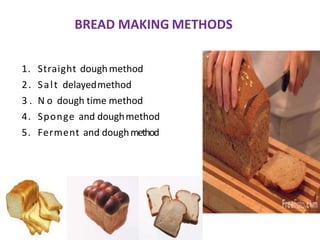
BREAD MAKING METHODS
1. Straight doughmethod
2. Salt delayedmethod
3 . N o dough time method
4. Sponge and doughmethod
5. Ferment and doughmethod
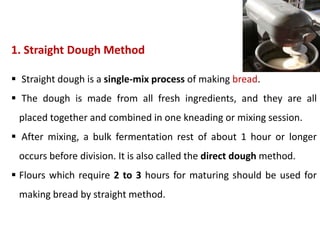
1. Straight Dough Method
 Straight dough is a single-mix process of making bread.
 The dough is made from all fresh ingredients, and they are all
placed together and combined in one kneading or mixing session.
 After mixing, a bulk fermentation rest of about 1 hour or longer
occurs before division. It is also called the direct dough method.
 Flours which require 2 to 3 hours for maturing should be used for
making bread by straight method.
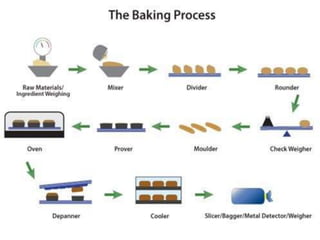
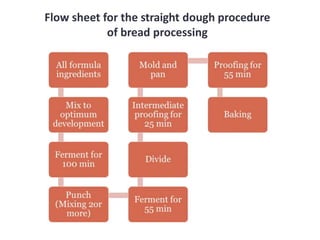
Flow sheet for the straight dough procedure
of bread processing
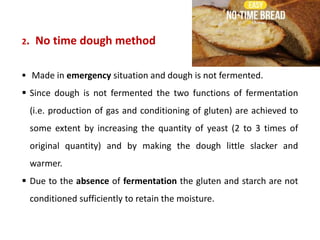
2. No time dough method
 Made in emergency situation and dough is not fermented.
 Since dough is not fermented the two functions of fermentation
(i.e. production of gas and conditioning of gluten) are achieved to
some extent by increasing the quantity of yeast (2 to 3 times of
original quantity) and by making the dough little slacker and
warmer.
 Due to the absence of fermentation the gluten and starch are not
conditioned sufficiently to retain the moisture.
3. Salt Delayed Method
 This slight variation of straight method, where all the
ingredients are mixed except salt and fat.
 The salt is added at a knock back stage. It may be sifted on the
dough and mixed or it may be creamed with fat and salt.
 Whatever way is chosen for mixing the salt, only 3/4 (of actual
mixing time) mixing should be given initially and one fourth
mixing at the time of adding salt.
 Due to absence of salt, the fermentation speed is enhanced
and gluten is matured in a reasonably shorter time.
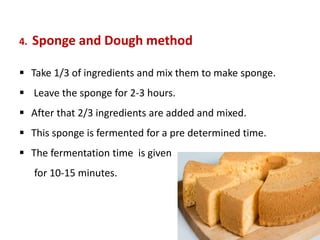
4. Sponge and Dough method
 Take 1/3 of ingredients and mix them to make sponge.
 Leave the sponge for 2-3 hours.
 After that 2/3 ingredients are added and mixed.
 This sponge is fermented for a pre determined time.
 The fermentation time is given
for 10-15 minutes.
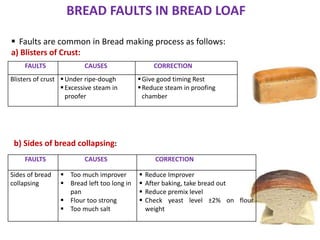
BREAD FAULTS IN BREAD LOAF
 Faults are common in Bread making process as follows:
a) Blisters of Crust:
FAULTS CAUSES CORRECTION
Blisters of crust Under ripe-dough
Excessive steam in
proofer
Give good timing Rest
Reduce steam in proofing
chamber
FAULTS CAUSES CORRECTION
Sides of bread
collapsing
 Too much improver
 Bread left too long in
pan
 Flour too strong
 Too much salt
 Reduce Improver
 After baking, take bread out
 Reduce premix level
 Check yeast level ±2% on flour
weight
b) Sides of bread collapsing:
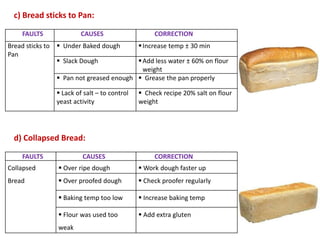
FAULTS CAUSES CORRECTION
Bread sticks to
Pan
 Under Baked dough Increase temp ± 30 min
 Slack Dough Add less water ± 60% on flour
weight
 Pan not greased enough  Grease the pan properly
 Lack of salt – to control
yeast activity
 Check recipe 20% salt on flour
weight
c) Bread sticks to Pan:
d) Collapsed Bread:
FAULTS CAUSES CORRECTION
Collapsed
Bread
 Over ripe dough  Work dough faster up
 Over proofed dough  Check proofer regularly
 Baking temp too low  Increase baking temp
 Flour was used too
weak
 Add extra gluten
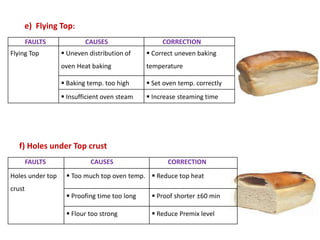
FAULTS CAUSES CORRECTION
Flying Top  Uneven distribution of
oven Heat baking
 Correct uneven baking
temperature
 Baking temp. too high  Set oven temp. correctly
 Insufficient oven steam  Increase steaming time
e) Flying Top:
f) Holes under Top crust
FAULTS CAUSES CORRECTION
Holes under top
crust
 Too much top oven temp.  Reduce top heat
 Proofing time too long  Proof shorter ±60 min
 Flour too strong  Reduce Premix level
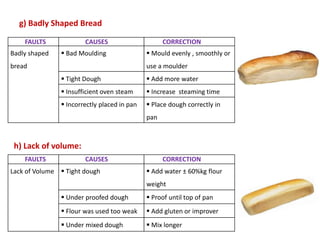
FAULTS CAUSES CORRECTION
Badly shaped
bread
 Bad Moulding  Mould evenly , smoothly or
use a moulder
 Tight Dough  Add more water
 Insufficient oven steam  Increase steaming time
 Incorrectly placed in pan  Place dough correctly in
pan
FAULTS CAUSES CORRECTION
Lack of Volume  Tight dough  Add water ± 60%kg flour
weight
 Under proofed dough  Proof until top of pan
 Flour was used too weak  Add gluten or improver
 Under mixed dough  Mix longer
g) Badly Shaped Bread
h) Lack of volume:
FAULTS CAUSES CORRECTION
Rapid staling Stiff dough Add more water
Baking time too long Check baking time ±30 min
Baking temp low Increase baking temp.
Flour deficient in maltose Add additional sugar
FAULTS CAUSES CORRECTION
Too much
volume
Over-proofed Checker proofer more regularly
Too much yeast Check yeast percentage ±2% on
flour weight
Too much pre-mix Check % premix recommended
i) Rapid Staling:
j) Too Much Volume:
REFERENCES
1. http://www.ddegjust.ac.in/studymaterial/pgdbst/pgdbst-05.pdf
2. http://www.fao.org/3/a-au108e.pdf
3. Khetarpaul, Neelam. Bakery science and cereal technology. Daya Books,
2005.
4. https://pdfs.semanticscholar.org/1c37/d93cab048aea85537abd0f42193bd7
23ad01.pdf
5. https://www.fob.uk.com/wp-content/uploads/2017/01/FS-7-How-bread-is-
made.pdf
Bakery ppt

Bakery ppt

  • 1.
    METHODS OF BREADMAKING BY DIVYA .P IIFPT
  • 2.
    INTRODUCTION  Bread makingprocesses have been modified to suit modern and fast processing of wheat flour into bread.  The earlier processes had requirements of long fermentation and large space requirements.  The recently developed processes are no time to minimum time processes, which are fast, labor and space effective.  However, all these processes have single aim to convert wheat flour and other ingredients into palatable bread products.
  • 3.
     Lean Dough Is the basic ingredient for bread such as flour, yeast, water, a little sugar, and shortening.  It is used for making Crusty Breads like French Bread and Pan De Sal.  Rich Dough Is a dough that contains, fat (butter) , nuts, dried fruits, eggs flavorings, and more sugar. It enhances flavor and itsnutritive value of bread. KINDS OF DOUGH
  • 5.
    BREAD MAKING METHODS 1.Straight doughmethod 2. Salt delayedmethod 3 . N o dough time method 4. Sponge and doughmethod 5. Ferment and doughmethod
  • 6.
    1. Straight DoughMethod  Straight dough is a single-mix process of making bread.  The dough is made from all fresh ingredients, and they are all placed together and combined in one kneading or mixing session.  After mixing, a bulk fermentation rest of about 1 hour or longer occurs before division. It is also called the direct dough method.  Flours which require 2 to 3 hours for maturing should be used for making bread by straight method.
  • 7.
    Flow sheet forthe straight dough procedure of bread processing
  • 8.
    2. No timedough method  Made in emergency situation and dough is not fermented.  Since dough is not fermented the two functions of fermentation (i.e. production of gas and conditioning of gluten) are achieved to some extent by increasing the quantity of yeast (2 to 3 times of original quantity) and by making the dough little slacker and warmer.  Due to the absence of fermentation the gluten and starch are not conditioned sufficiently to retain the moisture.
  • 9.
    3. Salt DelayedMethod  This slight variation of straight method, where all the ingredients are mixed except salt and fat.  The salt is added at a knock back stage. It may be sifted on the dough and mixed or it may be creamed with fat and salt.  Whatever way is chosen for mixing the salt, only 3/4 (of actual mixing time) mixing should be given initially and one fourth mixing at the time of adding salt.  Due to absence of salt, the fermentation speed is enhanced and gluten is matured in a reasonably shorter time.
  • 10.
    4. Sponge andDough method  Take 1/3 of ingredients and mix them to make sponge.  Leave the sponge for 2-3 hours.  After that 2/3 ingredients are added and mixed.  This sponge is fermented for a pre determined time.  The fermentation time is given for 10-15 minutes.
  • 11.
    BREAD FAULTS INBREAD LOAF  Faults are common in Bread making process as follows: a) Blisters of Crust: FAULTS CAUSES CORRECTION Blisters of crust Under ripe-dough Excessive steam in proofer Give good timing Rest Reduce steam in proofing chamber FAULTS CAUSES CORRECTION Sides of bread collapsing  Too much improver  Bread left too long in pan  Flour too strong  Too much salt  Reduce Improver  After baking, take bread out  Reduce premix level  Check yeast level ±2% on flour weight b) Sides of bread collapsing:
  • 12.
    FAULTS CAUSES CORRECTION Breadsticks to Pan  Under Baked dough Increase temp ± 30 min  Slack Dough Add less water ± 60% on flour weight  Pan not greased enough  Grease the pan properly  Lack of salt – to control yeast activity  Check recipe 20% salt on flour weight c) Bread sticks to Pan: d) Collapsed Bread: FAULTS CAUSES CORRECTION Collapsed Bread  Over ripe dough  Work dough faster up  Over proofed dough  Check proofer regularly  Baking temp too low  Increase baking temp  Flour was used too weak  Add extra gluten
  • 13.
    FAULTS CAUSES CORRECTION FlyingTop  Uneven distribution of oven Heat baking  Correct uneven baking temperature  Baking temp. too high  Set oven temp. correctly  Insufficient oven steam  Increase steaming time e) Flying Top: f) Holes under Top crust FAULTS CAUSES CORRECTION Holes under top crust  Too much top oven temp.  Reduce top heat  Proofing time too long  Proof shorter ±60 min  Flour too strong  Reduce Premix level
  • 14.
    FAULTS CAUSES CORRECTION Badlyshaped bread  Bad Moulding  Mould evenly , smoothly or use a moulder  Tight Dough  Add more water  Insufficient oven steam  Increase steaming time  Incorrectly placed in pan  Place dough correctly in pan FAULTS CAUSES CORRECTION Lack of Volume  Tight dough  Add water ± 60%kg flour weight  Under proofed dough  Proof until top of pan  Flour was used too weak  Add gluten or improver  Under mixed dough  Mix longer g) Badly Shaped Bread h) Lack of volume:
  • 15.
    FAULTS CAUSES CORRECTION Rapidstaling Stiff dough Add more water Baking time too long Check baking time ±30 min Baking temp low Increase baking temp. Flour deficient in maltose Add additional sugar FAULTS CAUSES CORRECTION Too much volume Over-proofed Checker proofer more regularly Too much yeast Check yeast percentage ±2% on flour weight Too much pre-mix Check % premix recommended i) Rapid Staling: j) Too Much Volume:
  • 16.
    REFERENCES 1. http://www.ddegjust.ac.in/studymaterial/pgdbst/pgdbst-05.pdf 2. http://www.fao.org/3/a-au108e.pdf 3.Khetarpaul, Neelam. Bakery science and cereal technology. Daya Books, 2005. 4. https://pdfs.semanticscholar.org/1c37/d93cab048aea85537abd0f42193bd7 23ad01.pdf 5. https://www.fob.uk.com/wp-content/uploads/2017/01/FS-7-How-bread-is- made.pdf