Most of us have been in a bakeshop and have
tasted different types of breads
and pastries. What we don’t see is how these
breads and pastries are prepared and
baked.
Bakery Products Preparation
A. Pies and Pastries
- Pies are baked goods that has
layers of pastry dough that form a
crust and fillings. Some traditional
varieties of pies include apple, mango,
strawberry pies, among others.
Bakery Products Preparation
B. Quick Breads
- Quick breads are also known
as sweetened loaves. It usually
contains more sugar, fats, and eggs
than yeast breads, but less than in
cakes.
C. Cakes
- Cakes are very similar to sweetened loaves
in and breads but it is the richest and
sweetest type of baked product.
- There are numerous cake recipes but these
can be grouped into four types of cakes
according to the mixing method employed
in making them – shortened cakes, sponge
cakes, angel food cakes and chiffon cakes.
D. Cookies
“Cookie” means “small cake” or a
small, flat baked product. In some
countries, they call this product biscuits
instead of cookies. In the Philippines, we
use both cookies and biscuits to refer to
cookie products. There are many kinds of
cookies based on the how it is shaped.
Kinds of Cookies
1. Pressed cookies – made from

soft dough. The dough must be soft
enough to be forced through a
pastry bag of cookie press but stiff
enough to hold its shape. Some
butter cookies are made this way.
Kinds of Cookies
2. Dropped cookies – these are also
made from soft dough that is dropped to
the baking sheet with a spoon or scoop.
The dough may be of the same
consistency as for pressed cookies but
dropping the cookie is preferred when the
dough contains pieces of fruits, nuts or
chocolate or when you want the cookies
to have a rough, homemade look.
Kinds of Cookies
3. Rolled Cookies – cookies that are
rolled and cut from stiff dough. This
method produces cookies which can
have a variety of shapes either hand cut
or using a cookie cutter.
Kinds of Cookies
4. Molded cookies – the cookie dough is
first divided into equal portions then
each piece is molded into the desired
shape by flattening the pieces out with
a weight in which the design is embossed
or carved out like a stamp.
Kinds of Cookies
5. Icebox or refrigerator cookies – the
rolls of dough may be made in advance
and stored, and then it can easily cut and
baked as needed. Pinwheel and
checkerboard cookies are made this way.
Kinds of Cookies
6. Sheet Cookies – commonly called bar
cookies. The batter is baked in a shallow
pan and then cut into bars. Brownies,
lemon squares, fudge bars are examples
of this type of cookie.
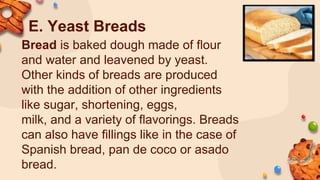
E. Yeast Breads
Bread is baked dough made of flour
and water and leavened by yeast.
Other kinds of breads are produced
with the addition of other ingredients
like sugar, shortening, eggs,
milk, and a variety of flavorings. Breads
can also have fillings like in the case of
Spanish bread, pan de coco or asado
bread.
MIXING TECHNIQUES
- Mixing method greatly affect flour
mixtures and its resulting product.
Various techniques have been
developed for efficiency and
convenience. Some of them are as
follows:
Creaming
- Rubbing one or two ingredients in a
bowl with the help of a
wooden spoon or electric mixer to
make a soft fluffy mixture
Cutting in
– mixing fat and flour with the use of
pastry blender or two knives in a
scissor-like manner.
Folding
– This is working with two ingredients
very gently to retain air in
mixture.
Cut and Fold
– a combination of two motions cutting
vertically through the mixture and
turning over and over by gliding the
spoon or rubber scraper across the
bottom of the mixing bowl at each
turn.
Beating
- Done to incorporate air in a mixture
by mechanical agitation. Could be
done with the use of wire whisks, egg
beater or electric food mixers.
Stirring
- Often done with a wooden spoon,
rotating it through a mixture
long as necessary usually until the
ingredients are combined.
Whipping
- a process of beating eggs and cream
to fill them with air and
make them thick and fluffy.
Sifting
- the process of separating coarse
particles in the ingredients by
passing through a sieve.
GENERAL PROCEDURE FOR PREPARATION
AND BAKING
Before the actual
preparation and baking, it is
important to know the
general procedure for
bakeshop production.
MISE-EN-PLACE
Mise-en-place (pronounced miz on
plas) is a French word which means
“everything
in place”. It literally means, you have
to set everything in place before
starting the
actual baking procedures.
CLEAN AS YOU GO
(CLAYGO)
Good kitchen and laboratory
practices have to be followed
but one very simple
rule to remember is to “clean
as you go”. Have a plan for
keeping your workspace
clean. Clean up as you go.
Thank you for listening!

Lesson 2 - Bakery Products Preparation.pptx

  • 2.
    Most of ushave been in a bakeshop and have tasted different types of breads and pastries. What we don’t see is how these breads and pastries are prepared and baked.
  • 3.
    Bakery Products Preparation A.Pies and Pastries - Pies are baked goods that has layers of pastry dough that form a crust and fillings. Some traditional varieties of pies include apple, mango, strawberry pies, among others.
  • 4.
    Bakery Products Preparation B.Quick Breads - Quick breads are also known as sweetened loaves. It usually contains more sugar, fats, and eggs than yeast breads, but less than in cakes.
  • 7.
    C. Cakes - Cakesare very similar to sweetened loaves in and breads but it is the richest and sweetest type of baked product. - There are numerous cake recipes but these can be grouped into four types of cakes according to the mixing method employed in making them – shortened cakes, sponge cakes, angel food cakes and chiffon cakes.
  • 8.
    D. Cookies “Cookie” means“small cake” or a small, flat baked product. In some countries, they call this product biscuits instead of cookies. In the Philippines, we use both cookies and biscuits to refer to cookie products. There are many kinds of cookies based on the how it is shaped.
  • 9.
    Kinds of Cookies 1.Pressed cookies – made from soft dough. The dough must be soft enough to be forced through a pastry bag of cookie press but stiff enough to hold its shape. Some butter cookies are made this way.
  • 10.
    Kinds of Cookies 2.Dropped cookies – these are also made from soft dough that is dropped to the baking sheet with a spoon or scoop. The dough may be of the same consistency as for pressed cookies but dropping the cookie is preferred when the dough contains pieces of fruits, nuts or chocolate or when you want the cookies to have a rough, homemade look.
  • 11.
    Kinds of Cookies 3.Rolled Cookies – cookies that are rolled and cut from stiff dough. This method produces cookies which can have a variety of shapes either hand cut or using a cookie cutter.
  • 12.
    Kinds of Cookies 4.Molded cookies – the cookie dough is first divided into equal portions then each piece is molded into the desired shape by flattening the pieces out with a weight in which the design is embossed or carved out like a stamp.
  • 13.
    Kinds of Cookies 5.Icebox or refrigerator cookies – the rolls of dough may be made in advance and stored, and then it can easily cut and baked as needed. Pinwheel and checkerboard cookies are made this way.
  • 14.
    Kinds of Cookies 6.Sheet Cookies – commonly called bar cookies. The batter is baked in a shallow pan and then cut into bars. Brownies, lemon squares, fudge bars are examples of this type of cookie.
  • 15.
    E. Yeast Breads Breadis baked dough made of flour and water and leavened by yeast. Other kinds of breads are produced with the addition of other ingredients like sugar, shortening, eggs, milk, and a variety of flavorings. Breads can also have fillings like in the case of Spanish bread, pan de coco or asado bread.
  • 25.
    MIXING TECHNIQUES - Mixingmethod greatly affect flour mixtures and its resulting product. Various techniques have been developed for efficiency and convenience. Some of them are as follows:
  • 26.
    Creaming - Rubbing oneor two ingredients in a bowl with the help of a wooden spoon or electric mixer to make a soft fluffy mixture
  • 27.
    Cutting in – mixingfat and flour with the use of pastry blender or two knives in a scissor-like manner.
  • 28.
    Folding – This isworking with two ingredients very gently to retain air in mixture.
  • 29.
    Cut and Fold –a combination of two motions cutting vertically through the mixture and turning over and over by gliding the spoon or rubber scraper across the bottom of the mixing bowl at each turn.
  • 30.
    Beating - Done toincorporate air in a mixture by mechanical agitation. Could be done with the use of wire whisks, egg beater or electric food mixers.
  • 31.
    Stirring - Often donewith a wooden spoon, rotating it through a mixture long as necessary usually until the ingredients are combined.
  • 32.
    Whipping - a processof beating eggs and cream to fill them with air and make them thick and fluffy.
  • 33.
    Sifting - the processof separating coarse particles in the ingredients by passing through a sieve.
  • 35.
    GENERAL PROCEDURE FORPREPARATION AND BAKING Before the actual preparation and baking, it is important to know the general procedure for bakeshop production.
  • 36.
    MISE-EN-PLACE Mise-en-place (pronounced mizon plas) is a French word which means “everything in place”. It literally means, you have to set everything in place before starting the actual baking procedures.
  • 37.
    CLEAN AS YOUGO (CLAYGO) Good kitchen and laboratory practices have to be followed but one very simple rule to remember is to “clean as you go”. Have a plan for keeping your workspace clean. Clean up as you go.
  • 38.
    Thank you forlistening!