BIRTH AND PHYSICAL
DEVELOPMENT DURING THE
   FIRST THREE YEARS

Carlos F. Martinez MHA, M.Ed.

  http://carlosFmartinez.com
Overview
   History
   Child Birth Process
   Cesarean Delivery
   The New Baby Born
   Complications of Childbirth
   Early Physical Development
   Nutrition
   Sensory and Perceptual
    Development
How Birth Has Changed
   Child birth before the 20th century (US &
    Europe)
   The development of science: delivery at
    hospitals
   Today: delivery in birth centers
Child Birth Process
   Dilation of the cervix

   Descent of the baby

   Expulsion of the umbilical cord and placenta
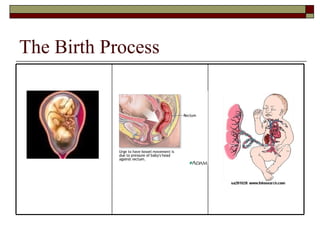
The Birth Process
The Birth Process…(Continue)

   Electronic Fetal Monitoring

   Vaginal VS Cesarean Delivery

   Medicated VS Non-medicated Delivery
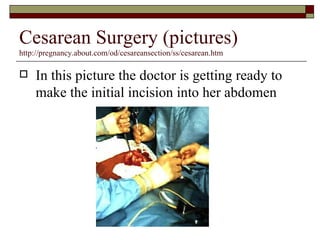
Cesarean Surgery (pictures)
http://pregnancy.about.com/od/cesareansection/ss/cesarean.htm

   In this picture the doctor is getting ready to
    make the initial incision into her abdomen
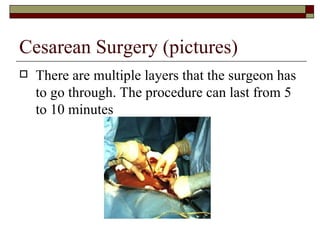
Cesarean Surgery (pictures)
   There are multiple layers that the surgeon has
    to go through. The procedure can last from 5
    to 10 minutes
Cesarean Surgery (pictures)
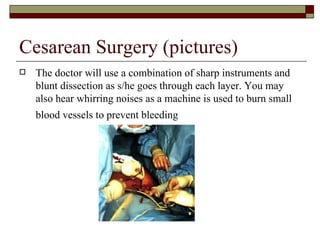
   The doctor will use a combination of sharp instruments and
    blunt dissection as s/he goes through each layer. You may
    also hear whirring noises as a machine is used to burn small
    blood vessels to prevent bleeding
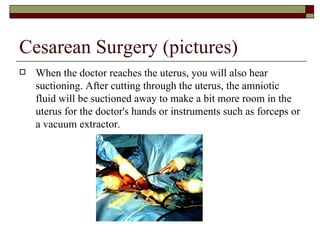
Cesarean Surgery (pictures)
   When the doctor reaches the uterus, you will also hear
    suctioning. After cutting through the uterus, the amniotic
    fluid will be suctioned away to make a bit more room in the
    uterus for the doctor's hands or instruments such as forceps or
    a vacuum extractor.
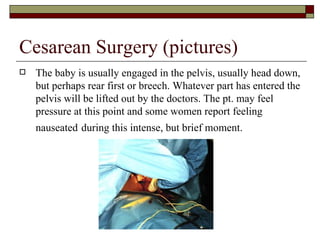
Cesarean Surgery (pictures)
   The baby is usually engaged in the pelvis, usually head down,
    but perhaps rear first or breech. Whatever part has entered the
    pelvis will be lifted out by the doctors. The pt. may feel
    pressure at this point and some women report feeling
    nauseated during this intense, but brief moment.
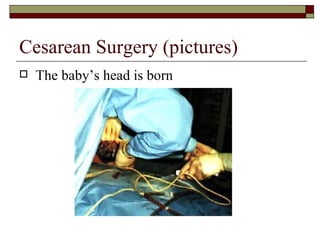
Cesarean Surgery (pictures)
   The baby’s head is born
Cesarean Surgery (pictures)
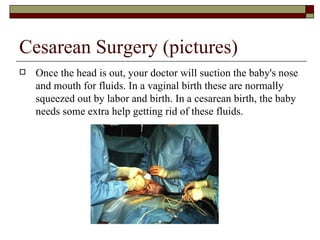
   Once the head is out, your doctor will suction the baby's nose
    and mouth for fluids. In a vaginal birth these are normally
    squeezed out by labor and birth. In a cesarean birth, the baby
    needs some extra help getting rid of these fluids.
Cesarean Surgery (pictures)
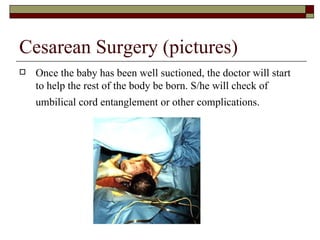
   Once the baby has been well suctioned, the doctor will start
    to help the rest of the body be born. S/he will check of
    umbilical cord entanglement or other complications.
Cesarean Surgery (pictures)
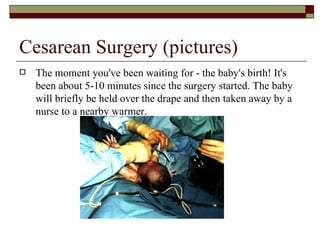
   The moment you've been waiting for - the baby's birth! It's
    been about 5-10 minutes since the surgery started. The baby
    will briefly be held over the drape and then taken away by a
    nurse to a nearby warmer.
Cesarean Surgery (pictures)
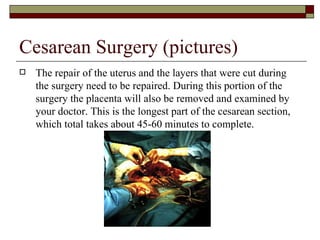
   The repair of the uterus and the layers that were cut during
    the surgery need to be repaired. During this portion of the
    surgery the placenta will also be removed and examined by
    your doctor. This is the longest part of the cesarean section,
    which total takes about 45-60 minutes to complete.
The New Baby Born
   Size and Appearance.
   Body Systems.
   Medical and Behavioral Assessments.
   States of Arousal.
Complications of Childbirth
Low Birth Weight:
   Smoking during pregnancy
   Induced delivery
   Delayed childbearing
   Fertility drugs
   Poor nutrition
   Medical conditions (High blood pressure,
    depression, anemia, etc.)
Complications of Childbirth…(Continue)

   Post-maturity

   Stillbirth
Survival and Health
Death during Infancy:
2.   About 8 million infants die before 1 year old (worldwide).
3.   Causes: Preterm delivery, pneumonia, asphyxiation.
4.   In the US 6.87 infants died for every 1,000 live births (Year
     2005).
5.   Birth defects is the # 1 cause of infant deaths in US,
     followed by SIDS, low-birth weight, and other maternal
     complications of pregnancy.
6.   African American babies are twice as likely to die in their
     first year compared to white and Hispanic babies.
7.   Death from Injuries.
SIDS
   Sudden infant death syndrome is a
    condition that occurs when infants stop
    breathing, usually during the night, & die
    without apparent cause.
   It is recommended to place infants on their
    backs to sleep in order to reduce the risk of
    SIDS.
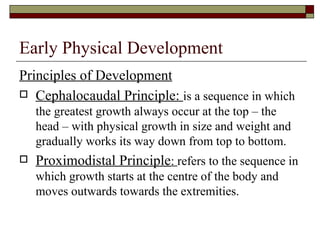
Early Physical Development
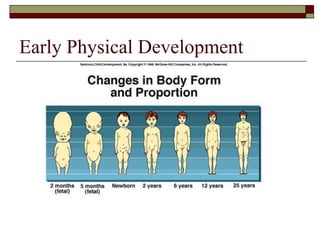
Principles of Development
 Cephalocaudal Principle: is a sequence in which
    the greatest growth always occur at the top – the
    head – with physical growth in size and weight and
    gradually works its way down from top to bottom.
   Proximodistal Principle: refers to the sequence in
    which growth starts at the centre of the body and
    moves outwards towards the extremities.
Early Physical Development
Early Physical Development…(Continue)
The Brain:

3.   Building the Brain
4.   Major Parts of the Brain
5.   Brain Cells
The Brain’s Development
   At birth, the newborn’s brain is about 25% of
    its adult weight.
   By age 2, the brain is about 75% of its adult
    weight.
   Newborns have all of the neurons they will
    ever have – about 100 billion.
   The primary motor areas of the brain develop
    earlier than the primary sensory areas.
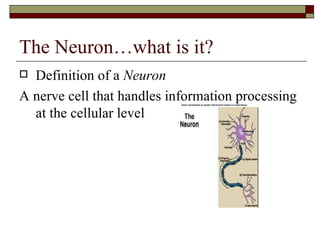
The Neuron…what is it?
 Definition of a Neuron
A nerve cell that handles information processing
  at the cellular level
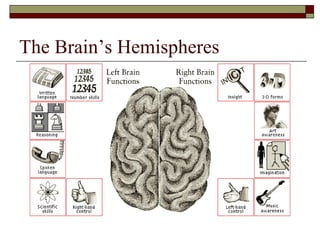
The Brain’s Hemispheres
   The cerebral cortex, the highest level of the brain, is divided
    into 2 halves, or hemispheres.
   Each hemisphere is involved in various & specialized
    functions of thinking, feeling, & behavior.
   Extensive research on the brain’s hemispheres has focused on
    language.
   At birth, the hemispheres have already started to specialize.
   Newborns show greater electrical brain activity in the left
    hemisphere than the right hemisphere when listening to
    speech.
The Brain’s Hemispheres
Early Physical Development…(Continue)
Nutrition:

3.   Breast or Bottle?

5.   Encouraging Breast-Feeding
Nutrition
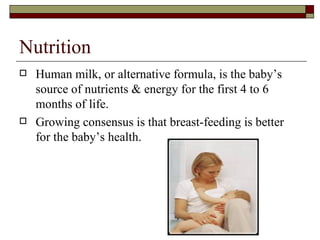
   Human milk, or alternative formula, is the baby’s
    source of nutrients & energy for the first 4 to 6
    months of life.
   Growing consensus is that breast-feeding is better
    for the baby’s health.
Nutritional Needs and Feeding
   Appropriate weight gain
   Fewer allergies
   Prevention or reduction of gastrointestinal &
    respiratory infections also acute & recurrent otitis
    media (middle ear infections)
   Denser bones in childhood & adulthood
   Reduced risks for childhood cancer & breast cancer
    in mothers.
   Lower incidence of SIDS
Malnutrition in Infancy
   Weaning from breast milk to inadequate
    nutrients, such as unsuitable & unsanitary
    cow’s milk formula, can lead to conditions
    called marasmus & kwashiorkor.
   Even if it’s not fatal, severe & lengthy
    malnutrition is detrimental to physical,
    cognitive, & social development.
Marasmus
   Marasmus is a wasting away of body tissue
    in the infant’s first year, caused by severe
    protein calorie deficiency.
   Infants become grossly underweight &
    muscles atrophy.
Kwashiorkor
   Kwashiorkor is a condition caused by a deficiency in protein
    in which the child’s face, legs, & abdomen swell with water.
   Vital organs collect nutrients & deprive other parts of the
    body of them.
   Hair becomes thin, brittle, & colorless.
Sensory and Perceptual
Development
   Sensation and Perception
   Visual Perception
   Hearing
   Touch
   Smell
   Taste
Sensation and Perception
   Sensations occur when information interacts
    with sensory receptors – the eyes, ears,
    tongue, nostrils, and skin.

   Perception is the interpretation of what is
    sensed.
Visual Perception
   The newborn’s vision is estimated to be 20/400 to
    20/800 on the Snellan chart – about 10–30 times
    lower than normal adult vision (20/20).
   By 6 months vision improves to 20/100.
   By 8 months, vision approximates that of an adult.
   By 4 months all color-sensitive receptors are
    functioning at adult capacity.
Hearing
   In the last few months of pregnancy, a fetus
    can hear sounds (the mother’s voice, music,
    etc.)
   Infants are born with the ability to
    discriminate speech sounds from any
    language, but without constant exposure, they
    lose the ability by their 1st birthday.
Touch
   Newborns respond to touch, particularly with
    the sucking & rooting reflex.
   An important ability that develops during the
    first year is to connect information about
    vision with information about touch.
   Newborns can feel pain.
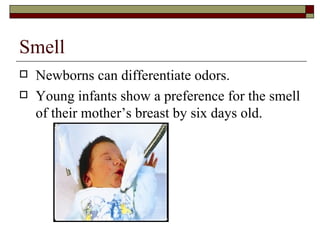
Smell
   Newborns can differentiate odors.
   Young infants show a preference for the smell
    of their mother’s breast by six days old.
Taste
   Sensitivity to taste may be present at before
    birth.
   Two-hour-old newborns made different facial
    expressions when they tasted sweet, sour, and
    bitter solutions.
   At 4 months of age, infants prefer salty tastes,
    which newborns found adverse.
Motor Development
   Reflexes

   Gross Motor Skills

   Fine Motor Skills
Motor Development…(Continue)
   Reflexes are genetically carried survival
    mechanisms, that govern the newborn’s
    movements.
   Reflexes may serve as important building
    blocks for subsequent purposeful motor
    activity.
The Sucking Reflex
   The sucking reflex occurs when newborns
    automatically suck an object placed in their
    mouth.
   Enables newborns to get nourishment before
    they have associated a nipple with food.
   Disappears after 3–4 months.
The Rooting Reflex
   The rooting reflex occurs when the infant’s
    cheek is stroked or the side of the mouth is
    touched.
   In response, the infant turns its head towards
    the side that was touched in an apparent effort
    to find something to suck.
   Disappears after 3–4 months.
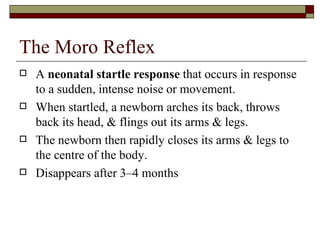
The Moro Reflex
   A neonatal startle response that occurs in response
    to a sudden, intense noise or movement.
   When startled, a newborn arches its back, throws
    back its head, & flings out its arms & legs.
   The newborn then rapidly closes its arms & legs to
    the centre of the body.
   Disappears after 3–4 months
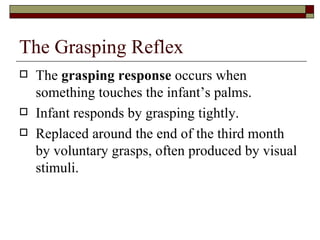
The Grasping Reflex
   The grasping response occurs when
    something touches the infant’s palms.
   Infant responds by grasping tightly.
   Replaced around the end of the third month
    by voluntary grasps, often produced by visual
    stimuli.
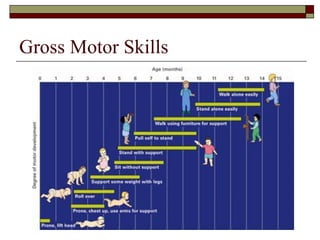
Gross Motor Skills
   Gross motor skills involve large muscle activities,
    such as moving one’s arms & walking.
   Gross motor changes are the most dramatic &
    observable changes in the infant’s 1st yr of life.
   The month at which gross motor milestones occur
    varies by as much as 2-4 months.
   In the 2nd yr of life toddlers become more mobile.
Gross Motor Skills
Fine Motor Skills
   Fine motor skills involve more finely tuned
    movements, such as finger dexterity.
   Infants have hardly any control over fine motor
    skills at birth.
   They do have many components of what later
    become finely coordinated hand & finger
    movements.
   Reaching & grasping become more refined during
    the first 2 yrs of life.
Questions?


     THANK YOU!

carlos@carlosFmartinez.com

Birth and physical development during the first 3 years

  • 1.
    BIRTH AND PHYSICAL DEVELOPMENTDURING THE FIRST THREE YEARS Carlos F. Martinez MHA, M.Ed. http://carlosFmartinez.com
  • 2.
    Overview  History  Child Birth Process  Cesarean Delivery  The New Baby Born  Complications of Childbirth  Early Physical Development  Nutrition  Sensory and Perceptual Development
  • 3.
    How Birth HasChanged  Child birth before the 20th century (US & Europe)  The development of science: delivery at hospitals  Today: delivery in birth centers
  • 4.
    Child Birth Process  Dilation of the cervix  Descent of the baby  Expulsion of the umbilical cord and placenta
  • 5.
  • 6.
    The Birth Process…(Continue)  Electronic Fetal Monitoring  Vaginal VS Cesarean Delivery  Medicated VS Non-medicated Delivery
  • 7.
    Cesarean Surgery (pictures) http://pregnancy.about.com/od/cesareansection/ss/cesarean.htm  In this picture the doctor is getting ready to make the initial incision into her abdomen
  • 8.
    Cesarean Surgery (pictures)  There are multiple layers that the surgeon has to go through. The procedure can last from 5 to 10 minutes
  • 9.
    Cesarean Surgery (pictures)  The doctor will use a combination of sharp instruments and blunt dissection as s/he goes through each layer. You may also hear whirring noises as a machine is used to burn small blood vessels to prevent bleeding
  • 10.
    Cesarean Surgery (pictures)  When the doctor reaches the uterus, you will also hear suctioning. After cutting through the uterus, the amniotic fluid will be suctioned away to make a bit more room in the uterus for the doctor's hands or instruments such as forceps or a vacuum extractor.
  • 11.
    Cesarean Surgery (pictures)  The baby is usually engaged in the pelvis, usually head down, but perhaps rear first or breech. Whatever part has entered the pelvis will be lifted out by the doctors. The pt. may feel pressure at this point and some women report feeling nauseated during this intense, but brief moment.
  • 12.
    Cesarean Surgery (pictures)  The baby’s head is born
  • 13.
    Cesarean Surgery (pictures)  Once the head is out, your doctor will suction the baby's nose and mouth for fluids. In a vaginal birth these are normally squeezed out by labor and birth. In a cesarean birth, the baby needs some extra help getting rid of these fluids.
  • 14.
    Cesarean Surgery (pictures)  Once the baby has been well suctioned, the doctor will start to help the rest of the body be born. S/he will check of umbilical cord entanglement or other complications.
  • 15.
    Cesarean Surgery (pictures)  The moment you've been waiting for - the baby's birth! It's been about 5-10 minutes since the surgery started. The baby will briefly be held over the drape and then taken away by a nurse to a nearby warmer.
  • 16.
    Cesarean Surgery (pictures)  The repair of the uterus and the layers that were cut during the surgery need to be repaired. During this portion of the surgery the placenta will also be removed and examined by your doctor. This is the longest part of the cesarean section, which total takes about 45-60 minutes to complete.
  • 17.
    The New BabyBorn  Size and Appearance.  Body Systems.  Medical and Behavioral Assessments.  States of Arousal.
  • 18.
    Complications of Childbirth LowBirth Weight:  Smoking during pregnancy  Induced delivery  Delayed childbearing  Fertility drugs  Poor nutrition  Medical conditions (High blood pressure, depression, anemia, etc.)
  • 19.
    Complications of Childbirth…(Continue)  Post-maturity  Stillbirth
  • 20.
    Survival and Health Deathduring Infancy: 2. About 8 million infants die before 1 year old (worldwide). 3. Causes: Preterm delivery, pneumonia, asphyxiation. 4. In the US 6.87 infants died for every 1,000 live births (Year 2005). 5. Birth defects is the # 1 cause of infant deaths in US, followed by SIDS, low-birth weight, and other maternal complications of pregnancy. 6. African American babies are twice as likely to die in their first year compared to white and Hispanic babies. 7. Death from Injuries.
  • 21.
    SIDS  Sudden infant death syndrome is a condition that occurs when infants stop breathing, usually during the night, & die without apparent cause.  It is recommended to place infants on their backs to sleep in order to reduce the risk of SIDS.
  • 22.
    Early Physical Development Principlesof Development  Cephalocaudal Principle: is a sequence in which the greatest growth always occur at the top – the head – with physical growth in size and weight and gradually works its way down from top to bottom.  Proximodistal Principle: refers to the sequence in which growth starts at the centre of the body and moves outwards towards the extremities.
  • 23.
  • 24.
    Early Physical Development…(Continue) TheBrain: 3. Building the Brain 4. Major Parts of the Brain 5. Brain Cells
  • 25.
    The Brain’s Development  At birth, the newborn’s brain is about 25% of its adult weight.  By age 2, the brain is about 75% of its adult weight.  Newborns have all of the neurons they will ever have – about 100 billion.  The primary motor areas of the brain develop earlier than the primary sensory areas.
  • 26.
    The Neuron…what isit?  Definition of a Neuron A nerve cell that handles information processing at the cellular level
  • 27.
    The Brain’s Hemispheres  The cerebral cortex, the highest level of the brain, is divided into 2 halves, or hemispheres.  Each hemisphere is involved in various & specialized functions of thinking, feeling, & behavior.  Extensive research on the brain’s hemispheres has focused on language.  At birth, the hemispheres have already started to specialize.  Newborns show greater electrical brain activity in the left hemisphere than the right hemisphere when listening to speech.
  • 28.
  • 29.
    Early Physical Development…(Continue) Nutrition: 3. Breast or Bottle? 5. Encouraging Breast-Feeding
  • 30.
    Nutrition  Human milk, or alternative formula, is the baby’s source of nutrients & energy for the first 4 to 6 months of life.  Growing consensus is that breast-feeding is better for the baby’s health.
  • 31.
    Nutritional Needs andFeeding  Appropriate weight gain  Fewer allergies  Prevention or reduction of gastrointestinal & respiratory infections also acute & recurrent otitis media (middle ear infections)  Denser bones in childhood & adulthood  Reduced risks for childhood cancer & breast cancer in mothers.  Lower incidence of SIDS
  • 32.
    Malnutrition in Infancy  Weaning from breast milk to inadequate nutrients, such as unsuitable & unsanitary cow’s milk formula, can lead to conditions called marasmus & kwashiorkor.  Even if it’s not fatal, severe & lengthy malnutrition is detrimental to physical, cognitive, & social development.
  • 33.
    Marasmus  Marasmus is a wasting away of body tissue in the infant’s first year, caused by severe protein calorie deficiency.  Infants become grossly underweight & muscles atrophy.
  • 34.
    Kwashiorkor  Kwashiorkor is a condition caused by a deficiency in protein in which the child’s face, legs, & abdomen swell with water.  Vital organs collect nutrients & deprive other parts of the body of them.  Hair becomes thin, brittle, & colorless.
  • 35.
    Sensory and Perceptual Development  Sensation and Perception  Visual Perception  Hearing  Touch  Smell  Taste
  • 36.
    Sensation and Perception  Sensations occur when information interacts with sensory receptors – the eyes, ears, tongue, nostrils, and skin.  Perception is the interpretation of what is sensed.
  • 37.
    Visual Perception  The newborn’s vision is estimated to be 20/400 to 20/800 on the Snellan chart – about 10–30 times lower than normal adult vision (20/20).  By 6 months vision improves to 20/100.  By 8 months, vision approximates that of an adult.  By 4 months all color-sensitive receptors are functioning at adult capacity.
  • 38.
    Hearing  In the last few months of pregnancy, a fetus can hear sounds (the mother’s voice, music, etc.)  Infants are born with the ability to discriminate speech sounds from any language, but without constant exposure, they lose the ability by their 1st birthday.
  • 39.
    Touch  Newborns respond to touch, particularly with the sucking & rooting reflex.  An important ability that develops during the first year is to connect information about vision with information about touch.  Newborns can feel pain.
  • 40.
    Smell  Newborns can differentiate odors.  Young infants show a preference for the smell of their mother’s breast by six days old.
  • 41.
    Taste  Sensitivity to taste may be present at before birth.  Two-hour-old newborns made different facial expressions when they tasted sweet, sour, and bitter solutions.  At 4 months of age, infants prefer salty tastes, which newborns found adverse.
  • 42.
    Motor Development  Reflexes  Gross Motor Skills  Fine Motor Skills
  • 43.
    Motor Development…(Continue)  Reflexes are genetically carried survival mechanisms, that govern the newborn’s movements.  Reflexes may serve as important building blocks for subsequent purposeful motor activity.
  • 44.
    The Sucking Reflex  The sucking reflex occurs when newborns automatically suck an object placed in their mouth.  Enables newborns to get nourishment before they have associated a nipple with food.  Disappears after 3–4 months.
  • 45.
    The Rooting Reflex  The rooting reflex occurs when the infant’s cheek is stroked or the side of the mouth is touched.  In response, the infant turns its head towards the side that was touched in an apparent effort to find something to suck.  Disappears after 3–4 months.
  • 46.
    The Moro Reflex  A neonatal startle response that occurs in response to a sudden, intense noise or movement.  When startled, a newborn arches its back, throws back its head, & flings out its arms & legs.  The newborn then rapidly closes its arms & legs to the centre of the body.  Disappears after 3–4 months
  • 47.
    The Grasping Reflex  The grasping response occurs when something touches the infant’s palms.  Infant responds by grasping tightly.  Replaced around the end of the third month by voluntary grasps, often produced by visual stimuli.
  • 48.
    Gross Motor Skills  Gross motor skills involve large muscle activities, such as moving one’s arms & walking.  Gross motor changes are the most dramatic & observable changes in the infant’s 1st yr of life.  The month at which gross motor milestones occur varies by as much as 2-4 months.  In the 2nd yr of life toddlers become more mobile.
  • 49.
  • 50.
    Fine Motor Skills  Fine motor skills involve more finely tuned movements, such as finger dexterity.  Infants have hardly any control over fine motor skills at birth.  They do have many components of what later become finely coordinated hand & finger movements.  Reaching & grasping become more refined during the first 2 yrs of life.
  • 51.
    Questions? THANK YOU! carlos@carlosFmartinez.com