Business Information Research – Lecture 2
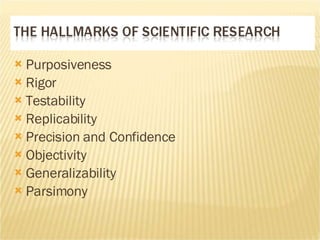
Purposiveness  Rigor  Testability  Replicability  Precision and Confidence  Objectivity  Generalizability  Parsimony
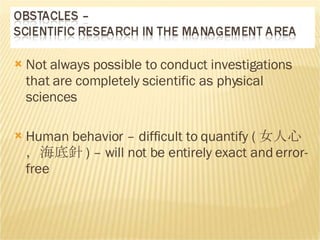
Not always possible to conduct investigations that are completely scientific as physical sciences Human behavior – difficult to quantify ( 女人心,海底針 ) – will not be entirely exact and error-free
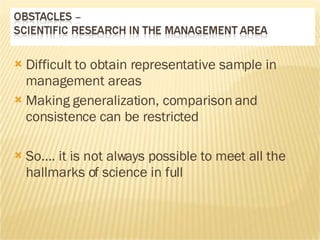
Difficult to obtain representative sample in management areas Making generalization, comparison and consistence can be restricted So…. it is not always possible to meet all the hallmarks of science in full
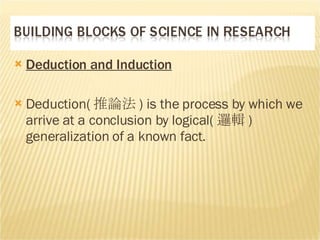
Deduction and Induction Deduction( 推論法 )  is the process by which we arrive at a conclusion by logical( 邏輯 )  generalization of a known fact.
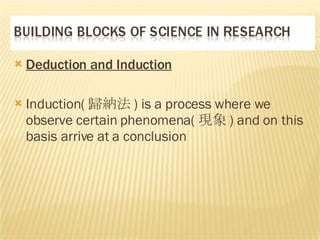
Deduction and Induction Induction( 歸納法 )  is a process where we observe certain phenomena( 現象 )  and on this basis arrive at a conclusion
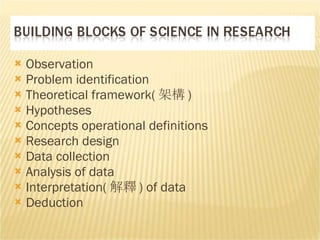
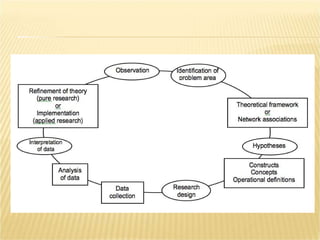
Observation Problem identification Theoretical framework( 架構 ) Hypotheses Concepts operational definitions Research design Data collection Analysis of data Interpretation( 解釋 ) of data Deduction
 
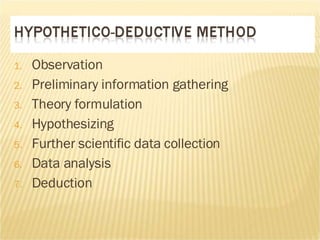
Observation Preliminary information gathering Theory formulation Hypothesizing Further scientific data collection Data analysis Deduction
Observation A phenomena is seen (observed) to have potentially important consequences( 結果 ) For example: The Manager is aware of (observes) the changes in communication pattern in the office and senses the staff disinterestedness (i.e. the problem) in the new MIS system.
Preliminary information gathering Seek preliminary information of what is observed For example: by talking informally to several staff or clients on what is happening and why
Theory formulation  Integrate all the information in a logical manner; conceptualize the problem and formulate a theoretical framework.  Examine critical variables why the problem occurs and how it can be solved.  For example: The new MIS system is not well received due to the lack of user training and resistance to changes (variables).
Hypothesizing  Generate testable statement (hypotheses) from the connection of the variables  For example: Hypothesize (in a testable statement) that the staff disinterestedness will be reduced if strong management endorsement( 支持 )  to the system is seen.
Further scientific data collection Obtain data with respect( 注視 )  to each variable in the hypotheses Collect further scientific data to test the hypotheses  For example: Measure the staff acceptance level in respect to current MIS system. Collect further data on staff acceptance level when MIS system user training and management endorsement are available.
Data analysis  Analyze all the data collected  statistically  to see if the hypotheses are supported.  Correlation analysis( 相關分析 ) :  Determine the relationship between two variables (e.g. to see if user training influence staff acceptance level, use correlation analysis and determine the relationship between the two variables.)
Data analysis  Analyze all the data collected  statistically  to see if the hypotheses are supported.  Quantitative analysis and Qualitative analysis :  data that are collected through interviews, e.g. staff’s response to new MIS system interface  can be done and determine if certain conjectures (assumptions) exist.
Deduction  Draw conclusions by interpreting the results of the data analysis.  For example: If it was found that user training was positively correlated to higher staff acceptance, we can deduce that if new MIS system is to be implemented well, adequate user training must be provided.
Case studies involve  in-depth and  contextual  analyses  of the other organizations where similar problem is experienced as in the current situation.  case studies are seldom undertaken in organizations because despite of similar setting (such as organization size, type of problem) the solution are difficult to come by.
Researcher begins with an already-identified problem, gathers relevant data and provide a tentative( 暫時的 )  solution This solution is then implemented with the knowledge that unplanned consequences can occur
Action research carries on and the effects are evaluated regularly until the problem is resolved Action research methodology is most appropriate when planned changes (e.g. ways to handle staff resistance) are introduced to an organization.

BIR_LT2

  • 1.
  • 2.
    Purposiveness Rigor Testability Replicability Precision and Confidence Objectivity Generalizability Parsimony
  • 3.
    Not always possibleto conduct investigations that are completely scientific as physical sciences Human behavior – difficult to quantify ( 女人心,海底針 ) – will not be entirely exact and error-free
  • 4.
    Difficult to obtainrepresentative sample in management areas Making generalization, comparison and consistence can be restricted So…. it is not always possible to meet all the hallmarks of science in full
  • 5.
    Deduction and InductionDeduction( 推論法 ) is the process by which we arrive at a conclusion by logical( 邏輯 ) generalization of a known fact.
  • 6.
    Deduction and InductionInduction( 歸納法 ) is a process where we observe certain phenomena( 現象 ) and on this basis arrive at a conclusion
  • 7.
    Observation Problem identificationTheoretical framework( 架構 ) Hypotheses Concepts operational definitions Research design Data collection Analysis of data Interpretation( 解釋 ) of data Deduction
  • 8.
  • 9.
    Observation Preliminary informationgathering Theory formulation Hypothesizing Further scientific data collection Data analysis Deduction
  • 10.
    Observation A phenomenais seen (observed) to have potentially important consequences( 結果 ) For example: The Manager is aware of (observes) the changes in communication pattern in the office and senses the staff disinterestedness (i.e. the problem) in the new MIS system.
  • 11.
    Preliminary information gatheringSeek preliminary information of what is observed For example: by talking informally to several staff or clients on what is happening and why
  • 12.
    Theory formulation Integrate all the information in a logical manner; conceptualize the problem and formulate a theoretical framework. Examine critical variables why the problem occurs and how it can be solved. For example: The new MIS system is not well received due to the lack of user training and resistance to changes (variables).
  • 13.
    Hypothesizing Generatetestable statement (hypotheses) from the connection of the variables For example: Hypothesize (in a testable statement) that the staff disinterestedness will be reduced if strong management endorsement( 支持 ) to the system is seen.
  • 14.
    Further scientific datacollection Obtain data with respect( 注視 ) to each variable in the hypotheses Collect further scientific data to test the hypotheses For example: Measure the staff acceptance level in respect to current MIS system. Collect further data on staff acceptance level when MIS system user training and management endorsement are available.
  • 15.
    Data analysis Analyze all the data collected statistically to see if the hypotheses are supported. Correlation analysis( 相關分析 ) : Determine the relationship between two variables (e.g. to see if user training influence staff acceptance level, use correlation analysis and determine the relationship between the two variables.)
  • 16.
    Data analysis Analyze all the data collected statistically to see if the hypotheses are supported. Quantitative analysis and Qualitative analysis : data that are collected through interviews, e.g. staff’s response to new MIS system interface can be done and determine if certain conjectures (assumptions) exist.
  • 17.
    Deduction Drawconclusions by interpreting the results of the data analysis. For example: If it was found that user training was positively correlated to higher staff acceptance, we can deduce that if new MIS system is to be implemented well, adequate user training must be provided.
  • 18.
    Case studies involve in-depth and contextual analyses of the other organizations where similar problem is experienced as in the current situation. case studies are seldom undertaken in organizations because despite of similar setting (such as organization size, type of problem) the solution are difficult to come by.
  • 19.
    Researcher begins withan already-identified problem, gathers relevant data and provide a tentative( 暫時的 ) solution This solution is then implemented with the knowledge that unplanned consequences can occur
  • 20.
    Action research carrieson and the effects are evaluated regularly until the problem is resolved Action research methodology is most appropriate when planned changes (e.g. ways to handle staff resistance) are introduced to an organization.