Title Page Photo


         “A nation that destroys it's soils destroys itself.”
           —Franklin D. Roosevelt (Brainyquote.com)


            Vocabulary Chapter 12
A horizon (p. 367)                       loam (p. 364)
B horizon (p. 367)                       O horizon (p. 367)
calcification (p. 371)                   parent material (p. 355)
cations (p. 359)                         peds (p. 364)
C horizon (p. 367)                       regolith (p. 354)
colloid (p. 366)                         R horizon (p. 367)
E horizon (p. 367)                       salinization (p. 371)
eluviation (p. 362)                      soil (p. 353)
gleization (p. 370)                      soil order (p. 373)
horizon (soil horizon) (p. 367)          soil profile (p. 367)
humus (p. 357)                           Soil Taxonomy (p. 372)
illuviation (p. 362)                     soil-water balance (p. 362)
laterization (p. 368)                    wilting point (p. 362)
leaching (p. 362)


                  Soil and Regolith
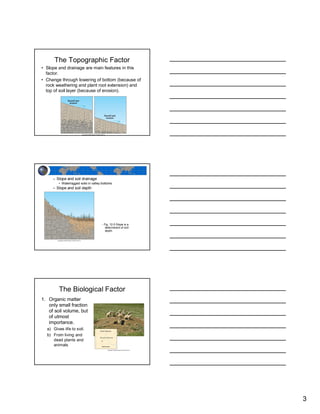
• Soil—zone of plant growth.
    – The upper portion of
      lithosphere characterized by
      its ability to produce and store
      plant nutrients.
         • Average depth is about 15
           centimeters (6 inches).
    – An infinitely varying mixture of
      weathered mineral particles,
      decaying organic matter, living
      organisms, gases, and liquid
      solutions.
    – Stage in a never-ending
      continuum of physical–
      chemical–biotic activities.
• Regolith—a layer of broken
  and partly decomposed rock
  particles that covers bedrock;
  its upper part is soil.


                                                                       1
Soil-Forming Factors
 •     Five factors are involved in forming soil:
      1.     Geology
      2.     Climate
      3.     Topography
      4.     Biology
      5.     Time


                  The Geologic Factor
• Parent material—the source of the
  weathered fragments of rock from
  which soil is made; solid bedrock or
  loose sediments that have been
  transported from elsewhere by the
  action of water, wind, or ice.
     – Influences chemical composition of soil
       and plays role in soil development.
           • This influence diminishes with time, as
             other factors become increasingly
             important.


                     The Climatic Factor

 • In long run, climate is generally the most
   influential factor.
      – Temperature and moisture are most
        significant.
             • High temperatures and abundant moistures
               accelerate chemical and biological processes in
               soil.


                                                                 2
The Topographic Factor
• Slope and drainage are main features in this
  factor.
• Change through lowering of bottom (because of
  rock weathering and plant root extension) and
  top of soil layer (because of erosion).


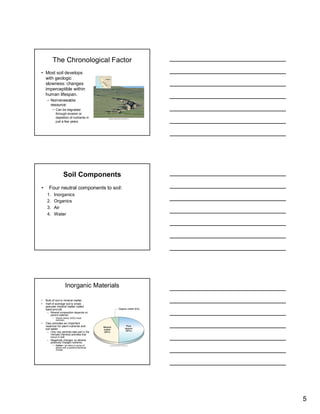
     – Slope and soil drainage
        • Waterlogged soils in valley bottoms
     – Slope and soil depth


                                      - Fig. 12-5 Slope is a
                                         determinant of soil
                                         depth.


         The Biological Factor
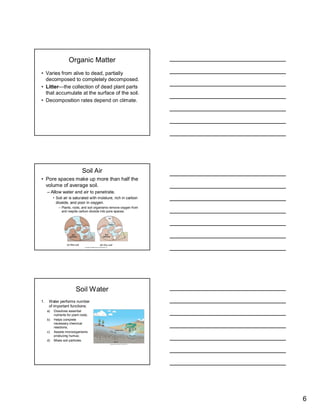
1. Organic matter
   only small fraction
   of soil volume, but
   of utmost
   importance.
  a) Gives life to soil.
  b) From living and
     dead plants and
     animals


                                                               3
The Biological Factor
  2. Vegetation provides passageways for drainage and
     aeration.
  3. Pedoturbation—mixing of soil provided by animals,
     which counteracts tendency of other soil-forming
     processes to accentuate the vertical differences among
     soil layers.
  4. Microorganisms generate estimated 75% of soil’s
     metabolic activity.
       a) Create humus—decomposed organic matter of utmost
          important to agriculture.
       b) Loosens soil structure, lessens density, and promotes root
          development.
           •   Provides reservoirs for plant nutrients and soil water.


                The Biological Factor
5. Earthworms
   –   Of large variety of animal life in soil, earthworm is
       most important to soil formation and development.
        a) Tunnels facilitate drainage and aeration, deepening
           of soil profile.
        b) Movement creates a crumbly soil structure, which is
           favorable for plant growth.
        c) Movement brings in leaf litter, which fertilizes
           subsoil.
        d) Digestive actions and tunnels increase porosity and
           help soil impact of raindrops, which helps deter
           erosion.
        e) Casts, which are the inorganic material worms
           excrete, increase nutrients of soil through their
           physical and chemical nature.
        f) Movement also brings deeper material to surface,
           where it can be weathered more rapidly.
        g) Movement, digestive action, and decomposition of
           own bodies help promote nitrification.


                The Biological Factor
  6. Microorganisms in the Soil
       – An estimated three quarters of a soil’s
         metabolic activity is generated by
         microorganisms.
       – Microbes decompose organic material into
         humus (a dark adhesive of minute
         particles).
       – This makes nutrients usable by plants.


                                                                         4
The Chronological Factor
• Most soil develops
  with geologic
  slowness: changes
  imperceptible within
  human lifespan.
     – Nonrenewable
       resource:
          • Can be degraded
            through erosion or
            depletion of nutrients in
            just a few years.


                    Soil Components
•     Four neutral components to soil:
     1.    Inorganics
     2.    Organics
     3.    Air
     4.    Water


                      Inorganic Materials

•   Bulk of soil is mineral matter.
•   Half of average soil is small,
    granular mineral matter called
    sand and silt.
     – Mineral composition depends on
       parent material.
          • Quartz (silica, SiO2) most
            common.
•   Clay provides an important
    reservoir for plant nutrients and
    soil water.
     – Only clay particles take part in the
       intricate chemical activities that
       occur in soil.
     – Negatively charged, so attracts
       positively charged nutrients.
          • Cation—an atom or group of
            atoms with a positive electrical
            charge.


                                               5
Organic Matter
• Varies from alive to dead, partially
  decomposed to completely decomposed.
• Litter—the collection of dead plant parts
  that accumulate at the surface of the soil.
• Decomposition rates depend on climate.


                               Soil Air
• Pore spaces make up more than half the
  volume of average soil.
     – Allow water and air to penetrate.
          • Soil air is saturated with moisture, rich in carbon
            dioxide, and poor in oxygen.
             – Plants, roots, and soil organisms remove oxygen from
               and respite carbon dioxide into pore spaces.


                          Soil Water
1.    Water performs number
      of important functions:
     a)   Dissolves essential
          nutrients for plant roots;
     b)   Helps complete
          necessary chemical
          reactions;
     c)   Assists microorganisms
          producing humus;
     d)   Mixes soil particles.


                                                                      6
– Four forms of soil moisture             • Gravitational Water
                                                           (Free Water)
                                                         • Capillary Water
                                                           (Water of Cohesion)
                                                         • Hygroscopic Water
                                                           (Water of Adhesion)
                                                         • Combined


                                                             - Fig. 12-12


                                      Soil Water
    2. Leaching—the process in which gravitational
       water dissolves soluble materials and carries
       them downward in solution to be redeposited at
       lower levels.
    3. Eluviation—the process by which gravitational
       water picks up fine particles of soil from the
       upper layers and carries them downward.
    4. Illuviation—the process by which fine particles
       of soil from the upper layers are deposited at a
       lower level.


                                      Soil Water
5. Soil–Water Budget—the relationship
   between gain, loss, and storage of soil
   water (percolation of rainfall or
   snowmelt vs. evapotranspiration).
    a) Field capacity—the maximum amount
       of water that can be retained in the soil
       after the gravitational water has drained
       away.
         •   Most of the pore spaces are filled with
             water.
    b) Wilting point—the point at which plants
       are no longer able to extract moisture
       from the soil because the capillary water
       is all used up or evaporated.
    c) Soil–water budget—an accounting that
       demonstrates the variation of the soil–
       water balance over a period of time.
    d) Four forms of soil moisture: gravitational
       water, capillary water, hygroscopic
       water, combined water.
         •   Gravitational water is mostly superfluous
             to plant development, while capillary
             water is the most important.


                                                                                 7
Soil Properties
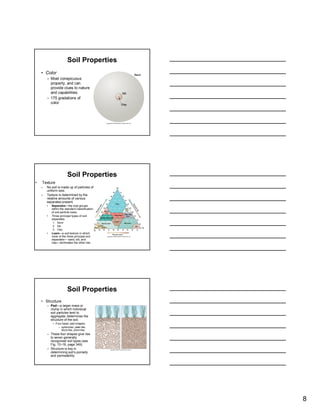
    • Color
        – Most conspicuous
          property, and can
          provide clues to nature
          and capabilities.
        – 175 gradations of
          color.


                        Soil Properties
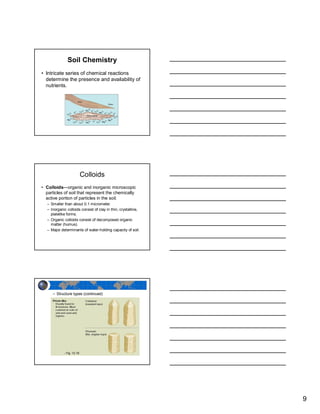
•   Texture
    –   No soil is made up of particles of
        uniform size.
    –   Texture is determined by the
        relative amounts of various
        separates present.
        •   Separates—the size groups
            within the standard classification
            of soil particle sizes.
        •   Three principal types of soil
            separates:
            1. Sand
            2. Silt
            3. Clay
        •   Loam—a soil texture in which
            none of the three principal soil
            separates— sand, silt, and
            clay—dominates the other two.


                        Soil Properties
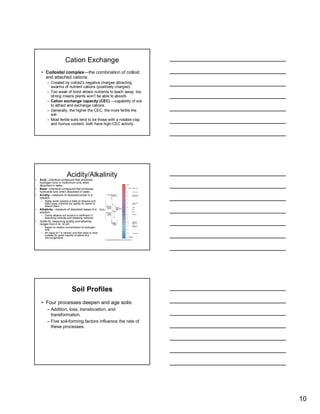
    • Structure
        – Ped—a larger mass or
          clump in which individual
          soil particles tend to
          aggregate; determines the
          structure of the soil.
            • Four basic ped shapes:
                 – spheroidal, plate-like,
                   block-like, prism-like.
        – These four shapes give rise
          to seven generally
          recognized soil types (see
          Fig. 12–16, page 349).
        – Structure is key in
          determining soil’s porosity
          and permeability.


                                                 8
Soil Chemistry
• Intricate series of chemical reactions
  determine the presence and availability of
  nutrients.


                           Colloids
• Colloids—organic and inorganic microscopic
  particles of soil that represent the chemically
  active portion of particles in the soil.
  – Smaller than about 0.1 micrometer.
  – Inorganic colloids consist of clay in thin, crystalline,
    platelike forms.
  – Organic colloids consist of decomposed organic
    matter (humus).
  – Major determinants of water-holding capacity of soil.


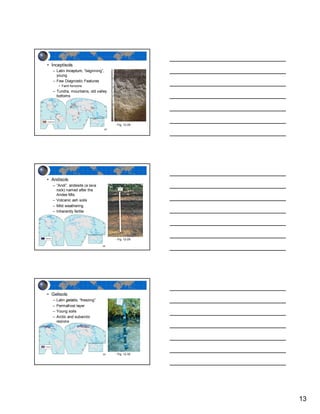
     – Structure types (continued)


            - Fig. 12-18


                                                               9
Cation Exchange
     • Colloidal complex—the combination of colloid
       and attached cations.
          – Created by colloid’s negative charges attracting
            swarms of nutrient cations (positively charged).
          – Too weak of bond allows nutrients to leach away; too
            strong means plants won’t be able to absorb.
          – Cation exchange capacity (CEC) —capability of soil
            to attract and exchange cations.
          – Generally, the higher the CEC, the more fertile the
            soil.
          – Most fertile soils tend to be those with a notable clay
            and humus content; both have high-CEC activity.


                            Acidity/Alkalinity
•   Acid—chemical compound that produces
    hydrogen ions or hydronium ions when
    dissolved in water.
•   Base—chemical compound that produces
    hydroxide ions when dissolved in water.
•   Acidity—measure of dissolved acids in a
    solution.
     – Highly acidic solution is likely to dissolve and
       leach away nutrients too rapidly for plants to
       absorb them.
•   Alkalinity—measure of dissolved bases in a
    solution.
     – Overly alkaline soil solution is inefficient in
       dissolving minerals and releasing nutrients.
•   Scale for measuring acidity and alkalinity
    ranges from 0 to 14 pH.
     – Based on relative concentration of hydrogen
       ions.
     – pH value of 7 is neutral, and that value is most
       suitable for great majority of plants and
       microorganisms.


                                 Soil Profiles
     • Four processes deepen and age soils:
          – Addition, loss, translocation, and
            transformation.
          – Five soil-forming factors influence the rate of
            these processes.


                                                                      10
Soil Profiles
•   Horizon—a more or less distinctly
    recognizable layer of soil, distinguished from
    another by differing characteristics and forming
    a vertical zonation of the soil.
    – Six different horizons: O, A, E, B, C, R.
       1. O (organic litter; not typical for soils to have)
       2. A (topsoil; mineral and organic)
       3. E (eluvial layer; concentration of sand and silt particles)
       4. B (subsoil; mineral layer that contains materials removed
          from E level)
       5. C (unconsolidated regolith; no organic matter)
       6. R (bedrock)


    • Soil Horizons
       – O horizon
            • Organic matter
       – A horizon
            • Top soil/dark color
       – E horizon
            • Eluviation layer
       – B horizon
            • Illuviation layer
       – C horizon
            • Beyond reach of roots
       – R horizon                  - Fig. 12-22
            • bedrock


                      Soil Profiles
• Soil profile—a vertical cross section from
  Earth’s surface down through the soil layers into
  the parent material beneath.
• Solum—the true soil that includes only the top
  four horizons.
• Water plays critical role in development of
  profile.
• Time also important.
    – Formation of B horizon normally indicates mature soil.


                                                                        11
-Fig. 12-25: Map of Major Soil Orders


 Global Distribution of Major Soils


      – Figure 12-28. The general relationship among the soil
        orders in terms of weathering, soil development, and
        broad environmental conditions.


 Global Distribution of Major Soils
• Entisols
  – “Ent”, from recent
    formation
  – Very little profile
    development
     • Thin and sandy
     • Low fertility


                                                - Fig. 12-27


                                                                12
• Inceptisols
  – Latin Inceptum, “beginning”,
    young
  – Few Diagnostic Features
       • Faint horizons
  – Tundra, mountains, old valley
    bottoms


                                    - Fig. 12-28


• Andisols
  – “Andi”, andesite (a lava
    rock) named after the
    Andes Mts.
  – Volcanic ash soils
  – Mild weathering
  – Inherently fertile


                                    - Fig. 12-29


• Gelisols
  –   Latin gelatio, “freezing”
  –   Permafrost layer
  –   Young soils
  –   Arctic and subarctic
      regions
       • Cryoturbation


                                    - Fig. 12-30


                                                   13
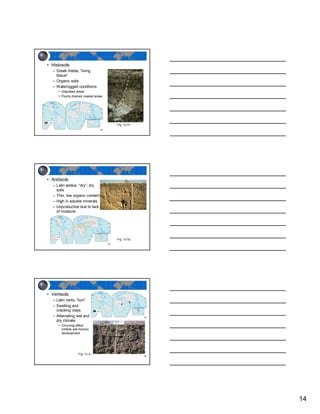
• Histosols
  – Greek histos, “living
    tissue”
  – Organic soils
  – Waterlogged conditions
     • Glaciated areas
     • Poorly drained coastal areas


                                      - Fig. 12-31


• Aridisols
  – Latin aridus, “dry”; dry
    soils
  – Thin, low organic content
  – High in soluble minerals
  – Unproductive due to lack
    of moisture


                                      - Fig. 12-32


• Vertisols
  – Latin verto, “turn”
  – Swelling and
    cracking clays
  – Alternating wet and
    dry climate
     • Churning effect
       inhibits soil-horizon
       development


                  - Fig. 12-33


                                                     14
• Mollisols
   – Latin mollis, “soft”; soft
     soils
   – Best agricultural soil
      • Rich clay-humus content
   – Central Eurasia, Pampas
     of Argentina, North
     American Great Plains


                                        - Fig. 12-34


• Alfisols
   – “al” for aluminum, “f” for iron
   – Moderate leaching
      • Subsurface clay accumulation
        with high nutrient bases
   – Second to Mollisols in fertility


                                         - Fig. 12-35


• Ultisols
   – Latin ultimus, “last”; last of
     their nutrient bases leached
     out
      • Low fertility due to leaching
      • Reddish color throughout
   – Possible fate of Alfisols


                                        - Fig. 12-36


                                                        15
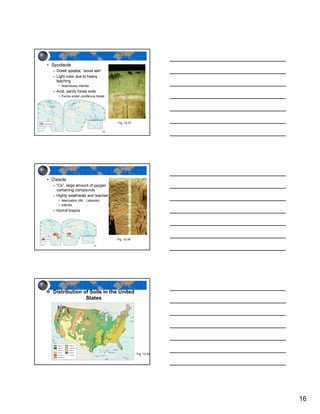
• Spodisols
  – Greek spodos, “wood ash”
  – Light color due to heavy
    leaching
     • Notoriously infertile
  – Acid, sandy forest soils
     • Forms under coniferous forest


                                        - Fig. 12-37


• Oxisols
  – “Ox”, large amount of oxygen
    containing compounds
  – Highly weathered and leached
     • laterization (Alt. : Latosols)
     • Infertile
  – Humid tropics


                                        - Fig. 12-38


 Distribution of Soils in the United
                States


                                                       - Fig. 12-39


                                                                      16

Ch 12

  • 1.
    Title Page Photo “A nation that destroys it's soils destroys itself.” —Franklin D. Roosevelt (Brainyquote.com) Vocabulary Chapter 12 A horizon (p. 367) loam (p. 364) B horizon (p. 367) O horizon (p. 367) calcification (p. 371) parent material (p. 355) cations (p. 359) peds (p. 364) C horizon (p. 367) regolith (p. 354) colloid (p. 366) R horizon (p. 367) E horizon (p. 367) salinization (p. 371) eluviation (p. 362) soil (p. 353) gleization (p. 370) soil order (p. 373) horizon (soil horizon) (p. 367) soil profile (p. 367) humus (p. 357) Soil Taxonomy (p. 372) illuviation (p. 362) soil-water balance (p. 362) laterization (p. 368) wilting point (p. 362) leaching (p. 362) Soil and Regolith • Soil—zone of plant growth. – The upper portion of lithosphere characterized by its ability to produce and store plant nutrients. • Average depth is about 15 centimeters (6 inches). – An infinitely varying mixture of weathered mineral particles, decaying organic matter, living organisms, gases, and liquid solutions. – Stage in a never-ending continuum of physical– chemical–biotic activities. • Regolith—a layer of broken and partly decomposed rock particles that covers bedrock; its upper part is soil. 1
  • 2.
    Soil-Forming Factors • Five factors are involved in forming soil: 1. Geology 2. Climate 3. Topography 4. Biology 5. Time The Geologic Factor • Parent material—the source of the weathered fragments of rock from which soil is made; solid bedrock or loose sediments that have been transported from elsewhere by the action of water, wind, or ice. – Influences chemical composition of soil and plays role in soil development. • This influence diminishes with time, as other factors become increasingly important. The Climatic Factor • In long run, climate is generally the most influential factor. – Temperature and moisture are most significant. • High temperatures and abundant moistures accelerate chemical and biological processes in soil. 2
  • 3.
    The Topographic Factor •Slope and drainage are main features in this factor. • Change through lowering of bottom (because of rock weathering and plant root extension) and top of soil layer (because of erosion). – Slope and soil drainage • Waterlogged soils in valley bottoms – Slope and soil depth - Fig. 12-5 Slope is a determinant of soil depth. The Biological Factor 1. Organic matter only small fraction of soil volume, but of utmost importance. a) Gives life to soil. b) From living and dead plants and animals 3
  • 4.
    The Biological Factor 2. Vegetation provides passageways for drainage and aeration. 3. Pedoturbation—mixing of soil provided by animals, which counteracts tendency of other soil-forming processes to accentuate the vertical differences among soil layers. 4. Microorganisms generate estimated 75% of soil’s metabolic activity. a) Create humus—decomposed organic matter of utmost important to agriculture. b) Loosens soil structure, lessens density, and promotes root development. • Provides reservoirs for plant nutrients and soil water. The Biological Factor 5. Earthworms – Of large variety of animal life in soil, earthworm is most important to soil formation and development. a) Tunnels facilitate drainage and aeration, deepening of soil profile. b) Movement creates a crumbly soil structure, which is favorable for plant growth. c) Movement brings in leaf litter, which fertilizes subsoil. d) Digestive actions and tunnels increase porosity and help soil impact of raindrops, which helps deter erosion. e) Casts, which are the inorganic material worms excrete, increase nutrients of soil through their physical and chemical nature. f) Movement also brings deeper material to surface, where it can be weathered more rapidly. g) Movement, digestive action, and decomposition of own bodies help promote nitrification. The Biological Factor 6. Microorganisms in the Soil – An estimated three quarters of a soil’s metabolic activity is generated by microorganisms. – Microbes decompose organic material into humus (a dark adhesive of minute particles). – This makes nutrients usable by plants. 4
  • 5.
    The Chronological Factor •Most soil develops with geologic slowness: changes imperceptible within human lifespan. – Nonrenewable resource: • Can be degraded through erosion or depletion of nutrients in just a few years. Soil Components • Four neutral components to soil: 1. Inorganics 2. Organics 3. Air 4. Water Inorganic Materials • Bulk of soil is mineral matter. • Half of average soil is small, granular mineral matter called sand and silt. – Mineral composition depends on parent material. • Quartz (silica, SiO2) most common. • Clay provides an important reservoir for plant nutrients and soil water. – Only clay particles take part in the intricate chemical activities that occur in soil. – Negatively charged, so attracts positively charged nutrients. • Cation—an atom or group of atoms with a positive electrical charge. 5
  • 6.
    Organic Matter • Variesfrom alive to dead, partially decomposed to completely decomposed. • Litter—the collection of dead plant parts that accumulate at the surface of the soil. • Decomposition rates depend on climate. Soil Air • Pore spaces make up more than half the volume of average soil. – Allow water and air to penetrate. • Soil air is saturated with moisture, rich in carbon dioxide, and poor in oxygen. – Plants, roots, and soil organisms remove oxygen from and respite carbon dioxide into pore spaces. Soil Water 1. Water performs number of important functions: a) Dissolves essential nutrients for plant roots; b) Helps complete necessary chemical reactions; c) Assists microorganisms producing humus; d) Mixes soil particles. 6
  • 7.
    – Four formsof soil moisture • Gravitational Water (Free Water) • Capillary Water (Water of Cohesion) • Hygroscopic Water (Water of Adhesion) • Combined - Fig. 12-12 Soil Water 2. Leaching—the process in which gravitational water dissolves soluble materials and carries them downward in solution to be redeposited at lower levels. 3. Eluviation—the process by which gravitational water picks up fine particles of soil from the upper layers and carries them downward. 4. Illuviation—the process by which fine particles of soil from the upper layers are deposited at a lower level. Soil Water 5. Soil–Water Budget—the relationship between gain, loss, and storage of soil water (percolation of rainfall or snowmelt vs. evapotranspiration). a) Field capacity—the maximum amount of water that can be retained in the soil after the gravitational water has drained away. • Most of the pore spaces are filled with water. b) Wilting point—the point at which plants are no longer able to extract moisture from the soil because the capillary water is all used up or evaporated. c) Soil–water budget—an accounting that demonstrates the variation of the soil– water balance over a period of time. d) Four forms of soil moisture: gravitational water, capillary water, hygroscopic water, combined water. • Gravitational water is mostly superfluous to plant development, while capillary water is the most important. 7
  • 8.
    Soil Properties • Color – Most conspicuous property, and can provide clues to nature and capabilities. – 175 gradations of color. Soil Properties • Texture – No soil is made up of particles of uniform size. – Texture is determined by the relative amounts of various separates present. • Separates—the size groups within the standard classification of soil particle sizes. • Three principal types of soil separates: 1. Sand 2. Silt 3. Clay • Loam—a soil texture in which none of the three principal soil separates— sand, silt, and clay—dominates the other two. Soil Properties • Structure – Ped—a larger mass or clump in which individual soil particles tend to aggregate; determines the structure of the soil. • Four basic ped shapes: – spheroidal, plate-like, block-like, prism-like. – These four shapes give rise to seven generally recognized soil types (see Fig. 12–16, page 349). – Structure is key in determining soil’s porosity and permeability. 8
  • 9.
    Soil Chemistry • Intricateseries of chemical reactions determine the presence and availability of nutrients. Colloids • Colloids—organic and inorganic microscopic particles of soil that represent the chemically active portion of particles in the soil. – Smaller than about 0.1 micrometer. – Inorganic colloids consist of clay in thin, crystalline, platelike forms. – Organic colloids consist of decomposed organic matter (humus). – Major determinants of water-holding capacity of soil. – Structure types (continued) - Fig. 12-18 9
  • 10.
    Cation Exchange • Colloidal complex—the combination of colloid and attached cations. – Created by colloid’s negative charges attracting swarms of nutrient cations (positively charged). – Too weak of bond allows nutrients to leach away; too strong means plants won’t be able to absorb. – Cation exchange capacity (CEC) —capability of soil to attract and exchange cations. – Generally, the higher the CEC, the more fertile the soil. – Most fertile soils tend to be those with a notable clay and humus content; both have high-CEC activity. Acidity/Alkalinity • Acid—chemical compound that produces hydrogen ions or hydronium ions when dissolved in water. • Base—chemical compound that produces hydroxide ions when dissolved in water. • Acidity—measure of dissolved acids in a solution. – Highly acidic solution is likely to dissolve and leach away nutrients too rapidly for plants to absorb them. • Alkalinity—measure of dissolved bases in a solution. – Overly alkaline soil solution is inefficient in dissolving minerals and releasing nutrients. • Scale for measuring acidity and alkalinity ranges from 0 to 14 pH. – Based on relative concentration of hydrogen ions. – pH value of 7 is neutral, and that value is most suitable for great majority of plants and microorganisms. Soil Profiles • Four processes deepen and age soils: – Addition, loss, translocation, and transformation. – Five soil-forming factors influence the rate of these processes. 10
  • 11.
    Soil Profiles • Horizon—a more or less distinctly recognizable layer of soil, distinguished from another by differing characteristics and forming a vertical zonation of the soil. – Six different horizons: O, A, E, B, C, R. 1. O (organic litter; not typical for soils to have) 2. A (topsoil; mineral and organic) 3. E (eluvial layer; concentration of sand and silt particles) 4. B (subsoil; mineral layer that contains materials removed from E level) 5. C (unconsolidated regolith; no organic matter) 6. R (bedrock) • Soil Horizons – O horizon • Organic matter – A horizon • Top soil/dark color – E horizon • Eluviation layer – B horizon • Illuviation layer – C horizon • Beyond reach of roots – R horizon - Fig. 12-22 • bedrock Soil Profiles • Soil profile—a vertical cross section from Earth’s surface down through the soil layers into the parent material beneath. • Solum—the true soil that includes only the top four horizons. • Water plays critical role in development of profile. • Time also important. – Formation of B horizon normally indicates mature soil. 11
  • 12.
    -Fig. 12-25: Mapof Major Soil Orders  Global Distribution of Major Soils – Figure 12-28. The general relationship among the soil orders in terms of weathering, soil development, and broad environmental conditions.  Global Distribution of Major Soils • Entisols – “Ent”, from recent formation – Very little profile development • Thin and sandy • Low fertility - Fig. 12-27 12
  • 13.
    • Inceptisols – Latin Inceptum, “beginning”, young – Few Diagnostic Features • Faint horizons – Tundra, mountains, old valley bottoms - Fig. 12-28 • Andisols – “Andi”, andesite (a lava rock) named after the Andes Mts. – Volcanic ash soils – Mild weathering – Inherently fertile - Fig. 12-29 • Gelisols – Latin gelatio, “freezing” – Permafrost layer – Young soils – Arctic and subarctic regions • Cryoturbation - Fig. 12-30 13
  • 14.
    • Histosols – Greek histos, “living tissue” – Organic soils – Waterlogged conditions • Glaciated areas • Poorly drained coastal areas - Fig. 12-31 • Aridisols – Latin aridus, “dry”; dry soils – Thin, low organic content – High in soluble minerals – Unproductive due to lack of moisture - Fig. 12-32 • Vertisols – Latin verto, “turn” – Swelling and cracking clays – Alternating wet and dry climate • Churning effect inhibits soil-horizon development - Fig. 12-33 14
  • 15.
    • Mollisols – Latin mollis, “soft”; soft soils – Best agricultural soil • Rich clay-humus content – Central Eurasia, Pampas of Argentina, North American Great Plains - Fig. 12-34 • Alfisols – “al” for aluminum, “f” for iron – Moderate leaching • Subsurface clay accumulation with high nutrient bases – Second to Mollisols in fertility - Fig. 12-35 • Ultisols – Latin ultimus, “last”; last of their nutrient bases leached out • Low fertility due to leaching • Reddish color throughout – Possible fate of Alfisols - Fig. 12-36 15
  • 16.
    • Spodisols – Greek spodos, “wood ash” – Light color due to heavy leaching • Notoriously infertile – Acid, sandy forest soils • Forms under coniferous forest - Fig. 12-37 • Oxisols – “Ox”, large amount of oxygen containing compounds – Highly weathered and leached • laterization (Alt. : Latosols) • Infertile – Humid tropics - Fig. 12-38  Distribution of Soils in the United States - Fig. 12-39 16