
muralishingri@gmail.com
ECOLOGY:
Branch of Science which deals with relationship between
organisms & their physical & biological environment.
Ecology is a subject which studies the interactions among organisms
and between the organism and its physical (abiotic) environment.
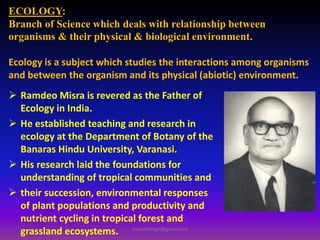
 Ramdeo Misra is revered as the Father of
Ecology in India.
 He established teaching and research in
ecology at the Department of Botany of the
Banaras Hindu University, Varanasi.
 His research laid the foundations for
understanding of tropical communities and
 their succession, environmental responses
of plant populations and productivity and
nutrient cycling in tropical forest and
grassland ecosystems. muralishingri@gmail.com
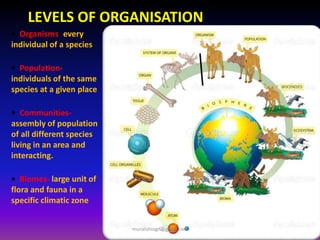
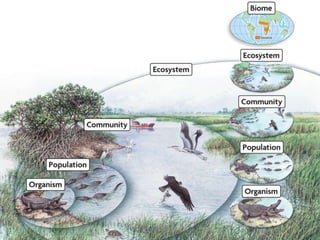
LEVELS OF ORGANISATION
• Organisms- every
individual of a species
• Population-
individuals of the same
species at a given place
• Communities-
assembly of population
of all different species
living in an area and
interacting.
• Biomes- large unit of
flora and fauna in a
specific climatic zone
muralishingri@gmail.com
ORGANISM AND ITS ENVIRONMENT
• Rotation of sun and the tilt of its axis cause annual
variations in the intensity and duration of temperature,
resulting distinct seasons.
• These variations along with annual variations in
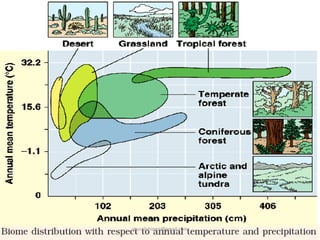
precipitation, forms major biomes, such as desert, rain
forest, and tundra.
• Temperature, water, light and soil are the key elements
that lead to so much variation in the physical and
chemical conditions of habitats.
• Both abiotic (physic-chemical) and biotic components
(pathogen, parasites, predators, competitions)
characterize the habitat of an organism.
muralishingri@gmail.com
Major abiotic factors
Temperature decreases progressively from equator towards the
pole and high altitudes to > 50o C in tropical deserts in summer.
Thermal springs and deep-sea hydrothermal vents are unique with
>100o C.
Temperature affects the kinetics of enzymes, BMR and other
physiological actions.
Temperature:
muralishingri@gmail.com
Eurythermals:
• organism which can tolerate wide range of
temperatures.
• mango trees do not and cannot grow in
temperate countries like Canada and Germany,
Stenothermal:
• organism which can tolerate narrow range of
temperatures.
• snow leopards are not found in Kerala forests
• tuna fish are rarely caught beyond tropical
muralishingri@gmail.com
Water
• Water is also important factor that influence the life of
organism.
• The productivity and distribution of plants is also
depends on water.
• The salinity varies in aquatic environment:
– 5% in inland waters (fresh water)
– 30-35% in sea water
– More than 100% in hyper saline lagoons.
• Euryhaline: organism which can tolerate wide range of
salinity
• Stenohaline: organism which can tolerate narrow range
of salinity.
(because of the osmotic problems)
muralishingri@gmail.com
Light
• Plant produce food by photosynthesis, which only
possible in presence of light. Hence it very important
for autotrophs.
• Plant species (herbs and shrubs) adapted for
photosynthesize under canopy, because they are
constantly overshadowed.
• Sunlight is required for photoperiodic response like
flowering.
• Animals use diurnal and seasonal variations in light
intensity and photoperiod as cues for timing their
foraging reproductive and migratory activities.
• Among the red, green and brown algae that inhabit
the sea, which is likely to be found in the deepest
waters? Why? muralishingri@gmail.com
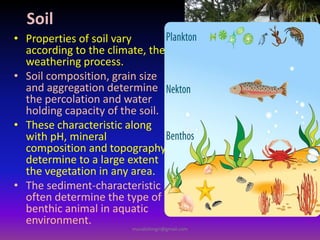
Soil
• Properties of soil vary
according to the climate, the
weathering process.
• Soil composition, grain size
and aggregation determine
the percolation and water
holding capacity of the soil.
• These characteristic along
with pH, mineral
composition and topography
determine to a large extent
the vegetation in any area.
• The sediment-characteristic
often determine the type of
benthic animal in aquatic
environment.
muralishingri@gmail.com
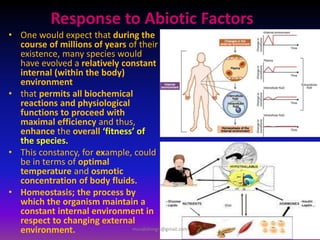
Response to Abiotic Factors
• One would expect that during the
course of millions of years of their
existence, many species would
have evolved a relatively constant
internal (within the body)
environment
• that permits all biochemical
reactions and physiological
functions to proceed with
maximal efficiency and thus,
enhance the overall ‘fitness’ of
the species.
• This constancy, for example, could
be in terms of optimal
temperature and osmotic
concentration of body fluids.
• Homeostasis; the process by
which the organism maintain a
constant internal environment in
respect to changing external
environment. muralishingri@gmail.com
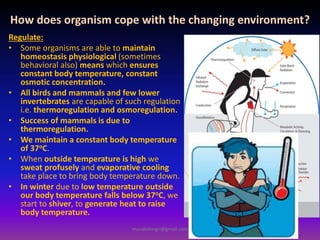
How does organism cope with the changing environment?
Regulate:
• Some organisms are able to maintain
homeostasis physiological (sometimes
behavioral also) means which ensures
constant body temperature, constant
osmotic concentration.
• All birds and mammals and few lower
invertebrates are capable of such regulation
i.e. thermoregulation and osmoregulation.
• Success of mammals is due to
thermoregulation.
• We maintain a constant body temperature
of 37oC.
• When outside temperature is high we
sweat profusely and evaporative cooling
take place to bring body temperature down.
• In winter due to low temperature outside
our body temperature falls below 37oC, we
start to shiver, to generate heat to raise
body temperature.
muralishingri@gmail.com
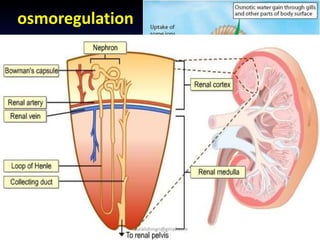
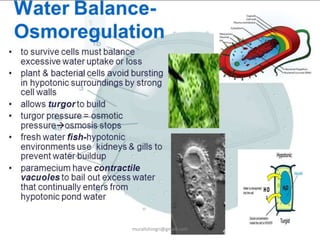
osmoregulation
muralishingri@gmail.com
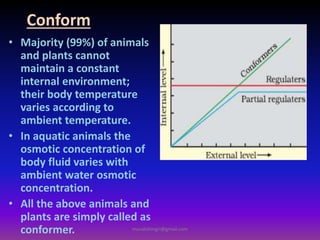
Conform
• Majority (99%) of animals
and plants cannot
maintain a constant
internal environment;
their body temperature
varies according to
ambient temperature.
• In aquatic animals the
osmotic concentration of
body fluid varies with
ambient water osmotic
concentration.
• All the above animals and
plants are simply called as
conformer. muralishingri@gmail.com
Why the conformer not evolved to became regulators?
• Thermoregulation is energetically
expensive for many animals.
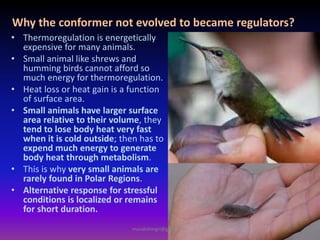
• Small animal like shrews and
humming birds cannot afford so
much energy for thermoregulation.
• Heat loss or heat gain is a function
of surface area.
• Small animals have larger surface
area relative to their volume, they
tend to lose body heat very fast
when it is cold outside; then has to
expend much energy to generate
body heat through metabolism.
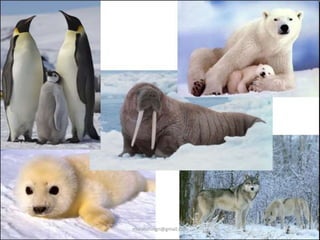
• This is why very small animals are
rarely found in Polar Regions.
• Alternative response for stressful
conditions is localized or remains
for short duration.
muralishingri@gmail.com
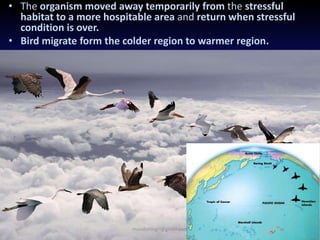
Migrate• The organism moved away temporarily from the stressful
habitat to a more hospitable area and return when stressful
condition is over.
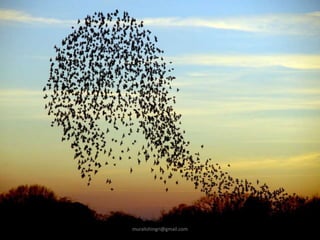
• Bird migrate form the colder region to warmer region.
muralishingri@gmail.com
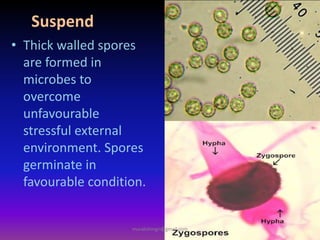
Suspend
• Thick walled spores
are formed in
microbes to
overcome
unfavourable
stressful external
environment. Spores
germinate in
favourable condition.
muralishingri@gmail.com
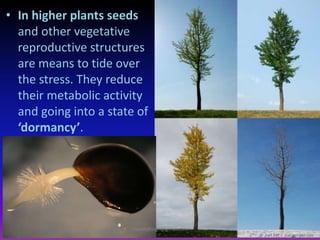
• In higher plants seeds
and other vegetative
reproductive structures
are means to tide over
the stress. They reduce
their metabolic activity
and going into a state of
‘dormancy’.
muralishingri@gmail.com
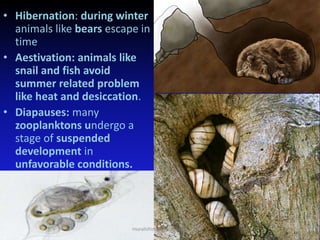
• Hibernation: during winter
animals like bears escape in
time
• Aestivation: animals like
snail and fish avoid
summer related problem
like heat and desiccation.
• Diapauses: many
zooplanktons undergo a
stage of suspended
development in
unfavorable conditions.
muralishingri@gmail.com
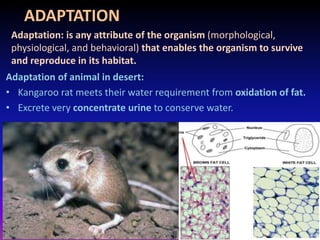
ADAPTATION
Adaptation of animal in desert:
• Kangaroo rat meets their water requirement from oxidation of fat.
• Excrete very concentrate urine to conserve water.
Adaptation: is any attribute of the organism (morphological,
physiological, and behavioral) that enables the organism to survive
and reproduce in its habitat.
muralishingri@gmail.com
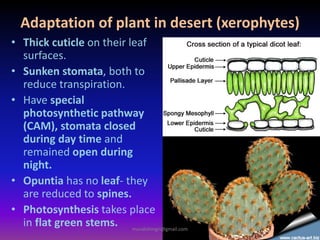
Adaptation of plant in desert (xerophytes)
• Thick cuticle on their leaf
surfaces.
• Sunken stomata, both to
reduce transpiration.
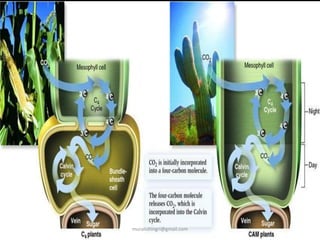
• Have special
photosynthetic pathway
(CAM), stomata closed
during day time and
remained open during
night.
• Opuntia has no leaf- they
are reduced to spines.
• Photosynthesis takes place
in flat green stems. muralishingri@gmail.com
muralishingri@gmail.com
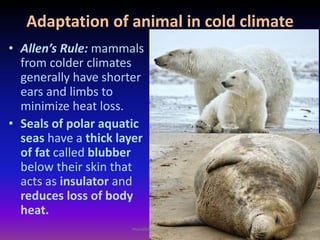
Adaptation of animal in cold climate
• Allen’s Rule: mammals
from colder climates
generally have shorter
ears and limbs to
minimize heat loss.
• Seals of polar aquatic
seas have a thick layer
of fat called blubber
below their skin that
acts as insulator and
reduces loss of body
heat.
muralishingri@gmail.com
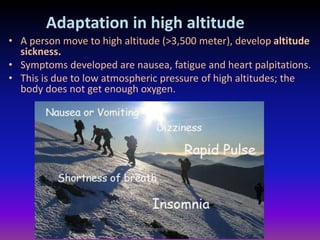
Adaptation in high altitude
• A person move to high altitude (>3,500 meter), develop altitude
sickness.
• Symptoms developed are nausea, fatigue and heart palpitations.
• This is due to low atmospheric pressure of high altitudes; the
body does not get enough oxygen.
muralishingri@gmail.com
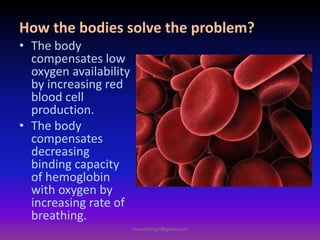
• The body
compensates low
oxygen availability
by increasing red
blood cell
production.
• The body
compensates
decreasing
binding capacity
of hemoglobin
with oxygen by
increasing rate of
breathing.
How the bodies solve the problem?
muralishingri@gmail.com
• Many tribes live in the high altitude of
Himalayas.
• Find out if they normally have a higher red
blood cell count (or total hemoglobin) than
people living in the plains.
• A large variety of marine invertebrates and fish
live at great depths in the ocean where the
pressure could be >100 times the normal
atmospheric pressure that we experience.
• How do they live under such crushing pressures
and do they have any special enzymes?
• Organisms living in such extreme environments
show a fascinating array of biochemical
adaptations
muralishingri@gmail.com
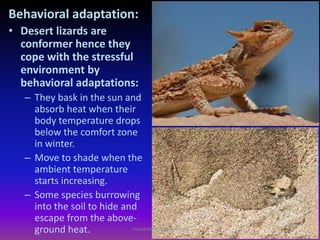
Behavioral adaptation:
• Desert lizards are
conformer hence they
cope with the stressful
environment by
behavioral adaptations:
– They bask in the sun and
absorb heat when their
body temperature drops
below the comfort zone
in winter.
– Move to shade when the
ambient temperature
starts increasing.
– Some species burrowing
into the soil to hide and
escape from the above-
ground heat. muralishingri@gmail.com
POPULATION
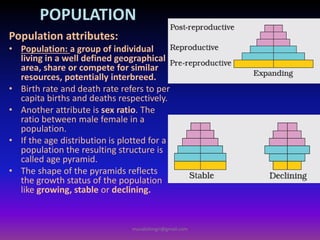
Population attributes:
• Population: a group of individual
living in a well defined geographical
area, share or compete for similar
resources, potentially interbreed.
• Birth rate and death rate refers to per
capita births and deaths respectively.
• Another attribute is sex ratio. The
ratio between male female in a
population.
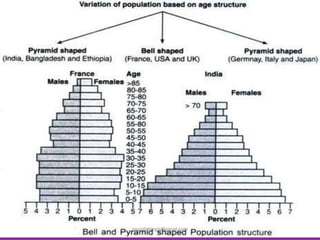
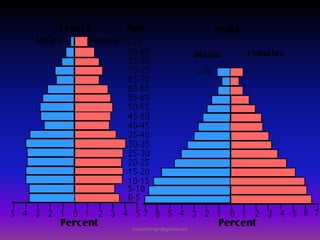
• If the age distribution is plotted for a
population the resulting structure is
called age pyramid.
• The shape of the pyramids reflects
the growth status of the population
like growing, stable or declining.
muralishingri@gmail.com
• If in a pond there are 20 lotus plants last year
and through reproduction 8 new plants are
added, taking the current population to 28,
• we calculate the birth rate as 8/20 = 0.4
offspring per lotus per year.
• If 4 individuals in a laboratory population of
40 fruitflies died during a specified time
interval, say a week,
• the death rate in the population during that
period is 4/40 = 0.1 individuals per fruitfly
per week
The population size is more technically called as
population density.
muralishingri@gmail.com
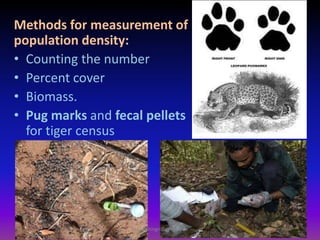
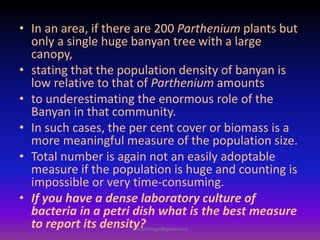
Methods for measurement of
population density:
• Counting the number
• Percent cover
• Biomass.
• Pug marks and fecal pellets
for tiger census
muralishingri@gmail.com
• In an area, if there are 200 Parthenium plants but
only a single huge banyan tree with a large
canopy,
• stating that the population density of banyan is
low relative to that of Parthenium amounts
• to underestimating the enormous role of the
Banyan in that community.
• In such cases, the per cent cover or biomass is a
more meaningful measure of the population size.
• Total number is again not an easily adoptable
measure if the population is huge and counting is
impossible or very time-consuming.
• If you have a dense laboratory culture of
bacteria in a petri dish what is the best measure
to report its density?muralishingri@gmail.com
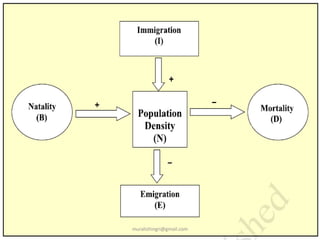
Population growth
• The size of the population changes depending on food
availability, predation pressure and reduce weather.
• Population size fluctuated due to changes in four basic
processes, two of which (Natality and immigration)
contribute an increase in population density and two
(mortality and emigration) to a decrease.
• Natality: number of birth in given period in the population.
• Mortality: number of deaths in the population in a given
period of time.
• Immigration: is the number of individuals of same species
that have come into the habitat from elsewhere during a
given period of time.
• Emigration: number of individuals of the population who left
the habitat and gone elsewhere during a given time period.
muralishingri@gmail.com
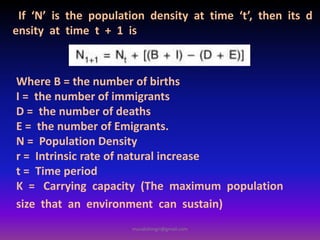
if N is the population density at time t, then its
density at time t +1 is
Nt+1 = Nt + [(B + I) – (D + E)]
population density will increase if the number of
births plus the number of immigrants (B + I) is
more than the number of deaths plus the number
of emigrants (D + E), otherwise it will decrease.
Growth Models:
muralishingri@gmail.com
If ‘N’ is the population density at time ‘t’, then its d
ensity at time t + 1 is
Where B = the number of births
I = the number of immigrants
D = the number of deaths
E = the number of Emigrants.
N = Population Density
r = Intrinsic rate of natural increase
t = Time period
K = Carrying capacity (The maximum population
size that an environment can sustain)
muralishingri@gmail.com
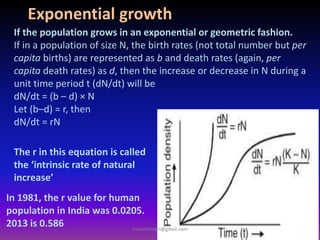
If the population grows in an exponential or geometric fashion.
If in a population of size N, the birth rates (not total number but per
capita births) are represented as b and death rates (again, per
capita death rates) as d, then the increase or decrease in N during a
unit time period t (dN/dt) will be
dN/dt = (b – d) × N
Let (b–d) = r, then
dN/dt = rN
Exponential growth
The r in this equation is called
the ‘intrinsic rate of natural
increase’
In 1981, the r value for human
population in India was 0.0205.
2013 is 0.586 muralishingri@gmail.com
Exponential growth
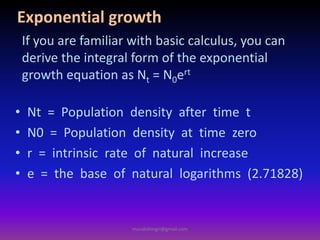
• Nt = Population density after time t
• N0 = Population density at time zero
• r = intrinsic rate of natural increase
• e = the base of natural logarithms (2.71828)
If you are familiar with basic calculus, you can
derive the integral form of the exponential
growth equation as Nt = N0ert
muralishingri@gmail.com
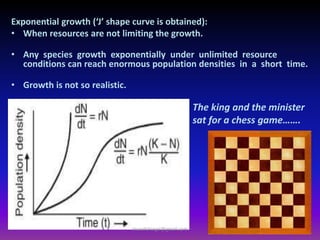
Exponential growth (‘J’ shape curve is obtained):
• When resources are not limiting the growth.
• Any species growth exponentially under unlimited resource
conditions can reach enormous population densities in a short time.
• Growth is not so realistic.
The king and the minister
sat for a chess game…….
muralishingri@gmail.com
Logistic Growth
• Sigmoid curve is obtained
• When responses are limiting the Growth.
• Resources for growth for most animal pop
ulations are finite and become limiting.
• The logistic growth model is a more realistic
one.
muralishingri@gmail.com
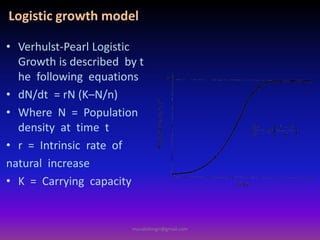
• Verhulst-Pearl Logistic
Growth is described by t
he following equations
• dN/dt = rN (K–N/n)
• Where N = Population
density at time t
• r = Intrinsic rate of
natural increase
• K = Carrying capacity
Logistic growth model
muralishingri@gmail.com
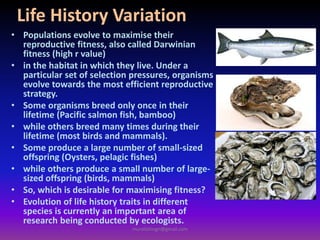
Life History Variation
• Populations evolve to maximise their
reproductive fitness, also called Darwinian
fitness (high r value)
• in the habitat in which they live. Under a
particular set of selection pressures, organisms
evolve towards the most efficient reproductive
strategy.
• Some organisms breed only once in their
lifetime (Pacific salmon fish, bamboo)
• while others breed many times during their
lifetime (most birds and mammals).
• Some produce a large number of small-sized
offspring (Oysters, pelagic fishes)
• while others produce a small number of large-
sized offspring (birds, mammals)
• So, which is desirable for maximising fitness?
• Evolution of life history traits in different
species is currently an important area of
research being conducted by ecologists.
muralishingri@gmail.com
There is no such habitat and such a situation is even
inconceivable. For any species, the minimal
requirement is one more species on which it can feed
• Even a plant species, which makes its own food,
cannot survive alone;
• It needs soil microbes to break down the organic
matter in soil and return the inorganic nutrients
for absorption.
• And then, how will the plant manage pollination
without an animal agent?
muralishingri@gmail.com
• Minimum requirement of species- one more species
to feed on.
• Interspecific interactions - Interactions of
populations of two different species.
muralishingri@gmail.com
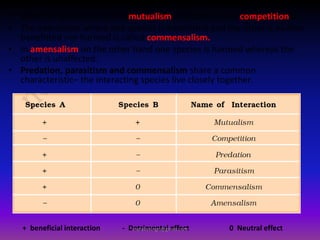
• Both the species benefit in mutualism and both lose in competition in.
• The interaction where one species is benefitted and the other is neither
benefitted nor harmed is called commensalism.
• In amensalism on the other hand one species is harmed whereas the
other is unaffected.
• Predation, parasitism and commensalism share a common
characteristic– the interacting species live closely together.
+ beneficial interaction - Detrimental effect 0 Neutral effectmuralishingri@gmail.com
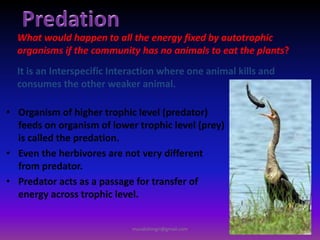
• Organism of higher trophic level (predator)
feeds on organism of lower trophic level (prey)
is called the predation.
• Even the herbivores are not very different
from predator.
• Predator acts as a passage for transfer of
energy across trophic level.
What would happen to all the energy fixed by autotrophic
organisms if the community has no animals to eat the plants?
It is an Interspecific Interaction where one animal kills and
consumes the other weaker animal.
muralishingri@gmail.com
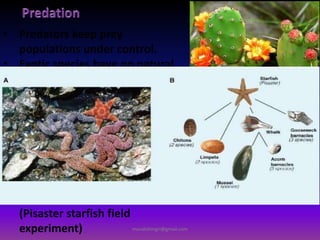
• Predators keep prey
populations under control.
• Exotic species have no natural
predator hence they grow very
rapidly. (prickly pear cactus
introduced in Australia created
problem)
• Predators also help in
maintaining species diversity in
a community, by reducing the
intensity of competition among
competing prey species.
(Pisaster starfish field
experiment) muralishingri@gmail.com
Defense developed by prey against predators
Animals:
• Insects and frogs are
cryptically coloured
(camouflaged) to avoid being
detected by the predator.
• Some are poisonous and
therefore avoided by the
predators.
• Monarch butterfly is highly
distasteful to its predator
(bird) due to presence of
special chemical it its body.
The chemical acquired by
feeding a poisonous weed
during caterpillar stage.
muralishingri@gmail.com
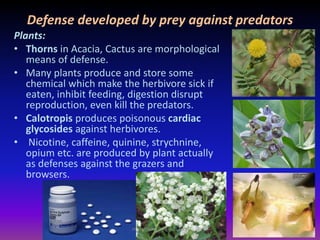
Plants:
• Thorns in Acacia, Cactus are morphological
means of defense.
• Many plants produce and store some
chemical which make the herbivore sick if
eaten, inhibit feeding, digestion disrupt
reproduction, even kill the predators.
• Calotropis produces poisonous cardiac
glycosides against herbivores.
• Nicotine, caffeine, quinine, strychnine,
opium etc. are produced by plant actually
as defenses against the grazers and
browsers.
Defense developed by prey against predators
muralishingri@gmail.com
Q: Why predators are prudent?
• A: Over exploitation of prey by the predators
results in extinction of prey and predator.
• Defense to lessen impact of predation
muralishingri@gmail.com
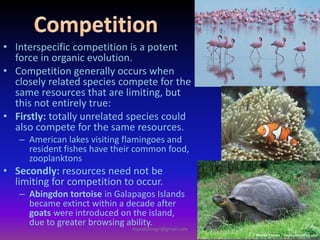
• Interspecific competition is a potent
force in organic evolution.
• Competition generally occurs when
closely related species compete for the
same resources that are limiting, but
this not entirely true:
• Firstly: totally unrelated species could
also compete for the same resources.
– American lakes visiting flamingoes and
resident fishes have their common food,
zooplanktons
• Secondly: resources need not be
limiting for competition to occur.
– Abingdon tortoise in Galapagos Islands
became extinct within a decade after
goats were introduced on the island,
due to greater browsing ability.
muralishingri@gmail.com
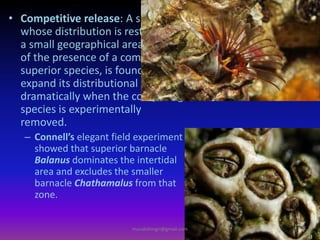
• Competitive release: A species,
whose distribution is restricted to
a small geographical area because
of the presence of a competitively
superior species, is found to
expand its distributional range
dramatically when the competing
species is experimentally
removed.
– Connell’s elegant field experiment
showed that superior barnacle
Balanus dominates the intertidal
area and excludes the smaller
barnacle Chathamalus from that
zone.
muralishingri@gmail.com
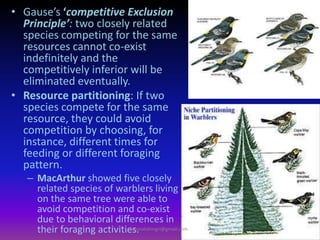
• Gause’s ‘competitive Exclusion
Principle’: two closely related
species competing for the same
resources cannot co-exist
indefinitely and the
competitively inferior will be
eliminated eventually.
• Resource partitioning: If two
species compete for the same
resource, they could avoid
competition by choosing, for
instance, different times for
feeding or different foraging
pattern.
– MacArthur showed five closely
related species of warblers living
on the same tree were able to
avoid competition and co-exist
due to behavioral differences in
their foraging activities.muralishingri@gmail.com
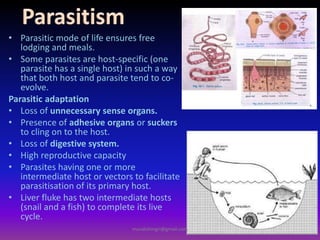
• Parasitic mode of life ensures free
lodging and meals.
• Some parasites are host-specific (one
parasite has a single host) in such a way
that both host and parasite tend to co-
evolve.
Parasitic adaptation
• Loss of unnecessary sense organs.
• Presence of adhesive organs or suckers
to cling on to the host.
• Loss of digestive system.
• High reproductive capacity
• Parasites having one or more
intermediate host or vectors to facilitate
parasitisation of its primary host.
• Liver fluke has two intermediate hosts
(snail and a fish) to complete its live
cycle.
muralishingri@gmail.com
Effects on the host:
• Parasite always harms the host.
• They reduce the survival, growth and
reproduction of the host.
• Reduce its population density.
• They make the host more vulnerable to the
predators, by making it physically weak.
muralishingri@gmail.com
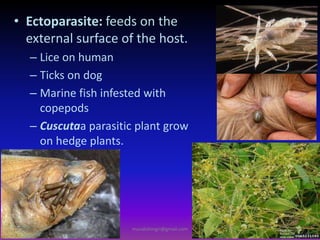
• Ectoparasite: feeds on the
external surface of the host.
– Lice on human
– Ticks on dog
– Marine fish infested with
copepods
– Cuscutaa parasitic plant grow
on hedge plants.
muralishingri@gmail.com
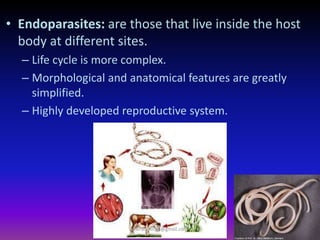
• Endoparasites: are those that live inside the host
body at different sites.
– Life cycle is more complex.
– Morphological and anatomical features are greatly
simplified.
– Highly developed reproductive system.
muralishingri@gmail.com
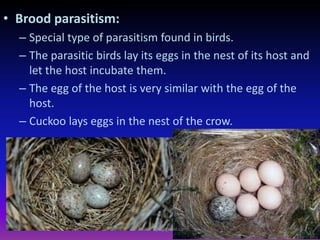
• Brood parasitism:
– Special type of parasitism found in birds.
– The parasitic birds lay its eggs in the nest of its host and
let the host incubate them.
– The egg of the host is very similar with the egg of the
host.
– Cuckoo lays eggs in the nest of the crow.
muralishingri@gmail.com
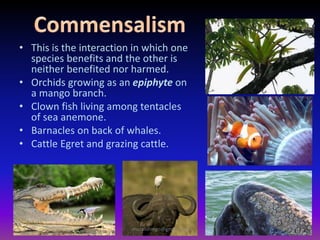
• This is the interaction in which one
species benefits and the other is
neither benefited nor harmed.
• Orchids growing as an epiphyte on
a mango branch.
• Clown fish living among tentacles
of sea anemone.
• Barnacles on back of whales.
• Cattle Egret and grazing cattle.
muralishingri@gmail.com
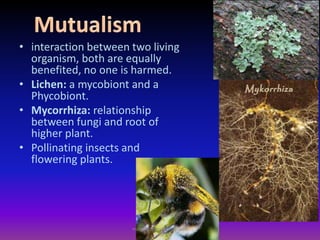
• interaction between two living
organism, both are equally
benefited, no one is harmed.
• Lichen: a mycobiont and a
Phycobiont.
• Mycorrhiza: relationship
between fungi and root of
higher plant.
• Pollinating insects and
flowering plants.
muralishingri@gmail.com
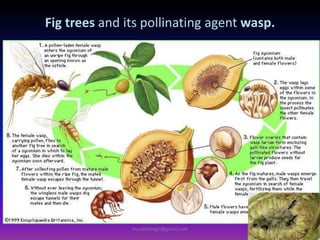
Fig trees and its pollinating agent wasp.
muralishingri@gmail.com
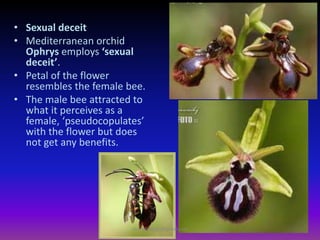
• Sexual deceit
• Mediterranean orchid
Ophrys employs ‘sexual
deceit’.
• Petal of the flower
resembles the female bee.
• The male bee attracted to
what it perceives as a
female, ‘pseudocopulates’
with the flower but does
not get any benefits.
muralishingri@gmail.com

Organisms and population.

  • 1.
  • 2.
    ECOLOGY: Branch of Sciencewhich deals with relationship between organisms & their physical & biological environment. Ecology is a subject which studies the interactions among organisms and between the organism and its physical (abiotic) environment.  Ramdeo Misra is revered as the Father of Ecology in India.  He established teaching and research in ecology at the Department of Botany of the Banaras Hindu University, Varanasi.  His research laid the foundations for understanding of tropical communities and  their succession, environmental responses of plant populations and productivity and nutrient cycling in tropical forest and grassland ecosystems. muralishingri@gmail.com
  • 3.
    LEVELS OF ORGANISATION •Organisms- every individual of a species • Population- individuals of the same species at a given place • Communities- assembly of population of all different species living in an area and interacting. • Biomes- large unit of flora and fauna in a specific climatic zone muralishingri@gmail.com
  • 4.
  • 5.
    ORGANISM AND ITSENVIRONMENT • Rotation of sun and the tilt of its axis cause annual variations in the intensity and duration of temperature, resulting distinct seasons. • These variations along with annual variations in precipitation, forms major biomes, such as desert, rain forest, and tundra. • Temperature, water, light and soil are the key elements that lead to so much variation in the physical and chemical conditions of habitats. • Both abiotic (physic-chemical) and biotic components (pathogen, parasites, predators, competitions) characterize the habitat of an organism. muralishingri@gmail.com
  • 6.
  • 7.
  • 8.
    Major abiotic factors Temperaturedecreases progressively from equator towards the pole and high altitudes to > 50o C in tropical deserts in summer. Thermal springs and deep-sea hydrothermal vents are unique with >100o C. Temperature affects the kinetics of enzymes, BMR and other physiological actions. Temperature: muralishingri@gmail.com
  • 9.
    Eurythermals: • organism whichcan tolerate wide range of temperatures. • mango trees do not and cannot grow in temperate countries like Canada and Germany, Stenothermal: • organism which can tolerate narrow range of temperatures. • snow leopards are not found in Kerala forests • tuna fish are rarely caught beyond tropical muralishingri@gmail.com
  • 10.
    Water • Water isalso important factor that influence the life of organism. • The productivity and distribution of plants is also depends on water. • The salinity varies in aquatic environment: – 5% in inland waters (fresh water) – 30-35% in sea water – More than 100% in hyper saline lagoons. • Euryhaline: organism which can tolerate wide range of salinity • Stenohaline: organism which can tolerate narrow range of salinity. (because of the osmotic problems) muralishingri@gmail.com
  • 11.
    Light • Plant producefood by photosynthesis, which only possible in presence of light. Hence it very important for autotrophs. • Plant species (herbs and shrubs) adapted for photosynthesize under canopy, because they are constantly overshadowed. • Sunlight is required for photoperiodic response like flowering. • Animals use diurnal and seasonal variations in light intensity and photoperiod as cues for timing their foraging reproductive and migratory activities. • Among the red, green and brown algae that inhabit the sea, which is likely to be found in the deepest waters? Why? muralishingri@gmail.com
  • 12.
    Soil • Properties ofsoil vary according to the climate, the weathering process. • Soil composition, grain size and aggregation determine the percolation and water holding capacity of the soil. • These characteristic along with pH, mineral composition and topography determine to a large extent the vegetation in any area. • The sediment-characteristic often determine the type of benthic animal in aquatic environment. muralishingri@gmail.com
  • 13.
    Response to AbioticFactors • One would expect that during the course of millions of years of their existence, many species would have evolved a relatively constant internal (within the body) environment • that permits all biochemical reactions and physiological functions to proceed with maximal efficiency and thus, enhance the overall ‘fitness’ of the species. • This constancy, for example, could be in terms of optimal temperature and osmotic concentration of body fluids. • Homeostasis; the process by which the organism maintain a constant internal environment in respect to changing external environment. muralishingri@gmail.com
  • 14.
    How does organismcope with the changing environment? Regulate: • Some organisms are able to maintain homeostasis physiological (sometimes behavioral also) means which ensures constant body temperature, constant osmotic concentration. • All birds and mammals and few lower invertebrates are capable of such regulation i.e. thermoregulation and osmoregulation. • Success of mammals is due to thermoregulation. • We maintain a constant body temperature of 37oC. • When outside temperature is high we sweat profusely and evaporative cooling take place to bring body temperature down. • In winter due to low temperature outside our body temperature falls below 37oC, we start to shiver, to generate heat to raise body temperature. muralishingri@gmail.com
  • 15.
  • 16.
  • 17.
    Conform • Majority (99%)of animals and plants cannot maintain a constant internal environment; their body temperature varies according to ambient temperature. • In aquatic animals the osmotic concentration of body fluid varies with ambient water osmotic concentration. • All the above animals and plants are simply called as conformer. muralishingri@gmail.com
  • 18.
    Why the conformernot evolved to became regulators? • Thermoregulation is energetically expensive for many animals. • Small animal like shrews and humming birds cannot afford so much energy for thermoregulation. • Heat loss or heat gain is a function of surface area. • Small animals have larger surface area relative to their volume, they tend to lose body heat very fast when it is cold outside; then has to expend much energy to generate body heat through metabolism. • This is why very small animals are rarely found in Polar Regions. • Alternative response for stressful conditions is localized or remains for short duration. muralishingri@gmail.com
  • 19.
  • 20.
    Migrate• The organismmoved away temporarily from the stressful habitat to a more hospitable area and return when stressful condition is over. • Bird migrate form the colder region to warmer region. muralishingri@gmail.com
  • 21.
  • 22.
    Suspend • Thick walledspores are formed in microbes to overcome unfavourable stressful external environment. Spores germinate in favourable condition. muralishingri@gmail.com
  • 23.
    • In higherplants seeds and other vegetative reproductive structures are means to tide over the stress. They reduce their metabolic activity and going into a state of ‘dormancy’. muralishingri@gmail.com
  • 24.
    • Hibernation: duringwinter animals like bears escape in time • Aestivation: animals like snail and fish avoid summer related problem like heat and desiccation. • Diapauses: many zooplanktons undergo a stage of suspended development in unfavorable conditions. muralishingri@gmail.com
  • 25.
    ADAPTATION Adaptation of animalin desert: • Kangaroo rat meets their water requirement from oxidation of fat. • Excrete very concentrate urine to conserve water. Adaptation: is any attribute of the organism (morphological, physiological, and behavioral) that enables the organism to survive and reproduce in its habitat. muralishingri@gmail.com
  • 26.
    Adaptation of plantin desert (xerophytes) • Thick cuticle on their leaf surfaces. • Sunken stomata, both to reduce transpiration. • Have special photosynthetic pathway (CAM), stomata closed during day time and remained open during night. • Opuntia has no leaf- they are reduced to spines. • Photosynthesis takes place in flat green stems. muralishingri@gmail.com
  • 27.
  • 28.
  • 29.
    Adaptation of animalin cold climate • Allen’s Rule: mammals from colder climates generally have shorter ears and limbs to minimize heat loss. • Seals of polar aquatic seas have a thick layer of fat called blubber below their skin that acts as insulator and reduces loss of body heat. muralishingri@gmail.com
  • 30.
    Adaptation in highaltitude • A person move to high altitude (>3,500 meter), develop altitude sickness. • Symptoms developed are nausea, fatigue and heart palpitations. • This is due to low atmospheric pressure of high altitudes; the body does not get enough oxygen. muralishingri@gmail.com
  • 31.
    • The body compensateslow oxygen availability by increasing red blood cell production. • The body compensates decreasing binding capacity of hemoglobin with oxygen by increasing rate of breathing. How the bodies solve the problem? muralishingri@gmail.com
  • 32.
    • Many tribeslive in the high altitude of Himalayas. • Find out if they normally have a higher red blood cell count (or total hemoglobin) than people living in the plains. • A large variety of marine invertebrates and fish live at great depths in the ocean where the pressure could be >100 times the normal atmospheric pressure that we experience. • How do they live under such crushing pressures and do they have any special enzymes? • Organisms living in such extreme environments show a fascinating array of biochemical adaptations muralishingri@gmail.com
  • 33.
    Behavioral adaptation: • Desertlizards are conformer hence they cope with the stressful environment by behavioral adaptations: – They bask in the sun and absorb heat when their body temperature drops below the comfort zone in winter. – Move to shade when the ambient temperature starts increasing. – Some species burrowing into the soil to hide and escape from the above- ground heat. muralishingri@gmail.com
  • 34.
    POPULATION Population attributes: • Population:a group of individual living in a well defined geographical area, share or compete for similar resources, potentially interbreed. • Birth rate and death rate refers to per capita births and deaths respectively. • Another attribute is sex ratio. The ratio between male female in a population. • If the age distribution is plotted for a population the resulting structure is called age pyramid. • The shape of the pyramids reflects the growth status of the population like growing, stable or declining. muralishingri@gmail.com
  • 35.
  • 36.
  • 37.
  • 38.
    • If ina pond there are 20 lotus plants last year and through reproduction 8 new plants are added, taking the current population to 28, • we calculate the birth rate as 8/20 = 0.4 offspring per lotus per year. • If 4 individuals in a laboratory population of 40 fruitflies died during a specified time interval, say a week, • the death rate in the population during that period is 4/40 = 0.1 individuals per fruitfly per week The population size is more technically called as population density. muralishingri@gmail.com
  • 39.
    Methods for measurementof population density: • Counting the number • Percent cover • Biomass. • Pug marks and fecal pellets for tiger census muralishingri@gmail.com
  • 40.
    • In anarea, if there are 200 Parthenium plants but only a single huge banyan tree with a large canopy, • stating that the population density of banyan is low relative to that of Parthenium amounts • to underestimating the enormous role of the Banyan in that community. • In such cases, the per cent cover or biomass is a more meaningful measure of the population size. • Total number is again not an easily adoptable measure if the population is huge and counting is impossible or very time-consuming. • If you have a dense laboratory culture of bacteria in a petri dish what is the best measure to report its density?muralishingri@gmail.com
  • 41.
    Population growth • Thesize of the population changes depending on food availability, predation pressure and reduce weather. • Population size fluctuated due to changes in four basic processes, two of which (Natality and immigration) contribute an increase in population density and two (mortality and emigration) to a decrease. • Natality: number of birth in given period in the population. • Mortality: number of deaths in the population in a given period of time. • Immigration: is the number of individuals of same species that have come into the habitat from elsewhere during a given period of time. • Emigration: number of individuals of the population who left the habitat and gone elsewhere during a given time period. muralishingri@gmail.com
  • 42.
  • 43.
    if N isthe population density at time t, then its density at time t +1 is Nt+1 = Nt + [(B + I) – (D + E)] population density will increase if the number of births plus the number of immigrants (B + I) is more than the number of deaths plus the number of emigrants (D + E), otherwise it will decrease. Growth Models: muralishingri@gmail.com
  • 44.
    If ‘N’ isthe population density at time ‘t’, then its d ensity at time t + 1 is Where B = the number of births I = the number of immigrants D = the number of deaths E = the number of Emigrants. N = Population Density r = Intrinsic rate of natural increase t = Time period K = Carrying capacity (The maximum population size that an environment can sustain) muralishingri@gmail.com
  • 45.
    If the populationgrows in an exponential or geometric fashion. If in a population of size N, the birth rates (not total number but per capita births) are represented as b and death rates (again, per capita death rates) as d, then the increase or decrease in N during a unit time period t (dN/dt) will be dN/dt = (b – d) × N Let (b–d) = r, then dN/dt = rN Exponential growth The r in this equation is called the ‘intrinsic rate of natural increase’ In 1981, the r value for human population in India was 0.0205. 2013 is 0.586 muralishingri@gmail.com
  • 46.
    Exponential growth • Nt= Population density after time t • N0 = Population density at time zero • r = intrinsic rate of natural increase • e = the base of natural logarithms (2.71828) If you are familiar with basic calculus, you can derive the integral form of the exponential growth equation as Nt = N0ert muralishingri@gmail.com
  • 47.
    Exponential growth (‘J’shape curve is obtained): • When resources are not limiting the growth. • Any species growth exponentially under unlimited resource conditions can reach enormous population densities in a short time. • Growth is not so realistic. The king and the minister sat for a chess game……. muralishingri@gmail.com
  • 48.
    Logistic Growth • Sigmoidcurve is obtained • When responses are limiting the Growth. • Resources for growth for most animal pop ulations are finite and become limiting. • The logistic growth model is a more realistic one. muralishingri@gmail.com
  • 49.
    • Verhulst-Pearl Logistic Growthis described by t he following equations • dN/dt = rN (K–N/n) • Where N = Population density at time t • r = Intrinsic rate of natural increase • K = Carrying capacity Logistic growth model muralishingri@gmail.com
  • 50.
    Life History Variation •Populations evolve to maximise their reproductive fitness, also called Darwinian fitness (high r value) • in the habitat in which they live. Under a particular set of selection pressures, organisms evolve towards the most efficient reproductive strategy. • Some organisms breed only once in their lifetime (Pacific salmon fish, bamboo) • while others breed many times during their lifetime (most birds and mammals). • Some produce a large number of small-sized offspring (Oysters, pelagic fishes) • while others produce a small number of large- sized offspring (birds, mammals) • So, which is desirable for maximising fitness? • Evolution of life history traits in different species is currently an important area of research being conducted by ecologists. muralishingri@gmail.com
  • 51.
    There is nosuch habitat and such a situation is even inconceivable. For any species, the minimal requirement is one more species on which it can feed • Even a plant species, which makes its own food, cannot survive alone; • It needs soil microbes to break down the organic matter in soil and return the inorganic nutrients for absorption. • And then, how will the plant manage pollination without an animal agent? muralishingri@gmail.com
  • 52.
    • Minimum requirementof species- one more species to feed on. • Interspecific interactions - Interactions of populations of two different species. muralishingri@gmail.com
  • 53.
    • Both thespecies benefit in mutualism and both lose in competition in. • The interaction where one species is benefitted and the other is neither benefitted nor harmed is called commensalism. • In amensalism on the other hand one species is harmed whereas the other is unaffected. • Predation, parasitism and commensalism share a common characteristic– the interacting species live closely together. + beneficial interaction - Detrimental effect 0 Neutral effectmuralishingri@gmail.com
  • 54.
    • Organism ofhigher trophic level (predator) feeds on organism of lower trophic level (prey) is called the predation. • Even the herbivores are not very different from predator. • Predator acts as a passage for transfer of energy across trophic level. What would happen to all the energy fixed by autotrophic organisms if the community has no animals to eat the plants? It is an Interspecific Interaction where one animal kills and consumes the other weaker animal. muralishingri@gmail.com
  • 55.
    • Predators keepprey populations under control. • Exotic species have no natural predator hence they grow very rapidly. (prickly pear cactus introduced in Australia created problem) • Predators also help in maintaining species diversity in a community, by reducing the intensity of competition among competing prey species. (Pisaster starfish field experiment) muralishingri@gmail.com
  • 56.
    Defense developed byprey against predators Animals: • Insects and frogs are cryptically coloured (camouflaged) to avoid being detected by the predator. • Some are poisonous and therefore avoided by the predators. • Monarch butterfly is highly distasteful to its predator (bird) due to presence of special chemical it its body. The chemical acquired by feeding a poisonous weed during caterpillar stage. muralishingri@gmail.com
  • 57.
    Plants: • Thorns inAcacia, Cactus are morphological means of defense. • Many plants produce and store some chemical which make the herbivore sick if eaten, inhibit feeding, digestion disrupt reproduction, even kill the predators. • Calotropis produces poisonous cardiac glycosides against herbivores. • Nicotine, caffeine, quinine, strychnine, opium etc. are produced by plant actually as defenses against the grazers and browsers. Defense developed by prey against predators muralishingri@gmail.com
  • 58.
    Q: Why predatorsare prudent? • A: Over exploitation of prey by the predators results in extinction of prey and predator. • Defense to lessen impact of predation muralishingri@gmail.com
  • 59.
    • Interspecific competitionis a potent force in organic evolution. • Competition generally occurs when closely related species compete for the same resources that are limiting, but this not entirely true: • Firstly: totally unrelated species could also compete for the same resources. – American lakes visiting flamingoes and resident fishes have their common food, zooplanktons • Secondly: resources need not be limiting for competition to occur. – Abingdon tortoise in Galapagos Islands became extinct within a decade after goats were introduced on the island, due to greater browsing ability. muralishingri@gmail.com
  • 60.
    • Competitive release:A species, whose distribution is restricted to a small geographical area because of the presence of a competitively superior species, is found to expand its distributional range dramatically when the competing species is experimentally removed. – Connell’s elegant field experiment showed that superior barnacle Balanus dominates the intertidal area and excludes the smaller barnacle Chathamalus from that zone. muralishingri@gmail.com
  • 61.
    • Gause’s ‘competitiveExclusion Principle’: two closely related species competing for the same resources cannot co-exist indefinitely and the competitively inferior will be eliminated eventually. • Resource partitioning: If two species compete for the same resource, they could avoid competition by choosing, for instance, different times for feeding or different foraging pattern. – MacArthur showed five closely related species of warblers living on the same tree were able to avoid competition and co-exist due to behavioral differences in their foraging activities.muralishingri@gmail.com
  • 62.
    • Parasitic modeof life ensures free lodging and meals. • Some parasites are host-specific (one parasite has a single host) in such a way that both host and parasite tend to co- evolve. Parasitic adaptation • Loss of unnecessary sense organs. • Presence of adhesive organs or suckers to cling on to the host. • Loss of digestive system. • High reproductive capacity • Parasites having one or more intermediate host or vectors to facilitate parasitisation of its primary host. • Liver fluke has two intermediate hosts (snail and a fish) to complete its live cycle. muralishingri@gmail.com
  • 63.
    Effects on thehost: • Parasite always harms the host. • They reduce the survival, growth and reproduction of the host. • Reduce its population density. • They make the host more vulnerable to the predators, by making it physically weak. muralishingri@gmail.com
  • 64.
    • Ectoparasite: feedson the external surface of the host. – Lice on human – Ticks on dog – Marine fish infested with copepods – Cuscutaa parasitic plant grow on hedge plants. muralishingri@gmail.com
  • 65.
    • Endoparasites: arethose that live inside the host body at different sites. – Life cycle is more complex. – Morphological and anatomical features are greatly simplified. – Highly developed reproductive system. muralishingri@gmail.com
  • 66.
    • Brood parasitism: –Special type of parasitism found in birds. – The parasitic birds lay its eggs in the nest of its host and let the host incubate them. – The egg of the host is very similar with the egg of the host. – Cuckoo lays eggs in the nest of the crow. muralishingri@gmail.com
  • 67.
    • This isthe interaction in which one species benefits and the other is neither benefited nor harmed. • Orchids growing as an epiphyte on a mango branch. • Clown fish living among tentacles of sea anemone. • Barnacles on back of whales. • Cattle Egret and grazing cattle. muralishingri@gmail.com
  • 68.
    • interaction betweentwo living organism, both are equally benefited, no one is harmed. • Lichen: a mycobiont and a Phycobiont. • Mycorrhiza: relationship between fungi and root of higher plant. • Pollinating insects and flowering plants. muralishingri@gmail.com
  • 69.
    Fig trees andits pollinating agent wasp. muralishingri@gmail.com
  • 70.
    • Sexual deceit •Mediterranean orchid Ophrys employs ‘sexual deceit’. • Petal of the flower resembles the female bee. • The male bee attracted to what it perceives as a female, ‘pseudocopulates’ with the flower but does not get any benefits. muralishingri@gmail.com
  • 71.