Metamorphic Facies
https://trekgeo.net/m/occe.htm
Metamorphic Facies
• The metamorphic facies are groups of mineral compositions in
metamorphic rocks, that are typical for a certain field in pressure-
temperature space.
• The name facies was first used for specific sedimentary
environments in sedimentary rocks by Swiss geologist Amanz
Gressly in 1838.
• Analogous with these sedimentary facies a number of metamorphic
facies were proposed in 1920 by Finnish petrologist Pentti Eskola.
• Eskola's classification was refined in the 1970s by New-Zealand
geologist Francis John Turner.
• A metamorphic petrologist can decipher the times at which a
metamorphic rocks of a region were subjected to different P-T
conditions. In other words, the evolutionary history of such a region in
terms of pressure-temp-time (P-T-t).
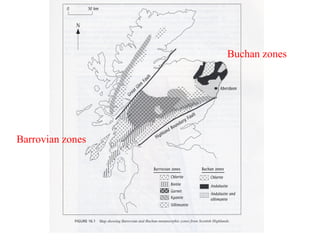
• In 1893 George Barrow carried out field-based study in Scotland using
mineralogical changes as a function of metamorphic intensity in mudrock
protolith (or pelite in metamorphic petrology).
– Barrow showed that distinct zones or boundaries are marked by
appearance/disappearance of a specific mineral (or index mineral) and this
can be mapped at outcrop scale, not just in Highlands but globally.
Metamorphic Facies
These zones are:
1. Chlorite zone: Chlorite + Muscovite + Quartz + Albite
2. Biotite zone: Biotite + Chlorite + Muscovite + Albite + Quartz
3. Garnet zone: Garnet + Quartz + Biotite + Muscovite + Albite
4. Staurolite zone: Staurolite + Garnet Quartz + Muscovite + Biotite + Plag
5. Kyanite zone: Kyanite + Garnet + Muscovite + Biotite + Quartz + Plag + K-
feldspar
• Barrow’s interpretation that the metamorphic grade/intensity increased from
Chlorite to the Sillimanite zones was based on observation that grain size also
increased. These zones are Barrovian Zones and are recognized as
representative of intermediate P-T metamorphism.
• Tilley extended this study and introduced the concept of an isograde which is a
contour on a geological map that marks the first appearance & disappearance of
an index mineral.
Buchan zones
Barrovian zones
Metamorphic facies + tectonic associations.
Mid-ocean ridges
Orogenic belts
Subduction zones
Note: White lines
are isograds
Glaucophane amphibole
Garnet & Omphacite pyroxene
Later studies found different types of metamorphic zonation in rocks of pelitic
composition worldwide. Close to Barrows study area, in the Buchan area of eastern
Dalradians, a very different sequence of metamorphic zones occurs in a pelitic
protolith. Here, the index mineral sequence is:
Buchan sequence: Staurolite - Cordierite - Andalusite - Sillimanite
Bulk composition (inc. fluid composition) has an important control on type of
mineral reactions in a protolith thus affecting the mineral-based isograds.
Bulk composition also dictates what minerals may form at specific P-T & fluid
composition. The list below highlights the different rocks forming under similar P-
T conditions:
Sandstone - quartzite
Limestone - marble
Basalt - amphibolite
Granite - garnet-gneiss
Shale - sillimanite gneiss
Peridotite - olivine-tremolite schist
• A metamorphic facies is not a single rock-type but a
wide range of minerals that form under similar P-T
and fluid composition conditions.
• A general facies diagram was developed and names
of each facies are based on those mineral assemblages
that develop when a mafic bulk composition
undergoes various P-T conditions
Metamorphic Facies
Metamorphic Facies
• The concept of metamorphic facies was first proposed
by Eskola (1915) who later (Eskola, 1920) gave the
following definition:
• A metamorphic facies is "a group of rocks characterized by a
definite set of minerals which, under the conditions obtaining
during their formation, were at perfect equilibrium with each
other. The quantitative and qualitative mineral composition in
the rocks of a given facies varies gradually in correspondence
with variation in the chemical bulk composition of the rocks“.
Metamorphic Facies
Eskola (1920) proposed 5 original facies:
• Greenschist
• Amphibolite
• Hornfels
• Sanidinite
• Eclogite
Easily defined on the basis of mineral assemblages
that develop in mafic rocks
Metamorphic Facies
In his final account, Eskola (1939) added:
• Granulite
• Epidote-amphibolite
• Glaucophane-schist (now called Blueschist)
... and changed the name of the hornfels facies to
the pyroxene hornfels facies
Metamorphic Facies
Fig. 25.1 The metamorphic facies proposed by Eskola and their relative temperature-pressure
relationships. After Eskola (1939) Die Entstehung der Gesteine. Julius Springer. Berlin.
Metamorphic Facies
Several additional facies types have been proposed.
Most notable are:
• Zeolite
• Prehnite-pumpellyite
...from Coombs in the “burial metamorphic” terranes of
New Zealand
Fyfe et al. (1958) also proposed:
• Albite-epidote hornfels
• Hornblende hornfels
Metamorphic Facies
Fig. 25.2. Temperature-
pressure diagram showing
the generally accepted
limits of the various facies
used in this text.
Boundaries are
approximate and
gradational. The “typical”
or average continental
geotherm is from Brown
and Mussett (1993). Winter
(2010) An Introduction to
Igneous and Metamorphic
Petrology. Prentice Hall.
Metamorphic Facies
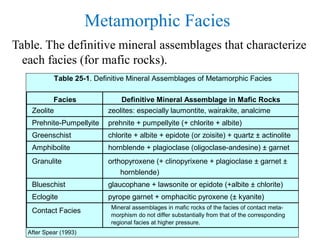
Table. The definitive mineral assemblages that characterize
each facies (for mafic rocks).
Facies Definitive Mineral Assemblage in Mafic Rocks
Zeolite zeolites: especially laumontite, wairakite, analcime
Prehnite-Pumpellyite prehnite + pumpellyite (+ chlorite + albite)
Greenschist chlorite + albite + epidote (or zoisite) + quartz ± actinolite
Amphibolite hornblende + plagioclase (oligoclase-andesine) ± garnet
Granulite orthopyroxene (+ clinopyrixene + plagioclase ± garnet ±
hornblende)
Blueschist glaucophane + lawsonite or epidote (+albite ± chlorite)
Eclogite pyrope garnet + omphacitic pyroxene (± kyanite)
Contact Facies
After Spear (1993)
Table 25-1. Definitive Mineral Assemblages of Metamorphic Facies
Mineral assemblages in mafic rocks of the facies of contact meta-
morphism do not differ substantially from that of the corresponding
regional facies at higher pressure.
METAMORPHIC FACIES: mineral assemblages
Original chemistry of parent rock controls the mineral
assemblage formed during metamorphism
Increasing
Temperature
REGIONAL METAMORPHISM OF BASALTS
Increasing Grade & relevant facies
Index
minerals
REGIONAL METAMORPHISM OF SHALES
Increasing Grade & relevant facies
Index
minerals
Minerals function of temperature, pressure & parent rock
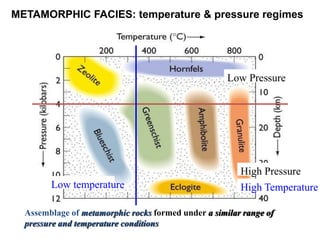
METAMORPHIC FACIES: temperature & pressure regimes
Assemblage of metamorphic rocks formed under a similar range of
pressure and temperature conditions
Low Pressure
High Temperature
Low temperature
High Pressure
It is convenient to consider metamorphic facies in 4 groups:
1) Facies of high pressure
• The blueschist and eclogite facies: conditions of high
pressure
• Blueschist facies- areas of low T/P gradients:
subduction zones
• Eclogites: stable under normal geothermal conditions
Metamorphic Facies
2) Facies of medium pressure
• Most exposed metamorphic rocks belong to the
greenschist, amphibolite, or granulite facies
• The greenschist and amphibolite facies conform to the
“typical” geothermal gradient.
Metamorphic Facies
• 3) Facies of low pressure
• Albite-epidote hornfels, hornblende hornfels, and
pyroxene hornfels facies: contact metamorphic
terranes and regional terranes with very high
geothermal gradient.
• Sanidinite facies is
rare- limited to
xenoliths in basic
magmas and the
innermost portions of
some contact aureoles
adjacent to hot basic
intrusives
Metamorphic Facies
• Zeolite and prehnite-
pumpellyite facies
not always
represented, and
greenschist facies
may be the lowest
grade developed in
many regional
terranes
• 4) Facies of low grades
• Rocks may fail to recrystallize thoroughly at very low
grades, and equilibrium not always attained
Contact Metamorphic Facies
1: Albite-epidote-hornfels facies
Mineral Assemblages
• [Felsic Rocks] Microcline, Quartz, Muscovite, Albite, Chlorite/Biotite
• [Mafic Rocks] Albite, Epidote, Actinolite, Chlorite/Biotite, Laumontite
• [Ultramafic Rocks] Serpentine, Talc
• [Mudstone] Muscovite/Andalusite, Chlorite/Biotite, Quartz, Albite,
(Epidote)
• [Bedded Mn] Braunite/Hausmannite, Rhodonite, Pyroxmangite,
Spessartine, Rhodochrosite
• [Carbonate Rocks] Calcite/Dolomite, Epidote,Tremolite/Actinolite,
Quartz
Contact Metamorphic Facies
2: Hornblende-hornfels facies
Mineral Assemblages
• [Felsic Rocks] Microcline, Quartz, Muscovite, Plagioclase, Biotite,
(Almandine)
• [Mafic Rocks] Hornblende, Plagioclase, (Diopside, Anthophyllite)
• [Ultramafic Rocks] Anthophyllite, Serpentine
• [Mudstone] Muscovite/Andalusite, Biotite, Cordierite, Quartz,
Plagioclase
• [Laterite] Hercynite, Corundum, Titanite, Plagioclase, (Andalusite,
Cordierite, Grossular)
• [Bedded Mn] Hausmannite, Rhodonite, Spessartine, Rhodochrosite,
Manganocummingtonite, Alabandite, Pyrrhotite
• [Carbonate Rocks] Calcite/Dolomite, Tremolite, Quartz, Grossular,
Plagioclase, Diopside, (Talc)
Contact Metamorphic Facies
3: Pyroxene-Hornfels facies
Mineral Assemblages
• [Felsic Rocks] Orthoclase, Quartz, Plagioclase, Biotite
• [Mafic Rocks] Orthopyroxene (Enstatite), Clinopyroxene, Plagioclase,
(Olivine)
• [Ultramafic Rocks] Enstatite, Serpentine
• [Mudstone] Cordierite, Quartz, Sillimanite/Andalusite, Orthoclase,
(Biotite, Garnet)
• [Bedded Mn] Bustamite, Rhodonite, Spessartine, K-feldspar,
Manganocummingtonite
• [Carbonate Rocks] Diopside, Grossular, Wollastonite, (Vesuvianite,
Forsterite, Periclase, Clinohumite, Spinel, Biotite)
Contact Metamorphic Facies
4: Sanidinite facies (very rare)
Mineral Assemblages
• [Felsic Rocks] Sanidine, Tridymite, Anorthite
• [Mafic Rocks] Augite, Enstatite (Hypersthene), Anorthite, Tridymite
• [Mudstone] Cordierite, Mullite, Sanidine, Tridymite, Enstatite
(Hypersthene), Sillimanite, Corundum
• [Carbonate Rocks] Wollastonite, Anorthite, Diopside, (Monticellite,
Melilite, Tilleyite, Spurrite, Merwinite, Larnite)
Contact Metamorphic Facies
Facies Name Index / diagnostic minerals
Albite-epidote-
hornfels
Albite + Epidote + Basic (Actinolite + Chlorite) + Altered
ultrabasic (Talc + Tremolite) + Pelitic (Muscovite +
Biotite)
Hornblende-
hornfels
Basic (Hornblende + Pg) + Impure calcareous rock
(Diopside + Forsterite + Grossular garnet) + Pelitic
(Andalusite + Cordierite)
Pyroxene-
hornfels
Calcareous (Wollastonite) + Basic (Hypersthene) + Pelitic
(Sillimanite + Cordierite + K-feldspar)
Sanidinite
(Very rare)
Felsic (Sanidine + Tridymite + Anorthite) Mafic (Augite +
Enstatite + Anorthite + Tridymite) + Pelitic (Cordierite +
Mullite + Sanidine + Tridymite + Enstatite) + Carbonate
(Wollastonite + Anorthite + Diopside + Monticellite +
Melilite + Tilleyite + Spurrite + Merwinite + Larnite)
Metamorphic Zones and Facies
• Metamorphic zone – a belt of rocks showing roughly the
same degree of metamorphism.
Metamorphic Zones and Facies
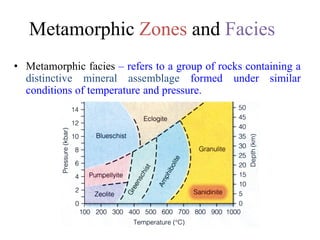
• Metamorphic facies – refers to a group of rocks containing a
distinctive mineral assemblage formed under similar
conditions of temperature and pressure.
Metamorphic Zones and Facies
• How do metamorphic zones and
metamorphic facies differ?
– Metamorphic zones show the gradational
metamorphic change within a single rock
composition.
– Metamorphic facies are groups of many
different rock compositions whose mineral
contents all indicate common temperature and
pressure conditions during metamorphism.
Metamorphic Facies
Combine the concepts of Isogrades, Zones, and Facies
• Examples: “chlorite zone of the greenschist facies,” the
“staurolite zone of the amphibolite facies,” or the
“cordierite zone of the hornblende hornfels facies,” etc.
• Metamorphic maps typically include isogrades that
define zones and ones that define facies boundaries.
• Determining a facies or zone is most reliably done
when several rocks of varying composition and
mineralogy are available.
Fig. 25.10. Typical mineral changes that take place in metabasic rocks during progressive metamorphism in the medium
P/T facies series. The approximate location of the pelitic zones of Barrovian metamorphism are included for comparison.
Winter (2010) An Introduction to Igneous and Metamorphic Petrology. Prentice Hall.
Metamorphic Facies Series
“A group of facies associated in space”.
A traverse up grade through a metamorphic terrane should
follow one of several possible metamorphic field gradients
(Fig. 21.1), and, if extensive enough, cross through a
sequence of facies.
Facies Series
Miyashiro (1961) proposed five facies series, most of them
named for a specific representative “type locality”. The
series were:
1. Contact Facies Series (very low-P)
2. Buchan or Abukuma Facies Series (low-P regional)
3. Barrovian Facies Series (medium-P regional)
4. Sanbagawa Facies Series (high-P, moderate-T)
5. Franciscan Facies Series (high-P, low T)
Figure 21.1. Metamorphic field gradients (estimated P-T conditions along surface traverses directly up metamorphic grade) for several
metamorphic areas. After Turner (1981). Metamorphic Petrology: Mineralogical, Field, and Tectonic Aspects. McGraw-Hill.
Baric Series
• Later, he reduced the number to three,
which he called “Baric Series”
 Low P-T
 Medium P-T
 High P-T
Fig. 25.3.
Temperature-
pressure diagram
showing the three
major types of
metamorphic
facies series
proposed by
Miyashiro (1973,
1994). Winter
(2010) An
Introduction to
Igneous and
Metamorphic
Petrology.
Prentice Hall.
Miyashiro’s
Baric Series
Low P-T Baric Series
• The low P-T series is characteristic of high-
heat-flow orogenic belts (Buchan or Ryoke-
Abukuma type), rift areas, or contact
metamorphism.
Low P-T Baric Series
• The sequence of facies may be:
 (zeolite facies) - (prehnite-pumpellyite facies) - greenschist
facies -amphibolite facies - (granulite facies)
 If protoliths are aluminous rocks-will contain cordierite
and/or andalusite
• Alternative sequence
 (zeolite facies) - albite-epidote hornfels facies - hornblende
hornfels facies - pyroxene hornfels facies
• Sanidinite facies rocks are rare, requiring the
transport of great heat to shallow levels
Medium P-T Baric Series
• The medium P-T series is characteristic of common
orogenic belts (Barrovian type)
• The sequence is
 (zeolite facies) - (prehnite-pumpellyite facies) -
greenschist facies -amphibolite facies - (granulite
facies)
Medium P-T Baric Series
• Crustal melting under water-saturated
conditions occurs in the upper amphibolite
facies (the solidus is indicated in figure)
• The granulite facies, therefore, occurs only in
water-deficient rocks, either dehydrated lower
crust, or areas with high XCO2 in the fluid.
43
Granite
Solidus
• Granulites are
impossible in
water-
saturated rocks
High P-T Baric Series
• The high P/T series typically occurs in
subduction zones where “normal” isotherms
are depressed by the subduction of cool
lithosphere faster than it can equilibrate
thermally
• Facies sequence is:
 (zeolite facies) - (prehnite-pumpellyite
facies) - blueschist facies - eclogite facies
Metamorphic Facies
Figure 25.4. Schematic cross-section of an island arc illustrating isotherm depression along the outer belt and elevation along the inner
axis of the volcanic arc. The high P/T facies series typically develops along the outer paired belt and the medium or low P/T series
develop along the inner belt, depending on subduction rate, age of arc and subducted lithosphere, etc. From Ernst (1976).

7. Metamorphic Facies-1.pdf

  • 1.
  • 2.
    Metamorphic Facies • Themetamorphic facies are groups of mineral compositions in metamorphic rocks, that are typical for a certain field in pressure- temperature space. • The name facies was first used for specific sedimentary environments in sedimentary rocks by Swiss geologist Amanz Gressly in 1838. • Analogous with these sedimentary facies a number of metamorphic facies were proposed in 1920 by Finnish petrologist Pentti Eskola. • Eskola's classification was refined in the 1970s by New-Zealand geologist Francis John Turner.
  • 3.
    • A metamorphicpetrologist can decipher the times at which a metamorphic rocks of a region were subjected to different P-T conditions. In other words, the evolutionary history of such a region in terms of pressure-temp-time (P-T-t). • In 1893 George Barrow carried out field-based study in Scotland using mineralogical changes as a function of metamorphic intensity in mudrock protolith (or pelite in metamorphic petrology). – Barrow showed that distinct zones or boundaries are marked by appearance/disappearance of a specific mineral (or index mineral) and this can be mapped at outcrop scale, not just in Highlands but globally. Metamorphic Facies
  • 4.
    These zones are: 1.Chlorite zone: Chlorite + Muscovite + Quartz + Albite 2. Biotite zone: Biotite + Chlorite + Muscovite + Albite + Quartz 3. Garnet zone: Garnet + Quartz + Biotite + Muscovite + Albite 4. Staurolite zone: Staurolite + Garnet Quartz + Muscovite + Biotite + Plag 5. Kyanite zone: Kyanite + Garnet + Muscovite + Biotite + Quartz + Plag + K- feldspar • Barrow’s interpretation that the metamorphic grade/intensity increased from Chlorite to the Sillimanite zones was based on observation that grain size also increased. These zones are Barrovian Zones and are recognized as representative of intermediate P-T metamorphism. • Tilley extended this study and introduced the concept of an isograde which is a contour on a geological map that marks the first appearance & disappearance of an index mineral.
  • 5.
  • 6.
    Metamorphic facies +tectonic associations. Mid-ocean ridges Orogenic belts Subduction zones Note: White lines are isograds Glaucophane amphibole Garnet & Omphacite pyroxene
  • 7.
    Later studies founddifferent types of metamorphic zonation in rocks of pelitic composition worldwide. Close to Barrows study area, in the Buchan area of eastern Dalradians, a very different sequence of metamorphic zones occurs in a pelitic protolith. Here, the index mineral sequence is: Buchan sequence: Staurolite - Cordierite - Andalusite - Sillimanite Bulk composition (inc. fluid composition) has an important control on type of mineral reactions in a protolith thus affecting the mineral-based isograds. Bulk composition also dictates what minerals may form at specific P-T & fluid composition. The list below highlights the different rocks forming under similar P- T conditions: Sandstone - quartzite Limestone - marble Basalt - amphibolite Granite - garnet-gneiss Shale - sillimanite gneiss Peridotite - olivine-tremolite schist
  • 8.
    • A metamorphicfacies is not a single rock-type but a wide range of minerals that form under similar P-T and fluid composition conditions. • A general facies diagram was developed and names of each facies are based on those mineral assemblages that develop when a mafic bulk composition undergoes various P-T conditions Metamorphic Facies
  • 9.
    Metamorphic Facies • Theconcept of metamorphic facies was first proposed by Eskola (1915) who later (Eskola, 1920) gave the following definition: • A metamorphic facies is "a group of rocks characterized by a definite set of minerals which, under the conditions obtaining during their formation, were at perfect equilibrium with each other. The quantitative and qualitative mineral composition in the rocks of a given facies varies gradually in correspondence with variation in the chemical bulk composition of the rocks“.
  • 10.
    Metamorphic Facies Eskola (1920)proposed 5 original facies: • Greenschist • Amphibolite • Hornfels • Sanidinite • Eclogite Easily defined on the basis of mineral assemblages that develop in mafic rocks
  • 11.
    Metamorphic Facies In hisfinal account, Eskola (1939) added: • Granulite • Epidote-amphibolite • Glaucophane-schist (now called Blueschist) ... and changed the name of the hornfels facies to the pyroxene hornfels facies
  • 12.
    Metamorphic Facies Fig. 25.1The metamorphic facies proposed by Eskola and their relative temperature-pressure relationships. After Eskola (1939) Die Entstehung der Gesteine. Julius Springer. Berlin.
  • 13.
    Metamorphic Facies Several additionalfacies types have been proposed. Most notable are: • Zeolite • Prehnite-pumpellyite ...from Coombs in the “burial metamorphic” terranes of New Zealand Fyfe et al. (1958) also proposed: • Albite-epidote hornfels • Hornblende hornfels
  • 14.
    Metamorphic Facies Fig. 25.2.Temperature- pressure diagram showing the generally accepted limits of the various facies used in this text. Boundaries are approximate and gradational. The “typical” or average continental geotherm is from Brown and Mussett (1993). Winter (2010) An Introduction to Igneous and Metamorphic Petrology. Prentice Hall.
  • 15.
    Metamorphic Facies Table. Thedefinitive mineral assemblages that characterize each facies (for mafic rocks). Facies Definitive Mineral Assemblage in Mafic Rocks Zeolite zeolites: especially laumontite, wairakite, analcime Prehnite-Pumpellyite prehnite + pumpellyite (+ chlorite + albite) Greenschist chlorite + albite + epidote (or zoisite) + quartz ± actinolite Amphibolite hornblende + plagioclase (oligoclase-andesine) ± garnet Granulite orthopyroxene (+ clinopyrixene + plagioclase ± garnet ± hornblende) Blueschist glaucophane + lawsonite or epidote (+albite ± chlorite) Eclogite pyrope garnet + omphacitic pyroxene (± kyanite) Contact Facies After Spear (1993) Table 25-1. Definitive Mineral Assemblages of Metamorphic Facies Mineral assemblages in mafic rocks of the facies of contact meta- morphism do not differ substantially from that of the corresponding regional facies at higher pressure.
  • 16.
    METAMORPHIC FACIES: mineralassemblages Original chemistry of parent rock controls the mineral assemblage formed during metamorphism Increasing Temperature
  • 17.
    REGIONAL METAMORPHISM OFBASALTS Increasing Grade & relevant facies Index minerals
  • 18.
    REGIONAL METAMORPHISM OFSHALES Increasing Grade & relevant facies Index minerals Minerals function of temperature, pressure & parent rock
  • 19.
    METAMORPHIC FACIES: temperature& pressure regimes Assemblage of metamorphic rocks formed under a similar range of pressure and temperature conditions Low Pressure High Temperature Low temperature High Pressure
  • 20.
    It is convenientto consider metamorphic facies in 4 groups: 1) Facies of high pressure • The blueschist and eclogite facies: conditions of high pressure • Blueschist facies- areas of low T/P gradients: subduction zones • Eclogites: stable under normal geothermal conditions
  • 21.
    Metamorphic Facies 2) Faciesof medium pressure • Most exposed metamorphic rocks belong to the greenschist, amphibolite, or granulite facies • The greenschist and amphibolite facies conform to the “typical” geothermal gradient.
  • 22.
    Metamorphic Facies • 3)Facies of low pressure • Albite-epidote hornfels, hornblende hornfels, and pyroxene hornfels facies: contact metamorphic terranes and regional terranes with very high geothermal gradient. • Sanidinite facies is rare- limited to xenoliths in basic magmas and the innermost portions of some contact aureoles adjacent to hot basic intrusives
  • 23.
    Metamorphic Facies • Zeoliteand prehnite- pumpellyite facies not always represented, and greenschist facies may be the lowest grade developed in many regional terranes • 4) Facies of low grades • Rocks may fail to recrystallize thoroughly at very low grades, and equilibrium not always attained
  • 24.
    Contact Metamorphic Facies 1:Albite-epidote-hornfels facies Mineral Assemblages • [Felsic Rocks] Microcline, Quartz, Muscovite, Albite, Chlorite/Biotite • [Mafic Rocks] Albite, Epidote, Actinolite, Chlorite/Biotite, Laumontite • [Ultramafic Rocks] Serpentine, Talc • [Mudstone] Muscovite/Andalusite, Chlorite/Biotite, Quartz, Albite, (Epidote) • [Bedded Mn] Braunite/Hausmannite, Rhodonite, Pyroxmangite, Spessartine, Rhodochrosite • [Carbonate Rocks] Calcite/Dolomite, Epidote,Tremolite/Actinolite, Quartz
  • 25.
    Contact Metamorphic Facies 2:Hornblende-hornfels facies Mineral Assemblages • [Felsic Rocks] Microcline, Quartz, Muscovite, Plagioclase, Biotite, (Almandine) • [Mafic Rocks] Hornblende, Plagioclase, (Diopside, Anthophyllite) • [Ultramafic Rocks] Anthophyllite, Serpentine • [Mudstone] Muscovite/Andalusite, Biotite, Cordierite, Quartz, Plagioclase • [Laterite] Hercynite, Corundum, Titanite, Plagioclase, (Andalusite, Cordierite, Grossular) • [Bedded Mn] Hausmannite, Rhodonite, Spessartine, Rhodochrosite, Manganocummingtonite, Alabandite, Pyrrhotite • [Carbonate Rocks] Calcite/Dolomite, Tremolite, Quartz, Grossular, Plagioclase, Diopside, (Talc)
  • 26.
    Contact Metamorphic Facies 3:Pyroxene-Hornfels facies Mineral Assemblages • [Felsic Rocks] Orthoclase, Quartz, Plagioclase, Biotite • [Mafic Rocks] Orthopyroxene (Enstatite), Clinopyroxene, Plagioclase, (Olivine) • [Ultramafic Rocks] Enstatite, Serpentine • [Mudstone] Cordierite, Quartz, Sillimanite/Andalusite, Orthoclase, (Biotite, Garnet) • [Bedded Mn] Bustamite, Rhodonite, Spessartine, K-feldspar, Manganocummingtonite • [Carbonate Rocks] Diopside, Grossular, Wollastonite, (Vesuvianite, Forsterite, Periclase, Clinohumite, Spinel, Biotite)
  • 27.
    Contact Metamorphic Facies 4:Sanidinite facies (very rare) Mineral Assemblages • [Felsic Rocks] Sanidine, Tridymite, Anorthite • [Mafic Rocks] Augite, Enstatite (Hypersthene), Anorthite, Tridymite • [Mudstone] Cordierite, Mullite, Sanidine, Tridymite, Enstatite (Hypersthene), Sillimanite, Corundum • [Carbonate Rocks] Wollastonite, Anorthite, Diopside, (Monticellite, Melilite, Tilleyite, Spurrite, Merwinite, Larnite)
  • 28.
    Contact Metamorphic Facies FaciesName Index / diagnostic minerals Albite-epidote- hornfels Albite + Epidote + Basic (Actinolite + Chlorite) + Altered ultrabasic (Talc + Tremolite) + Pelitic (Muscovite + Biotite) Hornblende- hornfels Basic (Hornblende + Pg) + Impure calcareous rock (Diopside + Forsterite + Grossular garnet) + Pelitic (Andalusite + Cordierite) Pyroxene- hornfels Calcareous (Wollastonite) + Basic (Hypersthene) + Pelitic (Sillimanite + Cordierite + K-feldspar) Sanidinite (Very rare) Felsic (Sanidine + Tridymite + Anorthite) Mafic (Augite + Enstatite + Anorthite + Tridymite) + Pelitic (Cordierite + Mullite + Sanidine + Tridymite + Enstatite) + Carbonate (Wollastonite + Anorthite + Diopside + Monticellite + Melilite + Tilleyite + Spurrite + Merwinite + Larnite)
  • 29.
    Metamorphic Zones andFacies • Metamorphic zone – a belt of rocks showing roughly the same degree of metamorphism.
  • 30.
    Metamorphic Zones andFacies • Metamorphic facies – refers to a group of rocks containing a distinctive mineral assemblage formed under similar conditions of temperature and pressure.
  • 31.
    Metamorphic Zones andFacies • How do metamorphic zones and metamorphic facies differ? – Metamorphic zones show the gradational metamorphic change within a single rock composition. – Metamorphic facies are groups of many different rock compositions whose mineral contents all indicate common temperature and pressure conditions during metamorphism.
  • 32.
    Metamorphic Facies Combine theconcepts of Isogrades, Zones, and Facies • Examples: “chlorite zone of the greenschist facies,” the “staurolite zone of the amphibolite facies,” or the “cordierite zone of the hornblende hornfels facies,” etc. • Metamorphic maps typically include isogrades that define zones and ones that define facies boundaries. • Determining a facies or zone is most reliably done when several rocks of varying composition and mineralogy are available.
  • 33.
    Fig. 25.10. Typicalmineral changes that take place in metabasic rocks during progressive metamorphism in the medium P/T facies series. The approximate location of the pelitic zones of Barrovian metamorphism are included for comparison. Winter (2010) An Introduction to Igneous and Metamorphic Petrology. Prentice Hall.
  • 34.
    Metamorphic Facies Series “Agroup of facies associated in space”. A traverse up grade through a metamorphic terrane should follow one of several possible metamorphic field gradients (Fig. 21.1), and, if extensive enough, cross through a sequence of facies.
  • 35.
    Facies Series Miyashiro (1961)proposed five facies series, most of them named for a specific representative “type locality”. The series were: 1. Contact Facies Series (very low-P) 2. Buchan or Abukuma Facies Series (low-P regional) 3. Barrovian Facies Series (medium-P regional) 4. Sanbagawa Facies Series (high-P, moderate-T) 5. Franciscan Facies Series (high-P, low T)
  • 36.
    Figure 21.1. Metamorphicfield gradients (estimated P-T conditions along surface traverses directly up metamorphic grade) for several metamorphic areas. After Turner (1981). Metamorphic Petrology: Mineralogical, Field, and Tectonic Aspects. McGraw-Hill.
  • 37.
    Baric Series • Later,he reduced the number to three, which he called “Baric Series”  Low P-T  Medium P-T  High P-T
  • 38.
    Fig. 25.3. Temperature- pressure diagram showingthe three major types of metamorphic facies series proposed by Miyashiro (1973, 1994). Winter (2010) An Introduction to Igneous and Metamorphic Petrology. Prentice Hall. Miyashiro’s Baric Series
  • 39.
    Low P-T BaricSeries • The low P-T series is characteristic of high- heat-flow orogenic belts (Buchan or Ryoke- Abukuma type), rift areas, or contact metamorphism.
  • 40.
    Low P-T BaricSeries • The sequence of facies may be:  (zeolite facies) - (prehnite-pumpellyite facies) - greenschist facies -amphibolite facies - (granulite facies)  If protoliths are aluminous rocks-will contain cordierite and/or andalusite • Alternative sequence  (zeolite facies) - albite-epidote hornfels facies - hornblende hornfels facies - pyroxene hornfels facies • Sanidinite facies rocks are rare, requiring the transport of great heat to shallow levels
  • 41.
    Medium P-T BaricSeries • The medium P-T series is characteristic of common orogenic belts (Barrovian type) • The sequence is  (zeolite facies) - (prehnite-pumpellyite facies) - greenschist facies -amphibolite facies - (granulite facies)
  • 42.
    Medium P-T BaricSeries • Crustal melting under water-saturated conditions occurs in the upper amphibolite facies (the solidus is indicated in figure) • The granulite facies, therefore, occurs only in water-deficient rocks, either dehydrated lower crust, or areas with high XCO2 in the fluid.
  • 43.
  • 44.
    High P-T BaricSeries • The high P/T series typically occurs in subduction zones where “normal” isotherms are depressed by the subduction of cool lithosphere faster than it can equilibrate thermally • Facies sequence is:  (zeolite facies) - (prehnite-pumpellyite facies) - blueschist facies - eclogite facies
  • 45.
    Metamorphic Facies Figure 25.4.Schematic cross-section of an island arc illustrating isotherm depression along the outer belt and elevation along the inner axis of the volcanic arc. The high P/T facies series typically develops along the outer paired belt and the medium or low P/T series develop along the inner belt, depending on subduction rate, age of arc and subducted lithosphere, etc. From Ernst (1976).