Introduction
• Feathers areunique integumentary derivatives found
exclusively in birds.
• They serve multiple functions: flight, insulation,
camouflage, courtship display, and waterproofing.
• Evolutionarily, feathers are believed to have originated
from reptilian scales
3.
Origin and Developmentof Feathers
• Feathers originate from the epidermis, with some
contribution from the dermis.
• Development begins in feather follicles, which are
invaginations of the epidermis into the dermis.
• They are keratinized structures, composed of β-keratin,
which is lighter and more flexible than α-keratin found in
mammals.
4.
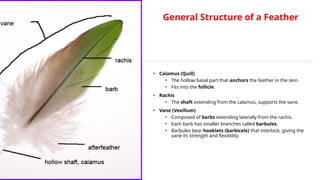
General Structure ofa Feather
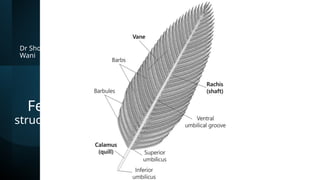
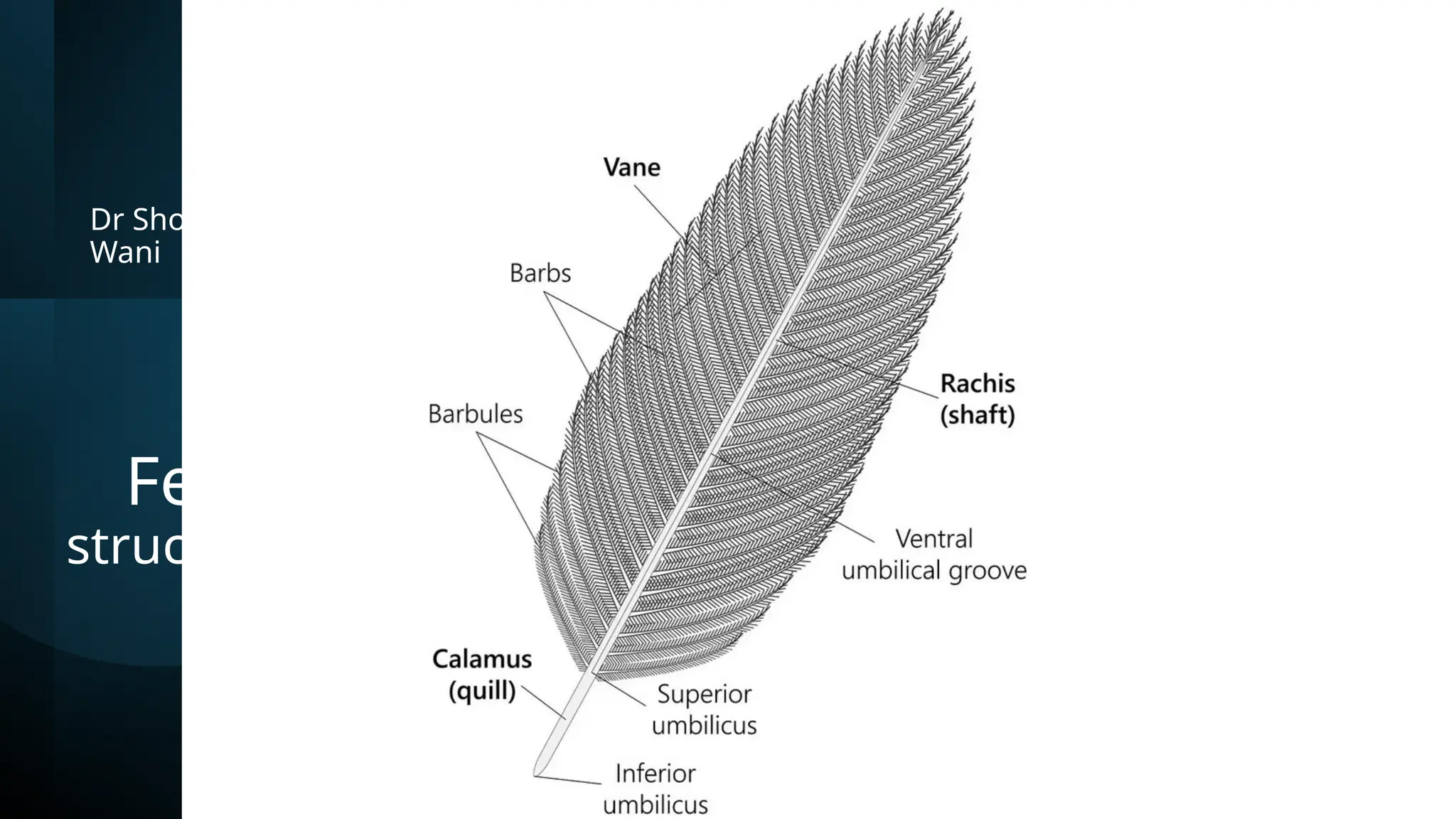
• Calamus (Quill)
• The hollow basal part that anchors the feather in the skin.
• Fits into the follicle.
• Rachis
• The shaft extending from the calamus, supports the vane.
• Vane (Vexillum)
• Composed of barbs extending laterally from the rachis.
• Each barb has smaller branches called barbules.
• Barbules bear hooklets (barbicels) that interlock, giving the
vane its strength and flexibility.
5.
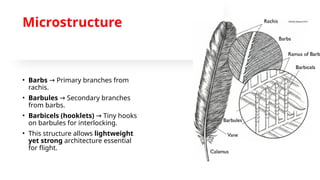
Microstructure
• Barbs Primarybranches from
→
rachis.
• Barbules Secondary branches
→
from barbs.
• Barbicels (hooklets) Tiny hooks
→
on barbules for interlocking.
• This structure allows lightweight
yet strong architecture essential
for flight.
6.
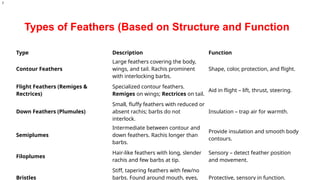
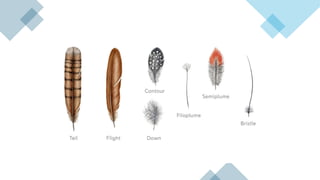
Types of Feathers(Based on Structure and Function
Type Description Function
Contour Feathers
Large feathers covering the body,
wings, and tail. Rachis prominent
with interlocking barbs.
Shape, color, protection, and flight.
Flight Feathers (Remiges &
Rectrices)
Specialized contour feathers.
Remiges on wings; Rectrices on tail.
Aid in flight – lift, thrust, steering.
Down Feathers (Plumules)
Small, fluffy feathers with reduced or
absent rachis; barbs do not
interlock.
Insulation – trap air for warmth.
Semiplumes
Intermediate between contour and
down feathers. Rachis longer than
barbs.
Provide insulation and smooth body
contours.
Filoplumes
Hair-like feathers with long, slender
rachis and few barbs at tip.
Sensory – detect feather position
and movement.
Bristles
Stiff, tapering feathers with few/no
barbs. Found around mouth, eyes, Protective, sensory in function.
)
8.
Specialized Feathers
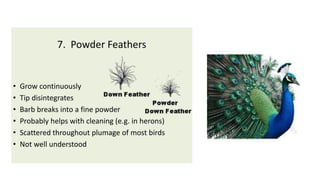
Powder downfeathers: Disintegrate into fine
keratin powder used for waterproofing (e.g.,
in herons).
Display feathers: Brightly colored or specially
shaped (e.g., peacock tail feathers) used in
courtship.
10.
Molting
• The processof shedding and replacement of feathers.
• Occurs seasonally or annually.
• Ensures maintenance of feather quality for insulation and
flight.
11.
Functions of Feathers
•Flight – Aerodynamic design aids in lift and thrust.
• Insulation – Down feathers maintain body temperature.
• Camouflage – Cryptic coloration helps in predator evasion.
• Communication and Courtship – Bright feathers used in
mating displays.
• Waterproofing – Especially in aquatic birds like ducks.
12.
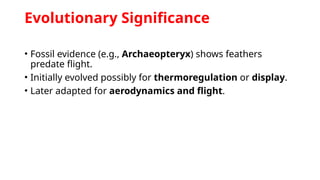
Evolutionary Significance
• Fossilevidence (e.g., Archaeopteryx) shows feathers
predate flight.
• Initially evolved possibly for thermoregulation or display.
• Later adapted for aerodynamics and flight.



![Polymer [ बहुलक ] Chemistry Notes PDF - Irfanullah Mehar - JJ Sir Chemistry.pdf](https://cdn.slidesharecdn.com/ss_thumbnails/polymerchemistrynotespdf-irfanullahmehar-jjsirchemistry-260210172118-3f9b37f7-thumbnail.jpg?width=640&height=640&fit=bounds)


