M . S C Z O O L O G Y P A R T I I
B Y
MaMMalian
CharaCteristiCs
NAVEED AKHTAR
NAVEED AKHTAR
ASSISTANT PROFESSOR OF ZOOLOGY
Lecture#1
Food and Feeding
Food and Feeding
 Mammals exploit an enormous variety of food
sources; some mammals require highly specialized
diets, whereas others are opportunistic feeders that
thrive on diversified diets.
 Food habits and physical structure are thus
inextricably linked.
 A mammal’s adaptations for attack and defense and
its specializations for finding, capturing, chewing,
swallowing, and digesting food all determine a
mammal’s shape and habits.
 Teeth, perhaps more than any other single physical
characteristic, reveal the life habit of a mammal
 With certain exceptions (monotremes, anteaters,
certain whales), all mammals have teeth, except
monotremes, anteaters, and certain whales, and
their modifications are correlated with what the
mammal eats.
 https://slidetodoc.com/dentition-teeth-of-
mammals-b-sc-ii-mrs/
Feeding Specializations
 The feeding, or trophic, apparatus of a mammal—
teeth and jaws, tongue, and alimentary canal—are
adapted to its particular feeding habits.
 Mammals are customarily divided among four basic
categories;
categories;
 1.Insectivores
 2.Carnivores
 3. Omnivores
 4.Herbivores
1. Insectivores
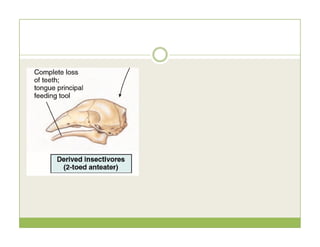
 Insectivores are small mammals such as shrews, moles,
anteaters, and most bats.
 They feed on insects, as well as a variety of small
invertebrates, such as worms and grubs. Since
insectivores eat little fibrous vegetable matter that
requires prolonged fermentation, their intestinal tract
tends to be short
 The insectivorous category is not a sharply distinguished
one because carnivores and omnivores may include
insects in their diets
 Even many rodents, which are considered herbivores,
may have a mixed diet of insect larvae, seeds, and fruits
2. Herbivores
 Herbivorous mammals that feed on grasses and
other vegetation form two main groups;
 Browsers and grazers, such as the ungulates
(hooved mammals including horses, deer, antelope,
cattle, sheep, and goats)
 Gnawers, such as the rodents, and rabbits and
hares
 Teeth Modifications
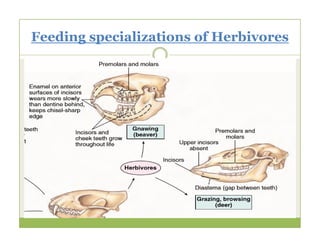
 In herbivores, the canines are absent or reduced
in size, whereas the molars, which are adapted for
grinding, are broad and usually high-crowned
 Rodents (for example, beavers) have chisel-sharp
incisors that grow throughout life and must be worn
away to keep pace with their continual growth
Feeding specializations of Herbivores
Digestive specializations of Herbivores
 Herbivorous mammals have a number of interesting
adaptations for dealing with their fibrous diet of
plant food.
 Cellulose, the structural carbohydrate of plants, is
composed of long chains of glucose molecules, and
therefore is a potentially nutritious food resource.
 However, the glucose molecules in cellulose are
linked by a type of chemical bond that few enzymes
can attack
 No vertebrates synthesize cellulose-splitting
enzymes.
 Instead, herbivorous vertebrates harbor anaerobic
bacteria and protozoa in huge fermentation
chambers in their gut.
 These microorganisms break down and metabolize
cellulose, releasing a variety of fatty acids, sugars,
and starches that the host animal can absorb and
utilize.
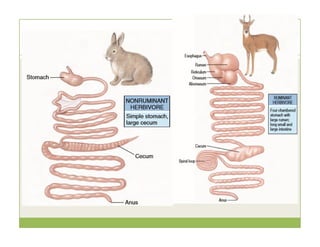
 Some herbivores, such as horses, zebras, rabbits,
hares, elephants, and many rodents, have a gut with
a spacious sidepocket, or diverticulum, called a
cecum, which serves as a fermentation chamber
and absorptive area
and absorptive area
 Hares, rabbits, and some rodents often eat their fecal
pellets (coprophagy), giving the food a second pass
through the fermenting action of the intestinal
microorganisms
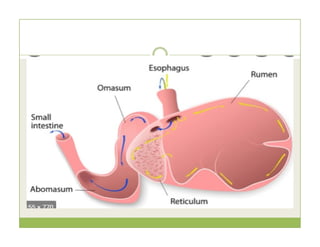
 Ruminants (cattle, bison, buffalo, goats, antelopes,
sheep, deer, giraffes, and okapis) have a huge four-
chambered stomach
 As a ruminant feeds, grass passes down the
esophagus to the rumen, where it is broken down
by microorganisms and then formed into small balls
of cud
 At its leisure, the ruminant returns the cud to its
mouth where the cud is deliberately chewed at length
to crush the fiber. Swallowed again, the food returns
 to the rumen where it is digested by the cellulolytic
microorganisms.
 The pulp passes to the reticulum, then to the
omasum, where water, soluble food, and microbial
products are absorbed
 The remainder proceeds to the abomasum
(“true” acid stomach), where proteolytic enzymes
are secreted and normal digestion takes place.
 Herbivores generally have large, long digestive tracts
and must eat a considerable amount of plant food to
survive.
 An African elephant weighing 6 tons must consume
135 to 150 kg (300 to 400 pounds) of rough fodder
each day to obtain sufficient nourishment for life
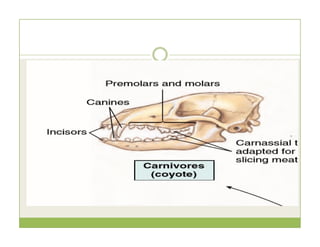
3. Carnivorous
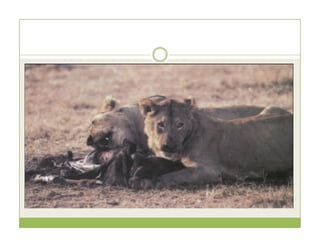
 Carnivorous mammals feed mainly on herbivores.
This group includes foxes, dogs, weasels, wolverines,
fishers, cats, lions, and tigers.
 Carnivores are well-equipped with biting and
piercing teeth and powerful clawed limbs for killing
their prey.
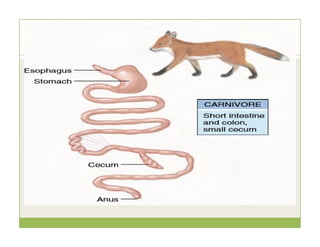
 Since their protein diet is more easily digested than
the woody food of herbivores, their digestive tract is
shorter and the cecum small or absent
 Carnivores organize their feeding into discrete meals
rather than feeding continuously (as do most
herbivores) and therefore have much more leisure
time
 In general, carnivores lead more active—and by
human standards more interesting—lives than do the
herbivores.
 Since a carnivore must find and catch its prey, there
is a premium on intelligence; many carnivores, such
as the cats, are noted for their stealth and cunning in
hunting prey
 In general, carnivores lead more active—and by human
standards more interesting—lives than do the herbivores.
 Since a carnivore must find and catch its prey, there is a
premium on intelligence; many carnivores, such as the cats,
are noted for their stealth and cunning in hunting prey
 This has led to a selection of herbivores capable either of
defending themselves or of detecting and escaping carnivores.
 Thus for herbivores, there has been a premium on keen
senses, speed and agility.
 Some herbivores, however, survive by virtue of their sheer size
(rhinos, elephants) or by defensive group behavior (for
example, muskoxen).
 Humans have changed the rules in the carnivore-
herbivore contest. Carnivores, despite their
intelligence, have suffered much from human
presence and have been virtually exterminated in
some areas.
some areas.
 Small herbivores, on the other hand, with their
potent reproductive ability, have consistently
defeated our most ingenious efforts to banish them
from our environment
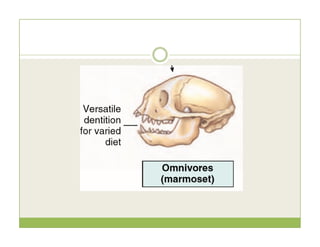
4. Omnivorous
 Omnivorous mammals—pigs, raccoons, rats, bears,
and most primates, including humans—live on both
plants and animals for food.
 Many carnivorous forms also eat fruits, berries, and
grasses when hard pressed. Foxes, which usually feed
on mice, small rodents, and birds, eat frozen apples,
beechnuts, and corn when their normal food sources
are scarce.
 For most mammals, searching for food and eating
occupy the majority of their active life.
 Seasonal changes in food supplies are considerable in
temperate zones.
 Living may be easy in the summer when food is
abundant, but in winter many carnivores must range far
and wide to eke out a narrow existence. Some migrate to
regions where food is more abundant while others
hibernate and sleep the winter months away
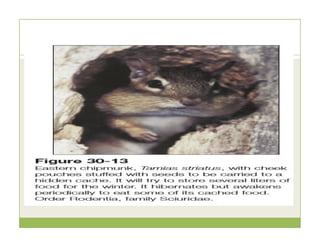
 Many mammals cache food stores during periods of
plenty. This habit is most pronounced in rodents, such as
squirrels, chipmunks, gophers, and certain mice.
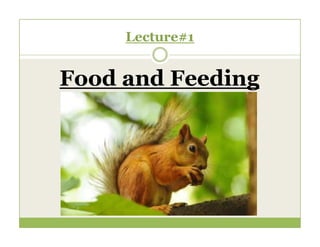
 All tree squirrels—red, fox, and gray—collect nuts,
conifer seeds, and fungi and store these in caches for
winter use.
 Often each item is hidden in a different place (scatter
hoarding) and marked by a scent to assist relocation
in the future. Some of the caches of chipmunks and
red squirrels can be quite large
Mammalian Characteristics

Mammalian Characteristics

  • 1.
    M . SC Z O O L O G Y P A R T I I B Y MaMMalian CharaCteristiCs NAVEED AKHTAR NAVEED AKHTAR ASSISTANT PROFESSOR OF ZOOLOGY ASSISTANT PROFESSOR OF ZOOLOGY
  • 2.
  • 3.
    Food and Feeding Mammals exploit an enormous variety of food sources; some mammals require highly specialized diets, whereas others are opportunistic feeders that thrive on diversified diets.  Food habits and physical structure are thus  Food habits and physical structure are thus inextricably linked.  A mammal’s adaptations for attack and defense and its specializations for finding, capturing, chewing, swallowing, and digesting food all determine a mammal’s shape and habits.
  • 4.
     Teeth, perhapsmore than any other single physical characteristic, reveal the life habit of a mammal  With certain exceptions (monotremes, anteaters, certain whales), all mammals have teeth, except monotremes, anteaters, and certain whales, and monotremes, anteaters, and certain whales, and their modifications are correlated with what the mammal eats.  https://slidetodoc.com/dentition-teeth-of- mammals-b-sc-ii-mrs/
  • 5.
    Feeding Specializations  Thefeeding, or trophic, apparatus of a mammal— teeth and jaws, tongue, and alimentary canal—are adapted to its particular feeding habits.  Mammals are customarily divided among four basic categories; categories;  1.Insectivores  2.Carnivores  3. Omnivores  4.Herbivores
  • 6.
    1. Insectivores  Insectivoresare small mammals such as shrews, moles, anteaters, and most bats.  They feed on insects, as well as a variety of small invertebrates, such as worms and grubs. Since insectivores eat little fibrous vegetable matter that requires prolonged fermentation, their intestinal tract requires prolonged fermentation, their intestinal tract tends to be short  The insectivorous category is not a sharply distinguished one because carnivores and omnivores may include insects in their diets  Even many rodents, which are considered herbivores, may have a mixed diet of insect larvae, seeds, and fruits
  • 8.
    2. Herbivores  Herbivorousmammals that feed on grasses and other vegetation form two main groups;  Browsers and grazers, such as the ungulates (hooved mammals including horses, deer, antelope, cattle, sheep, and goats) cattle, sheep, and goats)  Gnawers, such as the rodents, and rabbits and hares  Teeth Modifications  In herbivores, the canines are absent or reduced in size, whereas the molars, which are adapted for grinding, are broad and usually high-crowned
  • 9.
     Rodents (forexample, beavers) have chisel-sharp incisors that grow throughout life and must be worn away to keep pace with their continual growth
  • 10.
  • 11.
    Digestive specializations ofHerbivores  Herbivorous mammals have a number of interesting adaptations for dealing with their fibrous diet of plant food.  Cellulose, the structural carbohydrate of plants, is composed of long chains of glucose molecules, and composed of long chains of glucose molecules, and therefore is a potentially nutritious food resource.  However, the glucose molecules in cellulose are linked by a type of chemical bond that few enzymes can attack
  • 12.
     No vertebratessynthesize cellulose-splitting enzymes.  Instead, herbivorous vertebrates harbor anaerobic bacteria and protozoa in huge fermentation chambers in their gut. chambers in their gut.  These microorganisms break down and metabolize cellulose, releasing a variety of fatty acids, sugars, and starches that the host animal can absorb and utilize.
  • 13.
     Some herbivores,such as horses, zebras, rabbits, hares, elephants, and many rodents, have a gut with a spacious sidepocket, or diverticulum, called a cecum, which serves as a fermentation chamber and absorptive area and absorptive area  Hares, rabbits, and some rodents often eat their fecal pellets (coprophagy), giving the food a second pass through the fermenting action of the intestinal microorganisms
  • 15.
     Ruminants (cattle,bison, buffalo, goats, antelopes, sheep, deer, giraffes, and okapis) have a huge four- chambered stomach  As a ruminant feeds, grass passes down the esophagus to the rumen, where it is broken down esophagus to the rumen, where it is broken down by microorganisms and then formed into small balls of cud  At its leisure, the ruminant returns the cud to its mouth where the cud is deliberately chewed at length to crush the fiber. Swallowed again, the food returns
  • 16.
     to therumen where it is digested by the cellulolytic microorganisms.  The pulp passes to the reticulum, then to the omasum, where water, soluble food, and microbial products are absorbed products are absorbed  The remainder proceeds to the abomasum (“true” acid stomach), where proteolytic enzymes are secreted and normal digestion takes place.
  • 17.
     Herbivores generallyhave large, long digestive tracts and must eat a considerable amount of plant food to survive.  An African elephant weighing 6 tons must consume 135 to 150 kg (300 to 400 pounds) of rough fodder 135 to 150 kg (300 to 400 pounds) of rough fodder each day to obtain sufficient nourishment for life
  • 19.
    3. Carnivorous  Carnivorousmammals feed mainly on herbivores. This group includes foxes, dogs, weasels, wolverines, fishers, cats, lions, and tigers.  Carnivores are well-equipped with biting and piercing teeth and powerful clawed limbs for killing piercing teeth and powerful clawed limbs for killing their prey.  Since their protein diet is more easily digested than the woody food of herbivores, their digestive tract is shorter and the cecum small or absent
  • 20.
     Carnivores organizetheir feeding into discrete meals rather than feeding continuously (as do most herbivores) and therefore have much more leisure time  In general, carnivores lead more active—and by  In general, carnivores lead more active—and by human standards more interesting—lives than do the herbivores.  Since a carnivore must find and catch its prey, there is a premium on intelligence; many carnivores, such as the cats, are noted for their stealth and cunning in hunting prey
  • 23.
     In general,carnivores lead more active—and by human standards more interesting—lives than do the herbivores.  Since a carnivore must find and catch its prey, there is a premium on intelligence; many carnivores, such as the cats, are noted for their stealth and cunning in hunting prey  This has led to a selection of herbivores capable either of  This has led to a selection of herbivores capable either of defending themselves or of detecting and escaping carnivores.  Thus for herbivores, there has been a premium on keen senses, speed and agility.  Some herbivores, however, survive by virtue of their sheer size (rhinos, elephants) or by defensive group behavior (for example, muskoxen).
  • 24.
     Humans havechanged the rules in the carnivore- herbivore contest. Carnivores, despite their intelligence, have suffered much from human presence and have been virtually exterminated in some areas. some areas.  Small herbivores, on the other hand, with their potent reproductive ability, have consistently defeated our most ingenious efforts to banish them from our environment
  • 26.
    4. Omnivorous  Omnivorousmammals—pigs, raccoons, rats, bears, and most primates, including humans—live on both plants and animals for food.  Many carnivorous forms also eat fruits, berries, and grasses when hard pressed. Foxes, which usually feed grasses when hard pressed. Foxes, which usually feed on mice, small rodents, and birds, eat frozen apples, beechnuts, and corn when their normal food sources are scarce.  For most mammals, searching for food and eating occupy the majority of their active life.
  • 27.
     Seasonal changesin food supplies are considerable in temperate zones.  Living may be easy in the summer when food is abundant, but in winter many carnivores must range far and wide to eke out a narrow existence. Some migrate to and wide to eke out a narrow existence. Some migrate to regions where food is more abundant while others hibernate and sleep the winter months away  Many mammals cache food stores during periods of plenty. This habit is most pronounced in rodents, such as squirrels, chipmunks, gophers, and certain mice.
  • 28.
     All treesquirrels—red, fox, and gray—collect nuts, conifer seeds, and fungi and store these in caches for winter use.  Often each item is hidden in a different place (scatter hoarding) and marked by a scent to assist relocation hoarding) and marked by a scent to assist relocation in the future. Some of the caches of chipmunks and red squirrels can be quite large