Amity Institute of Pharmacy
Biosafety Guidelines Government of India
Presented by
Shivanki verma
M. Pharm. 3rd sem.
(Pharmacology)
A8454916002
Submitted to
Ms. Nimisha Srivastva
Assistant Professor AIP, AUUP
AMITY INSTITUTE OF PHARMACY
AMITY UNIVERSITY UTTAR PRADESH
LUCKNOW, INDIA
2017
1
Amity Institute of Pharmacy
CONTENTS
1. INTRODUCTION
2. HISTORY AND NECCESITY
3. BIOSAFETY LEVEL
4. RECOMMENDED BIOSAFETY LEVEL FOR INFECTIOUS AGENT
5. BIOSAFETY GUIDELINES- GOVERNMENT OF INDIA
6. ROLE OF INSTITUTIONAL BIOSAFETY COMMITTEE
7. CONTAINMENT
2
Amity Institute of Pharmacy
BIOSAFETY
1. Biosafety define the bio-containment (prevention from microbes) conditions under which
infectious agents can be safely manipulated.
2. “Biosafety” refers to the efforts that ensure safety in using, transporting, transferring, and
realsing biological organism including genetically modified organism which are capable of
harming humans, animals, plants or environment.[1]
3
Amity Institute of Pharmacy
HISTORY AND NECCESITY OF BIOSAFETY
 Innovation and development of biosafety in the United States is reflected accurately
in the history and pre-history of the American Biological Safety Association (ABSA).
 The first unofficial meeting was held on April 18, 1955 at Camp Detrick in the presence
of 14 representatives from three principle laboratories of U.S. Army.
 New safety programs and trainings were introduced which were related to biosafety
chemical, radiological and industrial safety issue.
 Later in the united states the Centers for disease control (CDC) specified 4 different
level of biocontainment which ranges from biosafety level-1 to biosafety level -4.
NECCESITY-
 In order to avoid infections /biohazards to the laboratory personnel and the environment
biosafety levels are very important.[1]
4
Amity Institute of Pharmacy
5
BIOSAFETY LEVEL
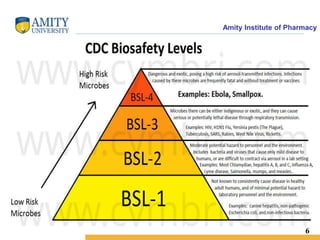
 A biosafety level is a set of biocontainment precautions required to isolate dangerous
biological agents in an enclosed laboratory facility.
 The levels of containment range from the lowest biosafety level 1 (BSL-1) to the highest
at level 4 (BSL-4).
 In the United States, the Centers for Disease Control and Prevention (CDC) have
specified these levels.
 The CDC is the leading national public health institute of the United States.
 Its main goal is to protect public health and safety through the control and prevention of
disease, injury, and disability in the US and internationally.[1]
Amity Institute of Pharmacy
6
Amity Institute of Pharmacy
7
BSL Agent Practice Primary barriers and
safety equipment
Facilities
(secondary
Barriers)
1.
Not known to
consistently cause
diseases in healthy
adults
• Standard
microbiologial
practice
• PPE: laboratory coats
and gloves; eye, face
protection, as needed
Laboratory
bench and sink
RECOMMENDED BIOSAFETY LEVEL FOR INFECTIOUS
AGENT
Amity Institute of Pharmacy
8
BSL Agent Practice Primary barriers and
safety equipment
Facilities
(secondary
Barriers)
2.
• Agents
associated with
human disease
• Routes of
transmission
include –
injury, ingestion,
mucous
membrane
exposure
BSL-1 practice
plus:
• Biohazard
warning signs
• “Sharps”
precautions
• Biosafety
manual defining
any needed
waste
decontamination
or medical
surveillance
policies
Primary barriers:
• BSCs or other
physical containment
devices used for all
manipulations of agents
that cause aerosols
transmitted infection
• PPE: Laboratory
coats, gloves, face and
eye protection, as
needed
BSL-1 plus
Autoclave
available
[2
Amity Institute of Pharmacy
9
BSL Agent Practice Primary barriers and
safety equipment
Facilities (secondary
Barriers)
3.
Indigenous or
exotic agents
that may cause
serious or
potentially
lethal disease
through the
inhalation route
of exposure
BSL-2
practice plus:
• Controlled
access
•
Decontamina
tion of all
waste
•
Decontamina
tion of
laboratory
clothing
Primary barriers:
• BSCs or other physical
containment devices
used for all open
manipulations of agents
• PPE: Protective
laboratory clothing,
gloves, face, eye and
respiratory protection, as
needed
Physical separation
from access corridors
• Self-closing, double-
door access
• Exhausted air not
re-circulated
• Hand washing sink
near laboratory exit
[2]
Amity Institute of Pharmacy
10
BSL Agent Practice Primary barriers
and safety equipment
Facilities
(secondary
Barriers)
4.
•
Dangerous/exotic
agents which post
high individual
risk of aerosol-
transmitted
laboratory
infections that are
frequently fatal,
BSL-3 practices
plus:
• Clothing
change before
entering
• Shower on
exit
• All material
decontaminated
on exit from
facility
Primary barriers:
• All procedures
conducted in Class III
BSCs or Class I or II
BSCs in combination
with full body, air-
supplied, positive
pressure suit
• Separate
building or
isolated zone
• Dedicated
supply and
exhaust,
vacuum, and
decontamination
systems
• Other
requirements
outlined in the
text
[2]
Amity Institute of Pharmacy
BIOSAFETY GUIDELINES- GOVERNMENT OF INDIA
11
 Policy proposed or adopted by the Government to avoid the risks of GEOs on
environment and public health.
 Minimizing the possibilities of occasional release of GEOs from the laboratory.
Banning the release of GEOs if they are supposed to be causing potential risks in the
environment .
rDNA Biosafety Guidelines Of India
 The Indian Government first issued rules and procedures for handling GM organisms
in December 1989. The Department of Biotechnology, inside the Ministry of Science
and Technology, published these rules and procedures in January 1990 (Department of
Biotechnology 1990).
 These guidelines deals with a set of rules for production, use, import, export and
storage of hazardous organisms.[3]
Amity Institute of Pharmacy
ROLE OF INSTITUTIONAL BIOSAFETY COMMITTEE
The role of IBSC in research, large-scale experiments/ production/field release:
1. Research activities related to rDNA technology: IBSC has to
review all recombinant research carried out by an organisation depending upon the
category of experiments, it follows Recombinant DNA Safety Guidelines,
• Category I experiments involving self cloning, using strains and also inter species
cloning belonging to organism in the same exchanger group etc.
• Category II experiments falling under containment levels II, III and IV, large scale use
of recombinants made of self cloning in systems belonging to exempt category etc.
• Category III experiments involving toxin gene cloning, cloning of genes for vaccine
production, use of infectious animals and plant viruses, self fusion experiments, field
testing and release of GMOs etc. require review and approval of IBSC before
commencement. 12
Amity Institute of Pharmacy

1.In case of research activities related to transgenic plants, IBSCs shall follow “Revised
Guidelines for Research in Transgenic Plant, 1998” by DBT .
2. Permission provided by IBSC but the decision of the IBSC needs to be intimated to
the RCGM (review committee on genetic manipulation).
3. Such experiments could be conducted only after clearance from RCGM and notified
by DBT.
13
Research activities related to transgenic plant
Amity Institute of Pharmacy
14
3. Large scale trails and production
 IBSC has to verify the information being forwarded to RCGM and GEAC(Genetic
Engineering Appraisal Committee ) in terms of physical containment.
 IBSC has to recommend emergency plan in case of large-scale operations, as and when
required, which would be then approved by competent authorities i.e. RCGM and GEAC.
 Emergency plan shall include methods and procedures for handling large volumes of
cultures and organisms for production, transport, storage or disposal etc.
4. Import and transfer/shipment
 Need clearance of IBSC and is subject to appropriate packaging, labeling and shipping
requirements.
Amity Institute of Pharmacy
In India, the rDNA guidelines has been implanted through
three committees-
15
Institutional biosafety committee (IBSC)- controls research activities at institutional
level.
Review committee on genetic manipulation(RCGM)- reviews special situations where
research with hazardous organisms in laboratory and grants permission to do that
research.
Genetic engineering approval committee(GEAC)- approves the GEOs for large scale
production and use in India.
Amity Institute of Pharmacy
CONTAINMENT
16
 The term "Containment" is used in describing the safe methods for managing
infectious agents in the laboratory environment where they are being handled or
maintained.
 The containment are two types-
 Physical containment
 Biological containment
PHYSICAL CONTAINMENT It works on the principal of physical
barriers
 Air filtration
 Sterilization lights
 Waste disposal
 Protective handling
Amity Institute of Pharmacy
BIOLOGICAL CONTAINMENT
17
 The biological principles used in the laboratories to prevent GEOs or
microbes .
 Biological containment makes the organisms unable to survive in the
outside environment.
Amity Institute of Pharmacy
18
REFERENCE-
1. https://en.wikipedia.org/wiki/Biosafety_level
2. https://usciences.blackboard.com
3.http://www.agbioworld.org/biotech-info/topics/dev-world/policies4.html
Amity Institute of Pharmacy
THANK YOU
19

Biosafety level

  • 1.
    Amity Institute ofPharmacy Biosafety Guidelines Government of India Presented by Shivanki verma M. Pharm. 3rd sem. (Pharmacology) A8454916002 Submitted to Ms. Nimisha Srivastva Assistant Professor AIP, AUUP AMITY INSTITUTE OF PHARMACY AMITY UNIVERSITY UTTAR PRADESH LUCKNOW, INDIA 2017 1
  • 2.
    Amity Institute ofPharmacy CONTENTS 1. INTRODUCTION 2. HISTORY AND NECCESITY 3. BIOSAFETY LEVEL 4. RECOMMENDED BIOSAFETY LEVEL FOR INFECTIOUS AGENT 5. BIOSAFETY GUIDELINES- GOVERNMENT OF INDIA 6. ROLE OF INSTITUTIONAL BIOSAFETY COMMITTEE 7. CONTAINMENT 2
  • 3.
    Amity Institute ofPharmacy BIOSAFETY 1. Biosafety define the bio-containment (prevention from microbes) conditions under which infectious agents can be safely manipulated. 2. “Biosafety” refers to the efforts that ensure safety in using, transporting, transferring, and realsing biological organism including genetically modified organism which are capable of harming humans, animals, plants or environment.[1] 3
  • 4.
    Amity Institute ofPharmacy HISTORY AND NECCESITY OF BIOSAFETY  Innovation and development of biosafety in the United States is reflected accurately in the history and pre-history of the American Biological Safety Association (ABSA).  The first unofficial meeting was held on April 18, 1955 at Camp Detrick in the presence of 14 representatives from three principle laboratories of U.S. Army.  New safety programs and trainings were introduced which were related to biosafety chemical, radiological and industrial safety issue.  Later in the united states the Centers for disease control (CDC) specified 4 different level of biocontainment which ranges from biosafety level-1 to biosafety level -4. NECCESITY-  In order to avoid infections /biohazards to the laboratory personnel and the environment biosafety levels are very important.[1] 4
  • 5.
    Amity Institute ofPharmacy 5 BIOSAFETY LEVEL  A biosafety level is a set of biocontainment precautions required to isolate dangerous biological agents in an enclosed laboratory facility.  The levels of containment range from the lowest biosafety level 1 (BSL-1) to the highest at level 4 (BSL-4).  In the United States, the Centers for Disease Control and Prevention (CDC) have specified these levels.  The CDC is the leading national public health institute of the United States.  Its main goal is to protect public health and safety through the control and prevention of disease, injury, and disability in the US and internationally.[1]
  • 6.
  • 7.
    Amity Institute ofPharmacy 7 BSL Agent Practice Primary barriers and safety equipment Facilities (secondary Barriers) 1. Not known to consistently cause diseases in healthy adults • Standard microbiologial practice • PPE: laboratory coats and gloves; eye, face protection, as needed Laboratory bench and sink RECOMMENDED BIOSAFETY LEVEL FOR INFECTIOUS AGENT
  • 8.
    Amity Institute ofPharmacy 8 BSL Agent Practice Primary barriers and safety equipment Facilities (secondary Barriers) 2. • Agents associated with human disease • Routes of transmission include – injury, ingestion, mucous membrane exposure BSL-1 practice plus: • Biohazard warning signs • “Sharps” precautions • Biosafety manual defining any needed waste decontamination or medical surveillance policies Primary barriers: • BSCs or other physical containment devices used for all manipulations of agents that cause aerosols transmitted infection • PPE: Laboratory coats, gloves, face and eye protection, as needed BSL-1 plus Autoclave available [2
  • 9.
    Amity Institute ofPharmacy 9 BSL Agent Practice Primary barriers and safety equipment Facilities (secondary Barriers) 3. Indigenous or exotic agents that may cause serious or potentially lethal disease through the inhalation route of exposure BSL-2 practice plus: • Controlled access • Decontamina tion of all waste • Decontamina tion of laboratory clothing Primary barriers: • BSCs or other physical containment devices used for all open manipulations of agents • PPE: Protective laboratory clothing, gloves, face, eye and respiratory protection, as needed Physical separation from access corridors • Self-closing, double- door access • Exhausted air not re-circulated • Hand washing sink near laboratory exit [2]
  • 10.
    Amity Institute ofPharmacy 10 BSL Agent Practice Primary barriers and safety equipment Facilities (secondary Barriers) 4. • Dangerous/exotic agents which post high individual risk of aerosol- transmitted laboratory infections that are frequently fatal, BSL-3 practices plus: • Clothing change before entering • Shower on exit • All material decontaminated on exit from facility Primary barriers: • All procedures conducted in Class III BSCs or Class I or II BSCs in combination with full body, air- supplied, positive pressure suit • Separate building or isolated zone • Dedicated supply and exhaust, vacuum, and decontamination systems • Other requirements outlined in the text [2]
  • 11.
    Amity Institute ofPharmacy BIOSAFETY GUIDELINES- GOVERNMENT OF INDIA 11  Policy proposed or adopted by the Government to avoid the risks of GEOs on environment and public health.  Minimizing the possibilities of occasional release of GEOs from the laboratory. Banning the release of GEOs if they are supposed to be causing potential risks in the environment . rDNA Biosafety Guidelines Of India  The Indian Government first issued rules and procedures for handling GM organisms in December 1989. The Department of Biotechnology, inside the Ministry of Science and Technology, published these rules and procedures in January 1990 (Department of Biotechnology 1990).  These guidelines deals with a set of rules for production, use, import, export and storage of hazardous organisms.[3]
  • 12.
    Amity Institute ofPharmacy ROLE OF INSTITUTIONAL BIOSAFETY COMMITTEE The role of IBSC in research, large-scale experiments/ production/field release: 1. Research activities related to rDNA technology: IBSC has to review all recombinant research carried out by an organisation depending upon the category of experiments, it follows Recombinant DNA Safety Guidelines, • Category I experiments involving self cloning, using strains and also inter species cloning belonging to organism in the same exchanger group etc. • Category II experiments falling under containment levels II, III and IV, large scale use of recombinants made of self cloning in systems belonging to exempt category etc. • Category III experiments involving toxin gene cloning, cloning of genes for vaccine production, use of infectious animals and plant viruses, self fusion experiments, field testing and release of GMOs etc. require review and approval of IBSC before commencement. 12
  • 13.
    Amity Institute ofPharmacy  1.In case of research activities related to transgenic plants, IBSCs shall follow “Revised Guidelines for Research in Transgenic Plant, 1998” by DBT . 2. Permission provided by IBSC but the decision of the IBSC needs to be intimated to the RCGM (review committee on genetic manipulation). 3. Such experiments could be conducted only after clearance from RCGM and notified by DBT. 13 Research activities related to transgenic plant
  • 14.
    Amity Institute ofPharmacy 14 3. Large scale trails and production  IBSC has to verify the information being forwarded to RCGM and GEAC(Genetic Engineering Appraisal Committee ) in terms of physical containment.  IBSC has to recommend emergency plan in case of large-scale operations, as and when required, which would be then approved by competent authorities i.e. RCGM and GEAC.  Emergency plan shall include methods and procedures for handling large volumes of cultures and organisms for production, transport, storage or disposal etc. 4. Import and transfer/shipment  Need clearance of IBSC and is subject to appropriate packaging, labeling and shipping requirements.
  • 15.
    Amity Institute ofPharmacy In India, the rDNA guidelines has been implanted through three committees- 15 Institutional biosafety committee (IBSC)- controls research activities at institutional level. Review committee on genetic manipulation(RCGM)- reviews special situations where research with hazardous organisms in laboratory and grants permission to do that research. Genetic engineering approval committee(GEAC)- approves the GEOs for large scale production and use in India.
  • 16.
    Amity Institute ofPharmacy CONTAINMENT 16  The term "Containment" is used in describing the safe methods for managing infectious agents in the laboratory environment where they are being handled or maintained.  The containment are two types-  Physical containment  Biological containment PHYSICAL CONTAINMENT It works on the principal of physical barriers  Air filtration  Sterilization lights  Waste disposal  Protective handling
  • 17.
    Amity Institute ofPharmacy BIOLOGICAL CONTAINMENT 17  The biological principles used in the laboratories to prevent GEOs or microbes .  Biological containment makes the organisms unable to survive in the outside environment.
  • 18.
    Amity Institute ofPharmacy 18 REFERENCE- 1. https://en.wikipedia.org/wiki/Biosafety_level 2. https://usciences.blackboard.com 3.http://www.agbioworld.org/biotech-info/topics/dev-world/policies4.html
  • 19.
    Amity Institute ofPharmacy THANK YOU 19