INTRODUCTION
• Recombinant deoxyribonucleicacid (rDNA) by definition involves in vitro
introduction of different segments of DNA (one being the vector and the
others normally unrelated DNA sequences) that are capable of replication in a
host cell either autonomously or as an integral part of host's genome and
maintenance of their continued propagation.
• This will include all types of cell fusion, microinjection of DNA or RNA or parts
or all of chromosomes, genetic engineering including self cloning and deletion
as well as cell hybridation, transformation and other types of virus or
pathogen introduction into unnatural hosts.
3.
• The organismsinvolved may belong to these categories:
1. i) Intergeneric organisms
ii) Well defined organisms with non-coding regulatory regions
2. i) Biological agents whose source of DNA is a pathogen
ii) Organisms that are generally recognised as non-pathogenic and may
imbibe the characteristics of a pathogen on genetic manipulation
4.
CLASSIFICATION OF PATHOGENICORGANISMS
• The classification of infective microorganisms are drawn up under 4 risk
groups in increasing order of risk based on the following parameters:
• pathogenicity of the agent
• modes of transmission and host range of the agent
• availability of effective preventive treatments or curative medicines
• capability to cause diseases to humans/animals/plants
• epidemic causing strains in India
• OTHER INFLUENCES: levels of immunity, density and movement of host
population, presence of vectors for transmission and standards of
environmental hygiene
5.
CONTAINMENT
• The term"Containment" is used in describing the safe methods for managing
infectious agents in the laboratory environment where they are being handled
or maintained.
• Purpose of containment
• To reduce exposure of laboratory workers, other persons, and outside
environment to potentially hazardous agents
6.
TYPES OF CONTAINMENT
•Biological containment (BC):
• In consideration of biological containment, the vector (plasmid, organelle, or
virus) for the recombinant DNA and the host (bacterial, plant, or animal cell)
in which the vector is propagated in the laboratory will be considered
together.
• Any combination of vector and host which is to provide biological
containment must be chosen or constructed to limit the infectivity of vector
to specific hosts and control the host-vector survival in the environment.
• These have been categorized into two levels - one permitting standard
biological containment and the other even higher that relates to normal and
disabled host-vector systems respective
7.
TYPES OF CONTAINMENT
•Physical Containment (PC):
The objective of physical containment is to confine recombinant organisms thereby preventing the
exposure of the researcher and the environment to the harmful agents.
Physical containment is achieved through the use of
i) Laboratory Practice,
ii) Containment Equipment, and
iii) Special Laboratory Design.
• The protection of personnel and the immediate laboratory environment from exposure to
infectious agents, is provided by good microbiological techniques and the use of appropriate
safety equipment, (Primary Containment).
• The protection of the environment external to the laboratory from exposure to infectious
materials, is provided by a combination of facility design and operational practices, (Secondary
Containment).
8.
ELEMENTS OF CONTAINMENT
•The three elements of containment include laboratory practice and technique,
safety equipment and facility design
• Laboratory practice and technique:
• Strict adherence to standard microbiological practices and techniques
• Awareness of potential hazards
• Providing/arranging for appropriate training of personnel
• Selection of safety practices in addition to standard laboratory practices if
required
• Developing of adopting a biosafety or operations manual which identifies
the hazard
9.
• Safety equipment(primary barriers):
• Safety equipment includes biological safety cabinets and a variety of enclosed
containers (e.g. safety centrifuge cup).
• The biological safety cabinet (BSC) is the principal device used to provide
containment of infectious aerosols generated by many microbiological
procedures.
• Three types of BSCs (Class I, II, III) are used in microbiological laboratories.
Safety equipment also includes items for personal protection such as gloves,
coats, gowns, shoe covers, boots, respirators, face shields and safety glasses,
etc.
10.
• Facility Design(Secondary barriers):
• The design of the facility is important in providing a barrier to protect persons
working in the facility but outside of the laboratory and those in the
community from infectious agents which may be accidentally released from
the laboratory.
• There are three types of facility designs: viz, the Basic Laboratory (for Risk
Group I and II), the Containment Laboratory (for Risk Group III) and the
Maximum Containment Laboratory (for Risk Group IV).
11.
BIOSAFETY LEVELS
• Itconsists of a combination of laboratory practices and techniques, safety
equipment and laboratory facilities appropriate for the operations performed
and the hazard posed by the infectious agents.
• The guidelines for Microbiological and Biomedical Laboratories suggest four
Biosafety levels in incremental order depending on the nature of work.
• Additional flexibility in containment levels can be obtained by combination of
the physical with the biological barriers.
• The proposed safety levels for work with recombinant DNA technique take
into consideration the source of the donor DNA and its disease-producing
potential.
• These four levels corresponds to (P1<P2<P3<P4) facilities approximate to 4
risk groups assigned for etiologic agents.
12.
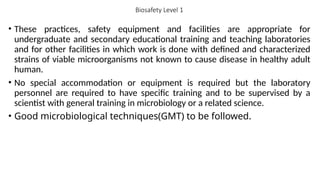
Biosafety Level 1
•These practices, safety equipment and facilities are appropriate for
undergraduate and secondary educational training and teaching laboratories
and for other facilities in which work is done with defined and characterized
strains of viable microorganisms not known to cause disease in healthy adult
human.
• No special accommodation or equipment is required but the laboratory
personnel are required to have specific training and to be supervised by a
scientist with general training in microbiology or a related science.
• Good microbiological techniques(GMT) to be followed.
13.
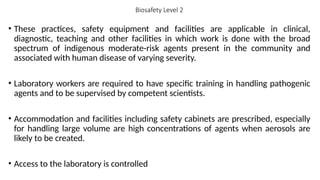
Biosafety Level 2
•These practices, safety equipment and facilities are applicable in clinical,
diagnostic, teaching and other facilities in which work is done with the broad
spectrum of indigenous moderate-risk agents present in the community and
associated with human disease of varying severity.
• Laboratory workers are required to have specific training in handling pathogenic
agents and to be supervised by competent scientists.
• Accommodation and facilities including safety cabinets are prescribed, especially
for handling large volume are high concentrations of agents when aerosols are
likely to be created.
• Access to the laboratory is controlled
14.
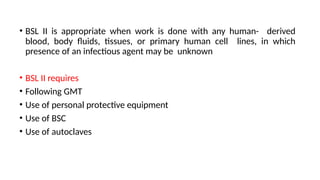
• BSL IIis appropriate when work is done with any human- derived
blood, body fluids, tissues, or primary human cell lines, in which
presence of an infectious agent may be unknown
• BSL II requires
• Following GMT
• Use of personal protective equipment
• Use of BSC
• Use of autoclaves
15.
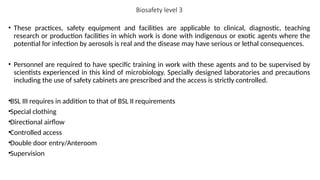
Biosafety level 3
•These practices, safety equipment and facilities are applicable to clinical, diagnostic, teaching
research or production facilities in which work is done with indigenous or exotic agents where the
potential for infection by aerosols is real and the disease may have serious or lethal consequences.
• Personnel are required to have specific training in work with these agents and to be supervised by
scientists experienced in this kind of microbiology. Specially designed laboratories and precautions
including the use of safety cabinets are prescribed and the access is strictly controlled.
•BSL III requires in addition to that of BSL II requirements
•Special clothing
•Directional airflow
•Controlled access
•Double door entry/Anteroom
•Supervision
16.
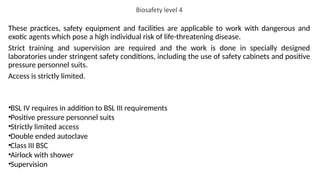
Biosafety level 4
Thesepractices, safety equipment and facilities are applicable to work with dangerous and
exotic agents which pose a high individual risk of life-threatening disease.
Strict training and supervision are required and the work is done in specially designed
laboratories under stringent safety conditions, including the use of safety cabinets and positive
pressure personnel suits.
Access is strictly limited.
•BSL IV requires in addition to BSL III requirements
•Positive pressure personnel suits
•Strictly limited access
•Double ended autoclave
•Class III BSC
•Airlock with shower
•Supervision
17.
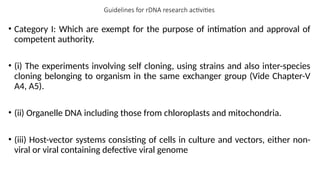
Guidelines for rDNAresearch activities
• Category I: Which are exempt for the purpose of intimation and approval of
competent authority.
• (i) The experiments involving self cloning, using strains and also inter-species
cloning belonging to organism in the same exchanger group (Vide Chapter-V
A4, A5).
• (ii) Organelle DNA including those from chloroplasts and mitochondria.
• (iii) Host-vector systems consisting of cells in culture and vectors, either non-
viral or viral containing defective viral genome
18.
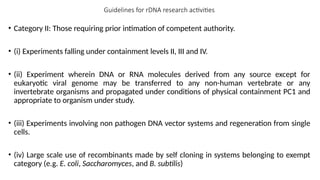
Guidelines for rDNAresearch activities
• Category II: Those requiring prior intimation of competent authority.
• (i) Experiments falling under containment levels II, III and IV.
• (ii) Experiment wherein DNA or RNA molecules derived from any source except for
eukaryotic viral genome may be transferred to any non-human vertebrate or any
invertebrate organisms and propagated under conditions of physical containment PC1 and
appropriate to organism under study.
• (iii) Experiments involving non pathogen DNA vector systems and regeneration from single
cells.
• (iv) Large scale use of recombinants made by self cloning in systems belonging to exempt
category (e.g. E. coli, Saccharomyces, and B. subtilis)
19.
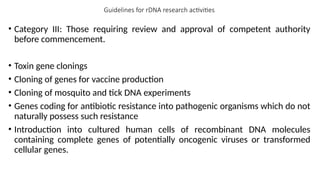
Guidelines for rDNAresearch activities
• Category III: Those requiring review and approval of competent authority
before commencement.
• Toxin gene clonings
• Cloning of genes for vaccine production
• Cloning of mosquito and tick DNA experiments
• Genes coding for antibiotic resistance into pathogenic organisms which do not
naturally possess such resistance
• Introduction into cultured human cells of recombinant DNA molecules
containing complete genes of potentially oncogenic viruses or transformed
cellular genes.
20.
Guidelines for rDNAresearch activities
• Introduction into animal cells of unidentified DNA molecules derived from
cancer cells or in vitro transformed cells.
• Experiments involving the use of infectious animal and plant viruses in tissue
culture systems.
• Experiments involving gene transfer to whole plants and animals.
• Cell fusion experiments of Animal cells containing sequences from viral
vectors if the sequence lead to transmissible infection either directly or
indirectly as a result of complementation or recombination in the animal
21.
Guidelines for rDNAresearch activities
• Transgenosis in animal experiments
• All experiments involving the genetic manipulation of plant pathogens and the
use of such genetically manipulated plant pathogens would require approval
of competent authority
• Transfer of genes with known toxicity to plants using Agrobacterium
tumefaciens or other vectors.
• In case of plant viruses, permission may be obtained only when it is known
that there is a chance of non-species specific spread of infection to plants that
could produce changes in pathogenicity host range or vector transmissibility.
22.
Guidelines for rDNAresearch activities
• Experiments requiring field testing and release of rDNA engineered microorganisms and
plants
• Experiments involving engineered microbes with deletions and certain rearrangements.
• Diagnostics: No major risk can be foreseen on diagnostics involving in vitro tests. But for
diagnostics involving in vivo tests, specific containment levels have to be prescribed on
case by case basis.
• For example, tuberculin moiety could be cloned and used for in vivo hypersensitivity
test as a diagnostic method.
• Gene therapy for hereditary diseases of genetic disorders.