BIOMETRICS
Mr. Mayank David Raiborde,
Assistant Professor,
Dept. of Forensic Science,
Kristu Jayanti College, Bengaluru
Overview
• What is Biometrics?
• Measures
• Biometric System
• Modes of Operation
• Modules
• Types of Biometric Recognition
• Applications
• Advantages/Disadvantages
What is Biometrics?
Methods of identifying a person based on
Physiological or Behavioral characteristic.
• Physiological- Hand or finger images, facial
characteristic, speak verification, iris recognition.
• Behavioral- Dynamic Signature Verification and
Keystroke Dynamics.
What Biological Measures Qualify to be a
Biometric
• Universality- Each person should have the characteristic.
• Distinctiveness- Two persons should be different in terms
of characteristics.
• Permanence- Characteristic should be invariant of time.
• Collectability- Characteristic should be measured
Quantitatively.
Biometric Systems
A biometric system is a pattern recognition system
that operates by
o Acquiring Biometric data from an Individual.
o Extracting Feature Set from the Data.
o Comparing the Feature Set with the Template in the
Database.
Operation Modes Of Biometrics
There are two modes of operation.
o Verification Mode
o Identification Mode.
• Depending on the Application Context, Biometric System
can work either on Verification Mode or in Identification
Mode.
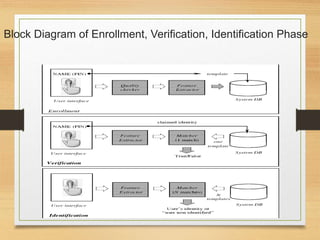
Block Diagram of Enrollment, Verification, Identification Phase
INTRODUCTION TO BIOMETRIC RECOGNITION
k diagrams of enrollment, verification, and identification tasks are shown using the four main modules of a biometric system, i.e.,
tcher, and system database.
Operational Modes Contd.
• In Verification mode, the system validates the
person’s identity by comparing the captured
biometric data with the template stored in the
database. This template is stored in the
Enrollment phase.
• In Identification mode the system identifies
the person by searching the templates of all
users in the database for a match. One to
many Comparison.
Modules needed to build a Biometric System
• Sensor module
• Feature Extraction module
• Matcher Module
• System Database Module
1. Sensor Module- It captures the Biometric data of an
Individual. An example can be a Fingerprint Sensor.
2. Feature Extraction Module- Here the obtained biometric data
of an Individual is processed to extract features. Example can be
the Local ridge feature extraction from a Fingerprint.
3. Matcher Module- Here the features extracted during the above
phase are matched against the templates stored in the database.
4. System Database Module- Used to Store Biometric templates
of the users enrolled. The enrollment module is responsible for
Enrolling Individuals to the database.
Types of Biometric Recognition
Common Techniques
• Fingerprint Recognition
• Face Recognition
• Voice Recognition
• Iris Recognition
• Hand Geometry
• Signature Verification
Other Techniques
• Keystroke
• Ear Geometry
• Lip Motion
• Thermograms
• Retina Recognition
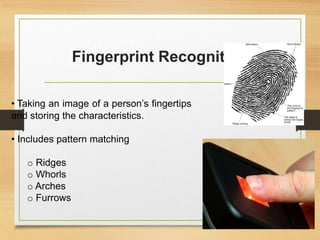
Fingerprint Recognition
• Taking an image of a person’s fingertips
and storing the characteristics.
• Includes pattern matching
o Ridges
o Whorls
o Arches
o Furrows
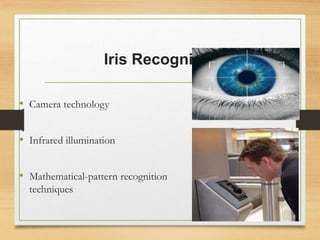
Iris Recognition
• Camera technology
• Infrared illumination
• Mathematical-pattern recognition
techniques
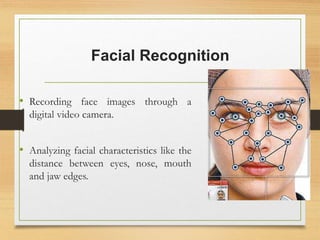
Facial Recognition
• Recording face images through a
digital video camera.
• Analyzing facial characteristics like the
distance between eyes, nose, mouth
and jaw edges.
Applications
• ATMs
• Computer Login
• Online Banking
• National Security
• Elections
• Criminal Investigation
• Identification of missing people
Advantages
• Easy to maintain
• More robust than ID Cards, Passwords, PIN numbers,
etc.
• Cannot be stolen or forgotten
• Single biometric protection for multiple logins
Disadvantages
• It can be very expensive
• The pattern matching might be inaccurate due to
environmental conditions
• The stored biometric data might be vulnerable to
malicious attacks
• Reproduction of biometric data by other people
THANK YOU!!!

Biometrics -Mayank.pptx

  • 1.
    BIOMETRICS Mr. Mayank DavidRaiborde, Assistant Professor, Dept. of Forensic Science, Kristu Jayanti College, Bengaluru
  • 2.
    Overview • What isBiometrics? • Measures • Biometric System • Modes of Operation • Modules • Types of Biometric Recognition • Applications • Advantages/Disadvantages
  • 3.
    What is Biometrics? Methodsof identifying a person based on Physiological or Behavioral characteristic. • Physiological- Hand or finger images, facial characteristic, speak verification, iris recognition. • Behavioral- Dynamic Signature Verification and Keystroke Dynamics.
  • 4.
    What Biological MeasuresQualify to be a Biometric • Universality- Each person should have the characteristic. • Distinctiveness- Two persons should be different in terms of characteristics. • Permanence- Characteristic should be invariant of time. • Collectability- Characteristic should be measured Quantitatively.
  • 5.
    Biometric Systems A biometricsystem is a pattern recognition system that operates by o Acquiring Biometric data from an Individual. o Extracting Feature Set from the Data. o Comparing the Feature Set with the Template in the Database.
  • 6.
    Operation Modes OfBiometrics There are two modes of operation. o Verification Mode o Identification Mode. • Depending on the Application Context, Biometric System can work either on Verification Mode or in Identification Mode.
  • 7.
    Block Diagram ofEnrollment, Verification, Identification Phase INTRODUCTION TO BIOMETRIC RECOGNITION k diagrams of enrollment, verification, and identification tasks are shown using the four main modules of a biometric system, i.e., tcher, and system database.
  • 8.
    Operational Modes Contd. •In Verification mode, the system validates the person’s identity by comparing the captured biometric data with the template stored in the database. This template is stored in the Enrollment phase. • In Identification mode the system identifies the person by searching the templates of all users in the database for a match. One to many Comparison.
  • 9.
    Modules needed tobuild a Biometric System • Sensor module • Feature Extraction module • Matcher Module • System Database Module
  • 10.
    1. Sensor Module-It captures the Biometric data of an Individual. An example can be a Fingerprint Sensor. 2. Feature Extraction Module- Here the obtained biometric data of an Individual is processed to extract features. Example can be the Local ridge feature extraction from a Fingerprint. 3. Matcher Module- Here the features extracted during the above phase are matched against the templates stored in the database. 4. System Database Module- Used to Store Biometric templates of the users enrolled. The enrollment module is responsible for Enrolling Individuals to the database.
  • 11.
    Types of BiometricRecognition Common Techniques • Fingerprint Recognition • Face Recognition • Voice Recognition • Iris Recognition • Hand Geometry • Signature Verification
  • 12.
    Other Techniques • Keystroke •Ear Geometry • Lip Motion • Thermograms • Retina Recognition
  • 13.
    Fingerprint Recognition • Takingan image of a person’s fingertips and storing the characteristics. • Includes pattern matching o Ridges o Whorls o Arches o Furrows
  • 14.
    Iris Recognition • Cameratechnology • Infrared illumination • Mathematical-pattern recognition techniques
  • 15.
    Facial Recognition • Recordingface images through a digital video camera. • Analyzing facial characteristics like the distance between eyes, nose, mouth and jaw edges.
  • 16.
    Applications • ATMs • ComputerLogin • Online Banking • National Security • Elections • Criminal Investigation • Identification of missing people
  • 17.
    Advantages • Easy tomaintain • More robust than ID Cards, Passwords, PIN numbers, etc. • Cannot be stolen or forgotten • Single biometric protection for multiple logins
  • 18.
    Disadvantages • It canbe very expensive • The pattern matching might be inaccurate due to environmental conditions • The stored biometric data might be vulnerable to malicious attacks • Reproduction of biometric data by other people
  • 19.