• BMW -emerged as anissueof concern over the
world
• Safescientific cost effective methodsof
BMW management – need of hour.
WASTE
Waste
Solid waste
Liquid
Waste
Gaseous
Waste
• Household waste
• Industrial waste
• Biomedical wasteor hospital waste
What is Bio-medical
waste ??
Waste generated during the
diagnosis, testing, treatment, research or
production of biological products for
humans or animals (WHO)
Sources of Bio-Medical
Waste
Major Sources
Hospitals
Labs
Research
centers
Animal research
Blood banks
Nursing homes
Mortuaries
Autopsy centers
Minor sources
 Clinics
 Dental clinics
 Home care
 Cosmetic clinics
 Paramedics
 Funeral services
 Institutions
Non-Infectious
waste, 80%
Pathological
and Infectious
waste, 15%
Chemical and
Pharmaceutical
waste, 3%
Sharps, 1%
Radioactive,
Cytotoxic and
heavy
metals, 1%
Bio-Medical
Wastes
Need of BMW Management in
Hospitals???
WHO IS ATRISK??
Sanitation
workers
Medical &
Paramedical
staff
Patients &
attenders
Public
Hazardous health care
waste may result in:
1. Infection
2. Genotoxicity and Cytotoxicity
3. Chemical toxicity
4. Radioactivity hazards.
5. Physical injuries
6. Public sensitivity.
PROBLEM ASSOCIATED WITH
BMW
ORGANISM DISEASES CAUSED RELATED WASTE ITEM
VIRUSES AIDS, Infected needles, body
HIV,Hepatitis B,Hepatitis A,C, Infectious Hepatitis, Fluids, Human excreta, soiled
Enteroviruses Dengue, Japanese linen, Blood, bodyfluids.
encephalitis,
fevers, etc.
BACTERIA Typhoid, Cholera, Tetanus Human excreta and
Salmonella typhi, Wound infections, body fluid in landfillsand
Vibrio cholerae, septicemia, rheumatic hospital wards, Sharpssuch as
Clostridium Tetani, fever, endocarditis, skin needles, surgical blades in
Pseudomonas,Streptococcus and soft tissueinfections hospital waste.
PARASITES Human excreta, blood and
W.Bancrofti, KalaAzar, Malaria body fluids in poorly
Plasmodium managed sewage system of
hospitals.
How did BMW came into
Existence?
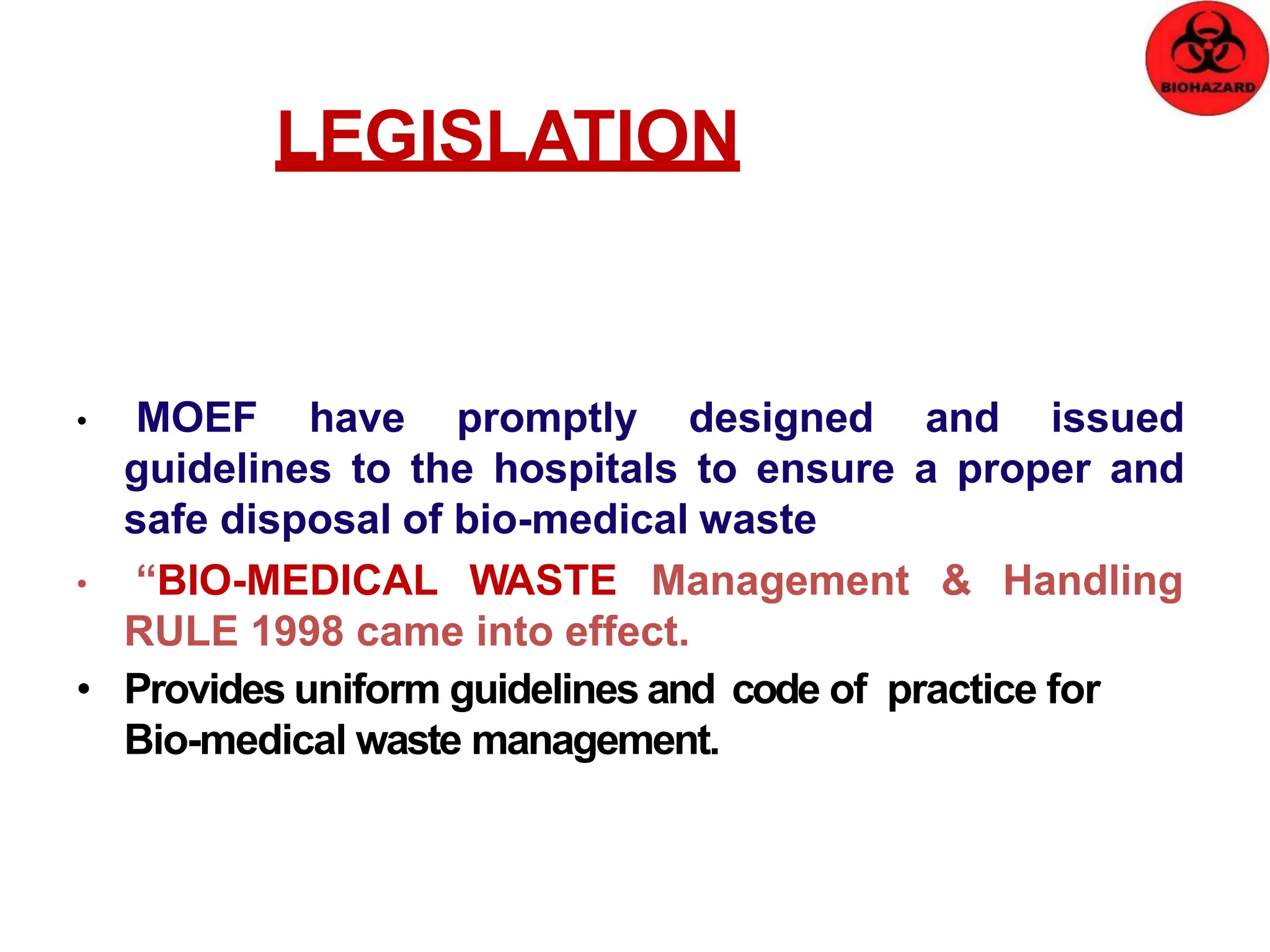
LEGISLATION
• MOEF have promptly designed and issued
guidelines to the hospitals to ensure a proper and
safe disposal of bio-medical waste
• “BIO-MEDICAL WASTE Management & Handling
RULE 1998 came into effect.
• Provides uniform guidelines and code of practice for
Bio-medical waste management.
Biomedical Waste
Management and Handling Rules,1998
[Amended in 2000]
• Theserules apply to all persons who generate,
collect, receive, store, transport, treat, dispose
or handle bio-medical waste in any form. All
Institutions generating BMW must take all steps
to ensure that suchwaste is handled without any
adverse effect to human health and the
environment
Bio-Medical Waste FlowChart
In House Segregation
(Collection, Segregation Packing
in Color Coded Poly Bags)
Common Storage Point
At
Hospitals
Transportation
(Approved Special Vehicle)
Unloading and Temp
Storage at CBWTF
Treatment
(Incineration,Autoclaving
and Shredding)
Disposal
( Recycling & Landfill)
Waste water
to ETP
Re Use
Generator
(HOSPITALS)
36
WASTE
CATEGOR
Y
TYPE OF WASTE
TREATMENT
AND
DISPOSAL
OPTION
Category No. 1 Human Anatomical Waste (Human tissues, organs, body
parts)
Incineration / deep
burial
Category No. 2
Animal Waste
(Animal tissues, organs,body parts, carcasses,bleeding parts,
fluid, blood and experimental animals usedin research, waste
generated by veterinary hospitals and colleges, discharge from
hospitals, animalhouses)
Incineration/ deep
burial
Category No. 3
Microbiology & Biotechnology Waste (Wastes from
laboratory cultures, stocks or specimen of live micro
organismsor attenuated vaccines, human and animal cell
cultures usedin research and infectious agentsfrom research
and industrial laboratories, wastes from production of
Localautoclaving/
microwaving /
incineration
Categories of Biomedical Waste
Schedule
37
Category No. 4
Waste Sharps (Needles, syringes, scalpels,
blades, glass,etc. that may causepuncture and
cuts. Thisincludes both used and unused
sharps)
Disinfecting (chemical
treatment / autoclaving /
microwaving and mutilation /
shredding
Category No. 5
Discarded Medicine and Cytotoxic
drugs (Wastescomprising of outdated,
contaminated and discarded medicines)
Incineration / destruction and
drugs disposal in secured
landfills
Category No.6
Soiled Waste (Items contaminated with body
fluids including cotton, dressings, soiled plaster
casts,lines, bedding and other materials
contaminated with blood.)
Incineration / autoclaving /
microwaving
Category No.7
Solid Waste (Waste generated from
disposable items other than the waste sharps
suchas tubing, catheters, intravenous sets,
Disinfecting by chemical
treatment / autoclaving /
microwaving and mutilation /
shredding# #
38
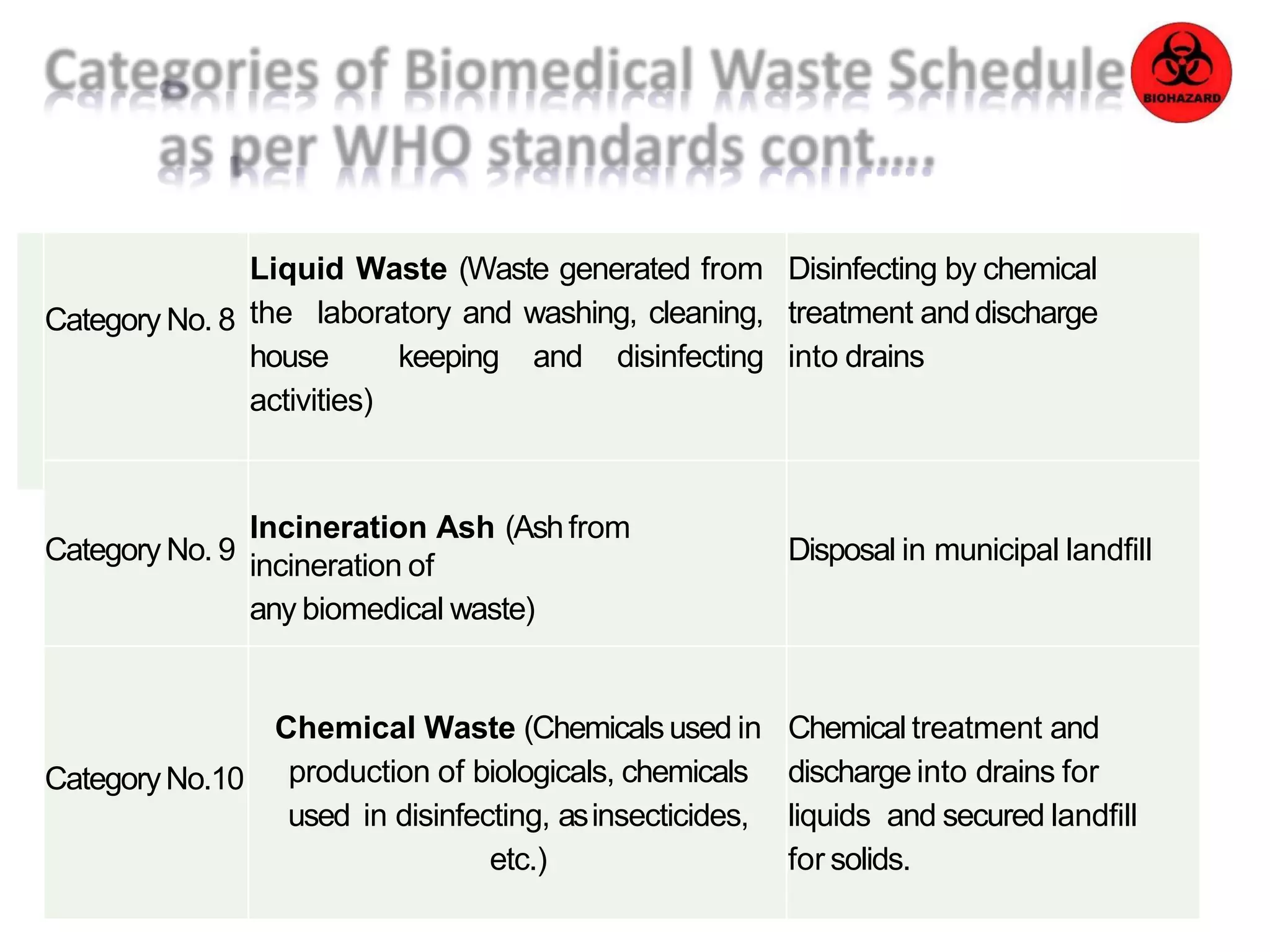
Category No. 8
Liquid Waste (Waste generated from
the laboratory and washing, cleaning,
house keeping and disinfecting
activities)
Disinfecting by chemical
treatment anddischarge
into drains
Category No. 9
Incineration Ash (Ashfrom
incineration of
any biomedical waste)
Disposal in municipal landfill
CategoryNo.10
Chemical Waste (Chemicalsused in
production of biologicals, chemicals
used in disinfecting, asinsecticides,
etc.)
Chemical treatment and
discharge into drains for
liquids and secured landfill
for solids.
Human
anatomical
waste Chemo
drugs Soiled
waste Expired
or Discarded
Medicines,
soiled linen
Contaminat
ed Plastic
Waste
(Recyclable)
Waste
sharps
including
Metals
Glasswar
e: Broken
or
discarded
and
contaminate
d glass
including
medicine
vials and
ampoules
General
waste
SCHEDULEI :YELLOWCATEGORY:SOILED
WASTE
(a)Human Anatomical Waste: Human tissues, organs,
body parts and fetus
(b)Animal Anatomical Waste :
(c)Soiled Waste: Items contaminated with blood, body
fluids like dressings, plaster casts, cotton swabs and
bags containing residual or discarded blood
Incineration or Plasma Pyrolysis or deep
burial
SCHEDULE1-REDC
A
T
E
G
O
R
Y
:PLASTICSRECYCLEBLE
WASTE
(a) Wastes generated from
tubing, bottles,
intravenous tubes and
sets, catheters, urine
bags, syringes (without
needles and fixed needle
syringes) and gloves
Autoclaving or micro-waving/hydroclaving
followed by shredding or mutilation
catheters, urine bags,
syringes (without
needles and fixed
needle syringes) and
gloves
SHARP CONT
AINERS
Puncture proof, Tamper proof, Leak proof containers!!
Glassware:
Broken or discarded
and contaminated glass
including medicine vials
and ampoules except
those contaminated with
cytotoxic wastes &
Metallic Body Implants
Disinfection (by soaking the
washed glass waste after
cleaning with detergent and
Sodium Hypochlorite treatment)
or through autoclaving or
microwaving or hydro claving and
then sent for recycling.
GENERALWASTEIN
BLACK
TAKEHOME MESSAGE….
YELLOW has blood, drugs and tissues dead,
Plastics;tubes and syringe nowgo in RED,
Sharps in Containers lockable & white,
Black is for garbage; BMW not by right,
Card boards shall carry bottles and Glasses,
All we need, are a few more classes!!
THANK YOU

BMW management ppt.pptx

  • 2.
    • BMW -emergedas anissueof concern over the world • Safescientific cost effective methodsof BMW management – need of hour.
  • 3.
    WASTE Waste Solid waste Liquid Waste Gaseous Waste • Householdwaste • Industrial waste • Biomedical wasteor hospital waste
  • 4.
    What is Bio-medical waste?? Waste generated during the diagnosis, testing, treatment, research or production of biological products for humans or animals (WHO)
  • 5.
    Sources of Bio-Medical Waste MajorSources Hospitals Labs Research centers Animal research Blood banks Nursing homes Mortuaries Autopsy centers Minor sources  Clinics  Dental clinics  Home care  Cosmetic clinics  Paramedics  Funeral services  Institutions
  • 6.
    Non-Infectious waste, 80% Pathological and Infectious waste,15% Chemical and Pharmaceutical waste, 3% Sharps, 1% Radioactive, Cytotoxic and heavy metals, 1% Bio-Medical Wastes
  • 7.
    Need of BMWManagement in Hospitals???
  • 8.
    WHO IS ATRISK?? Sanitation workers Medical& Paramedical staff Patients & attenders Public
  • 10.
    Hazardous health care wastemay result in: 1. Infection 2. Genotoxicity and Cytotoxicity 3. Chemical toxicity 4. Radioactivity hazards. 5. Physical injuries 6. Public sensitivity.
  • 11.
    PROBLEM ASSOCIATED WITH BMW ORGANISMDISEASES CAUSED RELATED WASTE ITEM VIRUSES AIDS, Infected needles, body HIV,Hepatitis B,Hepatitis A,C, Infectious Hepatitis, Fluids, Human excreta, soiled Enteroviruses Dengue, Japanese linen, Blood, bodyfluids. encephalitis, fevers, etc. BACTERIA Typhoid, Cholera, Tetanus Human excreta and Salmonella typhi, Wound infections, body fluid in landfillsand Vibrio cholerae, septicemia, rheumatic hospital wards, Sharpssuch as Clostridium Tetani, fever, endocarditis, skin needles, surgical blades in Pseudomonas,Streptococcus and soft tissueinfections hospital waste. PARASITES Human excreta, blood and W.Bancrofti, KalaAzar, Malaria body fluids in poorly Plasmodium managed sewage system of hospitals.
  • 12.
    How did BMWcame into Existence?
  • 13.
    LEGISLATION • MOEF havepromptly designed and issued guidelines to the hospitals to ensure a proper and safe disposal of bio-medical waste • “BIO-MEDICAL WASTE Management & Handling RULE 1998 came into effect. • Provides uniform guidelines and code of practice for Bio-medical waste management.
  • 14.
    Biomedical Waste Management andHandling Rules,1998 [Amended in 2000] • Theserules apply to all persons who generate, collect, receive, store, transport, treat, dispose or handle bio-medical waste in any form. All Institutions generating BMW must take all steps to ensure that suchwaste is handled without any adverse effect to human health and the environment
  • 15.
    Bio-Medical Waste FlowChart InHouse Segregation (Collection, Segregation Packing in Color Coded Poly Bags) Common Storage Point At Hospitals Transportation (Approved Special Vehicle) Unloading and Temp Storage at CBWTF Treatment (Incineration,Autoclaving and Shredding) Disposal ( Recycling & Landfill) Waste water to ETP Re Use Generator (HOSPITALS)
  • 16.
    36 WASTE CATEGOR Y TYPE OF WASTE TREATMENT AND DISPOSAL OPTION CategoryNo. 1 Human Anatomical Waste (Human tissues, organs, body parts) Incineration / deep burial Category No. 2 Animal Waste (Animal tissues, organs,body parts, carcasses,bleeding parts, fluid, blood and experimental animals usedin research, waste generated by veterinary hospitals and colleges, discharge from hospitals, animalhouses) Incineration/ deep burial Category No. 3 Microbiology & Biotechnology Waste (Wastes from laboratory cultures, stocks or specimen of live micro organismsor attenuated vaccines, human and animal cell cultures usedin research and infectious agentsfrom research and industrial laboratories, wastes from production of Localautoclaving/ microwaving / incineration Categories of Biomedical Waste Schedule
  • 17.
    37 Category No. 4 WasteSharps (Needles, syringes, scalpels, blades, glass,etc. that may causepuncture and cuts. Thisincludes both used and unused sharps) Disinfecting (chemical treatment / autoclaving / microwaving and mutilation / shredding Category No. 5 Discarded Medicine and Cytotoxic drugs (Wastescomprising of outdated, contaminated and discarded medicines) Incineration / destruction and drugs disposal in secured landfills Category No.6 Soiled Waste (Items contaminated with body fluids including cotton, dressings, soiled plaster casts,lines, bedding and other materials contaminated with blood.) Incineration / autoclaving / microwaving Category No.7 Solid Waste (Waste generated from disposable items other than the waste sharps suchas tubing, catheters, intravenous sets, Disinfecting by chemical treatment / autoclaving / microwaving and mutilation / shredding# #
  • 18.
    38 Category No. 8 LiquidWaste (Waste generated from the laboratory and washing, cleaning, house keeping and disinfecting activities) Disinfecting by chemical treatment anddischarge into drains Category No. 9 Incineration Ash (Ashfrom incineration of any biomedical waste) Disposal in municipal landfill CategoryNo.10 Chemical Waste (Chemicalsused in production of biologicals, chemicals used in disinfecting, asinsecticides, etc.) Chemical treatment and discharge into drains for liquids and secured landfill for solids.
  • 19.
    Human anatomical waste Chemo drugs Soiled wasteExpired or Discarded Medicines, soiled linen Contaminat ed Plastic Waste (Recyclable) Waste sharps including Metals Glasswar e: Broken or discarded and contaminate d glass including medicine vials and ampoules General waste
  • 20.
    SCHEDULEI :YELLOWCATEGORY:SOILED WASTE (a)Human AnatomicalWaste: Human tissues, organs, body parts and fetus (b)Animal Anatomical Waste : (c)Soiled Waste: Items contaminated with blood, body fluids like dressings, plaster casts, cotton swabs and bags containing residual or discarded blood Incineration or Plasma Pyrolysis or deep burial
  • 21.
    SCHEDULE1-REDC A T E G O R Y :PLASTICSRECYCLEBLE WASTE (a) Wastes generatedfrom tubing, bottles, intravenous tubes and sets, catheters, urine bags, syringes (without needles and fixed needle syringes) and gloves Autoclaving or micro-waving/hydroclaving followed by shredding or mutilation catheters, urine bags, syringes (without needles and fixed needle syringes) and gloves
  • 22.
    SHARP CONT AINERS Puncture proof,Tamper proof, Leak proof containers!!
  • 23.
    Glassware: Broken or discarded andcontaminated glass including medicine vials and ampoules except those contaminated with cytotoxic wastes & Metallic Body Implants Disinfection (by soaking the washed glass waste after cleaning with detergent and Sodium Hypochlorite treatment) or through autoclaving or microwaving or hydro claving and then sent for recycling.
  • 24.
  • 25.
    TAKEHOME MESSAGE…. YELLOW hasblood, drugs and tissues dead, Plastics;tubes and syringe nowgo in RED, Sharps in Containers lockable & white, Black is for garbage; BMW not by right, Card boards shall carry bottles and Glasses, All we need, are a few more classes!!
  • 26.