Presentation Outline
➢Biomedical waste – An overview
• Definition
• Sources
• Classification
➢Need for BMW Management
• Problems related to Biomedical waste
➢BMW Management legislation
➢BMW process adopted in India
➢BMW management during COVID-19 Pandemic in India
➢Conclusion
• Waste product which is
infectious, hazardous, and
sometimes radioactive and is
generated during the various
medical related activities
such as diagnosis, treatment
and immunization is known
as Bio medical waste.
3
4
5
6
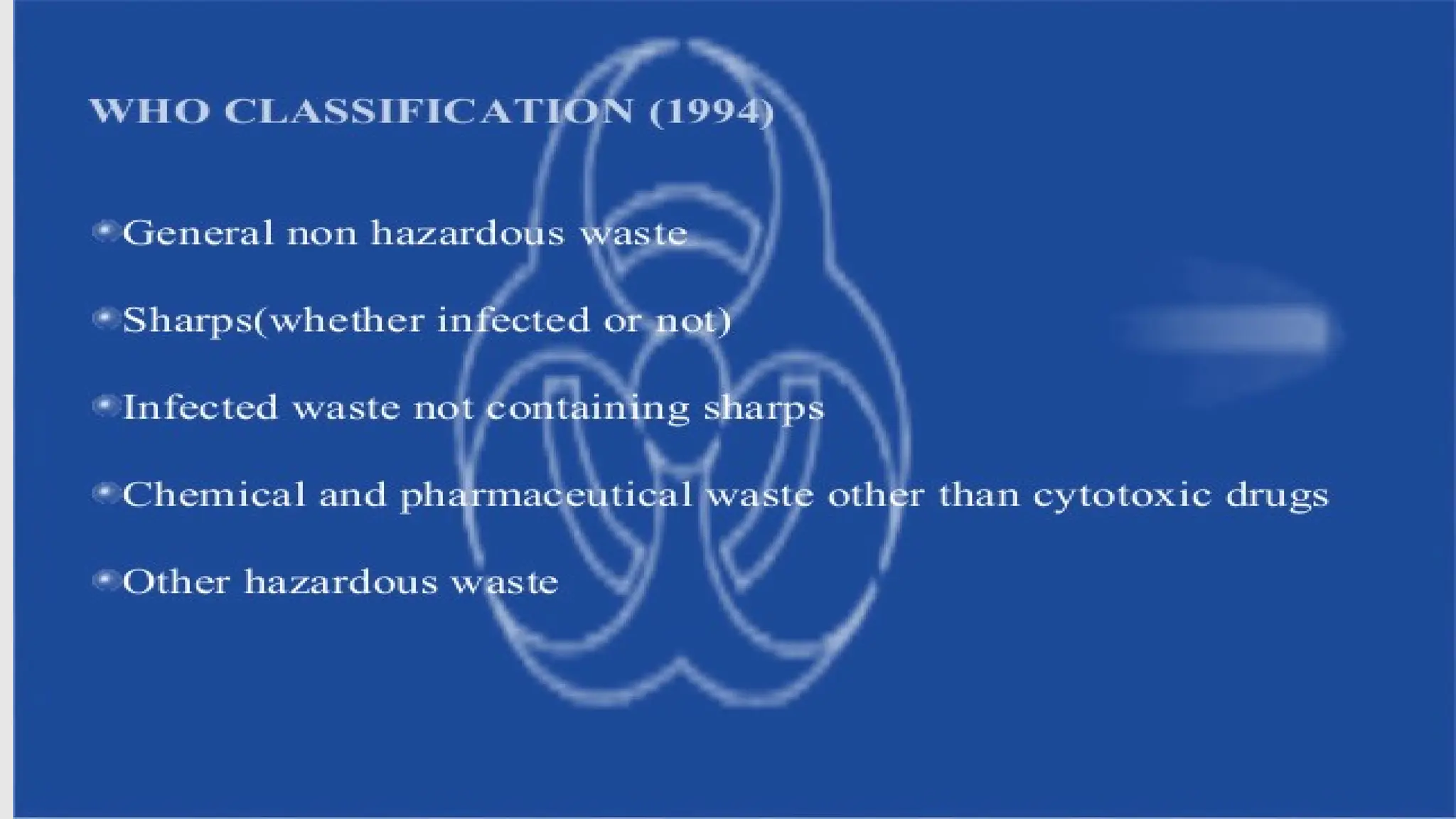
CLASSIFICATION
According to WHO
• 85% of hospital wastes are actually non-hazardous,
• around 10% are infectious and
• around 5% are non-infectious but hazardous wastes.
• In USA, about 15% of hospital waste is regulated as infectious waste. In
India this could range from 15% to 35% depending on the total amount of
waste generated
7
8
9
10
11
12
13
14
15
16
18
Need for BMW management
• In absence of proper segregation, the non infectious waste becomes infectious and poses
environmental threat to the society
• An inappropriate treatment and disposal will spread infectious diseases in society.
• Injuries from sharps leading to infection to all categories of hospital personnel and waste handlers.
• Risk associated with hazardous chemicals and drugs to persons handling wastes
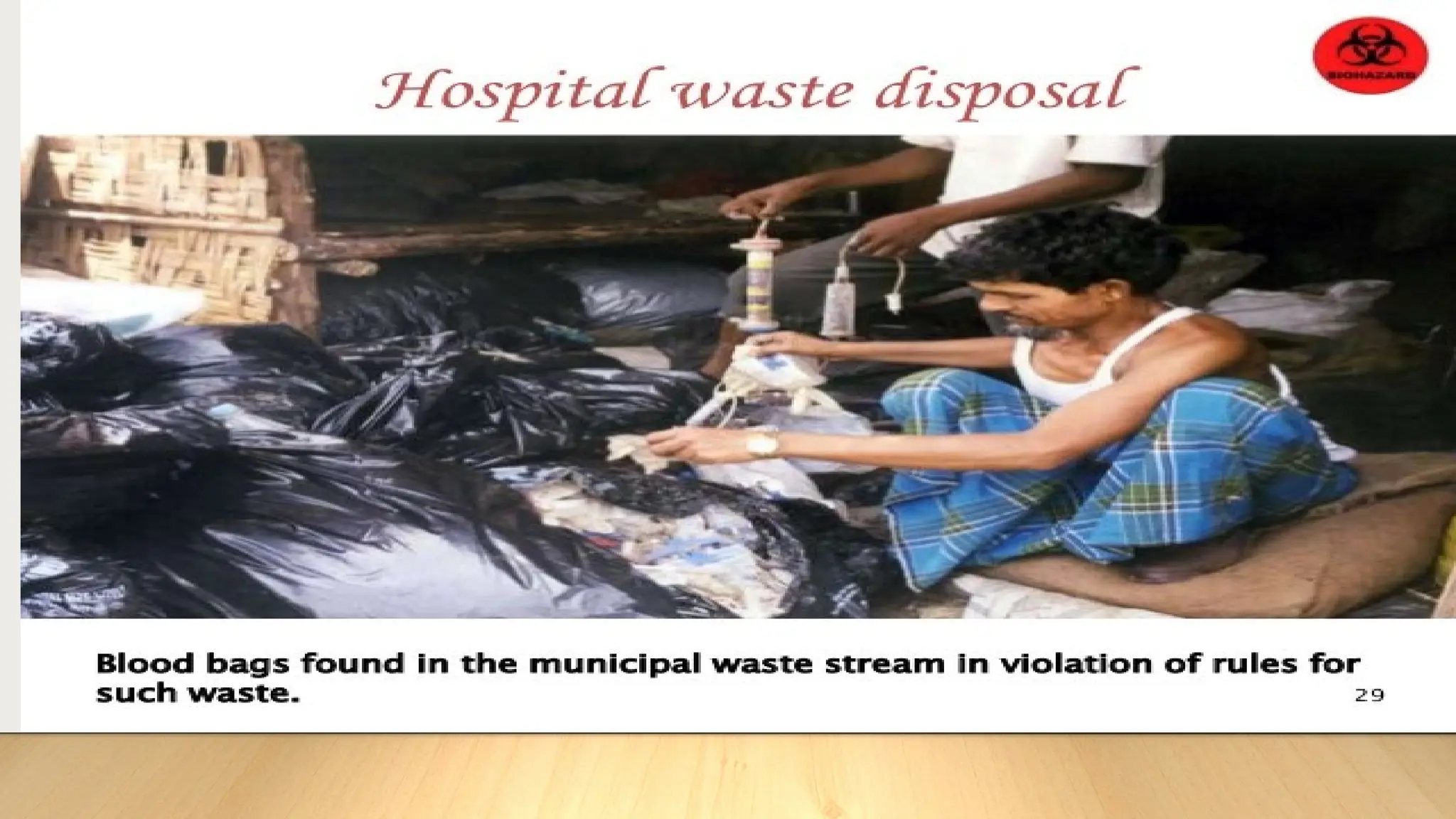
• Risk of infection outside hospital for waste handlers and scavengers
• Risk of spurious drugs due to repacking of disposed off drugs to unsuspecting buyers.
• air, water and soil pollution directly due to waste, or due to defective incineration, emissions and
ash.
Existing Scenario of Bio-Medical Waste in India
• Currently, in India, 550.9 tons of Bio-medical waste is
generated daily and is likely to reach about 775.5 tons per
day by 2022 from the current level. (Source: Joint report by Associated
Chambers of Commerce and Industry of India (Assocham) and Velocity in 2018)
23
Bio-medical Waste Management Rules Framed by
Ministry of Environment and Forest(MoEF), Govt. of
India
• On 20th July 1998,"Bio-medical waste (Management and
Handling) Rules were framed.
• • 1st Amendment on 06-03-2000.
• • 2nd Amendment on 17-09-2003.
• • On 28th March 2016, Under Environment (Protection) Act,
1986, MoEF&CC notified the new BMW Rules, 2016 and
replaced the earlier Rules(1988). Ammended in 2018
The salient features of Biomedical Waste (Management &
Handling) Rules, 1998 are:
➢ The rules were restricted to healthcare facilities with more than 1000 beds
and they are required to obtain authorisation.
➢Biomedical waste was divided into 10 categories as per their treatment
and disposal methods
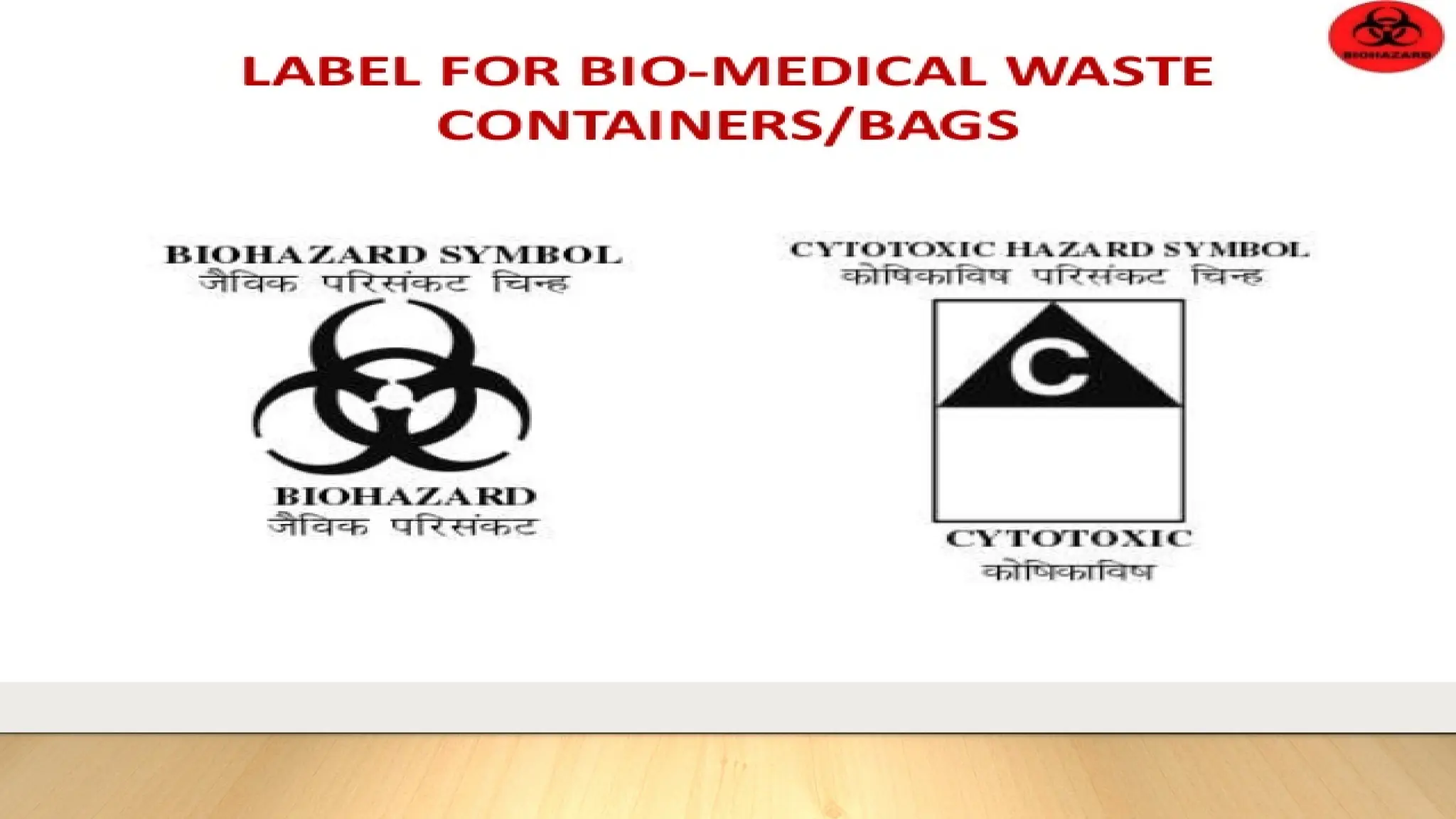
➢ Biomedical waste should be segregated into containers/bags at the point
of generation itself.
➢The containers should be clearly marked with the bio-hazard and
cytotoxic hazard symbol.
Salient features of BMW Management Rules, 2016 along with Biomedical
Waste Management (Amendment) Rules, 2018
➢expanded to include vaccination camps, blood donation camps, surgical camps or
any other healthcare activity.
➢Phase-out the use of chlorinated plastic bags, gloves and blood bags (extended to
27th March 2019)
➢Pre-treatment of the laboratory waste, microbiological waste, blood samples and
blood bags through disinfection sterilization on-site
➢ training to all its health care workers and immunize them for hepatitis B and
Tetanus
➢ Establish Bar-Code System for bags or containers
Salient features of BMW Management Rules, 2016 along with
BioMedical Waste Management (Amendment) Rules, 2018
➢No hospital/ healthcare facility (occupier) shall establish on-site treatment
and disposal facility, if a service of “common bio-medical waste treatment
facility’’ (CBMWTF) is available within seventy-five kilometers.
➢ ensure timely collection of bio-medical waste
➢Bio-medical waste has been classified into only 4 categories instead of 10
categories as per Biomedical Waste (Management & Handling) Rules,
1998 to improve the segregation of waste at source.
30
31
Segregation at Source
Bio Medical Waste Management Rules, 2016 categorises the bio-medical waste
generated from the health care facility into four categories based on the
segregation pathway and colour code.
➢ Yellow Category
➢ Red Category
➢ White Category
➢ Blue Category
Colour
Coding
Type of container Waste category Treatment options
Yellow Plastic Bag Human Anatomical Waste/Animal
Waste, Microbiology and
Biotechnology waste and Soiled waste
Incineration / Deep Burial
Red Disinfected container/
plastic bag
Microbiology and Biotechnology
waste and Soiled waste
Autoclave/ Microwave/ Chemical
Treatment
Blue Plastic Bag/ Puncture-proof
container
Broken/ discarded glass- Medicine
vials & ampoules except those
contaminated with cytotoxic wastes.
Metallic Body Implants
Autoclave/Microwave/ Chemical
Treatment and destruction /
shredding
White (or)
Translucent
Plastic Bag/ Puncture-proof
container Waste sharps including Metal
sharps-Needles, Syringes with fixed
needles, Needles from needle tip
cutter/burner, Scalpels, Blades
Autoclave/Microwave/ Chemical
Treatment and destruction /
shredding
Black Plastic Bag Discarded Medicines/Cytotoxic
Drugs, Incineration ash and
Chemical waste
Disposal in secured landfill
35
Storage of BMW
• Segregated wastes of different categories needs to be collected in identifiable
containers
• The duration of storage should not exceed for 8-10 hrs in big hospitals (more
than 250 bedded) and 24 hrs in nursing homes.
• Biomedical Waste & General Waste shall not be mixed.
• Storage time of waste should be as less as possible so that waste storage,
transportation and disposal is done within 48 hours (BMW Management
Rules, 2016)
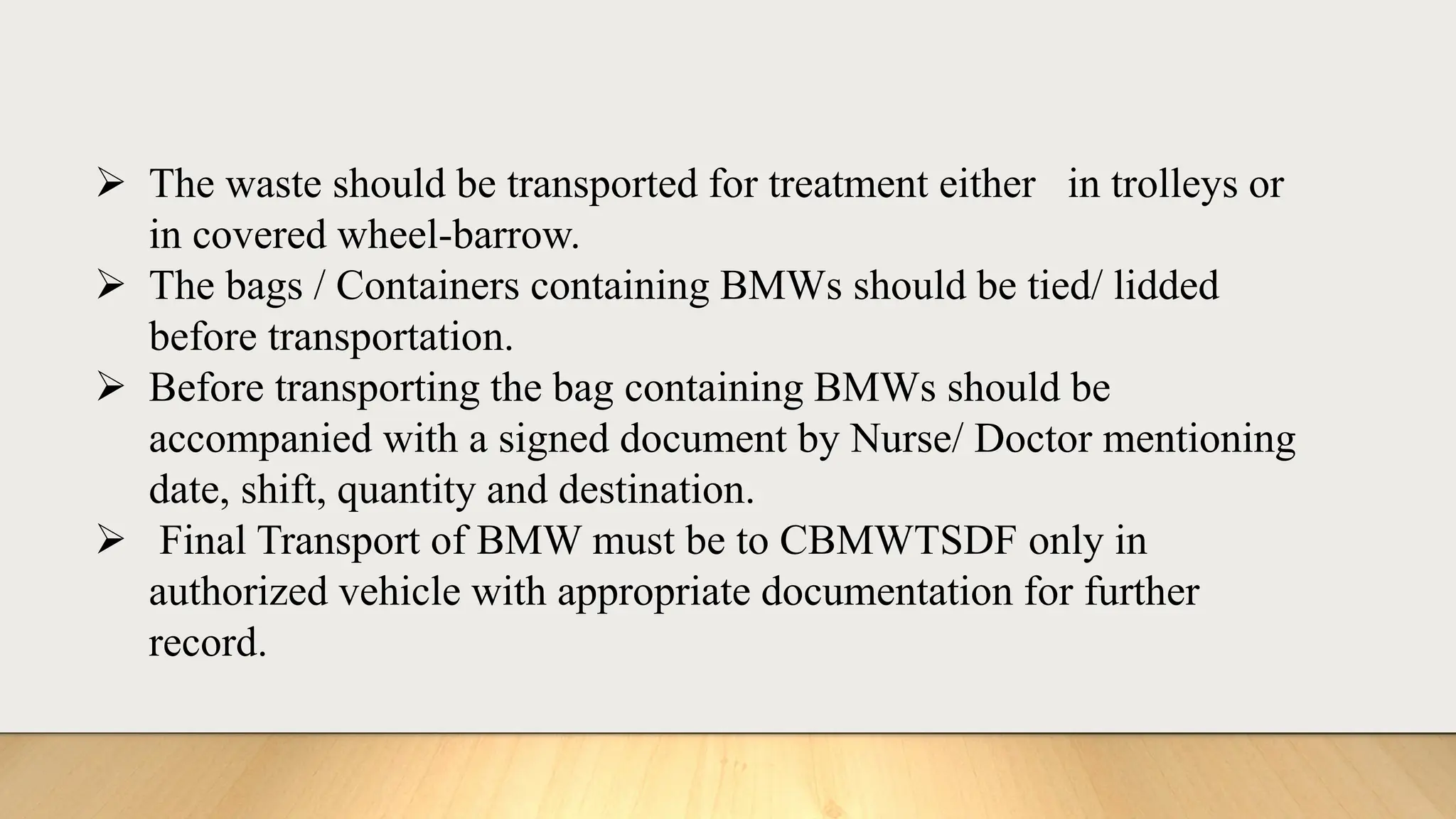
➢ The waste should be transported for treatment either in trolleys or
in covered wheel-barrow.
➢ The bags / Containers containing BMWs should be tied/ lidded
before transportation.
➢ Before transporting the bag containing BMWs should be
accompanied with a signed document by Nurse/ Doctor mentioning
date, shift, quantity and destination.
➢ Final Transport of BMW must be to CBMWTSDF only in
authorized vehicle with appropriate documentation for further
record.
Disposal methods
• Incineration
• Autoclave
• Hydroclave
• Microwave
• ETP for Liquid waste
• Deep Burial
• Plasma Pyrolysis
• Waste Sharps Dry heat
sterilization and encapsulation
• Shredding cum Chemical
disinfection
Incinerator
BMW management of India
288 303
486 501 515 530
0
100
200
300
400
500
600
2013 2014 2015 2016 2017 2018
BMW
treated
(MT/day)
Year
BMW Treatment in India Treatment & Disposal in metric tonnes/day
Source: CPCB report
Common Bio-medical Waste Treatment Facilities
(CBWTFs)/ Private Agencies
93
168
188
179
190
198
191
203 199 198
203
0
50
100
150
200
250
2008 2009 2010 2011 2012 2013 2014 2015 2016 2017 2018
No.
of
CBWTF
Year
Number of CBWTF in India
CBWTFs are widely accepted by healthcare facilities and increasing
in its number continuously because of various advantages such as
reduced capital investment,
• reduced cost of treatment,
• no operation & maintenance,
• checks mushrooming of treatment equipment in cities,
• easy implementation by the regulatory bodies etc.
During COVID times….
BMW Management Rules, 2016BMW Management Rules, 2016
COVID biomedical waste
Management
Guidelines to handle COVID-19 biomedical waste issued by
regulatory bodies
Guidelines for Handling, Treatment and Disposal of Waste Generated during
Treatment/Diagnosis/ Quarantine of COVID-19 Patients –
Revision 1 dated25/03/2020
Revision 2 dated18/04/2020
Revision 3 dated10/06/2020
COVID-19 WASTE MANAGEMENT – DO’S & DON’TS
(Quarantine Camp/Centre or Home-care)
DO’s
• Care takers of COVID-19 patients under home-care
shall store the biomedical waste in yellow coloured
bag provided by Urban Local Body
• Person taking care of suspected or confirmed
(asymptomatic and mild symptomatic) COVID-19
patient at home-care shall handover the yellow bag
to authorized waste collector from urban local body
or common biomedical waste treatment facility
operator.
DON'TS
• Home-care taker shall never mix general waste
with biomedical waste such as used syringes, date
expired or discarded medicines, used
masks/gloves etc.
• Never dispose off used masks of suspected or
confirmed (mild symptomatic or asymptomatic)
COVID-19 patients in bags other than yellow bag.
• Positive or suspected COVID-19 patient shall
never use fabric mask home-made masks, if any.
COVID-19 WASTE MANAGEMENT – DO’S & DON’TS
(Quarantine Camp/Centre or Home-care)
• Home-care care-taker may also deposit the yellow
bag at designated deposition center of ULB.
• General waste from home care or quarantine
center or quarantine camp shall be handed over as
solid waste to authorized waste collector of Urban
Local Body (ULB - Municipal Corporation /
Municipality).
• Do not leave your used mask within
the reach of others.
• Do not re-use surgical masks or
gloves.
• Quarantine center or camp or
homecare shall never store
biomedical waste for more than 48
hrs
COVID-19 WASTE MANAGEMENT – DO’S & DON’TS
(Quarantine Camp/Centre or Home-care)
• Used masks & gloves from Home quarantine or other
households after keeping aside in paper bag for 72
hours may be cut into pieces prior to disposal to
prevent re-use.
• Person operating quarantine camp or quarantine center
shall contact the CBWTF operator for lifting of
biomedical waste as and when generated.
• Persons operating quarantine camp or quarantine
center or care-takers of homecare may contact ULB in
case of any difficulty in getting the service.
• Dedicated waste collector of ULB cannot deny
collection of waste from quarantine centre /
quarantine camp / home-care.
• BMWM should be a shared teamwork with committed
government backing, good BMW practices followed by both
health-care workers and HCFs, continuous monitoring of
BMW practices, and strong legislature.
• The current BMWM 2016 rules are an improvement over earlier rules
in terms of improved segregation, transportation, and disposal
methods, to decrease environmental pollution and ensure the safety of
the staff, patients, and public.
CONCLUSION
• The pillar of BMWM is segregation of waste at source and WR.
• Moreover, more use of non-PVC medical devices and development of
newer novel, eco-friendly systems for disposal of BMW should be
encouraged.
• All participants in BMWM should pledge to guarantee a cleaner and
greener environment.
• Are our municipal waste generators, waste collectors and
waste managers aware of the risks they are entering in?
• Are our citizens aware on managing household medical
waste in this COVID-19 situation?
• Are cities ready with their waste management plans?
• Are biomedical waste management firms ready to handle the
extremely hazardous, heaps of biomedical waste our country is
going to generate?
References
• MoEF Guidelines
• CPCB guidelines
• Biomedical waste Management Rules (1998)
• Guidelines for Management of Healthcare Waste as per Biomedical Waste Management
Rules, 2016
• WHO guidelines
• ENVIS Newsletter on Biomedical waste management
• Guidelines for Handling, Treatment and Disposal of Waste Generated during
Treatment/Diagnosis/ Quarantine of COVID-19 Patients Revisions 1, 2 and 3 dated 25th
March 2020, 18th April 2020, 10th June 2020

Biomedical Waste collection treatment disposal

  • 2.
    Presentation Outline Presentation Outline ➢Biomedicalwaste – An overview • Definition • Sources • Classification ➢Need for BMW Management • Problems related to Biomedical waste ➢BMW Management legislation ➢BMW process adopted in India ➢BMW management during COVID-19 Pandemic in India ➢Conclusion
  • 3.
    • Waste productwhich is infectious, hazardous, and sometimes radioactive and is generated during the various medical related activities such as diagnosis, treatment and immunization is known as Bio medical waste. 3
  • 4.
  • 5.
  • 6.
  • 7.
    CLASSIFICATION According to WHO •85% of hospital wastes are actually non-hazardous, • around 10% are infectious and • around 5% are non-infectious but hazardous wastes. • In USA, about 15% of hospital waste is regulated as infectious waste. In India this could range from 15% to 35% depending on the total amount of waste generated 7
  • 8.
  • 9.
  • 10.
  • 11.
  • 12.
  • 13.
  • 14.
  • 15.
  • 16.
  • 18.
  • 19.
    Need for BMWmanagement • In absence of proper segregation, the non infectious waste becomes infectious and poses environmental threat to the society • An inappropriate treatment and disposal will spread infectious diseases in society. • Injuries from sharps leading to infection to all categories of hospital personnel and waste handlers. • Risk associated with hazardous chemicals and drugs to persons handling wastes • Risk of infection outside hospital for waste handlers and scavengers • Risk of spurious drugs due to repacking of disposed off drugs to unsuspecting buyers. • air, water and soil pollution directly due to waste, or due to defective incineration, emissions and ash.
  • 22.
    Existing Scenario ofBio-Medical Waste in India • Currently, in India, 550.9 tons of Bio-medical waste is generated daily and is likely to reach about 775.5 tons per day by 2022 from the current level. (Source: Joint report by Associated Chambers of Commerce and Industry of India (Assocham) and Velocity in 2018)
  • 23.
  • 26.
    Bio-medical Waste ManagementRules Framed by Ministry of Environment and Forest(MoEF), Govt. of India • On 20th July 1998,"Bio-medical waste (Management and Handling) Rules were framed. • • 1st Amendment on 06-03-2000. • • 2nd Amendment on 17-09-2003. • • On 28th March 2016, Under Environment (Protection) Act, 1986, MoEF&CC notified the new BMW Rules, 2016 and replaced the earlier Rules(1988). Ammended in 2018
  • 27.
    The salient featuresof Biomedical Waste (Management & Handling) Rules, 1998 are: ➢ The rules were restricted to healthcare facilities with more than 1000 beds and they are required to obtain authorisation. ➢Biomedical waste was divided into 10 categories as per their treatment and disposal methods ➢ Biomedical waste should be segregated into containers/bags at the point of generation itself. ➢The containers should be clearly marked with the bio-hazard and cytotoxic hazard symbol.
  • 28.
    Salient features ofBMW Management Rules, 2016 along with Biomedical Waste Management (Amendment) Rules, 2018 ➢expanded to include vaccination camps, blood donation camps, surgical camps or any other healthcare activity. ➢Phase-out the use of chlorinated plastic bags, gloves and blood bags (extended to 27th March 2019) ➢Pre-treatment of the laboratory waste, microbiological waste, blood samples and blood bags through disinfection sterilization on-site ➢ training to all its health care workers and immunize them for hepatitis B and Tetanus ➢ Establish Bar-Code System for bags or containers
  • 29.
    Salient features ofBMW Management Rules, 2016 along with BioMedical Waste Management (Amendment) Rules, 2018 ➢No hospital/ healthcare facility (occupier) shall establish on-site treatment and disposal facility, if a service of “common bio-medical waste treatment facility’’ (CBMWTF) is available within seventy-five kilometers. ➢ ensure timely collection of bio-medical waste ➢Bio-medical waste has been classified into only 4 categories instead of 10 categories as per Biomedical Waste (Management & Handling) Rules, 1998 to improve the segregation of waste at source.
  • 30.
  • 31.
  • 32.
    Segregation at Source BioMedical Waste Management Rules, 2016 categorises the bio-medical waste generated from the health care facility into four categories based on the segregation pathway and colour code. ➢ Yellow Category ➢ Red Category ➢ White Category ➢ Blue Category
  • 33.
    Colour Coding Type of containerWaste category Treatment options Yellow Plastic Bag Human Anatomical Waste/Animal Waste, Microbiology and Biotechnology waste and Soiled waste Incineration / Deep Burial Red Disinfected container/ plastic bag Microbiology and Biotechnology waste and Soiled waste Autoclave/ Microwave/ Chemical Treatment Blue Plastic Bag/ Puncture-proof container Broken/ discarded glass- Medicine vials & ampoules except those contaminated with cytotoxic wastes. Metallic Body Implants Autoclave/Microwave/ Chemical Treatment and destruction / shredding
  • 34.
    White (or) Translucent Plastic Bag/Puncture-proof container Waste sharps including Metal sharps-Needles, Syringes with fixed needles, Needles from needle tip cutter/burner, Scalpels, Blades Autoclave/Microwave/ Chemical Treatment and destruction / shredding Black Plastic Bag Discarded Medicines/Cytotoxic Drugs, Incineration ash and Chemical waste Disposal in secured landfill
  • 35.
  • 39.
    Storage of BMW •Segregated wastes of different categories needs to be collected in identifiable containers • The duration of storage should not exceed for 8-10 hrs in big hospitals (more than 250 bedded) and 24 hrs in nursing homes. • Biomedical Waste & General Waste shall not be mixed. • Storage time of waste should be as less as possible so that waste storage, transportation and disposal is done within 48 hours (BMW Management Rules, 2016)
  • 42.
    ➢ The wasteshould be transported for treatment either in trolleys or in covered wheel-barrow. ➢ The bags / Containers containing BMWs should be tied/ lidded before transportation. ➢ Before transporting the bag containing BMWs should be accompanied with a signed document by Nurse/ Doctor mentioning date, shift, quantity and destination. ➢ Final Transport of BMW must be to CBMWTSDF only in authorized vehicle with appropriate documentation for further record.
  • 44.
    Disposal methods • Incineration •Autoclave • Hydroclave • Microwave • ETP for Liquid waste • Deep Burial • Plasma Pyrolysis • Waste Sharps Dry heat sterilization and encapsulation • Shredding cum Chemical disinfection
  • 45.
  • 49.
    BMW management ofIndia 288 303 486 501 515 530 0 100 200 300 400 500 600 2013 2014 2015 2016 2017 2018 BMW treated (MT/day) Year BMW Treatment in India Treatment & Disposal in metric tonnes/day Source: CPCB report
  • 50.
    Common Bio-medical WasteTreatment Facilities (CBWTFs)/ Private Agencies
  • 52.
    93 168 188 179 190 198 191 203 199 198 203 0 50 100 150 200 250 20082009 2010 2011 2012 2013 2014 2015 2016 2017 2018 No. of CBWTF Year Number of CBWTF in India
  • 53.
    CBWTFs are widelyaccepted by healthcare facilities and increasing in its number continuously because of various advantages such as reduced capital investment, • reduced cost of treatment, • no operation & maintenance, • checks mushrooming of treatment equipment in cities, • easy implementation by the regulatory bodies etc.
  • 54.
    During COVID times…. BMWManagement Rules, 2016BMW Management Rules, 2016
  • 55.
    COVID biomedical waste Management Guidelinesto handle COVID-19 biomedical waste issued by regulatory bodies
  • 58.
    Guidelines for Handling,Treatment and Disposal of Waste Generated during Treatment/Diagnosis/ Quarantine of COVID-19 Patients – Revision 1 dated25/03/2020 Revision 2 dated18/04/2020 Revision 3 dated10/06/2020
  • 60.
    COVID-19 WASTE MANAGEMENT– DO’S & DON’TS (Quarantine Camp/Centre or Home-care) DO’s • Care takers of COVID-19 patients under home-care shall store the biomedical waste in yellow coloured bag provided by Urban Local Body • Person taking care of suspected or confirmed (asymptomatic and mild symptomatic) COVID-19 patient at home-care shall handover the yellow bag to authorized waste collector from urban local body or common biomedical waste treatment facility operator. DON'TS • Home-care taker shall never mix general waste with biomedical waste such as used syringes, date expired or discarded medicines, used masks/gloves etc. • Never dispose off used masks of suspected or confirmed (mild symptomatic or asymptomatic) COVID-19 patients in bags other than yellow bag. • Positive or suspected COVID-19 patient shall never use fabric mask home-made masks, if any.
  • 61.
    COVID-19 WASTE MANAGEMENT– DO’S & DON’TS (Quarantine Camp/Centre or Home-care) • Home-care care-taker may also deposit the yellow bag at designated deposition center of ULB. • General waste from home care or quarantine center or quarantine camp shall be handed over as solid waste to authorized waste collector of Urban Local Body (ULB - Municipal Corporation / Municipality). • Do not leave your used mask within the reach of others. • Do not re-use surgical masks or gloves. • Quarantine center or camp or homecare shall never store biomedical waste for more than 48 hrs
  • 62.
    COVID-19 WASTE MANAGEMENT– DO’S & DON’TS (Quarantine Camp/Centre or Home-care) • Used masks & gloves from Home quarantine or other households after keeping aside in paper bag for 72 hours may be cut into pieces prior to disposal to prevent re-use. • Person operating quarantine camp or quarantine center shall contact the CBWTF operator for lifting of biomedical waste as and when generated. • Persons operating quarantine camp or quarantine center or care-takers of homecare may contact ULB in case of any difficulty in getting the service. • Dedicated waste collector of ULB cannot deny collection of waste from quarantine centre / quarantine camp / home-care.
  • 65.
    • BMWM shouldbe a shared teamwork with committed government backing, good BMW practices followed by both health-care workers and HCFs, continuous monitoring of BMW practices, and strong legislature. • The current BMWM 2016 rules are an improvement over earlier rules in terms of improved segregation, transportation, and disposal methods, to decrease environmental pollution and ensure the safety of the staff, patients, and public. CONCLUSION
  • 66.
    • The pillarof BMWM is segregation of waste at source and WR. • Moreover, more use of non-PVC medical devices and development of newer novel, eco-friendly systems for disposal of BMW should be encouraged. • All participants in BMWM should pledge to guarantee a cleaner and greener environment.
  • 67.
    • Are ourmunicipal waste generators, waste collectors and waste managers aware of the risks they are entering in? • Are our citizens aware on managing household medical waste in this COVID-19 situation? • Are cities ready with their waste management plans? • Are biomedical waste management firms ready to handle the extremely hazardous, heaps of biomedical waste our country is going to generate?
  • 69.
    References • MoEF Guidelines •CPCB guidelines • Biomedical waste Management Rules (1998) • Guidelines for Management of Healthcare Waste as per Biomedical Waste Management Rules, 2016 • WHO guidelines • ENVIS Newsletter on Biomedical waste management • Guidelines for Handling, Treatment and Disposal of Waste Generated during Treatment/Diagnosis/ Quarantine of COVID-19 Patients Revisions 1, 2 and 3 dated 25th March 2020, 18th April 2020, 10th June 2020