BIOMASS SUPPORTED
SOLAR THERMAL HYBRID
POWER PLANT
INDEX
Introduction
Working principle of STPP
Proposed biomass supported STPP
Advantages
INTRODUCTION
Use of non-renewable energy cause environmental
pollution and also they gets depleted
Pollution free, freely available renewable sources are
best alternative
Solar power plants are widely used but its main
problem is variability
INTRODUCTION contd..
To overcome the disadvantages of both power plants
they are combined
By shared use of some of the equipments effective
cost is less than simple addition
Effective operating hours and therefore overall energy
generation is higher
WORKING PRINCIPLE OF SOLAR
THERMAL POWER PLANT

Need of solar thermal power
plant is increasing due to
increased fuel cost and
environmental pollution
METHODOLOGIES USED
Parabolic Trough Collector System
Parabolic Dish Focus System
Central Receiver System
Diagram of parabolic trough
WORKING . .
Most cost effective and reliable among the three
 It is constructed as a long parabolic trough-
shaped mirror, generally made of polished metal
Heat transfer fluid (usually oil) runs through the tube
to absorb the concentrated sunlight.
Diagram of parabolic dish STPP
Tracks the sun by rotating about
two axes and rays are brought to a
point focus
Receiver is placed at the focus
Working fluid in the receiver gets
heated
Using this heat steam is produced
Steam drives a prime mover to
generate electricity
Central Receiver System
WORKING . .
Solar radiation reflected from arrays of large mirrors
which are called heliostats is concentrated on a
receiver situated at the top of a supporting tower
A molten salt is used as working fluid and medium of
thermal storage
Characteristics of STPP
Collects thermal energy from sunrise
When obtained energy is insufficient
stored energy is used
Hence constant electrical output is
obtained
Stored energy will be depleted sooner
and thereafter no energy production
PROPOSED BIOMASS SUPPORTED STPP
FOR STABLE AND CONTINUOUS
OPERATION
Large amount of budget will be required for building
of large storage system
Biomass supported plant can contribute to generate
electrical energy continuously
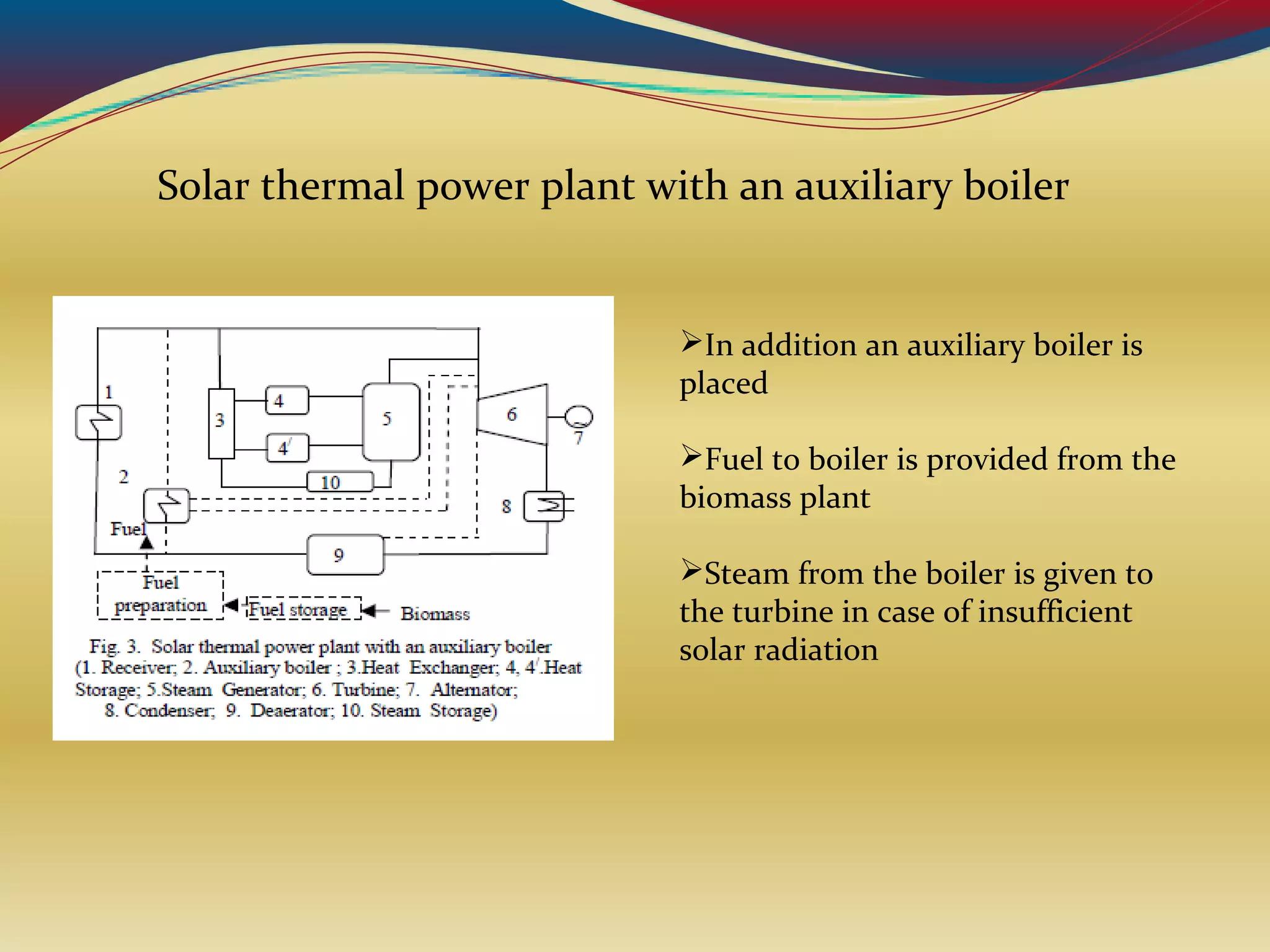
An auxiliary boiler is used to heat water whose fuel is
provided from the biomass plant
Solar thermal power plant with an auxiliary boiler
In addition an auxiliary boiler is
placed
Fuel to boiler is provided from the
biomass plant
Steam from the boiler is given to
the turbine in case of insufficient
solar radiation
Characteristics of STHPP with auxiliary boiler
Storage energy of STHPP remain
almost constant throughout the day
So the electrical energy produced is
stable and continuous
Thermal energy is relatively easier and less costly to
store compared to electrical energy
 Sensible heat storage is most commonly used heat
storage
 Thermal storage system of STHPP consists of two
distinct tanks
CONTRIBUTION OF THERMAL
ENERGY STORAGE SYSTEM
CONTD . .
One contains working fluid leaving the solar reflector
and other contains cooled working fluids leaving the
steam generator
Tanks must be of same size, in case of unavoidable
disturbances entire contents should be stored in one
tank
Thermal energy is passed to storage if the
temperature of heat source is higher than heat loads
and vice versa
BIOMASS FOR STPP
Obtained from biological materials such as plants,
trees, waste, sewage gas etc
The effectiveness of power generation requires
availability of biological materials and their
transportation
 Combustion gases from the auxiliary boiler are
conveyed to flue gas cleaning system and cleaned
gases are released to atmosphere
We must integrate the correct sources of energy for
optimal power supply to a region
ADVANTAGE OF BIOMASS SUPPORTED STHPP
Redundant energy is stored during sunny days
When the parameters of steam cannot reach rated
value during insufficient solar radiation, then
biomass plant starts to operate
Thus mixed steam reaches to rated value at exit of
receiver
FURTHER RESEARCH FOR
STHPP SYSTEM
To minimize the cost of large solar thermal energy
storage system
The operation of auxiliary boiler fed from biomass fuel
should be more optimized and automatic for stable
and reliable operation
CONCLUSION
Ensure to use 100% renewable sources
Stable and continuous mode of operation
The storage system of STHPP contributes to save
biomass fuel that will increase the overall efficiency of
the plant
This plant can be considered as most important
modes to use solar thermal and biomass power in
future
The world’s first plant combining biomass
and solar thermal energy in Catalonia
It can generate 25 MW of power
enough to supply 75000 houses
 It consist of almost 2,688 solar
panels
Using this renewable energy
plant will prevent 24,500 tones of
CO2 from being released into the
atmosphere.
REFERENCE
D. Mills, "Advances in solar thermal electricity
technology”
Z. Y. Ming and W. Jun, "Trough system and tower
system”
G. Celli, et al., "Optimal location of biogas and
biomass
generation plants"
WORKING . .
Used to drive Stirling engine to generate electricity
A Stirling engine is a heat engine operating by cyclic
compression and expansion of the working fluid, at
different temperature levels such that there is net
conversion of heat energy to mechanical
work( Stirling engine)
Alpha type Stirling engine. There are two cylinders. The expansion
cylinder (red) is maintained at a high temperature while the compression
cylinder (blue) is cooled. The passage between the two cylinders contains
the regenerator
Alpha type Stirling engine
ABSTRACT
Non-renewable resources are in a edge of depletion
Energy efficient renewable sources are needed for our
future
Biomass supported STHPP is a solution
Energy generation totally from renewable sources
Sources
Estimated
cost/KW (in USD) Estimated combined cost/KW
(in USD )
Solar thermal plant 3,149
5,018
Biomass plant 1,869
ESTIMATED COST OF PROPOSED BIOMASS
SUPPORTED SOLAR THERMAL HYBRID POWER PLANT

Biomass supported solar thermal hybrid power plant

  • 1.
  • 2.
    INDEX Introduction Working principle ofSTPP Proposed biomass supported STPP Advantages
  • 3.
    INTRODUCTION Use of non-renewableenergy cause environmental pollution and also they gets depleted Pollution free, freely available renewable sources are best alternative Solar power plants are widely used but its main problem is variability
  • 4.
    INTRODUCTION contd.. To overcomethe disadvantages of both power plants they are combined By shared use of some of the equipments effective cost is less than simple addition Effective operating hours and therefore overall energy generation is higher
  • 5.
    WORKING PRINCIPLE OFSOLAR THERMAL POWER PLANT  Need of solar thermal power plant is increasing due to increased fuel cost and environmental pollution
  • 6.
    METHODOLOGIES USED Parabolic TroughCollector System Parabolic Dish Focus System Central Receiver System
  • 7.
  • 8.
    WORKING . . Mostcost effective and reliable among the three  It is constructed as a long parabolic trough- shaped mirror, generally made of polished metal Heat transfer fluid (usually oil) runs through the tube to absorb the concentrated sunlight.
  • 9.
    Diagram of parabolicdish STPP Tracks the sun by rotating about two axes and rays are brought to a point focus Receiver is placed at the focus Working fluid in the receiver gets heated Using this heat steam is produced Steam drives a prime mover to generate electricity
  • 10.
  • 11.
    WORKING . . Solarradiation reflected from arrays of large mirrors which are called heliostats is concentrated on a receiver situated at the top of a supporting tower A molten salt is used as working fluid and medium of thermal storage
  • 12.
    Characteristics of STPP Collectsthermal energy from sunrise When obtained energy is insufficient stored energy is used Hence constant electrical output is obtained Stored energy will be depleted sooner and thereafter no energy production
  • 13.
    PROPOSED BIOMASS SUPPORTEDSTPP FOR STABLE AND CONTINUOUS OPERATION Large amount of budget will be required for building of large storage system Biomass supported plant can contribute to generate electrical energy continuously An auxiliary boiler is used to heat water whose fuel is provided from the biomass plant
  • 14.
    Solar thermal powerplant with an auxiliary boiler In addition an auxiliary boiler is placed Fuel to boiler is provided from the biomass plant Steam from the boiler is given to the turbine in case of insufficient solar radiation
  • 15.
    Characteristics of STHPPwith auxiliary boiler Storage energy of STHPP remain almost constant throughout the day So the electrical energy produced is stable and continuous
  • 16.
    Thermal energy isrelatively easier and less costly to store compared to electrical energy  Sensible heat storage is most commonly used heat storage  Thermal storage system of STHPP consists of two distinct tanks CONTRIBUTION OF THERMAL ENERGY STORAGE SYSTEM
  • 17.
    CONTD . . Onecontains working fluid leaving the solar reflector and other contains cooled working fluids leaving the steam generator Tanks must be of same size, in case of unavoidable disturbances entire contents should be stored in one tank Thermal energy is passed to storage if the temperature of heat source is higher than heat loads and vice versa
  • 18.
    BIOMASS FOR STPP Obtainedfrom biological materials such as plants, trees, waste, sewage gas etc The effectiveness of power generation requires availability of biological materials and their transportation  Combustion gases from the auxiliary boiler are conveyed to flue gas cleaning system and cleaned gases are released to atmosphere We must integrate the correct sources of energy for optimal power supply to a region
  • 19.
    ADVANTAGE OF BIOMASSSUPPORTED STHPP Redundant energy is stored during sunny days When the parameters of steam cannot reach rated value during insufficient solar radiation, then biomass plant starts to operate Thus mixed steam reaches to rated value at exit of receiver
  • 20.
    FURTHER RESEARCH FOR STHPPSYSTEM To minimize the cost of large solar thermal energy storage system The operation of auxiliary boiler fed from biomass fuel should be more optimized and automatic for stable and reliable operation
  • 21.
    CONCLUSION Ensure to use100% renewable sources Stable and continuous mode of operation The storage system of STHPP contributes to save biomass fuel that will increase the overall efficiency of the plant This plant can be considered as most important modes to use solar thermal and biomass power in future
  • 22.
    The world’s firstplant combining biomass and solar thermal energy in Catalonia It can generate 25 MW of power enough to supply 75000 houses  It consist of almost 2,688 solar panels Using this renewable energy plant will prevent 24,500 tones of CO2 from being released into the atmosphere.
  • 23.
    REFERENCE D. Mills, "Advancesin solar thermal electricity technology” Z. Y. Ming and W. Jun, "Trough system and tower system” G. Celli, et al., "Optimal location of biogas and biomass generation plants"
  • 24.
    WORKING . . Usedto drive Stirling engine to generate electricity A Stirling engine is a heat engine operating by cyclic compression and expansion of the working fluid, at different temperature levels such that there is net conversion of heat energy to mechanical work( Stirling engine)
  • 25.
    Alpha type Stirlingengine. There are two cylinders. The expansion cylinder (red) is maintained at a high temperature while the compression cylinder (blue) is cooled. The passage between the two cylinders contains the regenerator Alpha type Stirling engine
  • 26.
    ABSTRACT Non-renewable resources arein a edge of depletion Energy efficient renewable sources are needed for our future Biomass supported STHPP is a solution Energy generation totally from renewable sources
  • 27.
    Sources Estimated cost/KW (in USD)Estimated combined cost/KW (in USD ) Solar thermal plant 3,149 5,018 Biomass plant 1,869 ESTIMATED COST OF PROPOSED BIOMASS SUPPORTED SOLAR THERMAL HYBRID POWER PLANT