Ocean County College BIOL 161 Lectures Chemistry of Life … ...Better known as … BIOCHEMISTRY! BIOL161_03
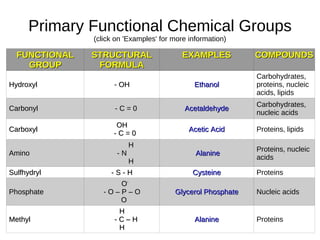
FUNCTIONAL GROUP STRUCTURAL FORMULA EXAMPLES COMPOUNDS Hydroxyl - OH Ethanol Carbohydrates, proteins, nucleic acids, lipids Carbonyl - C = 0 Acetaldehyde Carbohydrates, nucleic acids Carboxyl OH - C = 0 Acetic Acid Proteins, lipids Amino H - N H Alanine Proteins, nucleic acids Sulfhydryl - S - H Cysteine Proteins  Phosphate O - - O – P – O O Glycerol Phosphate Nucleic acids Methyl H - C – H H Alanine Proteins  Primary Functional Chemical Groups (click on 'Examples' for more information)
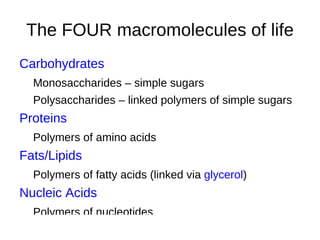
The FOUR macromolecules of life Carbohydrates Monosaccharides – simple sugars
Polysaccharides – linked polymers of simple sugars Proteins Polymers of amino acids Fats/Lipids Polymers of fatty acids (linked via  glycerol ) Nucleic Acids Polymers of nucleotides
Semiotic (i.e.,  information carrying ) molecules
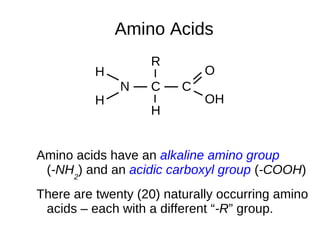
Amino Acids Amino acids have an  alkaline amino group ( -NH 2 ) and an  acidic carboxyl group  ( -COOH )
There are twenty (20) naturally occurring amino acids – each with a different “ -R ” group. C C N H R OH O H H
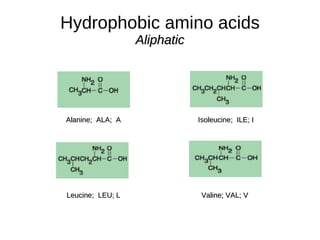
Hydrophobic amino acids Aliphatic Alanine;  ALA;  A Isoleucine;  ILE; I Leucine;  LEU; L Valine; VAL; V
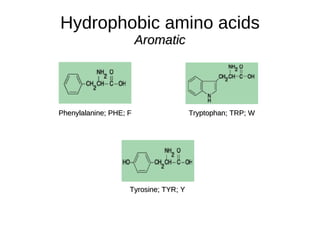
Hydrophobic amino acids Aromatic Phenylalanine; PHE; F Tyrosine; TYR; Y Tryptophan; TRP; W
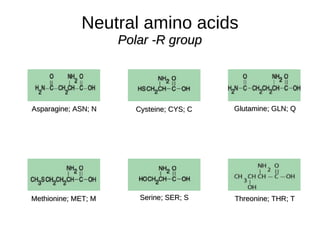
Neutral amino acids Polar -R group Asparagine; ASN; N Methionine; MET; M Threonine; THR; T Serine; SER; S Cysteine; CYS; C Glutamine; GLN; Q
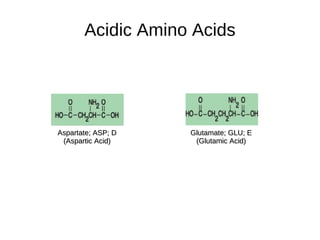
Acidic Amino Acids Aspartate; ASP; D (Aspartic Acid) Glutamate; GLU; E (Glutamic Acid)
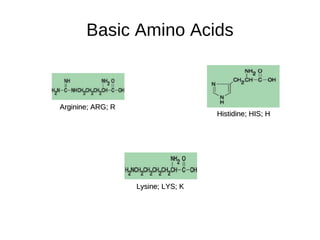
Basic Amino Acids Arginine; ARG; R Histidine; HIS; H Lysine; LYS; K
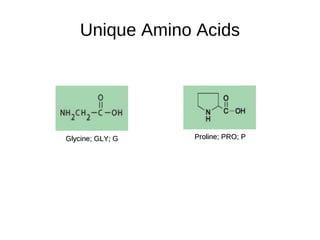
Unique Amino Acids Glycine; GLY; G Proline; PRO; P
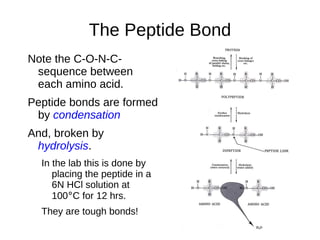
The Peptide Bond Note the C-O-N-C- sequence between each amino acid.
Peptide bonds are formed by  condensation
And, broken by  hydrolysis . In the lab this is done by placing the peptide in a 6N HCl solution at 100 ° C for 12 hrs.
They are tough bonds!
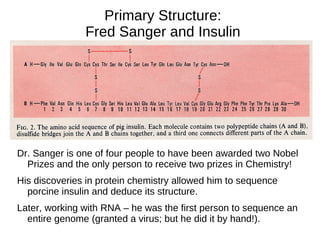
Primary Structure: Fred Sanger and Insulin Dr. Sanger is one of four people to have been awarded two Nobel Prizes and the only person to receive two prizes in Chemistry!
His discoveries in protein chemistry allowed him to sequence porcine insulin and deduce its structure.
Later, working with RNA – he was the first person to sequence an entire genome (granted a virus; but he did it by hand!).
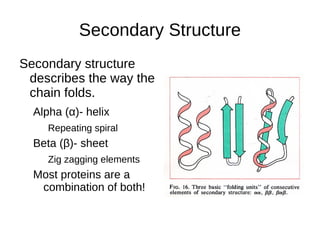
Secondary Structure Secondary structure describes the way the chain folds.  Alpha ( α )- helix Repeating spiral Beta ( β )- sheet Zig zagging elements Most proteins are a combination of both!
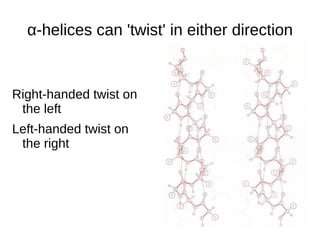
α -helices can 'twist' in either direction Right-handed twist on the left
Left-handed twist on the right
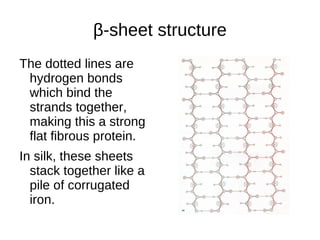
β -sheet structure The dotted lines are hydrogen bonds which bind the strands together, making this a strong flat fibrous protein.
In silk, these sheets stack together like a pile of corrugated iron.
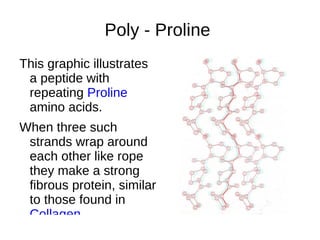
Poly - Proline  This graphic illustrates a peptide with repeating  Proline  amino acids.
When three such strands wrap around each other like rope they make a strong fibrous protein, similar to those found in  Collagen .
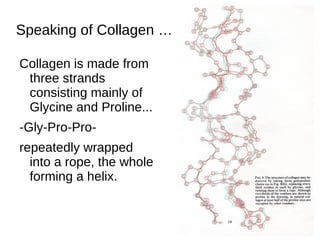
Speaking of Collagen …  Collagen is made from three strands consisting mainly of Glycine and Proline...
-Gly-Pro-Pro-
repeatedly wrapped into a rope, the whole forming a helix.
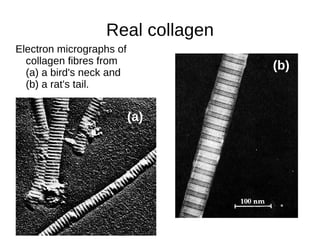
Real collagen Electron micrographs of collagen fibres from  (a) a bird's neck and  (b) a rat's tail. (a) (b)
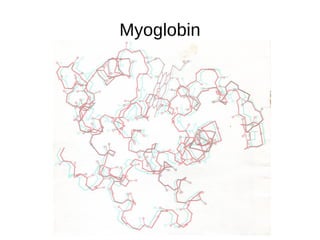
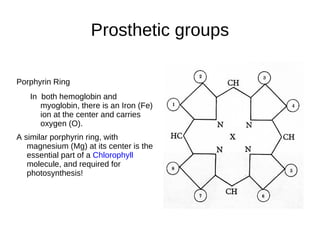
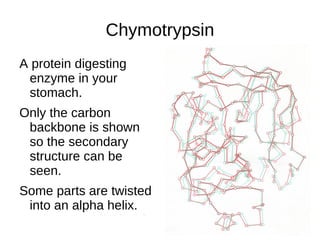
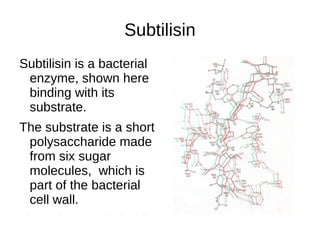
Three dimensional structure Tertiary structure the shapes which form when the secondary spirals of the protein chain further fold up on themselves. Quarternary structure any final alterations in the protein required for biological activity Chains may bind together or other inorganic substances may be incorporated into the molecule.

Biol161 03

  • 1.
    Ocean County CollegeBIOL 161 Lectures Chemistry of Life … ...Better known as … BIOCHEMISTRY! BIOL161_03
  • 2.
    FUNCTIONAL GROUP STRUCTURALFORMULA EXAMPLES COMPOUNDS Hydroxyl - OH Ethanol Carbohydrates, proteins, nucleic acids, lipids Carbonyl - C = 0 Acetaldehyde Carbohydrates, nucleic acids Carboxyl OH - C = 0 Acetic Acid Proteins, lipids Amino H - N H Alanine Proteins, nucleic acids Sulfhydryl - S - H Cysteine Proteins Phosphate O - - O – P – O O Glycerol Phosphate Nucleic acids Methyl H - C – H H Alanine Proteins Primary Functional Chemical Groups (click on 'Examples' for more information)
  • 3.
    The FOUR macromoleculesof life Carbohydrates Monosaccharides – simple sugars
  • 4.
    Polysaccharides – linkedpolymers of simple sugars Proteins Polymers of amino acids Fats/Lipids Polymers of fatty acids (linked via glycerol ) Nucleic Acids Polymers of nucleotides
  • 5.
    Semiotic (i.e., information carrying ) molecules
  • 6.
    Amino Acids Aminoacids have an alkaline amino group ( -NH 2 ) and an acidic carboxyl group ( -COOH )
  • 7.
    There are twenty(20) naturally occurring amino acids – each with a different “ -R ” group. C C N H R OH O H H
  • 8.
    Hydrophobic amino acidsAliphatic Alanine; ALA; A Isoleucine; ILE; I Leucine; LEU; L Valine; VAL; V
  • 9.
    Hydrophobic amino acidsAromatic Phenylalanine; PHE; F Tyrosine; TYR; Y Tryptophan; TRP; W
  • 10.
    Neutral amino acidsPolar -R group Asparagine; ASN; N Methionine; MET; M Threonine; THR; T Serine; SER; S Cysteine; CYS; C Glutamine; GLN; Q
  • 11.
    Acidic Amino AcidsAspartate; ASP; D (Aspartic Acid) Glutamate; GLU; E (Glutamic Acid)
  • 12.
    Basic Amino AcidsArginine; ARG; R Histidine; HIS; H Lysine; LYS; K
  • 13.
    Unique Amino AcidsGlycine; GLY; G Proline; PRO; P
  • 14.
    The Peptide BondNote the C-O-N-C- sequence between each amino acid.
  • 15.
    Peptide bonds areformed by condensation
  • 16.
    And, broken by hydrolysis . In the lab this is done by placing the peptide in a 6N HCl solution at 100 ° C for 12 hrs.
  • 17.
  • 18.
    Primary Structure: FredSanger and Insulin Dr. Sanger is one of four people to have been awarded two Nobel Prizes and the only person to receive two prizes in Chemistry!
  • 19.
    His discoveries inprotein chemistry allowed him to sequence porcine insulin and deduce its structure.
  • 20.
    Later, working withRNA – he was the first person to sequence an entire genome (granted a virus; but he did it by hand!).
  • 21.
    Secondary Structure Secondarystructure describes the way the chain folds. Alpha ( α )- helix Repeating spiral Beta ( β )- sheet Zig zagging elements Most proteins are a combination of both!
  • 22.
    α -helices can'twist' in either direction Right-handed twist on the left
  • 23.
  • 24.
    β -sheet structureThe dotted lines are hydrogen bonds which bind the strands together, making this a strong flat fibrous protein.
  • 25.
    In silk, thesesheets stack together like a pile of corrugated iron.
  • 26.
    Poly - Proline This graphic illustrates a peptide with repeating Proline amino acids.
  • 27.
    When three suchstrands wrap around each other like rope they make a strong fibrous protein, similar to those found in Collagen .
  • 28.
    Speaking of Collagen… Collagen is made from three strands consisting mainly of Glycine and Proline...
  • 29.
  • 30.
    repeatedly wrapped intoa rope, the whole forming a helix.
  • 31.
    Real collagen Electronmicrographs of collagen fibres from (a) a bird's neck and (b) a rat's tail. (a) (b)
  • 32.
    Three dimensional structureTertiary structure the shapes which form when the secondary spirals of the protein chain further fold up on themselves. Quarternary structure any final alterations in the protein required for biological activity Chains may bind together or other inorganic substances may be incorporated into the molecule.

Editor's Notes

  • #21 Tertiary Stucture Spot the Tertiary folding. Quaternary Structure Spot the Heme group (Side chains have been omitted for clarity.)