Confessions of a Poultry Geneticist G. F. Barbato Department of Poultry Science Graduate Program in Animal Science and Intercollege Graduate Program in Genetics The Pennsylvania State University
Research OED Noun :  The act of searching (closely or carefully) for or after a specified thing or person.  a. A search or investigation directed to the discovery of some fact by careful consideration or study of a subject; a course of critical or scientific inquiry.  b. Without article: Investigation, inquiry into things. Also, as a quality of persons, habitude of carrying out such investigation.  Investigation or pursuit of a subject. R are. Verb :  trans . To search into (a matter or subject); to investigate or study closely. Also, to engage in research upon (a subject, a person, etc.).  So:  Search, and re-search!
Google it. Research 1,120,000,000 hits (2008/06/30) 885,000,000 hits (2007/6/26) Over 5,460,000,000 hits (2006/6/26) 93,000,000 in June, 2005!! Why is research important? 845,000,000 hits Research process (or, strategy) 345 million hits... btw ... don't Google -->  google scholar  ?
How to create new knowledge (or evaluate old stuff) Historical perspective. Await revelation. Await enlightenment. Methodical evaluation. Fake it.
How to do research Identify a topic Harder than it sounds... Find background information Libraries, books and  articles (oh my!) Evaluate quality of sources Citations What happens when you can't find the answer?
Don't forget Knowledge is a function of BOTH method and  context . We assume a certain level of logic and mechanism. We also assume that rational principles govern the world. We further assume that humans are logical and capable of deducing these principles. [Now – That's a leap of faith!]
Four Easy Steps Observation and description of a phenomenon or group of phenomena. Formulation of an hypothesis to explain the phenomena.  Often, the hypothesis often takes the form of a causal mechanism or a mathematical relationship. Use of the hypothesis to predict the existence of other phenomena, or to quantitatively predict the results of new observations. Performance of empirical tests of the predictions by appropriately designed experiments and, preferably, several independent experimenters.
What's Important? What did Albert Einstein think? “Imagination is more important than knowledge.” “The important thing is to never stop questioning.” “The independence created by philosophical insight ... is the mark of distinction between a mere artisan or specialist and a real seeker of the truth.” Another way to put it: "Invention, my dear friends, is 93% perspiration, 6% electricity, 4% evaporation and 2% butterscotch ripple." W. Wonka
The  Problem 2005, Kaplan's Americas Hottest Colleges, Newsweek
The REAL Problem; (and the SOLUTION) How much time do American students spend in school?? High School 900 hrs / year College  (16 hrs/week * 15 weeks/ semester * 2 semesters) 480 hrs / year How much time do American students spend watching television? 1,023 hrs / year
Livestock Populations of the World (average 1990 - 92) (FAOSTAT, 1994,1998,2003) 2000-2002 Population 1.35 1.8 0.91 0.12 0.18 18.2 5.9 CURRENT WORLD POPULATION:  6,707,019,126
What are the challenges of human population growth? Undernutrition  More on the next slide Disease transmission More plants and animals Shrinking gene pools Biosecurity Xenobiotic transmission Social friction We experience more cultures than ever before. Misunderstanding;  both linguistic and cultural, abound Human biology Shrinking gene pool Is there any 'natural selection'?
Worldwide Chronic Undernutrition http://www.fao.org/es/ess/faostat/foodsecurity/FSMap/flash_map.htm Percentage of population undernourished, 1990-92 < 10% 20 - 30% 10 - 20% > 50% 30 - 50% Not Estimated
2004 USDA Hunger Survey 38.2 million Americans (13.2%) now live in hungry and food-insecure households. Over 36% of the individuals living in these households are children  (13.9 million children under the age of 18). •The number of American households experiencing hunger jumped 43% between 1999 and 2004.
Worldwide Meat Consumption (1997)
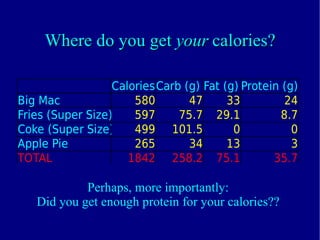
Where do you get  your  calories? Perhaps, more importantly: Did you get enough protein for your calories??
 
The world and plants
The 7 Neolithic Founder Crops
Wait a minute … What’s domestication? Economic Use such as meat, fur, eggs, milk, labor companionship!! The breeding, care and feeding of the animal are under the continuous control of man Any situation where artificial selection has replaced, in part, natural selection
 
 
The world, plants and animals
Behavioral characteristics favoring domestication GROUP STRUCTURE: Large social group Hierarchical social system Males affiliated with females SEXUAL BEHAVIOR: Promiscuous matings Males dominant over females Postural sexual signals Family groupings Territorial structure Males separate Pair-bonding Female dominance Morphological sexual signals
PARENTAL BEHAVIOR: Critical period Female accepts young Precocious young RESPONSES TO MAN: Short flight distance Least disturbed by activity Postural sexual signals OTHER: Catholic dietary habits Limited agility Environmentally adaptable Species bond Accept species characteristics Altricial young Extreme wariness Easily disturbed Morphological sexual signals Specialized diets Extreme agility Fixed habitat
Trait changes associated with domestication SIZE: Early domestic animals were smaller than their wild counterparts.  Now they are larger, due to artificial selection. COLOR: Many more colors in domestic varieties than observed in the wild. SKULL Facial features shortened relative to cranial size.  This is especially evident in swine and sheep.  The teeth get smaller and horns decrease in size. SKELETON: Domestic cattle have weak muscle ridges and poorly defined facets of the joints.  In domestic pigs, the  epiphyses of the limb bones do not fuse with the diaphyses until long after maturity.

2008 PGSAS Introduction

  • 1.
    Confessions of aPoultry Geneticist G. F. Barbato Department of Poultry Science Graduate Program in Animal Science and Intercollege Graduate Program in Genetics The Pennsylvania State University
  • 2.
    Research OED Noun: The act of searching (closely or carefully) for or after a specified thing or person. a. A search or investigation directed to the discovery of some fact by careful consideration or study of a subject; a course of critical or scientific inquiry. b. Without article: Investigation, inquiry into things. Also, as a quality of persons, habitude of carrying out such investigation. Investigation or pursuit of a subject. R are. Verb : trans . To search into (a matter or subject); to investigate or study closely. Also, to engage in research upon (a subject, a person, etc.). So: Search, and re-search!
  • 3.
    Google it. Research1,120,000,000 hits (2008/06/30) 885,000,000 hits (2007/6/26) Over 5,460,000,000 hits (2006/6/26) 93,000,000 in June, 2005!! Why is research important? 845,000,000 hits Research process (or, strategy) 345 million hits... btw ... don't Google --> google scholar ?
  • 4.
    How to createnew knowledge (or evaluate old stuff) Historical perspective. Await revelation. Await enlightenment. Methodical evaluation. Fake it.
  • 5.
    How to doresearch Identify a topic Harder than it sounds... Find background information Libraries, books and articles (oh my!) Evaluate quality of sources Citations What happens when you can't find the answer?
  • 6.
    Don't forget Knowledgeis a function of BOTH method and context . We assume a certain level of logic and mechanism. We also assume that rational principles govern the world. We further assume that humans are logical and capable of deducing these principles. [Now – That's a leap of faith!]
  • 7.
    Four Easy StepsObservation and description of a phenomenon or group of phenomena. Formulation of an hypothesis to explain the phenomena. Often, the hypothesis often takes the form of a causal mechanism or a mathematical relationship. Use of the hypothesis to predict the existence of other phenomena, or to quantitatively predict the results of new observations. Performance of empirical tests of the predictions by appropriately designed experiments and, preferably, several independent experimenters.
  • 8.
    What's Important? Whatdid Albert Einstein think? “Imagination is more important than knowledge.” “The important thing is to never stop questioning.” “The independence created by philosophical insight ... is the mark of distinction between a mere artisan or specialist and a real seeker of the truth.” Another way to put it: &quot;Invention, my dear friends, is 93% perspiration, 6% electricity, 4% evaporation and 2% butterscotch ripple.&quot; W. Wonka
  • 9.
    The Problem2005, Kaplan's Americas Hottest Colleges, Newsweek
  • 10.
    The REAL Problem;(and the SOLUTION) How much time do American students spend in school?? High School 900 hrs / year College (16 hrs/week * 15 weeks/ semester * 2 semesters) 480 hrs / year How much time do American students spend watching television? 1,023 hrs / year
  • 11.
    Livestock Populations ofthe World (average 1990 - 92) (FAOSTAT, 1994,1998,2003) 2000-2002 Population 1.35 1.8 0.91 0.12 0.18 18.2 5.9 CURRENT WORLD POPULATION: 6,707,019,126
  • 12.
    What are thechallenges of human population growth? Undernutrition More on the next slide Disease transmission More plants and animals Shrinking gene pools Biosecurity Xenobiotic transmission Social friction We experience more cultures than ever before. Misunderstanding; both linguistic and cultural, abound Human biology Shrinking gene pool Is there any 'natural selection'?
  • 13.
    Worldwide Chronic Undernutritionhttp://www.fao.org/es/ess/faostat/foodsecurity/FSMap/flash_map.htm Percentage of population undernourished, 1990-92 < 10% 20 - 30% 10 - 20% > 50% 30 - 50% Not Estimated
  • 14.
    2004 USDA HungerSurvey 38.2 million Americans (13.2%) now live in hungry and food-insecure households. Over 36% of the individuals living in these households are children (13.9 million children under the age of 18). •The number of American households experiencing hunger jumped 43% between 1999 and 2004.
  • 15.
  • 16.
    Where do youget your calories? Perhaps, more importantly: Did you get enough protein for your calories??
  • 17.
  • 18.
  • 19.
    The 7 NeolithicFounder Crops
  • 20.
    Wait a minute… What’s domestication? Economic Use such as meat, fur, eggs, milk, labor companionship!! The breeding, care and feeding of the animal are under the continuous control of man Any situation where artificial selection has replaced, in part, natural selection
  • 21.
  • 22.
  • 23.
    The world, plantsand animals
  • 24.
    Behavioral characteristics favoringdomestication GROUP STRUCTURE: Large social group Hierarchical social system Males affiliated with females SEXUAL BEHAVIOR: Promiscuous matings Males dominant over females Postural sexual signals Family groupings Territorial structure Males separate Pair-bonding Female dominance Morphological sexual signals
  • 25.
    PARENTAL BEHAVIOR: Criticalperiod Female accepts young Precocious young RESPONSES TO MAN: Short flight distance Least disturbed by activity Postural sexual signals OTHER: Catholic dietary habits Limited agility Environmentally adaptable Species bond Accept species characteristics Altricial young Extreme wariness Easily disturbed Morphological sexual signals Specialized diets Extreme agility Fixed habitat
  • 26.
    Trait changes associatedwith domestication SIZE: Early domestic animals were smaller than their wild counterparts. Now they are larger, due to artificial selection. COLOR: Many more colors in domestic varieties than observed in the wild. SKULL Facial features shortened relative to cranial size. This is especially evident in swine and sheep. The teeth get smaller and horns decrease in size. SKELETON: Domestic cattle have weak muscle ridges and poorly defined facets of the joints. In domestic pigs, the epiphyses of the limb bones do not fuse with the diaphyses until long after maturity.