Biogeochemical CyclesBiogeochemical Cycles
Section 22-2
Pages 420-423
describe the flow of essentialessential
elementselements from the
environment through living
organisms and back into
the environment.
Biogeochemical Cycles
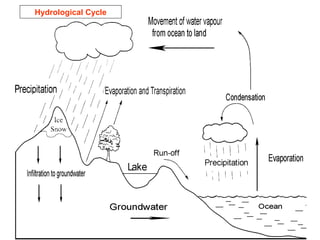
Hydrological Cycle
Hydrological CycleHydrological Cycle
(water cycle)
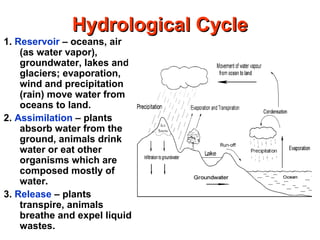
1. Reservoir – oceans, air (as water vapor),
groundwater, lakes and glaciers;
evaporation, wind and precipitation
(rain) move water from oceans to
land
2. Assimilation – plants absorb water from the
ground, animals drink water or eat
other organisms which are
composed mostly of water
3. Release – plants transpire, animals breathe
and expel liquid wastes
Hydrological CycleHydrological Cycle
1. Reservoir – oceans, air
(as water vapor),
groundwater, lakes and
glaciers; evaporation,
wind and precipitation
(rain) move water from
oceans to land.
2. Assimilation – plants
absorb water from the
ground, animals drink
water or eat other
organisms which are
composed mostly of
water.
3. Release – plants
transpire, animals
breathe and expel liquid
wastes.
Carbon Cycle
Carbon CycleCarbon Cycle
(carbon is required for building organic compounds)
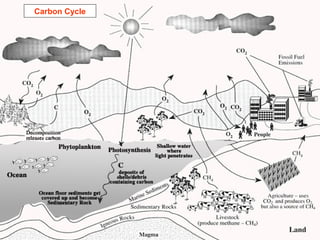
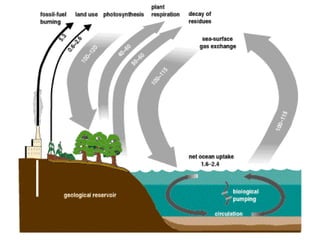
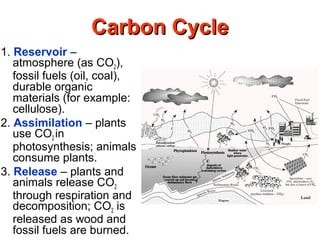
1. Reservoir – atmosphere (as CO2), fossil
fuels (oil, coal), durable organic
materials (for example: cellulose).
2. Assimilation – plants use CO2 in
photosynthesis; animals consume
plants.
3. Release – plants and animals release CO2
through respiration and
decomposition; CO2 is released as
wood and fossil fuels are burned.
Carbon CycleCarbon Cycle
1. Reservoir –
atmosphere (as CO2),
fossil fuels (oil, coal),
durable organic
materials (for example:
cellulose).
2. Assimilation – plants
use CO2 in
photosynthesis; animals
consume plants.
3. Release – plants and
animals release CO2
through respiration and
decomposition; CO2 is
released as wood and
fossil fuels are burned.
Nitrogen Cycle
Nitrogen CycleNitrogen Cycle
(Nitrogen is required for the manufacture of
amino acids and nucleic acids)
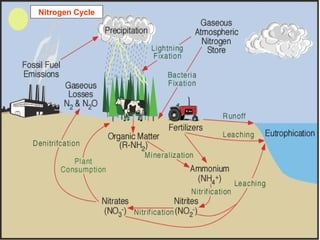
1. Reservoir – atmosphere (as N2); soil (as
NH4
+
or ammonium, NH3 or
ammonia, N02
-
or nitrite, N03
-
or
nitrate
2. Assimilation – plants absorb nitrogen as
either NH4
+
or as N03
-
, animals obtain
nitrogen by eating plants and other
animals. The stages in the
assimilation of nitrogen are as
follows:
Nitrogen Fixation: N2 to NH4
+
by
nitrogen-fixing bacteria (prokaryotes
in the soil and root nodules), N2 to N03
-
by lightning and UV radiation.
Nitrification: NH4
+
to N02
-
and N02
-
to
N03
-
by various nitrifying bacteria.
Nitrogen CycleNitrogen Cycle
3. Release – Denitrifying bacteria convert
N03
-
backto N2 (denitrification);
detrivorous bacteria convert
organic compounds back to NH4
+
(ammonification); animals excrete
NH4
+
(or NH3) urea, or uric acid.
Nitrogen CycleNitrogen Cycle
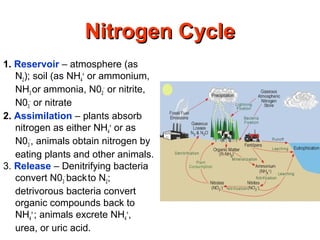
1. Reservoir – atmosphere (as
N2); soil (as NH4
+
or ammonium,
NH3 or ammonia, N02
-
or nitrite,
N03
-
or nitrate
2. Assimilation – plants absorb
nitrogen as either NH4
+
or as
N03
-
, animals obtain nitrogen by
eating plants and other animals.
3. Release – Denitrifying bacteria
convert N03
-
backto N2;
detrivorous bacteria convert
organic compounds back to
NH4
+
; animals excrete NH4
+
,
urea, or uric acid.
Phosphorus Cycle
Phosphorus CyclePhosphorus Cycle
(Phosphorus is required for the manufacture
of ATP and all nucleic acids)
1. Reservoir – erosion transfers phosphorus to
water and soil; sediments and rocks that
accumulate on ocean floors return to the
surface as a result of uplifting by
geological processes
2. Assimilation – plants absorb inorganic PO4
3-
(phosphate)from soils; animals obtain
organic phosphorus when they plants and
other animals
3. Release – plants and animals release phosphorus
when they decompose; animals excrete
phosphorus in their waste products
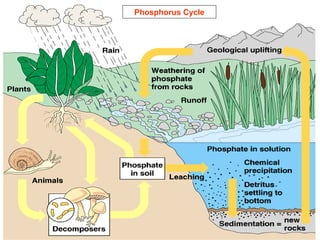
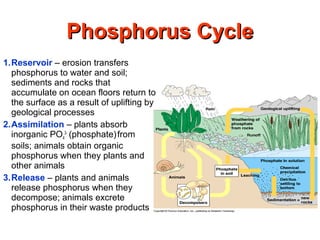
Phosphorus CyclePhosphorus Cycle
1.Reservoir – erosion transfers
phosphorus to water and soil;
sediments and rocks that
accumulate on ocean floors return to
the surface as a result of uplifting by
geological processes
2.Assimilation – plants absorb
inorganic PO4
3-
(phosphate)from
soils; animals obtain organic
phosphorus when they plants and
other animals
3.Release – plants and animals
release phosphorus when they
decompose; animals excrete
phosphorus in their waste products

Biogeochemical cycles

  • 1.
  • 2.
    describe the flowof essentialessential elementselements from the environment through living organisms and back into the environment. Biogeochemical Cycles
  • 3.
  • 4.
    Hydrological CycleHydrological Cycle (watercycle) 1. Reservoir – oceans, air (as water vapor), groundwater, lakes and glaciers; evaporation, wind and precipitation (rain) move water from oceans to land 2. Assimilation – plants absorb water from the ground, animals drink water or eat other organisms which are composed mostly of water 3. Release – plants transpire, animals breathe and expel liquid wastes
  • 5.
    Hydrological CycleHydrological Cycle 1.Reservoir – oceans, air (as water vapor), groundwater, lakes and glaciers; evaporation, wind and precipitation (rain) move water from oceans to land. 2. Assimilation – plants absorb water from the ground, animals drink water or eat other organisms which are composed mostly of water. 3. Release – plants transpire, animals breathe and expel liquid wastes.
  • 6.
  • 7.
    Carbon CycleCarbon Cycle (carbonis required for building organic compounds) 1. Reservoir – atmosphere (as CO2), fossil fuels (oil, coal), durable organic materials (for example: cellulose). 2. Assimilation – plants use CO2 in photosynthesis; animals consume plants. 3. Release – plants and animals release CO2 through respiration and decomposition; CO2 is released as wood and fossil fuels are burned.
  • 9.
    Carbon CycleCarbon Cycle 1.Reservoir – atmosphere (as CO2), fossil fuels (oil, coal), durable organic materials (for example: cellulose). 2. Assimilation – plants use CO2 in photosynthesis; animals consume plants. 3. Release – plants and animals release CO2 through respiration and decomposition; CO2 is released as wood and fossil fuels are burned.
  • 10.
  • 11.
    Nitrogen CycleNitrogen Cycle (Nitrogenis required for the manufacture of amino acids and nucleic acids) 1. Reservoir – atmosphere (as N2); soil (as NH4 + or ammonium, NH3 or ammonia, N02 - or nitrite, N03 - or nitrate
  • 12.
    2. Assimilation –plants absorb nitrogen as either NH4 + or as N03 - , animals obtain nitrogen by eating plants and other animals. The stages in the assimilation of nitrogen are as follows: Nitrogen Fixation: N2 to NH4 + by nitrogen-fixing bacteria (prokaryotes in the soil and root nodules), N2 to N03 - by lightning and UV radiation. Nitrification: NH4 + to N02 - and N02 - to N03 - by various nitrifying bacteria. Nitrogen CycleNitrogen Cycle
  • 13.
    3. Release –Denitrifying bacteria convert N03 - backto N2 (denitrification); detrivorous bacteria convert organic compounds back to NH4 + (ammonification); animals excrete NH4 + (or NH3) urea, or uric acid. Nitrogen CycleNitrogen Cycle
  • 14.
    Nitrogen CycleNitrogen Cycle 1.Reservoir – atmosphere (as N2); soil (as NH4 + or ammonium, NH3 or ammonia, N02 - or nitrite, N03 - or nitrate 2. Assimilation – plants absorb nitrogen as either NH4 + or as N03 - , animals obtain nitrogen by eating plants and other animals. 3. Release – Denitrifying bacteria convert N03 - backto N2; detrivorous bacteria convert organic compounds back to NH4 + ; animals excrete NH4 + , urea, or uric acid.
  • 15.
  • 16.
    Phosphorus CyclePhosphorus Cycle (Phosphorusis required for the manufacture of ATP and all nucleic acids) 1. Reservoir – erosion transfers phosphorus to water and soil; sediments and rocks that accumulate on ocean floors return to the surface as a result of uplifting by geological processes 2. Assimilation – plants absorb inorganic PO4 3- (phosphate)from soils; animals obtain organic phosphorus when they plants and other animals 3. Release – plants and animals release phosphorus when they decompose; animals excrete phosphorus in their waste products
  • 17.
    Phosphorus CyclePhosphorus Cycle 1.Reservoir– erosion transfers phosphorus to water and soil; sediments and rocks that accumulate on ocean floors return to the surface as a result of uplifting by geological processes 2.Assimilation – plants absorb inorganic PO4 3- (phosphate)from soils; animals obtain organic phosphorus when they plants and other animals 3.Release – plants and animals release phosphorus when they decompose; animals excrete phosphorus in their waste products