OmidTeymournejad
(Medical Bacteriology, PhD)
 A biofilm is an assemblage of surface-
associated microbial cells that is enclosed in
an extracellular polymeric substance matrix
 Biofilms may form on a wide variety of
surfaces, including living tissues, indwelling
medical devices, industrial or potable water
system piping
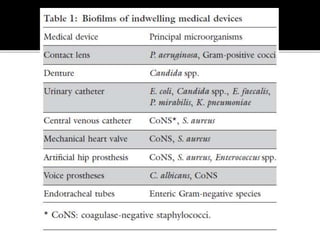
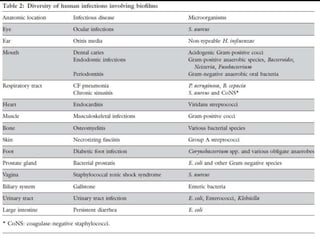
 Biofilms are a major cause of human
infections
 The majority of hospital-acquired infections
are due to biofilms because they can be life-
threatening colonizers of biomedical devices
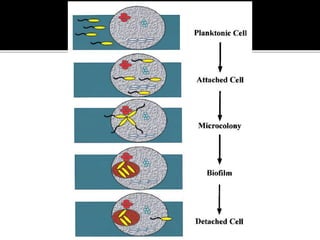
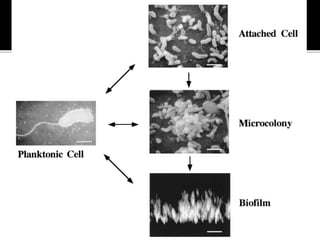
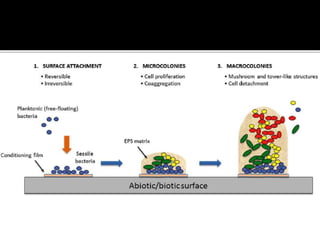
 The first step is the attachment of the
bacterial cells to the selected abiotic or biotic
surface
 Initial attachment is mediated through weak
reversible van derWaals interactions
between the cell surface and the substratum,
which can lead to stronger adhesion receptor
mediated attachment
 Bacterial cell surface structures such as flagella,
fimbriae, LPS, and exopolysaccharides
participate in irreversible interactions
 The second step corresponds to the
development of micro-colonies promoted by
the growth and division of the first attached
cells (primary colonizers)
 The micro-colonies progressively enlarge and
coalesce to form the first layer of cells
covering the surface
 When multiple layers of cells pile up on the
surface, the third step of the formation is
obtained
 indicated by the presence of a mature biofilm
characterized by the presence of macro-
colonies surrounded by water channels that
help distribute nutrients and signaling
molecules
 Finally, to survive when nutrients become
limited, or simply to spread and colonize to
other niches, some biofilm cells can detach
individually or in clumps
 biofilms display a common attribute, the biofilm
matrix.
 Contrary to free-floating planktonic cells, biofilm
cells are embedded in a self produced
extracellular matrix, the extracellular polymeric
substance (EPS), that holds them together
 Biofilms are composed of about 80–85% EPS (by
volume) and only 15–20% cells (by volume)
 Although the EPS may vary in chemical and
physical properties, its major components are
polysaccharides, proteins, and extracellular
DNA
 The EPS plays a major role in maintaining the
integrity of the biofilm and can confer other
beneficial properties.
 Since the EPS is also highly hydrated, it can
prevent desiccation in some natural biofilms
 The EPS can also act as a diffusion barrier,
preventing toxic substances such as
antibiotics and disinfectants from reaching
their target
 Most biofilms found in nature are
polymicrobials, where diverse species
expressing multiple phenotypes are involved
 The most amazing fact is that even in a
mono-species biofilm, phenotypic
heterogeneity exists
 Cell differentiation in biofilms may depend on
the local environmental conditions
surrounding the cells
 Different concentration gradients of oxygen,
nutrients, ions, and chemicals create a wide
variety of microhabitats providing conditions
suitable for bacterial colonization
 Cells located in the upper biofilm layers
consume all available oxygen and grow
aerobically, while an anaerobic micro-niche
developed underneath the aerobic layer
 Oxygen- and nutrient depleted regions are
found at the bottom layers of the biofilm
structure and under these circumstances,
most of the sessile cells are metabolically
inactive or dead
 A few years ago,Watnick & Kolter proposed
the interesting idea that biofilms can be
compared to cities
 In these cities of microbes, microorganisms
are considered “social” organisms able to
communicate with one another
 Using different chemical languages, bacteria
learn about their current cell population and
determine when they have reached a critical
mass
 Using that information, bacteria can thus
modify their behavior to carry out processes
that would require many cells acting in
conjunction to be effective
 Cell-to-cell communication is generally
carried out by diffusible signal molecules
produced and released by bacteria
 When bacteria are growing within a biofilm,
they secrete signaling molecules (auto-
inducers) that increase in concentration as a
function of bacterial cell density
 In a process called quorum sensing, bacteria
communicate with one another by using
auto-inducers to regulate their gene
expression in response to fluctuations in the
cell population density
 Two types of quorum-sensing systems are
recognized in bacteria:
 intra-species communication and inter-
species communication
 During intra-species communication, several
auto-inducers have been identified
 Gram-negative bacteria usually use acyl
homoserine lactone (AHL) as signal
molecules, while Gram-positive bacteria
utilize small peptides
 During inter-species communication, bacteria
use autoinducer-2 (AI-2)
 In some cases, quorum sensing does not
seem to be involved in biofilm structural
development
 while for other species, there is evidence that
quorum sensing is important for the
attachment of bacteria to the surface, the
maturation of the biofilm, or the control of
events leading to the dispersion of cells
 A significant characteristic of microbial
biofilms is their high-level drug tolerance
 Bacterial biofilms have been shown to have a
100- to 1,000- fold increased tolerance
toward antibiotics in comparison to their
free-swimming counterparts
 Diffusion barrier imparted by the EPS matrix
 Phenotypic heterogeneity
 GeneTransferring
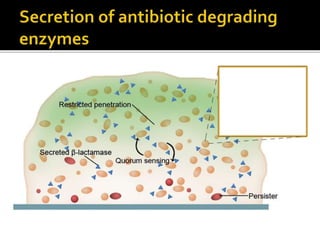
 Secretion of antibiotic degrading enzymes
 A primary function that has been attributed
to the biofilm matrix is protection,
 Several studies have shown that the EPS
matrix can act as an impermeable barrier to
limit antimicrobial penetration, thereby
protecting the biofilm cells
 Such protection can be due either to physical
hindrance in antimicrobial diffusion or to
direct binding of the antibiotics by the EPS
matrix
 Upon antibiotic treatment, cells at the top of
the liquid– biofilm interface die due to their
closer exposure, while bacteria embedded
deep inside the biofilm are able to survive
 Anionic EPS matrix can bind and sequester
toxic cationic heavy metals, cationic
antimicrobial peptides, and positively-
charged antibiotics (e.g. aminoglycosides)
 Phenotypic heterogeneity occurs within
biofilms notably due to different
concentration gradients
 Cells localized at the bottom layers of the
biofilm are normally found in a growth stage
analogous to stationary-phase planktonic
cells, while the physiology of cells localized at
the top surface layers is similar to
exponentially growing planktonic cells
 Microbial cells, especially those in the deeper
layers of the biofilms where nutrients and
oxygen are limited, are associated with a
lower growth rate
 This reduced metabolic activity might
account for the enhanced tolerance toward
antibiotics that target bacterial cellular
processes such as DNA replication or
translation
 Conventional antibiotics used to treat
infections are mostly effective at killing
rapidly growing cells
 The decreased metabolic activity of cells
found within the deeper biofilm layers may
thus contribute to antibiotic tolerance and
the persistence of biofilm infections
 Biofilms also provide an ideal niche for the
exchange of extrachromosomal DNA
(plasmids)
 Conjugation (the mechanism of plasmid
transfer) occurs at a greater rate between
cells in biofilms than between planktonic cells
Biofilm

Biofilm

  • 1.
  • 2.
     A biofilmis an assemblage of surface- associated microbial cells that is enclosed in an extracellular polymeric substance matrix  Biofilms may form on a wide variety of surfaces, including living tissues, indwelling medical devices, industrial or potable water system piping
  • 3.
     Biofilms area major cause of human infections  The majority of hospital-acquired infections are due to biofilms because they can be life- threatening colonizers of biomedical devices
  • 6.
     The firststep is the attachment of the bacterial cells to the selected abiotic or biotic surface  Initial attachment is mediated through weak reversible van derWaals interactions between the cell surface and the substratum, which can lead to stronger adhesion receptor mediated attachment
  • 7.
     Bacterial cellsurface structures such as flagella, fimbriae, LPS, and exopolysaccharides participate in irreversible interactions  The second step corresponds to the development of micro-colonies promoted by the growth and division of the first attached cells (primary colonizers)
  • 8.
     The micro-coloniesprogressively enlarge and coalesce to form the first layer of cells covering the surface  When multiple layers of cells pile up on the surface, the third step of the formation is obtained
  • 9.
     indicated bythe presence of a mature biofilm characterized by the presence of macro- colonies surrounded by water channels that help distribute nutrients and signaling molecules  Finally, to survive when nutrients become limited, or simply to spread and colonize to other niches, some biofilm cells can detach individually or in clumps
  • 13.
     biofilms displaya common attribute, the biofilm matrix.  Contrary to free-floating planktonic cells, biofilm cells are embedded in a self produced extracellular matrix, the extracellular polymeric substance (EPS), that holds them together  Biofilms are composed of about 80–85% EPS (by volume) and only 15–20% cells (by volume)
  • 14.
     Although theEPS may vary in chemical and physical properties, its major components are polysaccharides, proteins, and extracellular DNA  The EPS plays a major role in maintaining the integrity of the biofilm and can confer other beneficial properties.
  • 15.
     Since theEPS is also highly hydrated, it can prevent desiccation in some natural biofilms  The EPS can also act as a diffusion barrier, preventing toxic substances such as antibiotics and disinfectants from reaching their target
  • 16.
     Most biofilmsfound in nature are polymicrobials, where diverse species expressing multiple phenotypes are involved  The most amazing fact is that even in a mono-species biofilm, phenotypic heterogeneity exists
  • 17.
     Cell differentiationin biofilms may depend on the local environmental conditions surrounding the cells  Different concentration gradients of oxygen, nutrients, ions, and chemicals create a wide variety of microhabitats providing conditions suitable for bacterial colonization
  • 18.
     Cells locatedin the upper biofilm layers consume all available oxygen and grow aerobically, while an anaerobic micro-niche developed underneath the aerobic layer  Oxygen- and nutrient depleted regions are found at the bottom layers of the biofilm structure and under these circumstances, most of the sessile cells are metabolically inactive or dead
  • 19.
     A fewyears ago,Watnick & Kolter proposed the interesting idea that biofilms can be compared to cities  In these cities of microbes, microorganisms are considered “social” organisms able to communicate with one another
  • 20.
     Using differentchemical languages, bacteria learn about their current cell population and determine when they have reached a critical mass  Using that information, bacteria can thus modify their behavior to carry out processes that would require many cells acting in conjunction to be effective
  • 21.
     Cell-to-cell communicationis generally carried out by diffusible signal molecules produced and released by bacteria  When bacteria are growing within a biofilm, they secrete signaling molecules (auto- inducers) that increase in concentration as a function of bacterial cell density
  • 22.
     In aprocess called quorum sensing, bacteria communicate with one another by using auto-inducers to regulate their gene expression in response to fluctuations in the cell population density  Two types of quorum-sensing systems are recognized in bacteria:
  • 23.
     intra-species communicationand inter- species communication  During intra-species communication, several auto-inducers have been identified
  • 24.
     Gram-negative bacteriausually use acyl homoserine lactone (AHL) as signal molecules, while Gram-positive bacteria utilize small peptides  During inter-species communication, bacteria use autoinducer-2 (AI-2)
  • 25.
     In somecases, quorum sensing does not seem to be involved in biofilm structural development  while for other species, there is evidence that quorum sensing is important for the attachment of bacteria to the surface, the maturation of the biofilm, or the control of events leading to the dispersion of cells
  • 26.
     A significantcharacteristic of microbial biofilms is their high-level drug tolerance  Bacterial biofilms have been shown to have a 100- to 1,000- fold increased tolerance toward antibiotics in comparison to their free-swimming counterparts
  • 27.
     Diffusion barrierimparted by the EPS matrix  Phenotypic heterogeneity  GeneTransferring  Secretion of antibiotic degrading enzymes
  • 28.
     A primaryfunction that has been attributed to the biofilm matrix is protection,  Several studies have shown that the EPS matrix can act as an impermeable barrier to limit antimicrobial penetration, thereby protecting the biofilm cells
  • 29.
     Such protectioncan be due either to physical hindrance in antimicrobial diffusion or to direct binding of the antibiotics by the EPS matrix  Upon antibiotic treatment, cells at the top of the liquid– biofilm interface die due to their closer exposure, while bacteria embedded deep inside the biofilm are able to survive
  • 30.
     Anionic EPSmatrix can bind and sequester toxic cationic heavy metals, cationic antimicrobial peptides, and positively- charged antibiotics (e.g. aminoglycosides)
  • 31.
     Phenotypic heterogeneityoccurs within biofilms notably due to different concentration gradients  Cells localized at the bottom layers of the biofilm are normally found in a growth stage analogous to stationary-phase planktonic cells, while the physiology of cells localized at the top surface layers is similar to exponentially growing planktonic cells
  • 32.
     Microbial cells,especially those in the deeper layers of the biofilms where nutrients and oxygen are limited, are associated with a lower growth rate  This reduced metabolic activity might account for the enhanced tolerance toward antibiotics that target bacterial cellular processes such as DNA replication or translation
  • 33.
     Conventional antibioticsused to treat infections are mostly effective at killing rapidly growing cells  The decreased metabolic activity of cells found within the deeper biofilm layers may thus contribute to antibiotic tolerance and the persistence of biofilm infections
  • 34.
     Biofilms alsoprovide an ideal niche for the exchange of extrachromosomal DNA (plasmids)  Conjugation (the mechanism of plasmid transfer) occurs at a greater rate between cells in biofilms than between planktonic cells