Bacteria Biofilm
  Dr. Yousef Elshrek
• As humans, our environment consistently
  exposes us to a variety of dangers.
  Tornadoes,     lightning,   flooding    and
  hurricanes can all hamper our survival.
• Not to mention the fact that most of us can
  encounter swerving cars or ill-intentioned
  people at any given moment.
• Thousands of years ago, humans realized that
  they could better survive a dangerous world if
  they formed into communities, particularly
  communities consisting of people with
  different talents.
• They realized that a community is far more
  likely to survive through division of labor– one
  person makes food, another gathers resources,
  still another protects the community against
  invaders.
• Working together in this manner requires
  communication and cooperation.
• Inhabitants of a community live in close
  proximity and create various forms of shelter
  in order to protect themselves from external
  threats.
• We build houses that protect our families
  and larger buildings that protect the entire
  community.
• Grouping together inside places of shelter is a
  logical way to enhance survival.
• With the above in mind, it should come as no
  surprise that the pathogens we harbor are
  seldom found as single entities.
• Although the pathogens that cause acute
  infection are generally free-floating bacteria –
  also referred to as planktonic bacteria – those
  chronic bacterial forms that stick around for
  decades long ago evolved ways to join together
  into communities.
• Why? Because by doing so, they are better able
  to combat the cells of our immune system bent
  upon destroying them.
• It turns out that a vast number of the pathogens
  we harbor are grouped into communities called
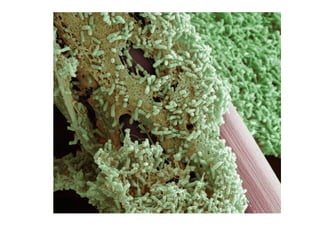
  biofilms “a structured community of bacterial cells
  enclosed in a self-produced polymeric matrix and
  adherent to an inert or living surface.”
• That means bacteria can join together on
  essentially any surface and start to form a
  protective matrix around their group.
• The matrix is made of polymers – substances
  composed of molecules with repeating structural
  units that are connected by chemical bonds.
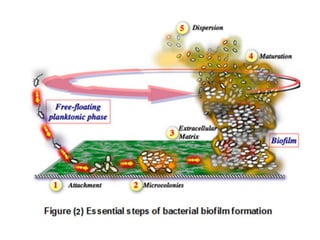
• Biofilms form when bacteria adhere to surfaces in
  aqueous or dry ( e.g. in milk powder) environments
  and begin to excrete a slimy, glue-like substance
  that can anchor them to all kinds of material – such
  as metals, plastics, soil particles, medical implant
  materials and, most significantly, low moiture food,
  human or animal tissue.
• The first bacterial colonists to adhere to a surface
  initially do so by inducing weak, reversible bonds
  called van der Waals forces.
• If the colonists are not immediately separated from
  the surface, they can anchor themselves more
  permanently using cell adhesion molecules,
  proteins on their surfaces that bind other cells in a
  process called cell adhesion.
• These bacterial pioneers facilitate the
  arrival of other pathogens by providing
  more diverse adhesion sites.
• They also begin to build the matrix that
  holds the biofilm together.
• If there are species that are unable to
  attach to a surface on their own, they
  are often able to anchor themselves to
  the matrix or directly to earlier
  colonists.
• During colonization, things start to get interesting.
• Multiple studies have shown that during the time a
  biofilm is being created, the pathogens inside it can
  communicate with each other thanks to a
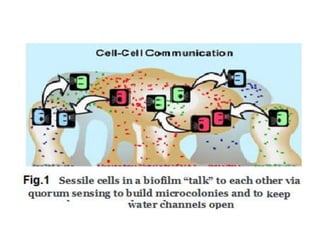
  phenomenon called quorum sensing (fig. 1).
• Although the mechanisms behind quorum sensing
  are not fully understood, the phenomenon allows a
  single-celled bacterium to perceive how many other
  bacteria are in close proximity.
• If a bacterium can sense that it is surrounded by a
  dense population of other pathogens, it is more
  inclined to join them and contribute to the
  formation of a biofilm.
• Bacteria that engage in quorum sensing
  communicate their presence by emitting
  chemical messages that their fellow infectious
  agents are able to recognize.
• When the messages grow strong enough, the
  bacteria respond en masse, behaving as a group.
• Quorum sensing can occur within a single
  bacterial species as well as between diverse
  species, and can regulate a host of different
  processes, essentially serving as a simple
  communication network.
• A variety of different molecules can be used as
  signals.
• Biofilms cause sanitary and industrial nuisances.
• Besides the positive ecological roles assumed by
  sessile microbial communities, biofilms that
  form in industrial and medical settings, in
  particular on indwelling medical devices, are
  difficult to eradicate and are therefore
  associated with both health and economic
  issues.
• During the last decade, their negative impact on
  human activities has stimulated research aimed
  at providing clues to fight detrimental biofilms
• A study just published in the International Journal of
  Food Microbiology examined the survival rates of free-
  floating cells of salmonella enterica Tennessee versus
  those in biofilm form when stored in dry milk powder
  for up to 30 days.
• In such a dry environment, pathogens cease to
  reproduce, but adhere to surfaces and produce a biofilm
  that protects them from a harsh environment when
  placed in such a dry environment. Experts disagree over
  whether pathogens prompted to produce biofilms in this
  way are more or less likely to survive passage into the
  human intestine and thus more likely to cause illness.
• "Biofilms are becoming an increasing
  problem within the food industry due to their
  ability to adhere to surfaces and withstand
  current sanitation practices," the paper states.
• Low moisture foods
• At various points during the study, the
  Salmonella was tested in a simulated
  gastrointestinal system. It survived this long-term
  storage in large numbers but the biofilm
  Salmonella proved more resilient than the free-
  floating cells.
• The researchers from US institute Virginia Tech also
  said the bacteria's stress response to the dry
  conditions made it more likely to cause disease. And
  they added that biofilms allowed the Salmonella to
  survive the harsh, acidic environment of the gut,
  increasing its chances of reaching the intestines.
• Outbreaks of Salmonella associated with dried foods
  such as nuts, cereals, spices, spices, powdered milk
  and pet foods have been associated with more than
  900 illnesses in the past five years, the scientists
  claimed. These foods were previously thought to be
  safe, because their dry nature would protect them
  from microbial growth.

Bacteria biofilm

  • 1.
    Bacteria Biofilm Dr. Yousef Elshrek
  • 2.
    • As humans,our environment consistently exposes us to a variety of dangers. Tornadoes, lightning, flooding and hurricanes can all hamper our survival. • Not to mention the fact that most of us can encounter swerving cars or ill-intentioned people at any given moment.
  • 3.
    • Thousands ofyears ago, humans realized that they could better survive a dangerous world if they formed into communities, particularly communities consisting of people with different talents. • They realized that a community is far more likely to survive through division of labor– one person makes food, another gathers resources, still another protects the community against invaders. • Working together in this manner requires communication and cooperation.
  • 4.
    • Inhabitants ofa community live in close proximity and create various forms of shelter in order to protect themselves from external threats. • We build houses that protect our families and larger buildings that protect the entire community. • Grouping together inside places of shelter is a logical way to enhance survival.
  • 5.
    • With theabove in mind, it should come as no surprise that the pathogens we harbor are seldom found as single entities. • Although the pathogens that cause acute infection are generally free-floating bacteria – also referred to as planktonic bacteria – those chronic bacterial forms that stick around for decades long ago evolved ways to join together into communities. • Why? Because by doing so, they are better able to combat the cells of our immune system bent upon destroying them.
  • 6.
    • It turnsout that a vast number of the pathogens we harbor are grouped into communities called biofilms “a structured community of bacterial cells enclosed in a self-produced polymeric matrix and adherent to an inert or living surface.” • That means bacteria can join together on essentially any surface and start to form a protective matrix around their group. • The matrix is made of polymers – substances composed of molecules with repeating structural units that are connected by chemical bonds.
  • 7.
    • Biofilms formwhen bacteria adhere to surfaces in aqueous or dry ( e.g. in milk powder) environments and begin to excrete a slimy, glue-like substance that can anchor them to all kinds of material – such as metals, plastics, soil particles, medical implant materials and, most significantly, low moiture food, human or animal tissue. • The first bacterial colonists to adhere to a surface initially do so by inducing weak, reversible bonds called van der Waals forces. • If the colonists are not immediately separated from the surface, they can anchor themselves more permanently using cell adhesion molecules, proteins on their surfaces that bind other cells in a process called cell adhesion.
  • 8.
    • These bacterialpioneers facilitate the arrival of other pathogens by providing more diverse adhesion sites. • They also begin to build the matrix that holds the biofilm together. • If there are species that are unable to attach to a surface on their own, they are often able to anchor themselves to the matrix or directly to earlier colonists.
  • 9.
    • During colonization,things start to get interesting. • Multiple studies have shown that during the time a biofilm is being created, the pathogens inside it can communicate with each other thanks to a phenomenon called quorum sensing (fig. 1). • Although the mechanisms behind quorum sensing are not fully understood, the phenomenon allows a single-celled bacterium to perceive how many other bacteria are in close proximity. • If a bacterium can sense that it is surrounded by a dense population of other pathogens, it is more inclined to join them and contribute to the formation of a biofilm.
  • 11.
    • Bacteria thatengage in quorum sensing communicate their presence by emitting chemical messages that their fellow infectious agents are able to recognize. • When the messages grow strong enough, the bacteria respond en masse, behaving as a group. • Quorum sensing can occur within a single bacterial species as well as between diverse species, and can regulate a host of different processes, essentially serving as a simple communication network. • A variety of different molecules can be used as signals.
  • 14.
    • Biofilms causesanitary and industrial nuisances. • Besides the positive ecological roles assumed by sessile microbial communities, biofilms that form in industrial and medical settings, in particular on indwelling medical devices, are difficult to eradicate and are therefore associated with both health and economic issues. • During the last decade, their negative impact on human activities has stimulated research aimed at providing clues to fight detrimental biofilms
  • 15.
    • A studyjust published in the International Journal of Food Microbiology examined the survival rates of free- floating cells of salmonella enterica Tennessee versus those in biofilm form when stored in dry milk powder for up to 30 days. • In such a dry environment, pathogens cease to reproduce, but adhere to surfaces and produce a biofilm that protects them from a harsh environment when placed in such a dry environment. Experts disagree over whether pathogens prompted to produce biofilms in this way are more or less likely to survive passage into the human intestine and thus more likely to cause illness.
  • 16.
    • "Biofilms arebecoming an increasing problem within the food industry due to their ability to adhere to surfaces and withstand current sanitation practices," the paper states. • Low moisture foods • At various points during the study, the Salmonella was tested in a simulated gastrointestinal system. It survived this long-term storage in large numbers but the biofilm Salmonella proved more resilient than the free- floating cells.
  • 17.
    • The researchersfrom US institute Virginia Tech also said the bacteria's stress response to the dry conditions made it more likely to cause disease. And they added that biofilms allowed the Salmonella to survive the harsh, acidic environment of the gut, increasing its chances of reaching the intestines. • Outbreaks of Salmonella associated with dried foods such as nuts, cereals, spices, spices, powdered milk and pet foods have been associated with more than 900 illnesses in the past five years, the scientists claimed. These foods were previously thought to be safe, because their dry nature would protect them from microbial growth.