BIOFILMS
SUTHAR RIDDHI
PATEL BIRAVA
DARVADIYA FIZA
what are biofilms ?
A biofilm is an assemblage of
microbial cells that is
irreversibly associated (not
removed by gentle rinsing)with
a surface and enclosed in a
matrix of extracellular
polymeric substance (EPS).
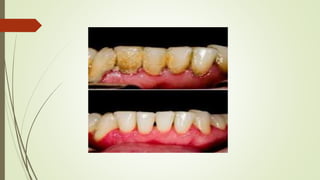
Can be found on our teeth ,
slime forms on shower tiles ,
slippery coating on pond rocks
and leaving tissues.
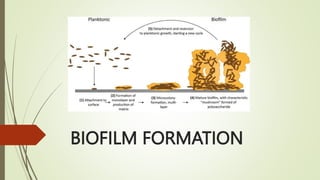
BIOFILM FORMATION
STAGES OF
BIOFILM
FORMATION
FIRST STAGE : reversible attachment of
planktonic cells to surface.
SECOND STAGE :irreversible attachment of same
cells.
THIRD STAGE : cell growth and early
development.
FOURTH STAGE : further development and
maturation.
FIFTH STAGE : dispersion into the liquid medium.
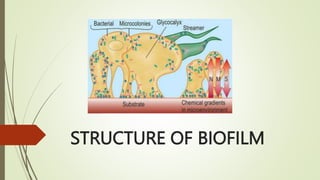
STRUCTURE OF BIOFILM
Basic structure : heterogeneous arrangement of microbial cells on a solid surface.
Glycocalyx matrix : extracellular polymeric substance surrounds the micro colonies
and anchors the bacterial cell to the substrate.
Biofilms are composed of about 80-85% EPS and only 15-20% cells.
EPS has its major components are polysaccharides , protein and extracellular DNA.
DNA.
EPS plays a major role in maintaining the integrity also it is highly hydrated and it
can prevent desiccation in some biofilms.
EPS can also act as a diffusion barrier , preventing toxic substance.
COMMUNICATION
LANGUAGE IN
BIOFILM
 Few years ago , some scientists proposed in cities that
microorganisms are considered as “social” organisms able to
communicate with one another.
 By using chemical languages bacteria can learn about their
current cell population also it can modify their behavior .
 When bacteria grow in the biofilms they secrete signaling
molecules and respond to signals called auto inducers
 This process , termed quorum sensing , allows bacteria to
monitor the environment for other bacteria and to alter
behavior on population.
 Two type of quorum sensing bacteria
 1. intra species communication
 2.interspecies communication
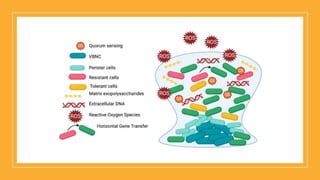
MULTI DRUG TOLERANCE
OF BIOFILMS
 It has high level drug tolerance , it can
fold 100-1000 folds tolerance towards
antibiotic .
 Bacterial population produce a small
number of dormant persister cells that
exhibit multidrug tolerance.
 The resistance mechanisms do
essentially the same thing : prevent the
antibiotic from hitting a target.
ADVANTAGES
OF BIOFILM
 Nutrients tend to concentrate at surfaces.
 Protective against predation and external
environment.
 Waste can accumulate to toxic levels inside
biofilm.
 Access to oxygen and water can become
limited.
DISADVANTAGES
OF BIOFILM
 Biofilm can cause fouling of the equipment.
 It can contaminate products.
 It can damage the water distribution system.
 It can spread the infection to distinct location
within the body.
 Biofilms inside bladder cells may cause urinary
tract infections.
https://images.app.goo.gl/M3gcxixX6GdHmdQN8
https://www.slideshare.net/selviganesh/biofilms-244899697
BIOFILMS_which cause the our theeth coating

BIOFILMS_which cause the our theeth coating

  • 1.
  • 2.
    what are biofilms? A biofilm is an assemblage of microbial cells that is irreversibly associated (not removed by gentle rinsing)with a surface and enclosed in a matrix of extracellular polymeric substance (EPS). Can be found on our teeth , slime forms on shower tiles , slippery coating on pond rocks and leaving tissues.
  • 4.
  • 5.
    STAGES OF BIOFILM FORMATION FIRST STAGE: reversible attachment of planktonic cells to surface. SECOND STAGE :irreversible attachment of same cells. THIRD STAGE : cell growth and early development. FOURTH STAGE : further development and maturation. FIFTH STAGE : dispersion into the liquid medium.
  • 6.
  • 7.
    Basic structure :heterogeneous arrangement of microbial cells on a solid surface. Glycocalyx matrix : extracellular polymeric substance surrounds the micro colonies and anchors the bacterial cell to the substrate. Biofilms are composed of about 80-85% EPS and only 15-20% cells. EPS has its major components are polysaccharides , protein and extracellular DNA. DNA. EPS plays a major role in maintaining the integrity also it is highly hydrated and it can prevent desiccation in some biofilms. EPS can also act as a diffusion barrier , preventing toxic substance.
  • 8.
    COMMUNICATION LANGUAGE IN BIOFILM  Fewyears ago , some scientists proposed in cities that microorganisms are considered as “social” organisms able to communicate with one another.  By using chemical languages bacteria can learn about their current cell population also it can modify their behavior .  When bacteria grow in the biofilms they secrete signaling molecules and respond to signals called auto inducers  This process , termed quorum sensing , allows bacteria to monitor the environment for other bacteria and to alter behavior on population.  Two type of quorum sensing bacteria  1. intra species communication  2.interspecies communication
  • 9.
    MULTI DRUG TOLERANCE OFBIOFILMS  It has high level drug tolerance , it can fold 100-1000 folds tolerance towards antibiotic .  Bacterial population produce a small number of dormant persister cells that exhibit multidrug tolerance.  The resistance mechanisms do essentially the same thing : prevent the antibiotic from hitting a target.
  • 11.
    ADVANTAGES OF BIOFILM  Nutrientstend to concentrate at surfaces.  Protective against predation and external environment.  Waste can accumulate to toxic levels inside biofilm.  Access to oxygen and water can become limited.
  • 12.
    DISADVANTAGES OF BIOFILM  Biofilmcan cause fouling of the equipment.  It can contaminate products.  It can damage the water distribution system.  It can spread the infection to distinct location within the body.  Biofilms inside bladder cells may cause urinary tract infections.
  • 13.