1
RESEARCH ETHICS IN HUMAN EXPERIMENT
PRESENTED BY:-
Supriya c s
1st M Pharm
Dept….of Pharmacology
2
CONTENT
• History
• General statement
• Statement of general principle
• Ethical review procedures
• Basic responsibilities
• Submission of application
• Selection of special group as research subjects
• References
3
HISTORY
 In 1947:- The Court enumerated some rules for "Permissible
Medical Experiments“(Nuremberg code ).
 In 1948 :- Universal Declaration of Human Rights expressed
concern about rights of human beings subjected to involuntary
maltreatment.
 In 1964:-Based on the preliminary efforts of the Council for
International Organisations of Medical Sciences (CIOMS) at
Helsinki, the World Medical Association formulated general
principles and specific guidelines on use of human subjects in
medical research, known as the Helsinki Declaration, which was
revised from time to time.
4
 In 1966:- International Covenant on Civil and Political Rights
specifically stated, ‘No one shall be subjected to torture or to cruel,
inhuman or degrading treatment or punishment.
 In 1980:- ICMR released a “Policy Statement on Ethical
Considerations Involved in Research on Human Subjects.”
 In 1985 -1990 :- Public Health Service Task Force on Women’s
Health issues report encouraging, for Women’s Health Research
inclusion of women in research.(U.S)
 In 1982:-WHO and CIOMS (council for international
organizations of medical sciences) issued the “Proposed
International Guidelines for Biomedical Research involving Human
Subjects.”
5
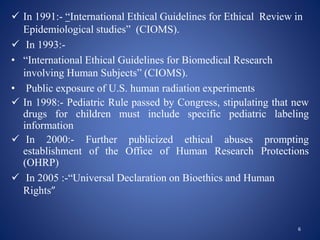
 In 1991:- “International Ethical Guidelines for Ethical Review in
Epidemiological studies” (CIOMS).
 In 1993:-
• “International Ethical Guidelines for Biomedical Research
involving Human Subjects” (CIOMS).
• Public exposure of U.S. human radiation experiments
 In 1998:- Pediatric Rule passed by Congress, stipulating that new
drugs for children must include specific pediatric labeling
information
 In 2000:- Further publicized ethical abuses prompting
establishment of the Office of Human Research Protections
(OHRP)
 In 2005 :-“Universal Declaration on Bioethics and Human
Rights”
6
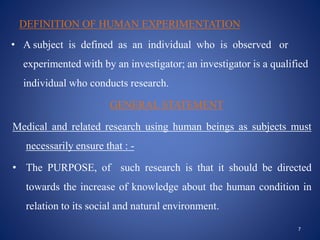
DEFINITION OF HUMAN EXPERIMENTATION
• A subject is defined as an individual who is observed or
experimented with by an investigator; an investigator is a qualified
individual who conducts research.
GENERAL STATEMENT
Medical and related research using human beings as subjects must
necessarily ensure that : -
• The PURPOSE, of such research is that it should be directed
towards the increase of knowledge about the human condition in
relation to its social and natural environment.
7
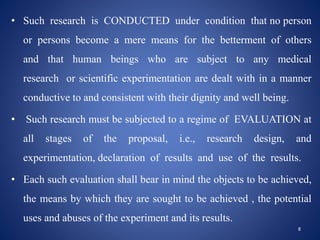
• Such research is CONDUCTED under condition that no person
or persons become a mere means for the betterment of others
and that human beings who are subject to any medical
research or scientific experimentation are dealt with in a manner
conductive to and consistent with their dignity and well being.
• Such research must be subjected to a regime of EVALUATION at
all stages of the proposal, i.e., research design, and
experimentation, declaration of results and use of the results.
• Each such evaluation shall bear in mind the objects to be achieved,
the means by which they are sought to be achieved , the potential
uses and abuses of the experiment and its results.
8
STATEMENT OF GENERAL PRINCIPLES
 Principles of essentiality.
 Project involving human subjects can be performed only after
if it gets approval from an authorized person, who checks the
essentiality of the project, whether it is useful or harmful for
the society & the person who checks the essentiality should be
an external body of the project.
 Principles of voluntariness and community agreement.
 Subjects which are going under such projects should be
informed about the project & its benefits & its risk factors.
9
In shortly, volunteer should know everything in briefly about the
project.
o If volunteer feels any risk at any stage of the project he/she can
abstain from further participation & no legal authority can stop
him from doing so.
o Research involving any community or a group of persons as a
research subjects these principles of voluntariness shall apply
to all members of community.
10
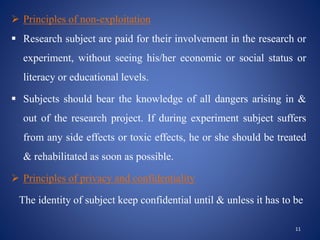
 Principles of non-exploitation
 Research subject are paid for their involvement in the research or
experiment, without seeing his/her economic or social status or
literacy or educational levels.
 Subjects should bear the knowledge of all dangers arising in &
out of the research project. If during experiment subject suffers
from any side effects or toxic effects, he or she should be treated
& rehabilitated as soon as possible.
 Principles of privacy and confidentiality
The identity of subject keep confidential until & unless it has to be
11
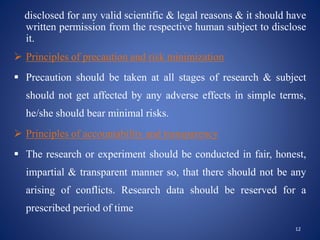
disclosed for any valid scientific & legal reasons & it should have
written permission from the respective human subject to disclose
it.
 Principles of precaution and risk minimization
 Precaution should be taken at all stages of research & subject
should not get affected by any adverse effects in simple terms,
he/she should bear minimal risks.
 Principles of accountability and transparency
 The research or experiment should be conducted in fair, honest,
impartial & transparent manner so, that there should not be any
arising of conflicts. Research data should be reserved for a
prescribed period of time
12
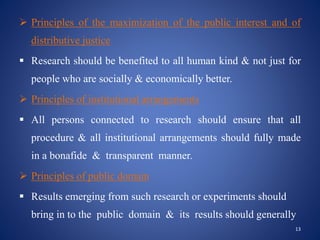
 Principles of the maximization of the public interest and of
distributive justice
 Research should be benefited to all human kind & not just for
people who are socially & economically better.
 Principles of institutional arrangements
 All persons connected to research should ensure that all
procedure & all institutional arrangements should fully made
in a bonafide & transparent manner.
 Principles of public domain
 Results emerging from such research or experiments should
bring in to the public domain & its results should generally
13
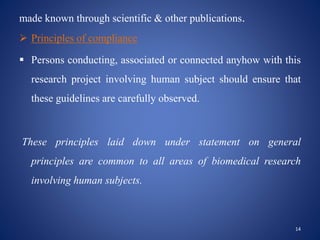
made known through scientific & other publications.
 Principles of compliance
 Persons conducting, associated or connected anyhow with this
research project involving human subject should ensure that
these guidelines are carefully observed.
These principles laid down under statement on general
principles are common to all areas of biomedical research
involving human subjects.
14
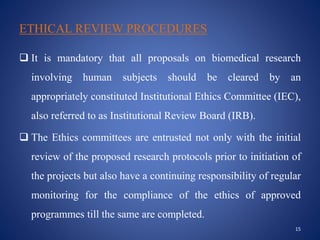
ETHICAL REVIEW PROCEDURES
 It is mandatory that all proposals on biomedical research
involving human subjects should be cleared by an
appropriately constituted Institutional Ethics Committee (IEC),
also referred to as Institutional Review Board (IRB).
 The Ethics committees are entrusted not only with the initial
review of the proposed research protocols prior to initiation of
the projects but also have a continuing responsibility of regular
monitoring for the compliance of the ethics of approved
programmes till the same are completed.
15
BASIC RESPONSBILITIES
 The basic responsibility of an IEC is to ensure a competent
review of all ethical aspects of the project proposals received.
 To protect the dignity, rights and well being of the potential
research participants.
 To ensure that universal ethical values and international
scientific standards are expressed in terms of local community
values and customs.
 To assist in the development and the education of a research
community responsive to local health care requirements.
16
SUBMISSION OF APPLICATION
The researcher should submit an appropriate application in a
prescribed format along with the study protocol at least
three weeks in advance.
The protocol should include the following: -
 Clear research objectives and rationale for undertaking the
investigation in human subjects in the light of existing
knowledge.
 Recent curriculum vitae of the Investigators indicating
qualification and experience.
 Subject recruitment procedures.
17
 Inclusion and exclusion criteria for entry of subjects in the study.
 Precise description of methodology of the proposed research,
including intended dosage of drugs; planned duration of treatment
and details of invasive procedures if any.
 A description of plans to withdraw or withhold standard therapies in
the course of research.
 The plans for statistical analysis of the study.
 Safety of proposed intervention and any drug or vaccine to be
tested, including results of relevant laboratory and animal research.
 Proposed compensation and reimbursement of incidental expenses.
18
INFORMED CONSENT FOR CLINICAL STUDIES
19
• Name the consent group
• Two parts of consent group
PART I: Information Sheet
• Introduction
• Purpose
• Type of Research Intervention
• Participant selection
• Voluntary Participation
• Information on the Trial Drug [Name of Drug] Procedures and
Protocol
20
• Duration
• Side Effects
• Risks
• Right to Refuse
• PART II: Certificate of Consent
21
SELECTION OF SPECIAL GROUPS AS
RESEARCH SUBJECTS
 PREGNANT OR NURSING WOMEN
Pregnant or nursing women should in no circumstances be the
subject of any research unless the research carries no more
than minimal risk to the fetus or nursing infant and the object
of the research is to obtain new knowledge about the fetus,
pregnancy and lactation.
22
 CHILDREN
 Before undertaking trial in children the investigator must ensure
that-
 Children will not be involved in research that could be carried out
equally well with adults;
 The purpose of the research is to obtain knowledge relevant to
health needs of children. For the evaluation of a new drug the
study in children should always be carried out after the phase III
clinical trials in adults. It can be studied earlier only if the drug has
a therapeutic value in a primary disease of children.
 Research should be conducted in settings in which the child and
parent can obtain adequate medical and psychological support.
23
 VULNERABLE GROUPS
 Effort may be made to ensure that individuals or communities
invited for research be selected in such a way that the burdens and
benefits of the research are equally distributed.
 Research on genetics should not lead to racial inequalities.
 Persons who are economically or socially disadvantaged should
not be used to benefit those who are better off than them.
 Adequate justification is required for the involvement of subjects
such as prisoners, students, employees, service personnel etc., who
have reduced autonomy as research subjects.
24
REFRENCE
• Ethical guidelines for biomedical research on human
participants(pdf)
• Research in humans (pdf)
• Ethical Principles in Human Subject Research(p pt)
• http://en.wikipedia.org/wiki/Human_subject_research
25
26

Research ethics in human experiment

  • 1.
  • 2.
    RESEARCH ETHICS INHUMAN EXPERIMENT PRESENTED BY:- Supriya c s 1st M Pharm Dept….of Pharmacology 2
  • 3.
    CONTENT • History • Generalstatement • Statement of general principle • Ethical review procedures • Basic responsibilities • Submission of application • Selection of special group as research subjects • References 3
  • 4.
    HISTORY  In 1947:-The Court enumerated some rules for "Permissible Medical Experiments“(Nuremberg code ).  In 1948 :- Universal Declaration of Human Rights expressed concern about rights of human beings subjected to involuntary maltreatment.  In 1964:-Based on the preliminary efforts of the Council for International Organisations of Medical Sciences (CIOMS) at Helsinki, the World Medical Association formulated general principles and specific guidelines on use of human subjects in medical research, known as the Helsinki Declaration, which was revised from time to time. 4
  • 5.
     In 1966:-International Covenant on Civil and Political Rights specifically stated, ‘No one shall be subjected to torture or to cruel, inhuman or degrading treatment or punishment.  In 1980:- ICMR released a “Policy Statement on Ethical Considerations Involved in Research on Human Subjects.”  In 1985 -1990 :- Public Health Service Task Force on Women’s Health issues report encouraging, for Women’s Health Research inclusion of women in research.(U.S)  In 1982:-WHO and CIOMS (council for international organizations of medical sciences) issued the “Proposed International Guidelines for Biomedical Research involving Human Subjects.” 5
  • 6.
     In 1991:-“International Ethical Guidelines for Ethical Review in Epidemiological studies” (CIOMS).  In 1993:- • “International Ethical Guidelines for Biomedical Research involving Human Subjects” (CIOMS). • Public exposure of U.S. human radiation experiments  In 1998:- Pediatric Rule passed by Congress, stipulating that new drugs for children must include specific pediatric labeling information  In 2000:- Further publicized ethical abuses prompting establishment of the Office of Human Research Protections (OHRP)  In 2005 :-“Universal Declaration on Bioethics and Human Rights” 6
  • 7.
    DEFINITION OF HUMANEXPERIMENTATION • A subject is defined as an individual who is observed or experimented with by an investigator; an investigator is a qualified individual who conducts research. GENERAL STATEMENT Medical and related research using human beings as subjects must necessarily ensure that : - • The PURPOSE, of such research is that it should be directed towards the increase of knowledge about the human condition in relation to its social and natural environment. 7
  • 8.
    • Such researchis CONDUCTED under condition that no person or persons become a mere means for the betterment of others and that human beings who are subject to any medical research or scientific experimentation are dealt with in a manner conductive to and consistent with their dignity and well being. • Such research must be subjected to a regime of EVALUATION at all stages of the proposal, i.e., research design, and experimentation, declaration of results and use of the results. • Each such evaluation shall bear in mind the objects to be achieved, the means by which they are sought to be achieved , the potential uses and abuses of the experiment and its results. 8
  • 9.
    STATEMENT OF GENERALPRINCIPLES  Principles of essentiality.  Project involving human subjects can be performed only after if it gets approval from an authorized person, who checks the essentiality of the project, whether it is useful or harmful for the society & the person who checks the essentiality should be an external body of the project.  Principles of voluntariness and community agreement.  Subjects which are going under such projects should be informed about the project & its benefits & its risk factors. 9
  • 10.
    In shortly, volunteershould know everything in briefly about the project. o If volunteer feels any risk at any stage of the project he/she can abstain from further participation & no legal authority can stop him from doing so. o Research involving any community or a group of persons as a research subjects these principles of voluntariness shall apply to all members of community. 10
  • 11.
     Principles ofnon-exploitation  Research subject are paid for their involvement in the research or experiment, without seeing his/her economic or social status or literacy or educational levels.  Subjects should bear the knowledge of all dangers arising in & out of the research project. If during experiment subject suffers from any side effects or toxic effects, he or she should be treated & rehabilitated as soon as possible.  Principles of privacy and confidentiality The identity of subject keep confidential until & unless it has to be 11
  • 12.
    disclosed for anyvalid scientific & legal reasons & it should have written permission from the respective human subject to disclose it.  Principles of precaution and risk minimization  Precaution should be taken at all stages of research & subject should not get affected by any adverse effects in simple terms, he/she should bear minimal risks.  Principles of accountability and transparency  The research or experiment should be conducted in fair, honest, impartial & transparent manner so, that there should not be any arising of conflicts. Research data should be reserved for a prescribed period of time 12
  • 13.
     Principles ofthe maximization of the public interest and of distributive justice  Research should be benefited to all human kind & not just for people who are socially & economically better.  Principles of institutional arrangements  All persons connected to research should ensure that all procedure & all institutional arrangements should fully made in a bonafide & transparent manner.  Principles of public domain  Results emerging from such research or experiments should bring in to the public domain & its results should generally 13
  • 14.
    made known throughscientific & other publications.  Principles of compliance  Persons conducting, associated or connected anyhow with this research project involving human subject should ensure that these guidelines are carefully observed. These principles laid down under statement on general principles are common to all areas of biomedical research involving human subjects. 14
  • 15.
    ETHICAL REVIEW PROCEDURES It is mandatory that all proposals on biomedical research involving human subjects should be cleared by an appropriately constituted Institutional Ethics Committee (IEC), also referred to as Institutional Review Board (IRB).  The Ethics committees are entrusted not only with the initial review of the proposed research protocols prior to initiation of the projects but also have a continuing responsibility of regular monitoring for the compliance of the ethics of approved programmes till the same are completed. 15
  • 16.
    BASIC RESPONSBILITIES  Thebasic responsibility of an IEC is to ensure a competent review of all ethical aspects of the project proposals received.  To protect the dignity, rights and well being of the potential research participants.  To ensure that universal ethical values and international scientific standards are expressed in terms of local community values and customs.  To assist in the development and the education of a research community responsive to local health care requirements. 16
  • 17.
    SUBMISSION OF APPLICATION Theresearcher should submit an appropriate application in a prescribed format along with the study protocol at least three weeks in advance. The protocol should include the following: -  Clear research objectives and rationale for undertaking the investigation in human subjects in the light of existing knowledge.  Recent curriculum vitae of the Investigators indicating qualification and experience.  Subject recruitment procedures. 17
  • 18.
     Inclusion andexclusion criteria for entry of subjects in the study.  Precise description of methodology of the proposed research, including intended dosage of drugs; planned duration of treatment and details of invasive procedures if any.  A description of plans to withdraw or withhold standard therapies in the course of research.  The plans for statistical analysis of the study.  Safety of proposed intervention and any drug or vaccine to be tested, including results of relevant laboratory and animal research.  Proposed compensation and reimbursement of incidental expenses. 18
  • 19.
    INFORMED CONSENT FORCLINICAL STUDIES 19
  • 20.
    • Name theconsent group • Two parts of consent group PART I: Information Sheet • Introduction • Purpose • Type of Research Intervention • Participant selection • Voluntary Participation • Information on the Trial Drug [Name of Drug] Procedures and Protocol 20
  • 21.
    • Duration • SideEffects • Risks • Right to Refuse • PART II: Certificate of Consent 21
  • 22.
    SELECTION OF SPECIALGROUPS AS RESEARCH SUBJECTS  PREGNANT OR NURSING WOMEN Pregnant or nursing women should in no circumstances be the subject of any research unless the research carries no more than minimal risk to the fetus or nursing infant and the object of the research is to obtain new knowledge about the fetus, pregnancy and lactation. 22
  • 23.
     CHILDREN  Beforeundertaking trial in children the investigator must ensure that-  Children will not be involved in research that could be carried out equally well with adults;  The purpose of the research is to obtain knowledge relevant to health needs of children. For the evaluation of a new drug the study in children should always be carried out after the phase III clinical trials in adults. It can be studied earlier only if the drug has a therapeutic value in a primary disease of children.  Research should be conducted in settings in which the child and parent can obtain adequate medical and psychological support. 23
  • 24.
     VULNERABLE GROUPS Effort may be made to ensure that individuals or communities invited for research be selected in such a way that the burdens and benefits of the research are equally distributed.  Research on genetics should not lead to racial inequalities.  Persons who are economically or socially disadvantaged should not be used to benefit those who are better off than them.  Adequate justification is required for the involvement of subjects such as prisoners, students, employees, service personnel etc., who have reduced autonomy as research subjects. 24
  • 25.
    REFRENCE • Ethical guidelinesfor biomedical research on human participants(pdf) • Research in humans (pdf) • Ethical Principles in Human Subject Research(p pt) • http://en.wikipedia.org/wiki/Human_subject_research 25
  • 26.