BIOELECTRONIC MEDICINE
Presented by
K. Bhanu Sri Chandana
T. Sri Sai Mounika
S. Nayeema Khowser
M. Pharm 1st year
Submitted to
Dr. M. Vidhyavathi
M. Pharmacy, Ph.D.
Contents :-
 Concept
 Definition
 History
 Advantages
 Disadvantages
 Mechanism
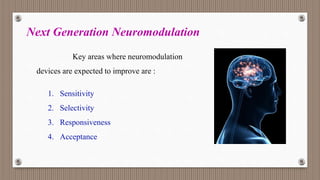
 Next Generation Neuromodulation
 Curable Diseases
 Various Bioelectronic Medicines Available
 Recent Inventions
 Future of Bioelectronic medicines
 Marketing and Applications
 References
Bioelectronic Medicine
Complex
Control
Coordination
Human Brain
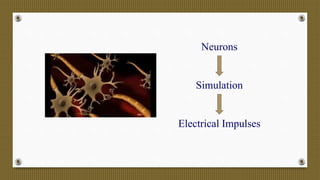
Neurons
Simulation
Electrical Impulses
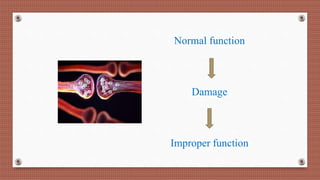
Normal function
Damage
Improper function
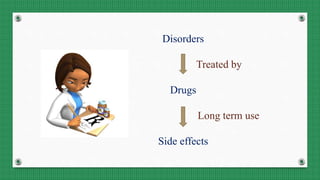
Disorders
Treated by
Drugs
Long term use
Side effects
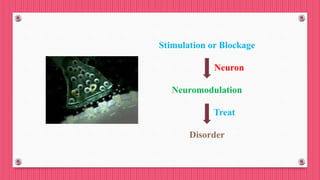
Stimulation or Blockage
Neuron
Neuromodulation
Treat
Disorder
Definition :-
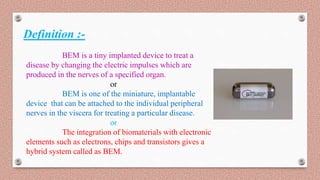
BEM is a tiny implanted device to treat a
disease by changing the electric impulses which are
produced in the nerves of a specified organ.
or
BEM is one of the miniature, implantable
device that can be attached to the individual peripheral
nerves in the viscera for treating a particular disease.
or
The integration of biomaterials with electronic
elements such as electrons, chips and transistors gives a
hybrid system called as BEM.
 Record, Stimulate, blocking of neural signals are done by using the
bioelectronic technologies.
 Neuroscience + Molecular medicine + Bioengineering = BEM
 An agency of the US department of Commerce, i.e., National
Institute of Standards and Technology (NIST) defined the
Bioelectronic medicines in 2009 as “The discipline resulting from
the convergence of biology and electronics”.

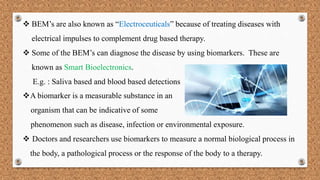
 BEM’s are also known as “Electroceuticals” because of treating diseases with
electrical impulses to complement drug based therapy.
 Some of the BEM’s can diagnose the disease by using biomarkers. These are
known as Smart Bioelectronics.
E.g. : Saliva based and blood based detections
A biomarker is a measurable substance in an
organism that can be indicative of some
phenomenon such as disease, infection or environmental exposure.
 Doctors and researchers use biomarkers to measure a normal biological process in
the body, a pathological process or the response of the body to a therapy.
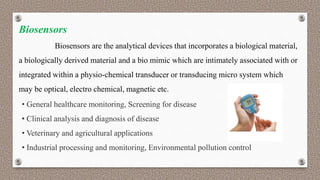
Biosensors
Biosensors are the analytical devices that incorporates a biological material,
a biologically derived material and a bio mimic which are intimately associated with or
integrated within a physio-chemical transducer or transducing micro system which
may be optical, electro chemical, magnetic etc.
• General healthcare monitoring, Screening for disease
• Clinical analysis and diagnosis of disease
• Veterinary and agricultural applications
• Industrial processing and monitoring, Environmental pollution control
History :-
 The first reference to bioelectronics was published
in 1912.
 This publishing focused on the measurement of
electrical signals generated in the body. This is the
basis of the Electrocardiogram.
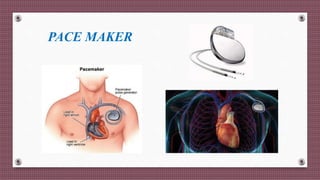
 In 1960’s a trend in bioelectronics began to appear by the invention of the
Transistor. This enabled the development of an implantable electronic device to be
placed in the body for stimulating the organs
E.g. : Pacemaker
At Present…
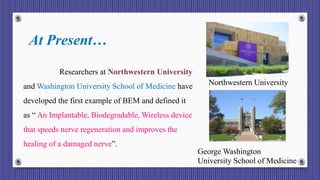
Researchers at Northwestern University
and Washington University School of Medicine have
developed the first example of BEM and defined it
as “ An Implantable, Biodegradable, Wireless device
that speeds nerve regeneration and improves the
healing of a damaged nerve”.
Northwestern University
George Washington
University School of Medicine
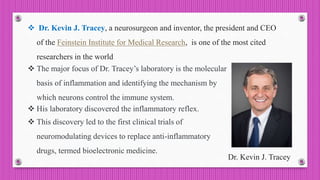
 Dr. Kevin J. Tracey, a neurosurgeon and inventor, the president and CEO
of the Feinstein Institute for Medical Research, is one of the most cited
researchers in the world
Dr. Kevin J. Tracey
 The major focus of Dr. Tracey’s laboratory is the molecular
basis of inflammation and identifying the mechanism by
which neurons control the immune system.
 His laboratory discovered the inflammatory reflex.
 This discovery led to the first clinical trials of
neuromodulating devices to replace anti-inflammatory
drugs, termed bioelectronic medicine.
Advantages :
 Painless approach to cure a disease
 Targeted treatment
 Minimum side effects
 Overcome the problems faced by Conventional dosage forms
 Increased selectivity and Cellular control
 Better patient compliance
Disadvantages:
High cost
Undesirable effects
Possibility of Electric Shock
Installation may be harmful
Not suitable for all
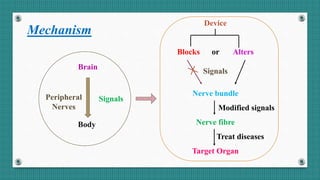
Mechanism
Brain
Signals
Body
Device
Blocks or Alters
Signals
Nerve bundle
Modified signals
Nerve fibre
Treat diseases
Target Organ
Peripheral
Nerves
Next Generation Neuromodulation
1. Sensitivity
2. Selectivity
3. Responsiveness
4. Acceptance
Key areas where neuromodulation
devices are expected to improve are :
Curable Diseases :-
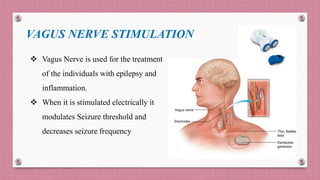
VAGUS NERVE STIMULATION
 Vagus Nerve is used for the treatment
of the individuals with epilepsy and
inflammation.
 When it is stimulated electrically it
modulates Seizure threshold and
decreases seizure frequency
Various Bioelectronic Medicines Available
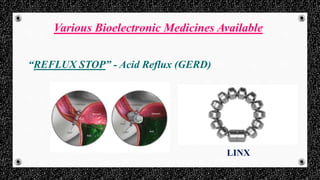
“REFLUX STOP” - Acid Reflux (GERD)
LINX
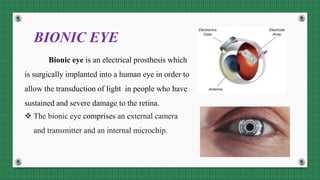
BIONIC EYE
Bionic eye is an electrical prosthesis which
is surgically implanted into a human eye in order to
allow the transduction of light in people who have
sustained and severe damage to the retina.
 The bionic eye comprises an external camera
and transmitter and an internal microchip.
PACE MAKER
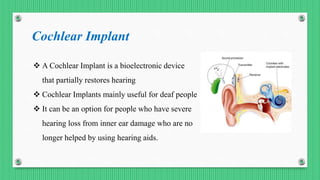
Cochlear Implant
 A Cochlear Implant is a bioelectronic device
that partially restores hearing
 Cochlear Implants mainly useful for deaf people
 It can be an option for people who have severe
hearing loss from inner ear damage who are no
longer helped by using hearing aids.
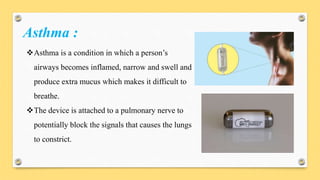
Asthma :
Asthma is a condition in which a person’s
airways becomes inflamed, narrow and swell and
produce extra mucus which makes it difficult to
breathe.
The device is attached to a pulmonary nerve to
potentially block the signals that causes the lungs
to constrict.
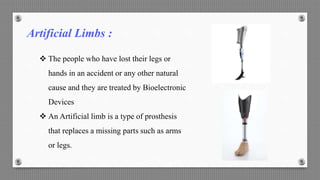
Artificial Limbs :
 The people who have lost their legs or
hands in an accident or any other natural
cause and they are treated by Bioelectronic
Devices
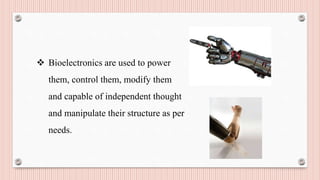
 An Artificial limb is a type of prosthesis
that replaces a missing parts such as arms
or legs.
 Bioelectronics are used to power
them, control them, modify them
and capable of independent thought
and manipulate their structure as per
needs.
Hypertension
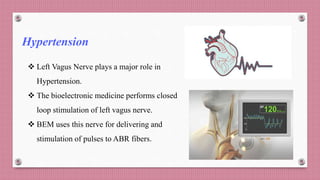
 Left Vagus Nerve plays a major role in
Hypertension.
 The bioelectronic medicine performs closed
loop stimulation of left vagus nerve.
 BEM uses this nerve for delivering and
stimulation of pulses to ABR fibers.
Biolung
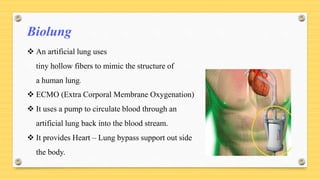
 An artificial lung uses
tiny hollow fibers to mimic the structure of
a human lung.
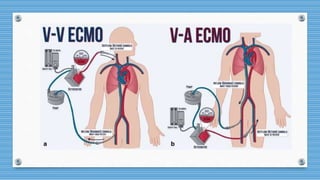
 ECMO (Extra Corporal Membrane Oxygenation)
 It uses a pump to circulate blood through an
artificial lung back into the blood stream.
 It provides Heart – Lung bypass support out side
the body.
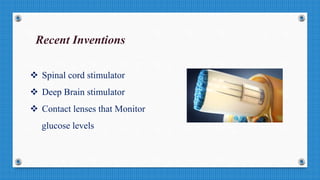
Recent Inventions
 Spinal cord stimulator
 Deep Brain stimulator
 Contact lenses that Monitor
glucose levels
Future of Bioelectronic medicines
 Type 2 Diabetes
 Hypertension and Sleep apnea
 Neuromodulation
 Movement Restoration
 Design of Electronic Medical Devices by Wireless Transfer Power
 Handheld device by ElextroCore
Neural Decoding
Neural Bypass
Marketing
Google pharmaceuticals, GSK, General
Electrics are the companies that are developing an
implantable device that will adjust the electrical signals in
nervous system to treat chronic diseases.
Applications
 Biofuel cells, Biosensors and Biocomputing
devices.
 Medicines, High-Tech Industry, Military
 Sensors for Diabetes
 Cancer
Conclusion
BEM is the future of Medicine and it promises better improvement in
various fields of medicine. It achieved a lot of remarkable efforts in a short time
span. The strategic drivers that were most frequently cited here were disease
detection, disease prevention, and prosthetics. As a next step, stakeholders from
government, academic, and industry should jointly develop a detailed
bioelectronics roadmap, which can serve to facilitate effective planning and
resource management for increasing the productivity and commercialization of
bioelectronics research and development.
References :
 A Review on Evolution of Bioelectronic Medicine by Antony Arnold, CEO of
Setpoint Medical
 An Editorial on BEM by Valentin A Pavlov and Kelvin J Tracey
 An Editorial Focus on Stimulating BEM Discovery
 BEM : Innovation in Disease Treatment from International Journal of
Pharmaceutical Sciences and Research
 American Journal of Physiology on Stimulating bioelectronic medicine discovery
by Peregrine B. Osborne
References :-
 A review on Bioelectronic medicine: technology targeting molecular mechanisms
for therapy by P. S. Olofsson and K. J. Tracey
 Endogenous Bioelectronics in Development, Cancer, and Regeneration: Drugs
and Bioelectronic Devices as Electroceuticals for Regenerative Medicine
 International Journal of Engineering Technology Science and Research on Smart
Bioelectronics: The Future of Medicine is Electric by Dr. Thonte S.S., Omprakash
G. Bhusnure , Makanikar V.G., Ovhal Pravin, Deshmukh Sagar, March 2016
Bioelectronic medicine

Bioelectronic medicine

  • 1.
    BIOELECTRONIC MEDICINE Presented by K.Bhanu Sri Chandana T. Sri Sai Mounika S. Nayeema Khowser M. Pharm 1st year Submitted to Dr. M. Vidhyavathi M. Pharmacy, Ph.D.
  • 2.
    Contents :-  Concept Definition  History  Advantages  Disadvantages  Mechanism  Next Generation Neuromodulation  Curable Diseases  Various Bioelectronic Medicines Available  Recent Inventions  Future of Bioelectronic medicines  Marketing and Applications  References
  • 3.
  • 4.
  • 5.
  • 6.
  • 7.
  • 8.
    Definition :- BEM isa tiny implanted device to treat a disease by changing the electric impulses which are produced in the nerves of a specified organ. or BEM is one of the miniature, implantable device that can be attached to the individual peripheral nerves in the viscera for treating a particular disease. or The integration of biomaterials with electronic elements such as electrons, chips and transistors gives a hybrid system called as BEM.
  • 9.
     Record, Stimulate,blocking of neural signals are done by using the bioelectronic technologies.  Neuroscience + Molecular medicine + Bioengineering = BEM  An agency of the US department of Commerce, i.e., National Institute of Standards and Technology (NIST) defined the Bioelectronic medicines in 2009 as “The discipline resulting from the convergence of biology and electronics”.
  • 10.
     BEM’s arealso known as “Electroceuticals” because of treating diseases with electrical impulses to complement drug based therapy.  Some of the BEM’s can diagnose the disease by using biomarkers. These are known as Smart Bioelectronics. E.g. : Saliva based and blood based detections A biomarker is a measurable substance in an organism that can be indicative of some phenomenon such as disease, infection or environmental exposure.  Doctors and researchers use biomarkers to measure a normal biological process in the body, a pathological process or the response of the body to a therapy.
  • 11.
    Biosensors Biosensors are theanalytical devices that incorporates a biological material, a biologically derived material and a bio mimic which are intimately associated with or integrated within a physio-chemical transducer or transducing micro system which may be optical, electro chemical, magnetic etc. • General healthcare monitoring, Screening for disease • Clinical analysis and diagnosis of disease • Veterinary and agricultural applications • Industrial processing and monitoring, Environmental pollution control
  • 12.
    History :-  Thefirst reference to bioelectronics was published in 1912.  This publishing focused on the measurement of electrical signals generated in the body. This is the basis of the Electrocardiogram.  In 1960’s a trend in bioelectronics began to appear by the invention of the Transistor. This enabled the development of an implantable electronic device to be placed in the body for stimulating the organs E.g. : Pacemaker
  • 13.
    At Present… Researchers atNorthwestern University and Washington University School of Medicine have developed the first example of BEM and defined it as “ An Implantable, Biodegradable, Wireless device that speeds nerve regeneration and improves the healing of a damaged nerve”. Northwestern University George Washington University School of Medicine
  • 14.
     Dr. KevinJ. Tracey, a neurosurgeon and inventor, the president and CEO of the Feinstein Institute for Medical Research, is one of the most cited researchers in the world Dr. Kevin J. Tracey  The major focus of Dr. Tracey’s laboratory is the molecular basis of inflammation and identifying the mechanism by which neurons control the immune system.  His laboratory discovered the inflammatory reflex.  This discovery led to the first clinical trials of neuromodulating devices to replace anti-inflammatory drugs, termed bioelectronic medicine.
  • 15.
    Advantages :  Painlessapproach to cure a disease  Targeted treatment  Minimum side effects  Overcome the problems faced by Conventional dosage forms  Increased selectivity and Cellular control  Better patient compliance
  • 16.
    Disadvantages: High cost Undesirable effects Possibilityof Electric Shock Installation may be harmful Not suitable for all
  • 17.
    Mechanism Brain Signals Body Device Blocks or Alters Signals Nervebundle Modified signals Nerve fibre Treat diseases Target Organ Peripheral Nerves
  • 18.
    Next Generation Neuromodulation 1.Sensitivity 2. Selectivity 3. Responsiveness 4. Acceptance Key areas where neuromodulation devices are expected to improve are :
  • 19.
  • 20.
    VAGUS NERVE STIMULATION Vagus Nerve is used for the treatment of the individuals with epilepsy and inflammation.  When it is stimulated electrically it modulates Seizure threshold and decreases seizure frequency
  • 21.
    Various Bioelectronic MedicinesAvailable “REFLUX STOP” - Acid Reflux (GERD) LINX
  • 22.
    BIONIC EYE Bionic eyeis an electrical prosthesis which is surgically implanted into a human eye in order to allow the transduction of light in people who have sustained and severe damage to the retina.  The bionic eye comprises an external camera and transmitter and an internal microchip.
  • 23.
  • 24.
    Cochlear Implant  ACochlear Implant is a bioelectronic device that partially restores hearing  Cochlear Implants mainly useful for deaf people  It can be an option for people who have severe hearing loss from inner ear damage who are no longer helped by using hearing aids.
  • 25.
    Asthma : Asthma isa condition in which a person’s airways becomes inflamed, narrow and swell and produce extra mucus which makes it difficult to breathe. The device is attached to a pulmonary nerve to potentially block the signals that causes the lungs to constrict.
  • 26.
    Artificial Limbs : The people who have lost their legs or hands in an accident or any other natural cause and they are treated by Bioelectronic Devices  An Artificial limb is a type of prosthesis that replaces a missing parts such as arms or legs.
  • 27.
     Bioelectronics areused to power them, control them, modify them and capable of independent thought and manipulate their structure as per needs.
  • 28.
    Hypertension  Left VagusNerve plays a major role in Hypertension.  The bioelectronic medicine performs closed loop stimulation of left vagus nerve.  BEM uses this nerve for delivering and stimulation of pulses to ABR fibers.
  • 29.
    Biolung  An artificiallung uses tiny hollow fibers to mimic the structure of a human lung.  ECMO (Extra Corporal Membrane Oxygenation)  It uses a pump to circulate blood through an artificial lung back into the blood stream.  It provides Heart – Lung bypass support out side the body.
  • 31.
    Recent Inventions  Spinalcord stimulator  Deep Brain stimulator  Contact lenses that Monitor glucose levels
  • 32.
    Future of Bioelectronicmedicines  Type 2 Diabetes  Hypertension and Sleep apnea  Neuromodulation  Movement Restoration  Design of Electronic Medical Devices by Wireless Transfer Power  Handheld device by ElextroCore Neural Decoding Neural Bypass
  • 33.
    Marketing Google pharmaceuticals, GSK,General Electrics are the companies that are developing an implantable device that will adjust the electrical signals in nervous system to treat chronic diseases.
  • 34.
    Applications  Biofuel cells,Biosensors and Biocomputing devices.  Medicines, High-Tech Industry, Military  Sensors for Diabetes  Cancer
  • 35.
    Conclusion BEM is thefuture of Medicine and it promises better improvement in various fields of medicine. It achieved a lot of remarkable efforts in a short time span. The strategic drivers that were most frequently cited here were disease detection, disease prevention, and prosthetics. As a next step, stakeholders from government, academic, and industry should jointly develop a detailed bioelectronics roadmap, which can serve to facilitate effective planning and resource management for increasing the productivity and commercialization of bioelectronics research and development.
  • 36.
    References :  AReview on Evolution of Bioelectronic Medicine by Antony Arnold, CEO of Setpoint Medical  An Editorial on BEM by Valentin A Pavlov and Kelvin J Tracey  An Editorial Focus on Stimulating BEM Discovery  BEM : Innovation in Disease Treatment from International Journal of Pharmaceutical Sciences and Research  American Journal of Physiology on Stimulating bioelectronic medicine discovery by Peregrine B. Osborne
  • 37.
    References :-  Areview on Bioelectronic medicine: technology targeting molecular mechanisms for therapy by P. S. Olofsson and K. J. Tracey  Endogenous Bioelectronics in Development, Cancer, and Regeneration: Drugs and Bioelectronic Devices as Electroceuticals for Regenerative Medicine  International Journal of Engineering Technology Science and Research on Smart Bioelectronics: The Future of Medicine is Electric by Dr. Thonte S.S., Omprakash G. Bhusnure , Makanikar V.G., Ovhal Pravin, Deshmukh Sagar, March 2016