Judife Magallanes, MSc.
Department of Food Science and Technology
Visayas State University 1
Brewing Overview
 Introduction
 Malting
 Brewing Process
 Maturation and Clarification of Beer
2
 What is Beer?
 century’s old process of converting sugared
water to fermented liquid
 beer was a necessity in ancient times
○ poor water quality
○ social and medical contributions
3
What is Beer?
 An alcoholic beverage produced by the
fermentation of sugar-rich extracts derived from
cereal grains or other starchy materials.
 Composed of:
 Barley “Body & Soul”
 Yeast “Life”
 Hops “Spice”
 Water “Integrity & Purity”
 Adjunct “The Wild Card”
4
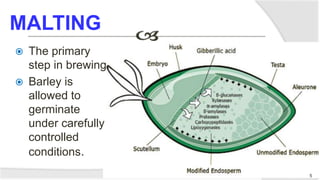
MALTING
 The primary
step in brewing.
 Barley is
allowed to
germinate
under carefully
controlled
conditions.
5
 Steeping
 Steeping the cleaned barley in a shallow
bed of water @ 10-15C for 4-5days.
 A good-quality brewing barley must have
high extraction yields as well as good
proteolytic and cytolytic activities.
6
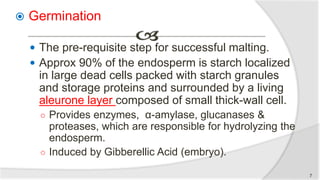
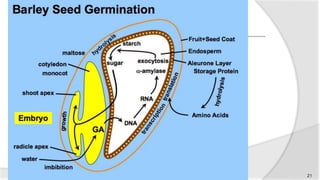
 Germination
 The pre-requisite step for successful malting.
 Approx 90% of the endosperm is starch localized
in large dead cells packed with starch granules
and storage proteins and surrounded by a living
aleurone layer composed of small thick-wall cell.
○ Provides enzymes, α-amylase, glucanases &
proteases, which are responsible for hydrolyzing the
endosperm.
○ Induced by Gibberellic Acid (embryo).
7
 Germination
 To occur: cell wall surrounding the endosperm
must be degraded to allow access for the
hydrolytic enzymes to attack the starch
endosperm.
 Designed to restrict the development of barley
seedling while at the same time ensuring
adequate modification of the endosperm.
8
 β-Glucanase
 Development of β-glucanase during barley
germination is responsible for solubilizing the
insoluble β-glucans.
○ Responsible on stabilizing foam through their ability
to increase viscosity.
 Mechanism: β-solubilase hydrolyze ester linkage
between β-glucans & protein.
○ Slow filtration results to brewing problems as β-
glucans is not solubilized.
9
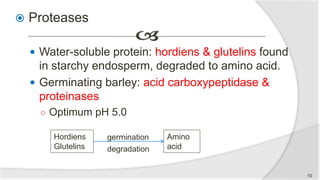
 Proteases
 Water-soluble protein: hordiens & glutelins found
in starchy endosperm, degraded to amino acid.
 Germinating barley: acid carboxypeptidase &
proteinases
○ Optimum pH 5.0
Hordiens
Glutelins
Amino
acid
germination
degradation
10
 Protein Mobilization
 Mobilization of protein during germination
 Initial phase: degradation of protein bodies in the
scutellum and aleurone layers involving both acid
proteinase & carboxypeptidase.
 Second phase: degradation of protein in starchy
endosperm.
 Final phase: uptake of amino acids & small peptides
by the scutellum.
11
 Lipids
 Lipid content of barley varies from Dw=0.8-4.8%
 30% of lipids (primarily triacyl glycerol) lost during
germination
 2 separate lipases remains & increase during the
course of germination
○ 8-10% phospholipids (embryo)
○ 5-8% glycolipids (endosperm)
12
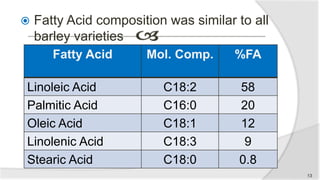
 Fatty Acid composition was similar to all
barley varieties
Fatty Acid Mol. Comp. %FA
Linoleic Acid C18:2 58
Palmitic Acid C16:0 20
Oleic Acid C18:1 12
Linolenic Acid C18:3 9
Stearic Acid C18:0 0.8
13
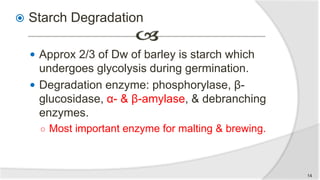
 Starch Degradation
 Approx 2/3 of Dw of barley is starch which
undergoes glycolysis during germination.
 Degradation enzyme: phosphorylase, β-
glucosidase, α- & β-amylase, & debranching
enzymes.
○ Most important enzyme for malting & brewing.
14
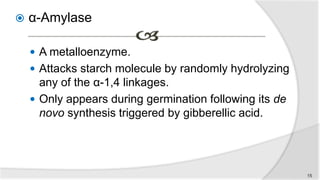
 α-Amylase
 A metalloenzyme.
 Attacks starch molecule by randomly hydrolyzing
any of the α-1,4 linkages.
 Only appears during germination following its de
novo synthesis triggered by gibberellic acid.
15
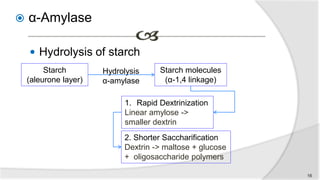
 α-Amylase
 Hydrolysis of starch
Starch
(aleurone layer)
Starch molecules
(α-1,4 linkage)
Hydrolysis
α-amylase
1. Rapid Dextrinization
Linear amylose ->
smaller dextrin
2. Shorter Saccharification
Dextrin -> maltose + glucose
+ oligosaccharide polymers
16
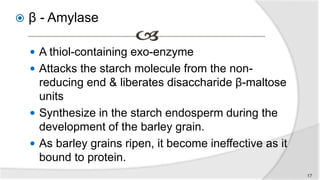
 β - Amylase
 A thiol-containing exo-enzyme
 Attacks the starch molecule from the non-
reducing end & liberates disaccharide β-maltose
units
 Synthesize in the starch endosperm during the
development of the barley grain.
 As barley grains ripen, it become ineffective as it
bound to protein.
17
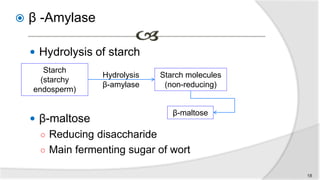
 β -Amylase
 Hydrolysis of starch
 β-maltose
○ Reducing disaccharide
○ Main fermenting sugar of wort
Starch
(starchy
endosperm)
Starch molecules
(non-reducing)
Hydrolysis
β-amylase
β-maltose
18
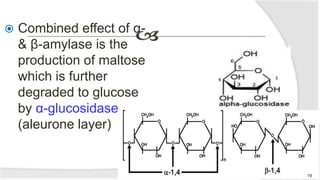
 Combined effect of α-
& β-amylase is the
production of maltose
which is further
degraded to glucose
by α-glucosidase
(aleurone layer)
19
 Barley Seed Germination
 Steps:
1) Keep the steeped barley in a ​cool, well ventilated area to grow the small leaflet
inside the grain called an acrospire. The ideal temperature for germination is 15°C
to 18°C.
2) To keep the seeds cool, spread them out on a cookie sheet in a thick layer (2+
inches thick).
3) As germination continues, the grain bed generates heat through respiration and
may lead to bacteria or mold growth. Therefore, it is important to aerate the grain
bed by mixing/turning every few hours to avoid infection and maintain consistent
growth.
4) Terminate germination once the acrospire is approximately 2/3 the length of the
kernel. Note that the acrospire is inside the grain, so split the kernel hull to open.
Look for the white leaf that is part of the endosperm and attached to the rootlets.
Most likely the external portion of the rootlet will be about twice the length of the
kernel when it is finished. Checking the acrospire length is the best way to
determine when to stop the germination process. The germination phase generally
takes 25 days depending on the dormancy, water sensitivity, water uptake,
germination capabilities of the barley variety.
20
21
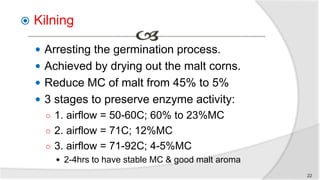
 Kilning
 Arresting the germination process.
 Achieved by drying out the malt corns.
 Reduce MC of malt from 45% to 5%
 3 stages to preserve enzyme activity:
○ 1. airflow = 50-60C; 60% to 23%MC
○ 2. airflow = 71C; 12%MC
○ 3. airflow = 71-92C; 4-5%MC
 2-4hrs to have stable MC & good malt aroma
22
The
Brewing
Process
23
24
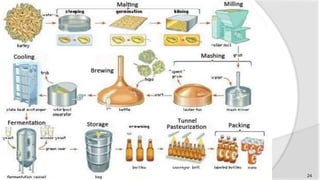
 Milling
 Reduction of particle size in the malt to form a
grist (ground or milled grain).
 Facilitates the extraction of soluble
components, mainly sugars & nitrogenous
compounds from endosperm.
 In relation to kilning, increase the MC
decreases the wort separation time & extract
recovery.
25
 Mashing
 1st step in wort production, involves extracting
soluble materials from the milled malt.
 The grist is feed to a masher with 65C water,
the floating endosperm particles hydrate &
undergo further amylolytic attack.
○ α-amylase being more thermostable
○ β-amylase exhibiting optimum activity @ a
higher pH 6.7
26
 Brewing Water
 95% - water
 Quality of water used is a major factor affecting the quality of the beer.
 through filtration or boiling; impurities, aromas & flavor differences can
be mitigated.
 Water styles can effect flavor:
o hard water – helps add crisp cleanliness
o soft water – adds smoothness
 Water hardness is defined as the amount of dissolved calcium and magnesium in the
water. Hard water has a lot of calcium and magnesium; soft water doesn’t. Water
softeners work by chemically replacing the calcium and magnesium in the water with
sodium or potassium.
 pH control thru:
○ Ca – protects α-amylase from heat destruction
○ Carbonate – salt mixture
27
 Adjuncts
 are added to change the flavor, character or
profile of beer.
 used to supplement main starch source to
provide better foam retention, color or aroma
 Adjuncts fall into two categories:
○ Starch-rich
○ Sugar-rich
 30-40% adjunct mix, 4:1 ratio starch:sugar
28
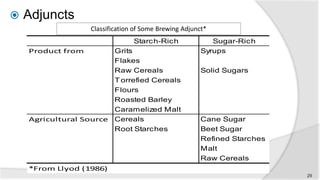
 Adjuncts
Starch-Rich Sugar-Rich
Product from Grits Syrups
Flakes
Raw Cereals Solid Sugars
T orrefied Cereals
Flours
Roasted Barley
Caramelized Malt
Agricultural Source Cereals Cane Sugar
Root Starches Beet Sugar
Refined Starches
Malt
Raw Cereals
*From Llyod (1986)
Classification of Some Brewinng Adjuncts*
29
Classification of Some Brewing Adjunct*
 Boiling of Wort
 Boiled for 2hrs @ atmospheric pressure after
addition of wort.
Objectives:
1. Sterilization of Wort & Enzyme Inactivation
2. Extraction of Bitter & Other Substances from Hops &
Formation of Flavor Compounds
3. Evaporation of Excess Water & Volatiles
30
 Boiling of Wort
1. Sterilization of Wort & Enzyme Inactivation
 Enzymes in the malt is inactivated to stabilize the
wort composition.
 High-molecular weight proteins readily coagulate
during wort boiling to insoluble precipitate & are
eliminated as “hot break” or “trub”.
 The level off coagulated nitrogen is reduced from
30-70ppm in the unboiled wort to 15-20ppm
during boiling.
31
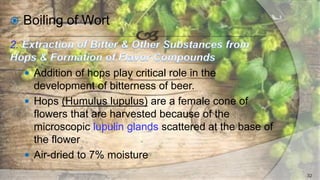
 Boiling of Wort
2.
 Addition of hops play critical role in the
development of bitterness of beer.
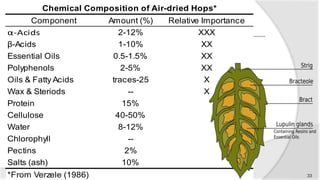
 Hops (Humulus lupulus) are a female cone of
flowers that are harvested because of the
microscopic lupulin glands scattered at the base of
the flower
 Air-dried to 7% moisture
32
Component Amount (%) Relative Importance
α-Acids 2-12% XXX
β-Acids 1-10% XX
Essential Oils 0.5-1.5% XX
Polyphenols 2-5% XX
Oils & Fatty Acids traces-25 X
Wax & Steriods -- X
Protein 15%
Cellulose 40-50%
Water 8-12%
Chlorophyll --
Pectins 2%
Salts (ash) 10%
*From Verzele (1986)
Chemical Composition of Air-dried Hops*
33
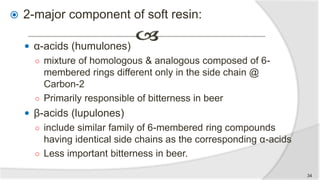
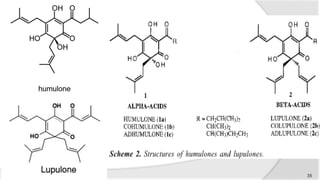
 2-major component of soft resin:
 α-acids (humulones)
○ mixture of homologous & analogous composed of 6-
membered rings different only in the side chain @
Carbon-2
○ Primarily responsible of bitterness in beer
 β-acids (lupulones)
○ include similar family of 6-membered ring compounds
having identical side chains as the corresponding α-acids
○ Less important bitterness in beer.
34
35
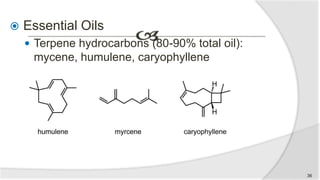
 Essential Oils
 Terpene hydrocarbons (80-90% total oil):
mycene, humulene, caryophyllene
36
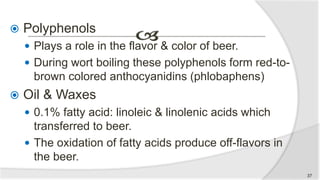
 Polyphenols
 Plays a role in the flavor & color of beer.
 During wort boiling these polyphenols form red-to-
brown colored anthocyanidins (phlobaphens)
 Oil & Waxes
 0.1% fatty acid: linoleic & linolenic acids which
transferred to beer.
 The oxidation of fatty acids produce off-flavors in
the beer.
37
 Extraction of Hops
 Use of liquid carbon dioxide to extract the brewing
constituents of hops
 @ P = 800psi, T= -5 to 20C
 Steam of CO2 was allowed to percolate upward &
enter an evaporator
 CO2 residues: α-acids, β-acids & essential hop oil
38
 Boiling of Wort
3. Evaporation of Excess Water & Volatiles
 Concentrates the wort & eliminates any unwanted
volatiles produced.
 Maintain 7% evaporation
 Ensures that the flavor contributed by these oils is
not too strong in the final beer product.
39
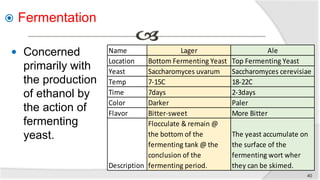
 Fermentation
 Concerned
primarily with
the production
of ethanol by
the action of
fermenting
yeast.
40
Name Lager Ale
Location Bottom Fermenting Yeast Top Fermenting Yeast
Yeast Saccharomyces uvarum Saccharomyces cerevisiae
Temp 7-15C 18-22C
Time 7days 2-3days
Color Darker Paler
Flavor Bitter-sweet More Bitter
Description
Flocculate & remain @
the bottom of the
fermenting tank @ the
conclusion of the
fermenting period.
The yeast accumulate on
the surface of the
fermenting wort wher
they can be skimed.
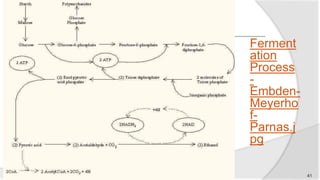
Ferment
ation
Process
-
Embden-
Meyerho
f-
Parnas.j
pg
41
42
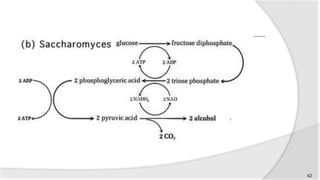
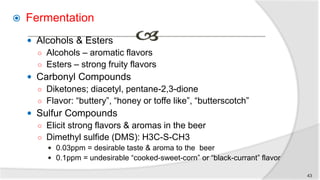
 Fermentation
 Alcohols & Esters
○ Alcohols – aromatic flavors
○ Esters – strong fruity flavors
 Carbonyl Compounds
○ Diketones; diacetyl, pentane-2,3-dione
○ Flavor: “buttery”, “honey or toffe like”, “butterscotch”
 Sulfur Compounds
○ Elicit strong flavors & aromas in the beer
○ Dimethyl sulfide (DMS): H3C-S-CH3
 0.03ppm = desirable taste & aroma to the beer
 0.1ppm = undesirable “cooked-sweet-corn” or “black-currant” flavor
43
Maturation & Clarification of
Beer
 Includes all the changes occurring between
the end of primary fermentation to final
fermentation.
○ Ale matured @ relatively warm temp 12-20C
○ Lager depend @ length of low-temp 2-6C
maturing process & amount of yeast &
fermentable sugar
 Stored 2-4weekss
44
45
46
Beer Difference to:
 Beer
 is the fermented product of sugars obtained
from the breakdown of complex polysaccharides
- starches.
 alcohol content: 4%-6% ABV generally
 Wine
 is the fermentation of sugar from fruit. Whilst it
can technically be made from any sweet fruit.
 alcohol content: 9%-16% ABV
47
Beer Difference to:
 Champagne
 a sparkling(carbonated) wine
 Spirits
 aka Liquor or Distilled beverage
 Whisky, Rum, Brandy, Vodka, Tequila
 Alcohol up to 40% ABV
48
Beer Difference to:
 Soda
 nothing but carbonated water
 Cocktail
 is a mixed alcoholic drink/beverage that
contains two or more ingredients (like a
distilled spirit, soda, fruit juice, honey, herbs
etc.)
49
Thank You!!!
50

Biochemistry of Brewing

  • 1.
    Judife Magallanes, MSc. Departmentof Food Science and Technology Visayas State University 1
  • 2.
    Brewing Overview  Introduction Malting  Brewing Process  Maturation and Clarification of Beer 2
  • 3.
     What isBeer?  century’s old process of converting sugared water to fermented liquid  beer was a necessity in ancient times ○ poor water quality ○ social and medical contributions 3
  • 4.
    What is Beer? An alcoholic beverage produced by the fermentation of sugar-rich extracts derived from cereal grains or other starchy materials.  Composed of:  Barley “Body & Soul”  Yeast “Life”  Hops “Spice”  Water “Integrity & Purity”  Adjunct “The Wild Card” 4
  • 5.
    MALTING  The primary stepin brewing.  Barley is allowed to germinate under carefully controlled conditions. 5
  • 6.
     Steeping  Steepingthe cleaned barley in a shallow bed of water @ 10-15C for 4-5days.  A good-quality brewing barley must have high extraction yields as well as good proteolytic and cytolytic activities. 6
  • 7.
     Germination  Thepre-requisite step for successful malting.  Approx 90% of the endosperm is starch localized in large dead cells packed with starch granules and storage proteins and surrounded by a living aleurone layer composed of small thick-wall cell. ○ Provides enzymes, α-amylase, glucanases & proteases, which are responsible for hydrolyzing the endosperm. ○ Induced by Gibberellic Acid (embryo). 7
  • 8.
     Germination  Tooccur: cell wall surrounding the endosperm must be degraded to allow access for the hydrolytic enzymes to attack the starch endosperm.  Designed to restrict the development of barley seedling while at the same time ensuring adequate modification of the endosperm. 8
  • 9.
     β-Glucanase  Developmentof β-glucanase during barley germination is responsible for solubilizing the insoluble β-glucans. ○ Responsible on stabilizing foam through their ability to increase viscosity.  Mechanism: β-solubilase hydrolyze ester linkage between β-glucans & protein. ○ Slow filtration results to brewing problems as β- glucans is not solubilized. 9
  • 10.
     Proteases  Water-solubleprotein: hordiens & glutelins found in starchy endosperm, degraded to amino acid.  Germinating barley: acid carboxypeptidase & proteinases ○ Optimum pH 5.0 Hordiens Glutelins Amino acid germination degradation 10
  • 11.
     Protein Mobilization Mobilization of protein during germination  Initial phase: degradation of protein bodies in the scutellum and aleurone layers involving both acid proteinase & carboxypeptidase.  Second phase: degradation of protein in starchy endosperm.  Final phase: uptake of amino acids & small peptides by the scutellum. 11
  • 12.
     Lipids  Lipidcontent of barley varies from Dw=0.8-4.8%  30% of lipids (primarily triacyl glycerol) lost during germination  2 separate lipases remains & increase during the course of germination ○ 8-10% phospholipids (embryo) ○ 5-8% glycolipids (endosperm) 12
  • 13.
     Fatty Acidcomposition was similar to all barley varieties Fatty Acid Mol. Comp. %FA Linoleic Acid C18:2 58 Palmitic Acid C16:0 20 Oleic Acid C18:1 12 Linolenic Acid C18:3 9 Stearic Acid C18:0 0.8 13
  • 14.
     Starch Degradation Approx 2/3 of Dw of barley is starch which undergoes glycolysis during germination.  Degradation enzyme: phosphorylase, β- glucosidase, α- & β-amylase, & debranching enzymes. ○ Most important enzyme for malting & brewing. 14
  • 15.
     α-Amylase  Ametalloenzyme.  Attacks starch molecule by randomly hydrolyzing any of the α-1,4 linkages.  Only appears during germination following its de novo synthesis triggered by gibberellic acid. 15
  • 16.
     α-Amylase  Hydrolysisof starch Starch (aleurone layer) Starch molecules (α-1,4 linkage) Hydrolysis α-amylase 1. Rapid Dextrinization Linear amylose -> smaller dextrin 2. Shorter Saccharification Dextrin -> maltose + glucose + oligosaccharide polymers 16
  • 17.
     β -Amylase  A thiol-containing exo-enzyme  Attacks the starch molecule from the non- reducing end & liberates disaccharide β-maltose units  Synthesize in the starch endosperm during the development of the barley grain.  As barley grains ripen, it become ineffective as it bound to protein. 17
  • 18.
     β -Amylase Hydrolysis of starch  β-maltose ○ Reducing disaccharide ○ Main fermenting sugar of wort Starch (starchy endosperm) Starch molecules (non-reducing) Hydrolysis β-amylase β-maltose 18
  • 19.
     Combined effectof α- & β-amylase is the production of maltose which is further degraded to glucose by α-glucosidase (aleurone layer) 19
  • 20.
     Barley SeedGermination  Steps: 1) Keep the steeped barley in a ​cool, well ventilated area to grow the small leaflet inside the grain called an acrospire. The ideal temperature for germination is 15°C to 18°C. 2) To keep the seeds cool, spread them out on a cookie sheet in a thick layer (2+ inches thick). 3) As germination continues, the grain bed generates heat through respiration and may lead to bacteria or mold growth. Therefore, it is important to aerate the grain bed by mixing/turning every few hours to avoid infection and maintain consistent growth. 4) Terminate germination once the acrospire is approximately 2/3 the length of the kernel. Note that the acrospire is inside the grain, so split the kernel hull to open. Look for the white leaf that is part of the endosperm and attached to the rootlets. Most likely the external portion of the rootlet will be about twice the length of the kernel when it is finished. Checking the acrospire length is the best way to determine when to stop the germination process. The germination phase generally takes 25 days depending on the dormancy, water sensitivity, water uptake, germination capabilities of the barley variety. 20
  • 21.
  • 22.
     Kilning  Arrestingthe germination process.  Achieved by drying out the malt corns.  Reduce MC of malt from 45% to 5%  3 stages to preserve enzyme activity: ○ 1. airflow = 50-60C; 60% to 23%MC ○ 2. airflow = 71C; 12%MC ○ 3. airflow = 71-92C; 4-5%MC  2-4hrs to have stable MC & good malt aroma 22
  • 23.
  • 24.
  • 25.
     Milling  Reductionof particle size in the malt to form a grist (ground or milled grain).  Facilitates the extraction of soluble components, mainly sugars & nitrogenous compounds from endosperm.  In relation to kilning, increase the MC decreases the wort separation time & extract recovery. 25
  • 26.
     Mashing  1ststep in wort production, involves extracting soluble materials from the milled malt.  The grist is feed to a masher with 65C water, the floating endosperm particles hydrate & undergo further amylolytic attack. ○ α-amylase being more thermostable ○ β-amylase exhibiting optimum activity @ a higher pH 6.7 26
  • 27.
     Brewing Water 95% - water  Quality of water used is a major factor affecting the quality of the beer.  through filtration or boiling; impurities, aromas & flavor differences can be mitigated.  Water styles can effect flavor: o hard water – helps add crisp cleanliness o soft water – adds smoothness  Water hardness is defined as the amount of dissolved calcium and magnesium in the water. Hard water has a lot of calcium and magnesium; soft water doesn’t. Water softeners work by chemically replacing the calcium and magnesium in the water with sodium or potassium.  pH control thru: ○ Ca – protects α-amylase from heat destruction ○ Carbonate – salt mixture 27
  • 28.
     Adjuncts  areadded to change the flavor, character or profile of beer.  used to supplement main starch source to provide better foam retention, color or aroma  Adjuncts fall into two categories: ○ Starch-rich ○ Sugar-rich  30-40% adjunct mix, 4:1 ratio starch:sugar 28
  • 29.
     Adjuncts Starch-Rich Sugar-Rich Productfrom Grits Syrups Flakes Raw Cereals Solid Sugars T orrefied Cereals Flours Roasted Barley Caramelized Malt Agricultural Source Cereals Cane Sugar Root Starches Beet Sugar Refined Starches Malt Raw Cereals *From Llyod (1986) Classification of Some Brewinng Adjuncts* 29 Classification of Some Brewing Adjunct*
  • 30.
     Boiling ofWort  Boiled for 2hrs @ atmospheric pressure after addition of wort. Objectives: 1. Sterilization of Wort & Enzyme Inactivation 2. Extraction of Bitter & Other Substances from Hops & Formation of Flavor Compounds 3. Evaporation of Excess Water & Volatiles 30
  • 31.
     Boiling ofWort 1. Sterilization of Wort & Enzyme Inactivation  Enzymes in the malt is inactivated to stabilize the wort composition.  High-molecular weight proteins readily coagulate during wort boiling to insoluble precipitate & are eliminated as “hot break” or “trub”.  The level off coagulated nitrogen is reduced from 30-70ppm in the unboiled wort to 15-20ppm during boiling. 31
  • 32.
     Boiling ofWort 2.  Addition of hops play critical role in the development of bitterness of beer.  Hops (Humulus lupulus) are a female cone of flowers that are harvested because of the microscopic lupulin glands scattered at the base of the flower  Air-dried to 7% moisture 32
  • 33.
    Component Amount (%)Relative Importance α-Acids 2-12% XXX β-Acids 1-10% XX Essential Oils 0.5-1.5% XX Polyphenols 2-5% XX Oils & Fatty Acids traces-25 X Wax & Steriods -- X Protein 15% Cellulose 40-50% Water 8-12% Chlorophyll -- Pectins 2% Salts (ash) 10% *From Verzele (1986) Chemical Composition of Air-dried Hops* 33
  • 34.
     2-major componentof soft resin:  α-acids (humulones) ○ mixture of homologous & analogous composed of 6- membered rings different only in the side chain @ Carbon-2 ○ Primarily responsible of bitterness in beer  β-acids (lupulones) ○ include similar family of 6-membered ring compounds having identical side chains as the corresponding α-acids ○ Less important bitterness in beer. 34
  • 35.
  • 36.
     Essential Oils Terpene hydrocarbons (80-90% total oil): mycene, humulene, caryophyllene 36
  • 37.
     Polyphenols  Playsa role in the flavor & color of beer.  During wort boiling these polyphenols form red-to- brown colored anthocyanidins (phlobaphens)  Oil & Waxes  0.1% fatty acid: linoleic & linolenic acids which transferred to beer.  The oxidation of fatty acids produce off-flavors in the beer. 37
  • 38.
     Extraction ofHops  Use of liquid carbon dioxide to extract the brewing constituents of hops  @ P = 800psi, T= -5 to 20C  Steam of CO2 was allowed to percolate upward & enter an evaporator  CO2 residues: α-acids, β-acids & essential hop oil 38
  • 39.
     Boiling ofWort 3. Evaporation of Excess Water & Volatiles  Concentrates the wort & eliminates any unwanted volatiles produced.  Maintain 7% evaporation  Ensures that the flavor contributed by these oils is not too strong in the final beer product. 39
  • 40.
     Fermentation  Concerned primarilywith the production of ethanol by the action of fermenting yeast. 40 Name Lager Ale Location Bottom Fermenting Yeast Top Fermenting Yeast Yeast Saccharomyces uvarum Saccharomyces cerevisiae Temp 7-15C 18-22C Time 7days 2-3days Color Darker Paler Flavor Bitter-sweet More Bitter Description Flocculate & remain @ the bottom of the fermenting tank @ the conclusion of the fermenting period. The yeast accumulate on the surface of the fermenting wort wher they can be skimed.
  • 41.
  • 42.
  • 43.
     Fermentation  Alcohols& Esters ○ Alcohols – aromatic flavors ○ Esters – strong fruity flavors  Carbonyl Compounds ○ Diketones; diacetyl, pentane-2,3-dione ○ Flavor: “buttery”, “honey or toffe like”, “butterscotch”  Sulfur Compounds ○ Elicit strong flavors & aromas in the beer ○ Dimethyl sulfide (DMS): H3C-S-CH3  0.03ppm = desirable taste & aroma to the beer  0.1ppm = undesirable “cooked-sweet-corn” or “black-currant” flavor 43
  • 44.
    Maturation & Clarificationof Beer  Includes all the changes occurring between the end of primary fermentation to final fermentation. ○ Ale matured @ relatively warm temp 12-20C ○ Lager depend @ length of low-temp 2-6C maturing process & amount of yeast & fermentable sugar  Stored 2-4weekss 44
  • 45.
  • 46.
  • 47.
    Beer Difference to: Beer  is the fermented product of sugars obtained from the breakdown of complex polysaccharides - starches.  alcohol content: 4%-6% ABV generally  Wine  is the fermentation of sugar from fruit. Whilst it can technically be made from any sweet fruit.  alcohol content: 9%-16% ABV 47
  • 48.
    Beer Difference to: Champagne  a sparkling(carbonated) wine  Spirits  aka Liquor or Distilled beverage  Whisky, Rum, Brandy, Vodka, Tequila  Alcohol up to 40% ABV 48
  • 49.
    Beer Difference to: Soda  nothing but carbonated water  Cocktail  is a mixed alcoholic drink/beverage that contains two or more ingredients (like a distilled spirit, soda, fruit juice, honey, herbs etc.) 49
  • 50.

Editor's Notes

  • #5 Body & Soul: determine the color, foamy texture and malty sweet flavor of beer Life: thousands of brewers yeast that create a variety beer styles Spice: antiseptic qualities, aroma fruity flowery characteristics, bitterness balances malt sweetness, foam stabilization enhances head properties Integrity & Purity: hard water – helps add crisp cleanliness, soft water – adds smoothness Wild card: change the flavor, character or profile of beer
  • #7 Determines the malt extract.
  • #8 These enzyme released in response to the message sent out from the embryo in the form of hormone, Gibberellic Acid.
  • #9 Take note that low modification of endosperm tissue is undesirable -> low yield extract, filtration problem
  • #10 Foam building properties beer are due to proteins, polysaccharides & bitter constituents.
  • #12 2. Attributed by the initial phase in response to gibberellic acid from embryo.
  • #15 Lipids does not explain nor site its importance towards malting. But lipid is determinant of the germination process.
  • #16 Metalloenzyme-enzyme containing metal ion
  • #17 Dextrin-intermediate in the formation of maltose
  • #20 Insert structure of amylase & glucosidase!
  • #26 Wort=malted barley
  • #27 Wort=malted barley The pH & T facilitates the enzyme to work effectively
  • #28 H20 - Major component of beer. Ca-permits liquefaction of starch during mashing
  • #32 Removal? Important in terms of the taste & colloidal stability of the finished product.
  • #33 Hops-graded by appearance, aroma, bitterness resin ->bitterness & flavor of beer
  • #41 Larger: 7 days Ale: 2-3 days
  • #49 Distillation is just further processing of fermented beverage to purify and remove any diluting components like water. This increases the proportion of their alcohol content and that's why they are also commonly known as 'Hard Liquor'