atom:  smallest unit of matter that still retains the properties of an element By Fastfission at en.wikipedia [CC-BY-SA-3.0 (www.creativecommons.org/licenses/by-sa/3.0/), GFDL (www.gnu.org/copyleft/fdl.html) or GFDL (www.gnu.org/copyleft/fdl.html)], from Wikimedia Commons
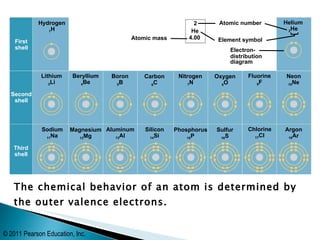
The chemical behavior of an atom is determined by the outer valence electrons. © 2011 Pearson Education, Inc. Hydrogen 1 H Lithium 3 Li Beryllium 4 Be Boron 5 B Carbon 6 C Nitrogen 7 N Oxygen 8 O Fluorine 9 F Neon 10 Ne Helium 2 He Atomic number Element symbol Electron- distribution diagram Atomic mass 2 He 4.00 First shell Second shell Third shell Sodium 11 Na Magnesium 12 Mg Aluminum 13 Al Silicon 14 Si Phosphorus 15 P Sulfur 16 S Chlorine 17 Cl Argon 18 Ar
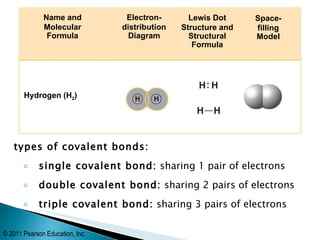
types of covalent bonds: single covalent bond:  sharing 1 pair of electrons double covalent bond:  sharing 2 pairs of electrons triple covalent bond:  sharing 3 pairs of electrons © 2011 Pearson Education, Inc. Hydrogen (H 2 ) Name and Molecular Formula Electron- distribution Diagram Lewis Dot Structure and Structural Formula Space- filling Model
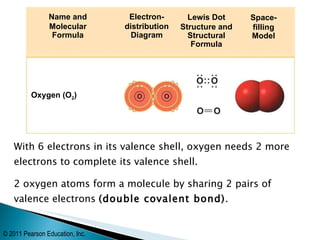
With 6 electrons in its valence shell, oxygen needs 2 more electrons to complete its valence shell. 2 oxygen atoms form a molecule by sharing 2 pairs of valence electrons  (double covalent bond) . © 2011 Pearson Education, Inc. Oxygen (O 2 ) Name and Molecular Formula Electron- distribution Diagram Lewis Dot Structure and Structural Formula Space- filling Model
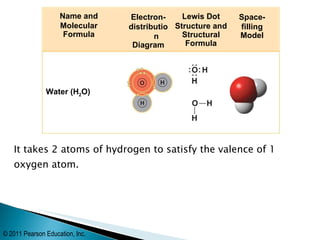
It takes 2 atoms of hydrogen to satisfy the valence of 1 oxygen atom. © 2011 Pearson Education, Inc. Water (H 2 O) Name and Molecular Formula Electron- distribution Diagram Lewis Dot Structure and Structural Formula Space- filling Model

BIO106 Covalent Bonds

  • 1.
    atom: smallestunit of matter that still retains the properties of an element By Fastfission at en.wikipedia [CC-BY-SA-3.0 (www.creativecommons.org/licenses/by-sa/3.0/), GFDL (www.gnu.org/copyleft/fdl.html) or GFDL (www.gnu.org/copyleft/fdl.html)], from Wikimedia Commons
  • 2.
    The chemical behaviorof an atom is determined by the outer valence electrons. © 2011 Pearson Education, Inc. Hydrogen 1 H Lithium 3 Li Beryllium 4 Be Boron 5 B Carbon 6 C Nitrogen 7 N Oxygen 8 O Fluorine 9 F Neon 10 Ne Helium 2 He Atomic number Element symbol Electron- distribution diagram Atomic mass 2 He 4.00 First shell Second shell Third shell Sodium 11 Na Magnesium 12 Mg Aluminum 13 Al Silicon 14 Si Phosphorus 15 P Sulfur 16 S Chlorine 17 Cl Argon 18 Ar
  • 3.
    types of covalentbonds: single covalent bond: sharing 1 pair of electrons double covalent bond: sharing 2 pairs of electrons triple covalent bond: sharing 3 pairs of electrons © 2011 Pearson Education, Inc. Hydrogen (H 2 ) Name and Molecular Formula Electron- distribution Diagram Lewis Dot Structure and Structural Formula Space- filling Model
  • 4.
    With 6 electronsin its valence shell, oxygen needs 2 more electrons to complete its valence shell. 2 oxygen atoms form a molecule by sharing 2 pairs of valence electrons (double covalent bond) . © 2011 Pearson Education, Inc. Oxygen (O 2 ) Name and Molecular Formula Electron- distribution Diagram Lewis Dot Structure and Structural Formula Space- filling Model
  • 5.
    It takes 2atoms of hydrogen to satisfy the valence of 1 oxygen atom. © 2011 Pearson Education, Inc. Water (H 2 O) Name and Molecular Formula Electron- distribution Diagram Lewis Dot Structure and Structural Formula Space- filling Model

Editor's Notes

  • #2 We symbolize atoms with the same abbreviation used for the element made up of those atoms; thus, C stands for both the element carbon and a single carbon atom. Simplified models of a helium (He) atom. The helium nucleus consists of 2 neutrons (brown) & 2 protons (pink). Two electrons (blue) move rapidly around the nucleus. These models are not to scale; they greatly overestimate the size of the nucleus in relation to the electron cloud. These are simplified cartoons: Atoms do not have defined surfaces. Electrons do not travel in planetary orbits around the nucleus of the atom. Shared electron pairs are paired spatially in covalent bonds. Electron shells represent energy levels rather than the position of electrons.
  • #3 The periodic table of the elements shows the electron distribution for each element. The chemical behavior of an atom is determined by its electron configuration-that is, the distribution of electrons in the atom's electron shells. Beginning with hydrogen, the simplest atom, we can imagine building the atoms of the other elements by adding 1 proton and 1 electron at a time (along with an appropriate number of neutrons). An abbreviated version of what is called the periodic table of the elements, shows this distribution of electrons for the first 18 elements, from hydrogen ( 1 H) to argon ( 18 Ar). The elements are arranged in three rows, or periods, corresponding to the number of electron shells in their atoms. The left-to-right sequence of elements in each row corresponds to the sequential addition of electrons (and protons). Hydrogen's 1 electron & helium's 2 electrons are located in the 1 st shell. Electrons, like all matter, tend to exist in the lowest available state of potential energy, which they have in the first shell. However, the first shell can hold no more than 2 electrons; thus, there are only two elements (hydrogen and helium) in the first row of the table. An atom with more than 2 electrons must use higher shells because the first shell is full. The next element, lithium, has 3 electrons. Two of these electrons fill the first shell while the third electron occupies the second shell. The second shell holds a maximum of 8 electrons. Neon, at the end of the second row, has 8 electrons in the second shell, giving it a total of 10 electrons. The chemical behavior of an atom depends mostly on the number of electrons in its outermost shell. We call those outer electrons valence electrons and the outermost electron shell the valence shell. In the case of lithium, there is only 1 valence electron, and the second shell is the valence shell. Atoms with the same number of electrons in their valence shells exhibit similar chemical behavior. For example, fluorine (F) and chlorine (Cl) both have 7 valence electrons, and both combine with the element sodium to form compounds. An atom with a completed valence shell is unreactive; that is, it will not interact readily with other atoms it encounters. At the far right of the periodic table are helium, neon, and argon, the only three elements shown that have full valence shells. These elements are said to be inert, meaning chemically unreactive. All the other atoms are chemically reactive because they have incomplete valence shells.
  • #4 Each hydrogen atom now has 2 electrons associated with it in what amounts to a completed valence shell, shown in an electron-shell diagram. Two or more atoms held together by covalent bonds constitute a molecule. In this case, we have formed a hydrogen molecule. We can abbreviate the structure of this molecule as H–H, where the line represents a single covalent bond-that is, a pair of shared electrons. This notation, which represents both atoms and bonding, is called a structural formula. We can abbreviate even further by writing H 2 , a molecular formula indicating simply that the molecule consists of 2 atoms of hydrogen. The space-filling model comes closest to representing the actual shape of the molecule.
  • #5 Each atom that can share valence electrons has a bonding capacity corresponding to the number of covalent bonds the atom can form. When the bonds form, they give the atom a full complement of electrons in the valence shell. The bonding capacity of oxygen, for example, is 2. This bonding capacity is called the atom's valence and usually equals the number of unpaired electrons in the atom's outermost (valence) shell. By counting the unpaired electrons, you can see that the valence of hydrogen is 1; oxygen, 2; nitrogen, 3; and carbon, 4. A more complicated case is phosphorus (P), another element important to life. Phosphorus can have a valence of 3, as we would predict from its 3 unpaired electrons. In biologically important molecules, however, we can consider it to have a valence of 5, forming three single bonds and one double bond.