Chapter Two Water: The Solvent for Biochemical Reactions Paul D. Adams University of Arkansas
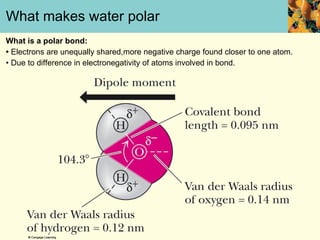
What makes water polar What is a polar bond: •  Electrons are unequally shared,more negative charge found closer to one atom. •  Due to difference in electronegativity of atoms involved in bond.
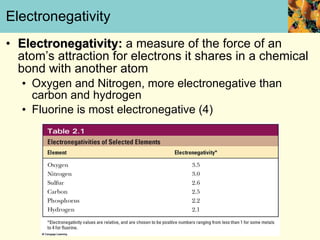
Electronegativity Electronegativity:  a measure of the force of an atom’s attraction for electrons it shares in a chemical bond with another atom Oxygen and Nitrogen, more electronegative than carbon and hydrogen Fluorine is most electronegative (4)
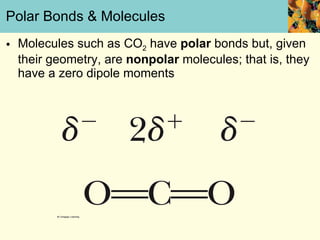
Polar Bonds & Molecules Molecules such as CO 2  have  polar  bonds but, given their geometry, are  nonpolar  molecules; that is, they have a zero dipole moments
Solvent Properties of H 2 O Ionic compounds (e.g.,KCl) and low-molecular- weight polar covalent compounds (e.g., C 2 H 5 OH and CH 3 COCH 3 ) tend to dissolve in water The underlying principle is electrostatic attraction of unlike charges; the positive dipole of water for the negative dipole of another molecule, etc. ion-dipole interaction: e.g., KCl dissolved in H 2 O dipole-dipole interactions: e.g., ethanol or acetone dissolved in H 2 O dipole induced-dipole interactions: weak and generally do not lead to solubility in water
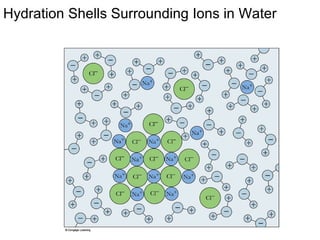
Hydration Shells Surrounding Ions in Water
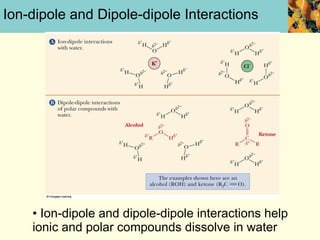
•  Ion-dipole and dipole-dipole interactions help ionic and polar compounds dissolve in water Ion-dipole and Dipole-dipole Interactions
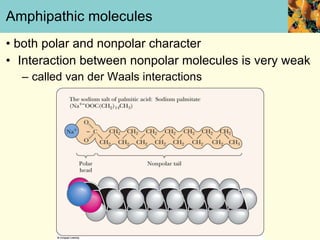
Solvent Properties of H 2 O Hydrophilic : water-loving tend to dissolve in water Hydrophobic : water-fearing tend not to dissolve in water Amphipathic : has characteristics of both properties molecules that contain one or more hydrophobic and one or more hydrophilic regions, e.g., sodium palmitate
Amphipathic molecules •  both polar and nonpolar character Interaction between nonpolar molecules is very weak called van der Waals interactions
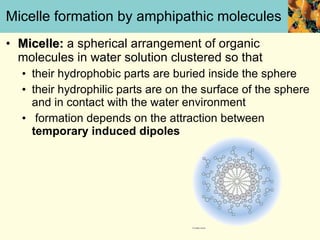
Micelle formation by amphipathic molecules Micelle:  a spherical arrangement of organic molecules in water solution clustered so that their hydrophobic parts are buried inside the sphere  their hydrophilic parts are on the surface of the sphere and in contact with the water environment formation depends on the attraction between  temporary induced dipoles
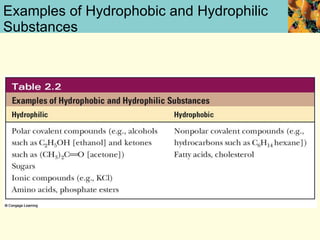
Examples of Hydrophobic and Hydrophilic Substances
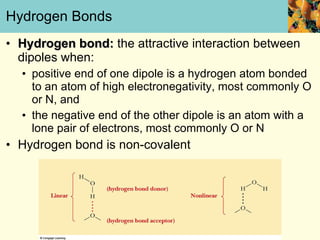
Hydrogen Bonds Hydrogen bond:  the attractive interaction between dipoles when: positive end of one dipole is a hydrogen atom bonded to an atom of high electronegativity, most commonly O or N, and the negative end of the other dipole is an atom with a lone pair of electrons, most commonly O or N Hydrogen bond is non-covalent
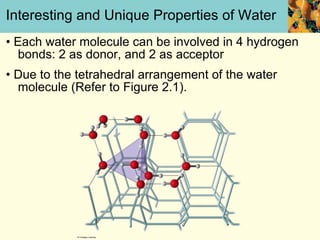
Interesting and Unique Properties of Water •  Each water molecule can be involved in 4 hydrogen bonds: 2 as donor, and 2 as acceptor •  Due to the tetrahedral arrangement of the water molecule (Refer to Figure 2.1).
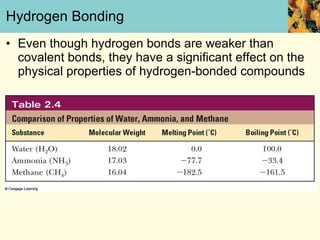
Hydrogen Bonding Even though hydrogen bonds are weaker than covalent bonds, they have a significant effect on the physical properties of hydrogen-bonded compounds
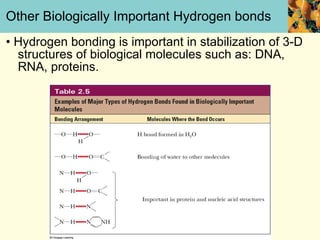
Other Biologically Important Hydrogen bonds •  Hydrogen bonding is important in stabilization of 3-D structures of biological molecules such as: DNA, RNA, proteins.
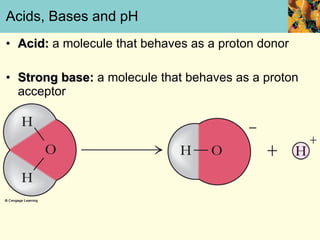
Acids, Bases and pH Acid:   a molecule that behaves as a proton donor Strong base:   a molecule that behaves as a proton acceptor
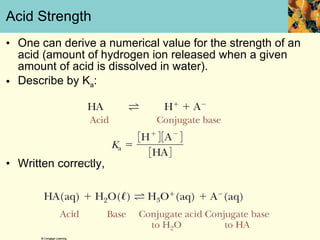
One can derive a numerical value for the strength of an acid (amount of hydrogen ion released when a given amount of acid is dissolved in water). Describe by K a :  Written correctly, Acid Strength
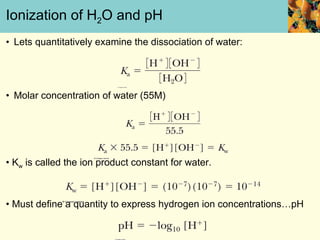
Ionization of H 2 O and pH Lets quantitatively examine the dissociation of water: • Molar concentration of water (55M) •  K w  is called the ion product constant for water. •  Must define a quantity to express hydrogen ion concentrations…pH
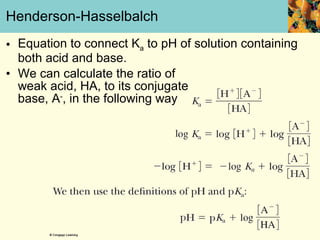
Henderson-Hasselbalch Equation to connect K a  to pH of solution containing both acid and base.  We can calculate the ratio of  weak acid, HA, to its conjugate  base, A - , in the following way
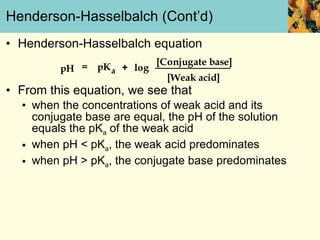
Henderson-Hasselbalch (Cont’d) Henderson-Hasselbalch equation From this equation, we see that when the concentrations of weak acid and its conjugate base are equal, the pH of the solution equals the pK a  of the weak acid when pH < pK a , the weak acid predominates when pH > pK a , the conjugate base predominates
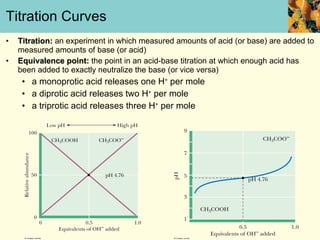
Titration Curves Titration:  an experiment in which measured amounts of acid (or base) are added to measured amounts of base (or acid) Equivalence point:  the point in an acid-base titration at which enough acid has been added to exactly neutralize the base (or vice versa) a monoprotic acid releases one H +  per mole a diprotic acid releases two H +  per mole a triprotic acid releases   three H +  per mole
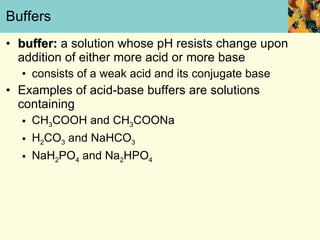
Buffers buffer:  a solution whose pH resists change upon addition of either more acid or more base consists of a weak acid and its conjugate base Examples of acid-base buffers are solutions containing CH 3 COOH and CH 3 COONa H 2 CO 3  and NaHCO 3 NaH 2 PO 4  and Na 2 HPO 4
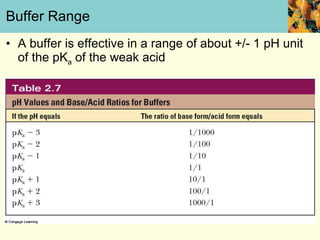
Buffer Range A buffer is effective in a range of about +/- 1 pH unit of the pK a  of the weak acid
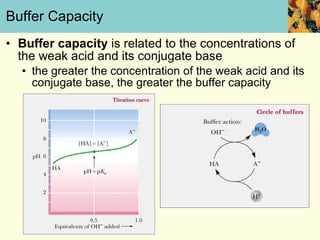
Buffer Capacity Buffer capacity  is related to the concentrations of the weak acid and its conjugate base the greater the concentration of the weak acid and its conjugate base, the greater the buffer capacity
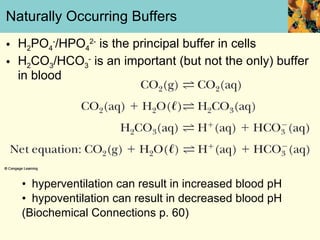
Naturally Occurring Buffers H 2 PO 4 - /HPO 4 2-  is the principal buffer in cells H 2 CO 3 /HCO 3 -  is an important (but not the only) buffer in blood hyperventilation can result in increased blood pH hypoventilation can result in decreased blood pH (Biochemical Connections p. 60)
Selecting a Buffer The following criteria are typical suitable pK a no interference with the reaction or detection of the assay suitable ionic strength  suitable solubility its non-biological nature
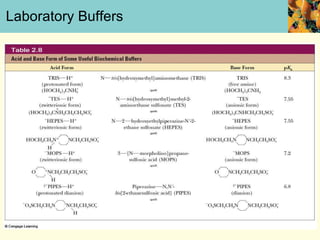
Laboratory Buffers

Campbell6e lecture ch2

  • 1.
    Chapter Two Water:The Solvent for Biochemical Reactions Paul D. Adams University of Arkansas
  • 2.
    What makes waterpolar What is a polar bond: • Electrons are unequally shared,more negative charge found closer to one atom. • Due to difference in electronegativity of atoms involved in bond.
  • 3.
    Electronegativity Electronegativity: a measure of the force of an atom’s attraction for electrons it shares in a chemical bond with another atom Oxygen and Nitrogen, more electronegative than carbon and hydrogen Fluorine is most electronegative (4)
  • 4.
    Polar Bonds &Molecules Molecules such as CO 2 have polar bonds but, given their geometry, are nonpolar molecules; that is, they have a zero dipole moments
  • 5.
    Solvent Properties ofH 2 O Ionic compounds (e.g.,KCl) and low-molecular- weight polar covalent compounds (e.g., C 2 H 5 OH and CH 3 COCH 3 ) tend to dissolve in water The underlying principle is electrostatic attraction of unlike charges; the positive dipole of water for the negative dipole of another molecule, etc. ion-dipole interaction: e.g., KCl dissolved in H 2 O dipole-dipole interactions: e.g., ethanol or acetone dissolved in H 2 O dipole induced-dipole interactions: weak and generally do not lead to solubility in water
  • 6.
  • 7.
    • Ion-dipoleand dipole-dipole interactions help ionic and polar compounds dissolve in water Ion-dipole and Dipole-dipole Interactions
  • 8.
    Solvent Properties ofH 2 O Hydrophilic : water-loving tend to dissolve in water Hydrophobic : water-fearing tend not to dissolve in water Amphipathic : has characteristics of both properties molecules that contain one or more hydrophobic and one or more hydrophilic regions, e.g., sodium palmitate
  • 9.
    Amphipathic molecules • both polar and nonpolar character Interaction between nonpolar molecules is very weak called van der Waals interactions
  • 10.
    Micelle formation byamphipathic molecules Micelle: a spherical arrangement of organic molecules in water solution clustered so that their hydrophobic parts are buried inside the sphere their hydrophilic parts are on the surface of the sphere and in contact with the water environment formation depends on the attraction between temporary induced dipoles
  • 11.
    Examples of Hydrophobicand Hydrophilic Substances
  • 12.
    Hydrogen Bonds Hydrogenbond: the attractive interaction between dipoles when: positive end of one dipole is a hydrogen atom bonded to an atom of high electronegativity, most commonly O or N, and the negative end of the other dipole is an atom with a lone pair of electrons, most commonly O or N Hydrogen bond is non-covalent
  • 13.
    Interesting and UniqueProperties of Water • Each water molecule can be involved in 4 hydrogen bonds: 2 as donor, and 2 as acceptor • Due to the tetrahedral arrangement of the water molecule (Refer to Figure 2.1).
  • 14.
    Hydrogen Bonding Eventhough hydrogen bonds are weaker than covalent bonds, they have a significant effect on the physical properties of hydrogen-bonded compounds
  • 15.
    Other Biologically ImportantHydrogen bonds • Hydrogen bonding is important in stabilization of 3-D structures of biological molecules such as: DNA, RNA, proteins.
  • 16.
    Acids, Bases andpH Acid: a molecule that behaves as a proton donor Strong base: a molecule that behaves as a proton acceptor
  • 17.
    One can derivea numerical value for the strength of an acid (amount of hydrogen ion released when a given amount of acid is dissolved in water). Describe by K a : Written correctly, Acid Strength
  • 18.
    Ionization of H2 O and pH Lets quantitatively examine the dissociation of water: • Molar concentration of water (55M) • K w is called the ion product constant for water. • Must define a quantity to express hydrogen ion concentrations…pH
  • 19.
    Henderson-Hasselbalch Equation toconnect K a to pH of solution containing both acid and base. We can calculate the ratio of weak acid, HA, to its conjugate base, A - , in the following way
  • 20.
    Henderson-Hasselbalch (Cont’d) Henderson-Hasselbalchequation From this equation, we see that when the concentrations of weak acid and its conjugate base are equal, the pH of the solution equals the pK a of the weak acid when pH < pK a , the weak acid predominates when pH > pK a , the conjugate base predominates
  • 21.
    Titration Curves Titration: an experiment in which measured amounts of acid (or base) are added to measured amounts of base (or acid) Equivalence point: the point in an acid-base titration at which enough acid has been added to exactly neutralize the base (or vice versa) a monoprotic acid releases one H + per mole a diprotic acid releases two H + per mole a triprotic acid releases three H + per mole
  • 22.
    Buffers buffer: a solution whose pH resists change upon addition of either more acid or more base consists of a weak acid and its conjugate base Examples of acid-base buffers are solutions containing CH 3 COOH and CH 3 COONa H 2 CO 3 and NaHCO 3 NaH 2 PO 4 and Na 2 HPO 4
  • 23.
    Buffer Range Abuffer is effective in a range of about +/- 1 pH unit of the pK a of the weak acid
  • 24.
    Buffer Capacity Buffercapacity is related to the concentrations of the weak acid and its conjugate base the greater the concentration of the weak acid and its conjugate base, the greater the buffer capacity
  • 25.
    Naturally Occurring BuffersH 2 PO 4 - /HPO 4 2- is the principal buffer in cells H 2 CO 3 /HCO 3 - is an important (but not the only) buffer in blood hyperventilation can result in increased blood pH hypoventilation can result in decreased blood pH (Biochemical Connections p. 60)
  • 26.
    Selecting a BufferThe following criteria are typical suitable pK a no interference with the reaction or detection of the assay suitable ionic strength suitable solubility its non-biological nature
  • 27.