BIO-AVAILABILITY
PRESENTED BY
PREMSAI.K
I M PHARM
PHARMACEUTICS
KRUPANDHI COLLEGE
OF PHARMACY
BANGALORE
CONTENT
 Definition
 Purpose of bio availability
 Factors affecting bio availability
 Measurements of bio availability
 Reasons for poor availability
 Approches to enhance the bio availability
 Methods of enhancement of bio availability
 Reference
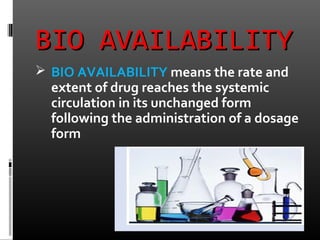
BIO AVAILABILITYBIO AVAILABILITY
 BIO AVAILABILITY means the rate and
extent of drug reaches the systemic
circulation in its unchanged form
following the administration of a dosage
form
PURPOSE OF BIOAVAILABILITYPURPOSE OF BIOAVAILABILITY
 For marketing approval of new drug, FDA meets
bioavailability studies
 Establish the pharmacokinetic characters and it
is useful in establish dosage regimens
 Bio availability studies are useful in determining
the safety, efficacy, identity, strength, quality
and purity of the drug product
Factors affecting
Bioavailability
A)Pharmaceutic factors :
1) Physicochemical properties of
drug
 Drug solubility & dissolution rate.
 Particle size & effective surface area.
 Polymorphism & Amorphism.
 Amorphous > metastable > stable
 Pseudopolymorphism (Hydrates / Solvates )
 Anhydrates > hydrates e.g. Theophylline,
Ampicillin
 Organic solvates > non solvates e.g.
fludrocortisone
 Salt form of the drug.
 Weakly acidic drugs – strong basic salt
e.g.barbiturates , sulfonamides.
 Weakly basic drugs – strong acid salt
 Lipophilicity of the drug .
 pKa of the drug & pH .
 Drug stability.
2) Dosage form characteristics &
Pharmaceutic Ingredients
 Disintegration time (tab/cap)
 Dissolution time.
 Manufacturing variables.
 Pharmaceutic ingredients( excipients /
adjuvants )
 Nature & type of dosage form.
 Solutions> Emulsions> Suspensions> Cap> Tab>
Enteric Coated Tab > Sustained Release
 Product age & storage conditions.
B)Patient related factors
 Age
 Gastric emptying time .
 Intestinal transit time .
 Gastrointestinal pH .(HCL > Acetic > citric )
 Disease States .
 Blood flow through the gastrointestinal tract .
 Gastrointestinal contents :
 Other drugs .

 Food .
 Fluids
 Other normal g.i. contents
 Presystemic metabolism (First – Pass effect )
by :
 Luminal enzymes .
 Gut wall enzymes .
 Bacterial enzymes .
 Hepatic enzymes .
C)Routes of
administration :
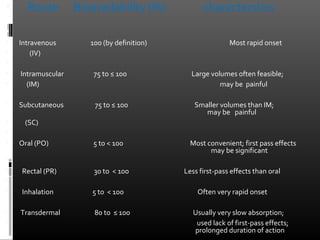
 Parentral > Rectal > Oral > Topical
 Route Bioavailability (%) characterstics

 Intravenous 100 (by definition) Most rapid onset
 (IV)

 Intramuscular 75 to ≤ 100 Large volumes often feasible;
 (IM) may be painful
 Subcutaneous 75 to ≤ 100 Smaller volumes than IM;
may be painful
 (SC)

 Oral (PO) 5 to < 100 Most convenient; first pass effects
may be significant

 Rectal (PR) 30 to < 100 Less first-pass effects than oral

 Inhalation 5 to < 100 Often very rapid onset
 Transdermal 80 to ≤ 100 Usually very slow absorption;
 used lack of first-pass effects;
prolonged duration of action
MEASUREMENT OF BIO AVAILABILITYMEASUREMENT OF BIO AVAILABILITY
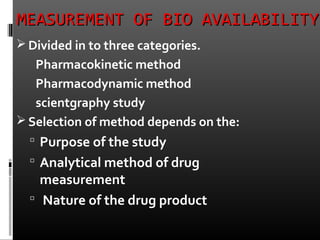
 Divided in to three categories.
Pharmacokinetic method
Pharmacodynamic method
scientgraphy study
 Selection of method depends on the:
 Purpose of the study
 Analytical method of drug
measurement
 Nature of the drug product
PHARMACOKINETIC METHODPHARMACOKINETIC METHOD
It is also called as Indirect method
 Plasma level-time studies
 Urinary excretion studies
PLASMA LEVEL-TIME STUDIESPLASMA LEVEL-TIME STUDIES
PRINCIPLE:
It is based on the assumption that
two dosage forms that exhibit super
imposable plasma level time profile
in a group of subjects should result in
identical therapeutic activity
FOR SINGLE DOSE STUDYFOR SINGLE DOSE STUDY
 It requires collection of serial blood
samples for a period of 2 to 3 biological
half lives, after drug administration
 And then analysis for drug concentration
 By making a plot of concentration vs
corresponding time of sample collection
to obtain plasma level time profile
FOR MULTIPLE DOSEFOR MULTIPLE DOSE
 Method involves drug administration
for at least 5 biological half lives
 A blood sample should be taken at
the end of previous dosing interval
and 8 to 10 samples after the
administration of next dose
PARAMETERSPARAMETERS
3 parameters of these method used to
estimate the bio availability are:
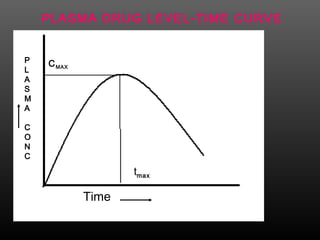
Cmax : Peak plasma concentration.
Tmax : Peak time
AUC : Area under the plasma level-
time curve
Time
tmax
CMAX
P
L
A
S
M
A
C
O
N
C
PLASMA DRUG LEVEL-TIME CURVE
MEASUREMENT OF AUCMEASUREMENT OF AUC
 1)PHYSICAL METHODS
A)CUT AND WEIGHT METHOD
B)PLANIMETER
 2)TRAPEZOIDAL METHOD
 3)INTEGRATION METHOD
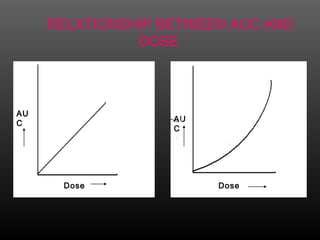
RELATIONSHIP BETWEEN AUC AND
DOSE
AU
C
Dose
AU
C
Dose
CUT & WEIGH AND PLANIMETERCUT & WEIGH AND PLANIMETER
METHODSMETHODS
 CUT & WEIGH: Plasma concentration profile are
plotted on smooth paper, these can be cut out
and weighed and the weight of the papers is
directly proportional to AUC
 PLANIMETER : A planimeter is a percision
instrument which allows the calculation
of areas by tracing there outlines
TRPEZOIDAL METHODTRPEZOIDAL METHOD
 It involves the breaking up of the
plasma con vs time profile in to several
trapezoids calculating the area of each
trapezoid and add them to obtain the
AUC
 AUC = [(co+c1)(t1-
to)/2]+……… + (cn-1+cn)(tn-tn-1)/2
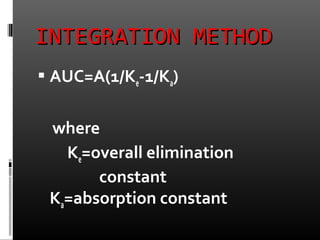
INTEGRATION METHODINTEGRATION METHOD
 AUC=A(1/Ke-1/Ka)
where
Ke=overall elimination
constant
Ka=absorption constant
EXTENT OF BIOAVAILABILITYEXTENT OF BIOAVAILABILITY
FOR SINGLE DOSE STUDYFOR SINGLE DOSE STUDY
F=[AUC]oralDiv/ [AUC]ivDoral
Fr=[AUC]testDstd/[AUC]stdDtest
D = DOSE
ADMINISTERED
EXTENT OF BIOAVAILABILITYEXTENT OF BIOAVAILABILITY
FOR MULTIPLE DOSE STUDYFOR MULTIPLE DOSE STUDY
Fr=[AUC]testDstdTtest/[AUC]stdDtestTstd
T=Dosing interval
Bioavailability can also be measured by peak
plasma concentration at steady state,
Fr=[Cssmax]testDstdTtest/[Cssmax]stdDtestTstd
T=dosing interval
URINARY EXTRECTION STUDIESURINARY EXTRECTION STUDIES
 PRINCIPLE: It involves urinary excretion of
unchanged drug is directly proportional toplasma
concentration of drug
 Eg : thiazide diuretics, sulphonamides
For drugs that have urine as site of
action
eg: urinary antiseptics : nitrofurantoin.
METHOD FOR URINARY EXCRETIONMETHOD FOR URINARY EXCRETION
STUDIESSTUDIES
 It involves collection of urine at regular intervals
for a time span equal to 7 biological half lives
 Then analysis for unchanged drug in the
collected sample
 Then determined the amount of drug excreted
in each interval and cumulative amount
excreted
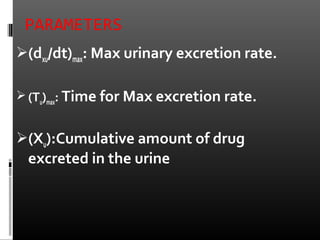
PARAMETERS
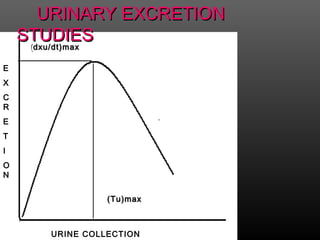
(dxu/dt)max: Max urinary excretion rate.
 (Tu)max: Time for Max excretion rate.
(Xu):Cumulative amount of drug
excreted in the urine
E
X
C
R
E
T
I
O
N
URINE COLLECTION
((dxu/dt)maxdxu/dt)max
(Tu)max(Tu)max
URINARY EXCRETIONURINARY EXCRETION
STUDIESSTUDIES
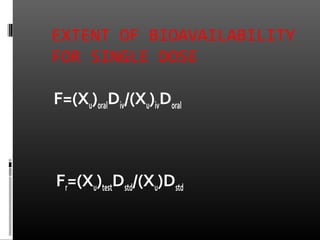
EXTENT OF BIOAVAILABILITY
FOR SINGLE DOSE
F=(Xu)oralDiv/(Xu)ivDoral
Fr=(Xu)testDstd/(Xu)Dstd
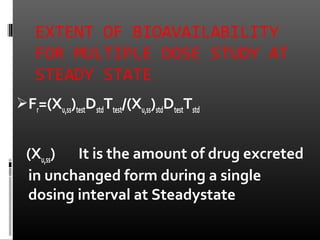
EXTENT OF BIOAVAILABILITY
FOR MULTIPLE DOSE STUDY AT
STEADY STATE
Fr=(Xu,ss)testDstdTtest/(Xu,ss)stdDtestTstd
(Xu,ss) It is the amount of drug excreted
in unchanged form during a single
dosing interval at Steadystate
ADVATAGES OF URINARY EXCRETION
STUDIES
 These method is useful when there is a lack of
sufficiently sensitive analytic tech to measure
concentration of drugs in plasma with accuracy
 Convenince of collecting urine samples.
 Direct measurement of absolute and relative
bioavailablity is possible without the neccesity of
fitting the data to a mathematic model
 When coupled with plasma level-time data,it can be
used to estimate renal clearance of un changed
drug,by
CLR=total amount of drug excreted unchanged / AUC
PHARMACODYNAMIC METHOD
It is also called as direct method
Acute pharmacological response
Therapeutic response
ACUTE PHARMACOLOGICAL
RESPONSE Acute pharmacological effect such as
change in ECG OR EEG readings,pupil
diameter etc is related to the time
course of a given drug
 Bioavailability can be determined:
 By construction of pharmacologic effect -
time curve
 By dose-response graphs
THERAPEUTIC RESPONSE
 This method is based on observing the
clinical response to a drug formulation
given to a patient suffering from disease
for which it is intended to be used
 Draw back is difficult assessment of
relative bio availability between two
dosage forms of the same drug
SCIENTGRAPHY STUDY
 Radioactive substances is used
to investigate the extent of
absorption of drugs, which are
directly introduced to the colon
or targeted to colon
REASONS FOR POOR
BIO-AVAILABILITY
Poor aqueous solubility or slow
dissolution rate.
Poor stability of the dissolved drug at the
physiologic PH
Inadequate partition coefficient and thus
poor permeation through the bio
membrane.
 Extensive pre-systemic metabolism.
APPROACHES TO ENHANCE THE
BIOAVAILABILITY
 THE PHARMACEUTIC APPROACH
 THE PHARMACOKINETIC
APPROACH
 THE BIOLOGIC APPROACH
METHODS FOR ENHANCEMENT OF
BIOAVAILABILITY
 MICRONIZATION: Steroidal drugs, sulfa drugs,
griseofulvin
 USE OF SURFACTANTS: Polysorbates increases
the bio avaialability of spiranolactone
 USE OF SALT FORMS : Alkali metal salts of acidic
drugs like pencillin, strong acid salts of basic
drugs like atropine have more water soluble than
parent drug
ALTERATION OF PH OFALTERATION OF PH OF
MICROENVIRONM ENT OF DRUG:MICROENVIRONM ENT OF DRUG: by twoby two
waysways A) In situ salt formation B) additionA) In situ salt formation B) addition
of buffers eg: buffered aspirin tabletsof buffers eg: buffered aspirin tablets
USE OF META STABLE POLYMORPHSUSE OF META STABLE POLYMORPHS ::
Eg: B- chloramphenicol palmitate is moreEg: B- chloramphenicol palmitate is more
water soluble than A and Cwater soluble than A and C
SELECTIVE ADSORPTION ON INSOLUBLESELECTIVE ADSORPTION ON INSOLUBLE
CARRIERSCARRIERS : Bentonite can enhance the: Bentonite can enhance the
dissolution of poorly water soluble drugsdissolution of poorly water soluble drugs
such as indometacin,prednisone by twosuch as indometacin,prednisone by two
reasons weak physical bonding betweenreasons weak physical bonding between
adsorbate and adsorbent and hydration,adsorbate and adsorbent and hydration,
sweeling of clay in aqueous mediasweeling of clay in aqueous media
SOLID SOLUTIONS: a) use of solid solutions
b)use of eutectic mixtures
c)use of solid dispersions
reduces the particle size by different mechanisms
and thus enhances the bioavailability.
MOLECULAR ENCAPSULATION WITH
CYCLODEXTRIN : the beta dextrins and there
derivatives have ability to molecular inclusion complexes
with hydro phobic drugs having poor water solubility.the out
side of the host molecule have water soluble and thus
improves the aqueous solubility and dissolution rate and
thus bio availability. Eg: thiazides diuretics
REFERENCES
 1. D.M. Brahmankar, Biopharmaceutics and
Pharmacokinetics, Vallabh prakashan, second editon, 2009
 2. Shagel Wu-pong yu, bio pharmaceutics
&pharmacokinetics, fifth edition ,2005
 3. www. Goggle.com
 4. en.wikipedia.org
 5. Amidd.inon,g.l,Lennernas, A therotical basis for a
biopharmaceutical drug classification
 WWW.pubmed
bio availability

bio availability

  • 1.
    BIO-AVAILABILITY PRESENTED BY PREMSAI.K I MPHARM PHARMACEUTICS KRUPANDHI COLLEGE OF PHARMACY BANGALORE
  • 2.
    CONTENT  Definition  Purposeof bio availability  Factors affecting bio availability  Measurements of bio availability  Reasons for poor availability  Approches to enhance the bio availability  Methods of enhancement of bio availability  Reference
  • 3.
    BIO AVAILABILITYBIO AVAILABILITY BIO AVAILABILITY means the rate and extent of drug reaches the systemic circulation in its unchanged form following the administration of a dosage form
  • 4.
    PURPOSE OF BIOAVAILABILITYPURPOSEOF BIOAVAILABILITY  For marketing approval of new drug, FDA meets bioavailability studies  Establish the pharmacokinetic characters and it is useful in establish dosage regimens  Bio availability studies are useful in determining the safety, efficacy, identity, strength, quality and purity of the drug product
  • 5.
  • 6.
    A)Pharmaceutic factors : 1)Physicochemical properties of drug  Drug solubility & dissolution rate.  Particle size & effective surface area.  Polymorphism & Amorphism.  Amorphous > metastable > stable  Pseudopolymorphism (Hydrates / Solvates )  Anhydrates > hydrates e.g. Theophylline, Ampicillin  Organic solvates > non solvates e.g. fludrocortisone
  • 7.
     Salt formof the drug.  Weakly acidic drugs – strong basic salt e.g.barbiturates , sulfonamides.  Weakly basic drugs – strong acid salt  Lipophilicity of the drug .  pKa of the drug & pH .  Drug stability.
  • 8.
    2) Dosage formcharacteristics & Pharmaceutic Ingredients  Disintegration time (tab/cap)  Dissolution time.  Manufacturing variables.  Pharmaceutic ingredients( excipients / adjuvants )  Nature & type of dosage form.  Solutions> Emulsions> Suspensions> Cap> Tab> Enteric Coated Tab > Sustained Release  Product age & storage conditions.
  • 9.
    B)Patient related factors Age  Gastric emptying time .  Intestinal transit time .  Gastrointestinal pH .(HCL > Acetic > citric )  Disease States .  Blood flow through the gastrointestinal tract .  Gastrointestinal contents :  Other drugs . 
  • 10.
     Food . Fluids  Other normal g.i. contents  Presystemic metabolism (First – Pass effect ) by :  Luminal enzymes .  Gut wall enzymes .  Bacterial enzymes .  Hepatic enzymes .
  • 11.
    C)Routes of administration : Parentral > Rectal > Oral > Topical
  • 12.
     Route Bioavailability(%) characterstics   Intravenous 100 (by definition) Most rapid onset  (IV)   Intramuscular 75 to ≤ 100 Large volumes often feasible;  (IM) may be painful  Subcutaneous 75 to ≤ 100 Smaller volumes than IM; may be painful  (SC)   Oral (PO) 5 to < 100 Most convenient; first pass effects may be significant   Rectal (PR) 30 to < 100 Less first-pass effects than oral   Inhalation 5 to < 100 Often very rapid onset  Transdermal 80 to ≤ 100 Usually very slow absorption;  used lack of first-pass effects; prolonged duration of action
  • 13.
    MEASUREMENT OF BIOAVAILABILITYMEASUREMENT OF BIO AVAILABILITY  Divided in to three categories. Pharmacokinetic method Pharmacodynamic method scientgraphy study  Selection of method depends on the:  Purpose of the study  Analytical method of drug measurement  Nature of the drug product
  • 14.
    PHARMACOKINETIC METHODPHARMACOKINETIC METHOD Itis also called as Indirect method  Plasma level-time studies  Urinary excretion studies
  • 15.
    PLASMA LEVEL-TIME STUDIESPLASMALEVEL-TIME STUDIES PRINCIPLE: It is based on the assumption that two dosage forms that exhibit super imposable plasma level time profile in a group of subjects should result in identical therapeutic activity
  • 16.
    FOR SINGLE DOSESTUDYFOR SINGLE DOSE STUDY  It requires collection of serial blood samples for a period of 2 to 3 biological half lives, after drug administration  And then analysis for drug concentration  By making a plot of concentration vs corresponding time of sample collection to obtain plasma level time profile
  • 17.
    FOR MULTIPLE DOSEFORMULTIPLE DOSE  Method involves drug administration for at least 5 biological half lives  A blood sample should be taken at the end of previous dosing interval and 8 to 10 samples after the administration of next dose
  • 18.
    PARAMETERSPARAMETERS 3 parameters ofthese method used to estimate the bio availability are: Cmax : Peak plasma concentration. Tmax : Peak time AUC : Area under the plasma level- time curve
  • 19.
  • 20.
    MEASUREMENT OF AUCMEASUREMENTOF AUC  1)PHYSICAL METHODS A)CUT AND WEIGHT METHOD B)PLANIMETER  2)TRAPEZOIDAL METHOD  3)INTEGRATION METHOD
  • 21.
    RELATIONSHIP BETWEEN AUCAND DOSE AU C Dose AU C Dose
  • 22.
    CUT & WEIGHAND PLANIMETERCUT & WEIGH AND PLANIMETER METHODSMETHODS  CUT & WEIGH: Plasma concentration profile are plotted on smooth paper, these can be cut out and weighed and the weight of the papers is directly proportional to AUC  PLANIMETER : A planimeter is a percision instrument which allows the calculation of areas by tracing there outlines
  • 23.
    TRPEZOIDAL METHODTRPEZOIDAL METHOD It involves the breaking up of the plasma con vs time profile in to several trapezoids calculating the area of each trapezoid and add them to obtain the AUC  AUC = [(co+c1)(t1- to)/2]+……… + (cn-1+cn)(tn-tn-1)/2
  • 24.
    INTEGRATION METHODINTEGRATION METHOD AUC=A(1/Ke-1/Ka) where Ke=overall elimination constant Ka=absorption constant
  • 25.
    EXTENT OF BIOAVAILABILITYEXTENTOF BIOAVAILABILITY FOR SINGLE DOSE STUDYFOR SINGLE DOSE STUDY F=[AUC]oralDiv/ [AUC]ivDoral Fr=[AUC]testDstd/[AUC]stdDtest D = DOSE ADMINISTERED
  • 26.
    EXTENT OF BIOAVAILABILITYEXTENTOF BIOAVAILABILITY FOR MULTIPLE DOSE STUDYFOR MULTIPLE DOSE STUDY Fr=[AUC]testDstdTtest/[AUC]stdDtestTstd T=Dosing interval Bioavailability can also be measured by peak plasma concentration at steady state, Fr=[Cssmax]testDstdTtest/[Cssmax]stdDtestTstd T=dosing interval
  • 27.
    URINARY EXTRECTION STUDIESURINARYEXTRECTION STUDIES  PRINCIPLE: It involves urinary excretion of unchanged drug is directly proportional toplasma concentration of drug  Eg : thiazide diuretics, sulphonamides For drugs that have urine as site of action eg: urinary antiseptics : nitrofurantoin.
  • 28.
    METHOD FOR URINARYEXCRETIONMETHOD FOR URINARY EXCRETION STUDIESSTUDIES  It involves collection of urine at regular intervals for a time span equal to 7 biological half lives  Then analysis for unchanged drug in the collected sample  Then determined the amount of drug excreted in each interval and cumulative amount excreted
  • 29.
    PARAMETERS (dxu/dt)max: Max urinaryexcretion rate.  (Tu)max: Time for Max excretion rate. (Xu):Cumulative amount of drug excreted in the urine
  • 30.
  • 31.
    EXTENT OF BIOAVAILABILITY FORSINGLE DOSE F=(Xu)oralDiv/(Xu)ivDoral Fr=(Xu)testDstd/(Xu)Dstd
  • 32.
    EXTENT OF BIOAVAILABILITY FORMULTIPLE DOSE STUDY AT STEADY STATE Fr=(Xu,ss)testDstdTtest/(Xu,ss)stdDtestTstd (Xu,ss) It is the amount of drug excreted in unchanged form during a single dosing interval at Steadystate
  • 33.
    ADVATAGES OF URINARYEXCRETION STUDIES  These method is useful when there is a lack of sufficiently sensitive analytic tech to measure concentration of drugs in plasma with accuracy  Convenince of collecting urine samples.  Direct measurement of absolute and relative bioavailablity is possible without the neccesity of fitting the data to a mathematic model  When coupled with plasma level-time data,it can be used to estimate renal clearance of un changed drug,by CLR=total amount of drug excreted unchanged / AUC
  • 34.
    PHARMACODYNAMIC METHOD It isalso called as direct method Acute pharmacological response Therapeutic response
  • 35.
    ACUTE PHARMACOLOGICAL RESPONSE Acutepharmacological effect such as change in ECG OR EEG readings,pupil diameter etc is related to the time course of a given drug  Bioavailability can be determined:  By construction of pharmacologic effect - time curve  By dose-response graphs
  • 36.
    THERAPEUTIC RESPONSE  Thismethod is based on observing the clinical response to a drug formulation given to a patient suffering from disease for which it is intended to be used  Draw back is difficult assessment of relative bio availability between two dosage forms of the same drug
  • 37.
    SCIENTGRAPHY STUDY  Radioactivesubstances is used to investigate the extent of absorption of drugs, which are directly introduced to the colon or targeted to colon
  • 38.
    REASONS FOR POOR BIO-AVAILABILITY Pooraqueous solubility or slow dissolution rate. Poor stability of the dissolved drug at the physiologic PH Inadequate partition coefficient and thus poor permeation through the bio membrane.  Extensive pre-systemic metabolism.
  • 39.
    APPROACHES TO ENHANCETHE BIOAVAILABILITY  THE PHARMACEUTIC APPROACH  THE PHARMACOKINETIC APPROACH  THE BIOLOGIC APPROACH
  • 40.
    METHODS FOR ENHANCEMENTOF BIOAVAILABILITY  MICRONIZATION: Steroidal drugs, sulfa drugs, griseofulvin  USE OF SURFACTANTS: Polysorbates increases the bio avaialability of spiranolactone  USE OF SALT FORMS : Alkali metal salts of acidic drugs like pencillin, strong acid salts of basic drugs like atropine have more water soluble than parent drug
  • 41.
    ALTERATION OF PHOFALTERATION OF PH OF MICROENVIRONM ENT OF DRUG:MICROENVIRONM ENT OF DRUG: by twoby two waysways A) In situ salt formation B) additionA) In situ salt formation B) addition of buffers eg: buffered aspirin tabletsof buffers eg: buffered aspirin tablets USE OF META STABLE POLYMORPHSUSE OF META STABLE POLYMORPHS :: Eg: B- chloramphenicol palmitate is moreEg: B- chloramphenicol palmitate is more water soluble than A and Cwater soluble than A and C SELECTIVE ADSORPTION ON INSOLUBLESELECTIVE ADSORPTION ON INSOLUBLE CARRIERSCARRIERS : Bentonite can enhance the: Bentonite can enhance the dissolution of poorly water soluble drugsdissolution of poorly water soluble drugs such as indometacin,prednisone by twosuch as indometacin,prednisone by two reasons weak physical bonding betweenreasons weak physical bonding between adsorbate and adsorbent and hydration,adsorbate and adsorbent and hydration, sweeling of clay in aqueous mediasweeling of clay in aqueous media
  • 42.
    SOLID SOLUTIONS: a)use of solid solutions b)use of eutectic mixtures c)use of solid dispersions reduces the particle size by different mechanisms and thus enhances the bioavailability. MOLECULAR ENCAPSULATION WITH CYCLODEXTRIN : the beta dextrins and there derivatives have ability to molecular inclusion complexes with hydro phobic drugs having poor water solubility.the out side of the host molecule have water soluble and thus improves the aqueous solubility and dissolution rate and thus bio availability. Eg: thiazides diuretics
  • 43.
    REFERENCES  1. D.M.Brahmankar, Biopharmaceutics and Pharmacokinetics, Vallabh prakashan, second editon, 2009  2. Shagel Wu-pong yu, bio pharmaceutics &pharmacokinetics, fifth edition ,2005  3. www. Goggle.com  4. en.wikipedia.org  5. Amidd.inon,g.l,Lennernas, A therotical basis for a biopharmaceutical drug classification  WWW.pubmed