Ecology: Ecosystems

   Ecosystem: all of the organisms in a
    particular environment and their physical
    environment
   Community: all of the species in an area
   Population: all the members of a species
    in an area

   # pops = community; # comm + env =
    ecosystem
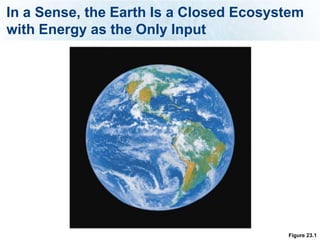
In a Sense, the Earth Is a Closed Ecosystem
with Energy as the Only Input


                                        Figure 23.1
The Biosphere Is a Part of the
Earth Where Life Exists

      Consists of many ecosystems (rem: the
       organisms in a specific geographic area and
       their physical environment)

      A couple of terms that the book brings up
       here:
         Niche: organism’s role in ecosystem
            E.g., herbivores: prey, consumers
         Habitat: the environment in which the
          organism lives: e.g., rainforest canopy
Ecosystems are Dynamic


   Chemicals cycle through ecosystems –
    cycles affect populations/communities
   Humans can upset biogeochemical cycles
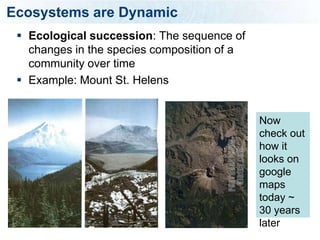
Ecosystems are Dynamic
  Ecological succession: The sequence of
   changes in the species composition of a
   community over time
  Example: Mount St. Helens


                                             Now
                                             check out
                                             how it
                                             looks on
                                             google
                                             maps
                                             today ~
                                             30 years
                                             later
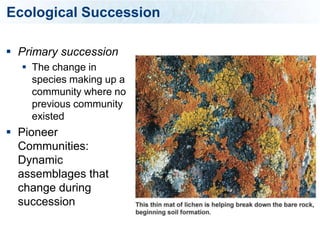
Ecological Succession

 Primary succession
   The change in
    species making up a
    community where no
    previous community
    existed
 Pioneer
  Communities:
  Dynamic
  assemblages that
  change during
  succession
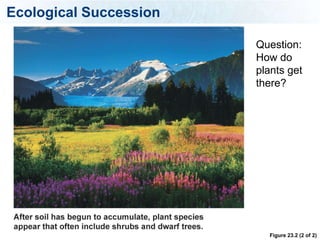
Ecological Succession

                        Question:
                        How do
                        plants get
                        there?


                          Figure 23.2 (2 of 2)
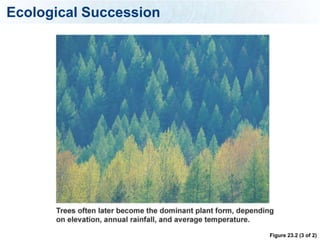
Ecological Succession


                        Figure 23.2 (3 of 2)
Ecological Succession


   As time goes on, the an ecosystem’s
    organismal makeup progresses from a
    pioneer community to a climax community
Climax Communities
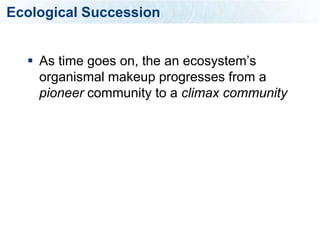
 Relatively stable community over long term
 The nature of the climax community depends largely
  upon geography

                                 Temperate deciduous
                                 forest. These forests
                                 receive 75–125 cm (30–50
                                 in.) of rainfall per year.
                                 Summers are hot, and
                                 winters are cold. Trees
                                 lose their leaves in the
                                 winter so as to avoid water
                                 loss when it is too cold to
                                 photosynthsize. Insects,
                                 mice, squirrels, and many
                                 species of birds are
                                 common in these forests.


                                                     Figure 23.3 (1 of 5)
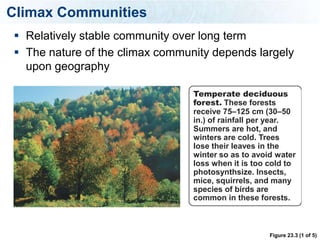
Climax Communities


                     Temperate grasslands.
                     These grasslands receive
                     25–75 cm (10–30 in.) of
                     rainfall per year. Long dry
                     periods and fire are
                     important factors in
                     maintaining grasslands.
                     Grazing animals such as
                     antelope and burrowing
                     animals such as prairie
                     dogs are common.


                                        Figure 23.3 (2 of 5)
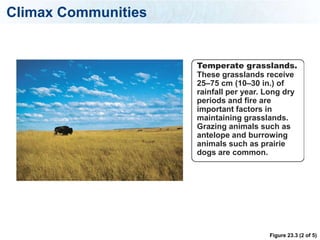
Climax Communities


                     Desert. Lack of water
                     defines the desert
                     community. Deserts receive
                     less than 25 cm (10 in.) of
                     rain each year. Most deserts
                     are hot, but some are cold.
                     Both plants and animals
                     must be able to conserve
                     water. Many desert plants
                     are succulents with leaves
                     that retain and store water.
                     Animals may tend to avoid
                     the sun by foraging at night.


                                         Figure 23.3 (3 of 5)
Climax Communities


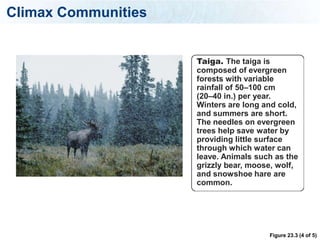
                     Taiga. The taiga is
                     composed of evergreen
                     forests with variable
                     rainfall of 50–100 cm
                     (20–40 in.) per year.
                     Winters are long and cold,
                     and summers are short.
                     The needles on evergreen
                     trees help save water by
                     providing little surface
                     through which water can
                     leave. Animals such as the
                     grizzly bear, moose, wolf,
                     and snowshoe hare are
                     common.


                                       Figure 23.3 (4 of 5)
Climax Communities


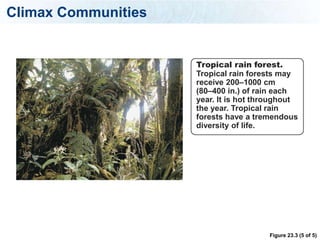
                     Tropical rain forest.
                     Tropical rain forests may
                     receive 200–1000 cm
                     (80–400 in.) of rain each
                     year. It is hot throughout
                     the year. Tropical rain
                     forests have a tremendous
                     diversity of life.


                                       Figure 23.3 (5 of 5)
Ecological Succession


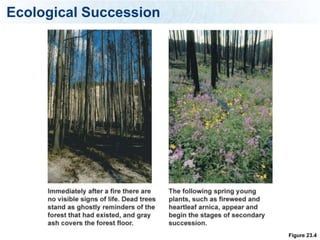
   Secondary succession
      Occurs when an existing community
       becomes cleared and then undergoes a
       sequence of events leading once again to a
       climax community
   Soil is already present in secondary
    succession
Ecological Succession


                        Figure 23.4
Energy Flows through Ecosystems
from Producers to Consumers

   The only input to the Ecosystem of Earth?
   Then? How does this input drive other
    processes? … focus on life process

   Photosynthesis
Energy Flows through Ecosystems
from Producers to Consumers

   Food chains and food webs depict feeding
    relationships
   (Both tend to be oversimplified and based
    on incomplete understanding)
Energy Flows through Ecosystems
from Producers to Consumers

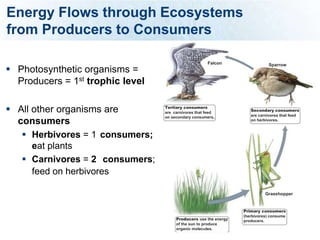
                                                      Falcon                 Sparrow
 Photosynthetic organisms =
  Producers = 1st trophic level

 All other organisms are         Tertiary consumers
                                  are carnivores that feed
                                                                     Secondary consumers
                                                                     are carnivores that feed
                                  on secondary consumers.
  consumers                                                          on herbivores.


    Herbivores = 1 consumers;
      eat plants
    Carnivores = 2 consumers;
      feed on herbivores

                                                                            Grasshopper


                                                                  Primary consumers
                                                                  (herbivores) consume
                                       Producers use the energy   producers.
                                       of the sun to produce
                                       organic molecules.
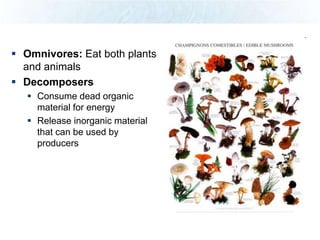
 Omnivores: Eat both plants
  and animals
 Decomposers
    Consume dead organic
     material for energy
    Release inorganic material
     that can be used by
     producers
Energy Flows through Ecosystems
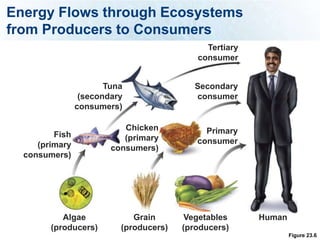
from Producers to Consumers
                                             Tertiary
                                           consumer


                       Tuna                Secondary
                 (secondary                consumer
                consumers)

                           Chicken           Primary
         Fish              (primary
     (primary                              consumer
                        consumers)
  consumers)


           Algae             Grain       Vegetables     Human
        (producers)       (producers)   (producers)
                                                                Figure 23.6
Energy Flows through Ecosystems
from Producers to Consumers

   Food chains
     Linear patterns that describe the flow of
      energy through an ecosystem
   Food webs
     The complex interrelationships of many food
      chains
     More realistically describes the trophic
      relationships in an ecosystem
Energy Flows through Ecosystems
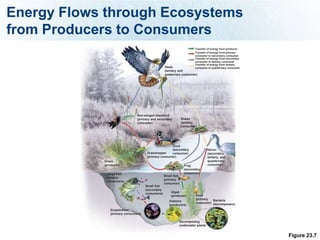
from Producers to Consumers
                                                                       Transfer of energy from producer
                                                                       Transfer of energy from primary
                                                                       consumer to secondary consumer
                                                                       Transfer of energy from secondary
                                                                       consumer to tertiary consumer
                                                                       Transfer of energy from tertiary
                                                  Hawk                 consumer to quarternary consumer
                                                  (tertiary and
                                                  quaternary consumer)


                               Red-winged blackbird
                               (primary and secondary          Snake
                               consumer)                       (tertiary
                                                               consumer)


                                                     Duck
                                                     (secondary                 Heron
                                      Grasshopper    consumer)                  (secondary,
                                      (primary consumer)                        tertiary, and
            Grass                                                               quarternary
            (producer)                                          Frog            consumer)
                                                                (secondary
             Large fish                                         consumer)
                                                  Small fish
             (tertiary
                                                  (primary
             consumers)
                                                  consumer)
                                     Small fish
                                     (secondary
                                     consumers)       Algae
                                                      (producer)       Snail
                                                                       (primary  Bacteria
                                                     Diatoms
                                                                       consumer) (decomposers)
                                                     (producers)
               Zooplankton
               (primary consumers)

                                                           Decomposing
                                                           underwater plants


                                                                                                           Figure 23.7
Energy Flow and Food Webs


  PLAY   Animation—Energy Flow and Food Webs
Energy Flows through Ecosystems
from Producers to Consumers
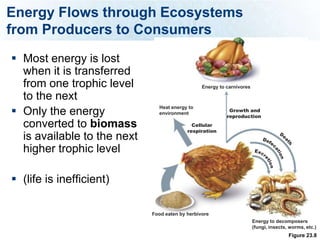
 Most energy is lost
  when it is transferred
  from one trophic level                         Energy to carnivores

  to the next
 Only the energy
                               Heat energy to
                                                            Growth and
                               environment
                                                           reproduction
  converted to biomass                       Cellular
                                           respiration
  is available to the next
  higher trophic level

 (life is inefficient)

                             Food eaten by herbivore
                                                                        Energy to decomposers
                                                                        (fungi, insects, worms, etc.)
                                                                                        Figure 23.8
Energy Flows through Ecosystems
from Producers to Consumers
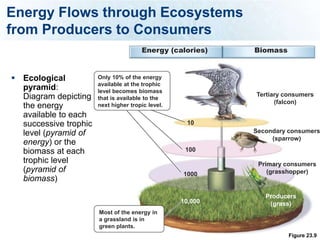
                                       Energy (calories)    Biomass


 Ecological           Only 10% of the energy
                       available at the trophic
  pyramid:             level becomes biomass
  Diagram depicting                                         Tertiary consumers
                       that is available to the
                                                                  (falcon)
  the energy           next higher tropic level.
  available to each
  successive trophic                                10
  level (pyramid of                                         Secondary consumers
                                                                 (sparrow)
  energy) or the
  biomass at each                                   100
  trophic level                                              Primary consumers
  (pyramid of                                      1000         (grasshopper)
  biomass)

                                                               Producers
                                                   10,000       (grass)
                       Most of the energy in
                       a grassland is in
                       green plants.
                                                                      Figure 23.9
Energy Flows through Ecosystems
from Producers to Consumers
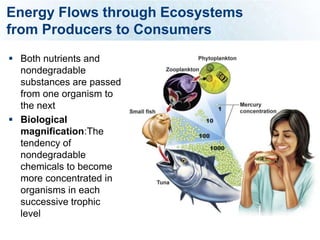
 Both nutrients and
  nondegradable
  substances are passed
  from one organism to
  the next
 Biological
  magnification:The
  tendency of
  nondegradable
  chemicals to become
  more concentrated in
  organisms in each
  successive trophic
  level
Energy Flows through Ecosystems
from Producers to Consumers

   Rem: Only about 10% of the energy
    captured by one trophic level is available
    to the next
     It takes a greater investment of energy
     More energy is lost as one eats higher on
      the food chain
Energy Flows through Ecosystems
from Producers to Consumers
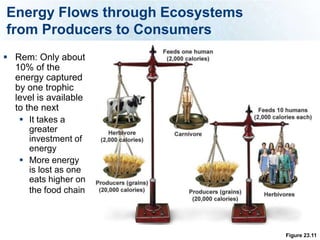
 Rem: Only about
  10% of the
  energy captured
  by one trophic
  level is available
  to the next
    It takes a
      greater
      investment of
      energy
    More energy
      is lost as one
      eats higher on
      the food chain


                                  Figure 23.11

Bio 151 ecology

  • 1.
    Ecology: Ecosystems  Ecosystem: all of the organisms in a particular environment and their physical environment  Community: all of the species in an area  Population: all the members of a species in an area  # pops = community; # comm + env = ecosystem
  • 2.
    In a Sense,the Earth Is a Closed Ecosystem with Energy as the Only Input Figure 23.1
  • 3.
    The Biosphere Isa Part of the Earth Where Life Exists  Consists of many ecosystems (rem: the organisms in a specific geographic area and their physical environment)  A couple of terms that the book brings up here:  Niche: organism’s role in ecosystem  E.g., herbivores: prey, consumers  Habitat: the environment in which the organism lives: e.g., rainforest canopy
  • 4.
    Ecosystems are Dynamic  Chemicals cycle through ecosystems – cycles affect populations/communities  Humans can upset biogeochemical cycles
  • 5.
    Ecosystems are Dynamic  Ecological succession: The sequence of changes in the species composition of a community over time  Example: Mount St. Helens Now check out how it looks on google maps today ~ 30 years later
  • 6.
    Ecological Succession  Primarysuccession  The change in species making up a community where no previous community existed  Pioneer Communities: Dynamic assemblages that change during succession
  • 7.
    Ecological Succession Question: How do plants get there? Figure 23.2 (2 of 2)
  • 8.
    Ecological Succession Figure 23.2 (3 of 2)
  • 9.
    Ecological Succession  As time goes on, the an ecosystem’s organismal makeup progresses from a pioneer community to a climax community
  • 10.
    Climax Communities  Relativelystable community over long term  The nature of the climax community depends largely upon geography Temperate deciduous forest. These forests receive 75–125 cm (30–50 in.) of rainfall per year. Summers are hot, and winters are cold. Trees lose their leaves in the winter so as to avoid water loss when it is too cold to photosynthsize. Insects, mice, squirrels, and many species of birds are common in these forests. Figure 23.3 (1 of 5)
  • 11.
    Climax Communities Temperate grasslands. These grasslands receive 25–75 cm (10–30 in.) of rainfall per year. Long dry periods and fire are important factors in maintaining grasslands. Grazing animals such as antelope and burrowing animals such as prairie dogs are common. Figure 23.3 (2 of 5)
  • 12.
    Climax Communities Desert. Lack of water defines the desert community. Deserts receive less than 25 cm (10 in.) of rain each year. Most deserts are hot, but some are cold. Both plants and animals must be able to conserve water. Many desert plants are succulents with leaves that retain and store water. Animals may tend to avoid the sun by foraging at night. Figure 23.3 (3 of 5)
  • 13.
    Climax Communities Taiga. The taiga is composed of evergreen forests with variable rainfall of 50–100 cm (20–40 in.) per year. Winters are long and cold, and summers are short. The needles on evergreen trees help save water by providing little surface through which water can leave. Animals such as the grizzly bear, moose, wolf, and snowshoe hare are common. Figure 23.3 (4 of 5)
  • 14.
    Climax Communities Tropical rain forest. Tropical rain forests may receive 200–1000 cm (80–400 in.) of rain each year. It is hot throughout the year. Tropical rain forests have a tremendous diversity of life. Figure 23.3 (5 of 5)
  • 15.
    Ecological Succession  Secondary succession  Occurs when an existing community becomes cleared and then undergoes a sequence of events leading once again to a climax community  Soil is already present in secondary succession
  • 16.
  • 17.
    Energy Flows throughEcosystems from Producers to Consumers  The only input to the Ecosystem of Earth?  Then? How does this input drive other processes? … focus on life process  Photosynthesis
  • 18.
    Energy Flows throughEcosystems from Producers to Consumers  Food chains and food webs depict feeding relationships  (Both tend to be oversimplified and based on incomplete understanding)
  • 19.
    Energy Flows throughEcosystems from Producers to Consumers Falcon Sparrow  Photosynthetic organisms = Producers = 1st trophic level  All other organisms are Tertiary consumers are carnivores that feed Secondary consumers are carnivores that feed on secondary consumers. consumers on herbivores.  Herbivores = 1 consumers; eat plants  Carnivores = 2 consumers; feed on herbivores Grasshopper Primary consumers (herbivores) consume Producers use the energy producers. of the sun to produce organic molecules.
  • 20.
     Omnivores: Eatboth plants and animals  Decomposers  Consume dead organic material for energy  Release inorganic material that can be used by producers
  • 21.
    Energy Flows throughEcosystems from Producers to Consumers Tertiary consumer Tuna Secondary (secondary consumer consumers) Chicken Primary Fish (primary (primary consumer consumers) consumers) Algae Grain Vegetables Human (producers) (producers) (producers) Figure 23.6
  • 22.
    Energy Flows throughEcosystems from Producers to Consumers  Food chains  Linear patterns that describe the flow of energy through an ecosystem  Food webs  The complex interrelationships of many food chains  More realistically describes the trophic relationships in an ecosystem
  • 23.
    Energy Flows throughEcosystems from Producers to Consumers Transfer of energy from producer Transfer of energy from primary consumer to secondary consumer Transfer of energy from secondary consumer to tertiary consumer Transfer of energy from tertiary Hawk consumer to quarternary consumer (tertiary and quaternary consumer) Red-winged blackbird (primary and secondary Snake consumer) (tertiary consumer) Duck (secondary Heron Grasshopper consumer) (secondary, (primary consumer) tertiary, and Grass quarternary (producer) Frog consumer) (secondary Large fish consumer) Small fish (tertiary (primary consumers) consumer) Small fish (secondary consumers) Algae (producer) Snail (primary Bacteria Diatoms consumer) (decomposers) (producers) Zooplankton (primary consumers) Decomposing underwater plants Figure 23.7
  • 24.
    Energy Flow andFood Webs PLAY Animation—Energy Flow and Food Webs
  • 25.
    Energy Flows throughEcosystems from Producers to Consumers  Most energy is lost when it is transferred from one trophic level Energy to carnivores to the next  Only the energy Heat energy to Growth and environment reproduction converted to biomass Cellular respiration is available to the next higher trophic level  (life is inefficient) Food eaten by herbivore Energy to decomposers (fungi, insects, worms, etc.) Figure 23.8
  • 26.
    Energy Flows throughEcosystems from Producers to Consumers Energy (calories) Biomass  Ecological Only 10% of the energy available at the trophic pyramid: level becomes biomass Diagram depicting Tertiary consumers that is available to the (falcon) the energy next higher tropic level. available to each successive trophic 10 level (pyramid of Secondary consumers (sparrow) energy) or the biomass at each 100 trophic level Primary consumers (pyramid of 1000 (grasshopper) biomass) Producers 10,000 (grass) Most of the energy in a grassland is in green plants. Figure 23.9
  • 27.
    Energy Flows throughEcosystems from Producers to Consumers  Both nutrients and nondegradable substances are passed from one organism to the next  Biological magnification:The tendency of nondegradable chemicals to become more concentrated in organisms in each successive trophic level
  • 28.
    Energy Flows throughEcosystems from Producers to Consumers  Rem: Only about 10% of the energy captured by one trophic level is available to the next  It takes a greater investment of energy  More energy is lost as one eats higher on the food chain
  • 29.
    Energy Flows throughEcosystems from Producers to Consumers  Rem: Only about 10% of the energy captured by one trophic level is available to the next  It takes a greater investment of energy  More energy is lost as one eats higher on the food chain Figure 23.11