
Binary Tree Traversals
Divide-and-Conquer Technique
Tree Traversal
 Also known as tree search and walking the tree
 Refers to the process of visiting each node in a tree data
structure exactly once
Tree Traversal Technique
 Based on the order in which the nodes are visited,
 Inorder traversal L-Ro-R
 Preorder traversal Ro-L-R
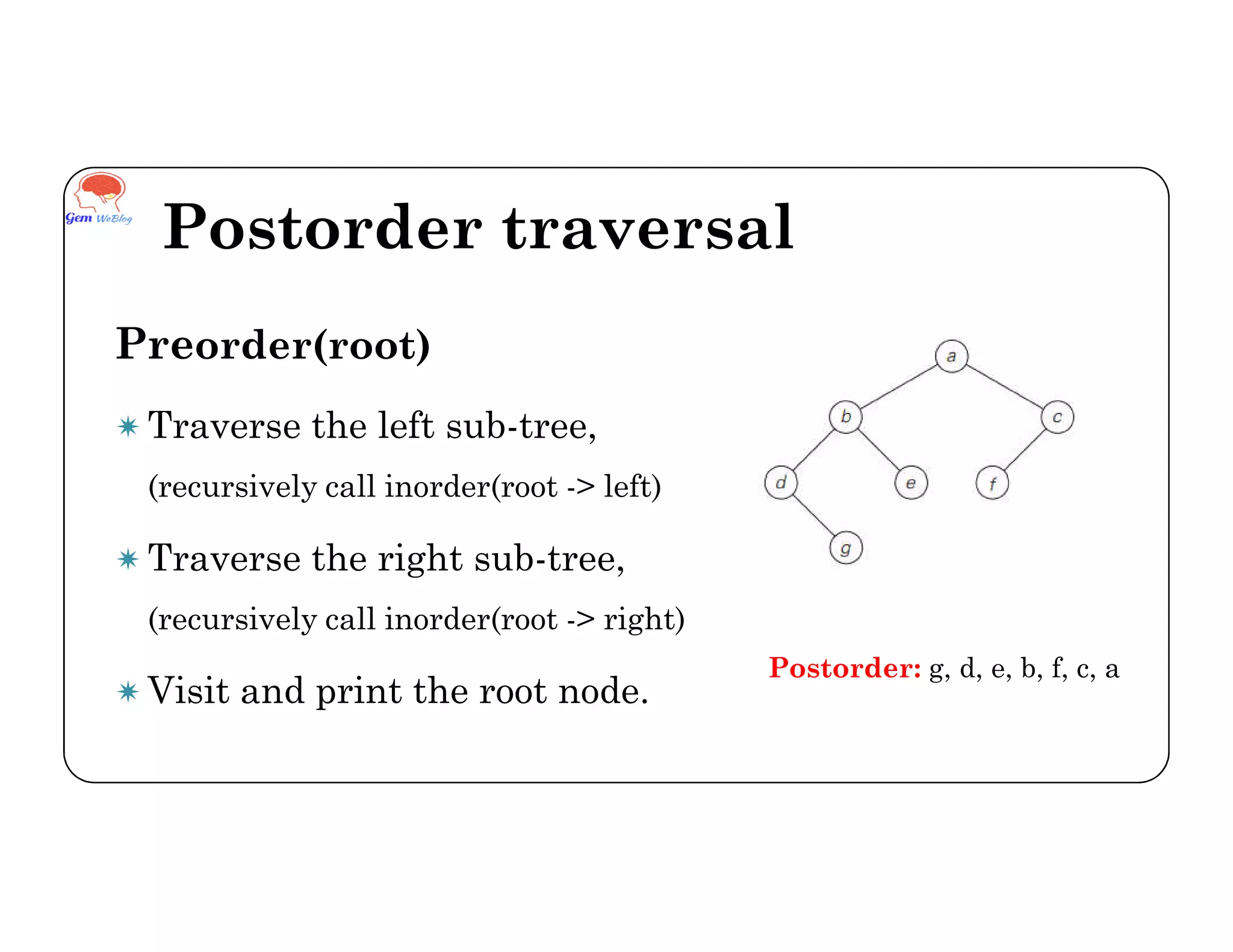
 Postorder traversal L-R-Ro
Inorder traversal
Inorder(root)
 Traverse the left sub-tree,
(recursively call inorder(root -> left)
 Visit and print the root node.
 Traverse the right sub-tree,
(recursively call inorder(root -> right)
Inorder: d, g, b, e, a, f, c
Preorder traversal
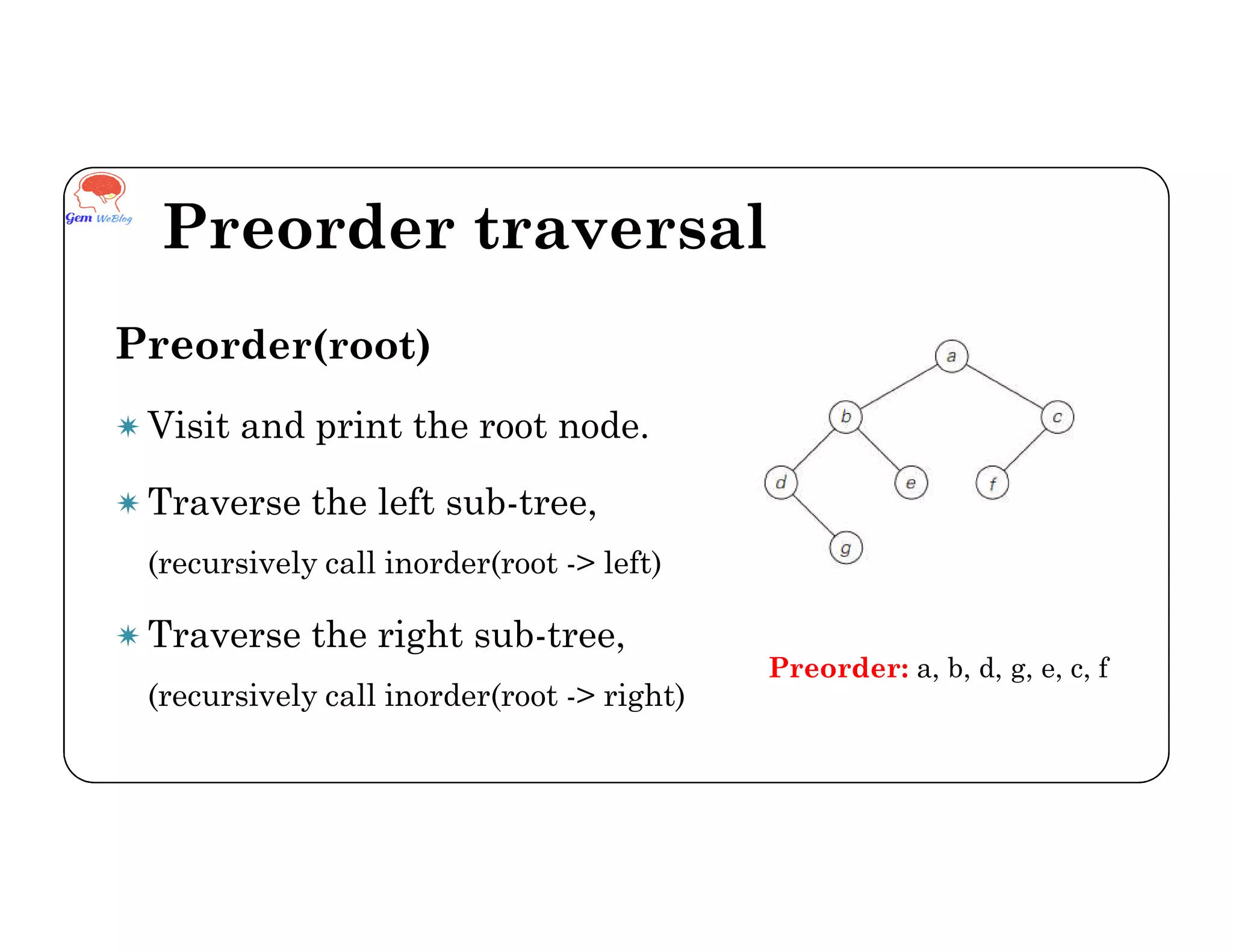
Preorder(root)
 Visit and print the root node.
 Traverse the left sub-tree,
(recursively call inorder(root -> left)
 Traverse the right sub-tree,
(recursively call inorder(root -> right)
Preorder: a, b, d, g, e, c, f
Postorder traversal
Preorder(root)
 Traverse the left sub-tree,
(recursively call inorder(root -> left)
 Traverse the right sub-tree,
(recursively call inorder(root -> right)
 Visit and print the root node.
Postorder: g, d, e, b, f, c, a
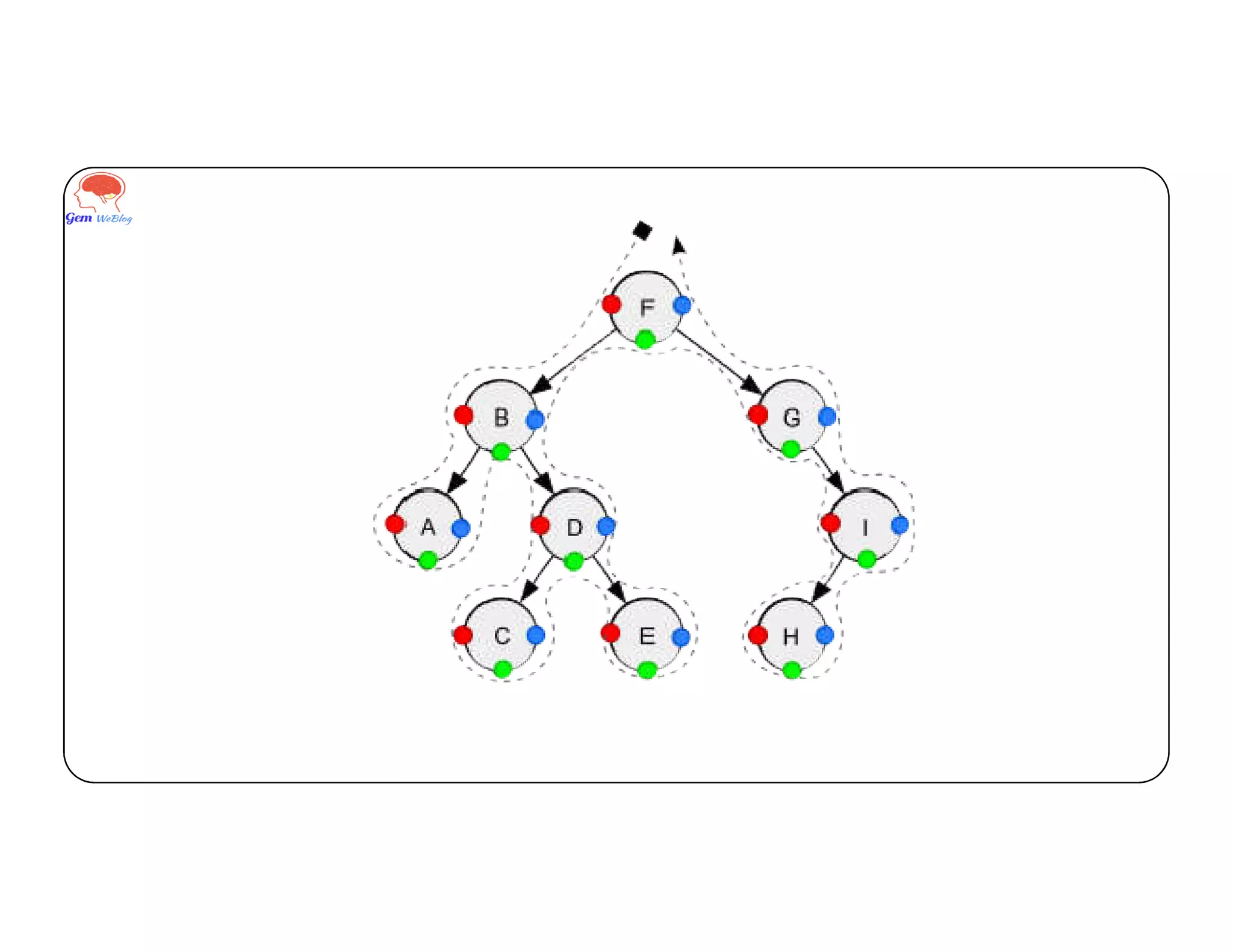
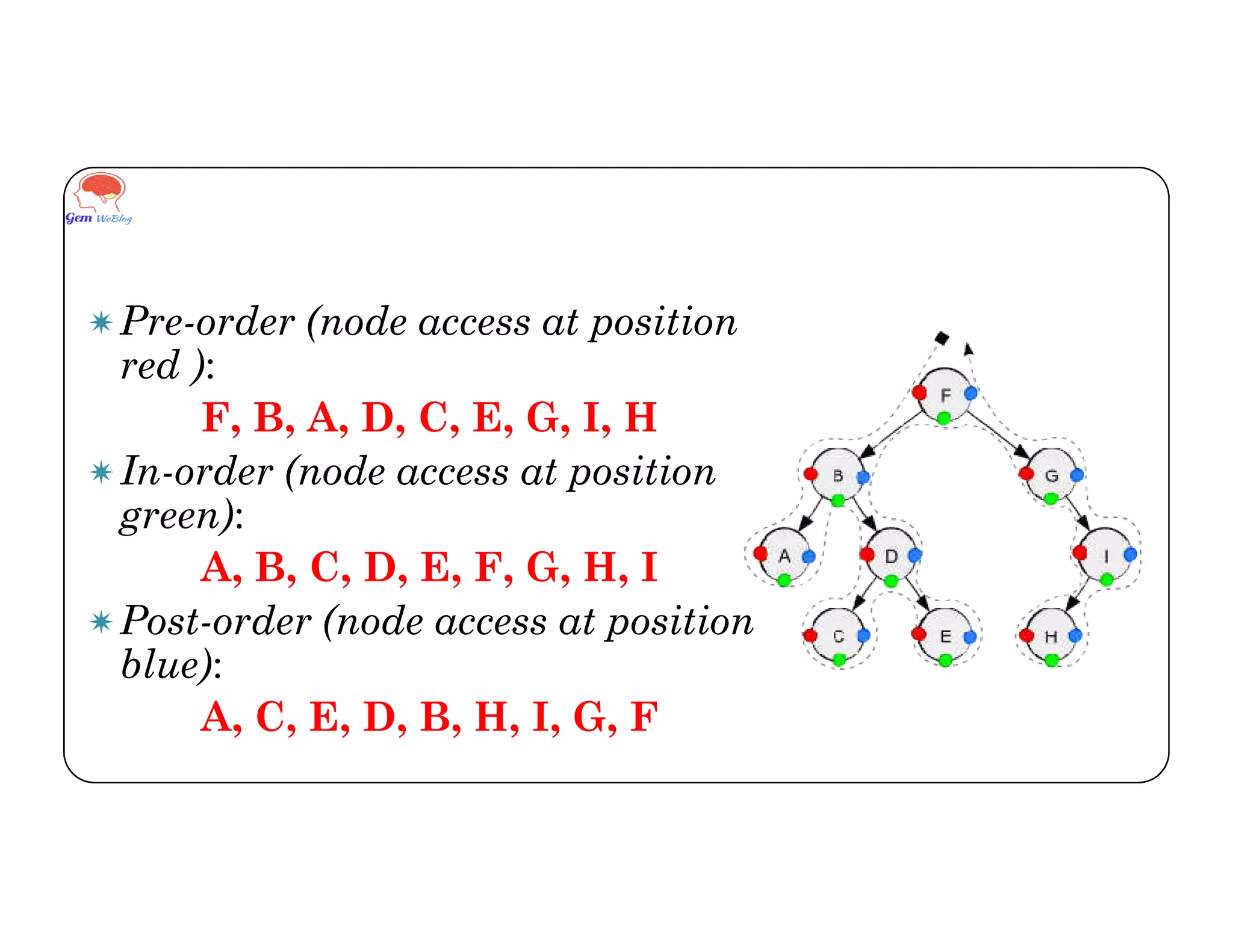
Pre-order (node access at position
red ):
F, B, A, D, C, E, G, I, H
In-order (node access at position
green):
A, B, C, D, E, F, G, H, I
Post-order (node access at position
blue):
A, C, E, D, B, H, I, G, F
External and Internal Node
 Number of external
nodes x is
always 1 more than
the number of
the number of
internal nodes n:
x = n + 1
Binary tree traversals (Divide and Conquer)

Binary tree traversals (Divide and Conquer)

  • 1.
  • 2.
    Tree Traversal  Alsoknown as tree search and walking the tree  Refers to the process of visiting each node in a tree data structure exactly once structure exactly once
  • 3.
    Tree Traversal Technique Based on the order in which the nodes are visited,  Inorder traversal L-Ro-R  Preorder traversal Ro-L-R  Postorder traversal L-R-Ro
  • 4.
    Inorder traversal Inorder(root)  Traversethe left sub-tree, (recursively call inorder(root -> left) (recursively call inorder(root -> left)  Visit and print the root node.  Traverse the right sub-tree, (recursively call inorder(root -> right) Inorder: d, g, b, e, a, f, c
  • 5.
    Preorder traversal Preorder(root)  Visitand print the root node.  Traverse the left sub-tree, (recursively call inorder(root -> left)  Traverse the right sub-tree, (recursively call inorder(root -> right) Preorder: a, b, d, g, e, c, f
  • 6.
    Postorder traversal Preorder(root)  Traversethe left sub-tree, (recursively call inorder(root -> left) (recursively call inorder(root -> left)  Traverse the right sub-tree, (recursively call inorder(root -> right)  Visit and print the root node. Postorder: g, d, e, b, f, c, a
  • 8.
    Pre-order (node accessat position red ): F, B, A, D, C, E, G, I, H In-order (node access at position In-order (node access at position green): A, B, C, D, E, F, G, H, I Post-order (node access at position blue): A, C, E, D, B, H, I, G, F
  • 9.
    External and InternalNode  Number of external nodes x is always 1 more than the number of the number of internal nodes n: x = n + 1